During the last few decades, many developed countries have shown increasingly later ages of entry into motherhood and lower fertility rates, which has triggered a discussion about the complex relationship between them (Kohler et al., Reference Kohler, Billari and Ortega2002). Several papers have mentioned the influence of a wide range of factors that explain such associations, most notably the continuous advance of women into the labour market, accompanied by higher education and a change in lifestyles and, in some cases, high youth unemployment rates and high housing prices (Kohler et al., Reference Kohler, Billari and Ortega2002; Adsera, Reference Adsera2005; Frejka et al., Reference Frejka, Sobotka, Hoem and Toulemon2008). Both individual and contextual factors influence the relationship between age at first birth and completed fertility. The most important drivers include fertility preferences, sexual behaviours, patterns of union formation, fecundity and contraceptive use. Ages of entry into motherhood in several developed countries have been predicted to keep rising (Lesthaeghe & Willems, Reference Lesthaeghe and Willems1999; Frejka & Sardon, Reference Frejka and Sardon2004) and this has indeed been the case (statistics from the United Nations Economic Commission for Europe).
A change in the relationship between (cohort average) age at first birth and completed fertility was observed amongst Nordic and French 1950s birth cohorts, where a flatter relationship between those variables was found and the term ‘fertility recuperation’ was coined (Lesthaeghe & Willems, Reference Lesthaeghe and Willems1999; Frejka & Calot, Reference Frejka and Calot2001; Kohler & Ortega, Reference Kohler and Ortega2002; Toulemon et al., Reference Toulemon, Pailhe and Rossier2008). From there it is possible to define fertility recuperation as the action of compensating for the fewer reproductive years with higher fertility once motherhood begins.
At the aggregate level it is not possible to capture the complexities of postponement and compensation, the two ideas behind the concept of fertility recuperation, by using a few numeric indicators. Even individual-level data studies are not close to providing unquestionable assessments of postponing and compensation. The dynamics of demographic indicators, however, provide population-level hints on the evolution and impact of fertility recuperation. Studies on cohort fertility recuperation use diverse measures built upon fertility rates by age and parity. One way to study the link between shifting age at first child and completed fertility is to analyse completed cohort fertility rate as an outcome of (i) the distribution of women by age at first child (AFC), and (ii) fertility rates conditional on AFC. This framework is also used by Andersson et al. (Reference Andersson, Rønsen, Knudsen, Lappegård, Neyer and Skrede2009), though their focus is on differences across education groups while in this study the focus is on differences across cohorts. Indeed, changes in AFC across cohorts are very commonly used as a measure of postponement. The first child is a key element in the transition into adulthood and family life (Shanahan, Reference Shanahan2000), and subsequent births normally follow fairly stable timing after the first one (Knodel, Reference Knodel1987; Van Bavel, Reference Van Bavel2004). Moreover, the first birth apparently has more influence on a woman's wage (Loughran & Zissimopoulos, Reference Loughran and Zissimopoulos2009). Changes in completed fertility conditional on AFC, on the other hand, are the correspondent complement to describe the emergence of fertility recuperation.
In countries where age at parenthood has shifted into older ages, a necessary precondition for fertility recuperation is that women having their first child later in life will also eventually achieve a higher completed fertility, compared with the previous cohorts. As a result, the relationship between age at first birth and completed fertility should weaken (or even become relatively flat) in countries where a large portion of postponed childbearing is eventually compensated with higher fertility thereafter.
However, it is not clear that only women of late motherhood age are recuperating fertility. Policies supporting gender equality, quality of labour markets and family formation have become common in developed countries, and it is possible that women of all ages are reacting in different ways to those policies. The availability of childcare, child cash benefits, parental leave (Del Boca, Reference Del Boca2002; Neyer, Reference Neyer2006; Rønsen & Skrede, Reference Rønsen and Skrede2010), the public sector as an employer (Adsera, Reference Adsera2006; Rønsen & Skrede, Reference Rønsen and Skrede2010), part-time work (Caldwell et al., Reference Caldwell, Caldwell and McDonald2002; Adsera, Reference Adsera2005, Reference Adsera2006; Amuedo-Dorantes & Kimmel, Reference Amuedo-Dorantes and Kimmel2005; Neyer, Reference Neyer2006), fathers' involvement in housework (Mills et al., Reference Mills, Begall, Mencarini and Tanturri2008) and waiting for the end of the motherhood penalty (meaning the building of a career sufficiently strong to maintain a wage trajectory even if motherhood begins; Amuedo-Dorantes & Kimmel, Reference Amuedo-Dorantes and Kimmel2005), might have different degrees of influence among groups of women who typically show early or late entry into motherhood. Moreover, fertility among families at the lower end of the income scale, who usually show earlier AFCs, could be much more sensitive to the state of the economy. Rønsen (Reference Rønsen2004) showed that in Nordic countries, adverse macroeconomic conditions and rising unemployment exert a diminishing influence on fertility, primarily affecting women of relatively low education.
Therefore the observed recuperation might be due to comparatively higher fertility amongst women of any age at entry into motherhood. This report assesses whether the recuperation of European fertility across three cohorts (1936–1940, 1946–1950 and 1956–1960) took place through changes in fertility rates of women of late AFC or changes in fertility rates among women of any AFC. The idea is to explore the following cohorts: a pre-transition cohort, i.e. a cohort where substantial reductions in fertility were still observed; a transition cohort; and one post-transition cohort, where fertility recuperation is clearly observed, as the first signs of recuperation, period-wise, emerge in the mid-eighties, i.e. the years when the 1956–1960 cohort was at its fertility peak. A brief review of this generational change is provided in Tsuya (Reference Tsuya2003).
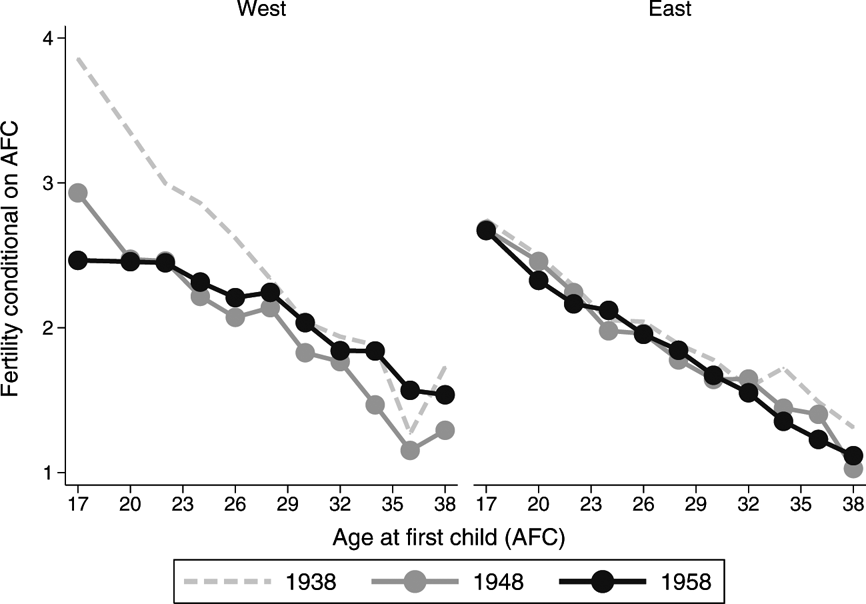
Figure 1 is built upon data from the Generation and Gender Survey (GGS) and the European Social Survey (ESS), collected primarily in 2005 and 2006, respectively, and collapsed into Western and Eastern Europe due to small country-specific AFC-specific sample sizes. This regional grouping is due to the relevance of socialism on the economic and social structure of European populations (Kreyenfeld, Reference Kreyenfeld2003; Bradatan & Firebaugh, Reference Bradatan and Firebaugh2007). Most countries in the West region are documented to experience clear signs of recuperation, cohort-wise, around the years 1956–1960, with the exception of Portugal and Spain (Lesthaeghe, Reference Lesthaeghe2001; Sobotka et al., Reference Sobotka, Zeman, Lesthaeghe, Frejka and Neels2011), while most countries in the East show relatively stable fertility across those cohorts (Myrskylä et al., Reference Myrskylä, Goldstein and Cheng2013).
Completed fertility rates conditional on age at first child (F AFC) by cohort and broader European region. Source: author's calculation based on ESS and GSS surveys. The AFCs on the x-axis are collapsed into three-year groups. ‘West’ is the average across Western European countries, where the countries are those included in the GSS survey (France, Germany and the Netherlands), plus one extra ‘country’: the pooled sample of Western European countries in the ESS survey (which includes Austria, Belgium, Denmark, Finland, Norway, Portugal, Spain, Sweden and Switzerland). ‘East’ is the average across Eastern European countries, where the countries are those included in the GSS survey (Bulgaria, Georgia, Hungary, Romania and Russia), plus one extra ‘country’: the pooled sample of Eastern European countries in the ESS survey (which includes Estonia, Poland, Slovakia, Slovenia and Ukraine).

Each AFC-conditional fertility rate (F ACR) displayed in Fig. 1 is the simple average across countries. In the West the transition cohort (1948 cohort) shows smaller F AFC values than the pre-transition cohort at all values of AFC. The post-transition cohort, on the other hand, shows higher values of F AFC amongst women who enter motherhood at a relatively late age (after age 30). In fact, the F AFC values of those women are comparable to those observed in the pre-transition cohort. In the East, F AFC values are remarkably steady and no postponement is visible in the data.
In conclusion, the empirical exercise in this study shows that fertility recuperation in Western Europe is accompanied by comparatively higher fertility of late-entry-into-motherhood women and constant fertility of women with earlier age at first birth. Although the data do not allow for a robust country-by-country comparison, it is apparent that Nordic countries and France are the group whose fertility rates of late-entry-into-motherhood women increased the most. This characteristic is not found in Eastern Europe, where ages at first birth and cohort fertility remained more or less constant across the cohorts analysed.
Acknowledgments
Hans-Peter Kohler, Francesco Billari, Michel Guillot, Samuel Preston and Jere Behrman provided very helpful comments for this research.