Hospitals are pillars in responding to emergencies and disasters due to their mission of saving lives and securing people’s health. Therefore, they must be able to continuously provide quality services to patients and injured both during disasters and in the current situation. This important duty necessitates that hospitals acquire preparedness at the pre-disaster phase. Reference Habibzadeh, Nazari and Lak1,Reference Jahangiri, Rostami and Sahebi2 Despite hospitals’ notable achievements in planning and enhancing their performance during disasters, there is still no internationally accepted standard for developing and implementing hospital preparedness and response programs during disasters. Reference Sharififar, Jahangiri, Zareiyan and Khoshvaghti3 Therefore, preparedness against disasters is one of the main priorities of hospitals. Reference Sharififar, Jahangiri, Zareiyan and Khoshvaghti3 Studies have reported the level of moderate to high preparedness of Iranian hospitals’ emergency departments in facing disasters, which can be promoted by proper planning and implementing appropriate measures. Reference Kazemzadeh, Shafiei and Jahangiri4
Fire is one of the dangers threatening hospitals, which are more prone to this event, particularly due to the presence of flammable fluids, medical gases, and electrical equipment. In addition to casualties, hospital fires impose considerable economic and financial consequences. Reference Sahebi, Jahangiri and Alibabaei5 Following fire, patients and staff need to be transferred to a safe location. Emergency evacuation is a complex process, especially for patients due to their special conditions and mobility limitations. Reference Sahebi, Jahangiri and Alibabaei6 The purpose of emergency evacuation is to transfer patients to a safe place within the shortest time, requiring patient transfer facilities. The mean duration of emergency evacuation also varies based on available resources, the number of patients, and the distance to the safe location. Reference Childers7,Reference Golmohammadi and Shimshak8 By predicting evacuation duration, accurate information and correct analyses can be obtained for emergency response planning, enabling managers to make right decisions in emergency situations, and timely perform evacuation actions to impose a lower risk on evacuees. Reference Urbanik9 The successful implementation of the emergency evacuation plan depends on the duration of evacuation. In fact, a decision to evacuate is based on acceptable predictions on the duration of evacuation, and in emergency situations, managers give the order for evacuation considering the anticipated evacuation time. Reference Rahman and Hasan10
The duration of evacuation can be calculated using a variety of methods from simple manual calculations to complex statistical models. Reference Spearpoint and Xiang11 According to a comprehensive literature review, the authors found that no statistical machine learning models have been employed yet to forecast the duration of emergency evacuation during hospital fires. Reference Sahebi, Jahangiri and Alibabaei5 Therefore, in this study, machine learning models were used to predict the duration of hospital emergency evacuation during fire.
Methods
In this study, using machine learning algorithms, the duration of hospital emergency evacuation after fire was predicted. Machine learning is one of the important subsets of artificial intelligence and includes a set of techniques and algorithms that can predict some future events. Reference Shafaf and Malek12 The precision of prediction in the statistical model of machine learning is higher compared to conventional statistical models. Reference Senanayake, White and Graves13
Study setting
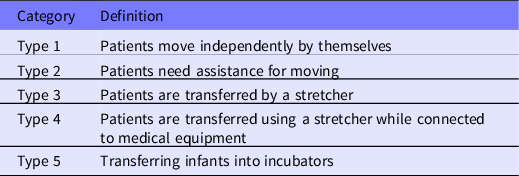
The research setting was a teaching hospital affiliated with one of the medical universities of Tehran, which was selected considering the factors influencing emergency evacuation (as identified in previous studies), Reference Sahebi, Jahangiri and Alibabaei5,Reference Sahebi, Jahangiri and Alibabaei6 and the geographical location of the hospital. Initially, a hospital fire scenario was simulated, and non-patient individuals were recruited to collect the data based on the parameters affecting hospital emergency evacuation. A total of 8 parameters, including patients’ movement capabilities, the number of hospital floors, patient preparation time, patient transfer time, the distance to the safe location, as well as patients’ weight, age, and sex, were regarded as the factors influencing the hospital emergency evacuation process during fires. Reference Sahebi, Jahangiri and Alibabaei5,Reference Sahebi, Jahangiri and Alibabaei6 Thereafter, patients were divided into 5 groups based on their movement capabilities (Table 1) and 4 groups, Reference Mushfaq and Mirzaei14 based on age. Initially, the patients were informed about the purpose and protocol of the study. The average number of patients in each floor of the hospital was 19. The patients were divided into 19 different groups based on movement ability, age, sex, weight, patient transfer time, patient preparation time, and distance from the safe location. Then the duration of emergency evacuation was separately calculated in each group, for each floor, and in both the east and west sides of the hospital. Since each of the east and west sides of the hospital had a different distance from the safe location and considering that each side had 5 floors, the emergency evacuation duration was estimated for 10 different floors based on the data related to 190 patients.
Patient classification based on movement capability in predict the duration of emergency evacuation following hospital fire using machine-learning algorithms

Data analysis
In machine learning models, the cross-validation technique is used for modeling when the number of data points is limited. In this technique, the data is divided into several categories, and in each category, a part of the data is used for testing, and the rest is preserved for training. The results are then presented based on the mean error of the parts tested. Reference Senders, Staples and Karhade15 In this study, for cross-validation, the 190 data points (samples) of this study were divided into 5 equal folds (n = 38 per fold). After classification, for each modeling phase, 1 of the folds was used for testing, and the other 4 were utilized for training. Reference Senders, Staples and Karhade15 As a result, the number of data used for training at each phase was 152. This type of modeling was repeated 5 times, and in each phase, another fold was separated for testing, and the rest were used for training. For data storage, Microsoft Excel 2018 (Microsoft Corp., Redmond, Washington, USA) was used, and modeling was performed using Python 3 software (Python Software Foundation, Wilmington, Delaware, USA). Reference Rever16 Also, considering the study objectives and available data used, supervised machine learning algorithms, including Support Vector Machines (SVM), Random Forest (RF), Naive Bayes Classifier (NBC), and Artificial Neural Network (ANN), were used to analyze the data and design a model for predicting the duration of hospital emergency evacuation during fire. The following is an explanation about these algorithms.
1. Machine learning algorithms
1-1. Support vector machine
This is one of the algorithms of supervised machine learning, which can be used to classify data and perform regression analysis. The SVM is essentially a 2-class categorization during which the classes are separated by a line boundary to identify the best categories among the available data and draw the overall performance. Multi-class SVM is usually implemented by combining several 2-class SVMs. Reference Shafaf and Malek12,Reference Park and Park17,Reference Shafiei and Azimi18
2-1. Random forest
This is a combined learning method for categorization and regression and consists of a large number of decision trees, reducing the variance compared to each decision tree alone. Reference Couronné, Probst and Boulesteix19,Reference Piryonesi and El-Diraby20 The RF algorithm is a powerful decision tree-based classifier and benefits from advantages such as the ability to combine several single predicting algorithms. Compared to some statistical and data mining methods, RF is a useful algorithm to determine the weight of each influential factor. Reference Mohammady, Pourghasemi and Amiri21
3-1. Naive bayes classifier
This supervised machine learning method works based on the Bayes law, which can determine the probability of an event based on existing databases. Due to its simplicity, efficiency, and rigor, the Bayesian classifier is one of the most widely used algorithms for classification. Reference Arar and Ayan22,Reference Phark, Kim and Yoon23
4-1. Artificial neural network
Artificial neural networks are designed by simulating living organisms’ brain structure. The outcomes of this model are obtained through interactions between parallel nodes that include an input layer for receiving and summarizing information and performing calculations, as well as an output layer for data presentation. Some researchers believe that the detection power and predictive accuracy of ANN models are higher compared to classical statistical models. Reference Phark, Kim and Yoon23,Reference Koning and Smith24
2. Feature ranking
Due to their simplicity, ranking methods are successfully applied in practice. Feature ranking determines the relationship between features and the class of variables and picks distinctive and informative attributes. As a result, this method improves the performance of classification models and facilitates the learning process. Reference Alhaj, Siraj and Zainal25 In this study, Information Gain, Gain Ratio, and Gini were used for feature ranking. The Information Gain is a statistical property for feature selection and in this method, important features are selected based on the class attribute rules of features classification. Reference Ghosh and Sanyal26 The Gini Index uses the impurity split method to discriminate between classes. Reference Ghosh and Sanyal26 The Gain Ratio is a correction of information gain. Reference Anggraeny and Purbasari27
3. Normalization
In this research, due to the possibility of the presence of outliers and noise, the data was normalized to better analyze them, remove noise, Reference Savareh, Hosseinkhani and Jafari28 and avoid the negative impacts of different data input scales on the processes of learning algorithms and teaching models. Reference Takhti and Jahantigh29 Thus, in this study, all quantitative variables were normalized using the linear method of data normalization according to equation No. 1. Reference Nadiri, Naderi and Asghari Moghaddam30
Equation 1: Data normalization
 $x\left( {norm} \right) = {{x \ - \ {x_{min}}} \over {{x_{max}} \ - \ {x_{min}}}}$
In this equation, x represents the input data, and xmin and xmax represent the minimum and maximum data points, respectively.
4. Validation of prediction models anticipating the duration of hospital emergency evacuation during fire
In this study, the Confusion Matrix was used to evaluate the results of the models. The Confusion Matrix comprises 4 states: true positive, false positive, true negative, and false negative. According to Confusion Matrix analyses, the validation indicators of the prediction model, including specificity, sensitivity, and Receiver Operating Characteristic (ROC), were used. Specificity is obtained by dividing the true positive percentage by the whole positive cases; sensitivity is the ratio of true positive to the sum of true positive and false negative values. The ROC and Area Under the Curve (AUC) reflect the relationship between sensitivity and specificity. According to AUC, the detection capability of the model is classified as follows: not applicable (AUC = 0.5), low accuracy (0.5 < AUC < 0.7), relative accuracy (0.7 < AUC < 0.9), high accuracy (0.9 < AUC < 1), and full accuracy (AUC = 1). Reference Phark, Kim and Yoon23,Reference Khosravanian and Ayat31 In this study, sensitivity, specificity, and AUC were used to validate prediction models.
Ethical consideration
This study was a part of a PhD thesis with the Ethics ID of IR.SBMU.PHNS.REC.1398.170, approved by the Ethics Committee of Shahid Beheshti University of Medical Sciences, Tehran, Iran. Written informed consent was obtained from all participants before data gathering.
Results
In the present study, the data collected from the simulated evacuation of 190 patients admitted to one of the hospitals of Tehran were analyzed to design machine learning models to predict the duration of hospital emergency evacuation after fire. In this research, the number of hospital floors, patients’ movement abilities, the distance to the safe place, as well as patients’ gender, age, weight, and movement time were considered as input parameters, and evacuation duration was regarded as the output parameter. Assuming that the patient’s evacuation time is the sum of the patient movement and preparedness times, to avoid any interference in the modeling process, the parameter of patient’s preparation time was not included in the data analysis.
1. Pre-processing of data
At first, the data were analyzed as both numerical and categorical values. Since the models predicting the emergency evacuation time were highly accurate when categorical data was used, this type of data was selected for the analyses. Initially, to remove outliers and noise, all the quantitative data of this study were normalized by being equalized in the range of 0 to 1. An outlier point is a data point that differs significantly from other data points in a dataset and Noise data is meaningless data that is generated when mislabeling the sample. Reference Perez and Tah32,Reference Xiao, Zou and Yin33 According to the study objectives, the parameters of the number of hospital floors, patients’ movement abilities, the distance to the safe place, as well as patients’ gender, age, weight, and movement time, were described as follows:
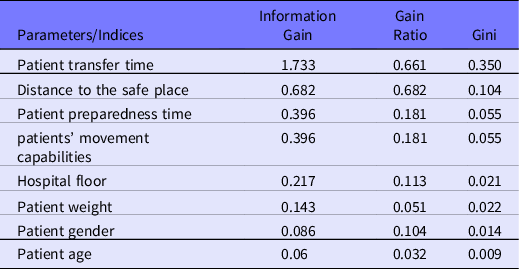
In this study, real emergency evacuation time was divided into 8 100-second sets. Also, Information Gain, Gain Ratio, and Gini were used to assess the weight of each of the parameters affecting the duration of hospital emergency evacuation (Table 2). According to the results of Table 2, the parameter of the patient transfer time, followed by the distance to the safe place, had the greatest impact on the prediction of hospital emergency evacuation duration during fire.
The ranking of the parameters influencing hospital emergency evacuation duration after fire based on Information Gain, Gain Ratio, and Gini index

2. The performance emergency evacuation duration prediction models in hospital fire
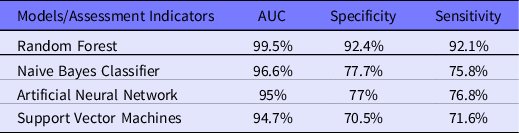
To evaluate the models used in this study, sensitivity, specificity, and AUC were calculated. The results of the Confusion Matrix analysis of different machine learning algorithms have been shown in Table 3. In this table, the performance of 4 supervised models of machine learning for predicting the duration of hospital emergency evacuation during fire has been indicated. According to the obtained results, the RF model had the best performance, and the SVM model showed lower performance in predicting hospital emergency evacuation duration upon fire.
Comparison of the performance of the 4 models presented for predicting hospital emergency evacuation time following fire

Discussion
In the present study, different models of machine learning, including the SVM, RF, ANN, and Naive Bayes Classifier were used to predict the duration of hospital emergency evacuation following fires. The results showed that compared to other algorithms, the RF model could more accurately predict the duration of hospital emergency evacuation upon fire. In a study in China in 2019, a simulation was performed to predict the time of emergency evacuation of residential buildings in urban areas using the 2 models of RF and back propagation neural network, and the results showed that the RF model had better predictive performance than the back propagation neural network model. Reference Chen, Yu and Wen34 Although the recent study used more data points than this study, a comparison between these results suggests the suitability of the RF model as a predictor of events, which can provide a desirable algorithm in all conditions.
The ANN model, after the RF model, delivered a better performance for predicting hospital emergency evacuation time. The results of a study conducted in 2010 to compare the performance of machine learning models in predicting time series showed the superiority of the Multilayer Perceptron and Gaussian Process models compared to other machine learning models. Reference Ahmed, Atiya and Gayar35 The results of another study conducted in the Republic of Korea in 2018 to predict the issuance of emergency evacuation orders following chemical accidents using machine learning algorithms showed the high accuracy of the ANN model in this regard, suggesting the use of machine learning models for ensuring the safety of chemical processes. Reference Phark, Kim and Yoon23 Also, the results of a 2012 study by Akhundzadeh in Iran suggested that the Multilayer Perceptron Neural Network model could be a suitable non-parametric method for predicting changes in nonlinear time series, such as earthquake precursors changes. Reference Akhoondzadeh36 Other studies have shown that neural networks are useful tools for modeling and predicting time series and are able to learn any complex functional relationship between the data of a phenomenon and identify their patterns even when they are complex or unknown. Reference Akhoondzadeh36 Therefore the results of the studies support those of this study, suggesting the better performance of artificial neural networks in predicting time.
In this study, it was found that the SVM model had a lower performance compared to the RF and ANN models for predicting hospital emergency evacuation time after fire. The results of a study conducted in the United States to model and predict evacuation trends during the Irma hurricane showed that the SVM model had the best performance. Reference Hong and Frias-Martinez37 The results of that conducted study contradict the present study, which can be due to the different number of data points used (i.e., the number of data points was lower in this study).
The results of feature ranking in this research showed that the parameters of the patient transfer time and the distance to the safe place had the largest impacts on the model of predicting the duration of hospital emergency evacuation following fire. A study in Thailand assessed the applicability of the ANN and regression analysis models to predict the pre-evacuation time in a plastics industry, whose results showed that there was a positive correlation between the pre-evacuation time and the number of floors of the building. In the most recent conducted study, because most staff were working on the lower floors of the building, they were quickly evacuated to a safe place after the fire alarm, and therefore reported a relatively short time for emergency evacuation. Reference Ketsakorn and Meethom38 Another study conducted in 2019 to assess the risks of emergency evacuation of buildings in Japan, sensitivity analysis showed that the number of people and their primary location (i.e., based on building floors) were among the most prominent parameters influencing the risks of emergency evacuation of buildings. Reference Zhang, Song and Song39 It should be noted that the present study was conducted in a hospital, and hospital residents are people with movement restrictions. During emergency evacuation after a fire, on the other hand, stairs are used for emergency exit, so the evacuation time for the upper floors of the hospital is longer. Therefore, it is recommended that hospitals reduce emergency evacuation time following fires by installing ramps.
Limitations
The relatively low number of the input factors in the machine learning model was one of the limitations of this study. Considering that these factors were chosen based on the structure of a hospital, a simulated scenario, and the performance of machine learning models, it was not amenable to include more factors.
Conclusions
The results of the present study showed that the RF model had the highest accuracy compared to other models to design an applicable model for predicting the duration of hospital emergency evacuation following fire. Since time is a vital and important parameter in hospital emergency evacuation, predicting the time required for evacuation can provide hospital managers with the opportunity to analyze the conditions for planning by providing accurate information. Therefore, health policy makers and managers are advised to use machine learning models to predict the time required for hospital emergency evacuation during fire so that they can develop and promote hospital emergency evacuation programs and guidelines following fire.
Acknowledgments
The authors of this article would like to thank the staff and managers of the study hospital for their cooperation in conducting this research.
Authors’ contributions
KJ, AS, and DKZ designed the research. AS and AAB collected the data. KJ, DKZ, and AAB took part in analyzing the data. All the authors prepared the primary manuscript and then finalized it.
Competing interests
The authors declare no competing interests
Funding statement
This study was officially supported by Shahid Beheshti University of Medical Sciences, Tehran, Iran.