1. Introduction
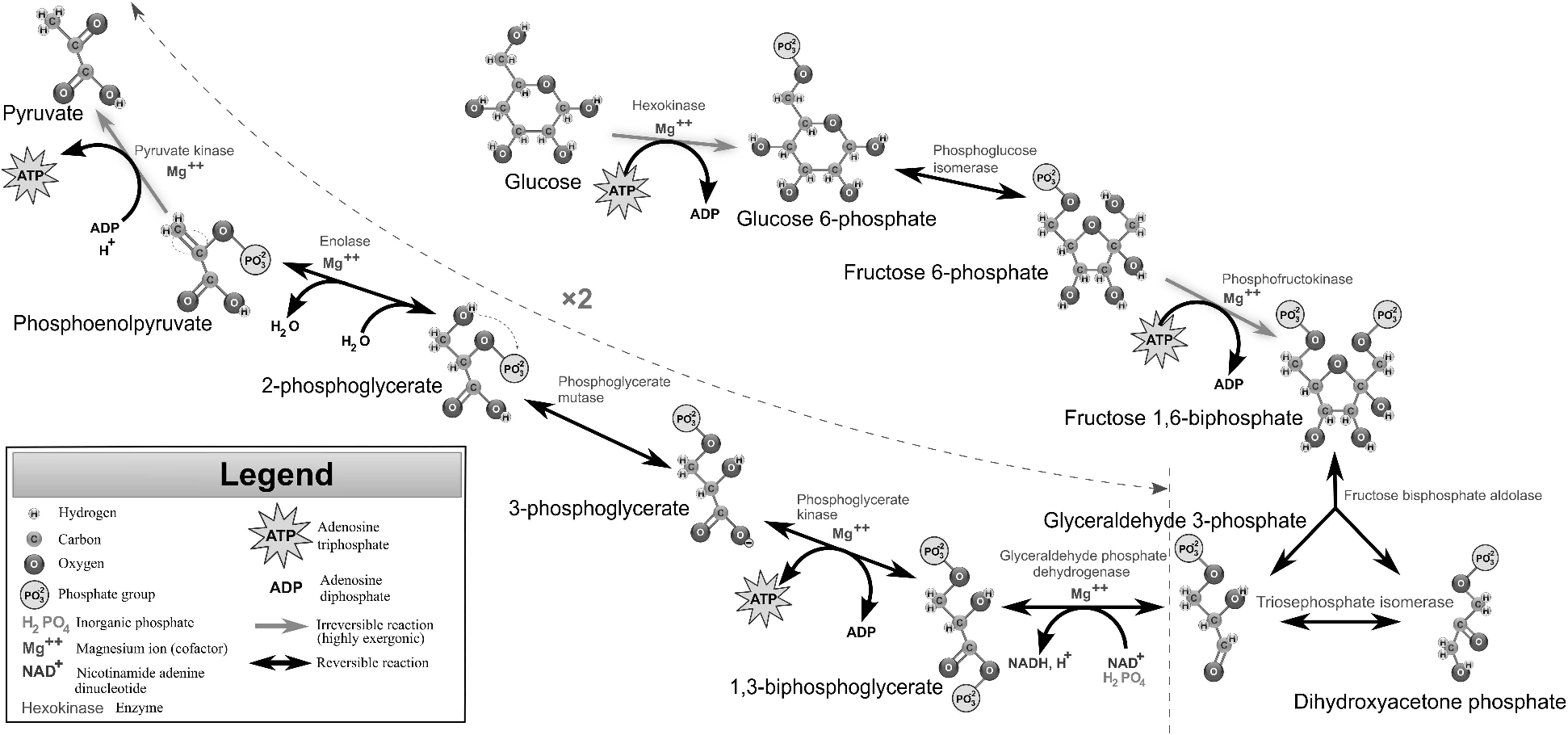
Glycolysis is a sequence of 10 chemical reactions that transforms glucose molecules into pyruvate, ATP (adenosine triphosphate), and NADH (reduced nicotinamide adenine dinucleotide). Nearly every living organism relies on glycolysis (with variations) as part of its metabolism. A diagram such as figure 1 is often given as a partial answer to the question, “How does glycolysis work?” Any adequate philosophical account of scientific explanation in molecular biology must be able to say how such a diagram contributes to a scientific explanation answering that question (at least in part).
Glycolysis. (Copyright 2009 by Yassine Mrabet; used under a Creative Commons Attribution-Share Alike 3.0 unported license, http://en.wikipedia.org/wiki/File:Glycolysis.svg)

The recent mechanisms literature in philosophy of science applies to such cases. Here I will discuss the Machamer, Darden, and Craver (Reference Machamer, Darden and Craver2000; MDC) account of mechanisms, one of the most influential versions among a range of related views. On the MDC view, we know how glycolysis works only when we know the mechanism by which glucose is broken down and reassembled into pyruvate, ATP, and NADH. Glycolysis fits the MDC characterization of “mechanism” well.
In this article, I address what I see as the core problem with the MDC approach: the word “mechanism” is too often ambiguous between a token arrangement (of entities and activities) and the arrangement itself, where the latter is an abstraction that can be instantiated by tokens. This confusion is reflected in the dissatisfying distinctions among a triple of concepts MDC introduces: mechanisms, mechanism schemata, and mechanism sketches.
Instead, I propose that a mechanism is an abstraction, akin to the mathematical abstraction of a directed graph, that is instantiated by token entities and their token activities. Scientists represent mechanisms with diagrams such as figure 1, and the represented mechanism answers (at least partially) how-questions such as, “How does glycolysis work?” For instance, figure 1 is a representation of the mechanism of glycolysis, and the mechanism is itself an abstraction that is instantiated by token causal chains inside innumerable cells every day. Whatever ontic status one wishes to ascribe to abstractions, mechanisms are distinct from causal chains because they abstract away from properties such as the length of the chain.
2. Mechanisms
The word “mechanism” is ubiquitous in the contemporary literature of the special sciences. It is also exceedingly vague. In the contemporary usage, a metabolic pathway such as glycolysis is a mechanism for the production of pyruvate, ATP, and NADH. This usage of “mechanism” is not restricted to machines or to mechanical collisions.
Craver and Darden (Reference Craver and Darden2005) distinguish a range of meanings for “mechanism,” and they work to establish a place for mechanisms in biology that is distinct from the mechanical philosophy of the seventeenth century. Some of the diverse meanings of “mechanism” they discuss include:
• mechanisms as machines, especially ones built from simple Archimedean machines
• mechanisms as naturalized (i.e., not occult)
• mechanisms as building on a small number of basic principles, each of which is “intrinsically intelligible”
• mechanisms as efficient and occurrent, as opposed to intentional and teleological
• mechanisms as deterministic
• mechanisms as features of atomism or corpuscular theories
• mechanisms as “temporally extended processes,” with start and end states
• mechanisms as things that can be exhaustively described with mathematics, in connection with the new geometry of the seventeenth century
• mechanisms as things that can be experimentally discovered, in connection with the rise of experimental science (234–36).
Cartesianism and the mechanical philosophy of the seventeenth century were associated with mechanisms as machines, the rejection of occult action-at-a-distance, determinism, atomism, mathematics, and empiricism. But it is doubtful that any one thinker of the seventeenth century held that all of these notions are essential to the concept of a mechanism. The contemporary usage rejects most of these points. For instance, glycolysis involves chemical bonding, not just geometry. Under standard accounts of quantum mechanics, chemical reactions are not deterministic, and it would be hard to argue that they are intrinsically intelligible. If glycolysis is a mechanism, then these notions cannot be essential to the contemporary understanding of “mechanism” (if, indeed, there is one coherent concept to speak of).
The astonishing variety of these related aspects of the meaning of “mechanism” leads directly to ambiguity. But the recent philosophical literature on mechanisms contains several attempts to bring clarity to the concept. The MDC view is prominent among philosophers and scientists.
2.1. Definitions
The MDC characterization of “mechanisms” is that “mechanisms are entities and activities organized such that they are productive of regular changes from start or set-up to finish or termination conditions” (Machamer et al. Reference Machamer, Darden and Craver2000, 3). An immediate problem with this characterization arises from its use of plurals. We are told that “mechanisms are entities and activities,” but what is a mechanism? Craver later writes that “a mechanism is a set of entities and activities organized such that they exhibit the phenomenon to be explained” (Reference Craver2007, 5; my emphasis). The characterization also elides types and tokens of entities and activities. I discuss both of these points below.
Essential to the MDC account is a dualism between entities and activities. Philosophers are accustomed to giving priority to entities (i.e., substantivalism), not only in discussions of ontology but also with formal tools such as set theory and propositional logic. The MDC account emphasizes activities as processes in which entities partake and by which the entities are changed. Their dualism about entities and activities is an attempt to negotiate a compromise between substantivalism and the long but quieter tradition of process philosophy (Machamer et al. Reference Machamer, Darden and Craver2000, 4).
The appeal to activities in MDC supports the condition of productivity in their characterization. Although the exact meaning is somewhat obscure, in rough terms a mechanism requires that one activity leads to another, in a continuous series (perhaps with branching and merging) from start conditions to termination conditions. While the MDC characterization requires regular changes, Bogen has convinced Machamer that regularities are not required (Bogen Reference Bogen2005).
The organization of the entities and the activities is perhaps the most important part of the MDC characterization, and the most in need of clarification. Mechanists appeal to Wimsatt's distinction between mere aggregates and emergent wholes in which the relationships between the parts make an important difference (Wimsatt Reference Wimsatt1997; Craver Reference Craver2007, 134–36). This provides a number of heuristics useful for learning more about mechanisms. For instance, with an aggregate, removing one part should have the same effect as removing any other, while with a nonaggregate system, removing different parts can lead to very different results. Mechanisms are more than mere aggregates, but the details are left to be spelled out by scientists in particular cases.
We can learn about MDC mechanisms through observation and experimentation. To successfully explain a phenomenon, on this account, is to describe the organization of entities and activities that truly produces the change from the start conditions to the termination conditions: “To give a description of a mechanism for a phenomenon is to explain that phenomenon, i.e., to explain how it was produced” (Machamer et al. Reference Machamer, Darden and Craver2000, 3). As a description, the explanation will be a representation of the mechanism, not the mechanism itself.
2.2. Mechanisms, Schemata, and Sketches
The distinction between a mechanism and its representation is clear enough in MDC. But complications emerge when we wish to distinguish one mechanism from another, when we ask whether a description of a mechanism is complete, and when we introduce further abstractions.
We are told that “mechanisms are identified and individuated by the activities and entities that constitute them, by their start and finish conditions, and by their functional roles” (Machamer et al. Reference Machamer, Darden and Craver2000, 6). We are also told that the start and termination conditions are “idealized states or parameters describing a privileged endpoint” (11). The idealizations are driven by pragmatic concerns: “For example, the end product may be the production of a particular kind of entity or state of affairs that we set out to understand or create” (12). Such idealizations are no doubt necessary in the special sciences but are usually considered to be necessary for epistemic reasons. Including these epistemic conditions creates a tension with the strong ontic interpretation of mechanisms as things in the world that the authors defend in their section 3: “Ontic Status of Mechanisms (Ontic Adequacy).”
In section 5 of Machamer et al. (Reference Machamer, Darden and Craver2000), we are told that “mechanisms occur in nested hierarchies and the descriptions of mechanisms in neurobiology and molecular biology are frequently multi-level” (13). We can break mechanisms down into their parts, which are often themselves mechanisms (i.e., submechanisms). This process of decomposition will “typically bottom out in lowest level mechanisms” (13). Just what counts as a lowest-level mechanism is relative to the historical state of science and the pragmatic concerns of the context.
Mechanisms are proposed in MDC as part of a descriptively adequate account of explanation in molecular biology and neuroscience. The authors present a case study: “Discovering the Mechanism of Protein Synthesis” (Machamer et al. Reference Machamer, Darden and Craver2000, 18). But in order to do justice to their case study they must introduce two further concepts: mechanism schemata and mechanism sketches.
Mechanism schemata leave out some of the details required for a mechanism: “A mechanism schema is a truncated abstract description of a mechanism that can be filled with descriptions of known component parts and activities” (Machamer et al. Reference Machamer, Darden and Craver2000, 15). Watson's central dogma of molecular biology is presented as an example, connecting DNA, RNA, and protein in terms of duplication, transcription, and translation. Mechanism schemata are instantiated by mechanisms: “When instantiated, mechanism schemata yield mechanistic explanations of the phenomenon that the mechanism produces” (17).
A mechanism sketch is an incomplete potential mechanism schema: “A sketch is an abstraction for which bottom out entities and activities cannot (yet) be supplied or which contains gaps in its stages” (Machamer et al. Reference Machamer, Darden and Craver2000, 18). A mechanism sketch may be filled in to the point that it becomes a mechanism schema, or it may be refuted by the evidence or otherwise abandoned.
In sum, a lowest-level mechanism is an arrangement of entities and activities that bottoms out in a context, and it has start and termination conditions that are idealizations in a given context; a mechanism schema is an abstract description that can be filled out with known submechanisms, based on the context; a mechanism sketch is an abstraction that may later be filled out into a mechanism schema. The context depends on the historical state of science and “the purposes of a given scientist, research group, or field” (Machamer et al. Reference Machamer, Darden and Craver2000, 13).
To differentiate these three concepts, and to individuate particular applications of each concept, we are asked to apply a confusing array of ontic, epistemic, and pragmatic distinctions. The ontic distinctions are particularly problematic since the three cannot all lie on a spectrum: a mechanism is an arrangement of entities and activities, while a mechanism schema is a description, and a mechanism sketch is an abstraction. For instance, glycolysis would be a mechanism in molecular biology, a mechanism schema in quantum chemistry, and a mechanism sketch in quantum field theory. We would like “glycolysis” to refer to the same thing in all three cases, but surely we cannot change the ontic status of glycolysis simply by changing the context.
2.3. Mechanisms Are Not Causal Chains
The underlying problem is a failure to distinguish between types and tokens of entities and activities in the characterization of a mechanism. Machamer et al. quote Wimsatt approvingly as saying, “At least in biology, most scientists see their work as explaining types of phenomena by discovering mechanisms” (Wimsatt Reference Wimsatt, Schaffner and Cohen1972, 67; cited at Machamer et al. Reference Machamer, Darden and Craver2000, 34). However they place the emphasis on “mechanisms” at the expense of “types.” I propose that mechanisms describe abstract organizations of types, and their instances are causal chains of token entities and token activities.
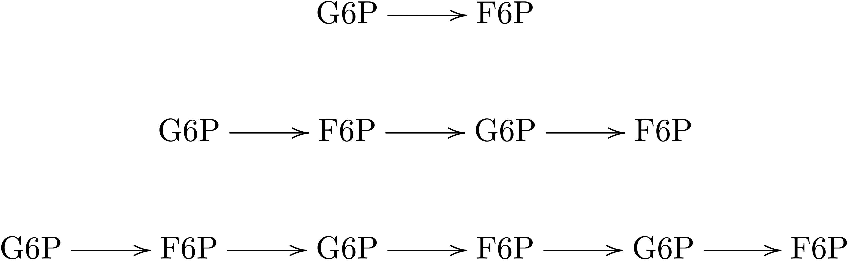
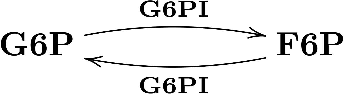
We can see the distinction between a mechanism and a causal chain (i.e., type relations and their token instantiations) in the case of glycolysis. Glycolysis is a mechanism that can be decomposed into a number of submechanisms. One of these submechanisms is phosphoglucose isomerism, shown in figure 2 (boldface indicates a type). Note that the arrow runs in both directions: a glucose 6-phosphate (G6P) molecule can be converted into a fructose 6-phosphate (F6P) molecule by a glucose-6-phosphate isomerase (G6PI), but an F6P molecule can also be converted into a G6P molecule by the same isomerase. Given the same start and termination conditions, a token causal chain (over token entities and token activities) can run to different lengths. Figure 3 represents three different causal chains, but I propose that each chain is a token instance of the same phosphoglucose isomerism mechanism.
Phosphoglucose isomerism as a type relation.

Three token phosphoglucose isomerism causal chains.

There may be a temptation to demur in this case—perhaps the first chain is one phosphoglucose isomerism mechanism, while the second chain is three phosphoglucose isomerism mechanisms, and the third chain is five phosphoglucose isomerism mechanisms. Or perhaps we should understand phosphoglucose isomerism as two mechanisms, one running from G6P to F6P, while the other runs from F6P to G6P. However I think a consideration of the larger mechanism of glycolysis removes that temptation.
Consider three causal chains that run through all the steps of glycolysis from start conditions to termination conditions, differing only in the portion of the causal chain corresponding to the phosphoglucose isomerism submechanism (see fig. 4). These three distinct causal chains differ in length but are three instances of the same mechanism: glycolysis. Figure 1 uses the double-headed arrow for the phosphoglucose isomerism step in order to indicate that a token molecule may be transformed back and forth between G6P and F6P any number of times during glycolysis.
Three token glycolysis causal chains.

The contrast between mechanisms and causal chains is also apparent in the structure of their diagrams. Granting that effects may not precede their causes in time, a diagram depicting token activities as arrows between token entities can branch but can never loop back on itself. But figure 1 shows several such loops, including phosphoglucose isomerism. Most mechanisms of interest include loops.
The MDC characterization of a mechanism can be revised as follows to emphasize type relations: “A mechanism is an organization of entity types and activity types such that token instances of the mechanism are productive of (regular) changes from start or set up to finish or termination conditions.” The productivity requirement concerns chains of causation that apply to the token entities and activities, not to the abstract entity types and activity types. Whether we should be realists, nominalists, or take some other view about the metaphysical status of types is a question I leave open.
If we accept that mechanisms must be abstractions of a sort, then the distinction between mechanisms and mechanism schemata becomes clearer. We saw that mechanisms are characterized in large part by their idealized start and termination conditions, while mechanism schemata are supposed to be abstractions from mechanisms in which some of the details are left out. There are important distinctions to be drawn between idealizations and abstractions (McMullin Reference McMullin1985; Batterman Reference Batterman2002; Jones Reference Jones, Jones and Cartwright2005; Morrison Reference Morrison, Jones and Cartwright2005), but this is a different case. Here we have an organization of abstract types with idealized boundaries (a mechanism) and a further abstraction of that idealization (a mechanism schema). It seems that the main difference between a mechanism and a mechanism schema is the bottom-out conditions, which depend on context. A mechanism sketch cannot (yet) be filled out by any bottom-out conditions accepted in the context, but we can include it as another abstraction alongside mechanisms and mechanism schemata.
We now have a situation in which the same abstraction, glycolysis, can be a mechanism in molecular biology, a mechanism schema in quantum chemistry, and a mechanism sketch in quantum field theory. Changing context is important for epistemic and pragmatic reasons (and perhaps other reasons), but context does not change the ontological status of glycolysis. We have an ontic distinction between token causal chains and organizations of types, and within the latter we have an epistemic/pragmatic distinction among mechanisms, mechanism schemata, and mechanism sketches. Further, if we accept that mechanisms are abstractions on a par with mathematical abstractions, then we open the door to the use of mathematical results for spelling out “organization” and for identifying and distinguishing mechanisms.
3. Mechanisms and Mathematical Abstractions
Craver offers the following characterization of a mechanism, mentioned earlier: “a mechanism is a set of entities and activities organized such that they exhibit the phenomenon to be explained” (Reference Craver2007, 5; my emphasis). While Craver may mean “set” informally, philosophers often discuss sets as abstract objects. If a mechanism is the latter kind of set, then the organization condition for mechanisms amounts to imposing additional structure on the set. Algebraists have defined numerous mathematical objects that are sets with a certain structure, for instance, monoids, groups, and fields. I propose that graphs are a useful mathematical structure for spelling out what “organization” means for a mechanism.
3.1. Graphs
A graph is a mathematical structure that consists of two sets: a set of vertices and a set of edges that connect pairs of vertices. In a directed graph, the edges have a direction, so we can distinguish between an edge  that runs from a to b and an edge
 that runs from b to a. The dualism between vertices and edges nicely reflects MDC's dualism between entities and activities.
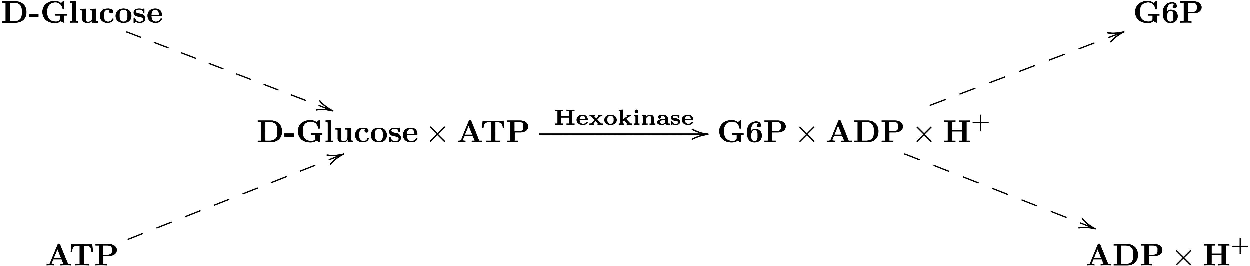
Figure 5 is an example of a directed graph, where each vertex represents a type of organic molecule, and the edge represents a type of chemical reaction, labeled by the relevant enzyme, that transforms token molecules of one type into token molecules of another type. Figure 1 is not a graph. It consists of a main chain of vertices and edges, with special arrows that show how secondary molecules enter and exit the main chain. This representation is a simplification of a more complex graph in which most of the vertices are sets of types of entities. In such a graph, some of the edges act to combine multiple types into a single product type or to break the product type into its components. Figure 6 is an example of the first step of glycolysis, phosphorylation of glucose, as a graph. It shows how the input types (D-Glucose and ATP) combine to form a product type (D-Glucose × ATP), which reacts with Hexokinase to form a new product type (G6P × ADP × H+), which has subtypes (G6P and ADP × H+). The dashed edges represent the type grouping and ungrouping relations rather than activity types, while a product type is a compound type built by grouping together other types.
Graph for phosphoglucose isomerism.

Phosphorylation of glucose as a graph.

I propose the following reworking of the MDC characterization as a plausible refinement to the contemporary usage of “mechanism” in the special sciences: “A mechanism is a weakly connected directed graph in which each vertex is a type of entity, and each edge is a type of activity or a primitive type relation. For each vertex that is a start condition, there is a path to one or more vertices that are termination conditions, and there is no vertex in the graph that does not belong to some such path from a start condition to a termination condition.” (A further restriction of mechanisms to finite graphs may be desirable.) This characterization refines the notion of “organization” used in the MDC characterization. A weakly connected directed graph is one in which there is a path (ignoring edge direction) between every pair of vertices. Productivity is established by requiring that the graph consists of overlapping paths from start conditions to termination conditions, without any vertices or edges left out. By “primitive type relation” I mean the dual operations of grouping types into product types and of ungrouping product types into their simpler types. These operations are not activities and are not instantiated by tokens, but they are (I believe) an innocent concession to the requirements of the graph formalism.
Every instance of a mechanism takes some path in the mechanism's graph from a start condition to a termination condition and instantiates that path as a causal chain. In the simplest case, each vertex in the path is an entity type that is instantiated by a token entity. Each edge in the path is an activity type that is instantiated by a token activity. The activity is productive of a change of the token entities that participate in it, which will often involve a change of the token entities from one entity type into another entity type (e.g., a G6P molecule changes into an F6P molecule).
In more complicated cases, a branching “path” will lead to multiple termination conditions, but the same principles of token instantiation apply. A vertex that represents a product type is instantiated by one entity for each simple type that composes the product type (e.g., one glucose molecule and one ATP molecule instantiate the product type D-Glucose × ATP).
There is more that could be said about the start and termination conditions. For instance, one could require that start condition vertices have no incoming edges. Graph theory provides many such distinctions, which could be useful for classifying mechanisms. As an example, we might be interested in distinguishing between cyclic and noncyclic mechanisms when discussing topics such as autocatalysis.
An immediate advantage of characterizing mechanisms as a kind of directed graph is that we have tools for composing and decomposing graphs and for determining when two graphs are isomorphic. A subgraph S of G contains a subset of the vertices of G and a subset of the edges of G such that adjacency relations are maintained. For example, if there are vertices  that correspond to vertices
 , then we can only have an edge e from a to b in S if there is a corresponding edge e′ from a′ to b′ in G. To form a submechanism, we would start with a subset of the vertices (i.e., the entity types), form a subgraph using a subset of the edges (i.e., activity types and primitive type relations), and make sure that the condition on paths from start to termination conditions is still met. Given a number of submechanisms, we can compose them by matching termination condition vertices to start condition vertices.
Given two graphs, we can determine whether they have the same organization by checking whether an isomorphism exists between them. For a graph isomorphism, we require, first, an isomorphism between the vertex sets and, second, an isomorphism between the edge sets that preserves the adjacency relations. An isomorphism of mechanisms would require, first, a graph isomorphism and, additionally, that the vertex and edge types match and that the start and termination condition vertices match. If the structures of the graphs match but the types do not, then we have an interesting case of structural similarity that should drive further investigation: Do we have two mechanisms with the same organization but different types, or have we made a mistake somewhere about the types?
Given two isomorphic mechanisms, do we wish to say that we really have one mechanism or two? The former answer requires a reformulation of the characterization: “A mechanism is an isomorphism class of connected directed graphs in which … .” This decision has little effect on the use of the characterization, but could reflect other commitments to the ontological status of types.
3.2. Alternatives
It is worth noting that there are mathematical structures other than graphs that could also serve as the basis of a characterization of “mechanism.” Automata are often depicted as graphs, where each vertex denotes a state of the system, and each directed edge denotes a possible transition from one state to another. In conversation, Machamer has objected to this suggestion on the grounds that state transitions do not support the rich notion of activity that MDC relies on. This is also expressed in the article: “It is artificial and impoverished to describe mechanisms solely in terms of entities, properties, interactions, inputs-outputs, and state changes over time” (Machamer et al. Reference Machamer, Darden and Craver2000, 5).
Category theory gives pride of place to activities (arrows, functions, morphisms) over entities (objects). A concrete category is a special kind of graph in which every vertex has an identity arrow (i.e., an edge from itself to itself) and that is closed under composition of arrows.
A related alternative comes from theoretical computer science in the form of modern type theory. (Note that “type” in type theory and “type” in the type/token distinction are not identical.) The core idea in modern type theory is that a function maps an input type to an output type (allowing for product types). A program instantiates a function by transforming token inputs into token outputs. The advantage of this approach would be to connect activities to algorithms and mechanisms to programs.
Mathematics offers a wide variety of structures, and science describes myriad phenomena. Molecular biology with its metabolic pathways and neuroscience with its neural networks are two examples of a trend in the special sciences toward graphs and networks. MDC argues that mechanisms are indispensable precisely in these fields. While I have argued that an appeal to graphs can sharpen the contemporary usage of “mechanism,” there are many other ways to mathematically describe the relationships between types of entities and types of activities.
4. Conclusion
MDC correctly emphasizes the role of mechanisms in the special sciences. “Mechanism” is widely used in the literature and deserves clarification by philosophers. But I have argued that the MDC characterization elides types and tokens, which leads to a tangle of ontic, epistemic, and pragmatic distinctions among mechanisms, mechanism schemata, and mechanism sketches. It is important to make an ontic distinction between token causal chains and mechanisms as organizations of types. This allows us to use epistemic and pragmatic criteria to distinguish mechanisms, mechanism schemata, and mechanism sketches. As the MDC case study shows, it is the abstraction mechanisms provide that makes them useful to scientists: they need to classify different causal chains as belonging to the same mechanism.
I propose a revised characterization of “mechanism” explicitly in terms of connected directed graphs over types. Understood in this way, figure 1 (at least partly) answers the question, “How does glycolysis work?” by representing the composition of submechanisms within the mechanism of glycolysis.