Towards the end of the eleventh chapter of the Śṛṅgāraprakāśa, there is an aside in gāthās that surveys the genres that king Bhoja accepts as constituting the complete range of literary form. The passage is long, 14 pages in Raghavan's edition, and gives us some idea of the unusual flavour of the Śṛṅgāraprakāśa as a whole.Footnote 1 Much of it is taken over en bloc from the Nāṭyaśāstra's eighteenth adhyāya, although with considerable reorganisation and occasional rewriting by Bhoja to account for the spectrum of forms said to be prekṣya ‘visible’ or abhineya ‘performable’.Footnote 2 When the text next moves to the anabhineya or ‘non-performable’ types (that is, what other genre surveys, following Kāvyādarśa 1: 39, would call śravyakāvya), Bhoja composes his own verses, though continuing in a very similar style to the old Bhāratīya gāthās, to account for the rest of his typology.
This portion is full of interesting literary-historical data in the formal definitions Bhoja offers as well as in the works he adduces as examples. All of this is extensively detailed in Raghavan's monograph.Footnote 3 Many definitions are familiar: the major dramatic types, the mahākāvya, ākhyāna and ākhyāyikā, the campū, etc. Some are atypical and somewhat eccentric, as when Bhoja proposes new generic types, parvabandha and kāṇḍabandha to account for the single (albeit massively important) token instances of the two Epics. In contrast to the schematic system of genres available in earlier critics, it is possible — though, I admit, purely speculative — to see here a new way to organise a wide-ranging collection of Sanskrit and Prakrit poetry, almost as if this was meant to serve as a versified catalogue for Bhoja's celebrated library at Dhārā.
It is the conclusion to this passage with which I would like to begin, both the final āryā as well as the bit of explanatory prose that the author attaches to it (Śṛṅgāraprakāśa, p. 727):
yasminn aśeṣavidyāsthānavibhūtayaḥ prakāśante |
saṃhatya sa sāhityaprakāśa etādṛśo bhavati ∥
etasmin hi śṛṅgāraprakāśe suprakāśam evāśeṣaśāstrārthasampadupaniṣadām akhilakalākāvyaucityakalpanārahasyānāṃ ca sanniveśo dṛśyate.
A work in which the treasures of all of the disciplines are drawn together and displayed is the sāhityaprakāśa, the Light upon Literature. It is like this.
It is in fact in this work, the Śṛṅgāraprakāśa or Light upon Passion, that one may see in the clearest possible way the complete range of the hidden excellences of every form of knowledge and the mysteries of how to best meet with success in poetry and in every other worldly craft.
What I seek to present in this essay is simply a gloss or upanyāsa on this short passage. This is confessedly a preliminary and tentative take on the mighty Śṛṅgāraprakāśa. I can hardly lay claim to expertise in the text or in the enormous world that it presupposes: at the most, I would say this is an effort to lay an initial understanding of the Śṛṅgāraprakāśa on the table, what H-G. Gadamer would call a ‘fore-structure of understanding’.Footnote 4 Given that the Śṛṅgāraprakāśa is so large and so atypical of much of alaṃkāraśāstra, hopefully this may be of some use, something to be adapted and modified or rejected in the course of subsequent study of the work.
In coming up with a preliminary approach to the Śṛṅgāraprakāśa, one needs to comment briefly on the influential and important recent history of scholarship on the text. It is comforting, perhaps, that for all the vicissitudes suffered by Bhoja's great work (little read and poorly understood, despite its breadth and astonishing ambition), it has in the last several decades been the recipient of the remarkable interpretive attentions of two great scholars, V. Raghavan and Sheldon Pollock. Their interpretations of the text will continue to inform all discussions of the Śṛṅgāraprakāśa. Both Raghavan and Pollock are strong readers and critics (much as was Bhoja, or perhaps better ‘Bhoja’Footnote 5): readers whose powerful agenda at every step inform their labour with the text. This is, in my view, right and good.
There are times, however, when this strength forces them up against the Śṛṅgāraprakāśa in odd ways. I have the impression that Raghavan really wanted Bhoja to think and write like a normative śāstrī: readers of his monograph will recall passages when he really seems quite frustrated and almost indignant towards the idiosyncrasies of presentation and argument that are characteristic of the Śṛṅgāraprakāśa, especially so in the typologies and taxonomies to which so much of the work is given over, and in the often very creative rereadings Bhoja gives of some of his sources, notably the Kāvyādarśa and the Nāṭyaśāstra.Footnote 6 As for Pollock (without whom the present generation, including myself, would have little to do with the work at all), he wants to fit the Śṛṅgāraprakāśa, especially its eleventh prakāśa, into the position of opposition to the Kashmirian school of literary theory synthesised by Abhinavagupta. As a consequence he rejects Raghavan's attempt to see the theory of ahaṃkāra-śṛṅgāra as a sort of generalised philosophical anthropology, a point to which I will return. Related to this, but ultimately even more significantly, Pollock wants to argue that the importance of the Śṛṅgāraprakāśa is as a priceless archival textual monument, an enormous attestation of how Sanskrit literary culture worked at its zenith, before the full-fledged transition to vernacularity and before the ultimately homogenising effect of Abhinavagupta's revision of Ānandavardhana's dhvani theory forever changed the rules of the game of literary interpretation.Footnote 7 I am sympathetic to this archival-monumental vision of the Śṛṅgāraprakāśa, but I have come to think that this insistence on the conservative, almost museological, understanding of the Śṛṅgāraprakāśa risks muting the innovative, even radical nature of some of the work's explicit and implied arguments.
With all of this in mind, and with due deference to these two scholars, I offer here two ways to frame the Śṛṅgāraprakāśa – two related but somewhat different paths ‘into’ the text. I begin with an appeal to a comparison, an upamāna, as a way to try and capture what is particular and unique at a structural level with Bhoja's enormous work. Following on this, I will conclude with a speculative reconstruction of what I call Bhoja's alternate universe: his vision of a textual-cultural order that culminates in poetry, poetic language and in the reflection thereon, sāhitya, the higher ‘unity’ of sound and sense possible in literature.
To work outward from an analogy is really in the spirit of the Śṛṅgāraprakāśa itself. Late in the text, in its twenty-fifth prakāśa, there is a lengthy discussion of the workings of prathamānurāga or ‘love at first sight’. Bhoja begins by describing how love at first sight begins in the realm of inchoate feeling (bhāvaskandha, the first of its four modalities), which itself emerges nāyakayoḥ prāg asaṅgatayoḥ mitho darśanaśravaṇābhyām, “through the furtive seeing and hearing of the two lovers who have not met before” (Śṛṅgāraprakāśa, p. 1315). This furnishes Bhoja the opportunity to develop a lengthy aside on the pramāṇas, the ways of knowing or epistemic warrants accepted in classical epistemology. Bhoja does this by subscribing the list of generally accepted pramāṇas to his twin rubics of ‘seeing’ (something he quickly expanded to mean ‘knowing’Footnote 8) and ‘hearing’, in the case of young lovers. In the course of this long discussion, he makes the interesting and, on the face of it, very strange assertion that upamāna, which is often one of the pramāṇas that epistemologists are wont to reject as really coming down to either one or other of the accepted forms of knowledge or a cocktail of several of them, is, in fact, the form of knowledge par excellence, that on which everything depends:Footnote 9
And there is something else. Let us give up on all of this great, pointless debate [about the validity of analogy]. Actually, for thoughtful people, comparison is largely the only form of valid knowledge; furthermore, [all other generally accepted pramāṇas] such as direct perception are, in fact, contained within similiarity [upamā]. To explain: in order to be practically useful, valid knowledge depends upon a prior awareness that is discursively constituted. Such discursively constituted awareness is linguistic in nature, and language can convey meaning only insofar as there is the grasping of the connection [between word and referent]. But since it is only subsequent to this that direct perception can reveal something to be similar to some other thing, how does it not amount to comparison?
[The sole surviving manuscript witness for this section is lacunose here: Bhoja goes on to cite the authority of the ancient Sāṃkhya authority Vindhyāvāsin, and to similarly reduce the pramāṇas of inference, scriptural testimony, and traditional opinion (aitihya) to analogy as well].
If this is really so, one might wonder what is the point of these other forms of knowledge, such as direct perception: to this, we would reply that received wisdom has real charm to it, as long as it goes unexamined: just like the ways of worldly life, it cannot endure scrutiny.
In short, it is really only through a series of working comparisons between dissimilar things that we are able get on with the business of life, while admitting there to be other ways to know the world only out of habit and convention. This argument — which is highly eccentric from the perspective of classical logic — gives something of the flavour of the Śṛṅgāraprakāśa. It is a work of wide-ranging ambition and intellectual confidence, unafraid to entertain unorthodox views and often couching its ideas in surprising ways. While this argument does have a traditional śāstric precedent in Vindhyāvāsin's now-lost works,Footnote 10 I suspect that the significance of this argument for Bhoja is motivated by his work's central concern with literary language and literary art, and with the critical place of similitude (aupamya, sādṛśya) therein. Bhoja's choice of words is deliberate when he dissolves all forms of knowledge into analogical reasoning, calling it upamā, the same name given in the alaṃkāra tradition to the simile, the most basic and essential meaning-based figure.Footnote 11 This suggests an essential point about the Śṛṅgāraprakāśa's larger argument, that the densely wrought language of poetry presents a series of paradigmatic instances by which we may truly understand the world.
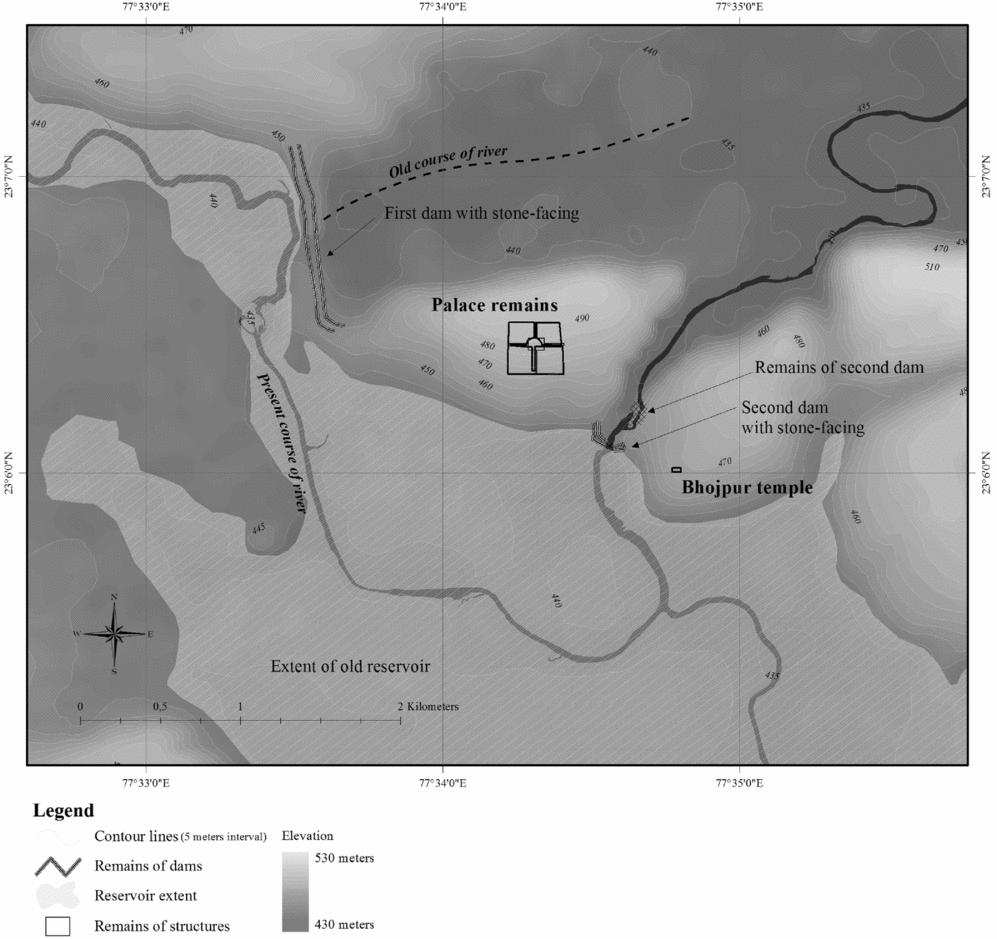
More immediately, however, these broad claims for the centrality of comparison embolden me to offer one of my own, in which I will venture to compare the immense complexity and monumentality of the Śṛṅgāraprakāśa to another, equally enormous project attributed to Bhoja. Imagine, for a moment, standing on a high hill in one corner of the Paramāra domain near the modern city of Bhopal, sometime in the decades after the completion of Bhoja's massive summa poeticae. From our hilltop perch, we could hardly fail to notice just how great this king's vision and ambition were. Taking advantage of a stretch of encircling hills near the headwaters of the Betwā river, this same Paramāra king set about transforming part of the world that was his birthright, setting up massive earthen and stone bulwarks to create an enormous artificial lake that bears his name, the so-called Bhoj tāl (Fig. 1). When the political agent William Kincaid surveyed the site in the late nineteenth century, by then known as Bhojpur after a nearby village, he made some calculations as to the size of the earthworks that Bhoja had created: two massive dams (the larger of the two nearly a half kilometre long), one towering forty feet above the ground and each hundreds of feet thick at their bases, tapering to a hundred-foot broad top, angled in to prevent their being overwhelmed by the waters they hemmed in.Footnote 12 Kincaid exaggerated the size of the constructions, but his observation that the nearby hill known as Maṇḍidīp (from dvīpa or ‘island’) reflects the size of the lake that had once been there seems to hold good. That by Kincaid's time this considerable body of water has disappeared is owed to the fact that in 1434 ce Hoshang Shāh, Sultan of Mālwa, in a bold coup de main, had the smaller of Bhoja's dams breached, in an effort, we are told in a Persian chronicle, to quell a local rebellion in the vicinty.Footnote 13 It took three years for the lake to drain, if the source is to be believed, and the hydrology of central India was substantially changed in the process.
Map showing the original size of the lake at Bhojpur.

I am very much an amateur when it comes to the history of irrigation in South Asia. But what I do know, gleaned from a brief excursion into the published work on the subject, suggests that it might be worthwhile to take these two great monuments of Bhoja – the Śṛṅgāraprakāśa and the Bhojpur constructions – in a single gaze. Bhoja's text and his waterworks are interestingly alike for more reason than showing that this man's attitude was ‘more-is-more’. For one, there is the anomaly that both are products of a royal command economy. While it was long an axiom of Marxist and vociferiously anti-Marxist scholarship alike that pre-modern India depended on the absolutist control over water – an arrangement variously called the ‘Asiatic mode of production’ or ‘hydraulic despotism’ – it has now been overwhelmingly demonstrated that this was simply not the case. For most of India's agrarian history, massive public works like Bhoja's were exceedingly rare, though obviously seriously consequential when they were built. Most of the creation and upkeep of the astonishing web of tanks, barriers, channels and watered fields across the subcontinent was an entirely decentralised affair, or one in which kings were only single nodes in much wider and more various networks of power.Footnote 14 So the shared gigantism with the constructions at Bhojpur reminds us just how odd it is at this point to possess the literary-theoretical and anthological bulk of the Śṛṅgāraprakāśa. Though royally-centred works of alaṃkāra would later become all the rage – those authored by kings like Siṅhabhūpāla in his Rasārṇavasudhākara, directed to royal patrons like the Pratāparudrīya of Vidyānātha, or works falling somewhere between the two – there had been no such major work prior to Bhoja's Śṛṅgāraprakāśa and his earlier Sarasvatīkaṇṭhābharaṇa.Footnote 15
The Bhojpur dam and its surroundings help give us a purchase on the Śṛṅgāraprakāśa in other ways as well. To be precise, we can use what we can reconstruct of the site to think about the structure of Śṛṅgāraprakāśa as a whole. To speak of the ‘architectonics’ of a text or other work of culture has long become a dead metaphor in certain kinds of humanistic scholarship, but I think it can be made to work as more than just a rhetorically inflated synonym for textual structure or organisation. It is worth exploring the ways in which the complex built environment of Bhojpur – from the mammoth edifice of the stone-faced earthen dams themselves, to their more humble (and now largely vanished) support structures, such as sluices, check-dams, spillways etc. – provides us a good working analogy for the linguistic bulk of the Śṛṅgāraprakāśa. At the very least, it allows us to frame the question of its design in terms that might be more familiar to those who work on material culture: how was the monumental text made and out of what sort of materials? And what was it for?
At the risk of appearing glib, I start with the second question and the suggestion that there is a functional as well as structural analogy between the Śṛṅgāraprakāśa and the Bhojpur dams. The enormous water structures along with their accompanying apparatus were meant, above all, to contain and to channel the evanescent flow of the waters of the Betwā, and so to bring increase to the heart of Paramāra kingdom. The Śṛṅgāraprakāśa, on my reading, was dedicated to a similar task, an attempt to contain and to channel an equally evanescent, equally crucial and equally life-giving resource – language itself. To continue the aqueous image, the work was meant to gather, to preserve, and to direct Sarasvatī, the liquid goddess of language personified, and a divinity to whom Bhoja was especially devoted.
The work's interest in the cultivation of Sarasvatī was not strictly archival, nor was it just the shambolic mess that some have seen it to be. On the contrary, the Śṛṅgāraprakāśa is organised around a single complex telos, that towards which language as such is directed and into which it can be focalised: the synthesis of sound and sense, signifier and signified that in Sanskrit is called sāhitya or ‘unity’. Tucked away among all the many significant points that are there to be found in Raghavan's invaluable monograph, there is a key chapter that provides a Begriffsgeschichte of the concept of sāhitya. The central point there is that in the eleventh century, the concept of sāhitya was revolutionised by two nearly contemporaneous works, the Śṛṅgāraprakāśa and the first unmeṣa of Kuntaka's Vakroktijīvita.Footnote 16 The notion of sāhitya was however an old one, dating back at least to Bhāmaha's definition that “Poetry is the union of word and meaning” (śabdārthau sahitau kāvyam, Kāvyālaṃkāra 1.16; an antecedent to this idea can be glimpsed in Kālidāsa's celebrated opening to the Raghuvaṃśa, vāgarthāv iva saṃpṛktau, etc.). Sanskrit belles-lettres, thus defined, was joined by the self-conscious reflection on poetic language in the form of alaṃkāraśāstra (often known under the name sāhityavidyā Footnote 17), the discipline governing the judgment of what constituted sāhitya: the theory and practice of poetry were deeply and inextricably imbricated long before Bhoja's time.
In the Paramāra king's hands, however, sāhitya is taken up and further extended, and turned into a master-concept that governs the entire extent of his massive Śṛṅgāraprakāśa. In his expanded definition, sāhitya connotes not just fine or literary writing, but serves as the highest synthesis of language as such: poetic language is significant because poetry forms the apex of any and all forms of language use, the point at which grammar and all of the features of Bhoja's twelve-part taxonomy of sāhitya are present. It is in poetry that these features, the very stuff that constitutes language in its most intensified, autotelic form, are made available deliberately, self-consciously and beautifully. Sārasvatī, so often at risk of melting away into thin air with every utterance, is fixed, made solid and so preserved by means of all of the cataloging, regimenting and theorising of Bhoja's great sāhityaprakāśa. This, it seems to me, is the global intention and ambition of the Śṛṅgāraprakāśa. It aims to provide an exhaustive mechanism to contain and to channel language towards the higher unity of which it is essentially and primordially capable.
But what about the structure of our mammoth Sarasvatī conservation project? To put the question another way, what is the text made of? Again, the Bhojpur constructions, ranging from the massive dams to the spillways, channels, and sluices that depended on them, and the natural environment in which they were all set, provide us with a starting point. We can begin with the preexisting materials incorporated into the work, prior texts treated almost as found objects. The Śṛṅgāraprakāśa in fact includes a huge amount of earlier textual material, whether through attributed quotation, reworked borrowing or wholesale incorporation. To mention only the big ticket items: the entirety of Daṇḍin's Kāvyādarśa is written into the text, as are hundreds of verses from the Vākyapadīya along with its commentaries of Puṇyarāja and Helārāja (including verses no longer available in the work as transmitted), something like 80 pages of the printed edition of the Nyāyamañjarī of Jayantabhaṭṭa, large chunks of the Nāṭyaśāstra, Kāmasūtra and Nyāyasūtra; while the opening chapters on Vyākaraṇa are either direct quotations of Patañjali's Mahābhāṣya or are written in a style of self-conscious homage to that great work.Footnote 18 To this we may add the enormous bulk of the udāharaṇa-citations of kāvya texts. As much as the text is a testament to an astonishing breadth of reading in Sanskrit and Prakrit literature (providing the literary historian with precious attestations of lost works, and casting even central parts of the canon in a considerably different light), it is striking even to the casual reader of the Śṛṅgāraprakāśa that Bhoja cites many verses over and over again, verses like yad eva rocate mahyam or mā bhaiḥ śaśāṅka mama śīthuni nāsti rāhuḥ.Footnote 19 These provide a sort of interwoven structural support to the text as a whole, as they are repeatedly introduced, often in the service of different points of the argument.
Outside of these incorporated materials, another key structural device of the Śṛṅgāraprakāśa is its central habit of taxonomy and of list-making. This is a feature of the text that cannot be missed, and which has tried the patience of even its most sympathetic readers. Bhoja almost certainly fills out some parts of his taxonomies (which usually are organised into sixes or multiples of six) purely in the interests of symmetry. If we are willing to accept, however, that symmetry is a virtue to an argumentative text, then the patterning that results has a certain logic, a patterning that resembles architecture more than conventional forensic or propositional text-making. It is at the intersection of these two structural devices – extensive taxonomy and constant citation – that much of the intellectual energy of the text is located.
Standing out from all of this, however, is the feature that makes the Śṛṅgāraprakāśa most distinctive in the history of Sanskrit literary theory: its argument that śṛṅgāra (normally, the erotic sentiment or rasa, one of the set normally numbered eight or nine) is, in fact, the same as ahaṃkāra or abhimāna, the I-cognition or sense of self, and that it is the sole real rasa, and that all forms of literary affect are only transformations of this one actually-existing emotional core. It is here especially where the strong readings of Raghavan and Pollock are the most at odds. Both highlight the crucial difference between this interpretation of the rasa problematic and that associated with Abhinavagupta and the Kashmirian tradition of literary theory, and both acknowledge the thorny conceptual issues that this raises. For Pollock, who understands the Śṛṅgāraprakāśa as the final, totalising statement of an earlier theoretical dispensation, Bhoja's analysis of śṛṅgāra is strictly confined to literary representation, and crucially, the locus of rasa is the literary character himself or herself. On this reading, Bhoja's theory of rasa
constantly redirects our attention toward the literary process itself and the production of literary communication. This is what Bhoja is above all concerned to analyze, not literary reception, and that is what his discourse on rasa appears to be designed to address. Although the various positions on rasa may not be mutually exclusive in theory, there was clearly variance among thinkers with respect to which aspect of the rasa problematic they invested with analytical primacy.Footnote 20
Raghavan earlier proposed a more ecumenical view. For him, literary characters are seen to most clearly typify the underlying workings of abhimāna-śṛṅgāra – of self-reflexive emotive awareness as the active structuring principle of consciousness – but this is only because it is in literature that this is most plainly laid bare. For Raghavan, Bhoja's theory contains within it the possibility of a general theory of culture and individuation, where the rasika, the one who “has rasa”, becomes an all encompassing model for subjectivity.Footnote 21 This places us far afield of Pollock's text-internal reading of the theory. There is certainly something unusual, even uncanny, about this equating of putatively fictitious persons and those we understand to be actually existing, and Pollock is wary of the more constructive and eclectic aspects of Raghavan's interpretation.Footnote 22 But the tendency to leap across conceptual and intellectual boundaries that Pollock sees in Raghavan's work (“an anachronistic hodgepodge of theories”) is certainly present in Bhoja's own thought,Footnote 23 and limiting the scope of the Śṛṅgāraprakāśa to a disenchanted theory of literature for literature's sake runs the risk of muting some of its unruly brilliance. If the ahaṃkāra-śṛṅgāra theory certainly is confined in its demonstration to the represented rasikas of literature, it would nevertheless be a mistake to posit too strong a divide between art and life in Bhoja's work: analytical primacy does not constitute ontological exclusivity.
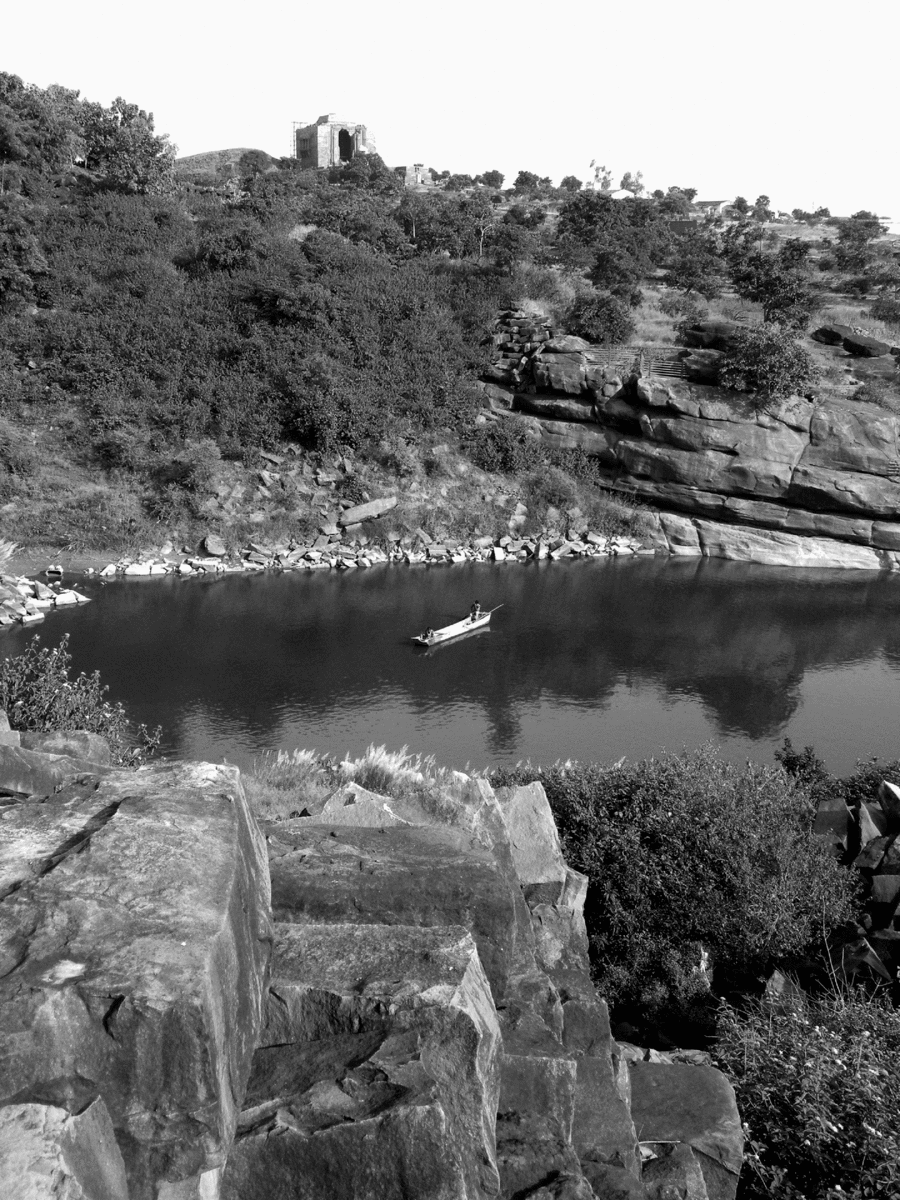
Notably, the main presentation of this idiosyncratic theory is really confined to the opening kārikās of the work and a significant part of its eleventh chapter. Pollock's 1998 article presents an integral translation of these passages; there is additionally the application of the newly empowered śṛṅgāra to the moral theory of the caturvarga, as Malamoud discussed in a classic article.Footnote 24 Though of course it is central to design of the text, this material is slight when set against the thirty-six long chapters of a text that will eventually reach, in its completed edition, more than two thousand pages of closely printed Sanskrit. Thus the presence of the reconfigured idea of śṛṅgāra in the text as a whole is, to put it paradoxically, marginal but essential. This is something that the placement of the précis of the theory in the Śṛṅgāraprakāśa's opening verses itself calls to mind. And this again jibes with what we know of the site at Bhojpur. Scholarship on pre-modern Indic water structures sometimes speaks of ‘monumentalised control structures’: temples or temple-like buildings erected on top of or near to features like the dams at Bhojpur (Fig. 2).Footnote 25 These seem to have been built at the point where the dams were pierced by spill-ways or other sorts of channels, often near enough their central point, where the system was under the greatest amount of pressure. Bhojpur, for its part, possesses an unfinished Śaiva temple, containing a massive monolithic liṅga, that stood on the edge of the lake and dam made by Bhoja.Footnote 26
View of the Betwā River at Bhojpur, showing the cyclopean masonry of the breached dam and, on the upper horizon, the unfinished Śiva temple.

Like a properly ornamented temple set within the precinct of a practical and public dam complex, the abhimāna-śṛṅgāra theory is set within the larger Śṛṅgāraprakāśa as its crowning pinnacle. The opening verses iconise this centrality: this is something that Bhoja himself avers to in his auto-commentary upon it in the seventh prakāśa.Footnote 27 It attracts the eye because it is meant to attract the eye, to call attention to itself and the details of its construction when set within its more functional or task-oriented surround. We can pursue the analogy a bit further. As a temple or temple-like structure could be set at the point of greatest physical strain to perform the work of structural but also ritual or apotropaic support for the entire system, so too the overarching theory of sāhitya embodied in the entirety of the Śṛṅgāraprakāśa required buttressing at exactly the point of greatest tension in its theory of language, that of subjectivity, and its problematic status as constituted by language and, simultaneously, its creatively active role within language. The śṛṅgāra theory can perhaps be understood in just this way, as a general theory of languaged consciousness.
I am now at the point where I can abandon my extended upamāna, but before doing so, I would like first to draw a final consequence of it. If we, as readers of the Śṛṅgāraprakāśa, find ourselves in an analagous position to archaeologist and architectural historians, then our work on the text can be taken as an attempt to understand it as a functional whole rather than as the setting for a curious theory of how rasa works. Our work becomes, mutatis mutandis, akin to what those working on material culture are trying to do with the built environment – trying to see monuments not just as stylistic one-offs or as serenely autonomous works of art, but to understand them integrally as part of larger complexes embedded within social and ecological networks whose interpretation is as significant and as challenging as that of particular masterpieces.
It remains for me, by way of conclusion, to situate what I think the wider project of the Śṛṅgāraprakāśa's cultivation of sāhitya was meant to perform. My suggestion is necessarily tentative, but it centres on the question raised by my title, that of Bhoja's alternate universe. As several scholars have argued, alaṃkāraśāstra languished in a peculiar place in the hierarchy of knowledges in classical Sanskritic culture.Footnote 28 In part, this was an artifact of its own textual situation: alaṃkāra lacked the authority of a foundational sūtra with its canonical entourage of vṛtti, vārttika and bhāṣya, and so had a hard time gaining a place at the table (or on the syllabus) with the likes of Nyāya or Mīmāṃsā. But more to the point, the śāstra's intellectual object was itself something both historically unstable and intellectually and morally questionable: when the Veda needs to be defended from the nāstikas, and questions about the fate of the embodied soul need answering, it could seem, to certain minds at least, disreputable to worry about the meaning of an erotic poem or how that poem went about meaning what it did. The long history of how this was negotiated both within the śāstra and across the domain of learned discourse is a fascinating one, but beyond the scope of this article. What I would simply like to suggest is that the Śṛṅgāraprakāśa, along with the many theoretical and literary critical arguments which it enters into, was directed towards this particular disciplinary question. To put it one way, Bhoja acts as if the disciplinary divides in which the study of kāvya was given short shrift did not even exist, or could be refigured in a radical way. Again this seems to suggest something like a royal command economy – Bhoja reorganised in a single stroke the entire world of Sanskrit and allied textuality. But to think simply in terms of discrete śāstras and to imagine that Bhoja sought to up-end the hierarchy and place alaṃkāra at the top seems to miss what is going on in the Śṛṅgāraprakāśa. Rather, Bhoja sought to reorient the entire world of learned discourse towards poetic language and, along with the world of śāstra, the entire natural and social world to which śāstra gives us reliable access. Alaṃkāra possesses a vital role as the necessary instrument to the understanding of such language. Bhoja was not trying to create a sovereign discipline of language analysis that takes poetry as a particularly interesting, rich, and formally ‘thick’ set of texts, as was the case in Mammaṭa's somewhat later Kāvyaprakāśa. In the definition of the meta-genre of sāhityaprakāśa with which we began, there is no intervening mention of other alaṃkāra works, or indeed of any other kind of śāstra whatsoever. Rather, Bhoja's vision of the world accepts sāhitya, the self-aware articulation of signifier and signified, to be the most highly valued language-form, above and beyond any particular śāstric reflection upon it. By so arguing, and by making this argument the keynote to this enormous text, Bhoja's new vision for the cultural universe has some very real consequences. For one, there is an implicit rejection of the sort of anti-kāvya and anti-alaṃkāra prejudice typified by Jayantabhaṭṭa's dismissal of Ānandavardhana's theory of suggestion in his Nyāyamañjarī: “In any case, it does not look good to argue like this with poets; even learned men lose their way on the trackless path of sentence-meaning”.Footnote 29 It is impossible to imagine from Bhoja's perspective such a negative contrast between kavi and vidvān.
A larger consequence can be found within the domain of systematic thought itself. Take the argument for the priority of upamāna that I mentioned earlier. For all that this argument possesses a conventional (if tenuous) scholarly pedigree in the lost work of Vindhyāvāsin, the significance of it to Bhoja seems to lie in the centrality of comparison to the work of poetic language, as can be seen in the foundational importance accorded to upamā or simile. Furthermore, recall that this whole lengthy aside on the nature of knowledge is found within a discussion on the vagaries of love at first sight: in Bhoja's reimagined kāvya-centric world, this is a matter worthy of epistemological reflection, not the dried-out logician's stock examples of the patch of blue or the smoke rising on a distant hillside. Bhoja's alternate universe of sāhitya thus has implications for the more traditional śāstras, raising the question: what is it like to turn back and read Kumārila or Jayanta or Uddyotakara with an eye set to the terms of the world of which Bhoja was the great kaviprajāpati?Footnote 30
And it is here – working within the rules of the alternate universe – that we see the peculiar energy that can be found at the intersection of the Śṛṅgāraprakāśa's taxonomic imagination and its massive corpus of citations. In a way that is distinctive among other ālaṃkārikas, in Bhoja's writing the poetry often seems to run ahead of the theory. Verses are not necessarily cited as exempla in order to be given an exhaustive reading (as one sees in Abhinavagupta's discussions, for example), but because a certain verse contains within it the fine detail of a particular taxon, and it is through focusing on this particular, often very subtle, element that we may see what it is that poetic language can really do. To give only a single example: within the first part of the twelve-member taxonomy that makes up sāhitya, that of abhidhā or ‘denotation’,Footnote 31 Bhoja begins by defining forms of linguistic referentiality familiar from as early as Patañjali's Mahābhāṣya, the beginning of serious grammatical speculation in Sanskrit: words can refer to class-categories, individual instances, forms, qualities, actions, and relations.Footnote 32 The third of these, ākṛti, ‘form’ or perhaps ‘shape’, is a term that has long been considered problematic (in Patañjali it is at times difficult to distinguish from jāti or ‘class’Footnote 33), and Bhoja's terse definition (“Denotation as it pertains to shape describes objects such as pictures, reflections, and images”Footnote 34) seems, from the perspective of this long tradition of discussion, quite beside the point. His two examples are, as everywhere in the Śṛṅgāraprakāśa, taken from existing works of poetry; if anything, they seem more eccentric than the definition:
This is that same almond tree where once,
long ago, in Śṛṅgiberapura
we met the devoted chieftain of the mountain tribe.
At its entranceway, in the pure white sand
I see a line of fresh footprints:
high in the front, deep at the heel
from the weight of heavy hips.
These are very famous verses, recognisable to any serious reader of kāvya, drawn from Bhavabhūti's Uttararāmacarita Footnote 35 and Kālidāsa's Abhijñānaśakuntala.Footnote 36 The first is Rāma's description to Sītā of a painting of their life-story seen in the palace in Ayodhyā before their heartbreaking separation; the second Duṣyanta's delicately realised erotic reverie provoked by a trace of Śakuntalā's presence. At first glance, the use of these verses in Bhoja's taxonomy seems dully literal: are these really only about a picture and a footprint? But, on reflection, Bhoja's perspicuity in plucking just these two verses out of the ocean of potential examples seems remarkable, miraculously capturing something of the wider totality of these beloved classics. Rāma and Sītā's seemingly innocent viewing of their own earlier adventures contains not just a proleptic echo of Bhavabhūti's play-within-a-play denouement, but an intimation of the play's wider metapoetic concerns; while Kālidāsa's masterpiece is shot through with meditations on the epistemic status of the traces of absence, and with the impress of outward signs on memory and on desire.Footnote 37 Both verses portray a profound, affectively saturated awareness centred on a representation, as it is refracted through the complex subjectivity of a protagonist-rasika, capturing something about the way an image ineffably concretises a mixture of projection and fantasy, memory and expectation. The net effect of verses such as these results in a certain kaleidoscopic effect, especially when the verse is one that Bhoja cites repeatedly: each citation creates the impression that just capturing the complex totality that is a single stanza brings to bear the entire conceptual spectrum of sāhitya, to say nothing of the larger textual wholes that Bhoja tries to accommodate within his work.
Bhoja's alternate universe, this vision of Sanskrit (and Prakrit and Apabhraṃśa) as containing as its highest end a creative, expressive potentiality, made sense within the world of the eleventh century and can tell us something quite significant about that epoch. This was a time when, standing on a hilltop in the central Indian plains, the creator or serious reader of kāvya could look to the horizons and imagine a world where anything was possible. This was not a moment of would-be modernists re-inventing or breaking with the past; it was one in which a serene confidence saw a line of earlier poets extending back as far as could be imagined, and saw in its own time peers to these great masters of the past. Bhoja knew these works, all of them seemingly, and probably knew, or knew of, all the brilliant poets of his generation: for instance, he knew Padmagupta and his own court poet Chittapa; and he may well have known Bilhaṇa at one remove, by reputation. He was also, of course, himself a poet, if we can in fact assign Śṛṅgāratilakakathā and the wonderful Campūrāmāyaṇa to him. The eleventh century was a time when anything seemed attainable, at least for those fortunate enough to participate in this world, those who laboured to bring sāhitya into a more perfect union.