INTRODUCTION
The family Achiridae is composed of approximately 33 species and seven genera, including Achirus, Apionichthys, Baiostoma, Catathyridium, Gymnachirus, Hypoclinemus and Trinectes (Nelson, Reference Nelson2006). Achirus is represented by 16 nominal species of which nine are recognized (Ramos et al., Reference Ramos, Ramos and Lopes2009). Achirus mazatlanus (Steindachner, 1869) is distributed in the tropical Eastern Pacific from Islas Coronados on the north-west coast of the Baja California Peninsula (Jordan, Reference Jordan1923) to Pizarro Harbor, Peru (Chirichigno & Vélez, Reference Chirichigno and Vélez1998), as well as the Gulf of California (Krupp, Reference Krupp, Fischer, Krupp, Schneider, Sommer, Carpenter and Niem1995; Robertson & Allen, Reference Robertson and Allen2002).
Achirus mazatlanus is a second level carnivore that feeds on polychaetes and crustaceans. It is reproductive all year, with two intensive seasons of maturation: one in the summer and one during the winter. Minimum size for maturation is between 140 and 159 mm total length (Amezcua-Linares & Castillo-Rodríguez, Reference Amezcua-Linares and Castillo-Rodríguez1992).
The body is pale white on the blind side, with dark brown and light tonalities on the ocular side, including six to eleven vertical lines (Chirichigno & Vélez, Reference Chirichigno and Vélez1998). The dorsal fin of 55–57 rays and no spines, extends from the snout and to the caudal fin. The anal fin ray of 41–44 (Meek & Hildebrand, Reference Meek and Hildebrand1928; Chirichigno & Vélez, Reference Chirichigno and Vélez1998) is connected to the pelvic fin by a membrane. The pectoral fin has one to four rays and is only found on the ocular side, which is covered by skin and scales. The lateral line is composed of at least 77 scales (Jordan & Evermann, Reference Jordan and Evermann1898; Meek & Hildebrand, Reference Meek and Hildebrand1928; Krupp, Reference Krupp, Fischer, Krupp, Schneider, Sommer, Carpenter and Niem1995; Castro-Aguirre et al., Reference Castro-Aguirre, Espinosa Pérez and Schmitter-Soto1999).
MATERIALS AND METHODS
The first specimen of A. mazatlanus was collected by Carranza, Mendizabal and Toboada, 9 July 1986 in Manzanillo Bay, Colima, Mexico, and deposited in the National Fish Collection at the Biology Institute, Universidad Nacional Autónoma de México (CNPE-IBUNAM-4723). The second specimen was collected by B.W. Walker, 24 January 1950 near Rio Muerto, Sonora, Mexico, and deposited in the Natural History Museum of Los Angeles County (LACM 48227-2). The fish were measured to the nearest 0.01 mm with a digital caliper.
RESULTS
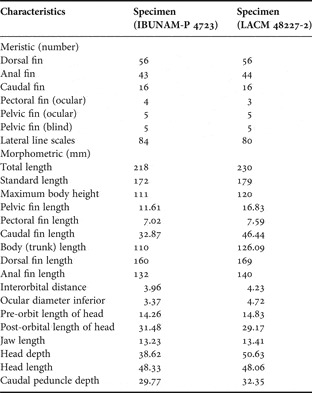
The first specimen of A. mazatlanus (CNPE-IBUNAM-4723) had a total length (TL) of 218 mm, with 84 scales in the lateral line. The second specimen (LACM 48227-8), with a length of 230 mm TL, with 80 scales in the lateral line, was collected near Rio Muerto, Sonora, Mexico.
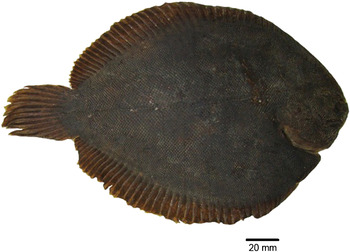
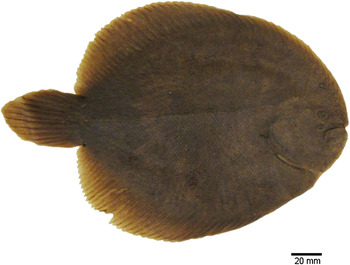
The length of the Manzanillo Bay specimen is 12 mm longer than previously reported and has seven additional scales in the lateral line (Meek & Hildebrand, Reference Meek and Hildebrand1928; Castro-Aguirre et al., Reference Castro-Aguirre, Espinosa Pérez and Schmitter-Soto1999: Figure 1 & Table 1). The Sonora specimen is 24 mm longer than previously reported (Figure 2 & Table 1).
Specimen of Pacific Lined Sole Achirus mazatlanus (IBUNAM-P 4723), Bay of Manzanillo, Colima, México.

Specimen of Pacific Lined Sole Achirus mazatlanus (LACM-48227-2), Sonora, México.

Meristics and morphometrics of Pacific Lined Sole Achirus mazatlanus.

DISCUSSION
Krupp (Reference Krupp, Fischer, Krupp, Schneider, Sommer, Carpenter and Niem1995), De la Cruz Agüero (Reference De la Cruz Agüero, Arellano Martínez, Cota Gómez and De La Cruz Agüero1997) and Amezcua-Linares (Reference Amezcua-Linares2009) reported a maximum size for A. mazatlanus of 200 mm (TL). However, Nieto-Navarro et al. (Reference Nieto-Navarro, Zetina-Rejón, Arreguín-Sánchez, Arcos-Huitrón and Peña-Messina2010) reported a maximum size of 206 mm (TL) along the south coast of the Gulf of California. The maximum sizes of A. mazatlanus are variable at different points of its distribution: 141 mm (standard length (SL)) at the Conchalito estuary, La Paz, Baja California Sur (González-Acosta et al., Reference González-Acosta, De La Cruz-Agüero and De La Cruz-Agüero2004), 80 mm (TL) in Peru (Chirichigno & Vélez, Reference Chirichigno and Vélez1998) and 70 mm (SL) in Panama (Meek & Hildebrand, Reference Meek and Hildebrand1928).
Other species of Achirus are usually medium-sized; Achirus lineatus has a maximum total length of 230 mm (Oliveira & Fávaro, Reference Oliveira and Fávaro2010) and Achirus klunzingeri a maximum total length of 300 mm (Krupp, Reference Krupp, Fischer, Krupp, Schneider, Sommer, Carpenter and Niem1995).
ACKNOWLEDGEMENTS
We thank Dr Margaret Neighbors and M.C. Fernando Del Moral for their corrections and suggestions. Thanks to CONACYT, CICIMAR-IPN, CNPE-IBUNAM and LACM for support.