I. INTRODUCTION
Bulk metallic glasses (BMGs) are of interest as new type of advanced materials due to excellent mechanical properties such as high strength, toughness and hardness, and superior corrosion resistance attributed to their disordered structure and the absence of grain boundaries as well as conventional deformation mechanism acting in crystalline materials.Reference Inoue1 BMGs have been already applied, for example, as materials for sporting goods, space application, and electronic casings so far.Reference Johnson2 As one of the most competitive candidates of advanced engineering materials, they are also expected to be more widely used in engineering applications, chemical storage and transportation systems, and military industry. However, their inherently limited plasticity and often unpredictable fracture at room temperature due to strongly inhomogeneous localized deformation accompanied by strain softening and unstable shear banding events are the biggest obstacles for potential applications as advanced structural materials for BMGs.Reference Ashby and Greer3, Reference Schuh and Lund4 Therefore, the challenge of how to stabilize and manipulate the inhomogeneous plastic flow is one of the important issues to overcome the room temperature brittleness of BMGs.
Second phases have been widely used in traditional crystalline alloys to optimize mechanical properties with a balance of strength, ductility, hardness, and fatigue resistance.Reference Decker5 The influence of second phases with difference size scale from the nanometer to the micrometer range on the mechanical properties has been discussed intensively.Reference Cahn and Haasen6 Normally, the introduction of second phases will tradeoff ductility for strength in crystalline alloys and alloy property optimization can be achieved through controlling the grain size and the morphology of the second phase particles/precipitates as well as by attempting to optimize dislocation-based deformation mechanisms and dislocation network structures.Reference Decker5, Reference Cahn and Haasen6 On the other hand, the influences of brittle or ductile micrometer-scale second phases (i.e., ex situ SiC and Ta particles and in situ Zr solid solution and CuZr intermetallic phases with particle size above 5 μm) on the mechanical properties of BMGs have been studied.Reference Choi-Yim, Busch, Köster and Johnson7–Reference Pauly, Gorantla, Wang, Kühn and Eckert10 The proper match of size ratio, volume fraction, and elastic constants between the second phases and glassy matrices can result in considerable improvement of plasticity (ductility) because of the formation of multiple shear bands and restriction of crack propagation.Reference Hays, Kim and Johnson11–Reference Park, Kim, Kim, Fleury, Lee, Kim and Eckert13 For BMGs, shear displacement of concentrated shear bands due to adiabatic effects is responsible for plastic deformation in contrast to dislocation generation and movement in crystalline materials.Reference Argon14 The possible thickness of the shear bands has been reported to be ∼100 nm based on the scale of the bead pattern associated with the melting of tin due to the temperature rise within shear bands during deformation of tin-coated BMG samples.Reference Lewandowski and Greer15 More recently, the width of individual shear bands has been regarded as 10–20 nm according to direct experimental observation by transmission electron microscopy (TEM)Reference Guo, Yan, Wang, Tan, Zhang, Sui and Ma16–Reference Chen, Ohkubo, Mukai and Hono18 and numerical simulations.Reference Shi and Falk19–Reference Matsumoto and Miyazaki21 Although the actual size of a shear band is still a matter of debate and may also be material dependent,Reference Lewandowski and Greer15–Reference Matsumoto and Miyazaki21 it is worth to note that the micrometer-scale size of second phases in glassy matrices is in any case far larger than the nanometer-scale thickness of the shear bands. Considering the strong influence of the precipitate size near to nanometer scale on the strength in crystalline alloys,Reference Cahn and Haasen6 it should be interesting to focus on the size effect of second phases on the plasticity of BMG composites. However, very little attention has been paid to this topic so far.
For the present work, a generally brittle FeB-based BMG system was chosen.Reference Park, Wang, Li, Mattern, Eckert and Kim22 Minor alloying was adopted to introduce Cu into the Fe71Nb6B23 glass-forming alloy with a systematic concentration variation of 0.25, 0.5, 0.75, and 1 at.% so as to produce glass matrix composites with nanometer-scale size-tunable precipitates.Reference Makino, Li, Yubuta, Chang, Kubota and Inoue23, Reference Park, Kim, Kim and Eckert24 The influence of the precipitate size on the mechanical properties was evaluated under compressive testing conditions. Furthermore, the fracture mechanism controlled by the precipitate size in the BMG composites is clarified.
II. EXPERIMENTAL
Alloy ingots (20 g) with nominal composition (Fe71Nb6B23)100−xCux (x = 0, 0.25, 0.5, 0.75, and 1) were prepared by arc melting of high purity elements (99.99 wt%) under an argon atmosphere followed by direct casting into cylindrical rods with 1-mm diameter and 30-mm length using a suction casting facility. High-resolution transmission electron microscopy (HRTEM) (JEM 2010F; JEOL, Tokyo, Japan) and x-ray diffraction (XRD) (Rigaku CN2301; Rigaku, Tokyo, Japan) using monochromatic Cu Kα radiation were performed for structural characterization. Thin foils for TEM investigation were prepared by using a conventional ion milling system (PIPS: Precision Ion Polishing System, Gatan model 691; Gatan, Vienna, OH). To evaluate the mechanical properties under compression, cylindrical specimens with a 2:1 aspect ratio were prepared and tested under quasistatic loading with an initial strain rate of 1 × 10⁻³ s−1 at room temperature using an Instron-type multitester (Hounsfield H25KT; Hounsfield Test Equipment, Salfords, UK). The lateral and fracture surface morphologies of failed samples were investigated by scanning electron microscopy (SEM; JEOL JSM-6390, JEOL, Tokyo, Japan).
III. RESULTS AND DISCUSSION
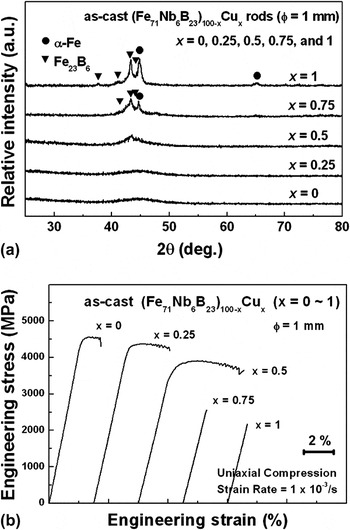
Figure 1 shows (a) XRD patterns and (b) room temperature compressive stress–strain curves for the as-cast (Fe71Nb6B23)100−xCux alloys with x = 0, 0.25, 0.5, 0.75, and 1, respectively. The XRD patterns [Fig. 1(a)] of the x = 0 and 0.25 alloys display only broad diffraction maxima in the 2θ range of 40–50°, as it is characteristic for an amorphous structure. However, in case of 0.5, 0.75, and 1 at.%Cu addition, the XRD patterns show several diffraction peaks appearing on top of the broad halo pattern indicating the precipitation of crystalline phases in the glassy matrix. The diffraction peaks were identified as metastable Fe23B6 and α-Fe phases. Figure 1(b) shows the room temperature compressive mechanical properties of the as-cast samples, and the corresponding mechanical properties are summarized in Table I. With increasing Cu addition, the yield strength continuously decreases from 4511 MPa for x = 0 to 2211 MPa for x = 1. The compressive plasticity increases with increasing Cu content (0.25 and 0.5 at.%) and reaches a maximum of 4.3 ± 0.8% at x = 0.5, followed by a drastic reduction with further addition of Cu (ε f = 0% for 0.75 and 1 at.%). The (Fe71Nb6B23)99Cu1 alloy exhibits premature failure with out plastic deformation. The structural and mechanical analyses reveal that BMG in situ composites were successfully formed by minor addition of Cu and their mechanical properties strongly depend on the actual amount of Cu addition.
(a) X-ray diffraction patterns and (b) room temperature compressive stress–strain curves obtained for the as-cast (Fe71Nb6B23)100−xCux (x = 0, 0.25, 0.5, 0.75, and 1) alloys.

Mechanical properties of the as-cast (Fe71Nb6B23)100−xCux alloys with x = 0, 0.25, 0.5, 0.75, and 1: Size and volume fraction of precipitates, yield stress σ y, yield strain ε y, ultimate compressive stress σ max, and plastic strain ε p.

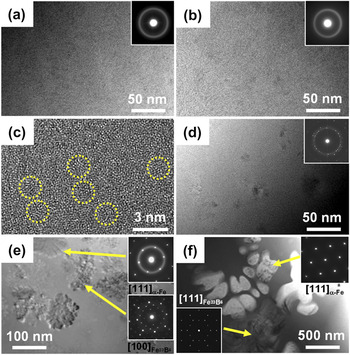
To get a better insight into the microstructural evolution and to understand the mechanical properties achieved by microalloying of Cu, further TEM investigations were performed. Figure 2 shows bright-field (BF), HRTEM images and selected area electron diffraction (SAED) patterns obtained from the as-cast (Fe71Nb6B23)100−xCux samples with x = 0, 0.25, 0.5, 0.75, and 1, respectively. In the case of the Cu-free alloy [Fig. 2(a)], the BF TEM image exhibits uniform contrast without any crystalline fringes and the inset SAED pattern only presents diffuse diffraction intensity as it is typical for an amorphous phase. For x = 0.25, there is a homogeneous contrast in the BF image [Fig. 2(b)] while the HRTEM image reveals the existence of locally ordered clusters in the amorphous matrix. As marked by dashed circles in Fig. 2(c), the size of the lattice fringes is in the range of 1–2 nm indicating the presence of atomic-scale medium range ordering (MRO). With further increase of the Cu content to 0.5 at.% [see Fig. 2(d)], 10–20-nm-sized nanocrystalline particles are formed that are homogeneously dispersed in a glassy matrix. Although the SAED patterns show spotty rings, it was difficult to identify the structure of the crystalline phases due to their small size. Figure 2(e) clearly exhibits in situ formed precipitates with a size of about ∼250 ± 100 nm that are randomly distributed throughout the glassy matrix (Cu = 0.75 at.%). The inset SAED patterns allow to identify the phases as a mixture of amorphous, Fe23B6 and α-Fe phases. When the Cu content reaches 1 at.% [Fig. 2(f)], micrometer-sized crystalline phases composed of metastable Fe23B6 and α-Fe are precipitated in the glassy matrix. The inset SAED patterns in Fig. 2(f) correspond to the [111] zone of the back-centered cubic structure of the α-Fe solid solution and the [111] zone of the face-centered cubic structure of the Fe23B6 phase, respectively. Thus, control of the Cu content allows to effectively tailor the size of the precipitates. At the same time, the volume fraction of the crystalline phases is roughly estimated on the basis of the difference in the released enthalpy in differential scanning calorimetry curves between the Cu-free and the Cu-containing alloys (not shown here), giving volume fractions of about 8 vol% for x = 0.5, 17 vol% for x = 0.75, and 32 vol% for x = 1, respectively. This clearly shows that heterogeneous glass matrix composites with tunable different size and volume fraction of crystalline phases can be obtained by the minor addition of Cu.
Bright-field (BF), high-resolution transmission electron microscopy (HRTEM) images and selected area electron diffraction (SAED) patterns for the as-cast (Fe71Nb6B23)100−xCux alloys; (a, b) and (d)–(f) BF images for x = 0, 0.25, 0.5, 0.75, and (c) HRTEM image for x = 0.25, respectively. The insets show the SAED patterns for each BF image.

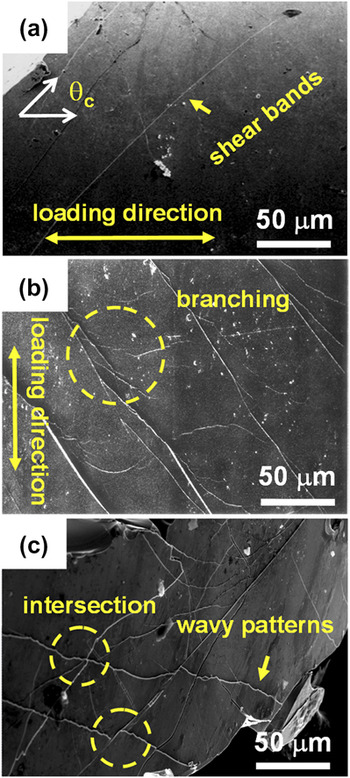
To investigate the effect of crystalline particle size on the plastic deformation behavior, monolithic BMG (x = 0) and in situ BMG composites (x = 0.25, 0.5, and 0.75) with different degree of plastic deformability were selected and careful observation of deformed samples was performed by SEM. Figure 3 illustrates the lateral surface morphologies of deformed samples for x = 0, 0.25, and 0.5. The fracture of all samples exhibits a characteristic shear failure at an angle inclined to the compression axis, i.e.,  = 46° for x = 0, 48° for x = 0.25, and 51° for x = 0.5 (not shown here), and they failed via localized plastic shear flow.Reference Argon14 This reveals that the shear fracture features disobey the Mohr–Coulomb criterion due to the rotation of shear fracture plane.Reference Zhang, He, Zhang and Eckert25 Furthermore, the lateral surface morphologies of each sample are noticeably different, as shown in Fig. 3. The monolithic BMG (Cu-free alloy; Fe71Nb6B23) exhibits a very limited number of shear bands on the lateral surface of a deformed sample [Fig. 3(a)], while the shear band features of the in situ BMG composites strongly depend on the size of the precipitated particles and on their volume fraction. For x = 0.25, primary shear bands with an inter-shear band distance of 50 ± 20 μm are generated parallel to the fracture plane, and irregular-shaped secondary shear bands develop by branching, as can be inferred from Fig. 3(b). In case of x = 0.5, abundant shear bands, protrusive shear steps (shear offset), and ledges related to a rather uniform plastic deformation are observed on the lateral surface of a failed sample [see Fig. 3(c)]. Most of the shear bands are extensively distributed and their movement is rather wavy in nature, as well as intersection between major shear bands can be clearly observed, as indicated by the circled regions in Fig. 3(c). Apparently, with the increased amount of shear band intersection and increasing shear offset, plastic deformation occurs more homogeneously and an enhanced macroscopic plasticity is achieved. When the Cu addition reaches up to 0.75 at.%, excessive compositional separation is induced and plastic instability becomes dominant, resulting in increased brittleness. Actually, the x = 0.75 alloy fractures by exploding into many very small pieces without macroscopic plasticity (not shown here). These findings reveal that the observed macroscopic plastic deformation of the glass matrix composites is linked to a shear banding mechanism and is strongly correlated with the density and the mobility of the shear bands.
Scanning electron micrographs of failed (Fe71Nb6B23)100−xCux rod samples; lateral surface morphologies of (a) x = 0, (b) x = 0.25, and (c) x = 0.5 rods, respectively.

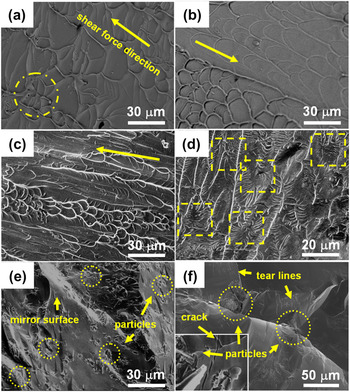
Figure 4 displays SEM images of the fracture surface obtained from failed (Fe71Nb6B23)100−xCux samples with x = 0, 0.25, 0.5, 0.75, and 1, respectively. Figures 4(a) and 4(b) present the typical vein patterns associated with the sudden drop in viscosity inside shear bands in which the temperature is close to approach T g just before fracture (x = 0 and 0.25).Reference Lewandowski and Greer15 Liquid droplets form and are highlighted by the dashed circle. With increase of the Cu content to 0.5 at.% [Figs. 4(c) and 4(d)], rough fracture surface morphologies with a rather uniform arrangement including veins with relatively fine length scale, ledge lines, and cores (marked by dashed boxes) which are produced under a certain normal stress condition are observed. In this case, the eventual failure occurs under a cooperative combined condition of normal and shear stresses due to the existence of nanocrystalline phases embedded in the glassy matrix. In contrast, when the Cu content reaches to 0.75 and 1 at.%, the fracture surface morphologies [Figs. 4(e) and 4(f)] consist of mirror-like surface region and tear lines indicating that the fracture occurs by a brittle fracture mechanism similar to typical brittle fracture behavior in Fe-, Mg- or Ca-based BMGs.Reference Xi, Zhao, Pan, Wang and Lewandowski26 Due to the strong tendency for fragmentation fracture, numerous crack networks form at the early stage of deformation and the sample disintegrates into several fragments.
Fracture surface morphologies of failed (Fe71Nb6B23)100−xCux rod samples; (a) x = 0, (b) x = 0.25, (c) and (d) x = 0.5, (e) x = 0.75, and (f) x = 1 rods, respectively.

It is well known that BMGs exhibit highly inhomogeneous deformation below the glass transition temperature, T g. The plastic deformation of BMGs is associated with the formation of localized narrow shear bands.Reference Spaepen27 Accordingly, the amount of plastic deformation apparently depends on the total number of shear bands. To obtain a high amount of plasticity, it is necessary to introduce multiple shear bands and to arrest their rapid propagation. As a way to improve the plasticity, it is vital to fabricate BMG matrix composites. The early efforts to obtain BMG matrix composites have been focused on annealing or deformation of monolithic BMGs.Reference Leonhard, Xing, Heilmaier, Gebert, Eckert and Schultz28–Reference Hajlaoui, Yavari, Doisneau, LeMoulec, Botta, Vaughan, Greer, Inoue, Zhang and Kvick33 Through partial crystallization or deformation-induced crystallization of BMGs, nanocrystalline inclusions were successfully introduced into the glassy matrix and plasticity improvement has been achieved.Reference Park, Park, Kim and Chang29–Reference Das, Tang, Kim, Theissmann, Baier, Wang and Eckert32 Although there are some contradicting reports as to whether precipitation of nanocrystals improves or deteriorates plasticity, it is believed that nanocrystallites play a critical role for the macroscopic mechanical response of BMGs. More recently, in situ ductile dendrite-reinforced BMG matrix composites have been developed through solidification.Reference Hofmann, Suh, Wiest, Duan, Lind, Demetrious and Johnson9, Reference Hays, Kim and Johnson11–Reference Park, Kim, Kim, Fleury, Lee, Kim and Eckert13, Reference Lee, Li and Schuh34, Reference Park, Jayaraj, Kim, Mattern, Wang and Eckert35 However, along with partial devitrification and ductile phase formation, some weaknesses unavoidably appear such as the need for careful and complex processing techniques and most often a drastic drop in yield strength, especially when larger volume fraction of ductile precipitate is present.Reference Hofmann, Suh, Wiest, Duan, Lind, Demetrious and Johnson9, Reference Lee, Li and Schuh34
Therefore, in the present study, we investigated the effect of in situ nanocrystalline phase precipitation in a glassy matrix by appropriate addition of an element (Cu) which is immiscible with the main constituent element (Fe) in the Fe-based bulk glass-forming alloy (Fe71Nb6B23) to obtain controllable shear bands and finally to improve the plasticity. The results outlined above reveal that a changeable room temperature plasticity can be achieved by microalloying of Cu in a series of (Fe71Nb6B23)100−xCux (x = 0, 0.25, 0.5, 0.75, and 1) glass matrix alloys with tunable size and volume fraction of precipitates. Depending on the Cu content, microstructural heterogeneities such as MRO clustering (Cu = 0.25 at.%), nanometer-size (Cu = 0.5 and 0.75 at.%) or micrometer-size (Cu = 1 at.%) crystalline phases are introduced into the glassy matrix and manipulate the mechanical properties. When considered the relative level of mechanical response of monolithic BMG and other BMG composites,Reference Johnson2, Reference Hofmann, Suh, Wiest, Duan, Lind, Demetrious and Johnson9, Reference Pauly, Gorantla, Wang, Kühn and Eckert10, Reference Leonhard, Xing, Heilmaier, Gebert, Eckert and Schultz28, Reference Lee, Li and Schuh34 the present in situ BMG composites with subnano-scale (MRO) and nano-scale heterogeneities (nanocrystalline particles) deform plastically and exhibit distinctly enhanced plastic strain, whereas the micrometer-scale crystalline phases embedded in the BMG composites exhibit catastrophic failure in a clearly brittle fashion [see Figs. 1(b), 2(c) and 2(d)].
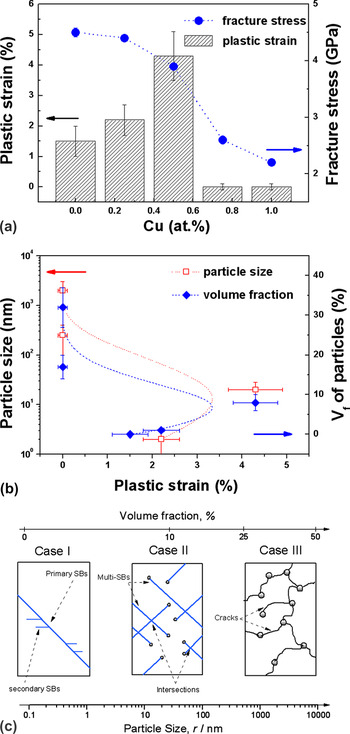
Figures 5(a) and 5(b) illustrate the effect of Cu addition on the compressive mechanical properties including the fracture stress and plastic strain and the relationship between the characteristics of particles and the plastic strain, respectively. For x = 0.5, optimized mechanical properties with high fracture strength (3.9 GPa) and large plasticity (4.3%) are obtained. At the same time, as described in Fig. 5(b), it is obvious that the characteristics of the precipitated particles have a significant influence on the plasticity. The MRO clusters and nanometer-size crystalline phase act as initiation (nucleation) sites for shear bands and barriers (hindering and deflecting) for their propagation, and thus the compressive plasticity continuously increases by multiplication of shear bands (see Fig. 3). Furthermore, there exists an apparent size effect of the microstructural heterogeneities on the plastic deformability and fracture behavior, as shown in Figs. 2 and 4. Figure 5(c) shows schematic illustrations for how the shear bands interact with the in situ formed precipitates in BMG and a correlation between particle size and shear band density/propagation behavior. For Cu-free BMG, one dominant shear band forms and propagates when the plastic deformation of the BMG sample takes place (Case I). In this case, the shear stress is relieved through the propagation of one dominant shear band. On the other hand, in the range of particles with a few nanometers in size (Case II), the shear deformation can be blocked when a shear band meets an in situ formed particle. Since the dominant shear bands are constrained, additional shear bands can be introduced and the propagation of shear bands is detoured to accommodate the macroscopic deformation. Stress concentration around the particles occurs when the macroscopic deformation becomes larger and larger. Finally, the particle will fracture due to the stress concentration. Then, the shear band will propagate easily and grows into a crack. Accordingly, multiple shear bands are formed and the overall plasticity can be improved concurrently. However, when the size of the particles is increased from a few to several hundred micrometers (Case III), these particles play a different role in the plastic deformation. The propagation behavior of the shear bands becomes very irregular. It seems that cracks initiate near the particles, leading to fracture of particles. Then, the crack propagates easily because of the stress concentration around the particle. Thus, large particles cannot retard the propagation of shear bands. In contrast, small particles with a size comparable to the shear bandwidth can have some effect on the shear band propagation. From Fig. 4(f), it is clear that cleavage fracture occurs in a large particle. Therefore, the mechanical properties, especially, the plasticity can be tailored and optimized via tuning the size and the volume fraction of precipitates.
Relationship between (a) mechanical properties and Cu content, (b) characteristics of precipitates and plastic strain, and (c) structural heterogeneities and fracture mechanism for Fe–Nb–B–Cu glass matrix alloys.

Altogether, this study reveals that, referring to the relationship between microstructural features and mechanical response, the size and the volume fraction of heterogeneities play a crucial role on the overall deformation and fracture behavior of in situ BMG composites. Only when the length scale and the volume fraction of heterogeneities are properly controlled (≤20 nm and ≤10%), large plasticity was achieved. This indicates that mechanical properties and deformation behavior are strongly related to the critical length scale and volume fraction of the microstructural heterogeneity, i.e., minor addition of Cu into a Fe-based glassy alloy causes atomistic-scale phase separation or nano-scale crystallization, leading to an enhanced plasticity by a combined effect of suppression and dispersion of shear bands.
IV. SUMMARY
Minor addition of Cu in Fe71Nb6B23 BMG yields enhanced compressive plasticity and ductile deformation behavior due to the formation of nanometer-sized microstructural heterogeneities. When the Cu content is properly controlled (≤0.5 at.%), (Fe71Nb6B23)99.5Cu0.5 alloy exhibits a maximum plastic strain of 4.3% and a high fracture strength of 3.9 GPa. In contrast, when the Cu content further increases to 0.75 at.%, the mechanical properties are drastically deteriorated due to the precipitation of a network of brittle microcrystalline phases. The microalloying of an element (Cu) having a positive enthalpy of mixing with the constituent elements (Fe–Cu: 13 kJ/mol, Cu–Nb = 3 kJ/mol, and Cu–B = 15 kJ/mol) in bulk glassy alloys can introduce nanometer-scale heterogeneity such as MRO clustering or nanocrystallization in the glassy matrix, leading to enhancement of the compressive plasticity. The microstructural heterogeneity can favorably stabilize the shear localization and minimize the deformation instability, which is ascribed to promoting multiple shear banding and hindering the rapid propagation of shear bands. The mechanical properties and the fracture behavior are strongly correlated with the critical length scale of the heterogeneity.
ACKNOWLEDGMENTS
This work was supported by the Defense Acquisition Program Administration and the Agency for Defense Development, the Global Research Laboratory Program of the Korea Ministry of Science and Technology, and the Center for Advanced Materials Processing of the 21st Century Frontier R&D Program of the Korea Ministry of Knowledge Economy. Stimulating discussions with E. Fleury, J.H. Han, K.B. Kim, S. Pauly, S. Scudino, U. Kühn, and W.T. Kim are gratefully acknowledged.