Introduction
Habitat fragmentation drives changes in landscape functioning, biota composition and interactions among species (Filgueiras et al. Reference Filgueiras, Melo, Andersen, Tabarelli and Leal2019). In South America, increases in the abundance of leaf-cutting ants (LCA) have been reported in forest fragments, being attributed to increases in resource availability and smaller predation pressure (Almeida et al. Reference Almeida, Wirth and Leal2008, Rao Reference Rao2000, Rao et al. Reference Rao, Terborgh and Nunez2001, Terborgh et al. Reference Terborgh, Lopez, Nuñez, Rao, Shahabuddin, Orihuela, Riveros, Ascanio, Adler, Lambert and Balbas2001). However, there is an overall lack of long-term monitoring data and few studies dealing with the drivers of LCA abundance.
LCA are species from Atta Fabricius (1804) and Acromyrmex Mayr (1865) genus (Hymenoptera, Formicidae, Myrmicinae, tribe Attini), known as saúvas and quenquéns, respectively. In their nests, they cultivate, on fresh vegetal material, a ‘garden’ of fungi from which they feed (Leal et al. Reference Leal, Wirth and Tabarelli2014). These are herbivores abundant in the Neotropical region and considered as generalists, for being capable of gathering around 50% of the plant species (Wirth et al. Reference Wirth, Beyschlag, Herz, Ryel and Hölldobler2003) and up to 20% of the vegetation in their foraging zones (Urbas et al. Reference Urbas, Araújo, Leal and Wirth2007). Their dispersion occurs through the nuptial flight when, after copulating, females search for places to establish new nests, which they found alone. Predation by insectivores is more efficient as population control if these females are captured in flight or right after it, when their nests are still incipient (Helms et al. Reference Helms, Godfrey, Ames and Bridge2016, Vieira-Neto & Vasconcelos Reference Vieira-Neto and Vasconcelos2010).
In forest landscapes subjected to fragmentation and converted to agriculture, there may be an increase in the density of fast-growing plants in the fragments, which are part of an impoverishment process called ‘secondarization’ (Joly et al. Reference Joly, Metzger and Tabarelli2014). These plants, together with many agricultural crops such as soybean, have been described as favourite resources for LCA (Rao et al. Reference Rao, Terborgh and Nunez2001, Urbas et al. Reference Urbas, Araújo, Leal and Wirth2007), contributing to higher nest density and herbivory rate and smaller foraging areas in forest fragments (Rao et al. Reference Rao, Terborgh and Nunez2001, Urbas et al. Reference Urbas, Araújo, Leal and Wirth2007) and other landscape elements, such as forest plantations (Zanetti et al. Reference Zanetti, Zanuncio, Santos, Silva, Ribeiro and Lemes2014).
Besides the known damages in agriculture, silviculture and fragmented habitats, LCA have been described as important factors in ecological restoration sites (Ferreira Reference Ferreira2015, Garcia et al. Reference Garcia, Bordignon, Gonzaga and Torezan2020, Massad Reference Massad2012, Massad et al. Reference Massad, Chambers, Rolim, Jesus and Dyer2011, Montagnini et al. Reference Montagnini, Gonzalez, Porras and Rheingans1995). In reforestations with native species, these ants may increase costs during the implantation phase (Montagnini et al. Reference Montagnini, Gonzalez, Porras and Rheingans1995). Moreover, high abundance of LCA is still recorded in subsequent phases (Garcia et al. Reference Garcia, Bordignon, Gonzaga and Torezan2020, Massad Reference Massad2012, Massad et al. Reference Massad, Chambers, Rolim, Jesus and Dyer2011, Montagnini et al. Reference Montagnini, Gonzalez, Porras and Rheingans1995). LCA herbivory can negatively influence plants in all life cycle stages, from establishment to reproduction (Leal et al. Reference Leal, Wirth and Tabarelli2014), changing the diversity and composition of plant species (Wirth et al. Reference Wirth, Beyschlag, Herz, Ryel and Hölldobler2003), then the successional trajectory and acting as an ecological filter, as suggested by Costa et al. (Reference Costa, Vasconcelos and Bruna2016) in forest fragments. Ferreira (Reference Ferreira2015) and Garcia et al. (Reference Garcia, Bordignon, Gonzaga and Torezan2020) suggested that the herbivory rate of Atta sexdens (Linnaeus, 1758) in restoration sites varies among plant species, affecting the survival and development of some species, making LCA an important ecological filter.
In restoration sites, often dominated by pioneer species, and particularly in those situated amidst agricultural landscapes, there is an increased availability of food, which points to a release in the bottom-up control (Garcia et al. Reference Garcia, Bordignon, Gonzaga and Torezan2020). Still, the top-down control, exerted mainly by insectivores and parasites, may also have been relaxed in isolated restoration sites. Many groups of organisms that affect ants have their populations decreased in fragmented habitats, including mammals (Rao Reference Rao2000), insectivore birds (Anjos et al. Reference Anjos, Bochio, Medeiros, Almeida, Lindsey, Calsavara, Ribeiro and Torezan2019) and parasite insects (Almeida et al. Reference Almeida, Wirth and Leal2008, Barrera et al. Reference Barrera, Becker, Elizalde and Queiroz2017). This reduction in abundance may occur through habitat loss (Barrera et al. Reference Barrera, Becker, Elizalde and Queiroz2017, Terborgh et al. Reference Terborgh, Lopez, Nuñez, Rao, Shahabuddin, Orihuela, Riveros, Ascanio, Adler, Lambert and Balbas2001), due to the influence of edge effects (Almeida et al. Reference Almeida, Wirth and Leal2008) or less permeable matrices (Anjos et al. Reference Anjos, Bochio, Medeiros, Almeida, Lindsey, Calsavara, Ribeiro and Torezan2019).
We postulate that both the position amidst palatable crops all year and the high proportion of native pioneer tree species in the restoration sites leads to a relaxation of bottom-up control, making nest density depend mostly on top-down control. Thus, we seek to test the prediction that restoration sites closer to Atlantic Forest remnants or with higher habitat cover in their surroundings have lower LCA nest density, in response to higher abundance of insectivores and parasites.
Methods
Study site
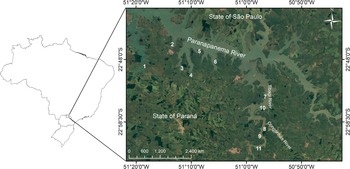
Eleven restoration sites (reforestations with native species) were selected, located at the margins of the Capivara reservoir, on the Paranapanema river, between the states of Parana and São Paulo (Figure 1; Supplementary Material 1). These sites are included in the long-term ecological research site ‘Mata Atlântica do Norte do Paraná’ (PELD MANP), established since 2014. This site is composed by a set of Atlantic Forest fragments and restoration sites scattered in an agricultural landscape in north of Parana state, southern Brazil.
Location of study sites in Brazil, Paraná state, at the Capivara hydroelectric power plant reservoir (light green), in the Paranapanema river. The white numbers (same numbers used in Table 1) indicate the sampled restoration sites (reforestations with native species ageing 9-12 years). Dark green patches are Atlantic Forest fragments.

According to Nitsche et al. (Reference Nitsche, Caramori, Ricce and Pinto2019), region climate is Köppen’s Cfa, with annual average temperature between 22ºC and 23ºC, winter temperature below 18ºC and summer temperature above 22ºC. Summers are hot, frosts are rare, and rain is concentrated in summer season, but with no marked dry season. Average annual rainfall ranges from 1,400 to 1,600 mm, and potential evapotranspiration is greater than 1,200 mm (Nitsche et al. Reference Nitsche, Caramori, Ricce and Pinto2019). Soils are Eutroferric Red Nitosols and Latosols, of great natural fertility. Original vegetation was a seasonal form of Atlantic Forest, now reduced to forest fragments totalling less than 3% in the studied area (Pereira et al. Reference Pereira, Oliveira and Torezan2013), with a high level of fragmentation. The current landscape is dominated by monocultures of soybeans (planted and harvested in summer) and corn (with both summer and winter cultivars). In exception for the restoration project (see below), land use and cover have been the same for the last 30 years, showing a high level of land occupancy by agriculture, with almost no spare lands.
Selected restoration sites are in the Capivara hydroelectric power plant reservoir buffer strips, which are of mandatory preservation. Restoration activities were carried out by the power plant company, with aid of a municipality consortium and university staff. All restoration sites are reforestations with about 45 native tree species, with a high proportion of pioneer tree species (usually > 50%, see Supplementary Material 2), and were of similar ages (9–12 years) when sampling was carried out (see Supplementary Material 3). Given the landscape structure, all sites are close to agricultural sites but are situated at different distances from Atlantic Forest remnants.
Seedlings were planted with 2 × 3 m spacing. Before planting the seedlings, the land was ploughed; mechanized mowing and chemical control of LCA (using fipronil ant killer baits) were held for two years after planting; other pesticides were not used. No fertilizers were applied.
Density of LCA nests
The density of LCA nests was estimated at each restoration site by two 250 m length and 40 m wide transects (1 ha per transect, 2 ha of sampling area per restoration site). Transects were placed at least 10 m from the site edge and at least 50 m from the other transect in the same site. The transect method was adapted from that described by Jaffe and Vilela (Reference Jaffe and Vilela1989) and Wirth et al. (Reference Wirth, Beyschlag, Herz, Ryel and Hölldobler2003) and was sampled in June and July 2014. In each transect, the nests were located and georeferenced with GPS. The nests were classified as active (living) or inactive (dead), and the active nests were further classified into juvenile/adult and new nests. Those whose mound of soil had up to 2 m2 and did not have the defence caste (soldiers) (Autuori Reference Autuori1941) were considered as new colonies, and the rest were considered juvenile/adult colonies. New nests are vulnerable to several biotic (e.g. control by microorganisms) and abiotic factors (e.g. heavy and abundant rainfall and soil attributes) that cause high mortality of colonies (Meyer et al. Reference Meyer, Leal and Wirth2009, Vieira-Neto & Vasconcelos Reference Vieira-Neto and Vasconcelos2010). Therefore, only established colonies (juvenile/adult) were included in the analysis, as is commonly done when studying colonies of LCA (Meyer et al. Reference Meyer, Leal and Wirth2009, Wirth et al. Reference Wirth, Beyschlag, Herz, Ryel and Hölldobler2003).
Ten workers, preferably soldiers, were collected from each active nest sampled in the transects for species identification. All the collected materials were packaged in properly labelled bottle and filled with 70% alcohol. Ant samples were identified with the help of specialists and belong to the species A. sexdens.
All elements of the analysed landscapes (forest fragments, rural residences, rural roads, restoration sites themselves) are possible sources of post-flight queens for the foundation of new nests in the restoration sites. As the restoration sites are between 9 and 12 years old, the adult nests themselves contained in them serve as a source for new nests.
Characterization of the surrounding landscape
A polygon around the two transects was drawn for the estimation of surrounding landscape metrics. The distance from the polygon border to the nearest forest fragment with at least one hectare was estimated as a straight line (D), simulating the trajectory of natural enemies (such as birds and parasitoids) crossing the matrix (Pereira et al. Reference Pereira, Oliveira and Torezan2013; see Supplementary Material 4). The distance to the nearest fragment was also calculated using a pathway through native vegetation corridors (DV); for this purpose, we considered as native vegetation any forest vegetation, including forest remnants, secondary succession and restoration sites (Pereira et al. Reference Pereira, Oliveira and Torezan2013), aiming to simulate the trajectory of natural enemies that avoid plantations and aquatic environments, such as armadillos or lizards (see Supplementary Material 4).
The surrounding forest habitat area (V) was estimated by the proportion of the landscape occupied by forest fragments, and the proximity index (PI) was estimated as the ratio between the total area of surrounding habitat inside a given search radius and the sum of the squared distances between the polygon containing the transects and the included forest patches (McGarigal & Marks Reference McGarigal and Marks1995). PI combines a measure of isolation (in the same way as D) and surrounding habitat area (in the same way as V). Restoration and early succession sites were not considered in V and PI calculations; only Atlantic Forest remnants (hereafter, forest fragments) were considered. Because ant natural enemies include heterogeneous groups, the V and PI were estimated for each polygon using 500 and 1,000 m search radii. The 500 m measure represents a local landscape scale; 1,000 m was the highest distance with no sample overlap.
Forest area and distances for V and PI estimations were calculated using a thematic map based on 10 m resolution orbital images (bands 2, 3, 4 and 8 of the Multispectral Sensor Instrument, Sentinel-2 satellite), from 19 to 29 November 2019. The free software QGIS 3.12.0 was used to process the images. The variables D and Dv were estimated using ‘Google Earth Pro’ with aid of field observations, when necessary.
Data analysis
The size of the restoration sites was not included in the analysis. Restoration sites form almost continuous land strips along hydroelectric power plant reservoir margins, so site size is not ecologically meaningful. The width of restoration sites was analysed and does not show any significant correlation with other variables (Supplementary Material 5).
The landscape metrics, as expected, are highly correlated (Supplementary Material 5). Thus, in order to find the metric that most influence nest density (active, inactive and total), we performed stepwise forward regression, using the Akaike Information Criterion (AIC) as a tool for selection of the best model. In a second step, we performed simple linear regressions (Zar Reference Zar2010) to clarify the influence of selected landscape metric on nest density.
The homogeneity of the variances was verified by the Levene’s test and normality by the Shapiro-Wilk test. All variables were transformed using log (x + 1), because of the excess of zero values and also to meet the assumptions of data normality and variance homogeneity (Zar Reference Zar2010). All analyses were done in the program R version 3.5.3 (R Core Team 2019).
All analyses were performed in the vegan package (Oksanen et al. Reference Oksanen, Simpson, Blanchet, Kindt, Legendre, Minchin, O’Hara, Solymos, Stevens, Szoecs, Wagner, Barbour, Bedward, Bolker, Borcard, Carvalho, Chirico, De Caceres, Durand, Evangelista, FitzJohn, Friendly, Furneaux, Hannigan, Hill, Lahti, McGlinn, Ouellette, Ribeiro Cunha, Smith, Stier, Ter Braak and Weedon2022) in the program R version 3.5.3 (R Core Team 2019).
Results
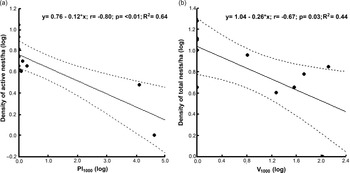
In the eleven restoration sites, we sampled 93 active nests, ranging from no nest to ten nests per hectare (Table 1). The density of active nests was negatively influenced by proximity of forest fragments (PI1000, Figure 2; see also Supplementary Material 6). The closer and larger the forest fragments are in the surrounding landscape, the lower the density of nests present in restoration sites.
Density of active (NA) and inactive (NI) nests of Atta sexdens, distance in a straight line (D) and through vegetation corridors (DV) between the restoration sites and the nearest forest fragment, proximity index (PI) and forest habitat area (V), for search radius of 500 and 1,000 m, in eleven restoration sites (reforestations with native species ageing 9–12 years) located at Capivara hydroelectric power plant reservoir margins, Parana state, Brazil

Relationship between landscape metrics and density of Atta sexdens active and total nest density (in number of nests per ha), recorded in restoration sites (reforestations with native species ageing 9–12 years) located at Capivara hydroelectric power plant reservoir margins, Parana state, Brazil. PI1000 – proximity index, and V1000 – proportion of the landscape occupied by forest fragments, estimated for 1,000 m neighbourhoods.

Inactive nests ranged from none to 13.5 nests per hectare (Table 1), and there was no relationship with the landscape metrics; thus, the null model showed the smallest AIC (-19.15; see Supplementary Material 7). However, total nest density (active + inactive) showed a negative relationship with the surrounding habitat area (V1000, Figure 2).
Discussion
Our results showed that restoration sites located further away from forest fragments and with less forest in their surroundings presented higher density of nests of the genus Atta. These results indicate a positive influence of both habitat loss and isolation on the population of LCA on restoration sites. This is possibly a result of negative effect of habitat loss and isolation on the dynamics of natural enemies of LCA such as anteaters, armadillos, lizards, insectivore or omnivore birds and other arthropods and parasitoids (Barrera et al. Reference Barrera, Becker, Elizalde and Queiroz2017, Camacho et al. Reference Camacho, Honorato, Fernandes, Boechat, Filho and Kanegae2012, Terborgh et al. Reference Terborgh, Lopez, Nuñez, Rao, Shahabuddin, Orihuela, Riveros, Ascanio, Adler, Lambert and Balbas2001), once that, for all sampled sites, resource availability for ants (palatable plants in crop fields and restoration sites) is uniformly high. Thus, an increase in isolation or a lower quantity of forest habitat in the surrounding landscape may contribute to relax the top-down control.
Data were sampled in restoration sites containing high abundance of pioneer species (see Supplementary Material 2) and surrounded by an agricultural matrix. As both native pioneer species and cultivated plants have less structural and chemical quantitative defences and higher nutritional value than non-pioneer species (Massad Reference Massad2012), restoration sites offer more resources to the LCA. This, in association with the proximity to agricultural crops, which are palatable to the LCA, results in high quantity and quality of available resources for foraging and thus represents a relaxation of the bottom-up control (Terborgh et al. Reference Terborgh, Lopez, Nuñez, Rao, Shahabuddin, Orihuela, Riveros, Ascanio, Adler, Lambert and Balbas2001, Urbas et al. Reference Urbas, Araújo, Leal and Wirth2007). Furthermore, A. sexdens presents a more generalist foraging behaviour when compared to other species of the same genus, foraging opportunistically and adapting to many habitat types (Garcia et al. Reference Garcia, Bordignon, Gonzaga and Torezan2020, Rao et al. Reference Rao, Terborgh and Nunez2001, Sousa-Souto et al. Reference Sousa-Souto, Schoereder and Lima2008).
Natural enemies of the LCA act in different phases of the life cycle of the colony, from the nuptial flight (Camacho et al. Reference Camacho, Honorato, Fernandes, Boechat, Filho and Kanegae2012), foundation and establishment of the nest (Araújo et al. Reference Araújo, Rodrigues, Oliveira and Jesus2015, Erthal Jr & Tonhasca Jr Reference Erthal and Tonhasca2001, Silveira et al. Reference Silveira, Santos, Viana, Falqueto, Vaz-de-Mello and Fernandes2006, Travaglini et al. Reference Travaglini, Forti, Arnosti, Camargo, Silva and Camargo-Mathias2016) and during selection and foraging activity (Almeida et al. Reference Almeida, Wirth and Leal2008, Barrera et al. Reference Barrera, Becker, Elizalde and Queiroz2017). These natural enemies encompass invertebrate predators as other species of ants, spiders, beetles and mites (Araújo et al. Reference Araújo, Rodrigues, Oliveira and Jesus2015, Erthal Jr & Tonhasca Jr Reference Erthal and Tonhasca2001, Silveira et al. Reference Silveira, Santos, Viana, Falqueto, Vaz-de-Mello and Fernandes2006); vertebrates as frogs, lizards, birds, armadillos and anteaters (Camacho et al. Reference Camacho, Honorato, Fernandes, Boechat, Filho and Kanegae2012, Rao Reference Rao2000, Terborgh et al. Reference Terborgh, Lopez, Nuñez, Rao, Shahabuddin, Orihuela, Riveros, Ascanio, Adler, Lambert and Balbas2001); parasitoids as flies from the family Phoridae and wasps (Almeida et al. Reference Almeida, Wirth and Leal2008, Barrera et al. Reference Barrera, Becker, Elizalde and Queiroz2017) and soil microorganisms as bacteria and fungi (Travaglini et al. Reference Travaglini, Forti, Arnosti, Camargo, Silva and Camargo-Mathias2016). All of them are important to the maintenance of LCA population control in a wide range of ecosystems. Nevertheless, the efficiency of population control is higher in the initial phase, when females are predated during the nuptial flight, or on the soil, or inside a shallow, incipient nest (Helms et al. Reference Helms, Godfrey, Ames and Bridge2016, Vieira-Neto & Vasconcelos Reference Vieira-Neto and Vasconcelos2010), than after the establishment of the colony.
There is no specific survey on the LCA’s natural enemies or on their potential for predation or parasitism conducted specifically on forest restoration sites. However, fauna surveys have been performed in the same restoration sites studied here, and potential enemy species have been identified. It is important to highlight that all these faunal samplings (Lima Reference Lima2012, Lima Reference Lima2018, Santos Jr et al. Reference Santos, Marques, Lima and Anjos2016, Silva Reference Silva2016) were made in restoration sites that are adjacent to forest fragments, and it is not reasonable to expect that the fauna of the more distant restoration sites is similar to those of that connected ones, highlighting the importance of greater landscape connectivity for the biological control of LCA. Among those species were beetles from the genus Canthon Hoffmannsegg, 1818 (Silva Reference Silva2016), which predate the queens to feed their larvae (Araújo et al. Reference Araújo, Rodrigues, Oliveira and Jesus2015, Silveira et al. Reference Silveira, Santos, Viana, Falqueto, Vaz-de-Mello and Fernandes2006). Furthermore, many anuran species were listed as common in restoration sites, adjacent forest fragments and nearby lakes (Lima Reference Lima2012), most of them being generalist insectivores. Lima (Reference Lima2018) registered Dasypus novemcinctus Linnaeus, 1758, nine-banded armadillo, which was considered abundant; Euphractus sexcinctus Linnaeus, 1758, six-banded armadillo and Tamandua tetradactyla Linnaeus, 1758, lesser anteater, both less abundant, both in forest fragments and adjacent restoration sites. Finally, among birds, there are insectivore and omnivore species that use the matrix for foraging (Anjos et al. Reference Anjos, Bochio, Medeiros, Almeida, Lindsey, Calsavara, Ribeiro and Torezan2019). In a study in the same region and including some of the restoration sites sampled in this study, Santos Jr et al. (Reference Santos, Marques, Lima and Anjos2016) suggest that, at least until they reach 12 to 15 years of age, restoration sites support only open area or generalist forest bird species. Nevertheless, these birds may have a crucial role in the control of LCA in the nuptial flight phase, as they include animals that capture insects in flight or on the soil (Helms et al. Reference Helms, Godfrey, Ames and Bridge2016, Vieira-Neto & Vasconcelos Reference Vieira-Neto and Vasconcelos2010).
Apart from predators, flies from the family Phoridae, important parasitoids of LCA, occur in higher abundances under high levels of humidity and moderate temperatures, avoiding environments under edge effect or high disturbance (Almeida et al. Reference Almeida, Wirth and Leal2008, Barrera et al. Reference Barrera, Becker, Elizalde and Queiroz2017). For this reason, it is possible that this group is absent or in low abundance at restoration sites, which hold drier and warmer microclimates when compared to forest fragments (Mota Reference Mota2013).
Since they consist of linear buffer strips in the margin of a water reservoir, presenting similar sizes and shapes, the whole area of the restoration sites is likely under edge effects (Mota Reference Mota2013). Considering also the high homogeneity of species composition, age, soil and other environmental features of those reforestations, the amount of surrounding forest habitat is possibly the more important factor affecting the natural enemies of LCA (Joly et al. Reference Joly, Metzger and Tabarelli2014).
In synthesis, our results suggest that both distance from forest fragments and the amount of surrounding forest habitat are important factors to determine the abundance of A. sexdens nests. This is likely a consequence of (1) the low abundance of ant natural enemies which leads to a relaxation of top-down control in more isolate restoration sites and (2) the high resource availability which relax the bottom-up control. Thus, landscape fragmentation may be acting as an ecological filter, regulating the presence of many groups of organisms in successional habitats, not only plants (Pereira et al. Reference Pereira, Oliveira and Torezan2013, Santos Jr et al. Reference Santos, Marques, Lima and Anjos2016) but also faunal groups, such as LCA’s natural enemies, which in turn may indirectly affect plant populations in forest restoration sites, by increasing herbivory (Garcia et al. Reference Garcia, Bordignon, Gonzaga and Torezan2020). Thus, LCA represent an important factor influencing on long-term trajectories of restoration sites; plant composition in restoration sites far away from forest remnants is known for being affected by plant dispersal itself responding to landscape structure (Suganuma et al. Reference Suganuma, Torezan and Durigan2017), and the effect of increased LCA presence on such isolated sites add uncertainty to long-term trends in vegetation development. This reinforces the importance of long-term studies in restoration sites, including the monitoring of LCA.
Supplementary material
To view supplementary material for this article, please visit https://doi.org/10.1017/S0266467422000517
Acknowledgments
Authors are also grateful to Odair do Carmo Pavão, Alba Cavalheiro and other members of LABRE team, for the help in the field and in the laboratory activities.
Financial support
This research was part of the long-term ecological research site PELD MANP, supported by CNPq (grant 441540/2016-3) and Fundação Araucária (41872.434.40722.27092013). CNPq also provided research grants for JMDT (309244/2015-3 and 447561/2014-6). CAPES provided a graduate scholarship for JMG (‘Finance Code 001’).
Conflicts of interest
The authors declare none.