Introduction
Telephone counselling has been shown to be effective in helping smokers quit (Stead, Perera, & Lancaster, Reference Stead, Perera and Lancaster2007). Quitlines appeal to a wide clientele as evidenced by the proliferation of these programmes globally. Telephone services, albeit varying in design and content, are currently available to residents in the United States (US) and in Canada, Mexico, Europe, Australia, New Zealand and many Asian countries (Anderson & Zhu, Reference Anderson and Zhu2007). Not only are smokers across Asia using quitlines, Asians in the US call in large numbers (Zhu, Wong, Stevens, Nakashima & Gamst, Reference Zhu, Wong, Stevens, Nakashima and Gamst2010). This is true despite reports that Asians are not inclined to seek professional help for behavioural health concerns (e.g., Burton et al., Reference Burton, Zeng, Chiu, Sun, Sze, Chen and Chin2010; Leong & Lau, Reference Leong and Lau2001; Spencer, Chen, Gee, Fabian & Takeuchi, Reference Spencer, Chen, Gee, Fabian and Takeuchi2010; Zhang, Snowden & Sue, Reference Zhang, Snowden and Sue1998). We recognise that the term Asian requires clarification. We use Asian in reference to people of Asian descent who may or may not be living in their country of origin and who may or may not speak English.
A large clinical trial conducted at the California quitline showed that Asian immigrant smokers readily use cessation counselling and successfully quit (Zhu et al., Reference Zhu, Cummins, Wong, Tedeschi, Gamst and Reyes-Nocon2012). This is noteworthy because traditional counselling approaches with roots in Western psychology are often challenged on their applicability to an ever-changing, culturally diverse treatment-seeking clientele (Benish, Quintana & Wampold, Reference Benish, Quintana and Wampold2011; Hwang, Reference Hwang2006; Sue, Zane, Nagayama Hall & Berger, Reference Sue, Zane, Nagayama Hall and Berger2009). We believe that the study protocol offers useful insights for intervention, particularly on how to integrate Western-based behavioural change principles with ones more consistent with Asian culture.
How would this approach look? We wanted to design an intervention that considered similarities in behaviour change, whether for English-speaking or Asian-language-speaking clients. Consequently, fundamental elements of this intervention were the same as an empirically validated counselling protocol used in earlier studies on smoking cessation (Zhu et al., Reference Zhu, Stretch, Balabanis, Rosbrook, Sadler and Pierce1996, Zhu et al., Reference Zhu, Anderson, Tedeschi, Rosbrook, Johnson and Byrd2002). Next, we believed that differences between Asian language-speakers and English-speakers were large enough to require a new protocol that would take into account these differences. Finally, despite differences across Asian groups, we created a single protocol with input from bilingual/bicultural Asian staff members and translated it into three languages. This allowed for a test of efficacy of a single protocol that addressed essential behavior change strategies, but left room to tailor counselling to individual needs.
In this paper we detail our telephone-based counselling protocol for Asian smokers. We base this discussion on our work with Asian immigrant clients in the US (Zhu et al., Reference Zhu, Wong, Stevens, Nakashima and Gamst2010), best practices for multicultural counselling and research (e.g., Bernal & Scharrón-Del-Río, Reference Bernal and Scharrón-Del-Río2001, Sue et al., Reference Sue, Zane, Nagayama Hall and Berger2009), and lessons learned from the results of our successful randomized trial with over 2,100 Chinese-, Korean-, and Vietnamese-speaking smokers (Zhu et al., Reference Zhu, Cummins, Wong, Tedeschi, Gamst and Reyes-Nocon2012). We then provide evaluation data on Asian-language-speaking smokers’ experience with quitline counselling. Specifically, we report on Asian smokers’ level of participation in cessation counselling and degree of service satisfaction compared with their English- and Spanish-speaking counterparts.
The Counselling Protocol
Guiding Principles
Essential in working with Asian clients is presenting services in a culturally relevant and appealing way, since this group does not typically seek help outside of the family or community (Burton et al., Reference Burton, Zeng, Chiu, Sun, Sze, Chen and Chin2010; Kim, Atkinson & Umemoto, Reference Kim, Atkinson and Umemoto2001; Leong & Lau, Reference Leong and Lau2001).
Presentation of services
Asians expect helpers to have expertise and to offer direction (Kim et al., Reference Kim, Atkinson and Umemoto2001; Lee, Reference Lee and Lee1997). Therefore, it is culturally consistent for promotional materials to describe services as provided by experts who have helped others succeed and who will answer calls in-language. The Asian-specific language lines of the California Smokers’ Helpline (CSH) frame the service by saying, ‘We offer help over the telephone for those who want to talk with a trained advisor about how to quit smoking successfully.’ The term advisor is used instead of counsellor. A direct translation of counsellor implies someone who helps one with serious mental illness, a potentially stigmatising idea that could deter Asian clients from reaching out for help.
Retaining clients in counselling
Presenting services in an attractive manner is one challenge, another is keeping clients engaged once they seek help. If clients do not experience relevant help, they prematurely withdraw from counselling (Barrett et al., Reference Barret, Chua, Crits-Christoph, Gibbons, Casiano and Thompson2008). Through our work with Asian clients and review of the pertinent literature (e.g., American Psychological Association, 2003; Benish et al., Reference Benish, Quintana and Wampold2011; Sue et al., Reference Sue, Zane, Nagayama Hall and Berger2009), we identified six main areas that address cultural relevance and client retention: 1) capitalising on first contact; 2) managing gender and age differences between counsellor and client; 3) establishing credibility; 4) assuming a more authoritative role; 5) determining degree of directiveness; and 6) considering the role of family.
Capitalising on first contact
Asians in the US underutilise mental health services due to practical, cultural and linguistic barriers (Abe-Kim et al., Reference Abe-Kim, Takeuchi, Hong, Zane, Sue and Spencer2007; Cheung, Reference Cheung1989; Meyer et al., Reference Meyer, Zane, Cho and Takeuchi2009; Snowden & Cheung, Reference Snowden and Cheung1990; Sue & Sue, Reference Sue and Sue1974) and Asians who adhere to traditional Asian values often believe they should be able to solve their own problems (Kim et al., Reference Kim, Atkinson and Umemoto2001). Because counselling is unfamiliar to most Asian-language-speaking clients, when they seek treatment a positive and useful first contact helps allay fears, reduce skepticism, and increase the chance of continued contact (Barrett et al., Reference Barret, Chua, Crits-Christoph, Gibbons, Casiano and Thompson2008).
Managing age & gender differences
Elders are respected in Asian society, older men in particular (Kim et al., Reference Kim, Atkinson and Umemoto2001; Sung, Reference Sung2004). This could pose a challenge for cessation programmes since most Asian-language-speaking smokers are older males, and Asian-language-speaking counsellors are often younger and female. How can younger Asian females garner respect from older Asian male smokers? By focusing on building credibility, being confident and knowledgeable, and providing tangible suggestions, counsellors reported more success at managing age and gender differences. For example, a counsellor might say, ‘I was working with a man who wanted to quit for his grandchildren. But he was worried about getting sick from the nicotine patches. I explained how the patch would help him with the physical withdrawal while he worked on how to keep from smoking, using strategies I provided.’
Establishing credibility
Clients must experience the helper as credible for services to be effective. Sue and Zane (Reference Sue and Zane1987) proposed that counsellor credibility is critical for increasing Asian client engagement and that it is most proximal to client service utilisation. Sue and Zane (Reference Sue and Zane1987) suggest that counsellors build credibility by applying the concept of gift giving. Giving and receiving gifts is integral to Asian culture. The challenge for counsellors is to find a way to give gifts early in the counselling process. Sue and Zane (Reference Sue and Zane1987) suggest the following gifts for the first counselling session: (a) anxiety reduction; (b) depression relief; (c) cognitive clarity; (d) normalisation; (e) reassurance; (f) hope and faith; (g) skills acquisition; (h) a coping perspective; and (i) goal setting. In a quitline setting other gifts can include written materials in-language and, in some cases, free nicotine replacement therapy. The counsellors’ aim is to minimise credibility problems and maximise gift giving (Sue & Zane, Reference Sue and Zane1987).
Assuming a more authoritative role
Asian cultural values include respect for, and deference to, authority figures (Kim et al., Reference Kim, Atkinson and Umemoto2001). Counsellors gain respect by virtue of their position or level of education. Asian-language-speaking clients often call their counsellors teacher and use terms that indicate respect. Clients who adhere to traditional Asian values appear most comfortable relating to counsellors who maintain a hierarchal, expert relationship (Sue & Sue, Reference Sue and Sue2013). Lee (Reference Lee and Lee1997) offers ways to establish this with Asian clients: (a) use professional titles; (b) demonstrate confidence and maturity; (c) obtain sufficient information about the client before starting the counselling; (d) educate about possible causes of the problem; (e) show familiarity with the client's cultural background; (f) use phrases that indicate the counsellor's expertise (e.g. ‘in my experience. . .’); and (g) offer immediate solutions to problems.
Determining degree of directiveness
Several authors (e.g. Akutsu, Reference Akutsu and Lee1997; Kim, Ng, & Ahn, Reference Kim, Ng and Ahn2009; Lee, Reference Lee and Lee1997; Leong, Reference Leong1986; Uba, Reference Uba1994; Yoon & Jepsen, Reference Yoon and Jepsen2008) propose a directive counselling approach entailing advice-giving, education, and a clearly recommended course of action, as consistent with Asian client expectations. Lee (Reference Lee and Lee1997) states that counselling should be problem-focused, goal-oriented, and symptom-relieving. This suggests that a collaborative approach, rather than a hierarchical one, can reduce the counsellor's credibility and may preclude the development of a working relationship. Counsellors at CSH use a semi-structured protocol which supports a directive approach. They give direction in order to meet clients’ expectations. However, counsellors can implement the protocol in a less directive, more facilitative manner if, in their assessment, a particular client would benefit more from such an approach.
Considering the role of family
Important to Asian families are the ideas of collectivism, conformity to family and social expectations, familial obligation, placing others’ needs ahead of one's own, and avoidance of family shame (Kim, Atkinson & Umemoto, Reference Kim, Atkinson and Umemoto2001). To strengthen Asian client motivation, counsellors discuss how quitting can help clients live longer (to be around for the family), become more positive role models for their children, and protect the family from the dangers of secondhand smoke.
Counsellors assess the level of support clients want or expect from family members and discuss ways to obtain it. Family members often call the CSH Asian-language lines, which suggests that they are involved in the quitting process, more than is typical of callers to the English line (35.4% vs. 4.8%) (Zhu et al., Reference Zhu, Wong, Stevens, Nakashima and Gamst2010). When possible and with the client's permission, counsellors talk with family members about the role of family in the quitting process. The purpose is to draw on the family as a cultural resource (e.g. Lee, Reference Lee and Lee1997) and a main source of support for the smoker.
Initial Contact
When smokers first call, a staff member introduces the service, describes the type of available help, determines what service clients want, and gathers demographic information. Following this 5–7 minute intake the staff member offers counselling on-the-spot, thus reducing the need to set an appointment for the initial session. If either counsellor or client is not available on-the-spot, an appointment is scheduled for a convenient time within a few days.
Number and Length of Counselling Sessions
As with our standard protocol, the Asian counselling protocol has two main parts. The first is a comprehensive pre-quit session and the second a series of up to five follow-up calls. The pre-quit session is a thorough 30–40-minute call that promotes client motivation and builds self-efficacy by creating an individualised plan, all of which encourages a quit attempt.
The five follow-up calls last about 10–15 minutes each and establish client accountability, provide support and review the quitting plan for possible adjustments. Follow-up calls are typically scheduled for 1, 3, 7, 14, and 30 days after the quit date. This schedule is arranged by probability of relapse and has been shown effective in preventing relapse (Zhu & Pierce, Reference Zhu and Pierce1995).
The First Counselling Session
The first session includes the following topics: treatment overview and rationale, motivational enhancement, smoking & quitting history, dependency on smoking, environmental influences, familial and social support, confidence and willpower, planning, the nonsmoker self-image, slips and relapse, and setting a quit date.
Treatment overview and rationale
To promote client commitment, counsellors provide an overview of the programme and offer a rationale for counselling. The goals are to set expectations, build credibility, and instill hope for change. For the Asian protocol, counsellors share that the Helpline is operated through the UCSD School of Medicine and uses an empirically validated method for smoking cessation, one which has been adopted by others in the US and in Asia (Anderson & Zhu, Reference Anderson and Zhu2007; Lichtenstein, Zhu & Tedeschi, Reference Lichtenstein, Zhu and Tedeschi2010).
Motivation
One of the first things counsellors want to know is what is driving their clients to quit; the most common reasons are health and family. To avoid assumptions though, counsellors start by saying, ‘Tell me some of your reasons for quitting smoking now’. These reasons are noted and explored. If clients do not mention health or family, counsellors often ask, ‘How do you think smoking affects your health?’ or ‘What does your family think about your smoking?’ This section allows counsellors to provide psychoeducational points on smoking-related illness, health benefits of quitting, and secondhand smoke effects on the family, which is often a primary concern for Asian clients.
Counsellors recognise that most people, regardless of ethnicity, are ambivalent about quitting smoking. So counsellors employ strategies from Motivational Interviewing (Miller & Rollnick, Reference Miller and Rollnick2002) to explore and resolve ambivalence. As part of a cost benefit analysis they ask, ‘What do you like about smoking?’ and ‘What's not so good about smoking?’ in order to highlight ambivalence and identify trigger situations that will be planned for later in the call.
Smoking and quitting history
After helping clients articulate their motivation for quitting, counsellors review the clients' smoking and quitting history. This review includes questions like, ‘How old were you when you started smoking?’ ‘What was the longest time you've ever gone without smoking?’ ‘What methods did you use?’ ‘What would you like to use this time, if anything?’ These questions allow the counsellor and client to learn from past experiences and make a new plan for the next attempt.
Clients often think of relapse as ‘failure’ rather than an opportunity to learn (Marlatt, Bowen & Witkiewitz, Reference Marlatt, Bowen, Witkiewitz and Miller2009). They tend to attribute this failure to a lack of willpower, rather than lack of motivation or planning. Counsellors stress that any time without smoking is a success, and that there is much to learn from these experiences. It is important to help clients understand the primary nature of their relapse. How much had to do with willpower, and how much had to do with inadequate planning? And what role might physical dependency have played?
Dependency on smoking
While many clients have misconceptions about nicotine and smoking, some of our Asian clients have a specific misunderstanding, namely that smoking protects them from illnesses, and that after quitting they are more apt to become sick. The belief is that quitting disrupts the body's equilibrium obtained over many years of smoking, a concept akin to Yin-Yang in Asian culture (Chen & Swartzman, Reference Chen, Swartzman, Kazarian and Evans2001). Counsellors educate clients about smoking and nicotine by asking, ‘What do you know about how nicotine works?’ and ‘What do you know about quitting aids like the nicotine patches and medications?’ Education on health, smoking and nicotine help build counsellor credibility and the perception that counselling is useful. The biological and physiological aspects of quitting smoking are only a part of the picture though. Asian clients regularly face significant environmental triggers.
Environmental influences
A challenging aspect of quitting for Asian-language clients is negotiating societal influences (Kim, Son & Nam, Reference Kim, Son and Nam2005; Ma, Shive, Tan & Toubbeh, Reference Ma, Shive, Tan and Toubbeh2002; Ma et al., Reference Ma, Shive, Toubbeh, Tan and Zhao2003; Ma et al., Reference Ma, Fang, Knauer, Tan and Shive2006). There is remarkable pressure in social situations, particularly for Asian men who are expected to smoke as part of their work environment, at drinking parties, and on special occasions. Refusing a cigarette at these times is often considered discourteous. Strategies that have worked include getting support from a well-respected relative or friend, avoiding social situations where cigarettes are offered, accepting a cigarette but not lighting it, and providing a personal reason why they are not able to smoke. For example, they might say, ‘My doctor told me to quit,’ or ‘I promised my children I wouldn't smoke anymore’. Even though environmental challenges are strong, family or social support can help mitigate these pressures.
Familial and social support
Counsellors try to determine what type of support exists for the client by asking, ‘Do your family and friends know about your decision to quit smoking? followed by, ‘Who could you talk with about quitting if you have a craving for a cigarette?’ Some clients believe they must tackle quitting on their own. However, for many Asian clients, family members are closely involved in this process. This can have both positive and negative implications for the person trying to quit. For example, what seems like support to a spouse might be experienced as nagging by the smoker.
Confidence and willpower
Counsellors assess clients’ confidence level because it is related to quitting success (Baer, Holt & Lichtenstein, Reference Baer, Holt and Lichtenstein1986; Gwaltney, Metrik, Kahler & Shiffman, Reference Gwaltney, Metrik, Kahler and Shiffman2009). But clients can dismiss confidence as irrelevant if their willpower is low, a commonly reported idea from our Asian smokers. Willpower is often viewed as something one has or does not have (Bruch & Ghoshal, Reference Bruch and Ghoshal2004). Counsellors propose that success does not depend on willpower alone. Willpower may seem like a stable, internal state that clients cannot change. However, willpower, like motivation, can go up and down over time (Loewenstein, Reference Loewenstein2000). Counsellors help clients focus on what they can control such as clarifying personal reasons to quit and creating a solid plan.
Planning
Much of the initial session is devoted to planning. If clients are not ready to quit smoking, counsellors discuss how clients might practice quitting. We suggest that one way of practicing is to quit for a day. Another way is to decrease the number of cigarettes smoked as an intermediate step toward a quit date (Lindson-Hawley, Aveyard, & Hughes, Reference Lindson-Hawley, Aveyard and Hughes2012). For clients who are ready to quit, planning helps them prepare to handle trigger situations with appropriate coping strategies.
Counsellors help clients develop a personalised plan to identify the most challenging triggers and effective strategies for managing them. As noted earlier, Asian clients may expect to be given explicit advice here. And while this may be culturally consistent, not all clients want or need this type of direction. Providing too little or too much direction at this point could prove detrimental to the counselling relationship (Howard, Nance & Meyers, Reference Howard, Nance and Myers1987), and may disempower clients. Counsellors try to strike an appropriate balance between giving advice and drawing out ideas from their clients.
For clients who want to use pharmacotherapy, counsellors share that quitting aids can curb physical withdrawal symptoms, but behavioural changes are still needed to quit smoking for good. Counsellors review behavioural strategies such as (a) keeping busy and distracting oneself (e.g. reading a newspaper, taking a shower or bath, playing music or singing karaoke, playing cards or mahjong); (b) keeping hands and mouth occupied (e.g., drinking water, chewing gum, brushing teeth, chewing on cinnamon bark or a toothpick); and (c) changing routines (e.g., watching TV in a different chair, sleeping in 10 minutes more, joining a group of non-smokers, switching the order of shower and breakfast).
Behavioural changes are critical in the quitting process, but cognitive strategies are potent as well. Cognitive strategies include bringing to mind the main reasons for quitting, thinking positively about handling cravings, or engaging in regular meditation. Another powerful cognitive strategy is changing one's self-image, which is often a new idea for Asian clients.
The non-smoker self-image
Once a workable quitting plan is set, counsellors introduce the idea that, when quit, clients can see themselves either as a smoker who is just not smoking or as a non-smoker, where smoking is no longer an option in any situation (Cummins et al., Reference Cummins, Tedeschi, Anderson, Quinlan-Downs, Harris and Zhu2007; Tedeschi, Zhu, Anderson, Cummins & Ribner, Reference Tedeschi, Zhu, Anderson, Cummins and Ribner2005; Zhu, Tedeschi, Anderson & Pierce, Reference Zhu, Tedeschi, Anderson and Pierce1996). Changing self-image is a long-term maintenance strategy, however, counsellors introduce this idea early on. If the client has quit before counsellors ask, ‘Let's go back to the time when you quit for those 2 weeks (longest quit), did you feel like you were a nonsmoker?’ Counsellors share ideas about how to start forming a non-smoker identity such as, acting until it feels natural, spending time with non-smokers, visualising being a non-smoker, and thinking of other changes in self-image made in the past such as becoming a parent. Counsellors help clients see how adopting a non-smoker self-image can reduce the risk of relapse.
Slips and relapse
Relapse is a natural concern. Shame is commonly at the root of this concern for many Asian clients (Mercado, Reference Mercado2000; Sakai et al., Reference Sakai, Ho, Shore, Risk and Price2005). If this topic has not come up, counsellors proactively address slips and relapse to help assuage client concerns. Counsellors normalise slips and relapse and attempt to reframe these events as learning opportunities. They emphasise that slips and relapse provide valuable information about what to include in the modified plan.
Setting a quit date
Counsellors emphasise the importance of making a quit attempt; much effort is given to setting a specific date and encouraging clients to try. Even though planning is vital to success, spending too much on it can be counterproductive, as it may result in a protracted quitting process or worse, no quit attempt at all. Counsellors give the message that even if clients haven't planned for every contingency, they ‘give it a try,’ underscoring the importance of taking action. Often clients are reluctant to set a quit date during the first call, so it's important for counsellors to be patient and flexible, holding clients accountable, but concurrently allowing them control.
The Follow-up Counselling Sessions
The main topics for the follow-up sessions include client progress, normalising withdrawal symptoms, pharmacotherapy review, effectiveness of coping strategies, slips & relapse situations, revising the plan, support, self-efficacy and motivation, non-smoker self-image, and long-term change.
Progress
When counsellors make follow-up calls, they try not to come across as policing. If clients have not attempted to quit smoking, or have quit and relapsed, counsellors provide support, normalise the challenges of quitting, and discuss the next course of action. This may include supporting clients who want to wait longer before trying again. Or it may include discussing relapse prevention, reworking the quitting plan, and/or setting a new quit date. For clients who have quit, counsellors discuss the topics described below, all of which have relevance for Asian and non-Asian clients alike.
Withdrawal symptoms
Not all clients experience withdrawal symptoms. But some find themselves so uncomfortable that they go back to smoking to alleviate the distress (Piasecki et al., Reference Piasecki, Niaura, Shadel, Abrams, Goldstein, Fiore and Baker2000). Counsellors ask if the client has noticed any withdrawal symptoms, either physical or emotional. For example, clients sometimes misconstrue coughing up phlegm, a common side effect of quitting, as an adverse health event. This affords a chance to normalise withdrawal symptoms and to educate clients about what is happening in the body, minimising the chance that clients use these symptoms as a reason to go back to smoking.
Pharmacotherapy
For clients who choose to use quitting aids, counsellors ask about the start date, current dosage, anticipated length of time on the aid, and any side effects. Each follow-up call creates a chance to review proper use of pharmacotherapy as well as assess clients’ plans for continued use. Some clients will still be using the quitting aid at the final call, so counsellors schedule an extra call for when clients plan to complete their quitting aid regimen.
Coping strategies
Most clients can identify at least one difficult trigger situation since quitting. Counsellors ask ‘What situations have been most challenging that you've handled successfully?’ This helps keep attention focused on what is going well. Discussing how clients coped with triggers reinforces the idea that they are in control of their quitting process. It also provides a chance to discuss how the coping strategies are working, and if any need to be removed or added.
Slips and relapse
Follow-up calls give an opportunity to discuss any smoking event since the quit date. Counsellors ask, ‘Have you smoked at all, even a puff since you quit?’ Clients commonly smoke at some point after they quit (Marlatt & Gordon, Reference Marlatt and Gordon1985). For Asian clients in particular, this may evoke strong feelings of shame. Counsellors try to normalise this experience while at the same time support clients in getting back on track. If clients slipped, but got back on track, counsellors reinforce the clients’ internal characteristics that enabled them to continue quitting. For relapses, counsellors refuse to accept that clients are inherently weak and therefore incapable, but rather focus on the external factors that are controllable. Specifically, counsellors discuss the need to rework the plan, as it was not sufficient to manage the situation that triggered the relapse. Counsellors ask, ‘The next time this situation comes up, how would you handle it?’ The main message is for clients to try again. Counsellors normalise that it usually takes several attempts to quit for good, and emphasise the idea to ‘Keep on quitting.’ Revisiting and reworking the plan reinforces this idea and helps relieve any feelings of shame that might keep clients from trying again.
Planning
Clients sometimes have difficulty predicting what triggers will be most troublesome. Often, clients are better able to plan in the midst of a quit attempt since triggers are no longer hypothetical. Counsellors ask, ‘Has there been anything else that's been difficult or is coming up in the next few days (or weeks) that we need to plan for?’ This is the chance to amend the plan to address real-time triggers and anticipated ones.
Support, motivation, & self-efficacy
Sufficient support, motivation and self-efficacy help smokers deal with the possibility of relapse (Shiffman, Kassel, Gwaltney & McChargue, Reference Shiffman, Kassel, Gwaltney, McChargue, Marlatt and Brown2005). Support can decrease as the length of abstinence increases. Family members and friends who were initially supportive may believe that clients are now out of the woods. A central question here is, ‘Support can really drop off over time, how has it been for you?’ If needed, counsellors review ideas on how to get more support or handle unhelpful responses from others.
Similar to waning support, client motivation can dip as the novelty of quitting wears off. In some cases, Asian smokers return to their home country, where smoking is widespread and the challenge to abstinence is great. Counsellors check motivation during follow up calls with the question, ‘How strong are your reasons to stay quit now?’ Counsellors raise the topic of motivation to bolster existing reasons to quit, or to identify new ones.
Health is another topic that counsellors review to buttress motivation. ‘What changes have you noticed in your health since you quit?’ Often clients will have noticed positive physical changes such as breathing more easily, tasting food more fully, or experiencing increased energy. If clients have not noticed health benefits, counsellors educate on positive changes already occurring in the body.
If clients are struggling to stay quit, it may relate to inadequate planning or declining motivation, or it may simply be that confidence is wavering. Typically self-efficacy increases the longer a client remains quit. However, confidence may suffer if a client slips. Counsellors directly address self-efficacy with questions like, ‘How have you been able to stay quit?’ By answering, clients share successful strategies and reference their own strengths, in so doing reinforce the idea that they can persist.
Self-image
Changing self-image is a gradual process, but it can maximise behavioural change (van den Putte, Willemsen, Yzer & de Bruijn, Reference Van den Putte, Willemsen, Yzer and de Bruijn2009). Despite introducing this idea in the first session, counsellors return to it in follow-up sessions, to highlight its importance for long term cessation. ‘Would you say you feel more like a smoker who's not smoking or a non-smoker? How so?’ and for those who still feel like a smoker, ‘How can you begin to feel more like a non-smoker?’ Clients may first feel like they are acting the part of a nonsmoker, but eventually can adopt their new self-image.
Long-term change
When clients are smoke-free at the final call, counsellors express that this is no small feat. Discussion centers on how clients have made the change. In addition to reinforcing the essential elements of planning, motivation and confidence, counsellors review the most common triggers reported by CSH callers that lead to relapse after sustained abstinence: being around smokers, drinking alcohol, and experiencing highly emotional situations. Counsellors discuss these common relapse situations judiciously to avoid undermining confidence in clients’ ability to stay quit, especially since Asian clients often encounter situations where alcohol is served and other smokers abound. Also, counsellors convey that personal strengths are responsible for the success; external factors such as pharmacotherapy or counselling are viewed only as helpful tools. The final session concludes with helping clients reflect on their success. Questions such as ‘What helped you the most?’ provide a chance to redirect clients to their own role or that of family members. ‘Is there anything that might make you go back to smoking?’ allows for final discussion on planning and self-efficacy. ‘What do you like most about not smoking?’ enhances motivation to stay quit, and ‘What advice would you give to a friend who was quitting smoking?’ puts clients in the role of expert, and reinforces the issues that contributed to their success.
Client Participation and Satisfaction with Counselling
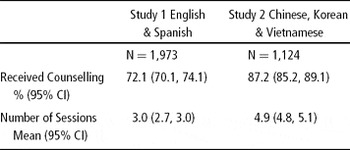
How did Asian-language-speaking smokers experience telephone counselling for smoking cessation, and how did this experience compare with English- and Spanish-speaking clients? We examined data from a large randomised trial conducted previously at the California quitline (Zhu et al., Reference Zhu, Anderson, Tedeschi, Rosbrook, Johnson and Byrd2002) and data from a large trial with Asian immigrants (Zhu et al., Reference Zhu, Cummins, Wong, Tedeschi, Gamst and Reyes-Nocon2012). Table 1 shows the average number of sessions received by smokers randomly assigned to the counselling condition in each study. Asian immigrant smokers received counselling (at least one comprehensive session) at higher rates than did English- and Spanish-speaking smokers, 87.2% and 72.1%, respectively. Moreover, among those who received counselling, Asian-language-speaking smokers received more sessions than did English- and Spanish-speakers (4.9 vs. 3.0).
Counselling Received by Study

N = number of participants assigned to counselling condition
CI = confidence interval
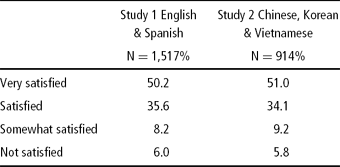
Table 2 shows the satisfaction levels of those in the counselling condition who were reached for evaluation. Asian-language-speaking clients expressed the same degree of service satisfaction as their English- and Spanish-speaking counterparts.
Satisfaction of Quitline Services by Study
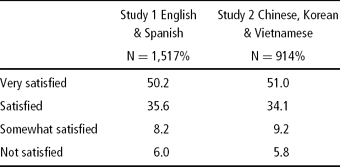
N = number of participants reached for evaluation
Note: Test of difference between the two studies, χ2 = 1.12, p = 0.77
Thus, it appears that Asian immigrant smokers are quite willing to engage in the counselling process as noted by the higher percentage of clients who received counselling and the higher average number of sessions received. The nearly-identical levels of satisfaction with the service between the two studies also indicate that the counselling was well received by all language groups.
Conclusion
Many Asian smokers want to quit, but few in-language treatment options exist in the US for this clientele. The telephone intervention described here, however, provides one such option. It is based on general principles of behaviour change with special considerations for Asians. A large randomised trial with Korean-, Vietnamese-, Mandarin-, and Cantonese-speaking smokers showed that Asian smokers will use a telephone-based programme and quit successfully. Results from this trial also indicate that standard principles of smoking cessation in a single protocol can be applied across Asian sub-groups with similar outcomes. At the same time this protocol can be modified as appropriate to take into account specific needs of individuals within the context of their particular group. The telephone counselling protocol detailed in this article has been shown to be an effective means for helping Asian smokers quit, and can be adapted to fit programmes aimed at promoting health care delivery in countries with a significant Asian population.
Acknowledgements
Many contributed to the development of the protocol presented. The authors wish to acknowledge and thank the Asian-language-speaking staff members at the California Smokers' Helpline, in particular, Shiushing Wong, Ruth Chang, Quyen Dinh, Joy Kim, Lina Kim, Mei Kuo, Mai Le, Crystal Moon, Andy Pham, Christy Pham, Wendy Shih, Wen Sze Chu, Peggy Wallace, Steve Wu, Ping Fan, & Bernadette Yip.
Financial support
This work was supported by the Centers for Disease Control and Prevention (grant number R18DP002106).
Conflict of Interest
None
Ethical Standards
The authors assert that all procedures contributing to this work comply with the ethical standards of the relevant national and institutional committees on human experimentation and with the Helsinki Declaration of 1975, as revised in 2008.