Introduction
The oriental fruit moth, Grapholita molesta (Busck) (Lepidoptera: Tortricidae), is a major pest of Rosaceae fruit trees and is widely distributed throughout the fruit-growing regions of Asia, Europe, America, Australia and Africa (Vickers et al., Reference Vickers, Rothschild and Jones1985; Natale et al., Reference Natale, Mattiacci, Hern, Pasqualini and Dorn2003; Myers et al., Reference Myers, Hull and Krawczyk2007). The diapausing larvae of G. molesta overwinter within silken cocoons in the late-season host orchard habitats (Rothschild & Vickers, Reference Rothschild, Vickers, van der Geest and Evenhuis1991; Notter-Hausmann & Dorn, Reference Notter-Hausmann and Dorn2010). The surviving larvae develop into pupae in the spring, and the adults emerge and disperse to oviposit on early-season host plants in or near the overwintering habitats (Sarai, Reference Sarai1970; Rice et al., Reference Rice, Doyle and Jones1972; Ellis & Hull, Reference Ellis and Hull2013). Upon hatching, the larvae infest young peach shoots (Prunus persica) in the early season and then shift to pear (Pyrus communis) or apple (Malus domestica) orchards (Zhao et al., Reference Zhao, Wang and Yan1989; Il'ichev et al., Reference Il'ichev, Williams and Gut2007; Piñero & Dorn, Reference Piñero and Dorn2009; Najar-Rodriguez et al., Reference Najar-Rodriguez, Bellutti and Dorn2013). In Northern China, G. molesta population outbreaks have been severe in peach orchards, partly because fruit bagging is usually adopted in pear and apple cultivation, and partly because peach fruits are not bagged as a consequence of the short stalk (Yang & Liu, Reference Yang and Liu2010; Lu et al., Reference Lu, Huang and Wang2012; Fan et al., Reference Fan, Liu, Lu, Feng, Yu, Gao and Zhang2013; Yang et al., Reference Yang, Feng, Liu, Fan, Ma and Wei2013). As a result, we do not believe that large numbers of G. molesta overwinter in pear or apple orchards adjacent to peach orchards in Northern China and that colonization in peach orchards origins from those habitats. Knowledge of overwintering habitats is crucial for determining the origins of pest populations and predicting their dispersal trajectory in adjacent orchards.
The management of overwintering G. molesta populations largely relies on precisely targeting the overwintering sites in orchard habitats, but the information available for G. molesta is varied. For example, loose tree bark scales, pruning wounds, the soil beneath the tree, leaf litter, weeds, trash and fruit bins can all serve as overwintering sites (Dustan, Reference Dustan1961; Riga et al., Reference Riga, Lacey, Guerra and Headrick2006; Knight et al., Reference Knight, Barros-Parada, Bosch, Escudero-Colomar, Fuentes-Contreras, Hernández-Sánchez, Yung, Kim, Kovanci, Levi, Lo, Molinari, Valls and Gemeno2015). A better understanding of overwintering preferences would be valuable for efficiently controlling the moth and lowering the infestation levels in subsequent growing seasons. Li & Xu (Reference Li and Xu1983) and Song et al. (Reference Song, Zheng and Ren1993) compared the overwintering preferences of G. molesta between host trees and the soil and found that most larvae overwintered in host trees in hawthorn orchards and in the soil in pear orchards. Therefore, the preferences of this species for different overwintering sites on host trees and in the soil (e.g., trunk, main trunk, lateral branches, aspect and height) require further study. Li et al. (Reference Li, Guo, Zhao, Men, Zhuang, Zhou, Xu and Yu2014) reported that most overwintering G. molesta were located on the branches followed by main trunk; however, only a few diapause larvae were found on trees, which was not in accord with the adult population occurrence in the following spring in the same orchard.
In this study, we investigated the overwintering biology of G. molesta in detail in four peach orchards and in adjacent pear and apple orchards in Northern China from 2011 to 2013. Our objective was to determine the key overwintering habitat and site location by comparing the numbers of cocooned larvae overwintering in different orchard habitats and cryptic sites with the ultimate goal of improving the control strategies for adjacent orchards.
Materials and methods
Study site
Field experiments were conducted in commercial orchards located in Shenzhou City, Hebei Province, China (38°N, 115°E), from 2011 to 2013. Shenzhou City is a major peach-growing area and the place of origin of the honey peach, and both early- and late-maturing varieties are grown there. In this area, pome fruit orchards, such as pear and apple, are commonly planted adjacent to peach orchards, so 4 peach orchards (‘Shazi Zaosheng’, ‘Jiubao’, ‘Shenzhou peach’ and ‘Beijing No. 14’) as well as one adjacent pear orchard and one adjacent apple orchard were selected for the experiment. The ‘Shazi Zaosheng’, ‘Jiubao’, ‘Shenzhou peach’ and ‘Beijing No.14’ orchards were adjacent to each other and were planted in an east–west direction with a 6 m gap between orchards. The orchards ranged in size from 0.5 to 1.2 ha; all of the peach trees were 18 years old, and the spacing between the rows and trees in each peach orchard was 6 and 5 m, respectively. An 18-year-old pear orchard (‘Yali’), located 12 m south of the peach orchards, encompassed 0.6 ha, and the trees were spaced 6 × 5 m2 apart. A 14-year-old apple orchard (‘Fuji’) was located 50 m east of the peach orchards and had an area of 1.0 ha with 4 × 3 m2 spacing. Fruits were bagged in apple and pear orchards, except for peach orchards. All of the trees were approximately 5–6 m in height, and each had three main branches and rough bark on the trunk. Most of the ground vegetation and the fallen fruits in the orchard were cleared away after harvest, and insecticides (beta-cypermethrin, emamectin benzoate, matrine) were applied during the 3 years of the study.
The harvest periods for the ‘Shazi Zaosheng’, ‘Jiubao’, ‘Beijing No.14’ and ‘Shenzhou honey peach’ varieties are mid-July, late July, early August and late August to late September, respectively. The ‘Yali’ pears and ‘Fuji’ apples are harvested during late September and mid-October, respectively.
Survey of overwintering, cocooned larvae by trapping
Corrugated cardboard bands were used to provide artificial shelters for overwintering G. molesta larvae, and each band was approximately 150 mm wide and of sufficient length to encircle the trunks (0.3–0.4 m above ground level) or main branches of the trees (0.8–1.0 m above ground level) (Horton et al., Reference Horton, Broers, Hinojosa, Lewis, Miliczky and Lewis2002; Isaia et al., Reference Isaia, Bona and Badino2006). Before a cardboard band was wrapped tightly around the trunk of each tree, the loose bark was removed from the trunk to increase the probability that larvae would enter the band. Ten trees were banded in each experimental orchard on the 21st of August. The trap trees were randomly selected at the beginning of banding, and the same trees were used throughout the study; the border rows were excluded. The bands were replaced every 10 days until the 30th of October, and upon removal, the bands were collected in individual plastic bags and kept in open. After 1 month under natural conditions, eclosion from some of the cocoons was observed, so the intact cocoons were considered to be overwintering cocoons. The numbers of overwintering, cocooned larvae were recorded in the six orchards at different periods of time, and one-way analysis of variance (ANOVA) was implemented in SPSS (version 16.0; SPSS, Inc., Chicago, IL) to compare the numbers of larvae between the different overwintering orchard habitats. Where significant differences were observed at the P < 0.05 level, a Tukey's multiple range test was used to compare the differences between the means.
Survey of overwintering, cocooned larvae by scraping
The underside of the bark of the host trees was grooved, and cocoons containing overwintering G. molesta larvae were wholly concealed under loose bark scales, bark crevices, or pruning wounds, so the bark of the study trees needed to be scraped entirely to survey the overwintering, cocooned larvae. In early November, when all of the larvae had entered their overwintering sites, an additional 10 trees with heavy damage from fruit-feeding were selected in each block. The trunk, main branches, lateral branches, trunk bifurcations and branch bifurcations on each tree were sampled. At each of these sampling sites, all of the bark scales, bark crevices and pruning wounds were scraped using a spud, but the larval habitats were preserved as much as possible. The number of overwintering, cocooned larvae at each sample site was recorded, and the aspects and heights of the cocooned larvae on the tree were recorded. The numbers of cocooned larvae overwintering in the different experimental orchards were then counted. Statistical analyses were conducted using SPSS (version 16.0; SPSS, Inc., Chicago, IL). The mean numbers of diapause larvae between different overwintering orchard habitats, sites, aspects and heights were compared using Tukey's multiple range test at the P < 0.05 level.
Survey of overwintering cocooned larvae in sieved soil
The soil beneath the host trees is another important overwintering site for G. molesta (Rothschild & Vickers, Reference Rothschild, Vickers, van der Geest and Evenhuis1991), so we also investigated the overwintering, cocooned larvae in the soil. In early November, we selected the soil beneath the trees that had been scraped with a spud, and all of the soil was sampled within 120 mm of the trunk to a depth of 5 cm. We surveyed the larvae using 2 mm mesh sieves, and the numbers of cocooned larvae overwintering in the soil in the different experimental orchards were recorded.
Results
Overwintering orchard habitat
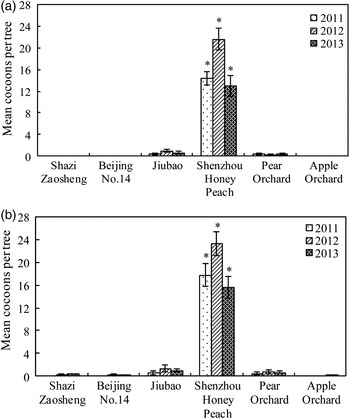
Four peach orchards, an adjacent pear orchard and an adjacent apple orchard were surveyed to compare the habitat preferences of G. molesta. Marked differences were observed in the mean number of cocooned larvae overwintering among the different orchard habitats (fig. 1), and the highest number of larvae (more than 90% of the total) was found by both trapping (F 2011 = 139.259, df2011 = 5, P 2011 < 0.01; F 2012 = 105.479, df2012 = 5, P 2012 < 0.01; F 2013 = 43.625, df2013 = 5, P 2013 < 0.01) and scraping (F 2011 = 79.002, df2011 = 5, P 2011 < 0.01; F 2012 = 104.015, df2012 = 5, P 2012 < 0.01; F 2013 = 111.297, df2013 = 5, P 2013 < 0.01) in the ‘Shenzhou honey peach’ orchard. Much lower numbers of overwintering larvae were found in the other peach orchards and in the pear and apple orchards. These results indicate that G. molesta preferred some of the orchards over others as overwintering habitat with the ‘Shenzhou honey peach’ orchard being the most preferred overwintering habitat.
Mean +/− standard error number of overwintering G. molesta cocoons in different orchard habitats in Northern China from 2011 to 2013. (a) Cocoons trapped by corrugated cardboard bands; (b) cocoons scraped by spud. * Above bars indicate significant differences at the P < 0.05 level (ANOVA followed by Tukey's multiple range test).

Overwintering site
The number of overwintering, cocooned larvae in the host trees and the soil differed significantly (table 1). Most of the larvae were detected under the bark of the host trees, and cocooned larvae were only rarely observed in the soil, which suggests that the host trees are the primary overwintering site for G. molesta.
Mean number of overwintering G. molesta cocoons in the host trees and the soil in different orchard habitats in Northern China from 2011 to 2013.

Overwintering distribution on host trees
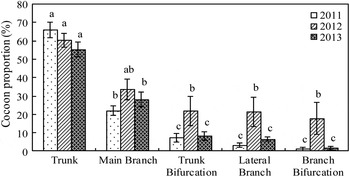
Cocooned larvae were primarily found overwintering on ‘Shenzhou honey peach’ trees, so we studied the distribution of the larvae on trees with a focus on the ‘Shenzhou honey peach’. The numbers of overwintering, cocooned larvae were significantly different among the different locations on the trees (F 2011 = 108.774, df2011 = 4, P 2011 < 0.01; F 2012 = 5.929, df2012 = 4, P 2012 < 0.01; F 2013 = 63.09, df2013 = 4, P 2013 < 0.01) (fig. 2). Larvae mainly overwintered on the trunk with more than 50% of the collected larvae from 2011 to 2013, followed by the main branch, and significantly fewer cocooned larvae were found overwintering in trunk bifurcations, lateral branches and branch bifurcations. The results indicate that the trunk is the most preferred site on the tree for overwintering G. molesta.
Mean +/− standard error proportions of overwintering G. molesta cocoons at different sites on the host trees in a Shenzhou Honey peach orchard in Northern China from 2011 to 2013. Different letters above bars indicate significant differences at the P < 0.05 level (ANOVA followed by Tukey's multiple range test).

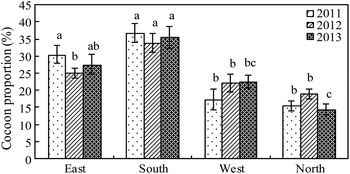
There were significant differences in the number of overwintering, cocooned larvae on different sides of the trees (F 2011 = 16.261, df2011 = 3, P 2011 < 0.01; F 2012 = 8.888, df2012 = 3, P 2012 < 0.01; F 2013 = 12.403, df2013 = 3, P 2013 < 0.01) (fig. 3), the greatest numbers of cocooned larvae were found on the south side of the trees during 2011–2013 (36.74, 33.92 and 35.53%, respectively) followed by the east side (30.45, 25.02 and 27.57%, respectively). Fewer of the overwintering larvae were found on the west and north side of the trees. These results suggest that G. molesta larvae prefer to overwinter on the sunny aspects of trees.
Mean +/− standard error proportions of overwintering G. molesta cocoons at the different aspects of the host trees in a Shenzhou Honey peach orchard in Northern China from 2011 to 2013. Different letters above bars indicate significant differences at the P < 0.05 level (ANOVA followed by Tukey's multiple range test).

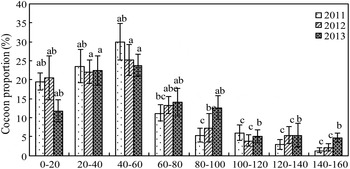
The number of overwintering larvae also varied by their height on the trees. As shown in fig. 4, 73.10, 67.85 and 58.10% of the overwintering cocoons were found at or below 60 cm in 2011, 2012 and 2013, respectively. Significantly fewer overwintering cocooned larvae were found above 60 cm on the trees (F 2011 = 14.383, df2011 = 7, P 2011 < 0.01; F 2012 = 7.528, df2012 = 7, P 2012 < 0.01; F 2013 = 6.608, df2013 = 7, P 2013 < 0.01).
Mean +/− standard error proportions of overwintering G. molesta cocoons at different heights on the host trees in a Shenzhou Honey peach orchard in Northern China from 2011 to 2013. Different letters above bars indicate significant differences at the P < 0.05 level (ANOVA followed by Tukey's multiple range test).

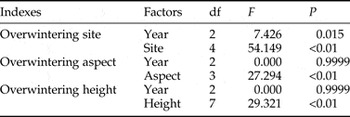
The distribution of overwintering G. molesta on the host trees in a ‘Shenzhou honey peach’ orchard was significantly influenced by the sites, aspects and heights of the trees, and there was no significant difference between sampling years (table 2).
Two-factorial ANOVAs testing for analysing the proportions of overwintering G. molesta cocoons at different sites, aspects and heights on the host trees by years.

Dynamics of overwintering, cocooned larvae
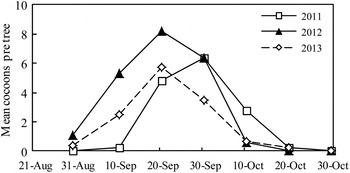
The dynamics of the cocooned larvae overwintering in the ‘Shenzhou honey peach’ orchard during the 3 years of the study were revealed by the numbers of larvae trapped with the cardboard bands every 10 days (fig. 5). Larvae entered the overwintering sites beginning in August and October. The peak period for entering winter diapause was from mid- to late September as 77.78, 67.59 and 71.15% of the total number of larvae were trapped during this period in 2011, 2012 and 2013, respectively. All of the larvae had entered their overwintering sites by late October for a long overall entrance period of between August and October.
The dynamics of overwintering G. molesta larvae on the host trees in a Shenzhou Honey peach orchard in Northern China from 2011 to 2013.

Discussion
The results of this study indicated that the ‘Shenzhou honey peach’ orchard was the most preferred overwintering habitat while the pear and apple orchards were unfavourable, and this is supported by the observation of a large overwintering population trapped in the ‘Shenzhou honey peach’ orchard (Y.X.F., unpublished data). The phenological stage of a fruit tree may partially explain these differences. Yang et al. (Reference Yang, Han and Boo2001) reported that the number of overwintering G. molesta larvae in pear trees varied extensively depending on the timing of the harvests of the different varieties; most of the overwintering larvae were located in the late cultivars. During the peak of the last adult generation of G. molesta in ‘Shenzhou’ in mid-August (Y.X.F., unpublished data), the females lay eggs on the mature peaches, and the larvae then infest the inside of the fruits. Before entering winter diapause, insects must accumulate energy reserves, such as carbohydrates, by feeding on host plants to survive unfavourable environmental conditions (Sakurai et al., Reference Sakurai, Kawai and Takeda1992; Pullin, Reference Pullin1996), so the selection of an appropriate overwintering habitat may be food-driven. Due to their low dispersal capacity (Stinner, Reference Stinner, Barfield, Stimac and Dohse1983), most of the full-grown larvae leave the fruits and overwinter nearby. The harvest period of the ‘Shenzhou honey peach’ is from late August to late September, so the late-maturing orchard is the key habitat for overwintering. The ‘Yali’ pear and ‘Fuji’ apple are also potential overwintering habitats based on their harvest periods, but these fruits are managed by bagging, so they provide little food for late-stage larvae thus leading to fewer overwintering, cocooned larvae.
G. molesta might disperse from their overwintering hosts to early-season host plants in the spring; so understanding their habitat preferences could be valuable in determining the origins of pest populations and predicting their dispersal into adjacent orchards. In the mid-Atlantic region, it is generally thought that G. molesta moths switch from peaches to apples or pears later in the season and that the overwintering moths then disperse from apples or pears the following spring (Allen & Brunson, Reference Allen and Brunson1943; Hughes & Dorn, Reference Hughes and Dorn2002; Tollerup et al., Reference Tollerup, Rucker and Shearer2012). However, because the late-maturing peach orchard was found to be the primary overwintering habitat in this study, we infer that the moths overwintering in Northern China disperse from the late-maturing peach orchards to other host plants during the spring and then return to the peach orchards late in the autumn, when the pears and apples are managed by bagging. Thus, more attention should be paid to late-maturing peaches when designing effective integrated pest management programmes.
In our study, the main overwintering site for G. molesta in the orchards was the host tree, and cocooned larvae were only very rarely found overwintering in the soil. Insects select suitable overwintering sites to avoid predation and to maximize the likelihood of survival (Brunson, Reference Brunson and Allen1948; Jones, Reference Jones, Unruh, Horton, Mills, Brunner, Beersa and Shearer2009; Timm, Reference Timm, Geertsema and Warnich2010), so future studies should address overwintering survival rates in orchard trees and soil. In addition, G. molesta prefer to overwinter on the trunks of peach trees followed by the main branches less than 60 cm from the ground, which is likely due to the quantity and quality of the loose bark scales at these sites. The bark crevices on the trunk and main branches intersect one another below 60 cm, and the loose bark scales are large, which favours greater overwintering survival. In contrast, Li & Xu (Reference Li and Xu1983) reported that G. molesta mainly overwintered in the soil in pear orchards with more than 70% of the total larvae being found there. This difference in our findings may be due to differences in the bark crevices of pear and peach trees; the bark crevices on pear trees are composed of longitudinal cracks, whereas those of peach trees are composed of loose scales of bark. Therefore, the bark of pear trees might be unsuitable as overwintering habitat thus promoting overwintering in the soil.
Later in the season, when diapausing larvae emerge from the fruits, G. molesta individuals must first orient toward an overwintering site and then travel some distance to reach favourable overwintering microhabitats (Jumean et al., Reference Jumean, Fazel, Wood, Cowan, Evenden and Gries2009; Notter-Hausmann & Dorn, Reference Notter-Hausmann and Dorn2010). However, it is unclear how the larvae are able to locate suitable sites in the trees, but previous studies suggest that visual factors play an important role in the selection of overwintering sites (Hausmann et al., Reference Hausmann, Samietz and Dorn2004; Nalepa et al., Reference Nalepa, Kennedy and Brownie2005; Prokopy & Owens, Reference Prokopy and Owens1983). Therefore, further studies of the behavioural responses of G. molesta to visual cues are necessary to understand the mechanisms that attract large numbers of them to particular overwintering sites as well as to provide a basis for the design of potential traps.
Eliminating cocoons from cryptic habitats during the overwintering period is one of the most commonly recommended control strategies, so accurate identification of the overwintering sites and appropriate timing are essential for the effective use of control agents (Parker et al., Reference Parker, Amir-Maafi, Skinner, Kim and El Bouhssini2011). Our study found that most G. molesta larvae overwintered under the bark of the trunks and main branches on late-maturing host peach trees at or below 60 cm in adjacent orchards, indicating that these sites are priorities for control. In addition, G. molesta in Hebei, China was found to begin overwintering between August and October with a peak period in mid- to late September. However, our survey was limited by the practices of the fruit tree producers, and we only investigated overwintering G. molesta in pears and apple orchards where the fruits were bagged. Our future studies will compare overwintering sites among solitary orchards (peaches, pears and apples) that do not practice fruit bagging.
Acknowledgements
We thank the farmer who allowed us to use his orchards for our experiments, and the anonymous referees for constructive comments on the manuscript. This study was supported by the National Special Fund for Agro-scientific Research in the Public Interest (grant no. 201103024).