In their focal article, White etal. (Reference White, Ravid, Siderits and Behrend2022) called for industrial-organizational (I-O) psychologists to produce timelier technology research to guide organizations in today’s technological landscape. We agree with this call and seek to expand on their recommendation to enhance interdisciplinarity in I-O psychology research. Collaborating with researchers in computer science, information technology, neuroscience, human factors, and engineering, among others would benefit our respective fields. In this commentary, we will discuss the potential benefits of and barriers to interdisciplinary research. We close with recommendations to support interdisciplinarity.
Why Conduct interdisciplinary research?
Interdisciplinarity can enhance the effectiveness of I-O psychology research by decreasing research execution time, reducing costs through pooled resources, and providing a broader range of practical and theoretical expertise (Cuevas etal., Reference Cuevas, Bolstad, Oberbreckling, LaVoie, Mitchell, Fielder and Foltz2012). Interdisciplinary partnerships enable researchers to contribute to the same goal from different levels of analysis, and they can create valuable developmental opportunities for early career psychologists (Proctor & Vu, Reference Proctor and Vu2019). Likewise, interdisciplinary research creates opportunities to extend I-O psychology theories and practices into new domains. For technology research in particular, interdisciplinarity could create a win–win for I-O psychology and other disciplines. For example, certain technologies are costly to purchase and use, making them impractical to study without first investing time and energy in pursuing grant funding. Many I-O psychology labs lack the equipment for such research. Moreover, I-O psychologists may lack the competencies that are necessary for conducting such research. Interdisciplinary partnerships could potentially mitigate these challenges.
Barriers to interdisciplinarity
Successfully conducting interdisciplinary research requires understanding what challenges can occur during such collaborations. We will use Borrego and Newswander’s (Reference Borrego and Newswander2010) model of interdisciplinary processes as an organizing framework to discuss barriers to interdisciplinarity. The framework highlights four elements to successful collaborations: (a) disciplinary grounding, (b) integration, (c) communication and translation across disciplinary boundaries, and (d) critical awareness. We define and discuss barriers to each element next.
Disciplinary grounding
Disciplinary grounding refers to whether interdisciplinary research sufficiently reflects each represented discipline’s core perspectives, theories, methods, and findings (e.g., Duraisingh & Mansilla, Reference Duraisingh and Mansilla2007). Sufficiently grounding research within each discipline can be potentially difficult due to tensions or incompatibilities between the disciplines. We focus here on one salient form of tension: publication norms. Each field has its own criteria for what qualifies as “publishable” research, such as what methods are commonly used (and thus require less “convincing” to gain acceptance from reviewers), how much analytical complexity is needed, or the centrality of theory. The potential for conflict in interdisciplinary teams may increase as a function of the incompatibility between each discipline’s standards and norms.
For example, several disciplines, including psychology, are facing “replication crises,” characterized by difficulty producing consistent research findings across repeated studies (e.g., Nosek etal., Reference Nosek, Hardwicke, Moshontz, Allard, Corker, Dreber, Fidler, Hilgard, Struhl, Nuijten, Rohrer, Romero, Scheel, Scherer, Schönbrodt and Vazire2022). Due to this crisis, replication studies are now common in psychology research. However, the issue of replication is still debated in other disciplines, such as computer science. Replication is fairly common in some areas, such as research on artificial intelligence (AI) and machine learning (ML); the development of AI/ML models often involves cross-validating them on new or different data (e.g., Putka etal., Reference Putka, Beatty and Reeder2018). In other areas, computer scientists have only recently raised alarms about replication issues in the broader field (Cockburn etal., Reference Cockburn, Dragicevic, Besançon and Gutwin2020). Extrapolating to an interdisciplinary collaboration between I-O psychologists and computer scientists, conflicting views could potentially emerge regarding the value of replication research or the need for having multiple studies within the same research manuscript.
Integration
Integration refers to the “gestalt” of interdisciplinary research findings (Duraisingh & Mansilla, Reference Duraisingh and Mansilla2007); its contributions should exceed the sum of its parts. In other words, successful interdisciplinary research—focusing on technology or otherwise—should generate insights that could not have been gained without combining the perspectives of each discipline.
We echo White etal. (Reference White, Ravid, Siderits and Behrend2022) call for I-O psychologists to develop better technology theories. However, because interdisciplinarity may be essential to develop at least some of these theories, we add that I-O psychologists should specifically strive for integrative technology theories. We advocate against what we will call “colonizing theories,” or existing psychological theories that are simply “repackaged” to technological contexts. Psychologists should avoid imposing preexisting theories onto a new discipline or domain without seriously considering (a) how that theory’s propositions differ or change as a function of the new discipline or context, (b) how knowledge from the new discipline can meaningfully augment the original theory, and/or (c) how the theory may connect to those of the new discipline. Failure to do so would leave psychologists with redundant theories and would leave researchers from other disciplines confused about how the new theory connects to their knowledge base, undermining its utility.
Communication and translation
Research highlights that discipline-specific language differences are the most pervasive barrier to interdisciplinary research (Borrego & Newswander, Reference Borrego and Newswander2010). Each field has its own jargon that may facilitate communication within a given discipline but may also impede communication between disciplines (e.g., Piorkowski etal., Reference Piorkowski, Park, Wang, Wang, Muller and Portnoy2021). To facilitate communication and translation across disciplinary boundaries, I-O psychologists must learn to communicate their field’s esoteric information to members of other disciplines in an accessible way.
Translational issues can pose challenges for interdisciplinary researchers through “jingle” and “jangle” fallacies, in which researchers use the same term to describe different phenomena (“jingle”) or use different terms to describe the same phenomenon (“jangle”; Kelley, Reference Kelley1927). An example of a jingle fallacy comes from sentiment analysis, an automated text analysis that evaluates language and scores how people feel about a topic, person, or target (Feldman, Reference Feldman2013). For computer scientists and linguists, the term “sentiment” is conceptually similar to attitudes: whether people generally evaluate a target positively, negatively, or neutrally. This differs from the psychological concept of sentiment, which is a specific, enduring emotion felt toward a target (e.g., hatred toward a person, pride in a group; Davidson etal., Reference Davidson, Ekman, Frijda, Goldsmith, Kagan, Lazarus, Panksepp, Watson, Clark, Ekman and Davidson1994). Although both concepts share a label, the former is broader and more abstract than the latter. As an example of a jangle fallacy, Langer and Landers (Reference Langer and Landers2021) found that the terms used to describe automated decision-making systems vary widely across research publications (e.g., “computer program,” “predictive model,” “AI/ML,” “algorithm”). Such jangle fallacies risk introducing construct proliferation into the field (Shaffer etal., Reference Shaffer, DeGeest and Li2016), limiting knowledge synthesis across disparate research streams. To summarize, jingle and jangle fallacies impede interdisciplinary research by creating the illusion of common ground (seemingly similar topics that are actually different) and by creating the illusion of no common ground (seemingly different topics that are actually similar), respectively.
Last, we add dissemination as a communication and translational issue, particularly regarding conflicting publication incentives. Disciplines may differ in their publication norms, which can lead to conflicting motivations among researchers in an interdisciplinary team. For instance, in engineering and computer science, research presentations at academic conferences are sometimes (depending on the conference) equivalent to top-tier publications. This contrasts with psychology, in which a conference presentation typically serves as a step toward an eventual journal publication and in some cases is even discouraged from being cited in publications. As a result, the “end points” of the research process may look different within each discipline. Without departments from each discipline having proper incentives in place, interdisciplinary research may continue to take a backseat to discipline-specific research.
Critical awareness
The final ingredient for successful interdisciplinary collaborations is critical awareness of each discipline’s strengths, limitations, foci, and biases (Duraisingh & Mansilla, Reference Duraisingh and Mansilla2007). Different fields may study similar topics yet have different foci. For example, I-O psychology may focus on the psychological effects of using technologies at work, whereas engineering may focus on the design of such technologies. These foci can diverge or even create conflicting goals between disciplines. For example, whereas some areas of computer science prioritize prediction and efficiency, these goals may compete with those that I-O psychologists often consider such as accepting reduced validity in exchange for enhanced diversity, fairness, and legal defensibility. Critical awareness involves reflecting on each field’s goals, finding opportunities for compromise and, where possible, creating “win–win” situations.
Recommendations
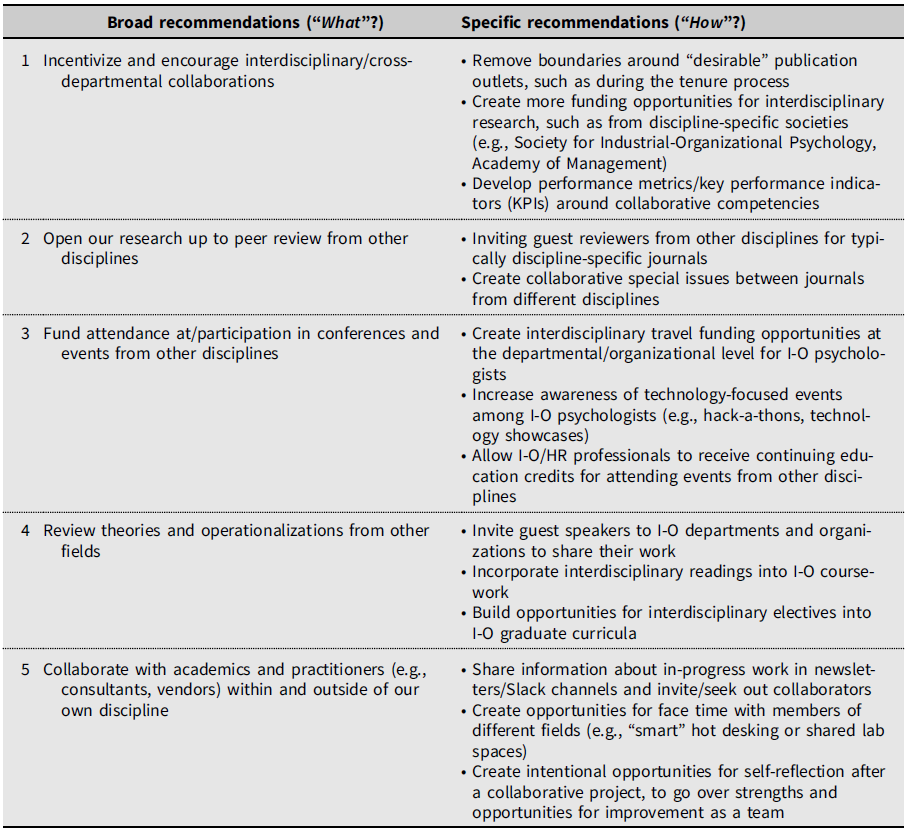
We conclude by considering how to better prepare and enable I-O psychologists to conduct timelier interdisciplinary technology research, both in academia and in practice. Table 1 includes extensive recommendations, but we will focus here on what we view as the most critical recommendations relating to two competencies: knowledge sharing and partnering with others.
Recommendations and Example Solutions For Enhancing Interdisciplinary Technology Research

Knowledge sharing
A core theme from our discussion is that I-O psychologists should promote greater knowledge sharing with other disciplines. The goal of knowledge sharing is to achieve effectiveness by contributing information to others. Greater knowledge sharing can aid interdisciplinary research in several ways such as by facilitating integration and a greater breadth of theory, fostering better communication across disciplines, and developing a greater understanding of the alignment (or misalignment) between each discipline’s values and goals.
We see two strategies for fostering greater knowledge sharing. First, I-O departments and organizations could better expose (especially early-career) I-O psychologists to research in other fields. For instance, instructors of graduate-level courses may consider incorporating readings or guest speakers from other disciplines so that I-O psychologists can learn how other disciplines study the same phenomena. Another example involves “lunch and learn” events where members in other fields can share their work and discuss areas that can overlap with ours. Second, bureaucratic walls (or “red tape”) that exist in academia and practice could be removed such as those pertaining to grant funding, publication criteria, and conference participation. To share knowledge, I-O academics and practitioners should enter spaces beyond their field such as technology showcases, engineering research conferences, and start-up tech companies, among others. To enable such boundary spanning would require institutional leaders to rethink their incentive structures. Based on the notion that interdisciplinary work would facilitate timelier technology research, we should link the behaviors needed for such work (i.e., entering new disciplinary spaces) to incentives that keep I-O psychologists accountable for engaging in them (i.e., research grants, interdisciplinary conference travel funds, not penalizing non-I-O outlets in the tenure process).
Collaborating
A second theme is that I-O psychologists should collaborate more closely with members of other disciplines. By collaborating across disciplinary boundaries, I-O psychologists stand to better communicate across disciplines, integrate research and practice from respective areas, and develop critical awareness of other disciplines. To foster successful partnerships, we recommend developing constructive feedback opportunities from other disciplines, which may broaden our own understanding of the constructs and processes that we study. Within organizations, for example, I-O or human resources (HR) professionals can work more closely with engineers who build and maintain various organizational technology systems to identify potential improvements. In turn, I-O psychologists can contribute their practical experience and their expertise in personnel practices such as those pertaining to validation, mitigating adverse impact, and enhancing utility (for a similar argument; see Gonzalez etal., Reference Gonzalez, Capman, Oswald, Theys and Tomczak2019). Similarly, academic institutions (universities, editorial boards) can create opportunities for members of other disciplines to guest review I-O research, spurring potential collaborations between the respective fields/departments. Furthermore, inviting external editors to review I-O research manuscripts may also incentivize I-O psychologists to begin research projects with collaborators from different fields, knowing that a broader audience will review their work.
Conclusion
I-O psychology is a dynamic and thriving field that stands to expand its reach through interdisciplinary technology research. We hope that our recommendations will enable I-O psychologists to continue meaningfully helping organizations through research and practice while bridging gaps and charting new territory with partners in other disciplines.