Graphene, first discovered in 2004, is one of the most important breakthrough in modern physics and chemistry because of its excellent electrical, mechanical, and thermal properties.Reference Novoselov, Geim, Morozov, Jiang, Zhang, Dubonos, Grigorieva and Firsov1 The unique inter-layered nanostructure of graphene has offered some promising applications in many fields such as nanoelectronics,Reference Li, Wang, Zhang, Lee and Dai2 fuel cells,Reference Dimitrakakis, Tylianakis and Froudakis3 graphene based nanocomposites,Reference Stankovich, Piner, Nguyen and Ruoff4 electrochemical capacitor,Reference Stoller, Park, Zhu, An and Ruoff5 and hydrogen storage.Reference Lin, Ding and Yakobson6 It is well known that graphene is initially isolated by mechanical exfoliation, through peeling off of the top surface of small mesas of pyrolytic graphite,Reference Ponomarenko, Schedin, Katsnelson, Yang, Hill, Novoselov and Geim7 but this process is not suitable for large scale production and application. More commonly, single sheets of graphene oxide (GO) are chemically reduced to graphene after adding certain reducing agent.Reference Niyogi, Bekyarova, Itkis, McWilliams, Hamon and Haddon8 However, the problem associated with the reduction process is that the van der waals force among these reduced graphene layers could result in aggregation in solution. Thus, various chemical functionalization approaches are usually introduced into the reaction system to make graphene sheets more stable.Reference Zhou and Liu9 Williams et al. have successfully obtained well-separated graphene semiconductor (TiO2) composite sheets by carrying out ultraviolet (UV)-induced photocatalytic reduction of GO.Reference Williams, Seger and Kamat10 It is reported that this one step strategy can be used to fabricate high quality graphene-based nanocomposites without using any stabilizing reagent. More interestingly, recent efforts on visible-light sensitization of TiO2 photocatalysts (i.e., doping with metal or nonmetal elements) also make it possible now to explore the low-energy photo-assisted reduction of GO by TiO2 photocatalysts within visible-light range.Reference Zhang, Zou and Wang11
In this communication, we report a new strategy to prepare TiO2–graphene nanocomposites by visible-light photocatalytic reduction of GO. In a typical preparation of visible-light-sensitive TiO2 colloidal suspension, titanium (IV) butoxide (97%, Sigma Aldrich, Germany) was first dissolved in ethanol by stirring for 30 min at room temperature to obtain solution A. In addition, deionized water was mixed with 5 mL nitric acid by stirring for 10 min for room temperature to obtain solution B. Solution B was then added dropwise into solution A under vigorous stirring and this was then followed by the hydrolysis of titanium (IV) butoxide under stirring conditions at room temperature until a transparent sol was formed. Visible-light sensitization was then achieved by dropwise addition of 2 mL (N to Ti molar ratio 1:1) triethylamine (Sigma Aldrich) to the formed TiO2 sol under continuous stirring for 24 h. Natural flake-type graphite (SP-2; Bay Carbon, USA) was used as starting material for GO synthesis, which was obtained by the modified Hummers method.Reference Hummers and Offeman12, Reference Li, Lu, Pan, Zhang and Sun13 The final product (0.25 g) was then added to the as-prepared TiO2 colloidal suspension and sonicated for 30 min to produce a dispersion of GO sheets coated with the TiO2 nanoparticles.
Visible light–assisted reduction of GO was carried out in a 50 mL cylindrical glass vessel under a Newport Oriel series Q solar simulator (USA) with a 100 W Xe lamp. A dichroic mirror (NewSpec 66219, USA) was mounted on the lamp to eliminate infrared and UV portion of the irradiation. The total collimated irradiance between 420 and 630 nm was measured at ∼570 mW on the sample surface by a 1918-C optical power meter (Newport, USA). A typical dispersion was 0.2 mM TiO2 and 5 mg/mL GO. The suspensions were kept agitated during visible light irradiation with magnetic stirring.
TiO2 semiconductor particles and its photocatalytic properties are well documented in many applications. TiO2 is a relatively mild reducing agent with conduction band around −0.5 V versus normal hydrogen electrode at neutral pH. Upon visible-light irradiation, electron–hole pairs within N-doped TiO2 colloidal suspension were induced. In the presence of ethanol solution the positive holes are scavenged to produce ethoxy radical, thus leaving the electrons to accumulate within TiO2 particles [Eq. (1)]. The accumulated electrons then serve to interact with GO sheets to reduce certain functional groups (e.g., epoxides, hydroxyls, and carboxylic acids) [Eq. (2)].


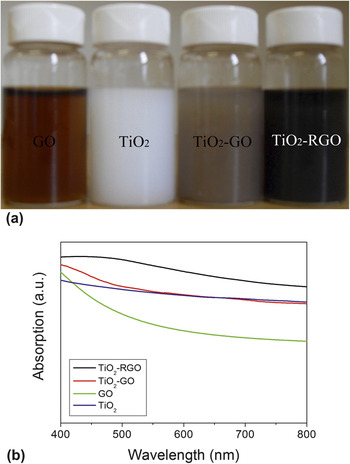
As a result, the change of color from brown to black was observed as shown in Fig. 1(a), which has been used previously as indicator of GO undergoing chemical reduction.Reference Becerril, Mao, Liu, Stoltenberg, Bao and Chen14 Changes in the absorption spectrum following the mixing with TiO2 sol and visible-light irradiation over 7 h are shown in Fig. 1(b) using a Varian Cary 100 UV–visible spectrophotometer (USA). Upon mixing with TiO2 sol, there is a broad increase of absorption in visible light range. This is due to the excitation of electrons within TiO2 photocatalysts. After 7 h exposure to visible-light irradiation, this absorption gap was further enlarged. This is probably attributed to the stabilizing effect of excited electrons in the presence of reduced graphene oxide (RGO), as the electrons stored in TiO2 nanoparticles are readily scavenged by the photocatalytically restored π network within the carbon structure.Reference Kongkanand and Kamat15 No significant changes in the color or absorption spectra could be seen during the visible light irradiation in absence of TiO2 nanoparticles.
The (a) color change and (b) absorption spectra of graphene oxide (GO) in ethanol and its mixture with TiO2 sol before and after visible-light irradiation.

The variation of TiO2–GO film resistivity can also confirm the reduction process as the GO sheet and TiO2 are both insulating materials. In theory, the maximum conductivity in these two-dimensional carbon nanostructured materials can be readily attained by the complete reduction of various oxygenated sites from reactive process and reconstruction of the sp2 network. In William’s paper, the film prepared from TiO2–GO suspension before UV irradiation had a resistance of 233 kΩ and an average value of 30.5 kΩ after 2 h irradiation.Reference Williams, Seger and Kamat10 A similar method was also adopted here to evaluate the film resistivity of TiO2–GO and TiO2–RGO. Samples for resistance measurements were made using two pieces of indium tin oxide (ITO) glass slides with a 1-mm gap, and 0.5 mL of 1 mg/mL TiO2–GO and TiO2–RGO solutions were deposited onto the gap at elevated temperatures to ensure immediate evaporation of the solvent for complete and reproducible coverage. The ITO glass also as collect electrode was connected to a digital multimeter, where resistance measurements were made. The measured resistivity of TiO2–GO film without visible light irradiation was 1005 kΩ, whereas this value was significantly reduced to 9.3 kΩ after 7 h irradiation. The higher resistivity of TiO2–GO film than that in Williams’s work may be caused by longer size of the measured film (7 cm, in our measurement process). This experiment confirms that the visible-light-sensitized TiO2 photocatalysts played an effective mediating role in reducing GO.
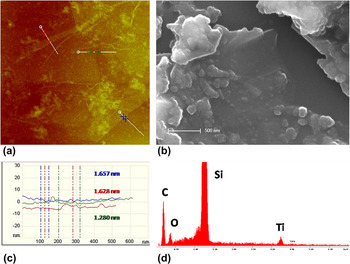
A typical atomic force microscopy (AFM) image of single layer GO sheets is shown in Fig. 2(a). The sheets have a wide form distribution, which consists of ribbon and layer (the scale bar of AFM image is 3.5 μm). The height profile of as-synthesized GO is given in Fig. 2(c) with an average thickness of ∼1.5 nm, indicating the single- or double-layered nature of the sheet coupled with various functional groups. Figure 2(b) presents a scanning electron microscopy (SEM) image of TiO2–RGO nanocomposites, and Fig. 2(d) presents the corresponding energy dispersive x-ray spectroscopy results. It is evident that TiO2 nanoparticles were successfully deposited and randomly distributed on the RGO sheets. There are multiple coupling mechanisms between TiO2 and GO sheets, including physisorption, electrostatic binding, or charge transfer interactions. SEM micrograph in Fig. 2(b) also suggests the aggregative nature of as-prepared TiO2–RGO nanocomposites because of the existence of residual functional groups induced from the preparation of GO.
(a) Atomic force microscopy (AFM) and (b) scanning electron microscopy images of GO and reduced graphene oxide (RGO) deposited on silicon wafer. (c) and (d) Cross-sectional analysis and energy dispersive x-ray spectroscopy spectrum of corresponding GO and RGO, respectively. (The scale bar for AFM image is 3.3 μm.)

Graphene and its nanocomposites coupled with different semiconductors have attracted a lot of interest in the nanoelectronics field, especially for energy storage and conversion. Taking TiO2–RGO nanocomposites, Kim et al. used UV-reduced TiO2–GO composites as an interfacial layer to reduce the back-transport reactions in dye-sensitized solar cells and found that it can effectively improve the photo-conversion efficiency.Reference Kim, Parvez and Chhowalla16 Accordingly, the electrochemical performance of TiO2–RGO nanocomposites was also investigated in this work. A typical three-compartment cell was used to probe the electrochemical performance of TiO2–GO and TiO2–RGO at ambient temperature. As-prepared products, glass carbon rod, and saturated calomel electrode were used as the working electrode, the counter electrode, and the reference electrode, respectively. The potential sweep cyclic voltammetry (CV) measurement was carried out in the 1 mol/L NaCl solution via an Autolab PGSTAT 128N (Metrohm Autolab B.V., The Netherlands).
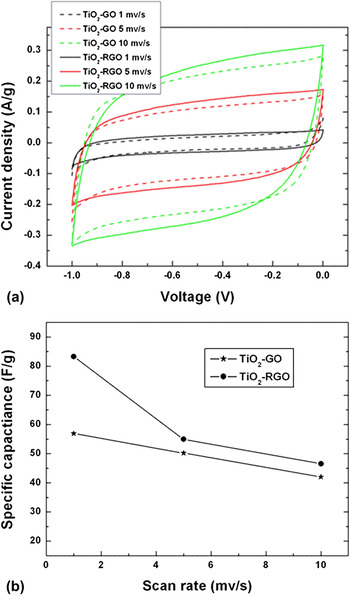
As shown in Fig. 3(a), no obvious redox peaks were found on TiO2–GO and TiO2–RGO in any scan rate, indicating no electron transfer kinetics, possibly due to the good coupling between TiO2 and graphene. The specific capacitance of as-prepared nanocomposites using the CV curves was calculated by integrating over the full CV curves to determine the average value and then followed by dividing the corresponding scan rate and weight of electrode materials,  , as shown in Fig. 3(b).
 is average current, m is mass of electrode, and dv/dt is scan rate. It can be seen that the specific capacitance of fabricated electrodes has a general decreasing trend with the increase in scan rate. More importantly, photocatalytic reduction resulted in an increase in specific capacitance because of the improved conductivity. Another potential contributor was the change of surface areas. The Brunauer-Emmett-Teller (BET) surface areas of TiO2–GO based on N2 adsorption–desorption tests via a Belsorp apparatus (BEL Japan, Inc., Japan) increased from 90.2 to 122 m2/g after 7 h irradiation, indicating that photocatalytic reduction process is effective in converting the GO into grapheme-like composites.
An environmental-friendly approach has been devised to reduce GO via TiO2 visible light photocatalysis. The binding of oxide nanoparticles kept the exfoliated graphene sheets from collapsing and aggregating because the TiO2 nanoparticles carry positive surface charge in the suspension below pH 6.8 (pzc of TiO2 sol). Consequently, this new and less chemical demanding route for GO reduction features no hazardous stabilizing reagent usage and lower energy cost compared with conventional approaches, that is, using elevated temperatures or strong reducing agents. In addition, the direct interaction between TiO2 and GO sheets (e.g., carboxylate linkage) also provides the basis to their effective coupling and GO reduction by a one-step strategy. The composite products demonstrate enhanced conductivity. This advantage and their possible synergistic effects of degradation of dissolved organic matters are envisaged to be beneficial to many environmental applications, that is, capacitive deionization for brackish water desalination, energy storage devices, and dissolved organic matter removal.
(a) Cyclic voltammetry curves of TiO2–GO and TiO2–RGO in different scan rates. (b) The comparative specific capacitance of TiO2–GO and TiO2–RGO in different scan rates.

ACKNOWLEDGMENTS
The author H. Li thanks the China Scholarship Council (CSC, File No. 2009614107) for their financial support; W. Zhang is grateful to an Australian Research Council (ARC) Linkage grant (LP0989240) for providing the Ph.D. scholarship.