





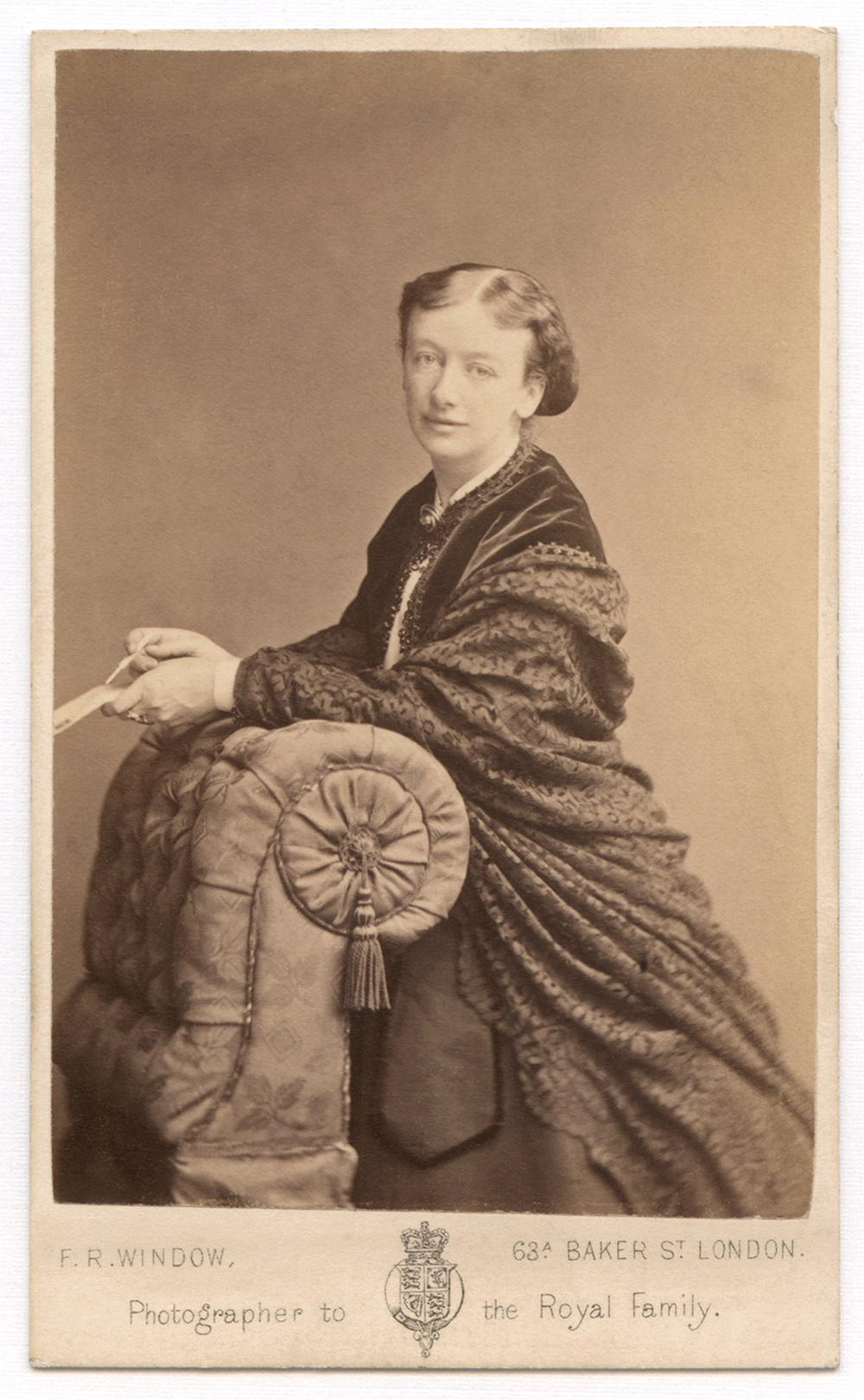
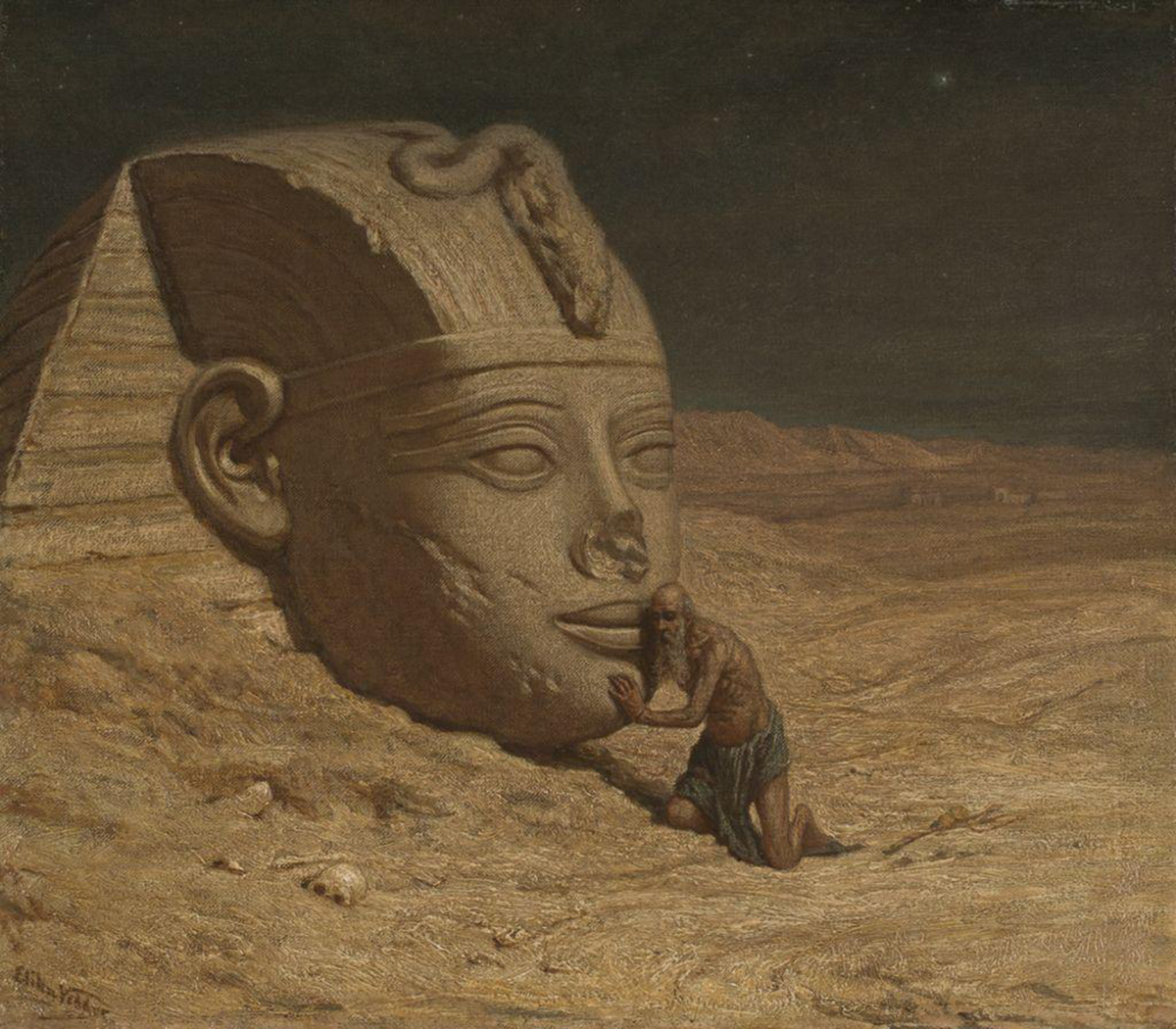
In the preface to the first edition of the memoir documenting her travels through Egypt, A Thousand Miles up the Nile, the novelist and budding Egyptologist Amelia Blanford Edwards (1831–1892) (Figure 1) ruminated on the advances of Egyptian exploration in the thirteen years since the American artist Elihu Vedder had painted his famous The Questioner of the Sphinx in 1863 (Figure 2):
Thirteen years is a short time to look back upon; yet great things have been done in Egypt, and in Egyptology, since then. Edfoo, with its extraordinary wealth of inscriptions, has been laid bare. The whole contents of the Boulak MuseumFootnote 1 have been recovered from the darkness of the tombs. The very mystery of the Sphinx has been disclosed … Thus the work goes on; students in their libraries, excavators under Egyptian skies, toiling along different paths towards a common goal.Footnote 2
Carte-de-visite photograph of Edwards by F. R. Window, c. 1871. Courtesy of the Peggy Joy Egyptology Library.

Elihu Vedder, The Questioner of the Sphinx, c. 1875, Worcester Art Museum (Worcester, Massachusetts), 1974.330. © Worcester Art Museum.

Edwards’s Egypt, like Vedder’s Sphinx, was full of mysteries still waiting to be discovered, but she was very clear about who was responsible for uncovering them. Egyptology was the pursuit of scholars. Yet her own legacy was built on something more complex: the manipulation of the line between academic discipline and popular spectacle. Her transformation into the ‘Queen of Egyptology’,Footnote 3 the authority on ancient Egypt, throughout the 1880s was not simply driven by passion, but by her ability to capture and mobilise public interest. She was thus propelled into the limelight as a public intellectual just as Egyptology was transforming itself from a field of amateur antiquarians into a professionalised scientific discipline.
Edwards’s popularisation of Egypt was framed by Britain’s intensifying economic and political interests in the region, from the growing demands for alternative sources of cotton during the American Civil War (1861–1865) and the opening of the Suez Canal in 1869 to the subsequent military occupation following the Anglo-Egyptian War in 1882, lasting until 1922.Footnote 4 While the government remained preoccupied with geopolitical events, elite collecting and exhibition of Egyptian antiquities surged, the result of competition between diplomatic officials sent to Egypt ostensibly to oversee the country’s economic development.Footnote 5 As these officials returned home with their spoils Egypt was brought even further into the public consciousness, stimulating popular demand for more. Edwards became a key facilitator. Her place in the development of Egyptology, especially as the founder of the Egypt Exploration Fund (EEF, now the Egypt Exploration Society) – also in 1882 – to promote and finance British excavation, has been well studied.Footnote 6 Recent scholarship has also illuminated the role of the EEF (and archaeology more generally) in imperial knowledge production,Footnote 7 the dislocation of heritage,Footnote 8 the obfuscation of local labourers and scholars,Footnote 9 and the mythmaking of the ‘heroic’ archaeologist in popular and academic culture alike,Footnote 10 which Edwards successfully exploited herself.
Building on these works, this article examines Edwards’s individual position in engineering a powerful form of imperial nostalgia through the creation of new structures of popular ‘remembering’ that enabled the British public to become active stakeholders in Egypt’s past. In doing so, it considers the paradoxes at the heart of her constructed persona: her simultaneous performance of common accessibility and intellectual elitism, as well as her carefully constructed authority based on popularisation and erasure. Crucial to Edwards’s project was her encouragement of those on the margins of Victorian power hierarchies to take part in Egyptian exploration, and by extension the advancement of imperial science, through support of the EEF. This was a time when Britain’s technological dominance after the Industrial Revolution, alongside its rapid overseas expansion, was escalating competition between Western powers. At home this had created a new sense of British moral responsibility as the stewards of civilisation and progress to service a novel ‘imperial mindset’;Footnote 11 science became seen as a popular means of advancing imperial legitimacy. The rhetorics of racial superiority and preservation of a ‘global’ heritage were therefore effective tools for archaeologists functioning as imperial agents while popularising their own exploits.Footnote 12 As Andrew Thompson notes, a key means by which the wider British public experienced empire was through ‘the adventure, excitement and spectacle of faraway and exotic places’,Footnote 13 something archaeology could deliver in multiple guises. Edwards took this a step further by crafting a performative space where temporal distance collapsed, allowing Victorians to feel as though they could witness or even inhabit antiquity.Footnote 14 Egypt was made a tangible memory to the masses in an act of ‘mnemohistory’ – the process, as Jan Assman defines it, where the present is ‘haunted’ by the past and the past is ‘modelled, invented, reinvented, and reconstructed by the present’.Footnote 15 Ultimately, this article reveals mechanisms of a distinctly British form of imperial ‘remembering’, shaped by broader tensions within Victorian culture during the professionalisation of a new scientific discipline and driven by key figures such as Edwards.
A tourist’s discovery and the birth of an Egyptologist
Edwards was not the typical Victorian scholar. Beyond her gender, her socio-economic background also differentiated her from the usual crowd of aristocratic antiquarians. Born in 1831 to a middle-class family in London,Footnote 16 by the time she undertook her trip to Egypt over the winter of 1873–4 she was a well-known novelist and burgeoning travel writer.Footnote 17 Egypt was already a burgeoning tourist destination when Edwards arrived in Alexandria with her travelling companions Lucy Renshaw (1833–1919) and Renshaw’s maid, Jenny Lane (1835–?). Several popular travel narratives had been published in the decades prior, and the company Thomas Cook had expanded its long-standing Grand Tour offerings in 1868 with an exploratory trip that included Egypt, Palestine, Syria and Turkey. Cook’s first official Grand Tour of the Middle East took place the following year in 1869.Footnote 18 This was also the year the Prince of Wales (later King Edward VII, r. 1901–10) made his second trip to Egypt (the first had been in 1862); his itinerary included a staged ‘discovery’ of a tomb containing sarcophagi and mummies, twenty of which returned with him to be gifted to British institutions.Footnote 19 The act of discovery had transcended the scholarly realm to become part of the tourist’s itinerary.
The memoir of Edwards’s trip was also a record of her own transformation, overcoming the bounds of gender and class to reinvent herself as an expert on ancient Egypt. She responded to fellow traveller’s questions regarding a group of women undertaking a tour of the Nile alone with humour, quipping that the impetus for their trip had been ‘stress of weather’ and comparing Egypt to the Burlington Arcade in London and Passage des Panoramas in Paris,Footnote 20 themselves paradigms of elite Victorian consumption. In making light of the normative Victorian expectations of a woman traveller, however, Edwards in fact exempted herself from the gendered strictures of travel.Footnote 21 But far from advocating for wider female agency in such travel, Edwards’s memoir made clear that she held an exceptional place, emphasised by her own characterisation. She was ‘the Writer’, the heroic adventurer whose exploits were contrasted with the ‘demurely feminine’ reactions of ‘L.’ (Renshaw).Footnote 22 For example, in Aswan, L., ‘given to vanities in the way of dress’, bought a ‘Madame Nubia’ (a rahat, a skirt of leather plaits), ‘chiefly in demand among English and American visitors’.Footnote 23 On a trip to the rock of Abusir, accessible by either land or water, the intrepid Writer took a local felucca (a traditional wooden sailing boat) and then climbed sand dunes on foot, while L. preferred the safety of a donkey.Footnote 24 Edwards set herself apart in a male-dominated world, which she authoritatively carried over into her Egyptological career.
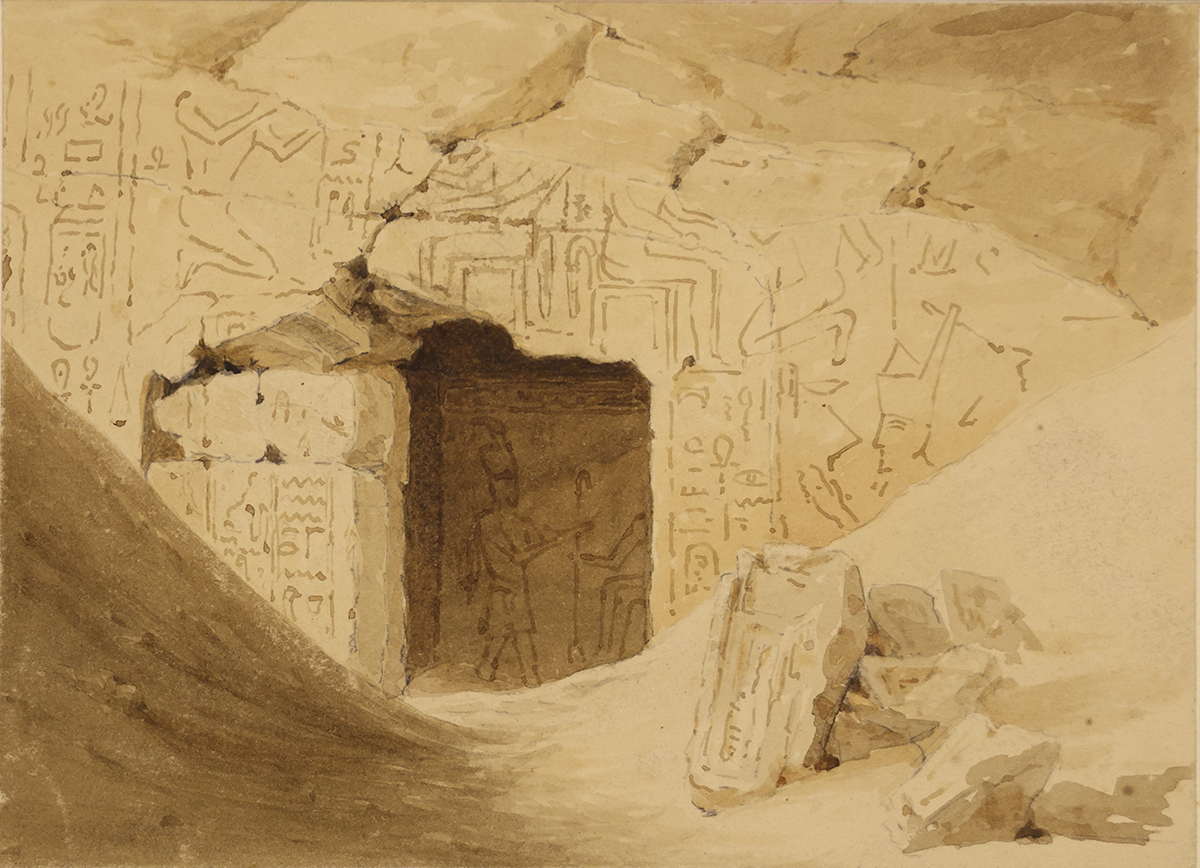
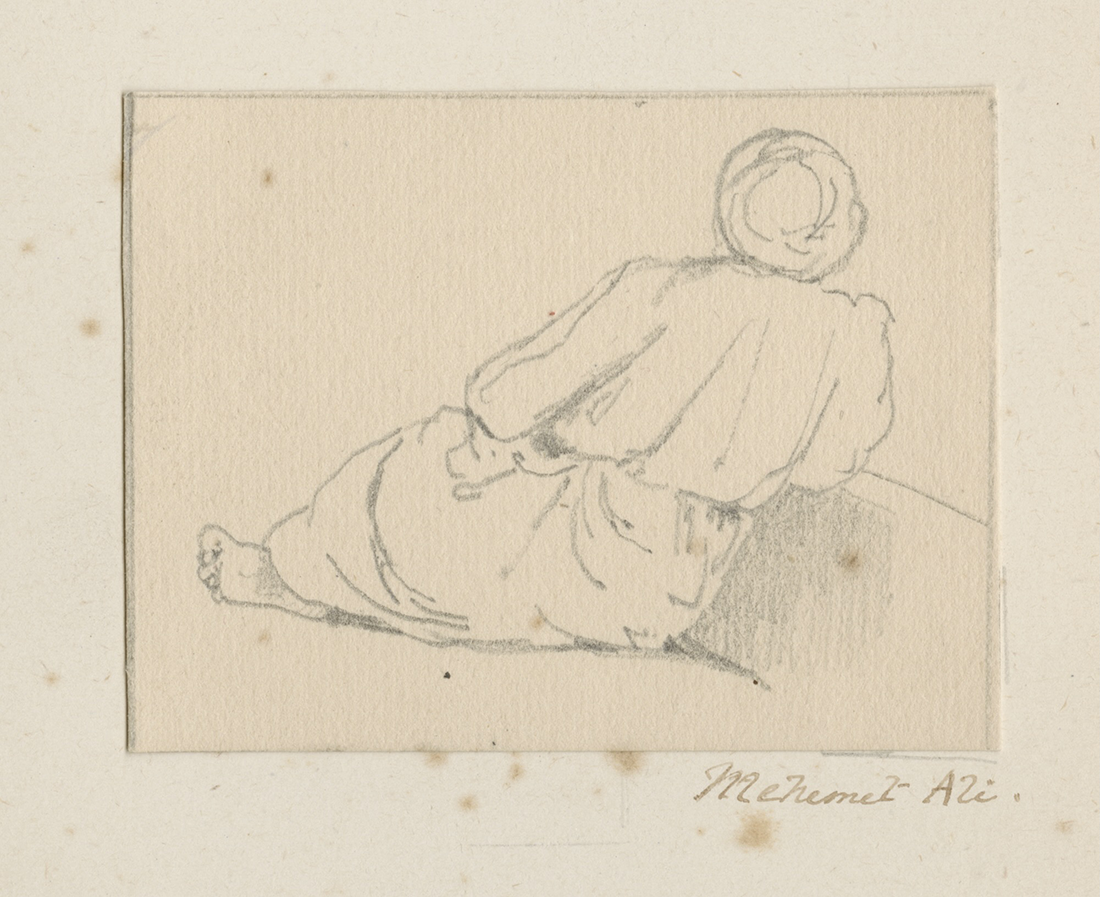
It was a chance encounter, however, that marked the creation of Edwards’s new identity. While at Abu Simbel, she relayed how one of her party, the landscape painter Andrew McCallum (referred to simply as ‘the Painter’), discovered the location of a hitherto unknown chapel next to the main temple (Figure 3). The Writer was the first to enter the chamber once the doorway was partially cleared (disregarding the sailor Mehemet Ali (Figure 4) they sent in first), noting:
the painted frieze running round just under the ceiling; the bas-relief sculptures on the walls, gorgeous with unfaded colour; the smooth sand, pitted near the top, where Mehemet Ali had trodden, but undisturbed elsewhere by human foot; the great gap in the middle of the ceiling, where the rock had given way; the fallen fragments on the floor, now almost buried in sand. Satisfied that the place was absolutely fresh and untouched, the Writer crawled out.Footnote 25
Edwards’s watercolour produced during her trip, labelled ‘Newly discovered library of the Great Temple of Abu Simbel opened by us on Feb. 16th 1874, Nubia’. Somerville College, University of Oxford, SCC/ABE/W71. © The Principal and Fellows, Somerville College, Oxford.

While Mehemet Ali was largely erased from the act of discovery, his figure was preserved in Edwards’s sketches. Griffith Institute Edwards MSS 2.1.4. Reproduced with permission of the Griffith Institute, University of Oxford.

In Edwards’s description of the ‘unfaded colour’ and the ‘undisturbed’ sand, she laid the foundation for an ‘encounter’ with the ancient world, and her own importance in preserving it. The group immediately arranged excavation of the monument by local workmen and went about documenting their find. For her part, Edwards stressed that their discovery had been missed by the great scholars of the time, saying that even Jean-François Champollion (the decipherer of Egyptian hieroglyphs), Giovanni Belzoni (who cleared the sands from Abu Simbel) and the great Karl Richard Lepsius ‘had passed it by’!Footnote 26
She also noted that the group dispatched news of their find to be published in The Times for the public to marvel at (reprinted as an appendix in her book), where it appeared on 18 March. This was the moment that Edwards the Egyptologist was born. But she included one further detail in her memoir, pertinent to the project that would occupy the rest of her life:
The Painter wrote his name and ours, with the date (February 16th, 1874), on a space over the inside of the doorway; and this was the only occasion upon which any of us left our names upon an Egyptian monument … I am told that our names are partially effaced, and that the wall-paintings which we had the happiness of admiring in all their beauty and freshness, are already much injured. Such is the fate of every Egyptian monument, great or small.Footnote 27
The initial defacement by the group, inscribing their names above the doorway,was framed as part of the act of discovery, completing the monument’s narrative and marking it as the intellectual property of the group, and more specifically, the ‘Writer’. Subsequent visitors brought mere destruction. In the later 1880s, when her friend and supporter Major Francis Grenfell (1841–1925, later Field Marshall Lord Grenfell) was in command of the forces in Upper Egypt between Gebel Silsila and Wadi Halfa, he wrote Edwards a letter stating, ‘I have had your little chamber at Abou Simbel swept and furnished and am having a door put on it. It has suffered a good deal.’Footnote 28 Yet despite the emergence of her own scientific elitism, Edwards’s account worked to demystify the role of the archaeologist, offering the possibility of such an encounter to her readers and fellow travellers. Through the EEF, this opportunity would be brought vicariously home as well.
A popular mission: Founding the EEF
To Edwards, the real threat to Egypt’s heritage was not crowds of tourists (although she remained generally disdainful of them), but the local population.Footnote 29 In particular, Edwards focused on the fellahin, the peasants described contemptuously digging (and destroying) sites either for antiquities to sell to preservationists and treasure hunters alike or for the decomposing mud-bricks known as sebakh used as fertiliser (a consequence of Britain’s growing reliance on Egypt for cotton). The contradiction of British industrialists exploiting the local populace to supply their cotton mills while also funding EEF excavations was apparently lost on Edwards.Footnote 30 Her publications were peppered with references to the destruction wrought by the fellahin, and how the EEF sought to combat it. In her report of the EEF’s excavation of Tell el-Yahudiya (Onias/Leontopolis in the Nile Delta), published in The Times in 1887, she lamented, ‘such is the very pretty historical problem which the Egypt Exploration Fund has commissioned Mr. Naville to solve, before all possibility of solution shall have returned to dust in the form of “sebakh”’.Footnote 31 Her message was that Egyptians cared so little for the past they actively destroyed it, requiring the enlightened European scholar to intervene.Footnote 32
The mission of the EEF was therefore to document and preserve the ancient monuments of Egypt, based on a subscription model like that used by the Palestine Exploration Fund (established in 1865).Footnote 33 While her proposal was initially met with resistance from some at the British Museum, she found an ally in the new French Director of the Antiquities Service in Egypt, Gaston Maspero.Footnote 34 Edwards and Maspero had already been correspondents for several years, and both shared a belief that the future of Egyptology lay in engagement with the public. In a letter written in 1879, Maspero praised Edwards’s advocacy and popular approach to Egyptology, writing:
If you are not a professional Egyptologist, you love Egypt, and you have done us a service by making it known to people who, without you, would know nothing about it, or would know much less than they do now … The fault of Egyptologists in general is that they remember too much the mysteries of the past and disdainfully refuse to leave the sanctuary. The role of the initiate is no longer appropriate in our countries and in our time.Footnote 35
Maspero’s own critique of the role of scholars – the ‘initiates’ worshipping Egypt’s mysteries – in ‘remembering’ ancient Egypt notably contrasted with his admiration of Edwards’s popular ‘scientific’ approach. He too was clearly aware of the opportunities an amateur Egyptophile could provide. Edwards’s persistence paid off and the EEF was officially established in 1882.
Edwards’s later publications for the EEF followed the model established in A Thousand Miles up the Nile, using personal anecdote and lavish illustrations to form a scientific discourse of ancient Egypt that would appeal to the public.Footnote 36 Yet she also remained careful to maintain a distinction between herself and the field archaeologists in how she interacted with the public. In a letter to the Rev. William Copely Winslow (1840–1925), who had established the American branch of the EEF in 1883, she wrote:
You must remember that Egyptologists do not write a picturesque and popular style like that of A.B.E., who has had thirty years of literary work in the romantic school, and who has especially cultivated style – worked at it as if it were a science – and mastered it … But our Egyptologists, etc., what do they know of subtle harmony? … I am the only romanticist in the world who is also an Egyptologist.Footnote 37
In a further letter to her EEF co-founder Reginald Stuart Poole (1832–95) regarding a disagreement with the Swiss archaeologist Edouard Naville (1844–1926) over one of her articles, she conceded: ‘[i]f Naville reads it otherwise, it does not matter. I don’t pretend to be a hieroglyphist, & don’t mind being wrong.’Footnote 38 Edwards’s skill as a novelist enabled her to translate esoteric archaeological and historical concepts into a form accessible to a general audience, concurrently fostering wider appeal while also further legitimising the field to the public and herself to the field.Footnote 39 Factual accuracy was not necessarily the point.
Edwards was also an enthusiastic public lecturer, turning Egyptology into a popular form of entertainment and capitalising on a society eager to participate in scientific discovery. She was invited to speak by both local societies and prestigious scholarly institutions, using a lanterna magica to project drawings and photographs, placing Egyptology within the sphere of scientific spectacle while also directly tying the material culture of Egypt to the means of experiencing its past.Footnote 40 Her lectures became popular events; a report of her talk at the Mayor’s parlour in Manchester noted the event ‘was crowded to excess’, while another a few weeks later in Stockport had ‘over 2,000 persons … present’.Footnote 41 Such lectures were not only a popular mode of scientific dissemination for the EEF, but a central tool for building the institutional and financial frameworks of the new academic discipline. Edwards viewed the public as a crucial constituency for the work of the EEF. When it became clear the Philae temple complex would be flooded by the proposed construction of the Old Aswan Dam at the first cataract of the Nile (completed in 1902), the EEF joined the Society for the Preservation of the Monuments of Ancient Egypt, founded in 1888 by her friend Edward John Poynter, to lobby the government against the project. She wrote to Poynter in 1891:
I do not think we ought to let this commission meet, and come to a definite conclusion, without first stirring up public opinion upon the subject, and making an effective protest … The sacred interests of the fellah, and the still more sacred interest of the bond-holders, will certainly turn the scale, unless public odium is made undeniably manifest.Footnote 42
Edwards recognised the power that the public had in shaping official responses to Egypt and the concerns of Egyptologists.
Beyond the monumental remains, portable artefacts, able to be experienced closer to home, became crucial to exciting fascination with Egypt through a system of partage negotiated by Maspero.Footnote 43 The EEF’s self-professed mission, to ‘exhibit illustrative collections’,Footnote 44 tied its operation of preservation directly to the public and a moral ethos of responsibility for certain heritage, and became the justification for practices of widespread removal. The artefacts taken from Egypt were eventually distributed to the Fund’s subscribers as a return on their outlay;Footnote 45 Edwards herself was a keen, if at times unscrupulous, collector. As such, the EEF made direct reference to the ideological foundations of contemporary European states which sought to portray themselves as the inheritors of the great ancient empires, linking Egyptology to linear conceptions of moral and scientific progress.Footnote 46 Edwards and the EEF made connections between the Egyptian and Classical pasts explicit with the publications of the 1884 excavation of Naukratis in the Nile Delta. Highlighting the Greek presence in the city not only appealed to Victorian fascination with the classical world but created a further bridge between European history and Egyptian heritage. In a paper delivered to the American Geographical Society on 9 December 1889 and published in its journal the following year, Edwards noted that the excavations undertaken by the Fund’s archaeologist Flinders Petrie (1853–1942) had yielded ‘results which tend to show that there were colonies of European foreigners settled in Egypt at a much earlier period than has hitherto been supposed’.Footnote 47
Edwards went to lengths to highlight Egypt’s place as a cultural and economic intermediary between Europe and Africa with a long history of European colonisation, an obvious parallel for the British presence in the country. The past was modelled on the present, and therefore contributed to a construction of a shared past. Egyptian history was part of Western history. Egyptian heritage was therefore also Western, and importantly, British heritage, and the extraction of antiquities a reproduction of imperial legitimacy and rivalry. A review of a lecture that Edwards delivered at The Priory in Nutfield, Surrey, in 1888 reported that she began by noting:
the increasing preponderance of American over English subscribers to the fund, and stated that, unless English subscribers came forward to balance this preponderance, the committee might find themselves embarrassed in their disposal of the excavated treasures; the claims of the Boston Museum having already to be admitted alongside of those of the British and provincial museums.Footnote 48
Edwards’s popular appeals were not just serving a vague imperial ideology; she was actively instructing the British public to view the removal of antiquities as a direct investment in their own national and cultural prestige. The excavations were enthusiastically reported at home, while field ‘memoirs’ were sent to subscribers to elicit further support.Footnote 49 Edwards’s popular presentation of Egypt, however, went a step further.
Encountering scientific and popular ‘remembering’
Edwards was keenly aware of the power of encounter and temporal flexibility in her own experience of Egypt. Narrating ‘the Writer’s’ visit to the temple of Saqqara in A Thousand Miles up the Nile she reflected that upon touching the stones:
the Writer suddenly became aware that these remote dates had never presented themselves to her mind until this moment as anything but abstract numerals. Now, for the first time, they resolved themselves into something concrete, definite, real. They were no longer figures, but years with their changes of season, their high and low Niles, their seed-times and harvests. The consciousness of that moment will never, perhaps, quite wear away. It was as if one had been snatched up for an instant to some vast height overlooking the plains of Time, and had seen the centuries mapped out beneath one’s feet.Footnote 50
Her experience with the monuments of Egypt had allowed her to encounter ancient Egypt across time and reinforced her authority as a source of knowledge.
Edwards sought to convey to her readers this same sense of encounter through a cultural touchstone they were already familiar with, the Bible. When the founding of the EEF was announced in The Times on 30 March 1882, the notice read:
A Society has been formed for the purpose of excavating the ancient sites of the Egyptian Delta, and the scheme has started with a reasonable prospect of success … It is proposed to raise a fund for the purpose of conducting excavations in the Delta, which up to this time has been rarely visited by travellers, and where but one site (Zoan-Tanis) has been explored by archaeologists. Yet here must undoubtedly lie concealed the documents of a lost period of Bible history – documents which we may confidently hope will furnish the key to a whole series of perplexing problems.Footnote 51
The invocation of biblical history – rendering Egypt as something both familiar and yet unexplored – was deliberate, intended to attract a wide audience beyond the intellectual elite.Footnote 52 Not only could archaeology serve the appetites of antiquarians and collectors, but it might also reveal the remains of the places and people of the Bible, ‘thereby cementing the biblical narratives in historical fact’.Footnote 53
While other learned societies such as The Society of Biblical Archaeology broadened the definition of what constituted biblical archaeology,Footnote 54 the EEF worked to widen its appeal after being granted concessions in the relatively less desirable Nile Delta by the French controlled Antiquities Service. Connecting these sites with the places of Exodus was a way of attracting subscribers (big and small) and building enthusiasm despite a general lack of monumental remains in the region. In return, subscribers were able to participate not only in the mission of excavation and preservation, but in the imperial development of Egyptology and an ideology of the past. Edwards was skilled at acquiring subscribers, insisting that the donations she personally solicited be recorded separately.Footnote 55 Normal subscriptions to the Fund were £1 per annum (in today’s purchasing power equivalent to just over £66),Footnote 56 and donors were even encouraged to band together to gather the fee under a single name to support the mission.Footnote 57 The EEF accepted casual donations as well, which could be in smaller amounts, sometimes as little as a couple of shillings,Footnote 58 expanding the scope of who could ‘buy in’ to British science and knowledge creation. Just as imperial archaeologies served to reproduce the hierarchies of empire through science,Footnote 59 those outside the elite classes were able to become active agents in that reproduction, and therefore, in the empire itself.Footnote 60
Edwards recognised the resonance Egypt, and particularly biblical Egypt, could have with the public. Such appeal became a central strategy in EEF fundraising. In his Cities of Egypt, published the same year the EEF was founded, Poole declared that the neglect of Egypt and its monuments by the British academe was the fault of the educated elites who ignored ‘a subject which deeply interests the half-educated population, even to the children of the village schools’; remedy would only be possible if ‘some prophet should arise to make a worthy protest, and call on the Pharoah of wasted opportunity and ill-spent wealth, to set free the priceless records his tyranny holds in bondage’.Footnote 61 Here Poole revealed the EEF’s strategy. His reference to the ‘half-educated population’ was rife with the condescension of a Victorian intellectual, yet it simultaneously identified this group not as a problem, but as a powerful, untapped resource. The implicit critique of the ‘educated elites’ positioned the EEF as the true champion of the people’s interests. His subsequent appeal to a ‘prophet’ suggested a moral crusade led by a charismatic visionary, a role Edwards was already cultivating. The ‘Pharoah of wasted opportunity’ was the British establishment itself, whose ‘tyranny’, like Maspero’s ‘initiates’, had perpetuated both neglect and intellectual gatekeeping in Egyptology.
Poole continued by highlighting the many discoveries that had been made by French rivals, again appealing to national pride. Edwards broadcast the call to action in her review of his book, advocating for the need to ‘wake the Bible-loving, church- and chapel-going English people from their long sloth, and to make them see that now, if ever, it is a serious duty, and not a mere archaeological pastime, to contribute funds for the purpose of conducting excavations on a foreign soil’.Footnote 62 In the century prior to the establishment of the EEF, collecting Egyptian artefacts (and the cultural imperialism that accompanied it) had been the preserve of the privileged classes.Footnote 63 As a result, those with the most resources dictated how knowledge of ancient Egypt was constructed and experienced.Footnote 64 Edwards and the EEF shifted the responsibility for preserving Egypt’s heritage from the wealthy to the pious, transforming the act of donating from a simple transaction into a performance of religious and moral virtue. The EEF expanded the landscape of imperial fantasy by encouraging popular participation in collecting and contributing to the ‘remembering’ of Egypt’s place in biblical history. But the fantasy was no longer dependent on owning a physical object. Instead, subscribers could purchase a stake in the narrative. They received field memoirs from archaeologists like Petrie, read sensational newspaper reports about discoveries, and attended Edwards’s popular lectures; Edwards, in exchange, got the funds needed to continue the EEF’s excavations. Through such media, the landscape of Egypt – its sands, its tombs, its ‘concealed documents’ – became a shared imaginative property of the British nation. Eventually, they would even be able to visit its heritage in museums on British soil.
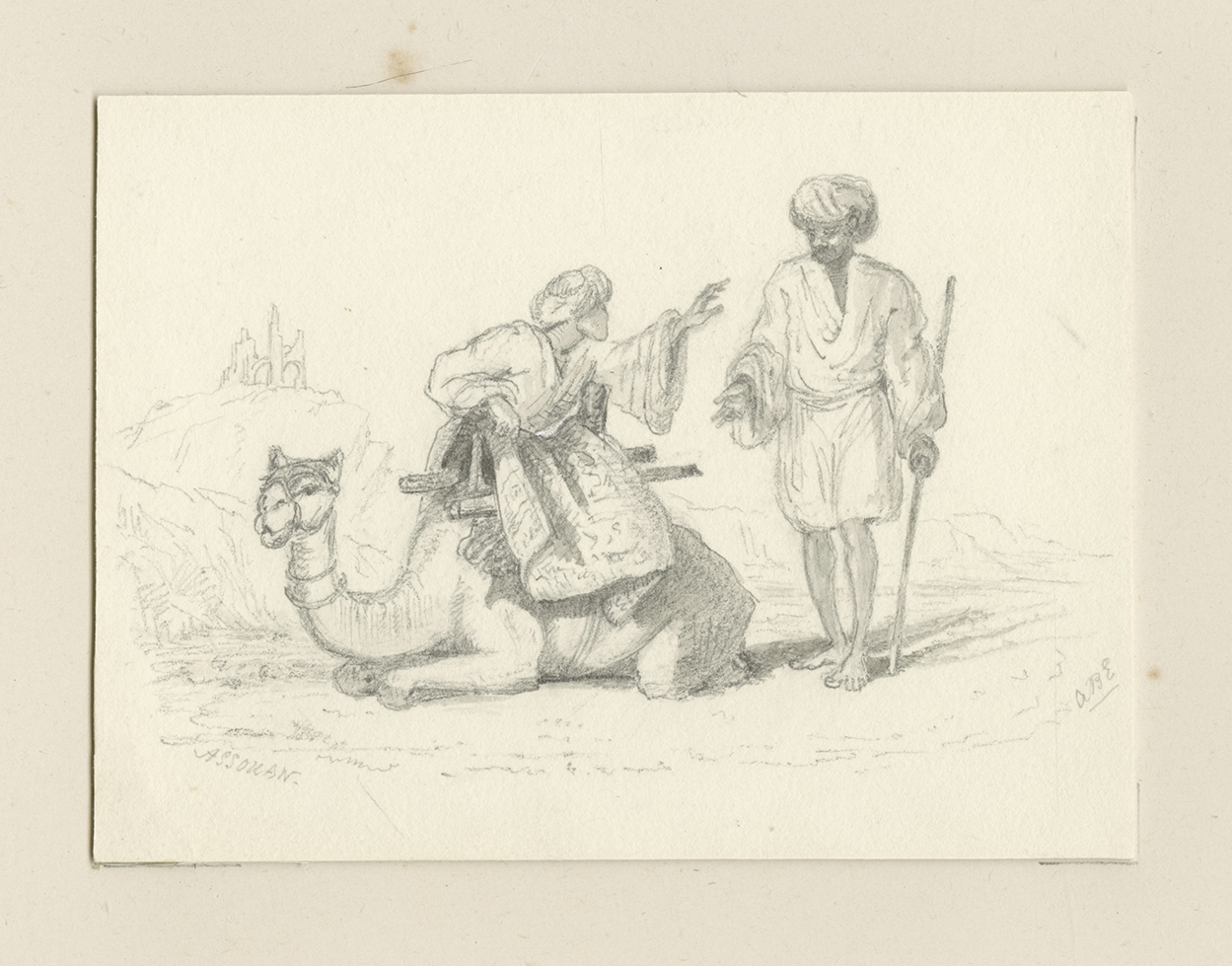
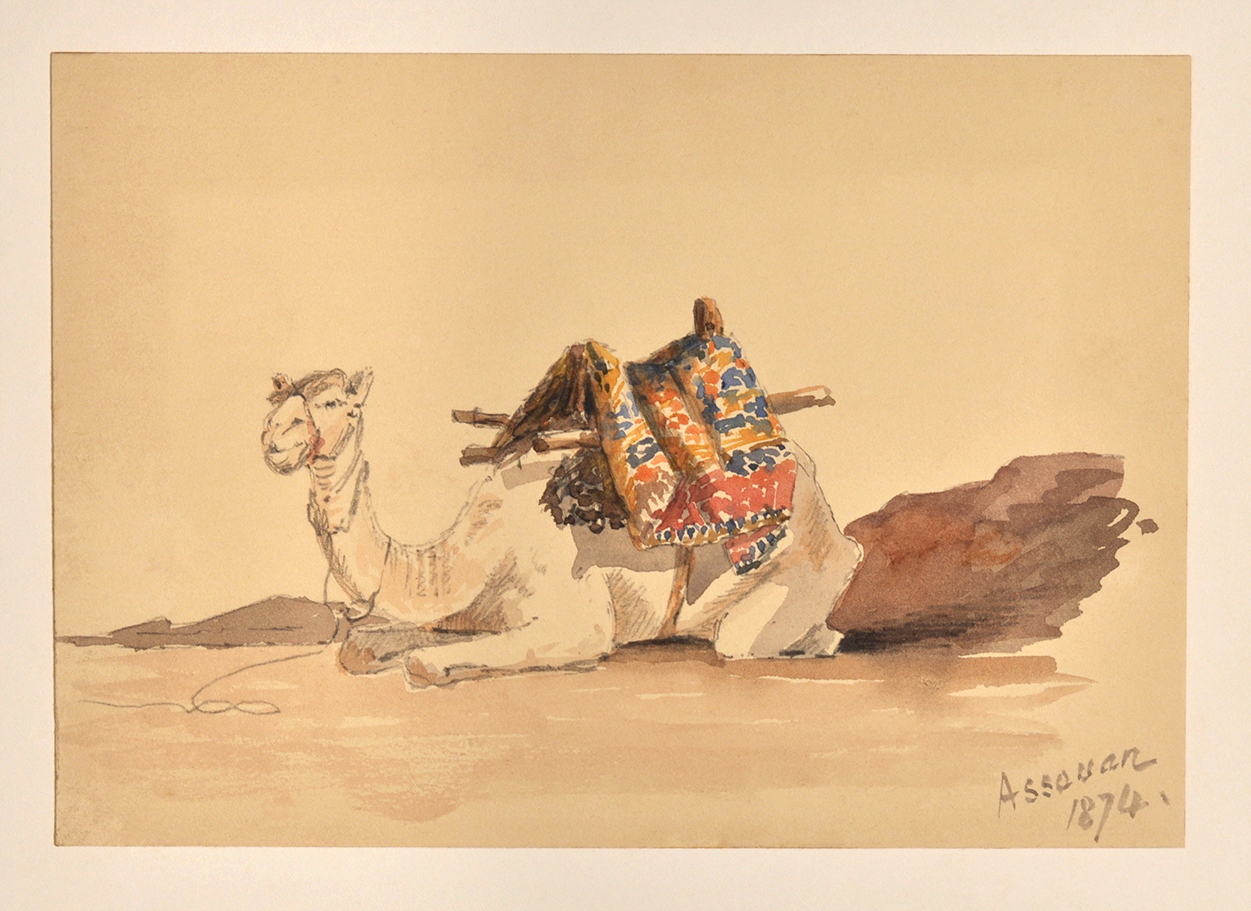
One of the first excavations undertaken by the EEF was that of Tell al-Maskhuta in the Nile Delta by Naville, who declared he had found the Old Testament ‘store city’ of Pithom; although there was little to support his claim, it brought him renown and proved critical to EEF fundraising.Footnote 65 Edwards was eager to distribute bricks from the site – true relics of the Bible – to their subscribers, requesting that 1,000 bricks be sent back to Britain, undeterred by the site destruction and oblivious to the logistical challenges.Footnote 66 But physical remains were not the only vectors that made encountering ancient Egypt possible, as exemplified by Edwards’s own experience. Egyptians themselves were part of the landscape, ‘living artefacts’ of the past,Footnote 67to be appreciated alongside the ruins of Egyptian antiquity but with no claim of ownership to them, an act of both erasure and appropriation. Whereas it had been more common for local peoples to be omitted entirely, as had been the case in the frontispiece of Description de l’Egypte published after Napoleon’s 1798–1801 campaign, Edwards inserted the local populace into her final memoir. As an example, the illustration accompanying the description of Aswan featured a camel alongside two figures with ruins in the background. In the original watercolour produced during her journey, however, only the camel appeared (Figures 5 and 6).Footnote 68 Regardless of the true motivation, the perception created was that both were integral to experiencing Egypt’s antiquity.
Redrawn sketch of ‘Camel at Assouan’ for publication. Griffith Institute Edwards MSS 2.1.20, ‘Two men with camel’. Reproduced with permission of the Griffith Institute, University of Oxford.

Edwards’s watercolour produced during her trip, ‘Camel at Assouan’. Courtesy of the Peggy Joy Egyptology Library.

Such visual reconstructions became embedded in the rhetoric of the period, but Edwards also incorporated acts of temporal displacement in her writing. A key example in her memoir occurred when describing a Coptic monk who had swum out to their boat near Minya in Upper Egypt, whom she immediately categorised as a ‘descendent of the true Egyptian stock’. Her justification, claiming ‘I think I see in him a different type to that of the Arab – something, however slight, which recalls the sculptured figures of the tomb of Ti’,Footnote 69 engaged in the same orientalist racial and historical framing that had long been used to dispossess the East of its heritage. She stripped the monk of his contemporary identity and recast him as a living relic of the pharaonic past, reinforcing her own authority as the expert mediator of ancient Egypt in the process. Crucially, her distinction between the Copt – whom she identified as a direct Christian descendant of the ancient Egyptians – and the implicitly Muslim ‘Arab’ allowed her, and her readers, to bypass Egypt’s Islamic history and draw a direct line from the pharaonic, biblical era to their own. Edwards would formalise this later, claiming ‘the truth probably is that as regards features … the ancient Egyptians differed very little, if at all, from the Copts of the present day’.Footnote 70 Ultimately, the people of Egypt were not positioned as inheritors of the past; they continued to be part of it, serving as another means by which that past could be encountered and ‘remembered’ by the West.
Edwards’s framing of the experience of Egyptian history as something ‘encounterable’ was crucial not only to her popular appeal, but also in opening male-dominated cultural spaces to others. Edwards often engaged with contemporary British social concerns in her publications and lectures, and as an avowed suffragette herself, it is unsurprising the condition of Victorian women was one such concern. In a lecture delivered during her American tour in the winter of 1889 and 1890, she emphasised the high social position of women in ancient Egypt in comparison to the relative strictures imposed on them by Victorian society, concluding:
I only hope that the picture I have drawn of the Social and Political Position of Women in ancient Egypt may not have excited sentiments of retrospective envy in the hearts of the ladies here present. I should indeed be grieved if they went home lamenting that they had not lived and died in the days of the Pharaohs, and that they are not at this moment mummies in the British Museum.Footnote 71
Women were actively recruited into the EEF. One of the more active ambassadors was Annie Barlow (1863–1941), who became the regional secretary for Bolton. Barlow came from a prominent family of cotton producers and was a member of the EEF nearly from its inception, and by 1883 she was collecting subscriptions for the Fund. Many subscribers requested that their share of excavated finds go to local institutions,Footnote 72 giving a sense of personal ownership and investment in Britain’s imperial presence throughout the globe. Barlow directed her shares to be given to the Chadwick (later Bolton) Museum. Fellow regional secretary Marianne Brocklehurst (1832–98), whom Edwards had met in Egypt (and competed with for the purchase of a mummy in Luxor),Footnote 73likewise founded the West Park Museum in Macclesfield with her own extensive collection of Egyptian artefacts.
Barlow travelled to Egypt herself in 1886, touring the sites the Fund had excavated and Edwards had publicised. Upon her return, she was given the opportunity to describe her trip at the sixth General Meeting of the EEF. She shared one of the highlights of her journey, which occurred in Tanis, in the north-eastern Nile Delta:
Here our most fascinating experience began. We had been taking some photographs, when two magnificent Bedouins joined us … They might have been kings of the East or dukes of Edom. Standing at least six foot three, clad in spotlessly clean cream-coloured garments flying in the wind, they leaned on their guns and bent their heads towards us with such gentle grace and dignity as one never expects to see again, and made a picture never to be forgotten … But they hardly disturbed the impression of that boundless plain; for they only seemed to cut us off from all sense of reality, and to shut us into the impression of the wonderful ruins we were approaching.Footnote 74
The two Bedouin Barlow encountered were presented as outside reality, not unlike the monk who swam to Edwards’s boat; rather, they were , an exotic aestheticised feature of the landscape, a landscape that Barlow had personally helped to uncover through her fundraising and her own contributions to the EEF. Poole’s wry response was also recorded: ‘Mr. Poole remarked that Miss Barlow had had a highly interesting experience in her journey to Tanis. She had not only seen the magnificent ruins of that venerable Temple, but she appeared to have made the acquaintance of the Patriarch Abraham himself.’Footnote 75
Conclusion: legacies of ‘remembering’
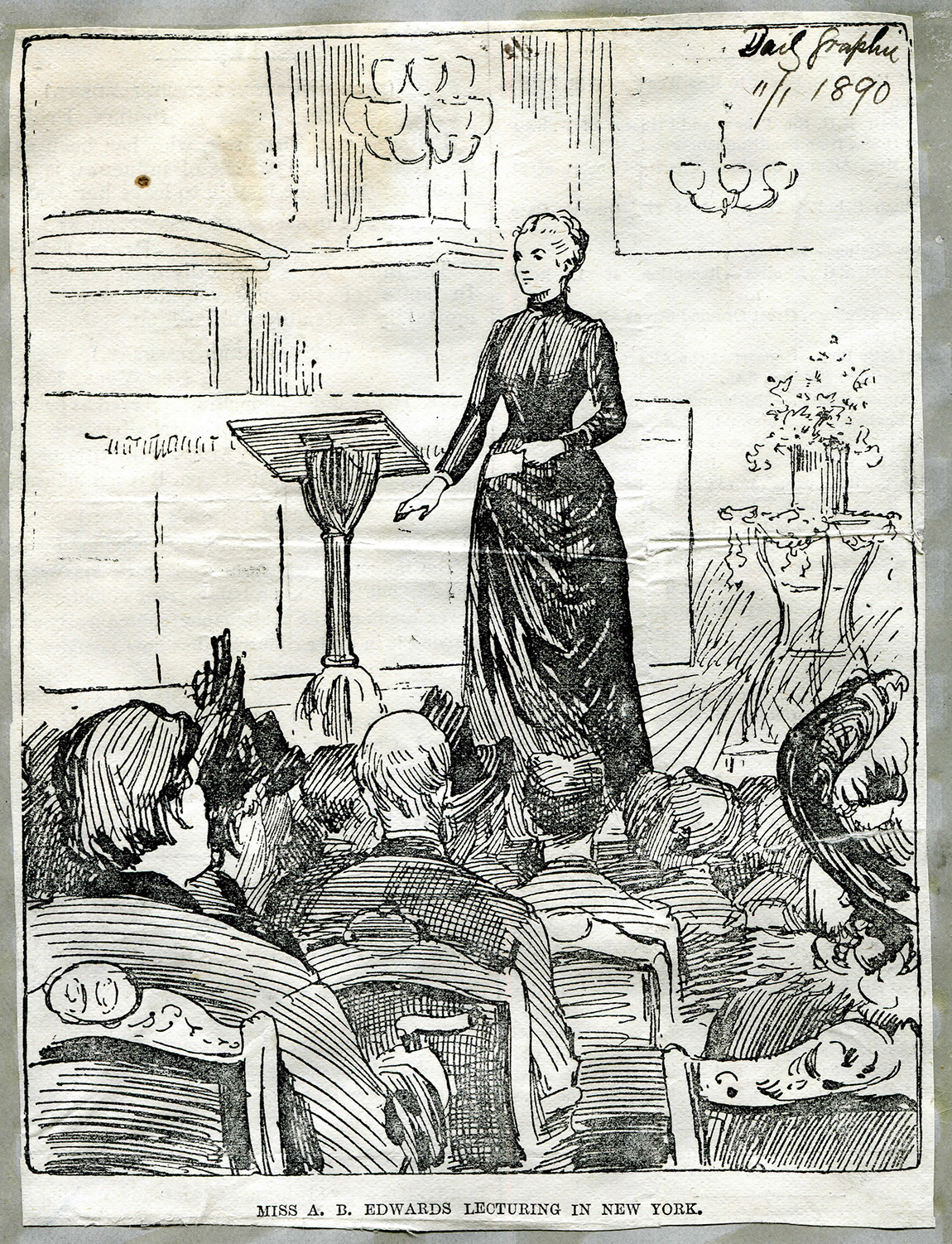
Edwards’s popularity continued to increase as she neared the end of her life, making her an international sensation. When she travelled to the United States for a series of public appearances, encouraged by Winslow of the American branch of the EEF, she continued to be met with huge crowds (Figure 7). In the nearly five months she spent lecturing in the United States in 1889 and 1890, she reportedly spoke before 100,000 people across sixteen states.Footnote 76 In the eyes of an international public, Edwards was no longer just an expert in ancient Egypt, but she was the expert. Some of her fiercest critics during this tour were other established figures in the field whose own public lectures were often met with critical silence. The American Frederic Cope Whitehouse (1842–1911) noted Edwards’s ability to ‘charm’ her audience, while at the same time denigrating her work and that of the EEF.Footnote 77 When she returned to England, she published a selection of these lectures in a volume which appeared only a month before her death in 1892, in which she again stressed the biblical connections between Egypt and Europe.Footnote 78 She had succeeded in breaking through the barriers that women faced in academia, and also bridged the divide between the public and the academy. But this had not been an end in itself and highlights the paradox of her legacy, one firmly rooted in the context of Western imperialism.
Press clipping of Edwards lecturing in New York. Somerville College, University of Oxford, SCSP/2/P/20/28. © The Principal and Fellows, Somerville College, Oxford.

Edwards’s work on Egypt emerged during a period of profound transformation in Victorian culture, where rising literacy and cheaper book manufacture created new audiences eager to participate in science and cultural production.Footnote 79 She encouraged those who could afford it to contribute to the mission of the EEF, regardless of class or gender, but as a means of her own legitimation in a male-dominated world. She remained critical of tourists who, like herself, travelled to Egypt to see ancient sites; the experience of Egypt was supposed to be mediated, preferably by the EEF and herself. By framing Egyptology through the lens of Britain’s imperial ethos – its scientific prominence, its moral responsibility for biblical and classical heritage, and its celebration of discovery – she made Egypt a site of British cultural superiority, exemplified by the transfer of artefacts out of the country. In connecting archaeologists, elite investors, and the general public, she was instrumental in promoting the shared interests of colonialism, inviting those traditionally outside the halls of power to become active participants in an imperial fantasy. Egyptian history was something real and tangible for the public that they could engage with and, for those who could afford it, help construct.
The popular ‘encounter’ Edwards offered, however, was only possible through processes of erasure. Despite the critical participation of Egyptians in Edwards’s and the EEF’s discoveries, they continued to be treated either as relics of the past or as aesthetic parts of the ancient landscape. Such relegation did not go unchallenged by Egyptians at the time, although the focus tended to be on the Egyptian government capitulating to British interests rather than the economic, social and cultural frameworks that individuals such as Edwards fixed within the discipline.Footnote 80 In her quest to give ancient Egypt a permanent home in the Western imagination, she imposed a ‘cultural dislocation’ not only on Egyptian antiquities and heritage,Footnote 81 but on the identities of Egyptians and the modern state itself. Their exclusion, however, was essential to the perpetuation of Edwards’s Egypt and her own place within it. Egyptians were part of the memory, not agents in the act of ‘remembering’. In the framework Edwards established – whereby the Western public was invited to participate in an Egyptian past that was curated, commodified, and disconnected from the Egyptian nation – Egypt was reserved for those who shared her vision of the past. This had a profound impact on the reception of Egypt in popular culture, especially in the adoption of concepts of encounter,Footnote 82 and how that reception shaped the discipline of Egyptology. The work, as Edwards noted, goes on; but so too does the challenge of dismantling the memory she helped to build.
Acknowledgements
I am grateful to Kate O’Donnell, the Assistant Archivist and Records Manager at Somerville College, University of Oxford, for her assistance in accessing the Edwards Archive held there. I would also like to thank the participants of the ‘Unofficial Diplomats’ workshop, funded by the Royal Historical Society and held at the University of Edinburgh on 12 December 2023, for engaging discussion, and especially Henry Stead for his helpful comments on a draft of this article, as well as the anonymous reviewers. All mistakes remain my own.

 Open access

