



The Healthy Hunger-Free Kids Act of 2010 enabled the US Department of Agriculture to set nutrition standards for all foods and beverages sold in schools( 1 ). This includes the Smart Snacks in Schools standards, which aim to improve the nutritional quality of competitive foods and beverages, which are snacks that are sold in schools outside the national school meals programmes. Traditionally, these competitive foods and beverages are high in energy, saturated fats and added sugars( Reference Turner and Chaloupka 2 ). The Massachusetts nutritional standards include a limit on energy, total fat, saturated fat, Na and sugar; whole grain requirements for snacks; and portion limits for beverages. Updating competitive food standards is particularly useful to improve students’ diets because they spend a significant amount of time at school and these snacks are readily available through à la carte lines, vending machines, school stores and sporting events( Reference Fox, Gordon and Nogales 3 ). Results from longitudinal observational studies suggest healthier competitive food policies have a beneficial impact on BMI and weight gain( Reference Sanchez-Vaznaugh, Sanchez and Baek 4 , Reference Taber, Chriqui and Perna 5 ). However, there is limited research on the effect of nutrition standards on the nutritional quality of competitive foods, or whether standards prompt food manufacturers to reformulate products.
Evidence from restaurant menu labelling policies and trans-fat package labelling suggest that policy changes encourage product reformulation. Results from studies of menu labelling in chain restaurants showed that restaurants reformulated entrées to be lower in energy, saturated fat and Na eighteen months after a county menu labelling law took effect and prompted fast-food chains to offer more healthful options( Reference Bruemmer, Krieger and Saelens 6 , Reference Namba, Auchincloss and Leonberg 7 ). Moreover, the labelling of trans-fat on the nutrition facts panel of packaged foods and beverages contributed to the near elimination of trans-fat from the US food supply( Reference Mozaffarian, Jacobson and Greenstein 8 , Reference Otite, Jacobson and Dahmubed 9 ).
Before Smart Snacks standards were implemented nationally in the 2014–2015 school year, Massachusetts passed a law to develop strict state-wide nutrition standards for competitive foods and beverages starting in the 2012–2013 school year (Massachusetts Law 105 CMR 225.000)( 10 ). The Massachusetts law set standards that were very similar to the current Smart Snacks standards( Reference Hoffman, Rosenfeld and Schmidt 11 ) and evaluation of their effectiveness may help to predict how well the national policy will change the nutritional quality of competitive foods and industry response.
School food-service directors can effectively implement competitive foods laws if food manufacturers supply sufficient variety in compliant foods. Previous quantitative analyses showed that a majority of foods and beverages available for purchase after the standards were implemented were compliant( Reference Hoffman, Rosenfeld and Schmidt 11 , Reference Gorski, Cohen and Hoffman 12 ) and evaluated the impact of the standards on school food revenues( Reference Cohen, Gorski and Hoffman 13 ). These analyses did not examine whether food manufacturers improved the nutritional quality of the products. Moreover, qualitative interviews with school food-service directors point to the need for food manufacturers to supply and market compliant products( Reference Rosenfeld, Cohen and Gorski 14 ). To do so, food manufacturers can either create new products that meet the competitive foods guidelines or reformulate existing products to meet the guidelines. Previous research has shown, however, that reformulated products that have similar-looking packaging with differing nutritional content confuse consumers and could potentially interfere with school messaging about good nutrition and health( Reference Harris, Hyary and Schwartz 15 ). Therefore, the aims of the present analysis were to: (i) quantify the extent to which food manufacturers reformulated products to be compliant with the new law; (ii) determine whether reformulated products were available outside schools; and (iii) assess the extent to which the standards improved nutrient composition of snacks available in schools.
Methods
Study population and follow-up
The NOURISH (Nutrition Opportunities to Understand Reforms Involving Student Health) study recruitment and participation have been described previously( Reference Hoffman, Rosenfeld and Schmidt 11 ). The sample includes thirty-six school districts from Massachusetts, with one middle school and one high school in each district. Middle schools had a mean of 636 (sd 239) students, and high schools had a mean of 1019 (sd 502) students. Middle schools had a mean of 29·6 (sd 17·8) % of students eligible for free or reduced-priced lunch, and high schools had a similar proportion (mean 24·7 (sd: 14·4) %). The percentage of non-White students in middle schools was 19·4 (sd 16·2) %, and high schools it was 19·1 (sd 16·7) %.
The overall response rate for the present study was 32·7 %, and food-service directors were compensated with $US 50 gift cards for their participation. At baseline (2012), thirty-seven districts agreed to participate, with non-consenting districts citing time or availability constraints as reasons for non-participation. State-wide student testing requirements delayed data collection until late spring in each school year. One consenting school district was excluded from this analysis because of incomplete baseline data. Two school districts had a shared cafeteria between the middle and high school, so data were entered twice for these districts to reflect availability of foods to both middle- and high-school students. Follow-up visits were conducted during lunchtime of spring 2013 (twenty-eight districts) and spring 2014 (twenty-one districts).
Nutrition information
Research assistants took digital photographs of all pre-packaged competitive foods and beverages in à la carte lines in cafeterias, school stores and vending machines (inside and outside cafeterias) during lunchtime to identify product names and brands. Product availability was determined each year as the number of unique products offered per school. All pre-packaged foods and beverages and à la carte cookies baked by the school from packaged dough were included in the analyses. Nutrition information was gathered from the package label and manufacturer websites designed for school purchases. When this was not available, nutrition information was ascertained from an online retailer (e.g. Amazon or Walmart). To ensure that nutrition information was accurate for the year the product was sold, research assistants used the Internet Archive WayBack Machine (www.archive.org) to access manufacturer websites for the year in which the food was sold. Nutrition information was also checked against the John C. Stalker A-List for each year, which lists vending and snack products that meet the Massachusetts competitive food and beverage standards each year (http://www.johnstalkerinstitute.org/alist). For all analyses, nutrition information was calculated for the total package size, not per serving size.
Reformulation and repackaging
Foods and beverages were considered reformulated if their nutrition information changed from 2012 to 2013 and/or 2014, but the product name and brand remained the same. Similarly, foods and beverages were considered repackaged if they were available in a different package size in 2013 and/or 2014 compared with what was available in 2012. Reformulation and repackaging could not be assessed for products that were sold only in one year (17 % of items).
Look-alike foods
For the present study, look-alike competitive foods were defined as reformulated items that had the same manufacturer and product name as items available in stores, but were made for distribution primarily in schools and were not available in grocery stores. Items were coded as look-alike when: (i) they were available in this sample of schools but were not for sale at Stop & Shop (a large local supermarket chain) or Walmart (a large national chain); and (ii) they had the same manufacturer and product name as items available in stores. Look-alike foods often had similar packaging to the non-school versions, but this was not a requirement by our definition. For example, a popular brand of chips (crisps) made a reduced-fat version with similar packaging that was available for purchase in schools, but not for sale in stores. Research assistants evaluated whether reformulated foods were available at local and national grocery stores by searching for them on the stores’ grocery shopping websites.
Statistical analysis
Multilevel linear regression was used to predict the mean change in nutrient composition (energy, total fat, saturated fat, Na, sugar, fibre, protein) from 2012 to 2013 and 2012 to 2014, adjusting for school level (middle or high school) and accounting for clustering of products within schools and districts. Models did not adjust for demographic covariates (percentage eligible for free/reduced-priced lunch, percentage racial/ethnic minority), as these were not statistically significantly associated with any nutrient outcomes.
To assess whether product reformulation changed during the study period, we calculated the percentage of reformulated foods and beverages in each year and used Pearson’s χ 2 to test for significant changes in reformulation between 2013 and 2014. Similarly, the percentages of repackaged foods and beverages were calculated and a χ 2 test was performed. An additional sub-analysis used multilevel linear regression models to predict the changes in the package size of chips and beverages between 2012 and 2014, adjusting for school level. Changes in other categories of foods were not evaluated due to lack of standardized packaging. We additionally conducted a sensitivity analysis for selection bias among school districts that met or exceeded the state percentage of racial/ethnic minority students or students eligible for free/reduced-priced lunch, and compared the changes in nutritional profile of foods with those in the full analysis. All statistical analyses were conducted using the statistical software package Stata release 14 (2015).
Results
Reformulation among foods and beverages
Among the foods available two years following the implementation of the Massachusetts nutrition standards, 8·1 % were reformulated by 2013 and 17·1 % were reformulated by 2014 (Pearson’s χ 2 =4·76, P=0·03; Table 1). Reformulation and repackaging were not widespread among beverages. Less than 1 % of all beverages were reformulated in 2014 and less than 1 % of beverages were repackaged over follow-up. However, the mean package size of beverages did decrease by 0·79 ounces (23·4 ml) between 2012 and 2014, after adjusting for school level (P=0·009).
Number and percentage of foods reformulated and repackaged after implementation of Massachusetts competitive foods standards in 2012Footnote *,Footnote †
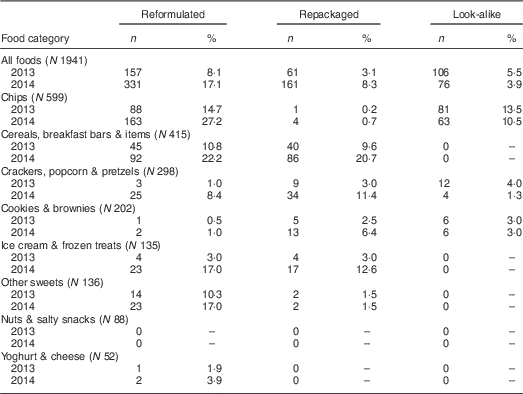
* Foods were considered reformulated if the product name remained the same, but the nutritional content changed. Percentages of foods reformulated and repackaged from 2014 include items that were modified between 2012 and 2013. For example, among all foods, 8·1 % were reformulated in 2013 and an additional 9·0 % were reformulated in 2014 (total 17·1 % by 2014). Look-alike foods are defined as reformulated items that were available in our sample of schools but were not for sale at local or national grocery stores. Look-alike foods have the same manufacturer and product name as items available in stores, but are made for distribution primarily in schools.
† These data were collected through photographic inventory of all competitive snacks sold in this sample of schools in Massachusetts. At baseline, thirty-six school districts participated; of those, twenty-eight districts participated in 2013 and twenty-one districts in 2014.
More than one-quarter (27·2 %) of the chips offered in schools after the law was implemented were reformulated. Chips remained the most frequent food category even after the implementation of the new law; roughly 30 % of all competitive foods were chips in 2013 and 2014. The mean package size of chips decreased by 0·13 ounces (3·7 g) between 2012 and 2014, adjusting for school level (P<0·001), although this was not due to new package designs because only <1 % of chips were repackaged after baseline (Table 1).
Ice cream, popsicles and frozen treats were the second most reformulated food type (see online supplementary material, Supplemental Table 1, for examples of foods/beverages in each category); 17·0 % of foods in this category were reformulated after 2012 (Table 1). Some ice cream, popsicles and frozen treats were also repackaged: 12·6 % by 2014 (Table 1). The proportion of ice cream, popsicles and frozen treats decreased from 17·8 % in 2012 to 4·0 % of available foods in 2013 and 11·0 % in 2014. It should be noted that number of total available competitive foods in each school decreased over time as study participation declined, thus the denominator in all prevalence estimates decreased (available competitive foods: 2012, n 1914; 2013, n 1136; 2014, n 805).
Cereals and breakfast bars and items were also reformulated: 10·8 % in 2013 and an additional 11·4 % by 2014 (Table 1). By 2014, 20·7 % of cereals and breakfast bars and items were also repackaged (Table 1). After the nutrition standards were implemented, cereals and breakfast bars and items became a larger proportion of the available competitive foods.
Look-alike foods
In this sample, 14·7 % of all reformulated foods were look-alike foods, defined as reformulated items that had the same manufacturer and product name as items available in stores but were made for distribution primarily in schools and were not available in grocery stores. Look-alike foods made up almost one in five (19 %) of all chips available in schools.
Nutrient changes to competitive foods and beverages
At baseline, before the Massachusetts law took effect, 27 % of competitive foods offered in this sample were chips, which had a mean of 157 kcal (657 kJ) and 6·7 g of fat (1·0 g saturated) per package. Ice cream, popsicles and frozen treats were the second most widely available category of competitive foods (18 %) in 2012, and had a mean of 163 kcal (682 kJ) and 6·4 g of fat (3·8 g saturated) per package.
After the standards were implemented, most schools were compliant with nutrient cut-offs. The standards placed a limit of 200 kcal (837 kJ) on snack items, and by 2014, 9·3 % of items exceeded this limit. The reforms also required a limit on percentage of energy from fat (≤35 % total energy from fat, <10 % total energy from saturated fat), which were exceeded by 7·8 and 10·3 % of foods and beverages, respectively. By 2014, only 1·4 % of milk beverages had greater than the maximum amount of 22 g sugar. With respect to sugar and Na limits, 6·8 % were >35 % sugar by weight and 14·7 % had >200 mg Na. Energy, total fat, saturated fat, Na and sugar decreased and fibre increased in competitive foods overall (Table 2) and when stratified by food category (all P<0·05 for all categories; Table 3), except among nuts and salty snacks. Among the beverages available after 2012, mean energy, Na and sugar decreased and mean protein per beverage increased (Table 2). The mean energy in the ‘other’ category of competitive beverages, which included lemonade and soda, decreased from 108 kcal (452 kJ) in 2012 to 73 kcal (305 kJ) in 2014, and the mean sugar content per container decreased from 25 to 16 g.
Mean nutrients and change in nutrient profiles of all competitive foods and beverages in thirty-six Massachusetts school districts before (2012) and after (2013–2014) implementation of competitive food and beverage standardsFootnote *,Footnote †,Footnote ‡
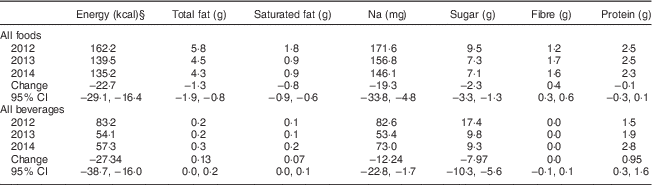
* Multilevel linear regression models were used to find the mean change in each nutrient comparing 2012 and 2014 (and its CI), adjusting for school level (middle or high school) and modelling clustering of items within schools and districts. At baseline, thirty-six school districts participated; of those, twenty-eight districts participated in 2013 and twenty-one districts in 2014.
† The means reported for each nutrient in each year are unadjusted for school level.
‡ These data were collected through photographic inventory of all competitive snacks sold in this sample of schools in Massachusetts. Nutrition information was gathered from the package label and manufacturer websites designed for school purchases. When this was not available, nutrition information was ascertained from an online retailer.
§ To convert to kJ, multiply kcal values by 4·184.
Mean nutrients and change in nutrients from competitive foods and beverages available at thirty-six Massachusetts school districts from before (2012) to after (2014) implementation of competitive food and beverage standards, according to food/beverage categoryFootnote *,Footnote †,Footnote ‡
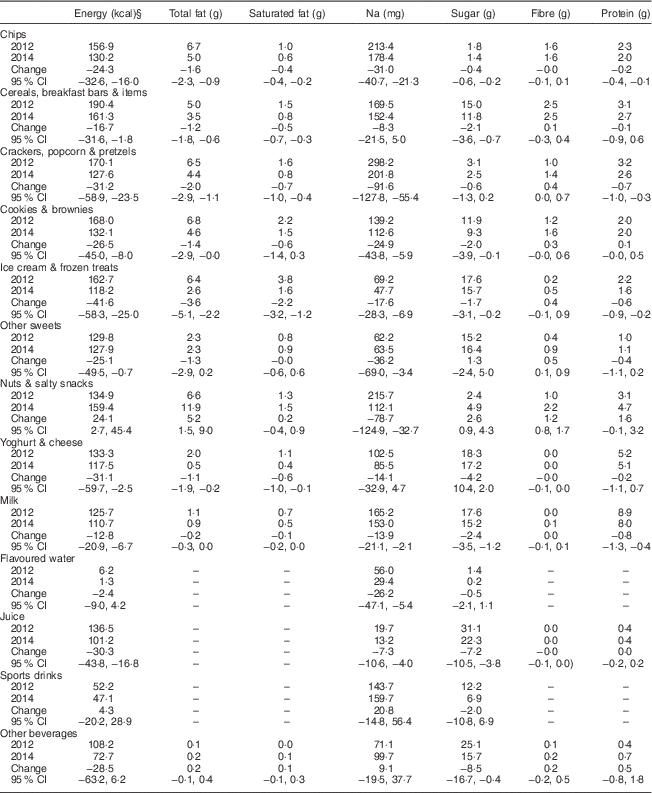
* Multilevel models were used to find the mean change in each nutrient comparing 2012 and 2014 (and its CI), adjusting for school level (middle or high school) and clustering of items within schools and districts. At baseline, thirty-six school districts participated; of those, twenty-eight districts participated in 2013 and twenty-one districts in 2014.
† The means reported for each nutrient in each year are unadjusted for school level.
‡ These data were collected via photographic inventory of all competitive snacks sold in this sample of schools in Massachusetts. Nutrition information was gathered from the package label and manufacturer websites designed for school purchases. When this was not available, nutrition information was ascertained from an online retailer.
§ To convert to kJ, multiply kcal values by 4·184.
Discussion
The present study is the first to evaluate the extent of competitive food reformulation in response to the implementation of new competitive food standards in middle schools and high schools. The results of the study indicate that product reformulation did play a role in helping schools make nutritional improvements after the competitive foods standards were passed. These product reformulations occurred after and perhaps in response to the competitive food regulations in Massachusetts, as well as potentially in anticipation of the national Smart Snacks law. Reformulation was uncommon among beverages, but a higher percentage of beverages were compliant with state nutrition standards at baseline( Reference Gorski, Cohen and Hoffman 12 ), and since skimmed milk, 100 % juice and plain water were available at baseline these products were not considered reformulated. There were no reformulations of sports drinks and sugar-sweetened beverages, which categorically would not be allowed for sale under the law.
A previous simulation study estimated that reformulating a competitive prepared food could improve students’ diet quality, but it did not measure actual nutritional changes in available foods( Reference Hur, Marquart and Reicks 16 ). Another simulated estimate among adults found that food reformulation may reduce disease-related mortality by up to 5·5 %, indicating its potential to improve the public’s health if used on a broad scale( Reference Leroy, Requillart and Soler 17 ). Reformulated meals have had a positive impact on healthy food consumption for children( Reference Tritt, Reicks and Marquart 18 ), which indicates that this may be one promising strategy for schools trying to increase their compliance with the standards.
Of the foods that were reformulated, 15 % were look-alike versions that were compliant with the standards but were not currently available for sale outside schools. This indicates that food manufacturers were able to successfully respond to strict state nutrition standards by changing the nutrient profile of foods within a short time frame, but these foods were not yet available on the wider market. A recent study found that parents and students cannot distinguish between healthier look-alike items and store versions of the same brands in terms of expected taste or healthfulness, and they have a similar intent to purchase( Reference Harris, Hyary and Schwartz 15 ). Manufacturers of look-alike foods and non-compliant foods are thus able to market to children in schools, potentially encouraging them to establish brand preferences for unhealthy products sold outside school with consumers’ expectations that they would have the same nutritional qualities as the snacks available at schools( Reference Cornwell, McAlister and Polmear-Swendris 19 , Reference Terry-McElrath, Turner and Sandoval 20 ). Although it is possible that brand preferences established outside school may lead children to purchase the reformulated look-alike versions in school, it is also possible that having these brands available may hurt schools’ credibility when teaching nutrition and wellness because of their association with less healthy versions( Reference Harris, Hyary and Schwartz 15 ). This issue would be avoided if schools sold only new, compliant products or if reformulated versions had clearly different packaging.
Changes to package sizes also helped school districts improve the nutritional quality of competitive foods. Package sizes decreased overall (with nutrient density remaining unchanged); the size of chip bags decreased by 0·13 ounces (3·7 g) between 2012 and 2014. The present data indicate that some foods were repackaged (8·3 % by 2014) to meet the competitive food standards. Many smaller package sizes were available at baseline but became more widely used after the standards were implemented, and these items were thus not counted as repackaged. The decrease in observed package size for beverages demonstrates that this component of the law was effectively implemented (8 fluid ounces (237 ml) for milk and 4 fluid ounces (118 ml) for juice).
Among this sample of Massachusetts schools, the implementation of nutrition standards for competitive foods and beverages was associated with improvements to the nutrient profile of foods and beverages, due in part to food manufacturers reformulating and repackaging products. The findings of this analysis support existing evidence that setting strict nutrition standards can positively impact the nutritional profile of school food( Reference Taber, Chriqui and Chaloupka 21 – Reference Chriqui, Pickel and Story 23 ). This nutritional information expands upon previous research that showed schools had on average 60 % of foods and 78 % of beverages compliant with the nutritional guidelines two years after implementation of the standards( Reference Gorski, Cohen and Hoffman 12 ). Therefore, the nutritional improvements observed in the present study suggest that even imperfect compliance with the law positively impacted the nutritional quality of competitive foods and beverages.
The strengths of the present study include data collection from both pre- and post-implementation of the competitive food law and its two-year follow-up to observe immediate and ongoing response to the policy. The study also has limitations that are important to identify. First, schools in the study may not be racially/ethnically or economically representative of all schools in Massachusetts, and schools in Massachusetts may not be generalizable to the rest of the country. However, in a sensitivity analysis among the few school districts in the study sample that met or exceeded the state percentage of racial/ethnic minority students or students eligible for free/reduced-priced lunch, results for changes in nutritional profile of foods were similar to those in the full sample. The study also did not capture non-packaged competitive food items such as fresh fruits and vegetables because they were served in non-standardized portions. These unpackaged foods were typically sold as part of the school meal programme and were not usually intended to be sold as competitive foods. We also did not capture competitive foods that were sold in the morning for breakfast, although we were able to document competitive foods sold in vending machines that would be available throughout the day. The present study did not analyse data on individual consumption or purchasing behaviour. Previous analyses using NOURISH study data did find decreases in schools’ competitive foods sales. However, students compensated for decreased competitive food purchases by selecting the healthier school meals, which overall is beneficial to both children and schools( Reference Cohen, Gorski and Hoffman 13 ). Future NOURISH studies will examine how product reformulation impacts individual student consumption as well. Lastly, the present study’s estimate of product reformulation is an underestimate of total reformulation, as it only assessed reformulation between 2012 and 2014. It is likely that products were reformulated prior to 2012, especially in light of Massachusetts previously considering competitive foods nutrition standards( 10 ).
Given that the national Smart Snacks standards are very similar to the Massachusetts competitive foods standards, national brands that reformulated products in this sample may reformulate more products to fit national standards. Thus, results of the present study suggest the Smart Snacks in School standards may have a similar impact on the nutritional profile of competitive foods nationwide. Because frequently packaging for reformulated versions of products is very similar to less healthy versions, researchers and state governments should continue to monitor the nutritional quality of competitive foods to ensure that they comply with the competitive foods standards. More broadly, it will also be important to investigate the contribution of competitive foods to children’s overall diet quality, as well as nutritional reforms to other food environments.
Acknowledgements
Acknowledgements: The authors thank the participating school districts and research assistants, especially Chloe Fishman and Kia Turner, who made this study possible. Financial support: Funding for the Nutrition Opportunities to Understand Reforms Involving Student Health (NOURISH) study was provided by Harvard Catalyst and the Healthy Eating Research Program of the Robert Wood Johnson Foundation. J.F.W.C. was supported by the Nutrition Epidemiology of Cancer Education and Career Developing Program (grant number R25 CA 098566). M.T.G.-F. is supported by the Agency for Healthcare Research and Quality (grant number T32HS000055). The funding agencies had no involvement in the study design, interpretation of data, article preparation, or the decision to submit the article for publication. The content is solely the responsibility of the authors and does not necessarily represent the official views of the Agency for Healthcare Research and Quality. Conflict of interest: None. Authorship: J.L.J. formulated the research question, analysed the data and wrote the article. J.F.W.C., M.T.G.-F., J.A.H., L.R., R.C., L.S. and E.B.R. designed the study and carried it out. All authors read and edited the manuscript. Ethics of human subject participation: This study was conducted according to the guidelines laid down in the Declaration of Helsinki and all procedures involving human subjects were approved by the Harvard University Institutional Review Board. Written informed consent was obtained from all subjects.
Supplementary Material
To view supplementary material for this article, please visit https://doi.org/10.1017/S1368980017003445



