The subject of electoral reform for the British House of Commons has returned dramatically to the political agenda. In the wake of the scandal over MPs' expenses that rocked British politics in May and June 2009, a wide range of projects for constitutional and other institutional reform have been dusted off, not least those relating to reform of the electoral system. Some voices have argued for limited reforms, such as the introduction of the alternative vote (AV) system within the existing constituency structure. Others have urged the wholesale adoption of one or other form of proportional representation. Others still have advocated intermediate options such as the ‘AV plus’ system that was proposed in 1998 by the Independent Commission on the Voting System chaired by Lord Jenkins.
This article asks what the prospects are for the adoption of at least a significant element of proportional representation (PR) for elections to the House of Commons. Useful inquiries into this question, based largely on domestic evidence, have been offered recently by Dunleavy and Margetts and by Blau.Footnote 1 Here I explore the lessons of international evidence: major reforms have been enacted or attempted in a number of long-established democracies in recent years; these episodes offer valuable insights into the routes by which reform can occur and the factors likely to promote success or failure.
The article was written before the expenses scandal erupted. I have chosen not to update it in light of those recent events: aside from this introduction, the text is unchanged.Footnote 2 The article thus offers a record of how the world seemed, at least to one observer, before Westminster's standard assumptions were turned upside down. Some of the judgements might now (or soon) appear misguided, but it is too early at the time of writing to be sure. I venture that, in fact, most of the analysis is likely to turn out to be accurate. Even if that proves not to be so, it will be useful for historians to know what seemed reasonable at the time.
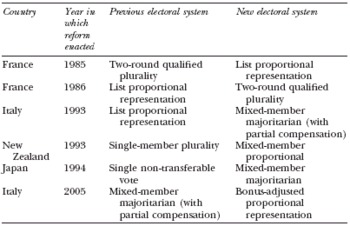
In drawing on the international evidence, I identify four possible paths to electoral reform. These cover all the cases of major reform to national lower house electoral systems in established democracies since 1960 as well as a number of salient recent near misses in Canadian provinces. I label these paths majority imposition, minority bargain, mass revolt and mass disillusionment. I argue four main points. The first is uncontroversial and will not require further elaboration: major electoral reform in the national lower house is difficult. As Table 1 shows, it has occurred just six times in established democracies in the last 50 years.Footnote 3 The remaining points are the subjects of the rest of the article. The second is that those reforms that have occurred have mostly followed the majority imposition or mass revolt paths, but that reform by neither of these paths is likely in the UK. Of all the judgements in this article, it is the argument that politicians in the UK are unlikely to be pushed into major electoral reform by a spasm of popular disquiet that appears most contentious in light of recent events. Third, I argue that the fact that the two remaining paths – minority bargain and mass disillusionment – have generated little reform to date is no accident: the barriers to successful reform by these routes are high. Fourth, the evidence suggests, however, that reform by these two routes is possible if the circumstances are right. At least before the expenses scandal, it was by these paths that reform in the UK appeared most likely. On the basis of all these considerations, I argue the international evidence suggests that adoption of PR for the House of Commons is unlikely, but not impossible.
Major Electoral Reforms in Established Democracies Since 1980

Note: I define major reform as a shift from one electoral system type to another. Andrew Reynolds, Ben Reilly and Andrew Ellis, Electoral System Design: The New International IDEA Handbook, Stockholm, International Institute for Democracy and Electoral Assistance, 2005, pp. 35–118, identify 12 such types. The system of bonus-adjusted proportional representation adopted in Italy in 2005 does not fit readily into any of these types, so I count it separately.
I begin by examining the general dynamics of each of the four possible reform types. For two reasons, I then focus in more narrowly upon the likely outcome of an electoral reform referendum: first, as I shall argue, a referendum is an almost inevitable component of any process leading to major reform; second, its outcome is very difficult to predict from domestic evidence alone. Finally, I draw out overall implications.
MAJORITY IMPOSITION
In the simplest path to reform, a majority party concludes that an alternative electoral system would better serve its power interests than the status quo and therefore enacts it over the opposition of other parties. Of the six cases of major reform outlined in Table 1, the case that fits this most closely is the French reform of 1985, when the Socialist government led by President François Mitterrand, seeing it was heading for resounding defeat in the following year's National Assembly elections, replaced the two-round system established in 1958 with PR. It hoped thereby to minimize its own seat losses and give Jean-Marie Le Pen's National Front a foothold in the legislature, which would hamper the centre right's prospects of forming a secure majority.Footnote 4 The new system operated largely as expected, but the centre-right nevertheless secured a narrow majority in 1986 and reversed the reform later that year. Here again, the power interests of the governing parties predominated.
But this reform path is not likely to lead to PR in the UK. First, as Blau shows, such reform is unlikely to serve the power interests of either majority party, even allowing for the status quo's current significant bias against the Conservatives.Footnote 5 Second, manipulation of the electoral system for partisan gain is subject to legitimacy constraints, or what Quintal calls ‘costs of voter affect’: voters who see a party as trying to rig the system to its own benefit are likely to react by taking their votes elsewhere.Footnote 6 France is unusual: electoral reform has occurred there more often than anywhere elseFootnote 7 and has been seen as part of the normal political game.Footnote 8 Elsewhere, imposing reform has not proved so easy. Italy's ruling parties were punished by voters for forcing through electoral reform in 1953;Footnote 9 Germany's two major parties have shied away from majoritarian reform both times they have formed a grand coalition, in part because imposing a change designed to harm the smaller parties ‘would have been considered by many as little short of an assault on democracy itself’.Footnote 10 Governing parties facing the prospect of heavy defeat in Westminster democracies – as in Canada in 1984 and 1993 and New Zealand in 1972 and 1990 – have often changed their leaders in the hope of reviving their fortunes, but have never attempted major electoral reform; in part at least this probably reflects their expectation that such reform would lose them all public credibility.
Pinning down exactly when these legitimacy constraints will be high and when low is difficult, but it appears that history is the most significant factor. Where an electoral system has survived over a prolonged period, it is likely to be seen as part of the fundamental architecture of the system; manipulation of it for short-term partisan gain is therefore less likely to be tolerated. Such is the case in the UK, where the fundamentals of the electoral system have been unaltered since 1885. The French route to reform is thus unlikely to be viable in the UK.
MINORITY BARGAIN
In the second path, a minor party demands electoral reform as a condition for joining a governing coalition; the major party accedes to this demand not because it wants electoral reform, but because it wants to gain office and pursue its wider policy agenda. Looking simply from the UK perspective, this appears to be the most likely reform scenario: a hung parliament in which no single party can form a government on its own is a definite possibility. The Liberal Democrats have made it clear that electoral reform will be among their key demands in any post-election negotiations.
There is certainly international evidence that such coalition considerations have blocked reforms sought by large parties. The veto power of small coalition parties has prevented all but minor adjustment of the Israeli electoral system since 1949,Footnote 11 and one reason for the lack of reform in West Germany during the grand coalition of the late 1960s was the large parties' fear of upsetting the small Free Democrats.Footnote 12 Coalition negotiations have also led to minor electoral reforms, notably in Austria in 1971, West Germany in 1985 and Norway in 1988.Footnote 13 It is harder, however, to find any major reform enacted via this route. The closest case is the Italian reform of 2005, when the mixed-member system established in 1993 was replaced with a bonus-adjusted proportional system under which the largest party or coalition is automatically awarded 54 per cent of the lower house seats. This reform was initiated by the smallest party in the governing coalition, the Christian Democrats (UDC), which ideally wanted a return to the proportional system of old. But the UDC did not entirely get its way: the majority bonus, which the larger coalition partners insisted on, significantly dilutes proportionality and maintains the bipolar logic that the UDC dislikes.Footnote 14
The paucity of clear cases of reform of this type points to the fact that such reform faces significant barriers. Large parties retain strong bargaining power. Small parties may be reluctant to push too hard, for fear of appearing overly self-interested. This may explain why small parties have greater power to block reform than to force it through: given that voters in normal times take the existing electoral system for granted, arguing for the status quo is less likely to incur costly voter affect than is arguing for change.
In the UK, neither major party is likely to concede anything more than a review of the electoral system, followed by a referendum. In the face of such demands, the Liberal Democrats could not plausibly insist upon parliamentary enactment of reform without a popular vote: they agreed to the referendum path at the 2001 and 2005 elections, and a referendum remains central to their general package of constitutional renewal.Footnote 15 Thus, any reform by this route could occur only if, first, a review body recommended it, second, a referendum was then called to decide the issue, and, third, reform was accepted by a majority of the British electorate. Provided the Liberal Democrats are able to bargain for an impartial review body, international evidence suggests the first of these requisites is likely to be met: review bodies in New Zealand in 1986 and in five Canadian provinces have all recommended proportional systems; none has advocated the status quo or a variant thereof. British experience after 1997 urges caution on the second requisite, but in the event of a hung parliament, the Liberal Democrats' bargaining power would be stronger and the government would find it much harder to back out. The third requisite is crucial and requires the most careful examination; I assess it in the section below on referendums.
MASS REVOLT
Though models of electoral reform have often focused narrowly on politicians,Footnote 16 in fact the three most notable reforms of recent decades – those in Italy, Japan and New Zealand in 1993–94 – all involved substantial popular pressure. In Italy, reform was imposed by citizen-initiated referendum; in theory, parliament could have responded by enacting a new system similar to the old, but it recognized that this would only court public fury.Footnote 17 In New Zealand, a combination of missteps by some politicians and genuine interest in reform among others led to a referendum and the passage of electoral reform that only a minority of politicians wanted.Footnote 18 In Japan, reform occurred without a referendum, but one of the significant factors causing the Diet majority to accept it was the fear of a voter backlash if they did otherwise.Footnote 19
Such developments are surprising: electoral reform does not normally fire the public imagination. Our task is to understand the circumstances in which such public pressure can arise – and whether it is likely in the UK. As Shugart argues, reform pressure is more likely if the existing electoral system is inherently prone to generating problems: that is, if it is ‘extreme’ in one of several possible directions.Footnote 20 That is true in the UK, where the electoral system is highly pluralitarian, displaying a strong tendency to turn a plurality of votes into an absolute majority of seats. But reform pressure is likely to develop only if those inherent weaknesses become manifest in specific instances of ‘systemic failure’.Footnote 21 What sorts of systemic failure may trigger mass revolt against the status quo?
Shugart highlights two types of failure: ‘wrong-winner’ outcomes, in which a party coming second in votes wins the majority of seats, and elections generating lopsided majorities for one party. Yet the evidence does not suggest that such outcomes generate sufficient popular pressure to force reform. Siaroff finds that though wrong-winner elections have occurred in nine countries, they have been followed by electoral reform only in two.Footnote 22 The two reform cases are a marginal adjustment to the Maltese electoral system in 1987 and the major reform in New Zealand in 1993. The Maltese reform was generated within the political elite without much popular involvement. In New Zealand, while it was popular pressure that eventually forced change, this arose long after the wrong-winner election outcomes of 1978 and 1981 and was largely a response to other concerns; the effect of the wrong-winner outcomes themselves was largelyconfined to Labour Party activists.Footnote 23 Perhaps the most egregious case of lopsided majorities, meanwhile, is that of the Canadian province of Prince Edward Island, where five of the last six elections have given one party over 80 per cent of the seats, though never with a vote share above 60.7 per cent. Yet these results generated no significant public reaction. As I discuss further below, a referendum on mixed-member proportionality (MMP) in 2005 gained just 36.4 per cent support.
In fact, all three cases of reform by elite–mass interaction have involved major failure not just in the electoral system specifically, but in the political system as a whole. In Italy and Japan, this was corruption. Italian politics was rocked from 1992 onwards by the Tangentopoli scandal that uncovered massive networks of bribes and kickbacks among politicians, businessmen and mafia.Footnote 24 In Japan the Recruit scandal of 1988–89 was rapidly followed by the Sagawa Kyubin scandal of 1991–92, revealing huge illegal donations from business to politicians.Footnote 25 In both cases, the problem appeared systemic: politicians across the political spectrum were implicated; merely changing whom they voted for therefore did not offer voters a way out. In New Zealand, meanwhile, the main problem was a perceived lack of democratic control over government: successive governments in the late 1980s and early 1990s introduced huge economic restructuring that voters had not expected.Footnote 26 As in Italy and Japan, the problem appeared systemic: the economic reforms were initiated by a Labour government but then intensified by a National government; these being the two major parties, voters had no realistic alternative to turn to within the existing system.
Systemic failures such as these are unlikely to generate pressure for electoral reform in the UK. Certainly, there is concern over corruption, but PR would not help tackle it. Corruption in both Italy and Japan was plausibly seen as facilitated by the lack of alternation of governing parties, blame for which could be pinned partly on the electoral system. The British system of single-member plurality (SMP), by contrast, has typically been effective in generating alternation, and while this capacity might be impaired by the rise of small parties and the decline of the ‘cube law’,Footnote 27 it would be impaired more by adoption of PR. The Japanese electoral system could, additionally, be criticized for encouraging intra-party competition that forced politicians to make non-programmatic appeals to voters based on clientelism. Again, this is not true of the UK system. In fact, SMP is generally seen as providing effective accountability,Footnote 28 which is the best guarantee any electoral system can provide against corruption. New Zealand, meanwhile, was by some margin the most majoritarian democracy in the world in the 1980s:Footnote 29 in addition to SMP, it had a unicameral legislature, unitary state structure, no written constitution, and – until 1990 – no bill of rights. Thus, once politicians started to ignore their electoral mandate, they faced no effective checks and balances.Footnote 30 The UK – with its bicameral legislature, quasi-federal structure and (weak) bill of rights – is not so extreme. Furthermore, leading politicians in New Zealand displayed a quite exceptional disregard for public opinion and forced the economy through an almost unparalleled revolution. Such actions are unlikely to be repeated often. The Thatcher revolution in the UK was mild in comparison and did not spawn interest in electoral reform outside narrow elite circles. In the era of focus-group politics there appears little prospect of another such radical government any time soon.
Thus, though it cannot be ruled out that some problem of great import to voters may arise in the UK that generates strong public pressure for electoral reform, it is not clear what that problem might be: no plausible candidate emerges from the existing cases.
MASS DISILLUSIONMENT
The final potential path to reform is generated by increasing voter disillusionment with politics. In the cases of mass revolt discussed above, specific events generated a spike in voter antipathy towards existing political arrangements. In cases of mass disillusionment, by contrast, there is no such short-term trigger. Dalton argues that the growth of disillusionment with and apathy towards politics among voters over recent decades – which he associates with the rise of postmaterialist values – may lead to rejection of existing institutions, including electoral systems, such that voters may be more and more drawn to the idea of reform even in the absence of specific strong systemic failures.Footnote 31 Politicians, meanwhile, may increasingly view promises of institutional reforms as an effective ploy for attracting votes, and will therefore give voters opportunities to express their reform wishes. In this scenario, therefore, vote-seeking politicians collude in undermining the status quo in response to pressure from popular opinion that is much milder than was seen in Italy, Japan and New Zealand in the early 1990s.
Some evidence of these mechanisms does indeed exist. Postmaterialists were more likely than others to back electoral reform in New Zealand in 1993.Footnote 32 Politicians have begun to respond to voter disillusionment with policies on institutional reform. British Columbia's premier, in proposing to set up a citizens’ assembly on electoral reform, argued for the need to ‘re-establish the critical link between our democratic institutions and those they are supposed to serve’.Footnote 33 The similar citizens' assembly established in Ontario was born of a manifesto promise designed to attract votes.Footnote 34
Nevertheless, evidence that this mechanism may generate actual reform remains very limited. No reform has occurred by this path. The British Social Attitudes survey shows that, while voters' trust in politicians has steadily declined, there has been no significant change in attitudes to electoral reform, as measured by two distinct questions, since 1983.Footnote 35 Several recent referendums in Canadian provinces offer further evidence, which I consider below.
ELECTORAL REFORM REFERENDUMS
So far I have considered the likelihood of potential reform paths in the round. For two reasons, however, the possible outcome of any referendum on electoral reform demands particular attention. First, a referendum appears to be an almost inevitable element of any process leading to electoral reform in the UK. Marshall argues that a constitutional convention requiring a referendum before electoral reform may now exist.Footnote 36 Even without a firm constitutional convention, the analysis above suggests that any plausible route to reform would require a referendum: a majority party that imposed reform without a popular vote would risk incurring significant costs in voter affect; a minority bargain is unlikely to yield more than a referendum commitment; any party responding to a specific mass revolt or to general voter disillusionment would promise a referendum rather than outright reform.
The second reason for focusing attention upon referendum dynamics is that the outcome of a referendum is very difficult to predict on the basis of domestic evidence alone. Many polls have been taken on electoral reform, but their results are highly dependent upon the question asked, reflecting the fact that voters simply do not think about electoral systems very much.Footnote 37 The spur-of-the-moment ‘preferences’ expressed to pollsters are not settled and may therefore change in a referendum situation, so that likely voter behaviour in a referendum cannot be extrapolated straightforwardly from the polling data. Farrell and Gallagher seek to overcome this problem through focus group research. This is a valuable exercise, but even it does not replicate referendum conditions.Footnote 38
Table 2 shows the results of every referendum on major electoral reform held at national or state level in democratic contexts.Footnote 39 As can be seen, 19 such referendums have occurred. At the aggregate level, these cases give cause for a mildly positive assessment of reform likelihood. On the one hand, of the 18 referendums with known outcomes,Footnote 40 only five have led to reform. On the other hand, ten of the 18 have yielded majority votes for change (in five, reform was blocked because a supermajority or turnout threshold was not met). If we can assume that no special thresholds would be introduced in the UK – such thresholds gained a bad name in the context of the Scottish devolution referendum of 1979 and have not been used since – then the aggregate evidence indicates that a referendum on electoral reform would be more likely to pass than not. Table 3 suggests that it is harder for a referendum to pass if it increases proportionality – as would be the case in the UK – than if it reduces it, but the sample is too small for any great weight to be placed on this pattern.
Electoral Reform Referendums

BV = block vote; CV = cumulative vote; MMM = mixed-member majoritarian; MMP = mixed-member proportional; PR = proportional representation; SMP = single-member plurality; STV = single transferable vote; TRS = two-round system.
Sources:-David Butler and Austin Ranney (eds), Referendums Around the World: The Growing Use of Direct Democracy, Basingstoke, Macmillan, 1994, pp. 110–29 and 265–84; Bruno Kaufmann and M. Dane Waters (eds), Direct Democracy in Europe: A Comprehensive Reference Guide to the Initiative and Referendum Process in Europe, Durham, NC, Carolina Academic Press, 2004, pp. 141–55; Suchmaschine für direkte Demokratie (referendum archive), at www.sudd.ch; Initiative and Referendum Institute, ‘Statewide Initiatives Since 1904–2000’, at www.iandrinstitute.org; Elections BC, Statement of Votes: Referendum on Electoral Reform, May 17, 2005, Victoria, Elections BC, 2005; Elections BC, results of 2009 referendum, at www.elections.bc.ca; Elections PEI, referendum results, at www.electionspei.ca; Elections Ontario, referendum results, at www.elections.on.ca; Italian Ministry of the Interior, results of 2009 referendum, at www.elezioni.interno.it/; ‘Referendum elettorale 21–22 giugno 2009’, La Repubblica, at www.repubblica.it/speciale/2009/referendum/index.html?refresh_cens; David H. Everson, ‘The Bullet Bites the Dust: Will the Cutback Amendment Bring Competition and Accountability?’, Illinois Issues, 7: 3 (March 1981), pp. 10–15; Andrej Auersperger Matic, ‘Electoral Reform as a Constitutional Dilemma’, East European Constitutional Review, 9: 3 (Summer 2000), pp. 77–81.
Patterns in Electoral Reform Referendums

Note:-the Andorran referendum is excluded because information on its content is unavailable. That in Slovenia is excluded because multiple options were offered.
But we can say more about these referendums than identify aggregate patterns. Different referendums took place under different conditions, corresponding to different types of reform process. The greatest number took place in the context of mass revolt: three clearly belong to this category, including the first Italian case and those in New Zealand and Illinois; the remaining Italian cases and the Romanian case also essentially fit this type. These cases encompass three of the five instances of enacted reform and seven of the ten cases of majority support for reform. Such referendums are called in significant part because of mass pressure, and it is therefore hardly surprising that they consistently generate pro-reform majorities. Yet if, as I have argued, this reform path is unlikely to operate in the UK, these cases offer little guidance as to the likely outcome of a referendum in the UK. Two further referendums – those in Ireland in 1959 and 1968 – involved attempts at majority imposition constrained by the constitutional requirement that electoral reform be passed only by referendum. Both attempts failed. As we would expect, citizens are less willing to endorse reform initiated by the ruling elite than by popular pressure. Again, however, this scenario is unlikely to arise in the UK, so offers limited relevant evidence.
The most relevant information comes from referendums belonging to the two reform paths that, as I argued above, are most likely in the UK: minority bargain and mass disillusionment. No actual referendums have followed exactly the minority bargain path that isrelevant for the UK, but in four cases – the Swiss referendums of 1900, 1910 and 1918, and the Slovenian referendum of 1996 – minority parties have brought their reform demands to the agenda by means of citizen-initiated referendums. As I suggested above, the four recent Canadian cases – in British Columbia in 2005 and 2009, Prince Edward Island in 2005 and Ontario in 2007 – come close to the route of mass disillusionment.Footnote 41 Of these eight referendums, only one – that in Switzerland in 1918 – led to reform. One more, in British Columbia in 2005, returned a strong pro-reform majority that was thwarted by a high supermajority threshold, while the Slovenian case allowed for multiple reform options and thereby generated an ambiguous outcome.Footnote 42 The five remaining cases generated majorities for the status quo. These referendums thus do not present a strong record of reform success.
What explains this record of conservatism? Voters deciding how to vote in a referendum can rely on two different types of information: either knowledge of the issues in question, or cues from actors whose views they trust.Footnote 43 Polling evidence shows most voters' knowledge of electoral system issues to be very limited, which may influence a referendum outcome in two ways. According to one approach, voters are likely to respond to short-term cues in the referendum campaign and question. As LeDuc puts it, ‘Referendums on issues such as these with which the mass public is largely unfamiliar often tend to be highly volatile and therefore unpredictable events.’Footnote 44 Authors writing specifically about a prospective electoral reform referendum in the UK have emphasized this mechanism.Footnote 45 According to the second approach, meanwhile, voters faced with an issue about which they know little will tend, especially in the absence of reliable cues, to opt for the status quo.Footnote 46 These two mechanisms may, of course, co-exist: some voters may respond to short-term cues while others hedge towards the status quo.
In the three Swiss referendums, it appears that partisan cues were crucial: voter behaviour was strongly shaped by party positions;Footnote 47 the first two referendums failed because reform advocates commanded too little partisan support; their success in 1918 reflected in part a rise in that support. This may suggest a general explanation for the poor record of referendums under the minority bargain and mass disillusionment categories: the parties that support reform tend to be in the minority. With partisan dealignment, however, the number of strong partisans has declined sharply,Footnote 48 and we should expect the effect of party cues to be weaker. Evidence from the recent Canadian referendums suggests that the key factor is the status quo bias of uncertain voters: in British Columbia in 2005, fully 72 per cent of voters claiming to know something about the proposed single transferable vote (STV) system supported it, while only 53 per cent of those knowing nothing about it did so;Footnote 49 similar patterns emerged in Ontario.Footnote 50 The same Canadian studies suggest two further important points. First, voters who knew about the citizens' assemblies and recognized them as composed of ordinary voters were more likely to support reform, suggesting that a pro-reform cue can be built into the reform process.Footnote 51 Second, it would be wrong to say that voters entirely lack stable views on electoral systems: there are some aspects about which their views are clear. In particular, prospects for reform were diminished in Ontario by the fact that the MMP system on offer entailed an increase in the number of MPs and involved closed party lists.Footnote 52 In an era of distrust towards parties and politicians, such features do not go down well.
What do these findings suggest for the UK? First, prospects for a successful reform referendum may depend upon the reform option available: reform advocates should certainly avoid an increase in the number of MPs; it appears they should also eschew closed party lists. Second, the reform process preceding a referendum may also make a difference. The Liberal Democrats have proposed a constitutional convention to prepare a new written constitution; they would be well advised to extend this mechanism to the design of a new electoral system and to ensure the convention is as free as possible of established party interests. Third, however, reform will be hobbled to the extent that voters remain ignorant of the system proposed. Opponents of reform in the main parties and sections of the media can be expected to try to stifle discussion of the issue. How far they are likely to succeed cannot be predicted from the international evidence alone, but to the extent that they do succeed we can expect the status quo bias of uncertain voters to present a significant barrier to securing a vote for change.
In short, evidence from referendums around the world suggests that any referendum on the introduction of PR in the UK will face an uphill struggle, but it also suggests a pro-reform majority is possible. The outcome will be influenced by the nature of the reform process and of the reform option on the table.
CONCLUSIONS
Major electoral reform rarely occurs at the level of the national lower house in established democracies. Nevertheless, it does happen occasionally: there have been six instances in the last 50 years. I have reviewed four possible routes to major electoral reform in the UK. Two of these – reform by majority imposition and mass revolt – are unlikely to generate a significant shift from SMP towards proportionality in the UK context. That these routes encompass five of the six existing cases should give reformers pause for thought: the mechanisms that have led to reform in France, Italy (in 1993), Japan and New Zealand are unlikely to bring major reform to the UK. Nevertheless, there is reason to think that reform by the other two routes is possible: first, the Liberal Democrats may succeed, in the event of a hung parliament, in bargaining for a review of the electoral system leading to a referendum; second, either of the major parties may concede such a review as a means of responding to growing voter disillusionment with politics. I have argued that the barriers even to these reform routes are high, but they are not insurmountable. Indeed, perhaps the likeliest path to reform incorporates elements of both, with voter disillusionment encouraging the Liberal Democrats to push harder and the major parties to make concessions. The adoption of PR for elections to the British House of Commons remains unlikely, but it cannot be ruled out.