Supplementation of fat or plant secondary metabolites in ruminant diets is a promising strategy to reduce enteric methane (CH4) emission. Despite an extensive body of published research into dietary manipulation to reduce enteric CH4 emissions (e.g. Grainger et al. Reference Grainger, Clarke, Auldist, Beauchemin, McGinn, Waghorn and Eckard2009, Reference Grainger, Williams, Clarke, Wright and Eckard2010) little attention has been paid to the effects of modified diets on the resulting milk composition and its suitability for manufacturing purposes.
Feeding cottonseed oil to dairy cows can affect feed intake, milk fatty acid profile, and the concentration of fat and protein in milk (Mohamed et al. Reference Mohamed, Satter, Grummer and Ehle1988; Zheng et al. Reference Zheng, Liu, Yao, Yuan, Ye, Ye and Wu2005). High concentrations of polyunsaturated fatty acid in ruminant diets can alter the pathways of rumen biohydrogenation. As a result, intermediates fatty acids, which could inhibit de-novo synthesis of milk fat and alter milk fatty acid (FA) profile might be produced (Palmquist et al. Reference Palmquist, Lock, Shingfield and Bauman2005). Effects of dietary vegetable oil on milk composition are variable and depend on the concentration of fat, type of forage in the diet, supplementation form, and stage of lactation (Grainger & Beauchemin, Reference Grainger and Beauchemin2011).
Condensed tannins are plant secondary metabolites, which have antibacterial properties and have the capacity to bind protein and fibre (Waghorn et al. Reference Waghorn, Jones, Shelton and McNabb1990). These compounds may affect dry matter intake (DMI), nitrogen digestibility, and microbial protein synthesis (Waghorn et al. Reference Waghorn, Jones, Shelton and McNabb1990). Acacia mearnsii is a leguminous plant, which contains a substantial amount of condensed tannins (Khiaosa-Ard et al. Reference Khiaosa-Ard, Bryner, Scheeder, Wettstein, Leiber, Kreuzer and Soliva2009). An study in vitro showed that A. mearnsii-condensed tannin can alter rumen biohydrogenation (Khiaosa-Ard et al. Reference Khiaosa-Ard, Bryner, Scheeder, Wettstein, Leiber, Kreuzer and Soliva2009). However studies in vivo showed inconsistent effects of added tannins on milk fat concentration and FA profile (Benchaar & Chouinard, Reference Benchaar and Chouinard2009; Cabiddu et al. Reference Cabiddu, Molle, Decandia, Spada, Fiori, Piredda and Addis2009). Differences in concentration, processing, and animal species might contribute to these inconsistent findings (Toral et al. Reference Toral, Hervas, Bichi, Belenguer and Frutos2011). Unsaturated fatty acid (Jenkins, Reference Jenkins1993; Pantoja et al. Reference Pantoja, Firkins, Eastridge and Hull1994) and condensed tannins (Carulla et al. Reference Carulla, Kreuzer, Machmuller and Hess2005) have a similar effect on inhibiting rumen microorganisms and decreasing organic matter digestibility. However, information is still limited on the effects of a combination of fat and tannin supplement on milk composition.
We hypothesised that supplementation of the diet of dairy cows with cottonseed oil, condensed tannin, or their combination would alter the composition of the resulting milk. Thus the objective of this experiment was to investigate the effects of supplementing a dairy cow diet with cottonseed oil, condensed tannin, or combination of cottonseed oil and condensed tannin on milk fat and protein composition.
Materials and methods
Cows and treatments
The experiment was carried out at the Department of Primary Industries (DPI) Ellinbank Research Centre, Victoria, Australia (38°14′S, 145°56′E). The 13-week experiment was designed as a double 4×4 Latin square. Eight lactating, multiparous, rumen-fistulated (Rumen Cannula, www.rumencannula.com) Holstein-Friesian cows (32±3·4 kg milk/d, 39±13·0 d in milk, 4·1±1·31 years of age, 618±55·9 kg body weight) were fed over 4 periods, such that a cow received each treatment once, and there were two of each treatment imposed in each period. Each period was 21 d long. Eight columns of the double Latin square were assigned to the 8 cows with 4 rows assigned to the treatment diets, and these two sections were independently permuted at random. The treatment diets were: (1) a control treatment (CON), in which cows received a daily diet of approximately 6·0 kg DM of concentrates and alfalfa hay ad libitum (∼20 kg DM). The concentrate mix contained, on a DM basis, 68·3% crushed wheat, 25·0% cold-pressed canola meal, 2·0% mineral mix, 4·7% palabind molasses powder. The CON cows also received 800 ml/d of water, which was administered through the fistula; (2) a treatment comprised CON diet, but instead of the water each cow was administered 800 g/d of cottonseed oil via the fistula (CSO) (5 Ways Food Service, Dandenong, Victoria, Australia); (3) CON diet, but instead of the water each cow was administered 400 g/d of tannin from A. mearnsii through the fistula(TAN) (Mimosa Central Cooperative Ltd, Pietermaritzburg, South Africa); (4) CON diet with water replaced by 800 g/d of cottonseed oil and 400 g/d of tannin from A. mearnsii (CPT). Treatment-specific additives were administered via the fistula, twice daily following the morning (∼7·00) and afternoon (∼15·00) milkings. CON supplementation (water) was simply poured into the rumen. For the CSO, TAN and CPT supplements, ∼5 kg of rumen material was removed and the supplement was thoroughly mixed with this material, after which the mixture was placed into the rumen. Alfalfa hay (∼11 kg DM/feed) was offered in indoor feeding stalls (8·00–11·00 and 16·00–20·00) after cows had been given their concentrate supplement.
Two additional, ruminally cannulated cows were fed the CON diet throughout the experiment so that they could act as donors of rumen fluid to enable refaunation of the experimental cows at each diet transition. During each treatment period, individual cows were gradually introduced to their dietary treatment so that on day 1 they were administered 50% of their putative dietary treatment. On days 2 and 3, 75% of their dietary treatment was administered followed by 100% of the full daily dose of the dietary treatment from days 4–21. On day 2 of periods 2, 3 and 4, the rumens of all cows were inoculated with approximately 2 kg wet mass of rumen contents from the donor cows.
All quantities of feed offered and refused by individual cows were weighed and recorded. Feeds offered and refused were separately sampled and bulked for determination of DM concentration by drying in a forced-draft oven at 105 °C for 24 h. Samples of the alfalfa hay, and the concentrates were bulked each day during the experiment and kept frozen at −18 °C. These samples were subsequently freeze-dried and ground to pass through a 0·5-mm screen and analysed for crude protein, neutral detergent fibre, metabolisable energy and crude fat using near infra-red spectroscopy (#989.03; AOAC, 2000) at a commercial laboratory (Dairy-One Forage Laboratory, Ithaca NY, USA). Subsamples of the freeze-dried ground feeds and supplements were analysed for concentrations of total and individual FA. Fatty acids were extracted from feeds using standard methods (|IDF, 2001, 2002) and analysed for FA using a gas chromatographic procedure reported by Ponnampalam et al. (Reference Ponnampalam, Warner, Kitessa, McDonagh, Pethick, Allen and Hopkins2010). Calculations to estimate the total amounts of total FA and of individual FA that were eaten or administered, or estimated to have been absorbed from the intestines were made on the basis of the feed intake data, fatty acid composition of the dietary feed ingredients and supplements, and using the fat model in CPM-Dairy (Moate et al. Reference Moate, Chalupa, Jenkins and Boston2004).
Milk sample analysis
Milk yield from each cow was recorded using a DeLaval ALPRO milk metering system (DeLaval International, Tumba, Sweden). The milk was collected into test buckets on days 20 and 21. Representative samples were chilled to 4 °C prior to analysis for fat, lactose, total solids, fatty acid composition, protein composition and protein fractions within 48 h. Milk samples for composition analysis were stored at −20 °C. Prior to analysis, the frozen milk samples were thawed overnight at room temperature. Fat and lactose concentrations in milk were measured using a near-infrared milk analyser (model 2000, Bentley Instruments, Chaska MN, USA). Total solids concentration was determined according to method No. 925.23 (AOAC, 2006).
Protein composition
The thawed milk samples (50 ml) were centrifuged at 1000 g at 4° for 10 min in a bench top centrifuge (Sorvall RT7, Newton CT, USA) to remove fat. An aliquot of each skim milk sample was analysed on a Kjeltec System II (with Digestion System 2000 and Distillation Unit 1002; Tecator, Hoganas, Sweden) to determine the concentration of total nitrogen (TN, #991.20; AOAC, 2006). Proteins in milk samples were precipitated with 12% w/v trichloracetic acid, and following centrifugation at 1000 g at 4 °C for 10 min, filtrates were used to determine the concentration of non-protein nitrogen (NPN, #991.20; AOAC, 2006). Non-casein nitrogen (NCN, #998.05; AOAC, 2006) was determined using filtrates of skim milk samples after acidification with 10% v/v acetic acid and sodium acetate (1 m) solutions at pH 4·6. Casein nitrogen (CN) was calculated as:
 $${\rm [CN] = [TN]} - {\rm [NCN]}$$
Nitrogen concentrations were then converted to equivalent protein concentrations using the coefficient of 6·38 (#998.07; AOAC, 2006). True protein (TP) concentration was calculated as:
 $${\rm [TP] = \{ [TN]} - {\rm [NPN] \times 6}{\rm. 38\}} $$
Whey protein concentration was determined by NCN method (NCN, #998.05; AOAC, 2006).
Protein fractions
Concentrations of individual protein fractions (αs1-casein, αs2-casein, β-casein, κ-casein, α-lactalbumin, and β-lactoglobulin) were determined using RP-HPLC (Bonizzi et al. Reference Bonizzi, Buffoni and Feligini2009). Skimmed milk samples (0·4 ml) were diluted with 1·6 ml of denaturing urea solution (8 m-urea, 165 mm-Tris, 44 mm-sodium citrate and 0·3% v/v β-mercaptoethanol) and filtered through 0·45 μm pore cellulose membrane and directly analysed. Casein fractions were separated and quantified by RP-HPLC with a Zorbax 300SB-C8 RP-HPLC column (silica-based packing, 3·5 micron, 300A, Agilent Technologies Inc., USA). Eluent A was HPLC-grade water containing 0·1% v/v trifluoroacetic acid (TFA) and eluent B was HPLC-grade acetonitrile containing 0·1% v/v TFA. The gradient elution programme was run at a constant flow rate of 0·8 ml/min and was set as follows: 0–40 min linear gradient from 30% B to 50% B; 40–42 min linear gradient from 50% B to 100% B; 42–43 min isocratic elution 100% B; 43–46 min linear gradient from 100% B to 30% B followed by a 5-min isocratic elution at the initial conditions.
Standard solutions were prepared according to Bonizzi et al. (Reference Bonizzi, Buffoni and Feligini2009). Single-fraction mother solutions were prepared by adding respectively, 249·5 mg of purified αs-CN (purity 70%, catalogue number C6780, SIGMA, Castle Hill, NSW, Australia), 200·5 mg of purified β-CN (purity 98%, catalogue number C6905, SIGMA, Castle Hill, NSW, Australia), 51·2 mg of purified κ-CN (purity 70%, catalogue number C0406, SIGMA, Castle Hill, NSW, Australia), 201·2 mg of purified β-Lg B (purity 90%, catalogue number L8005, SIGMA, Castle Hill, NSW, Australia), and 201·6 mg purified β-Lg A (purity 90%, catalogue number L7880, SIGMA, Castle Hill, NSW, Australia) in 10 ml of denaturing solution. A mixed standard solution was prepared by mixing 1 ml of each single solution with 2 ml of the denaturing solution. Then, a set of four mixed concentration standards was obtained by adding 0·4, 0·8, 1·2, and 1·6 ml of mixed mother solution to 1·6, 1·2, 0·8, and 0·4 ml of urea solution, respectively. These standard solutions were used to construct αs1-, αs2-, β, and κ-CN as well as β-Lg, and α-Lac calibration curves. Since αs1- and αs2 are not available as single proteins, the corresponding values were calculated from the αs by applying the 4:1 proportion known for cow milk (Fernandes et al. Reference Fernandes, Bovol, Morettil, Rosiml, de Limall and de Oliveiral2008).
Fatty acid composition
Milk fat was extracted and FA was methylated according to |ISO14156-IDF172 and ISO15884-IDF182 (2001). Fatty acid methyl esters were quantified by a Varian CP-3800 GC (Varian Inc., Palo Alto CA, USA) equipped with Varian CP-8400 autosampler and a 100-m (0·25 mm ID×0·2 μm DF) CP-Sil 88 column. The oven temperature was programmed following the method of Kramer et al. (Reference Kramer, Cruz-Hernandez, Deng, Zhou, Jahreis and Dugan2004): 45 °C (4 min), 13 degrees per min to 175 °C (held for 27 min) and 4 degrees per min to 225 °C (held for 10 min). The injector and flame ionisation detector (FID) temperatures were 250 and 275 °C, respectively. Helium was used as the carrier gas at 29 psi. Fatty acids were identified using a standard mixture of 37 FA, C4–C24 (catalogue number CRM 47885, SUPELCO, Bellefonte PA, USA). Rumenic acid (c9, t11 CLA) and vaccenic acid (t11 18:1) were identified by linoleic acid, conjugated methyl ester (catalogue number 05632, SIGMA, Sigma-Aldrich, NSW, Australia) and trans-11-vaccenic acid (catalogue number 46905, SUPELCO, Bellefonte PA, USA) respectively. Nonanoic acid methyl ester (catalogue number N5502, SIGMA, Castle Hill, NSW, Australia) was used as the internal standard. The Δ-9 desaturase index is ratio of Δ-9 desaturase products to Δ-9 desaturase substrates + products. This index was calculated as 14:1+16:1+cis-9,18:1+cis-9,trans-11,18:2]/[14:0+14:1+16:0+16:1+18:0+cis-9,18:1+trans-11,18:1+cis-9, trans-11,18:2] (Wales et al. Reference Wales, Kolver, Egan and Roche2009), while Δ-9 desaturase activities on selected milk FA were calculated using product-to-substrate ratios of 14:1:14:0, 16:1:16:0; cis-9,18:1:18:0; and cis-9,trans-11,18:2: trans-11,18:1 (Lock & Garnsworthy, Reference Lock and Garnsworthy2003).
Fatty acids were extracted from feeds using standard methods (International Dairy Federation, 2001, 2002) and analysed by GC (Ponnampalam et al. Reference Ponnampalam, Warner, Kitessa, McDonagh, Pethick, Allen and Hopkins2010).
Statistical analysis
Data were analysed using REML in GenStat 13 to cope with imbalance caused by substitution of one cow after the first period. The statistical model was as follows:
 $$y_{ij} = {\rm \mu} + {\rm \alpha} _f + {\rm \beta} _t + {\rm \gamma} _{\,ft} + C_i + P_j + {\rm \varepsilon} $$
where μ is the overall mean, αf is the main effect of fat treatment f, βt is the main effect of tannin treatment t, γft is the interaction effect of fat and tannin treatments f and t, C i is an effect for cow i, P j is an effect for period j and εij is a random error term. All terms were included as fixed effects except for the error term, ε.
Tannin and fat main effects and interaction were tested by F tests. Distributional assumptions of normality and constant variance were checked visually using graphs of residuals verses fitted values, histograms of residuals and normal quantile plots. Cell count data were log-transformed prior to analysis.
Results
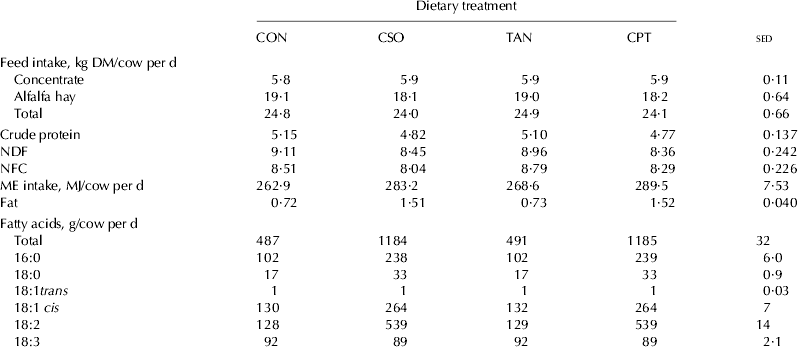
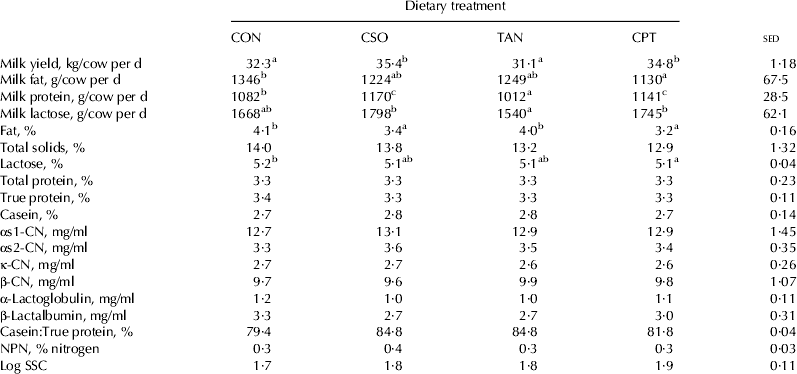
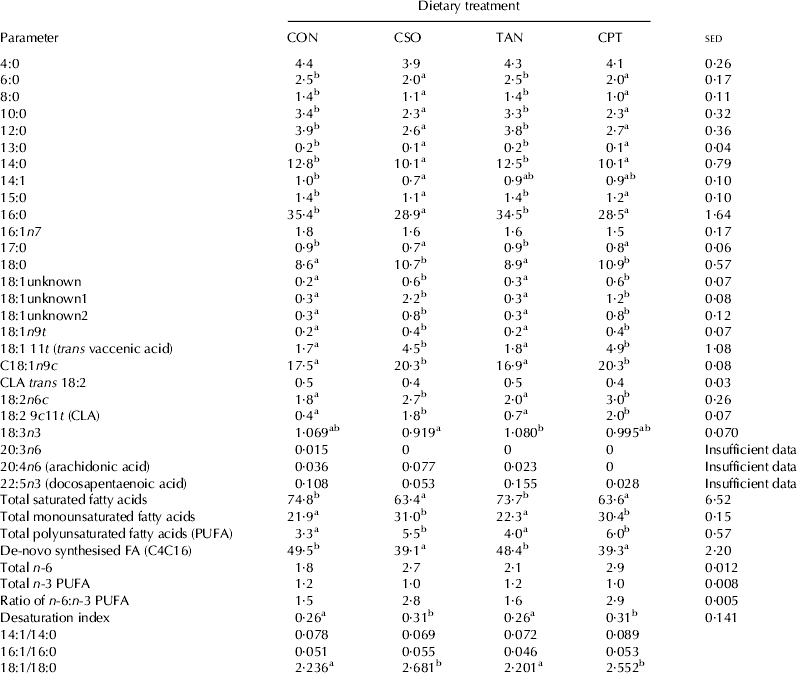
Inclusion of CSO in the diet did not affect (P>0·05) total feed intake (Table 1) but increased the yields of milk and milk protein (P<0·05) even though protein concentration in milk was unchanged (P>0·05) (Table 2). No significant effect was observed for yield and concentration of lactose. The CSO diet had little influence on the proportions of true protein, whey protein, casein, casein to protein ratio and individual protein fractions (Table 2). The effect of this diet on fat yield was minimal. However, milk fat concentration was reduced by 17·14% (Table 2) and the concentration of total saturated fatty acids (SFA) was reduced by 15·2%. This diet also reduced the percentage of short- (6:0 and 8:0), medium- (10:016:0), and linear-odd chain (13:0; 15:0; and 17:0) SFAs (P<0·05; Table 3). The percentage of butyric acid remained unaltered, but there was an increase (P<0·05) in 18:0 concentration (Table 3). The CSO diet also increased the concentrations of total monounsaturated fatty acids (MUFA) by 42%, total polyunsaturated fatty acids (PUFA) by 67%, linoleic acid by 50%, rumenic acid (c9, t11,18:2) by 350%, and vaccenic acid (t11,18:1) by 164% (P<0·05; Table 3).
Effect of administration (via rumen fistula) of tannin (TAN), cottonseed oil (CSO), and cottonseed oil plus tannin (CPT) relative to the control diet (CON) on the intake of concentrate mix and alfalfa hay, the calculated dietary intakes of crude protein, neutral detergent fibre (NDF), non-fibrous carbohydrate (NFC), total and individual fatty acids

Effect of administration (via rumen fistula) of tannin (TAN), cottonseed oil (CSO), and cottonseed oil plus tannin (CPT) relative to the control diet (CON) on milk yield and milk composition
a,bMeans in the same row within a category without a common superscript differ (P<0·05)
Effect of administration (via rumen fistula) of tannin (TAN), cottonseed oil (CSO), and cottonseed oil plus tannin (CPT) relative to the control diet (CON) on the composition of milk fatty acids (g/100 g of fatty acids)
a,bMeans in the same row within a category without a common superscript differ (P<0·05)
The TAN diet did not alter feed intake (Table 1), milk yield and the concentrations of protein or lactose (Table 2). However, the yields of protein and lactose were decreased (Table 2). Furthermore, the TAN diet had no effect (P>0·05) on yield and concentration of milk fat. The most abundant fatty acids in milk from cows fed the TAN diet were palmitic (16:0, 34·5·8%), myristic (14:0, 12·5%) and stearic acid (18:0, 18·9%). Total concentrations of SFA, MUFA, PUFA, rumenic, linoleic acid, vaccenic acid and oleic acid in milk fat were also unaltered (P>0·05).
The CPT diet did not affect total feed intake (Table 1) (P>0·05). Yields of milk and milk protein were increased (P<0·05) while protein concentration was unaffected. This diet showed no effect on lactose yield, but the concentration of lactose in milk was decreased (Table 2). In comparison with the CON diet, the CPT diet reduced yield and percentage of milk fat (Table 2). The CPT diet also induced changes in FA composition similar to those caused by the CSO diet (Table 3). In milk samples of cows fed the CSO dietary treatment, t10, c12 CLA constituted 0·03% of the total fatty acids, but in all other milk samples for the other dietary treatments, the concentrations of t10, c12 CLA, were below the level of detection. For all cows in all treatment groups, the concentrations of 20:5 n3 (EPA) and 22:6n3 (DHA) in milk fat were below the level of detection.
Discussion
Effect of CSO diet on milk yield and composition
Supplementation of cottonseed oil had no substantial effect on the total feed intake, which is consistent with the finding of Mohamed et al. (Reference Mohamed, Satter, Grummer and Ehle1988) but in contrast to results of other studies which showed a decrease (Bremmer et al. Reference Bremmer, Ruppert, Clark and Drackley1998; Benson et al. Reference Benson, Reynolds, Humphries, Rutter and Beever2001). This discrepancy could be related to the fact that the effects of fat supplementation on feed intake are influenced by degree of fatty acid saturation, feeding rate, palatability, fatty acid chain length, and form of fat (Drackley & Elliott, Reference Drackley and Elliott1993; Bu et al. Reference Bu, Wang, Dhiman and Liu2007). The increase of milk yield in cows fed CSO diet (Table 2) might be associated with the effect of dietary cottonseed oil in supplying more energy for the cows to support milk production (Weiss et al. Reference Weiss, Pinos-Rodrigues and Wyatt2011). In addition, the increase in milk production might also be associated with the effect of the CSO diet in reducing de-novo synthesis of FA (Table 3). According to DePeters & Cant (Reference DePeters and Cant1992), supplemented fat may increase energetic efficiency of milk production through its effect on decreasing de-novo synthesis FA which requires acetate.
The increase in milk protein yields of cows fed the CSO diet is in agreement with Wu & Huber (Reference Wu and Huber1994), who stated that supplementation of fat at concentrations below 8% of DM may increase the yield of milk protein. The increase of available energy due to cottonseed oil supplementation might also lead to greater milk protein yield (Table 2) by improving the efficiency of microbial protein synthesis (Hoover & Stokes, Reference Hoover and Stokes1991). Despite its positive effect on milk protein yield, CSO diet had no impact on the concentration of milk protein (Table 2). The lack of effect of the CSO diet on milk protein concentrations observed in our experiment (Table 2) is consistent with the findings of Mohamed et al. (Reference Mohamed, Satter, Grummer and Ehle1988) and Zheng et al. (Reference Zheng, Liu, Yao, Yuan, Ye, Ye and Wu2005), but contrasts with those of DePeters et al. (Reference DePeters, Taylor, Franke and Aguirre1985). A slight effect of the CSO diet on proportions of whey protein, casein, casein:protein ratio and individual protein fractions (Table 2) was similar to those reported by other researchers who used different fat sources such as sunflower or safflower seeds (Stegeman et al. Reference Stegeman, Casper, Schingoethe and Baer1992; Bobe et al. Reference Bobe, Lindberg, Reutzel and Hanigan2008). In contrast, De Peters et al. (Reference DePeters, Taylor, Franke and Aguirre1985) reported that the concentrations of protein, casein, and whey protein were reduced when soybean oil was added to the diet of dairy cows. The absence of an effect of the CSO diet on milk lactose concentration is in agreement with the findings of Zheng et al. (Reference Zheng, Liu, Yao, Yuan, Ye, Ye and Wu2005) but contrasts with those of MacLeod et al. (Reference MacLeod, Yu and Schaeffer1977) who observed a decrease. According to Sutton (Reference Sutton1988), the concentration of lactose in milk is remarkably constant owing to its osmotically active properties and the fact that it cannot pass out the Golgi or secretory vesicles. The minimal effect of the CSO diet on lactose yield and concentration might also be related to the unaltered feed intake (Table 1).
It might be argued that the lower fat concentration in the milk of cows fed the CSO diet compared with the CON diet (Table 2) was due to the alteration in rumen biohydrogenation of linoleic acid from the cottonseed oil leading to the production of t10,c12 CLA, which is known to be a potent inhibitor of milk fat synthesis (Bauman & Griinari, Reference Bauman and Griinari2001, Reference Bauman and Griinari2003). However, in the current study, t10,c12 CLA was only detected in the milk fat of cows fed the CSO diet, yet the CPT diet also contained cottonseed oil and also reduced milk fat percentage (Table 3) suggesting that some agent or fatty acid other than t10,c12 CLA may have been responsible for the reduced milk fat concentrations in cows fed the CSO and CPT diets. In support of this theory, in the milks from cows fed the CSO and CPT diets, there were enhanced concentrations of three unknown fatty acids whose chromatogram peaks were in the region where the two trans isomers, elaidic acid and trans-vaccenic acid normally elute (Table 3). We assume that these unknown fatty acids are octadecenoic acid isomers.
In agreement with Bauman & Griinari (Reference Bauman and Griinari2001, Reference Bauman and Griinari2003) the milk fat reduction in cows fed the CSO and CPT diets in this study was accompanied by lower concentrations of short- and medium-chain FA (de-novo synthesised fatty acids) and greater concentrations of long chain fatty acids (FA with more than 16 carbon atoms) compared with the concentrations of these FA in the milk of cows fed the CON diet (Table 3). The greater concentrations of 18:0 in the milks of cows fed the CSO and CPT diets compared with the CON diet (Table 3) were probably related to an increased ruminal supply of linoleic acid from the cottonseed oil, which was transformed into stearic acid during ruminal biohydrogenation.
The similar concentrations of butyric acid in the milks of cows fed all the diets is consistent with the findings of Chilliard et al. (Reference Chilliard, Ferlay, Manbridge and Doreau2000) who reported that the concentration of butyric acid in milk was not changed by dietary supplementation with fat. Butyric acid does not require acetate for its synthesis since it is produced in the mammary gland directly from β-hydroxybutyrate, derived from the blood, which is in contrast to the de-novo synthesised FA manufactured in the mammary gland by chain elongation using acetate units (Craninx et al. Reference Craninx, Steen, Van Laar, Van Nespen, Martin-Tereso, De Baets and Fievez2008). In our experiment, dietary supplementation with cottonseed oil (in the CSO and CPT diets) resulted in reduced concentrations of linear-odd chain FA such as 13:0; 15:0 and 17:0 (P<0·05) in milk, a finding contrary to that of Loor et al. (Reference Loor, Ueda, Ferlay, Chilliard and Doreau2004).
The effect of CSO diet on increasing long chain SFA (18:0) and reducing short- and medium-chain SFA, especially 12:0, 14:0, and 16:0 FA in milk could improve the nutritional value of milk (Chilliard et al. Reference Chilliard, Ferlay, Manbridge and Doreau2000). In terms of milk processing properties, it would be useful to ascertain the effect of cottonseed oil supplementation on cheese fatty acid composition, flavour and aroma since the milk concentrations of short- and medium-chain FA, particularly 4:0, 12:0, have been reported to influence the flavour and aroma of cheese (Molimard & Spinnler, Reference Molimard and Spinnler1996).
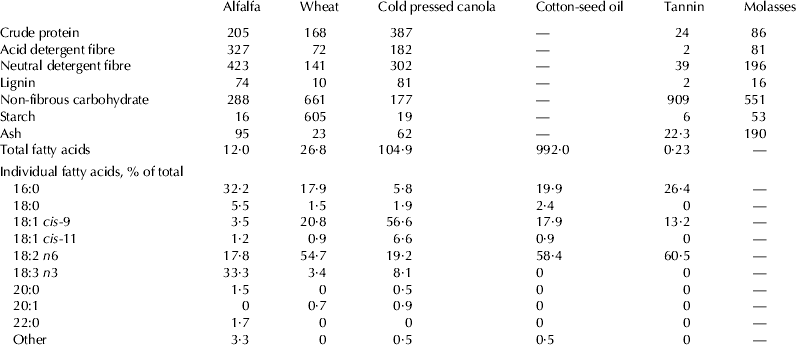
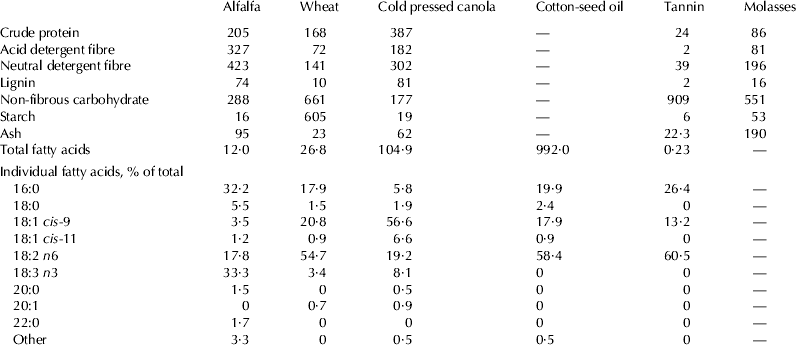
Cottonseed oil contains a high concentration of linoleic acid (Table 4). Therefore the increase of linoleic acid concentration in milk fat of cows fed the CSO and CPT diets may be related to a higher intake of this fatty acid. We speculate that this high ruminal supply of linoleic acid served as a substrate for the ruminal production by biohydrogenation, of rumenic acid and vaccenic acid (Moate et al. Reference Moate, Boston, Jenkins and Lean2007). Rumenic acid can be absorbed from the intestines, transported via the blood to the mammary gland and incorporated directly into milk fat (Moate et al. Reference Moate, Chalupa, Boston and Lean2008). When vaccenic acid is absorbed from the intestines and transported to the mammary gland, it enhances the concentration of vaccenic acid in milk fat (Moate et al. Reference Moate, Chalupa, Boston and Lean2008), and the enhanced supply of vaccenic acid to the mammary gland also serves as a precursor for the production and secretion of rumenic acid into milk fat (Mosley et al. Reference Mosley, Shafii, Moate and McGuire2006).
Composition of main dietary constituents (g/kg DM unless otherwise stated)
Effects of TAN diet on milk yield and composition
The presence of tannins in ruminant diets may reduce feed intake, nitrogen digestibility and microbial protein synthesis (Waghorn et al. Reference Waghorn, Jones, Shelton and McNabb1990). Generally, dietary condensed tannins reduce feed intake by decreasing palatability or affecting digestion owing to their astringency (Landau et al. Reference Landau, Perevolotsky, Bonfil, Barkai and Silanikova2000). The effect of condensed tannins on feed intake is also influenced by their concentration in the diet. A high concentration of condensed tannins (i.e. above 5–6% DM) has been associated with a reduction in feed intake (Barry & McNabb, Reference Barry and McNabb1999). However, other factors such as the source of condensed tannins, animal species, animal physiological state and diet composition may also influence the effect of CT. In the current experiment, the effect of the TAN diet on feed intake was not substantial, which may be partly attributed to the low concentration of condensed tannins in the diet. The lack of effect of condensed tannins on feed intake was also observed when heifers (Baah et al. Reference Baah, Ivan, Hristov, Koenig, Rode and McAllister2007) or cows (Benchaar et al. Reference Benchaar, McAllister and Chouinard2008) were fed quebracho condensed tannins. The minimal effect of the TAN diet on feed intake is consistent with the unaltered milk yield of cows fed this diet (Table 2). The lack of effect of condensed tannin on milk production has also been observed in early lactating ewes fed Lotus corniculatus (Wang et al. Reference Wang, Douglas, Waghorn, Barry and Foote1996). However, effects of condensed tannins in both increasing (Woodward et al. Reference Woodward, Auldist, Laboyrie and Jansen1999; Turner et al. Reference Turner, Waghorn, Woodward and Thomson2005) and decreasing (Grainger et al. Reference Grainger, Clarke, Auldist, Beauchemin, McGinn, Waghorn and Eckard2009) milk yield in dairy cows have been reported.
Reports on the effect of dietary tannins on yield and concentration of milk protein are inconsistent (Toral et al. Reference Toral, Hervas, Bichi, Belenguer and Frutos2011). Even though the mechanism responsible for the reduction in milk protein concentration associated with feeding the TAN diet is still unclear, we speculate that dietary tannins could reduce yield and concentration of milk protein by inhibiting microbial protein synthesis in the rumen and thus reducing amino acid production. According to Hoover & Stokes (Reference Hoover and Stokes1991), synthesis of microbial protein is influenced by the availability of energy derived from fermentation of carbohydrates. Condensed tannins are able to form stable complexes with proteins or carbohydrates (Barry & McNabb, Reference Barry and McNabb1999). Binding of condensed tannins to carbohydrates could reduce the extent of carbohydrate degradation and decrease the amount of energy available for microbial protein synthesis (Bach et al. Reference Bach, Calsamiglia and Stern2005) and consequently cause the reduction in the yield of milk proteins (Table 2).
Reductions in lactose yields in milk of cows fed the TAN diet might be due to the limited energy supply in the diet. In this study, the experimental cows were in early lactation and would have had a negative energy balance as they mobilised adipose tissue reserves to support milk production. Moreover, condensed tannin supplements might reduce starch digestion, which could then reduce the production of volatile fatty acids. In turn, a reduction in the amount of propionate would limit the synthesis of glucose, a precursor for lactose synthesis. In contrast, condensed tannins of L. corniculatus had no effect on lactose concentration in milk (Woodward et al. Reference Woodward, Auldist, Laboyrie and Jansen1999).
Added condensed tannins did not have a profound effect on milk fat concentration, which was also observed previously in studies that used condensed tannins from quebracho (Benchaar et al. Reference Benchaar, McAllister and Chouinard2008) and L. corniculatus (Woodward et al. Reference Woodward, Auldist, Laboyrie and Jansen1999). In contrast, condensed tannins from Hedysarum coronarium have been reported to induce a reduction in fat concentration in sheep milk (Molle et al. Reference Molle, Decandia, Giovanetti, Cabiddu, Foiz and Sitzia2009). The concentrations of de-novo synthesised FA and of SFA were also unaffected by the feeding the TAN diet, a finding similar to that of Benchaar & Chouinard (Reference Benchaar and Chouinard2009), who used quebracho-condensed tannins. Unlike short- and medium-chain saturated fatty acids, saturated fatty acids with more than 16 carbon atoms cannot be synthesised in the mammary gland. Thus the concentration of the latter in milk depends on a dietary source and subsequent synthesis in adipose tissue (Chilliard et al. Reference Chilliard, Ferlay, Manbridge and Doreau2000). However, Turner et al. (Reference Turner, Waghorn, Woodward and Thomson2005) found that when cows were fed birdsfoot trefoil (L. corniculatus), the condensed tannins in the lotus appeared to inhibit ruminal biohydrogenation of long chain fatty acids and the net effect was a reduction in the concentration of SFA in milk fat. In the current experiment, the concentrations of all of the individual fatty acids in the milk fat of the cows fed the TAN diet were not different from the concentrations of the corresponding fatty acids in the milk fat of the cows fed the CON diet. Thus, these findings suggest that the tannin from black wattle is ineffective at influencing the bacteria that produce the enzymes which are responsible for biohydrogenation processes within the rumen.
The concentrations of PUFA can be enhanced by feeding ruminants PUFA-rich feed or by decreasing biohydrogenation of PUFA in the rumen (Palmquist et al. Reference Palmquist, Lock, Shingfield and Bauman2005). However, the TAN diet had no effect on the concentration of total PUFA (Table 3), which could be attributed to the low level of PUFA in the TAN diet. Attempts to increase the concentration of CLA and its isomers in milk should be directed at increasing CLA synthesis during biohydrogenation in the rumen, or by increasing the activity of Δ9-desaturase in desaturating vaccenic acid to CLA in the mammary gland (Chilliard et al. Reference Chilliard, Ferlay, Manbridge and Doreau2000). Therefore, the negligible effect of the TAN diet on CLA concentrations could be attributed to the low amounts of CLA precursor (linoleic acid) in the diet and the lack of effect of this diet on the Δ9-desaturase enzyme activity in converting stearic to vaccenic acid (Table 2). Our results are similar to the previous report of Dschaak et al. (Reference Dschaak, Williams, Holt, Eun, Young and Min2011) but contradict studies in vitro, which indicated that tannins had potential to increase CLA concentration in milk by inhibiting the growth of Butyrivibrio fibrisolvens, a rumen microbe which is responsible for transforming the major CLA precursor into rumenic acid (Jones et al. Reference Jones, McAllister, Cheng and Muir1994) or by inhibiting the last step of rumen biohydrogenation (Khiaosa-Ard et al. Reference Khiaosa-Ard, Bryner, Scheeder, Wettstein, Leiber, Kreuzer and Soliva2009).
Effects of CPT diet on milk yield and composition
The observed effects of the CPT diet in reducing FA synthesis de novo and altering milk FA composition were probably due to the presence of cottonseed oil in the CPT diet since the addition of tannins had no effect on milk fat concentration and FA profile. This result is similar to the findings of Toral et al. (Reference Toral, Hervas, Bichi, Belenguer and Frutos2011) who reported that the inclusion of tannin to a diet containing sunflower oil did not increase the amount of vaccenic acid or rumenic acid above that achieved with a diet containing sunflower alone. Overall, results from our experiment showed that supplementation of cottonseed oil, condensed tannins or their mixture had a minimal impact on milk yield and composition. However, inclusion of cottonseed oil or in combination with condensed tannin (in the diet) reduced milk fat concentration but increased the proportion of CLA and its isomers in milk fat.
Conclusions
This study showed that inclusion of cottonseed oil or condensed tannin into cow diet could affect rumen metabolism and altered yield and composition of the milk. It is likely that supplementation of cottonseed oil increased available energy to dairy cows, thus increasing yields of milk and milk protein. The presence of cottonseed oil in the diets also altered rumen biohydrogenation, which caused a reduction in milk fat concentration and altered milk fatty acid profile. Dietary condensed tannins from A. maernsii appeared to affect nitrogen and carbohydrate metabolism, which led to reduced yields of protein and lactose in milk. However, condensed tannins appeared to have no impact on rumen biohydrogenation. Changes in fat concentration and fatty acid profile in milk of cows fed the CPT diet were probably due to the cottonseed oil in the diet since the effect of condensed tannins were not significant. Octadecanoeic acid isomers which eluted between elaidic acid and trans-vaccenic acid might be responsible for milk fat depression in milk of cows fed diets supplemented with cottonseed oil alone or in combination with condensed tannin. Further research is required to identify these isomers owing to their possible effect on milk fat depression, and to establish the effect of dietary cottonseed oil and condensed tannin on milk processing properties.
Aprianita gratefully acknowledges receipt of a PhD scholarship from the Directorate General of Higher Education of Republic Indonesia. The authors also express their sincere gratitude to Dr Craige Trenerry (Department of Primary Industries, Werribee) for fatty acid analyses; and Murray Hannah (Department of Primary Industries, Ellinbank) for statistical analyses. We are also indebted to Di Mapleson, Tony Hookey, Greg Morris, Alan McDonald, and Brigid Ribeaux (Department of Primary Industries, Ellinbank) for performing the cow experiment. This experiment was supported by Department of Primary Industries – Victoria; Gardiner Foundation; Australia's Department of Agriculture, Fisheries and Forestry; Dairy Australia; and Victoria University.