





According to the USDA, food insecurity is defined as limited or uncertain access to adequate food due to economic and household-level social conditions(1). Food insecurity can compromise the physical and emotional health of a pregnant person and the development of their fetus(Reference Agho and van der Pligt2,Reference Campanera, Gasull and Gracia-Arnaiz3) . In 2023, the national prevalence of food insecurity in the USA was 13·5 %(4). Research shows that inadequate nutrition during pregnancy can lead to increased antenatal anxiety, gestational diabetes, pregnancy-induced hypertension and overall reduced quality of life for the pregnant person(Reference Agho and van der Pligt2). Infants born to a food-insecure mother have a higher risk for low birth weight, preterm births and developmental delays(Reference Agho and van der Pligt2). Food insecurity is associated with poor early childhood and cognitive development and academic delays that persist into adulthood(Reference Pedroso, Buccini and Venancio5,Reference de Oliveira, de Almeida and Gubert6) .
The perinatal period – from pregnancy through postpartum – presents a critical window for both community-based (e.g. doulas, lactation consultants and social workers) and clinical (e.g. paediatricians and nurses) providers to identify and address the risks of adverse health outcomes associated with food insecurity. Providing equitable care for food-insecure pregnant people and infants can be done through the timely identification of needs, expanding opportunities to access services and coordinating care to address their needs(Reference Leifheit, Schwartz and Pollack7,Reference Mildon, Francis and Stewart8) . The Centers for Medicare and Medicaid Services (CMS) recommends the implementation of food insecurity programmes aiming at establishing screening, referrals and follow-up strategies to promote equitable care(Reference Hinton and Diana9). However, the strategies outlined for addressing food insecurity are not routinely implemented in either community or clinical perinatal settings.
Barriers to implementing strategies to screen, refer and follow up for food insecurity include limited provider knowledge(Reference Buccini, Schoetker and Poblacion10), organisational constraints(Reference Buccini, Schoetker and Poblacion10), limited time(Reference Kazi, Starling and Milicia11), stigma(Reference Kazi, Starling and Milicia11) and limited funding(Reference Giron, Cole and Nguyen12). While many of these barriers have been identified within healthcare settings, little is known about the unique challenges faced by community-based and clinical perinatal providers. Fostering a deeper understanding of these implementation barriers is essential for improving perinatal health outcomes and advancing health equity. Therefore, this study aimed to explore the perceived barriers that community and clinical perinatal providers encounter when addressing food insecurity among the populations they serve.
Methodology
Research design
This qualitative study used a phenomenological approach to analyse interviews with perinatal providers working in five zip codes with high risk for food insecurity in Southern Nevada. The University of Nevada, Las Vegas Institutional Review Board approved all study procedures (# 1801320), and consent was obtained before the start of the interviews. The Consolidated Criteria for Reporting Qualitative Research (COREQ) was used to guide the reporting of this study (full COREQ in online supplementary material, Supplemental Material 1).
Study setting
Five zip codes within Southern Nevada (89101, 89106, 89030, 89031 and 89032) are also known as the West Las Vegas Promise Neighborhood (WLVPN). These zip codes encompass areas that were historically redlined and continue to face the lasting effects of these discriminatory practices(Reference Dubay, Aarons and Brown13). This includes enduring social determinants of health overlapping with health-related social needs, such as food insecurity, poverty and health disparities such as increased rates of obesity, low birth weight and poor mental health (see online supplementary material, Supplemental Material 2 for full description of WLVPN population)(14). The study population is predominantly Hispanic (about 50·0 %) and Black/African American (23·6 %)(15).
Participants
A purposive sampling approach was used to identify and recruit perinatal providers working at clinical and community resources such as paediatrics and OB-GYN health clinics, grassroots organisations and community organisations providing health and nutrition resources to the targeted zip codes. Specifically, members of a maternal–child community advisory board focused in the WLVPN were contacted for recruitment. This advisory board supports the translational community research efforts to improve maternal–child health and food insecurity. Authors of this paper are also members of this advisory board. Providers were eligible to participate if they met the following two criteria: (1) offered health and/or nutrition services within their practice for at least 6 months; and (2) provided services to pregnant people and/or children who live within one of the target zip codes. Eligible participants were invited via email to share their perceptions and experiences regarding barriers and facilitators to providing equitable care for food insecurity and to provide suggestions on how perinatal services might be improved to reduce maternal–child health disparities, specifically to reduce levels of maternal–child food insecurity.
The minimum sample size recommended for phenomenological studies is between 6 and 10 participants(Reference Hennink and Kaiser16), and an average range of 5–25 interviews is recommended to reach saturation(Reference Onwuegbuzie and Collins17). These recommendations aided the determination of the study sample size. Seven interviews were conducted with community providers and eight with clinical providers. All interviews were conducted virtually, lasted 25 min to 1 h each, and were recorded and transcribed verbatim (see online Supplemental Material 3 for full interview guide). Written transcripts were checked against the original audio recording to ensure accuracy. Participants were not incentivised for their participation.
Research team reflexivity
In total, fifteen interviews were collected by a female co-author (AE) with training in qualitative methods in Spring 2023. Coding and thematic analysis was conducted by a female co-author (KS) receiving training in qualitative methods in Summer 2024. Data analysis and iterative coding reviews were supervised by GB, who is the principal investigator for the research with expertise in qualitative methods, maternal–child health and Public Health. TG, EM and CVRDO are faculty members with expertise in Public Health and contributed intellectually with reviewing the manuscript draft.
Data analysis
A two-phase thematic qualitative analysis method was utilised to examine the qualitative interviews. The first phase of the analysis involved a seven-step inductive coding process to develop code structure(Reference Bradley, Curry and Devers18). Transcripts were organised in chronological order to be coded. The first three interviews were open-coded by one coder (KS) due to the small sample size. The initial codes and subthemes were reviewed by author GB. This process was repeated until no new themes were identified, and saturation was met, which occurred by interview 10. A draft of the codebook was then created and applied to the remaining transcripts. Once all interviews were coded, the final codebook was refined for final review. The final codebook was then organised by the socio-ecological model for thematic analysis. This model was selected for its ability to observe complex phenomena and their relationship across five levels, which include (i) individual, (ii) interpersonal, (iii) institutional, (iv) community and (v) policy(Reference Garney, Wilson and Ajayi19).
Phase 2 involved a two-step process(Reference Weiss20): local integration (e.g. assigning significance to transcript excerpts) and inclusive integration (e.g. connecting transcript excerpts to form a narrative that responds to the research question). Quotes that best represented each theme were selected to illustrate the results.
Results
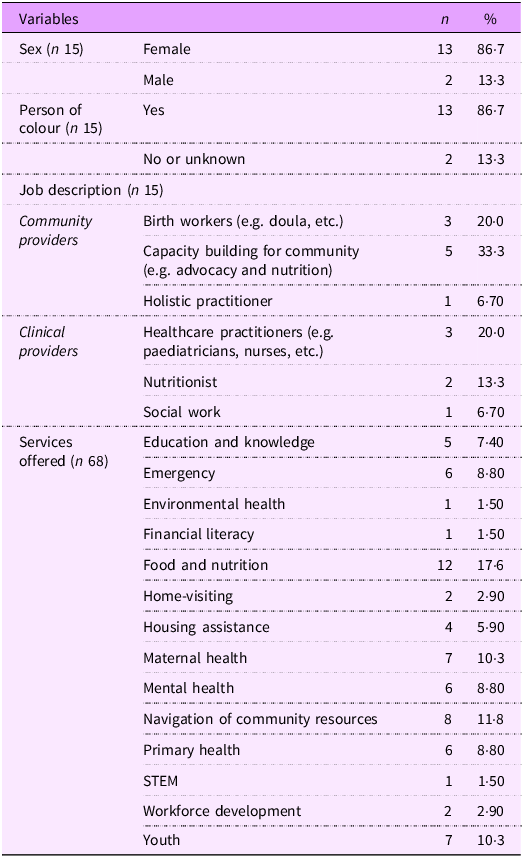
The perinatal providers (n 5) held roles focused on capacity building, including positions within advocacy groups and community-based organisations. Among the types of services, examples include food and nutrition services (n 12), navigation of community services (n 8), services for youth (n 7) and maternal health (n 7). Demographic information of the interviewees is provided in Table 1 (full description of the services in online supplementary material, Supplemental Material 4).
General characteristics and services offered across the perinatal providers

Table 1. Long description
A table summarizing demographic information and services offered by perinatal providers. The table has 15 rows and 3 columns. The columns are labeled Variables, n, and percent. The rows are grouped into categories: Sex, Person of colour, Job description, and Services offered. Each category has subcategories with corresponding values for n and percent. For example, under Sex, there are 13 females and 2 males. Under Person of colour, there are 13 yes and 2 no or unknown. Job descriptions include various roles such as Birth workers, Capacity building for community, Holistic practitioner, Healthcare practitioners, Nutritionist, and Social work, each with their respective counts and percentages. Services offered include categories like Education and knowledge, Emergency, Environmental health, Financial literacy, Food and nutrition, Home-visiting, Housing assistance, Maternal health, Mental health, Navigation of community resources, Primary health, STEM, Workforce development, and Youth, each with their respective counts and percentages.
Four themes were identified and organised following the socio-ecological model(Reference Kilanowski21): (i) individual, (ii) interpersonal, (iii) institutional and (iv) community and policy (full description of themes and subcodes in online supplementary material, Supplemental Material 5). The community and policy themes were combined due to limited findings within each theme. Within each theme, subthemes emerged that highlight key barriers when screening, referring and following up with individuals at risk of food insecurity.
Individual level
This theme describes the knowledge, attitudes, skills and behaviours relating to the individual providers.
Knowledge, education and experiences
Participants shared examples of how they acquired knowledge through educational courses or lived experiences from previous occupations that now play a role in the way they provide care to underserved communities. This combination of learned knowledge and lived experience was considered by perinatal care providers to be a facilitator for providing perinatal services to their clients, as illustrated in the quote below:
‘I was BST [Behavioral Skills Training], I was PSR [Psychosocial Rehabilitation], I was case management and then I was also the owner of a company. So, I definitely am able to take what I learned from that experience into birth work(…) bringing that experience in and being able to provide those types of services, not necessarily as a mental health worker, but taking what I’ve learned from that and being able to then apply it into birth work has definitely been beneficial’. (Participant #6, Birth Work)
The majority of perinatal providers reported knowledge and lived experience on the importance of addressing food insecurity. However, a barrier revealed by participants includes translating this knowledge into practice. For example, some clinical providers conduct food security screening but have no formal process to refer and follow up when clients screen positive for food insecurity. Community perinatal providers reported participating in several data collections that demonstrate the zip codes have a high need for food security, but they did not know how to translate the data into resources or services to support food security, as demonstrated in the following quote:
‘We collect data each year and we see how we can implement change for the following year… we know that these are high needs [food insecurity] and it’s easier to make the adjustment to provide certain services or bring additional resources to our community v. just continuing to collect and just have all this data. We don’t really know what to do with it’. (Participant #1, Capacity Building for Community)
Diversity training
Across all interviewees, only two community providers stated to have received ‘diversity training’. These individuals described the training as aiming to reduce individual biases, prejudices and discrimination that perinatal providers may have to create a culturally competent work environment. Although the total number of providers trained in diversity is low, perinatal providers state that their background and lived experiences may replace the need for formal training. Rather, it was reported that diversity training alone may not be enough to understand the needs of the target population, as seen in the following quote:
‘…CPS [Child Protective Services] was at her door because she shared in therapy that sometimes she just wants to just leave and leave the baby in the house. Now, when I heard that, right, what I heard was “I’m tired” and “I need a break.” Again, that’s why representation matters, right? And that’s why, I’m not gonna even say being culturally competent, just being culturally aware’. (Participant #4, Social Work)
Food insecurity training
A barrier presented throughout the interviews was the perinatal providers’ lack of food insecurity training. Across all interviewed perinatal providers, only two providers (one clinical and one community) were trained in food insecurity. Among those who were not trained, the lack of education on food insecurity was identified as a barrier to providing services for food-insecure patients. Examples of barriers included a lack of knowledge on how to properly identify food-insecure patients, how to address food insecurity and how to provide services that address food insecurity. These barriers prevented many providers from discussing this topic, as illustrated by the following quote:
‘To be honest no I have not been trained to talk about it with our clients…maybe if I knew specific words to use, that would give me more information for them, unless if straight out they come out and say you know I have a hard time doing this’. (Participant #7, Nutritionist)
Among the two participants trained in food insecurity, they shared that their food insecurity training included topics such as what food insecurities are, how they manifest differently among populations, and provided information on the available services that may aid families experiencing food insecurity. Additionally, these perinatal providers discussed the benefits of being trained and the way it facilitated how they provide care, for example, incorporating what they have learned about food insecurity into their work curriculum:
‘That’s why I made it a point to expose our residents to that [food insecurity]. Because yeah, a lot of people that have gone through med school, it’s just, you know, a lot of us haven’t had WIC or SNAP exposure’. (Participant #14, Healthcare Practitioner)
Interpersonal level
The interpersonal level theme includes the relationships that the perinatal provider had with the maternal–child target population, community partners and other perinatal providers.
Perceived stigma
Perinatal providers have noted that the perceived negative, inaccurate or unfair beliefs regarding clients who need referrals because of food insecurity were a barrier. The providers have recognised that some patients are unwilling to openly share their social needs due to thinking they may be judged for their circumstances and fear of being stigmatised. A provider shares how this perceived stigma has prevented patients from receiving the food insecurity services they may need.
‘Mothers want assistance but they don’t know where to go and they don’t know how they are going to get treated. A lot of mothers feel like they are going to get judged or belittled. They feel like they have to be careful with their words and what they say’. (Participant #11, Birth Worker)
Mandated reporting
Providers expressed hesitation about conducting formal screenings, including for food security. While mandatory reporting may apply to issues like child abuse or neglect, it does not apply to food insecurity. To overcome this and encourage honest responses, perinatal providers emphasised using flexible, conversational approaches, as illustrated below:
‘There’s a [patient’s] fear of asking too. Some of our population may be undocumented and so they want to necessarily seek the support and resources because of their fear of deportation…so you have to think about how you may screen them with a questionnaire but they may not honestly answer you’. (Participant #14, Healthcare Practitioner)
Building relationships
The importance of creating rapport with the patient and teaching them how to advocate for themselves was emphasised by the perinatal providers. Building and keeping trust by letting patients know that their information is confidential was reported to be essential to reducing fears, as illustrated in the following quote:
‘…talking about food insecurity is difficult. In communities of color, we have to always tread lightly because mostly they say, I have everything I need. But once you hang out and talk a little bit more and you become trusted you can start seeing those conversations become more truthful’. (Participant #11, Birth Worker)
Institutional level
This theme captures the strategies for equitable care when working with food-insecure populations, as well as the barriers and facilitators to implementing screenings, referrals and follow-ups for food insecurity within their practice.
Screening
Perinatal providers reported that screenings are often the first step to understanding what a patient’s immediate needs are. The processes in which perinatal providers conduct screenings differ across organisations. Some clinical providers are required to conduct a formal screening process (e.g. utilising validated questionnaires) to capture social determinants of health such as food insecurity, postpartum, depression and anxiety. However, these providers recognise how using a formal screening might impact their interpersonal relationships with their patients.
The community providers reported having more flexibility in their screening processes, with informal versions of screenings being shared. This includes a more conversation-based screening that focuses on the patient telling them first-hand what their needs are. Through this process, providers stated that their patients were more willing to share their needs and areas of support, as seen in the quote below:
‘Being an active listener for them and letting them guide the situation but then asking those follow-up questions and kind of trying to identify, would you like some help with this?’ (Participant #9, Capacity Building for Community)
Referral
Referrals were described by perinatal providers as the process of providing information on external resources to a patient to fulfil an unmet need. Many of the clinical perinatal providers conduct formal referrals, meaning they are required to refer their patients to a recommended list of services provided by their institutions. Clinical perinatal providers feel as if they have no choice but to refer their patients to these locations due to a lack of available and timely services. In addition to this, a barrier mentioned focuses on not trusting who they are referring their patients to as illustrated in the following quote:
‘I’m very concerned because I have a very small list of ones [referral sites] that I trust. I want the moms to be able to feel supported and go to someone who is as empathetic as I am. And 90 % of the time, that is not the case’. (Participant #11, Birth Worker)
Follow-up
Follow-ups were described by the perinatal providers as the action of checking in with a patient to discuss if their needs were met through the provided referral. A key finding of the follow-up process was that all providers had a different protocol for following up with their patients. Some clinical providers shared they will follow up with their patients at their next scheduled visit or communicate with a patient’s assigned community health worker (CHW). On the other hand, community perinatal providers described a phone call as the most common way to track referrals. For example, the following quote from a community provider describes their organisation’s follow-up process:
‘Our process internally is when we submit a referral [within the organization’s referral system], we track that. We do monthly follow up, but we also do weekly follow up so, depending on if a client is already actively receiving services’. (Participant #1, Capacity Building for Community)
Barriers to providing equitable care
Two main barriers were identified by the perinatal providers, which include this historical district of institutions and the organisational capacity of the available services. Providers perceived that the historical mistreatment of women and people of colour by healthcare institutions has left a negative impact on the ways institutions are currently perceived by communities, as illustrated by the following quote:
‘I hear lots of concerns and distrust, it’s distrust of institutions, right? And the reason that exists is because the institutions have failed this community’. (Participant #5)
When asked why a provider may not always provide any of the strategies for equitable care, a consistent barrier was a lack of time and organisational capacity. A barrier faced by the clinical providers includes the short amount of time they have with each patient. Many of these organisations were reported as understaffed or did not have consistent or available resources to deliver these types of care, thus affecting the number of patients the providers are able to reach. The quote below describes how the lack of capacity affects efforts to identify the social need:
‘…in the course of a visit, there’s a lot of things that you have to cover. And I think that food insecurity kind of gets pushed under the rug sometimes’. (Participant #13, Birth Worker)
Community and policy
The community and policy themes capture the social relationships within these settings that affect behaviours and change behaviours through legislative action, respectively.
Funding
When asking the perinatal providers about what barriers are faced when providing equitable care, a common response among the community providers was funding. Funding was stated as an essential support, especially among small or newly established community organisations, as it allowed the providers to expand their offered services. However, not having adequate and consistent funding was discussed as a barrier when it comes to supporting the community, as discussed in the following quote:
‘… a barrier is definitely funding. And so funding is definitely an issue for a lot of grassroots organizations. Especially those who are newer. Who is doing the work improving the impact that they have and so I know that opportunities will come for grants and funding’. (Participant #3, Capacity Building for Community)
Although screening, referring and follow-ups are common practices across clinical providers, there is a lack of focus on equitable care for social determinants, such as food insecurity. To assess these needs requires the efforts of many individuals, which smaller organisations may not have, as illustrated in the following quote:
‘Funding is always an issue. We always need additional funding for boots on the ground. So that we can assess the needs of our communities, so, funding’. (Participant #13)
Community outreach
A strategy to overcome the burdens of limited funding comes from the strength of the community itself. Community outreach, or the act of increasing public awareness of the available services, was identified as a facilitator to overcome hardship. Connecting with other services allowed perinatal providers to increase their list of sites to refer their patients. The WLVPN is described as a ‘tight-knit’ community, and this characteristic applies to the organisations based within it. Having a sense of community among perinatal services is essential to the reach of the organisations but assists in the process of sharing knowledge on complex issues and creating solutions. Community partnerships also diversify the services an organisation can refer a patient to. The importance of partnerships among the perinatal services in the community was heavily discussed during the interviews, as seen in the following quote:
‘So, community partnerships are actually super important to have because you’d be surprised how many people are out there that really want to help in the way that we want to help and it just helps us make it happen’. (Participant #10, Nutritionist)
Discussion
This study identified perceived barriers by clinical and community perinatal providers when providing care for individuals at risk of food insecurity in the perinatal period. We utilised the socio-ecological model to analyse providers’ experiences regarding food insecurity screening in underserved communities across four levels. The findings highlight critical barriers to implementing strategies for equitable care for food insecurity within perinatal care settings.
At the individual provider level, a lack of knowledge and education on food insecurity undermines how perinatal providers address the topic with their patients. Training on food insecurity is available for both clinical providers(Reference McWhorter, Aiyer and Ranjit22) and community providers(Reference Browne and Ponce23). However, these existing trainings lack focus on perinatal populations. Our findings showed that providers do not seek specific training on food insecurity, which may stem from a lack of training opportunities tailored to perinatal care settings or from the belief that their own lived experiences are sufficient to establish rapport and relate to patients. However, evidence shows that food insecurity is a complex, multifaceted issue, and adequate training is essential to ensure providers are well informed and equipped to address it effectively(Reference Nederveld, Jantz and Brennan24,Reference Stanford25) . Additionally, training may allow perinatal providers to broaden their understanding and offer opportunities to expand their offered services, such as how to discuss food insecurity, screen and refer patients(Reference Nederveld, Jantz and Brennan24).
Communication gaps due to social and educational disparities were found to impact the quality of the patient–provider relationship. Previous US studies in communities of colour have found that culturally competent physicians are highly valued by Hispanic and African American patients, as they enhance trust and improve patient–provider communication(Reference Diaz, Castillo Tafur and Lin26). In this context, diversity training can help bridge these gaps by educating providers on how historical and contemporary social issues uniquely impact different populations(Reference Valentin, Nielsen and Nielsen27). In the absence of dedicated diversity training, implementing implicit bias training within clinical and community perinatal settings may enhance providers’ awareness of social and cultural differences, thereby helping to bridge communication and care gaps(Reference Cooper, Saha and Van Ryn28,Reference Kim and Roberson29) .
At the interpersonal level, our study identified stigma and discrimination as a barrier to providing screening services, corroborating previous studies that were conducted with people with social needs in the USA(Reference Cullen, Attridge and Fein30–Reference Ronis, Masotya and Birkby32). To address these barriers, our study highlighted strategies like explaining the purpose of the screening and how it will be used to build patient–provider relationships. A study that describes implementing social needs screenings at a federally qualified community health centre has shown that open discussions on social and health needs between patients and their providers have facilitation relationship building and shared decision-making(Reference Drake, Batchelder and Lian31). Our findings indicated that perinatal providers must acknowledge the present and historical community context. The importance of understanding and learning about the community in which providers serve has been identified as a more appropriate and effective approaches to patient care(Reference Wang, Perzynski and Ronis33).
At the institutional level, specific barriers and facilitators were identified for the three strategies for equitable care: screening, referral and follow-up. Across the strategies to screen for the risk of food insecurity, both informal and formal processes were utilised by the perinatal providers to capture the needs of their patients. The use of standard tools such as the Hunger Vital Sign within healthcare settings is a standard protocol that has been found as important for the consistency and timeliness of results(Reference Billioux, Verlander and Anthony34). However, our findings highlighted the importance of having a flexible, or complementary, approach when asking sensitive information such as food insecurity screening questions. As reflected in the findings, community providers described flexible screening methods as a middle ground, enabling standardised assessments to be delivered through a more conversational, patient-centred approach that allows patients to ‘take the lead’. This complementary approach focuses on rapport building between the patient and provider and has been supported by previous research regarding what their healthcare looks like. Prior evidence has shown that engaging in open conversations during screenings not only improves the accuracy of patient responses but also strengthens patient trust in their providers(Reference Drake, Batchelder and Lian31).
Our study documented that referrals consist mainly of providing a list of services or organisations to patients. The practice of handing a list of services to patients is common in studies reporting the implementation of food insecurity screenings(Reference Cullen, Attridge and Fein30,Reference Billioux, Verlander and Anthony34) , which corroborates our findings. Our study also highlighted that perinatal providers have concerns regarding the quality of the services they are referring to their patients. Beyond listing services, innovative approaches to mapping and qualifying assets within communities of colour have been developed as a strategy to achieve equitable care for food insecurity during perinatal care(Reference Buccini, Saniatan and Poblacion35). In addition, our study documented a lack of protocol for conducting follow-ups with patients who have been given a referral. Follow-ups can be part of ‘warm hand-off’ practices – a well-established strategy to promote health equity by connecting sectors and networks of providers to a common goal. Warm hand-offs are recommended to close the loop between referrals and follow-ups when addressing social needs and supporting holistic health(Reference Sanderson, Braganza and Philips36,Reference Sjoberg, Liu and Rohs37) .
Follow-ups after screening and referral for food insecurity were the least used strategy among perinatal providers. This finding displays areas of opportunity to improve equity-focused strategies and their protocols. A prior study at a federally qualified community health centre described the follow-up process as an essential step in ensuring equitable care is being met, as it can identify if the patient’s needs have been met or not(Reference Sandhu, Lian and Smeltz38). Throughout the literature, there is a deficiency in protocols describing the implementation of a follow-up process(Reference Gagnon, Ortiz-Siberón and Patel39). Prior evidence describes that lack of communication between providers and referral sites can negatively affect patient outcomes, leading to fragmented care and reduced access to necessary services(Reference Kamrani and Flamm40). However, the process of providers reaching out to their referral sites increases communication, creates a robust referral process and increases the number of referrals made to that site(Reference Kamrani and Flamm40).
In some interviews in our study, the use of a care coordinator or community health workers allowed for open communication on the status of the referral itself, which may aid in overcoming the identified barriers of this strategy. The use of care coordinators in both clinical and community perinatal practices is increasingly common to connect underserved communities to necessary services(Reference Garcia and Hunter41,Reference Rex, Fifer and Johnson-Webb42) . Two recommendations from the study results to improve the follow-up process would be to (i) create formal protocols within their organisations and (ii) utilise care coordinators when available. Follow-up protocols should reflect on how to implement all three equitable strategies, with an emphasis on the follow-up process. Documenting and sharing protocols with other perinatal services may help refine strategies to best fit the needs of the target populations of the providers. Additionally, communicating with assigned care coordinators during the follow-up process may alleviate the burden on the perinatal providers while conducting care due to their increased familiarity with the equitable strategies.
While the community and policy levels were not the primary focus of the interviews, findings underscored their critical role in sustaining equitable care for perinatal populations. A key barrier at this level was the lack of consistent funding, which limited the services perinatal providers and their organisations could offer a challenge supported by prior research highlighting how funding cycles constrain community organisations’ capacity(Reference Kavanagh, Versace and Mc Namara43). To address this, capacity building through partnerships with local organisations may enhance service access. Evidence shows that such collaborations can improve nutritional outcomes among communities of colour(Reference Lofton, Kersten and Lubimbi44). Strengthening community connections may help overcome financial and organisational barriers, supporting long-term, equitable care for those facing food insecurity. Additional strategies include identifying low-cost, low-burden solutions, securing diverse funding sources(Reference Gosain, Chu and Smith45) and engaging in policy advocacy to promote sustainable support for perinatal health equity(Reference Day, McLeod and Hawkins46,Reference Sykes, Watkins and Wills47) .
Limitations
There are several limitations to the present study. First, although the sample size of the participants was appropriate for the selected phenomenological study design, it may provide limitations to the generalisability of the overall findings. Second, the interviews were conducted with known participants, thus increasing the risk of socially desirability and subjective interpretation of the study results. However, during the coding process, the interviews were rich in bringing different and in-depth perspectives on how food insecurity has been addressed within this community. Additionally, the iterative coding process between researchers (KS and GB) ensured that the rich perceptions of the providers were reflected throughout the study. Due to the specificity of the study setting (five zip codes in one state), the findings from this study may not be generalisable. However, location-specific data are important for the creation of targeted interventions. Therefore, the results identified in this study can be shared with local initiatives that address perinatal care inequities and food insecurity for the creation of impactful interventions.
Conclusion
This study identified critical factors for improving the implementation of screening, referring and following up strategies for perinatal patients facing food insecurity. Key strategies include incorporating food insecurity and diversity training to facilitate perinatal providers’ cultural competence, utilising care coordinators (i.e. community health workers) for effective follow-up and actively connecting with the community to reduce financial and organisational barriers. Additionally, bridging the gap between community and clinical-based perinatal providers may create a more robust referral network that expands the resources available to patients. Future research should focus on incorporating these recommendations into practice to improve food security among pregnant people and families in under-resourced communities.
Supplementary material
For supplementary material accompanying this paper visit https://doi.org/10.1017/S1368980026103152
Acknowledgements
The authors thank the clinical and community providers who participated in the interviews.
Author contributions
G.B. conceptualised the study. G.B. and A.E. developed the interview guides, and A.E. conducted the qualitative interviews. K.L.S. and G.B. conducted the thematic analysis for this study. K.L.S. wrote the manuscript under the supervision of G.B. T.G., E.M. and C.V.R.D.O. helped contribute to the writing of this manuscript. All authors reviewed and approved the final version.
Financial support
The research reported in this publication was supported by the Office of the Director of the National Institutes of Health under Award Number U01OD033239 (PI: Buccini) and by the Eunice Kennedy Shriver National Institute of Child Health & Human Development of the National Institutes of Health under Award Number U01HD115256 (PI: Buccini). The content is solely the responsibility of the authors and does not necessarily represent the official views of the National Institutes of Health. The funder had no role in the design, analysis or writing of this article.
Competing interests
There are no conflicts of interest.
Ethics of human subject participation
This study was conducted according to the guidelines laid down in the Declaration of Helsinki, and all procedures involving research study participants were approved by the University of Nevada, Las Vegas Institutional Review Board (#1801320). Written informed consent was obtained from all subjects. All participants were allowed to end the interview at any point if necessary.


 Open access

