1. Introduction
Throughout the twentieth century, certain currents within experimental music can be seen as moving progressively towards a more explicit interest in the intrinsic properties of sound (Solomos Reference Solomos2013); as Bériachvili puts it, ‘from the emancipation of timbre to the exploration of sound’ (Bériachvili Reference Bériachvili2008: 201). Solomos identifies a change of model during the last century, ‘from a musical civilisation centred on the sound’ to ‘a musical civilisation of sound’ (Solomos Reference Solomos2013: 491), and he recognises that this change occurs in many different contexts. Within this frame of reference, one can identify, starting from the mid-twentieth century, certain trends (i.e. non-teleological and acousmatic perspectives; Eastern influences; the fusion of electronic, acoustic and concrete sounds; and the extended use of sound spectra) that were simultaneously developed and established as the cardinal principles of artistic practice across distant genres of music (Cox and Warner Reference Cox and Warner2004). During this period, American (Riley, Feldman) and French (Grisey, Murail) composers independently explored sound as a tangible material, as well as non-narrative approaches to music, engaging in new musical forms such as continuous and progressive transformations of sound, musical textures and surfaces, and sonic masses (Fineberg Reference Fineberg1999; Cox and Warner Reference Cox and Warner2004; Solomos Reference Solomos2013: 365–73).
More recently, spectralism and the exploration of sound using electronic technology have acted as a sort of springboard for the development of new musical genres, namely in the electroacoustic field (Holmes Reference Holmes2008; Griffiths Reference Griffiths2010). At the same time, during the 1980s and 1990s, there was an ongoing process of constant and discrete refinement within many genres of popular and alternative music towards more advanced and sophisticated forms; for example, experimental rock, drone metal, basic channel style, IDM,Footnote 1 among others (Cox and Warner 2004; Demers Reference Demers2010; Solomos Reference Solomos2013). These new modes of expression frequently exhibit extremely complex rhythmic structures (Neill Reference Neill2004; Ratcliffe Reference Ratcliffe2011), timbres (Cascone Reference Cascone2000), spatial diffusion (LaBelle Reference LaBelle2006) and dynamics, combining an elaborate variety of sounds. This process of sophistication within different genres of popular music, often accompanied by more specialised though smaller audiences, lead to a shift of perspective: from music as entertainment and distraction to being something deserving contemplative home listening focused on the sonic experience. This attitude towards music corresponds with that of so-called high art (Demers Reference Demers2010: 8; Solomos Reference Solomos2013: 166).Footnote 2
Currently, these vastly different areas of musical exploration consider similar sonic materials and sometimes arrive at equivalent results. Common practices are found across distant styles;Footnote 3 for example, a flexible approach to harmony, the enormous extension of timbric range, the creative use of new technologies and, above all, the sculptural approach to sound as a matter to mould. This article looks at a cross-section of contemporary music and examines its use of fundamental musical elements in order to highlight this shared perspective across different music genres.
2. Area of Research and Methods
Today, the term electroacoustic is a flexible designation that covers an immense range of musical styles: EARS (www.ears.dmu.ac.uk/), for instance, lists 81 genres and categories of electroacoustic music. This examination is confined to those genres that approach sound as a sculptural material, considering it as a complex, dense and tangible entity.Footnote 4 This description is admittedly fairly generic and vague but allows going beyond the definition of electroacoustic music as a combination of acoustic and electrical sounds. As this article is drawn to identify common approaches to sound irrespective of the medium used, musical practices are considered whether they are electroacoustic, purely acoustic or electronic.
On the one hand, contemporary composers such as Georg Friedrich Haas, Fausto Romitelli and Bernhard Lang have advanced their artistic practice by exploring new possibilities within instrumental music, each according to his own method, considering sound as a complex, almost tactile substance. Another characteristic common to these composers is their unconventional vision of time in music. Through their particular use of repetition and their exploration of sound spectra, their work induces a kind of temporal dilation: sound is treated as an almost atemporal object, periodic, cyclic and static (Solomos Reference Solomos2013: 80, 261).
On the other hand, post-minimalist composers and electronic performers such as Alvin Lucier, Eliane Radigue and Alva Noto have made free use of the musical theories of the ‘experimental school’ of Cage, Feldman and Schaeffer, combining and absorbing these influences to create more ‘instinctive’ works. In some cases, their methods combine noise and tonal melodies (Christian Fennesz), granular and digital processes (Ryoji Ikeda), hypnotic repetitive clusters (minimal-techno and basic channel styles), immersive multi-channels soundscapes (Brandon Labelle) and exploratory sound resonances (Jacob Kirkegaard). These approaches maintain certain common features such as non-narrative development and a particular focus on the perceptual aspects of music.
Indeed, both of these two broad musical currents have the shared desire ‘[to] create works that seek to engage the listener in a stimulating listening experience’ (Weale Reference Weale2005: 30). This listening experience is characterised by a new vision of time (i.e. atemporal, static, periodic), space (i.e. multi-channels diffusion and sculptural musical design), musical evolution (non-narrative and extended) and repetition (generation of hypnotic effects and a listening ‘in accumulation’). These characteristics form an (ec)static listening environment, where the musical material is static (atemporal, non-narrative) and the listening attitude is ecstatic (free to explore and move through the dimensions of sound) (Cox and Warner Reference Cox and Warner2004; Hulse and Nesbitt Reference Hulse and Nesbitt2010; Voegelin Reference Voegelin2010).
Taking this cross-genre area of musical practice described above as a whole, it is possible to distinguish different approaches to sonic perception, seeing it as:
∙ a physiological or acoustic/psychoacoustic phenomenon (e.g. audio-acoustic experiments, sound installations, Alvin Lucier, Jacob Kirkegaard);
∙ an object (e.g. Michel Chion, Matmos, Olivia Block);
∙ an entity (e.g. Georg Friedrich Haas);
∙ an image (e.g. François Bayle);
∙ a corporeal event (e.g. Phill Niblock, Pan Sonic);
∙ an absolute perception (e.g. sound art, Luc Ferrari);
∙ or even an extreme result of an atomisation process using technology (e.g. Alva Noto, Ryoji Ikeda).
This variety makes a useful comparison difficult: how is it possible to examine the complex composition for 24 instruments in In Vain by Georg Friedrich Haas together with the indefinite drone of Kesto#4 by the electronic duo Pan Sonic? This article proposes that a meaningful study would not be concerned so much with their different compositional methods, but rather with their shared tendencies in handling sound, and would start by considering the fundamental musical components common to both works. In addition to this, one should consider that genres such as drone, dub techno or noise sometimes involve exploring the very fundamental physical limitations of listening itself (e.g. through extreme durations, saturated spectra, and uncontrolled volumes) that exceed meaning and ‘push sound beyond semiosis to a state in which it communicates directly to listeners’ bodies’ (Demers Reference Demers2010: 15; Solomos Reference Solomos2013: 166). Following this, the current study seeks to approach different genres from the side of perceived musical components rather than through comparison of any writing method or theory.
Most current methods approaching analysis in this way are only applied to electroacoustic and acousmatic music (Roy Reference Roy2003: 187–95),Footnote 5 and tend to focus on typo- and spectro-morphological audio analyses (Smalley Reference Smalley1997; Couprie Reference Couprie2003; Couprie and Malt Reference Couprie and Malt2014), and studies of perception (Bregman Reference Bregman1990; Landy Reference Landy2007; Delalande Reference Delalande2013). Though these methods posses a high level of precision in how they examine sound, and show considerable potential towards other genres, they are usually only applied in non-comparative analyses of electroacoustic music. These analytic procedures are certainly well suited to acousmatic and electroacoustic music: they make use of special tools for spectral and morphological inspection, and focus attention on the nature of sound (e.g. acoustic, noise, concrete, real-world, electronic). However, an effort to extend these approaches to a more general level capable of comparative studies across different genres is currently a subject of great interest among scholars (Emmerson and Landy Reference Emmerson and Landy2012), and is the aim of the analytical process proposed here.
3. Experimental Procedure
The question of how to compare an instrumental composition and an electronic improvisation can best be addressed by building on certain previous analytic methods (i.e. the spectro- and spatiomorphological definition, Smalley Reference Smalley1997; the structural grid, Roy Reference Roy2003, Emmerson Reference Emmerson1986; the perceptual categorisation, Landy Reference Landy1994) in order to use similar musical descriptors. However, a detailed computational analysis of sonic elements does not usually allow for inspired or audacious comparisons. It is clear, for example, that an electroacoustic piece has the potential for a larger sonic spectrum than a composition for a string quartet. Therefore, similar musical episodes would be better characterised through a qualitative description rather than a quantitative analysis that, for instance, examines magnitude spectra (Malt and Jourdan Reference Malt and Jourdan2011).
Consequently, the first step of this study is the definition of general categories to classify those musical events that seem typical of our area of study. This framework should consist of fundamental guidelines that can be adapted to different styles (e.g. acoustic, electroacoustic, electronic) and have the potential to describe the characteristics of sound itself. Therefore, similar to previous studies (Smalley Reference Smalley1997; Roy Reference Roy2003; Emmerson and Landy Reference Emmerson and Landy2012), I propose four categories with which to define a piece: time, dynamics, spectrum and mode (the latter two together making up dimensions) (Figure 1, step 1).
A three-step analysis led to the identification of nine musical attributes.

In order to identify common musical attributes, this examination consists of two analytic steps. First, each piece is divided up (Giomi and Ligabue Reference Giomi and Ligabue1998; Delalande Reference Delalande2013) according to either a narrative partitioning or a separation based on musical textures or events (e.g. short episodes, single tracks) (Roy Reference Roy2003: 149–52). This segmentation is described using a combination of four categories: time, dynamics, spectrum and mode (e.g. ‘loud and complex pulses with long decay, diffuse in a sparse environment with a dynamic contrast’) (Figure 1, step 1).
The second step looks at the sonic effects of each musical episode, and how these define a particular musical environment. This stage looks at: (i) space (e.g. creating the impression of an expansion or contraction of space), (ii) timbric features (e.g. emphasising sharpness or smoothness through frequency filters), and (iii) time-related aspects created through the use of repetition and contrast (e.g. transitioning from discrete to continuum events) (Figure 1, step 2).
Events can also be identified through a more intuitive apprehension of their properties and effects, first by collecting as many examples as possible in a less systematic or conscious manner according to whether they seem to have a common global morphological configuration. This intuitive selection can then be refined in order to remove those less representative cases and potentially add new more convincing ones. This process could then lead to a readjustment of the task of analysis (Delalande Reference Delalande2013: 178–9).
The framework put forward in this article is designed to be flexible and comprehensive, taking the characteristic of sound itself to stimulate the listening experience as its starting point. Even though this study uses descriptive tools, this examination seeks to classify musical sections according to their aesthetic and functional dimensions as well, beyond a purely morphological categorisation. To only highlight correspondences between, for instance, rotative, spin, spiral, pericentral or centrifugal motion processes (Smalley Reference Smalley1997) would not necessarily contribute to the definition of a shared perspective and may only provide a list of similarities that could hold for many different and unrelated results. The analytic procedure presented here is best regarded more as a comparative method than simply a taxonomic description.
Therefore, this study aims to provide a qualitative classification method with which to identify comparable musical events in a list of compositions. A six-step process is applied to clarify the means, sonic characteristics, effects and results of musical events:Footnote 6
1. What are the intentions behind a piece (or section)? [A+S] Footnote 7 A preliminary search for any possible indications of the intentions of the author that could help in dividing up a piece or in analysing musical sections.
2. What are the elements that define a musical section? [A+S] This identification process is carried out with both audio and score analysis.
3. What characteristics do these elements have? [A+S] In this step (Figure 1, step 1), the analysis of, for instance, the shape of pulses (time), dynamics, the nature of sounds used (spectrum) and typology (acoustic, real-world sounds, etc.) (mode) takes place.
4. What is the sonic effect of these characteristics? [A] This step aims to suggest plausible perceived effects corresponding to musical events that are associated with their sonic characteristics, in order to allow a possible comparison (Figure 1, step 2).
5. How are these musical events organised? [A+S] A broader overview of the piece (or of a more extended section) allows for the definition of musical organisations of events having similar traits (e.g. organised in a sparse syntax, as a solid block, or in a layered arrangement).
6. What are the results of a given structure? [A] This step is intended to evaluate the impact of a particular organisation of events within the guidelines of the second step (Figure 1). Focusing attention on the musical arrangement could reveal analogies between musical practices.
This analytical process was applied to a set of compositions and, as outlined below, revealed a large number of similarities that then led to the definition of nine musical attributes.
4. Applied Results and Discussion
It is important to accurately describe the selection process for the pieces considered below. For the purposes of this study, compositions characterised by an absence of overt sociocultural references and containing only a small number of real-world sounds were opted for. Musical works containing narrative voices or representational musical elements would have been ill-suited to the premise of starting with sound itself: extra-musical traits are more often related to social and cultural themes than to the sonic characteristics of a piece. However, this does not mean that the musical context cannot be taken into account: the background and context for each piece should be examined (Emmerson and Landy Reference Emmerson and Landy2012: 9), allowing the influence of a composer’s poietic intention to be acknowledged. Thus, this approach should be able to decode and interpret diverse musical works and be able to identify similarities among them.
The following pieces were analysed:
∙ G. F. Haas String Quartet no. 2 and In Vain (Haas Reference Haas2003, Reference Haas2004);
∙ B. Lang Differenz/Wiederholung series (Lang Reference Lang2000, Reference Lang2004, Reference Lang2006, Reference Lang2007, Reference Lang2014);
∙ R. Nova Eleven (Nova Reference Nova2005);
∙ G. Verrando Dulle Griet, Triptych #2 (Verrando Reference Verrando2013);
∙ Pan Sonic Kesto (Vaino and Väisänen Reference Vainio and Väisänen2004);
∙ Ryoji Ikeda +/- (Ikeda Reference Ikeda1996);
∙ Raime If Anywhere Was Here He Would Know Where We Are, Quarter Turns Over A Living Line and Hennail (Andrews and Halstead Reference Andrews and Halstead2010, Reference Andrews and Halstead2011, Reference Andrews and Halstead2012).
This selection reflects a great variety of styles but all pieces display a common focus on the precise use of various spectral characteristics of sound. The range of styles represented allows this study to demonstrate that the common perspective that emerges goes beyond any specific instrumentation or genre as the pieces cover acoustic (i.e. Haas and Lang), electronic (i.e. Ikeda, Raime, Pan Sonic), electroacoustic, mixed and real-world sounds (i.e. Nova, Verrando, Lang and Pan Sonic), and span from contemporary classical music to experimental alternative music genres.
Georg Friedrich Haas’s String Quartet no. 2 (Reference Haas1998) and In Vain (Reference Haas2000) represent prime examples of contemporary instrumental music that explore various sonic characteristics through a minute exploration of instrumental spectra and a large use of microtonality. Highlighting this approach, In Vain includes lighting instructions for live performance, denoting shifts from darkness to fully illuminated, driving the audience’s attention towards the perceptual aspects of sound.
The huge Bernhard Lang project, Differenz/Wiederholung, is characterised by the exploration of repetitive musical elements such as looping and the idea of erratic reiteration, suggesting connections with DJ and glitch aesthetics (Cascone Reference Cascone2000). Verrando’s (Dulle Griet, Triptych #2) and Nova’s (Eleven) pieces combine acoustic instruments, electronic sounds and noise to explore new limits in electroacoustic composition, embracing, for instance, enharmonic exploration and digital manipulation.
The Finnish duo Pan Sonic (Mika Vainio and Ilpo Väisänen) and the Japanese sound artist Ryoji Ikeda are representative figures of glitch music. The former are closer to an experimental industrial aesthetic and mostly work with analogue electronic devices, while Ikeda usually creates his sound digitally using a computer. Their music is often focused on ‘raw’ elements of sound, such as sine tones and noise, and uses an extreme spectral range pushing at the edges of human hearing. The London-based duo Raime (Joe Andrews and Tom Halstead) are typical of the recent underground scene in that they move freely between noise, techno and dub styles. Their music usually combines the asymmetrical rhythms of dubstep with minimal musical textures.
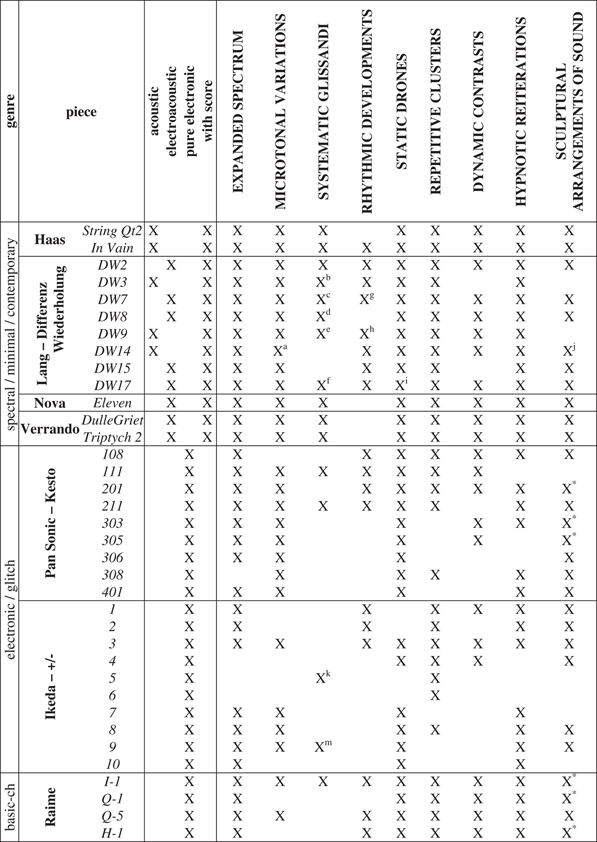
This selection includes composers (and performers) from diverse and unrelated musical scenes, and the pieces mentioned contain elements typical of the different contexts. However, the audio, spectral and score examinations previously described reveal nine musical attributes that are to a large extent common to all these pieces (Figure 1, step 3. See details in Table 1).
Musical attributes (columns) identified within our selection of pieces (rows)
Note: [Author – Pieces (Code)] Pan Sonic – Kesto (code XYZ, X: CD No. and YZ: track No.); Raime (code X–Y, X: CD-title as I for “If Anywhere…”,Q for “Quarter Turns…”, H for “Hennail” and Y: track); R. Ikeda – +/- (code: track No.). *Real-world sounds. Examples: a(from 04’40’’); b(07’33’’–07’50’’); c(15’35’’–16’05’’); d(10’20’’–11’20’’); e(26’35’’–27’40’’); f(35’15’’–38’50’’); g(03’18’’–03’30’’); h(15’35’’–16’40’’); i(19’50’’–23’40’’); j(19’20’’–24’00’’); k(end); m(12’00’’–end).
These attributes are:
∙ (A) An Expanded Spectrum, that is, the use of an extended frequency range. This trait is especially prominent in electronic or electroacoustic pieces. However, as mentioned above, this feature is also apparent in contemporary acoustic compositions using traditional instruments: Haas, for instance, makes frequent use of sforzato and sul ponticello techniques to generate multiple overtones in his string quartet. The use of an extended spectral range is identified by this method as an effect within the categories of sonic characteristics and space (Figure 1, step 2).
∙ (B) Microtonal Variations, that is, the use of microtonality or more generally interactions between neighbouring frequencies. Specifically, this attribute concerns, (i) the exploration of binaural beats (e.g. Ikeda, Haas), and (ii) the creation of static blocks with minimal fluctuation (e.g. Pan Sonic, Lang), and is found to a similar degree across the entire selection of pieces. It is generally categorised within the field of sonic characteristics.
∙ (C) Systematic Glissandi, that is, the use of glissandi embedded within repetitive units. This feature is present in most pieces: in the case of contemporary instrumental compositions, it often arises as a core structure used to create larger patterns (Haas, Lang), while in electronic pieces it is used more as a systemic contour to shape continuous evolutions (e.g. Vainio and Väisänen Reference Vainio and Väisänen2004: CD2 track 11; and Ikeda Reference Ikeda1996: tracks 5 and 9). Its effect is categorised within repetition and sonic characteristics (Figure 1).
∙ (D) Rhythmic Developments are integral to glitch or techno genres, but occasionally appear as minimal evolution in other contemporary pieces. They are frequently used by Lang within repetitive clusters (F) (see below), but also by Haas who creates synchronous progressions (e.g. the final part of In Vain) that generate a kind of rhythm. This attribute is common to all styles that are based on pulsations (in this study’s selection, the electronic-glitch and basic-channel styles of Pan Sonic, Ikeda and Raime respectively). In these cases, the rhythmic development should be considered and understood within the specific sociocultural context of these genres (e.g. IDM). Nevertheless, these styles do develop sophisticated rhythmic textures that are associated with timbric, spatial and dynamic attributes identified by this analytical method. In the interests of variety, the pieces selected for this study by these authors also include ones not primarily built on pulsation or rhythmic development.
∙ (E) Static Masses are constituted by layering sounds, but can also be created through continuous stationary textures; for example, Lang’s pieces. As mentioned above, this static attribute embodies an atypical vision of time. The creation of non-teleological musical sections is a common tendency among post-spectralist and minimalist pieces (Haas, Lang) using an immobilised temporal flow to explore sonic nuances. This attitude is also typical of those genres that use drones (i.e. the use of sustained, repeated sounds, or tone clusters) to originate hypnotic effects, such as in the work of Pan Sonic and Raime. In all cases, the use of static masses has an effect on the spatial aspects of a piece and involves the repetition/difference category.
∙ (F) Repetitive Clusters, that is, unvaried musical motifs that could generate rhythmic patterns (D), hypnotic effects (H), or mechanical and automated profiles. This attribute is strikingly prevalent in the pieces by Haas and Lang, where it is often the building block for more complex musical organisations. Each cluster, as a musical unit, can be composed differently: in the case of In Vain, for example, the cluster consists of sequential (during the first part) and layered (during the final part) groups of tones. The use of repetitive clusters is also representative of glitch and electronic genres.
∙ (G) Dynamic Contrasts, that is, the opposition of different elements according to certain sonic dimensions, are usually related to the sculptural use of sound (I), that is, the combination and succession of events creating repetition or difference. This attribute should be carefully evaluated, more through a qualitative and aesthetic assessment than a quantitative analysis using absolute values. A hasty comparison of the use of dynamic contrast in Ikeda and Haas pieces, for example, could lead to antithetical conclusions. The former makes use of extreme spectral ranges, whereas the latter creates contrasts only within a traditional acoustic palette. However, taking the possible dynamic range of instrumental composition into account, Haas’s designs can be seen as equally radical and contrasting.
∙ (H) Hypnotic Reiterations, that is, repetitive musical elements used both for static (E) and rhythmic development (D) purposes. This dual purpose in creating hypnotic effects using sustained sounds or streams of short tones (E) and continuous pulsations (D) is common to all the pieces selected and helps reinforce the idea that a shared perspective arises from the use of similar practices.
∙ (I) A Plastic and Sculptural Arrangement of Sound, that is, the use of a particular organisation of sounds based on their various characters, be it according to their sonic characteristics, narrative aspects or spatial character. This attribute, typical of electroacoustic and mixed music, is predominant in those genres that encompass the use of multichannel sound diffusion. In our selection, the sculptural arrangement of sonic elements is most often focused on the organisation of musical events in space in order to create virtual planes or dimensions of perception (i.e. Smalley’s spectral space and spatiomorphology, Smalley Reference Smalley1997). In some cases (i.e. Pan Sonic and Raime pieces), it is also accompanied by the use of real-world sounds that serve to clearly characterise specific spectral regions. It is evident that the type of a piece (i.e. acoustic, electroacoustic or electronic) has an impact on sculptural arrangement. In this regard, a piece’s typology should be taking into consideration when evaluating this attribute.
In some pieces, these attributes are frequently combined; for example, glitch-electronic music usually exhibits repetitive clusters (F) within rhythmic frameworks (D), while the repetition of musical units (F) in Lang and Haas’s pieces can at times be associated with non-rhythmic hypnotic reiterations (H) or more complex structures.
A typical example of this combination of attributes might involve the superimposition of musical elements of different type and opposite impact: a musical event that consists of ‘harsh interventions scattered into continuous layers of sound’ could be seen as exemplifying the attributes of (A) An Expanded Spectrum, (E) Static Drones, (G) Dynamic Contrasts and (I) A Sculptural Arrangement of Sound.
More generally, it can be seen that contemporary instrumental compositions (i.e. Haas’s and Lang’s pieces) make elaborate use of simple musical elements to create new effects: the reiteration of descending notes at the beginning of Haas’s piece In Vain evokes a sort of a cyclic falling whirl that constantly ascends. Similarly, electronic pieces apply drastic timbric techniques to arrive at analogous results, such as the application of periodically fluctuating frequency filters in the music of Pan Sonic (Vainio and Väisänen Reference Vainio and Väisänen2004: CD1, track 11). There are other parallels evident within our selection; for example, when more static musical episodes are considered or even when, in the case of Lang’s or Nova’s pieces, electronic devices are used in notated compositions (e.g. Lang 2000: track ‘Image/Idea’; Ikeda Reference Ikeda1996: track 7). In these cases, there is an explicit intention to take inspiration from wider cultural aesthetics, such as turntablism, glitch or noise for Lang, Nova and Verrando, respectively.
Considering the overall results of this study, each work displays at least eight out of the nine attributes identified above. Therefore, even though these nine attributes are fairly general, their presence across all pieces represents a starting point for the definition of a common cross-genre perspective.
One might argue that this selection of pieces includes strategically chosen examples to facilitate the method of analysis and that this analysis occurs only at a relatively general sonic level. However, as this cross-genre examination is innovative and untested, it was important to start with a solid and fertile set of musical works in order to create a clear template to be developed in the future.
5. Final Remarks and Conclusions
This study focused on a specific facet of today’s experimental music, selecting works that favour the exploration of sound itself over more structured writing techniques or systems. On the one hand, this study looked at styles of music that deal with a limited set of characteristics (e.g. hypnotic effects, repetition, rhythm) but which make use of innovative sonic contrasts and complex elaborations of sound. On the other hand, compositions belonging to the so-called contemporary instrumental music genre were seen to hold similar qualities within more elaborate structures.
This article does not intend to over- or underestimate any particular genre of music through its examination of, for example, simple rhythmic sections or by ignoring advanced compositional processes, but aims rather to highlight interesting correspondences between distant genres according to specific uses of sonic material and so originate constructive debates. It strives to compare (other than analyse) different styles based on a more aesthetic approach, trying to express it through descriptive attributes able to define more clearly this cross-genre perspective. The latter, in fact, even if it could be likely well know among scholars and trained listeners, continues to be indistinct and not fully recognised.
In expanding on this method going forwards, it seems necessary to incorporate aspects of production and reception into the musical analysis, as recently noted by Delalande (Reference Delalande2013). To this end, extension of this approach could occur through listening sessions and interviews in order to expand the scope of this cross-genre perspective to include perceptual and poietic aspects. This extension would permit a better understanding of various fields of music and would facilitate artistic convergences, and would help in the creation of a didactic and academic platform for the study of diverse musical contexts within a unified framework.