Although it is now commonplace for archaeologists to study use-alteration patterns on ceramics (e.g., Skibo Reference Skibo1992, Reference Skibo2013; Vieugué Reference Vieugué2014; Wilson and Rodning Reference Wilson and Rodning2002), the same cannot be said of one of the most ubiquitous classes of hunter-gatherer artifacts, fire-cracked rocks (FCR). However, many of the same methods and theories applied to the study of cooking ceramics are also relevant to the investigation of rocks as heating elements. Like cooking vessels, rocks exposed to heat display visible and recognizable use-alteration attributes. I discuss these attributes here to assist researchers in the identification of use-alteration patterns on FCR and to create a standardized terminology to describe them.
In this article, I first define FCR and review the different performance characteristics of rocks as various types of heating elements. Because use alteration analyses of FCR are scarce, I describe the thermal processes that affect stone and a range of physical signatures that are useful in the identification of FCR use-alteration patterns. I discuss as a case study my analysis of FCR from three Late Archaic period (5000–2000 BP) sites on Grand Island, Michigan: Duck Lake (FS09-10-03-1056/20AR580), 913 (FS09-10-03-913/20AR386), and 914 (FS09-10-03-914/20AR387).
A few unidentifiable and highly deteriorated calcined animal bones (<0.1 g) were recovered at Duck Lake, but none were identified at Sites 913 and 914. Organic remains are poorly preserved in the region, making the study of foodways a difficult endeavor using traditional approaches. However, FCR is found in abundance in Grand Island sites, and by creating a framework for its analysis, this article demonstrates that FCR provides an alternative means of investigating ancient food processing technologies. After considering multiple lines of evidence, I conclude that FCR recovered at Site 913 primarily constitute by-products of the stone boiling technique; meanwhile, FCR at Site 914 resulted primarily from the baking of foods in an earth oven feature, and FCR at Duck Lake was predominantly a by-product of open-air dry roasting facilities such as rock griddles.
Others have conducted experimental studies of FCR (e.g., Black et al. Reference Black, Ellis, Creel and Goode1997; Jackson Reference Jackson1998; Lovick Reference Lovick1983; Petraglia Reference Petraglia2002; Schalk and Meatte Reference Schalk, Meatte, Schalk and Taylor1988; Thoms Reference Thoms, Thoms and Burtchard1986, Reference Thoms1989, Reference Thoms, Frère-Sautot, Vicherd, Villes, Bontemps and Chastel2003, Reference Thoms2009; Wilson and VanDerwarker Reference Wilson and VanDerwarker2015), yet the most common archaeological reporting is limited to basic counts or presence/absence. The current study contributes a new appreciation of FCR while offering a framework for identifying and evaluating its potential function in various cultural practices and regions. With great quantities of FCR often available for analysis at prehistoric sites around the world, the framework proposed in this article will contribute a new line of evidence from which to infer behaviors associated with food production, midden accumulation, and site formation.
Uses of Fire-Cracked Rock
Ethnographic information provides examples of heated rocks used in a variety of contexts (e.g., Buckelew Reference Buckelew1911; Coues Reference Coues1893; Driver Reference Driver1952; Hough Reference Hough1926; Hutchings Reference Hutchings1888). They were commonly used in domestic facilities to cook food (e.g., stone boiling, earth oven baking, griddle roasting) and in noncooking facilities, for example, to provide heat in shelters (e.g., habitations, sweat lodges) and to melt snow for drinking water. Fire-cracked rock was also unintentionally created when structures burned (Jackson Reference Jackson1998:1) or from environmental events such as forest fires (Neubauer Reference Neubauer2016:174–179). Therefore, FCR informs on a range of behaviors, spanning economic (e.g., cooking), social (e.g., body warmth), and ritual (e.g., sweet lodges) spheres, and its systematic study may help to identify cultural behaviors and noncultural events (e.g., natural fires). This article focuses on the former and three specific forms of heat transfer in particular.
Earth Oven
Earth ovens (Supplemental Figure 1a) consist of layered cooking arrangements of fire, heated rocks, and food items that are designed to indirectly bake food for periods ranging from a few hours to several days (Black and Thoms Reference Black and Thoms2014: 205). In this cooking technique, food is sealed in a pit or depression with no added moisture other than the food itself and packing materials such as leaves. Foods cook from all sides via moist heat in an oxygen-reduced environment (Milburn et al. Reference Milburn, Doan and Huckabee2009:3).
Rock Griddle
The rock griddle (Supplemental Figure 1b) involves the process of cooking foods directly above or on elevated structures over uncovered pavements of heated rocks (Black and Thoms Reference Black and Thoms2014:208). These structures are used to dry-cook foods in order to desiccate, cure, or otherwise reduce their water content (Ellis Reference Ellis, Black, Ellis, Creel and Goode1997:61–62).
Stone Boiling
Stone boiling (Supplemental Figure 1c), for example, involves heating rocks in or near a fire until they have reached an optimal temperature, after which they are transferred into a watertight vessel, container, or pit containing liquid. The temperature can be maintained for boiling and simmering via the carefully timed addition of more heated rocks.
Performance Characteristics of Rocks as Heating Elements
Different raw materials withstand different fire temperatures and present distinct performance characteristics when heated (e.g., capacity to store and transfer heat, resistance to breakage). As stones are heated, their color and texture become altered in recognizable ways. How they change depends on a variety of factors, especially the nature and composition of the raw materials, their porosity and permeability, the length of time and temperatures to which they are subjected, and the number of times they are reused in heated contexts.
The more spherical an object is, the less surface area it has to radiate heat; therefore, and excluding other variables (e.g., cultural preferences and local availability), round rocks retain heat longer than flat slabs of equal density and are a better choice for heating (Black and Thoms Reference Black and Thoms2014:208; Fish Reference Fish, Spradley and McCurdy2012:219; Pierce Reference Pierce, McGuire and Hall1988:H4). Along with shape, rock size plays an integral role in heat retention and release. When all other factors are constant, a larger-sized rock (i.e., larger volume) will take longer to lose heat during cooling because it requires more time and energy to bring about a temperature change throughout the stone (Pierce Reference Pierce, McGuire and Hall1988:H5). Small rocks tend to heat and cool more evenly than large rocks, and therefore, smaller rocks are generally more resistant to fracturing (Crandell Reference Crandell2007).
Through experiments, Crandell (Reference Crandell2007) noted the following order of stone raw materials, from those that crack the most to those that crack the least: granite, quartz, quartzite, sandstone, and slate. Quartzite, a very resistant rock, can tolerate slow temperature changes until about 800 °C (Blackwelder Reference Blackwelder1927:138). When heated, quartzite breaks into large blocky pieces without shattering over a distance. Therefore, quartzite FCR can be more readily reused compared with more shatter-prone rock types such as quartz (Petraglia et al. Reference Petraglia, Bupp, Fitzell and Cunningham2002:11-13–11-14). Quartzite heats and boils water quickly but fractures much more often when heated than when cooled in water (McDowell-Loudan Reference McDowell-Loudan1983:26). During stone boiling experimentation, McParland (Reference McParland1977:33) noted that quartzite generally can be heated and submerged in cold water seven times without breaking.
Use-Alteration Attributes and Fracture Patterns of Fire-Cracked Rocks
FCR display distinctively irregular fractured surfaces that are described as jagged, angular, curvilinear, contorted, irregular, spalled, pot-lidded, crenulated, and wavy (Lovick Reference Lovick1983:42; McParland Reference McParland1977:32; Schalk and Meatte Reference Schalk, Meatte, Schalk and Taylor1988; Speth Reference Speth2015:55; Taggart Reference Taggart1981:144–145; Thoms Reference Thoms, Thoms and Burtchard1986:450); produce considerable quantities of debris or grit; are normally more friable than unheated stones of the same rock type; and exhibit texture and color changes toward pink, red, white, gray, and/or black hues (House and Smith Reference House, Smith, Schiffer and House1975:78; McParland Reference McParland1977:33; Schalk and Meatte Reference Schalk, Meatte, Schalk and Taylor1988:8.5–8.6). Here I describe use-alteration and fracture patterns of FCR in more detail.
Fracture Type
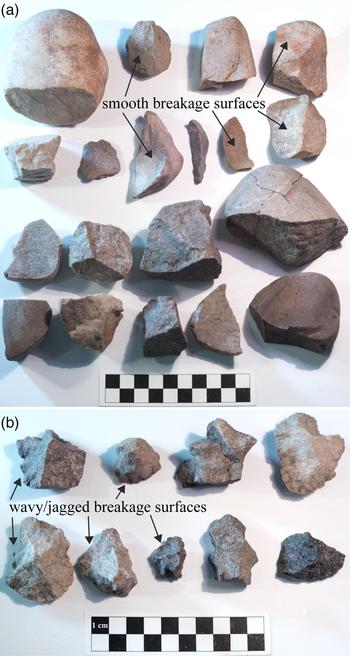
During various experiments with FCR, researchers (e.g., McDowell-Loudan Reference McDowell-Loudan1983; McParland Reference McParland1977; Taggart Reference Taggart1981; Zurel Reference Zurel1979) have noted two distinct types of breakage patterns (these are especially evident in fine-grained rocks such as quartzite). Expansion-fractured (dry-cooled) FCR is more commonly associated with rocks heated and cooled in a hearth, causing the outer portion of the rock to heat and expand faster than the relatively cooler interior (Jackson Reference Jackson1998). Dry-cooled FCR display flat, convex, or concave breakage faces that are smooth (Figure 1a).
Examples of fire-cracked rock (FCR): (a) expansion-fractured FCR with smooth interior faces that are characteristic of dry cooling; (b) contraction-fractured FCR exhibiting wavy/jagged/crenulated interior faces that are characteristic of wet cooling. (Color online)

In contrast, contraction-fractured (wet-cooled) FCR is most frequently created during rapid cooling in water. Wet-cooled FCR exhibit irregular crenulated/wavy/jagged fractures on the breakage faces and display two or more ridges on the inside of the rock, leaving a rough and undulating interior surface (Figure 1b; McParland Reference McParland1977:32). This fracture often appears on rocks used for stone boiling (e.g., McDowell-Loudan Reference McDowell-Loudan1983; McParland Reference McParland1977; Taggart Reference Taggart1981; Zurel Reference Zurel1979). During immersion, the exterior of the rock cools quickly, contracts, and sets up stress as a consequence of a shock response, although numerous water immersion episodes are often required to cause a complete fracture (Jackson Reference Jackson1998:39–41).
Buckley (Reference Buckley and Buckley1990), for example, conducted stone boiling experiments with seven naturally occurring rock types in Ireland. Buckley heated stones with an average diameter of 15 cm for 15 minutes in an open hearth and then placed them in 28 °C water. The number of heating/immersion episodes necessary to reduce rocks to <5 cm produced the following results: five episodes for micaceous sandstones, six for limestone, 10 for agglomerate, 12 for arkose, 20 for basalt, and more than 25 for vesiculated basalt and gabbro.
Some FCR fracture types cannot be placed in either expansion or contraction fracture categories and are referred to as intermediate type (Jackson Reference Jackson1998). In addition, I noted that some FCR pieces exhibit both types of breakage, which I designated as both expansion and contraction fracture types. For example, an FCR might display expansion fracturing on one face and contraction fracturing on the opposing surface. This type is less common but may indicate that an FCR was reused multiple times, perhaps as part of different cooking methods or heating contexts. This type could also result from rocks that fracture when initially heated and then again when placed in water. During stone boiling experimentation, McParland (Reference McParland1977:32) observed that during heating, when a spall crack developed but did not fracture, it could fracture similarly to an expansion fracture when the piece was later submerged in water, but these FCR differ in that at least one edge exhibits a typical contraction fracture. Therefore, such specimens will exhibit fractures of both expansion from the spall crack developed in the fire and contraction from being placed in water. McParland (Reference McParland1977: 32) also noted that fractures occurring along the natural bedding or faulting of a rock display a fracture type that is dependent upon the bedding, regardless of whether the fracture occurs in the fire or when submerged in water. Discerning these breakage patterns can be useful in determining the conditions and behaviors that resulted in FCR assemblages, whether through dry cooling or wet cooling.
Size Grade and Morphology
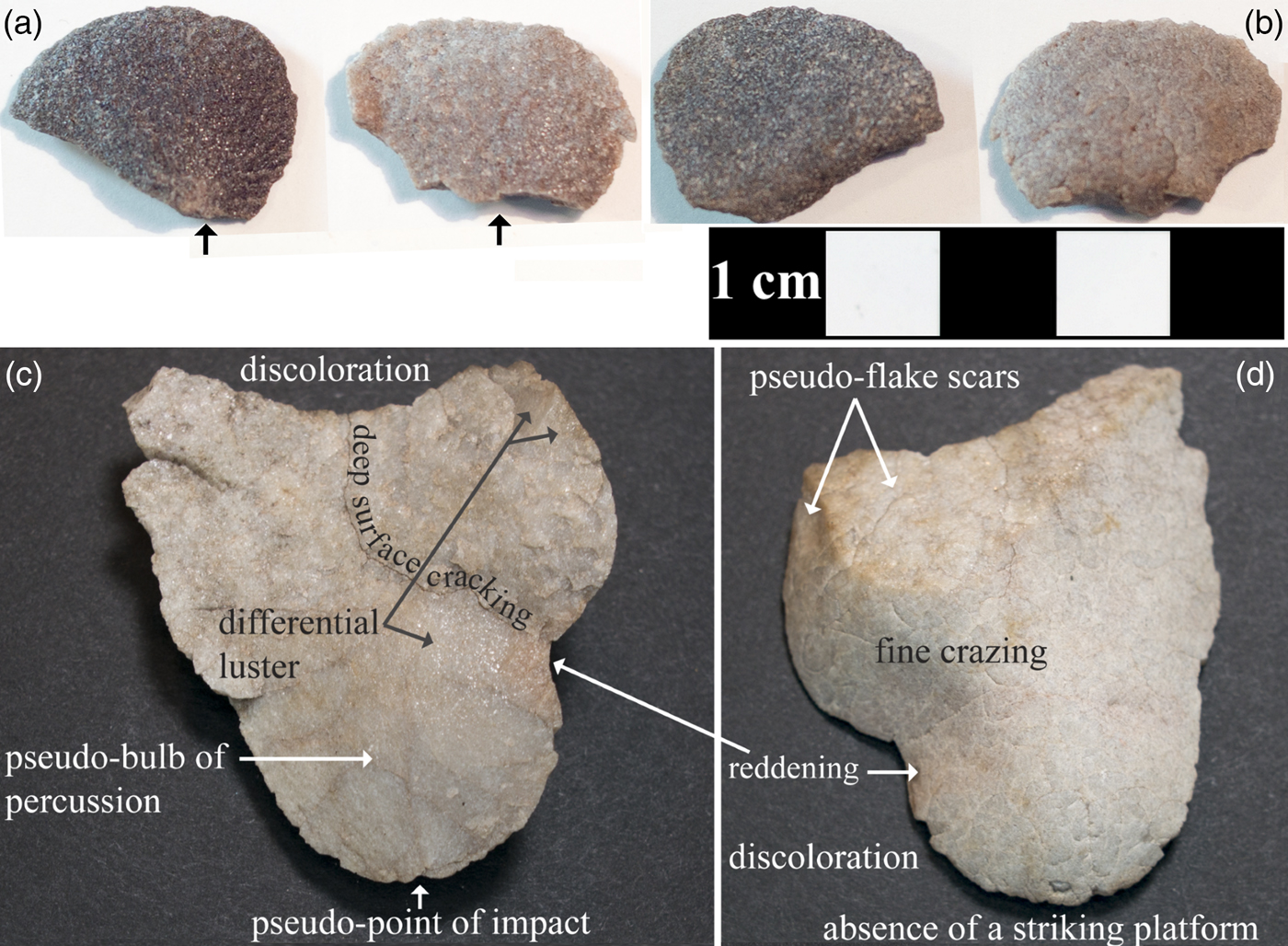
Fracture patterns on FCR can be divided into three major types depending on their size and morphology. The first type is spall or pseudo-flake fragments, which are small and roughly the size of flakes. The second type is blocky or pseudo-core fragments, which represent heat fractures that broke the core of the rock (Wilson and Delyria Reference Wilson and DeLyria1999:84). The third type is pot-lid “flake” fractures, which result from the differential expansion of heated rocks (Figure 2). Pot-lids can occur on various types of raw materials, such as quartzite and well-cemented sandstone (e.g., Neubauer Reference Neubauer2016:429), but are more common to lithics manufactured from cryptocrystalline silicate rocks such as chert (Ryan et al. Reference Ryan, Jones, Koerner and Lee2012:2017).
Fire-cracked pseudo-flakes: (a, c) ventral and (b, d) dorsal sides of pot-lid fractures resulting from heat exposure. Specimens a–b are typical pot-lid fractures, which are rounded and small, exhibit a pseudo-point of percussion, and lack a striking platform. The pot-lid on the right (a–b) has a fracture on its proximal end. These pseudo-flakes could easily be mistaken for intentionally chipped stone because they exhibit (a, c) a pseudo-point of impact and bulb of percussion on the ventral side and (d) pseudo-flake scars on the dorsal side. However, upon closer examination, pot-lids always lack a striking platform and usually display lustrous surfaces where the pseudo-bulb of percussion is situated (a, c). In addition, they often display one or more indicators of use alteration, such as (a–b) differential luster where the pseudo-bulb of percussion is located and discoloration of the quartzite to grayish (left) and whiter (right) hues, and (c–d) discoloration, reddening, differential luster, deep surface cracking, and fine crazing. (Color online)

Pot-lid fractures can be misclassified as knapped flakes (House and Smith Reference House, Smith, Schiffer and House1975:78–79). The same is true for pseudo-cores and knapped cores, but each can be easily recognized if an investigator is aware of the differences between them. Although the pot-lids sometimes look like knapped flakes and usually have a “bulb of percussion,” they always lack a striking platform. They may, however, display rugged margins similar to the ripples of a worked flake and a pseudo-point of impact (Figure 2a, c; Prous Reference Prous2004:86; Whittaker Reference Whittaker1994:73). The pot-lid fracture is generally ovoid or circular, flat on the dorsal side and convex on the ventral side, with its greatest thickness toward the center (Prous Reference Prous2004:86; Ryan et al. Reference Ryan, Jones, Koerner and Lee2012:2017). Although it is less common, pot-lids can also display a more irregular shape (Figure 2c–d), in contrast to the typical rounded shape (Figure 2a–b). Pot-lids usually display lustrous surfaces where the pseudo-“bulb of percussion” is located.
Size grade analysis can discriminate the thermal weathering process because every time a cooking/heating facility is used, some rocks will fracture and/or crack. As rocks are exposed to repeated episodes of heating and cooling, they fracture into ever smaller pieces. The degree of fracturing can be used to address questions of reuse of stones and features (Tennis et al. Reference Tennis, Hunziker and Leach1997:15). The resulting size of broken FCR may have influenced their performance characteristics, their suitability for reuse, and the point at which they were discarded.
Heated rocks tend to become weaker as the number of firing episodes they are exposed to increases (Jackson Reference Jackson1998). The quantity of fractured rocks increases as a cooking/heating facility's use increases, with the resultant rock sizes becoming smaller as rocks continue to fracture and be reused; therefore, the repeated use of a feature should result in a greater amount of fractured versus nonfractured rocks (Jackson Reference Jackson1998:46; Tennis et al. Reference Tennis, Hunziker and Leach1997:15). Combined with other variables (e.g., the original size of the rock, raw material type), the average size of FCR fragments at a site could be interpreted as a relative indicator of the intensity of its use (Graesch et al. Reference Graesch, DiMare, Schachner, Schaepe and Dallen2014; Pagoulatos Reference Pagoulatos1992; Thoms Reference Thoms1989:405).
Use Alteration
Twelve attributes of lithic use-alteration patterns can be discerned and are discussed in this section: heat fracture, differential luster, fine crazing, deep surface cracking, exfoliation, pot-lid negative/scar fracture, discoloration, reddening, sooting, oxidized patch, iron oxidation, and adhesion.
Heat Fracture
Heat fracture (also known as fire fracture) consists of the complete fracture of a specimen initiating from within the rock (Figure 1), resembling deliberate reduction but lacking bulbs of percussion (Deal Reference Deal, Ryan, Jones, Koerner and Lee2012:102), with the exception of pot-lid fractures, described previously (Figure 2a, c).
Differential Luster
Differential luster refers to internal changes in sheen and is one of the best indications that a stone has been thermally altered (Deal Reference Deal, Ryan, Jones, Koerner and Lee2012:100). Some fractures exhibit lustrous/glossy surfaces that can be oily in appearance (Figure 2c). In addition to FCR, intentionally heat-treated rocks also often display differential luster. Heat treatment prior to knapping improves the raw materials’ workability when they are heated slowly and out of direct contact with intense heat, at relatively low temperatures (Gregg and Grybush Reference Gregg and Grybush1976). The most obvious indicators for lithic heat treatment are changes to color and luster in some raw material types (e.g., quartzite and chert), although the latter may only become clear if a flake has been removed following heat exposure (Deal Reference Deal, Ryan, Jones, Koerner and Lee2012:99; Gregg and Grybush Reference Gregg and Grybush1976:190). When a heat-treated rock is knapped, it can produce a flake scar bearing differential luster (House Reference House, Schiffer and House1975:84; Prous Reference Prous2004:85). Moreover, the external surfaces of cherts, for example, tend to become optically dull when heated (i.e., nonreflective of light; Deal Reference Deal, Ryan, Jones, Koerner and Lee2012:100).
Fine Crazing
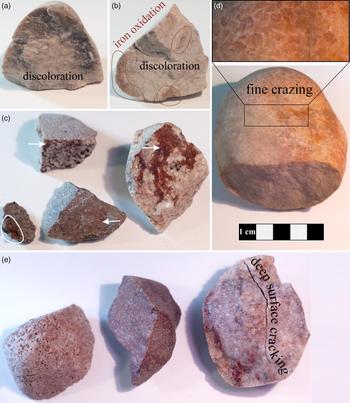
Fine crazing is characterized by the presence of a delicate network of very shallow surface cracks made up of fine, nonlinear or latticed cracks macroscopically visible on the surface of a specimen (Deal Reference Deal, Ryan, Jones, Koerner and Lee2012:102; Ryan et al. Reference Ryan, Jones, Koerner and Lee2012:210). Fine crazing forms a network of closed polygons (Figures 2d and 3d), probably caused by differential thermal expansion and/or cooling (Deal Reference Deal, Ryan, Jones, Koerner and Lee2012:102). I performed FCR heating and stone boiling experiments with Grand Island quartzite cobbles to help identify patterns observed in the archaeological materials (Neubauer Reference Neubauer2016:229–246). One noteworthy observation was that although fine crazing was identified on 65% of the stone boiling quartzite cobbles and was the second-most common use alteration after sooting, no fine crazing was observed on the quartzite cobbles that were placed in a hearth for five hours (Neubauer Reference Neubauer2016:244). One possible explanation is that fine crazing forms when rocks are exposed to low heat, perhaps for shorter amounts of time. Because the boiling stones exhibited a lesser degree of discoloration and reddening, it is likely that fine crazing develops before intense discoloration is evident (Neubauer Reference Neubauer2016:244). The higher degree of discoloration and reddening would consequently erase any traces of fine crazing if it was previously present. This also might indicate that a higher frequency of fine crazing, in combination with other factors (e.g., higher frequency of contraction-fractured FCR/wet cooling) can potentially provide another line of evidence for the interpretation of stone boiling activities in the archaeological record.
Examples of fire-cracked rock (FCR) exhibiting discoloration, iron oxidation, crazing, and cracking: (a–b) two sides of a fire-cracked rock exhibiting (a) partial discoloration from a brown (natural prefire color) to a whiter hue and (b) complete discoloration and iron oxidation on another side; (c) FCR exhibiting iron oxidation; (d) FCR with fine crazing; (e, far right) FCR with deep surface cracking. Note that FCR specimens d–e display reddening, while FCR a–c exhibit discoloration. (Color online)

Deep Surface Cracking
Deep surface cracking is typified by deep crevices splitting the surface of a specimen (Figures 2c, 3e, and 4a), probably due to the continued stretching and expansion of finely crazed surfaces (Deal Reference Deal, Ryan, Jones, Koerner and Lee2012:102). These deep surface cracks facilitate future complete heat fractures, which can occur naturally or through the reuse of specimens in fire-related contexts.
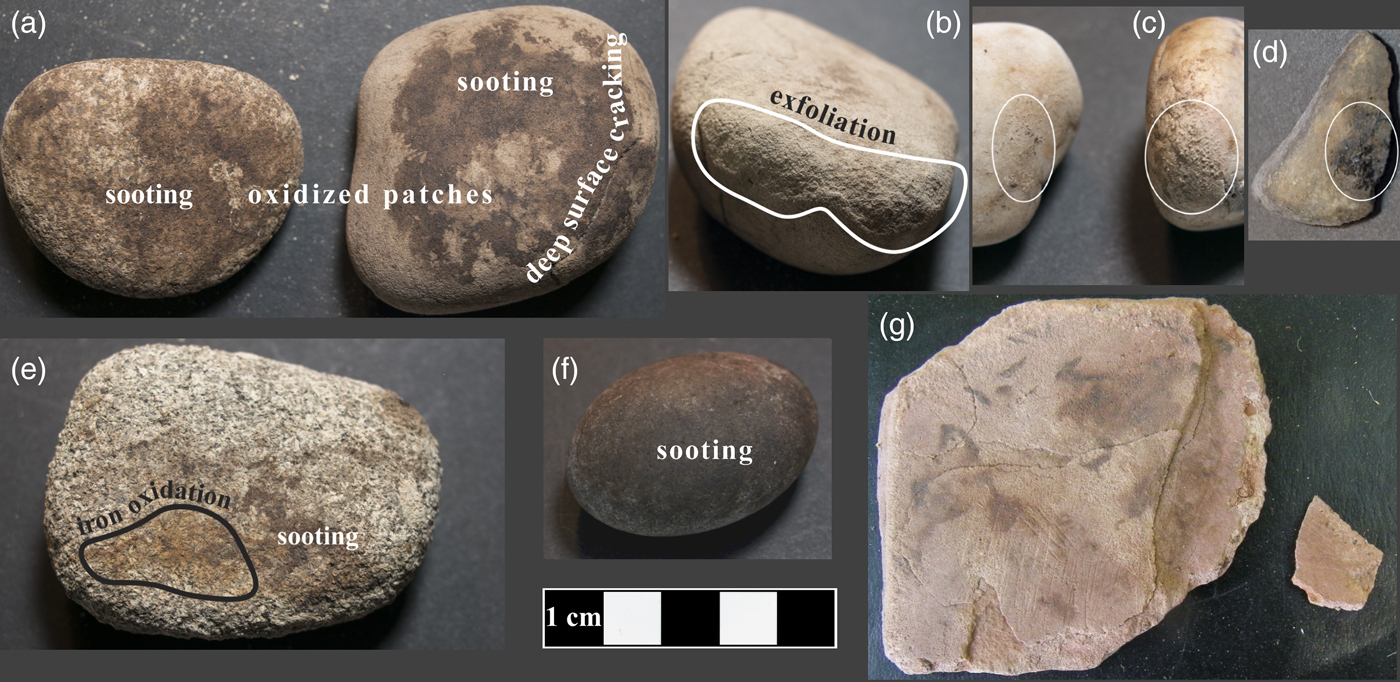
Examples of various use alterations on rocks: (a) sooting, oxidized patches, and deep surface cracking; (b) exfoliation; (c–d) adhesions on a rock's surface; (e) iron oxidation and sooting; (f) sooting; (g) slate slab exhibiting reddening and sooting, as well as exfoliation where several flakes are peeling off. (Color online)

Exfoliation
Exfoliation occurs when a specimen is exposed to cyclical increases and decreases in temperature, causing its surface layers to fracture in thin fragments, sheets, or flakes (Figure 4b, g). Some raw materials, such as sandstone and slate, are more susceptible to this type of use alteration due to their performance characteristics when heated (Neubauer Reference Neubauer2016:203).
Pot-Lid Negative/Scar Fracture
Pot-lid negative/scar fracture is a type of thermal fracturing resulting in the detachment of small round pot-lid “flakes” that pop off the surface of a rock (Figure 2), leaving an irregular pitted scar or negative impression on the surface of the parent rock (Darvill Reference Darvill2008; Whittaker Reference Whittaker1994:73). The fracture is most commonly characterized by a circular pit on the surface of the specimen, which represents the area in which the original surface exfoliated during differential heating and pressure release (Ryan et al. Reference Ryan, Jones, Koerner and Lee2012:217). The concave scars left on the parent rock are the result of differential thermal expansion and contraction of isotropic material, but they do not exhibit compression rings of force lines and are generally a natural occurrence rather than the intentional result of knapping (Crabtree Reference Crabtree1982:49).
Discoloration and Reddening
Overall, color changes resulting from heat exposure exhibit an increase in red/brown hues and brightness. Lighter brightness values result from the increased number of microfractures, which reflect more light and thus give the appearance of a lighter color (Figures 2c–d and 3a–b; Jackson Reference Jackson1998:61). Discoloration refers to observable color changes to a specimen (Figures 2 and 3a–c). Similarly, reddening is a specific type of discoloration in which a specimen changes from its original prefire color to a red hue (Figures 2c–d, 3d–e, and 4g). Discoloration and reddening typically result from chemical alterations to mineral composition caused by heat exposure (Ryan et al. Reference Ryan, Jones, Koerner and Lee2012:210). The chemical alteration generally results from oxidation (i.e., reddening: color shifts to red) or reduction (i.e., discoloration: color shifts to white, gray, or black; Pierce Reference Pierce, McGuire and Hall1988:H7). During experimentation, Pagoulatos observed that reddening and discoloration become more intense as rocks were heated for longer periods and that
reddening ranged from a dull red-yellow-brown (7.5 YR 6/6) in earlier re-uses to a strong red (2 YR 5/8) in later re-uses. Perhaps frequent re-use of stone results in a change from dull to bright reddening; this may represent a diagnostic marker of intensive re-use [Reference Pagoulatos1992:126].
Sooting
Sooting (also known as carbon deposition or smoke blackening) refers to carbon-based solid residues carried by flames that attach to a stone surface during the incomplete combustion of carbon-based fuels, resulting in smudging and blackening of the surface of a specimen placed in direct contact with a fire (Figure 4a, d–g). The sooted portion of a rock develops as a localized blackened area on its exterior surface that correlates to charcoal and/or soot staining and appears as a dark coating of fine carbon particles (Gur-Arieh et al. Reference Gur-Arieh, Maeir, Shahack-Gross, Karageorghis and Kouka2011:349; Jackson Reference Jackson1998:108–109; Ryan et al. Reference Ryan, Jones, Koerner and Lee2012). Carbon deposits on a stone's surface are formed as a by-product of the pyrolysis and combustion of organic materials. Therefore, sooting is the gray-black streaking and smoking from reduction (Figure 4a, d–g), where less oxygen reached the materials (McDowell-Loudan Reference McDowell-Loudan1983:25; Ryan et al. Reference Ryan, Jones, Koerner and Lee2012). In relation to ceramic cooking vessels, Skibo (Reference Skibo1992) and Gur-Arieh and colleagues (Reference Gur-Arieh, Maeir, Shahack-Gross, Karageorghis and Kouka2011) have observed that, even when they are subjected to high temperatures, soot does not appear to develop in the absence of flames, that is, on vessels placed on live embers or coals. Sooting only forms from the deposition of partially combusted particles in direct contact with flames. Thus, the reuse of vessels may alter sooting and oxidation patches. Although soot can accumulate on vessels during each use, its patterns change as a result of the conditions in the last heat exposure. Soot on ceramic vessel walls can be burned off when a pot is reused, and the soot patterning on vessels used several times in an open fire will display palimpsests of sooting and oxidizing events. Through my experiments, I found that similar processes apply to the formation of soot patterning on FCR (Neubauer Reference Neubauer2016:237, 242).
Oxidized Patch
Oxidized patches form during exposure to high temperatures when stone and ceramic surfaces react with atmospheric oxygen, resulting in either the discoloration of exposed surfaces (generally referred to in ceramic analysis as oxidation patterns) or the burning off of previously deposited soot (Skibo Reference Skibo1992). Oxidized patches can be formed by the application of heat in the absence of soot or by high-intensity heat, especially in situations where a specimen was set near a fire or if the fuel was very clean-burning (Skibo Reference Skibo1992:156). In laboratory kiln experiments, Skibo (Reference Skibo1992:160) observed that soot begins to burn off by 400 °C, which is well within the range of temperatures achieved by open fires. Above these temperatures, surfaces become so hot that no new soot will form (Skibo Reference Skibo2013:91). After the surface is initially sooted, the oxidized patch forms when the temperature of the specimen increases. Oxidized patches form at points nearest to the fire and range in color from white (when there is no soot and a completely oxidized surface) to light gray (when a light coating of soot remains; Figure 4a; Skibo Reference Skibo1992:159, Reference Skibo2013:91). However, oxidized patches do not develop during every use episode. In order for soot to oxidize, a surface must remain in the same position for a relatively long time, particularly when the sooting is thick (Figure 4f). If oxidized patches are formed, they may be sooted over during subsequent use episodes (Skibo Reference Skibo1992:156).
Iron Oxidation
Iron oxidation should not be confused with the definition of oxidation derived from pottery analysis (e.g., Skibo Reference Skibo1992, Reference Skibo2013). Iron oxidation more broadly refers to the chemical process in which an atom or ion combines with oxygen. The oxidation of carbon creates carbon dioxide gas, and the oxidation of iron may cause pottery and rocks to turn brown or red and metals to rust (Ryan et al. Reference Ryan, Jones, Koerner and Lee2012:217). Natural or cultural processes can trigger these reactions, as oxidizing agents include sunlight, heat, and oxygen (Quigg et al. Reference Quigg, Malainey, Przybylski and Monks2001:295). Iron oxidation is a type of chemical weathering that occurs when oxygen from the atmosphere reacts with metal elements such as iron in stone to form oxides, resulting in a brown to red coloration (Figures 3b–c and 4e; Jackson Reference Jackson1998).
Adhesion
Adhesions (also known as concretions) are conglomerates of organic (e.g., shells, bones, charcoal) and mineral (e.g., quartz, silica, silt, clay) remains that form as a by-product of anthropogenic or natural processes (Guimarães et al. Reference Guimarães, Gaspar and Schell-Ybert2005:2). Humidity and fire play an important role in the incorporation of materials on stone surfaces. An adhesion is a superficial deposit of foreign materials unlike that of the surrounding material of a rock. Adhesions are important because they can relate to the accumulation of food remains, especially when found on artifacts associated with hearths (Canada Department of Agriculture 1978:13; Hameister et al. Reference Hameister, Saldanha and Dias1997:25; Quinteira Reference Quinteira2013:19). Adhesions are usually cemented to the surfaces of rocks and are difficult to remove. Their conglomerations are generally small, spherical, and gray to black (Figure 4c–d).
Summary
It is important to note that an FCR often displays multiple types of use alterations depending on the intensity of the heat to which it was exposed, the amount of time it was exposed to heat, and the number of heating episodes. Understanding the magnitude of thermochemical weathering or use alteration displayed on FCR and being able to recognize the different types of use alteration of rocks may inform on a great range of ancient cooking behaviors and fire-related activities (Jackson Reference Jackson1998; Neubauer Reference Neubauer2016:426–427). For example, rocks heated experimentally to 800 °C and cooled gradually for 48 hours to simulate earth oven cooking exhibited intense use alteration compared with the moderate use alteration of stones heated similarly and cooled gradually for 24 hours to simulate hot-rock griddle cooking in an open hearth (Thoms Reference Thoms2007:486). In contrast, rocks heated to 800 °C and cooled quickly by immersion in water to simulate stone boiling cooking exhibited far less use alteration than those cooled gradually (Jackson Reference Jackson1998).
Fire-Cracked Rocks in Domestic Life and Subsistence Practices: A Case Study from the Great Lakes Region
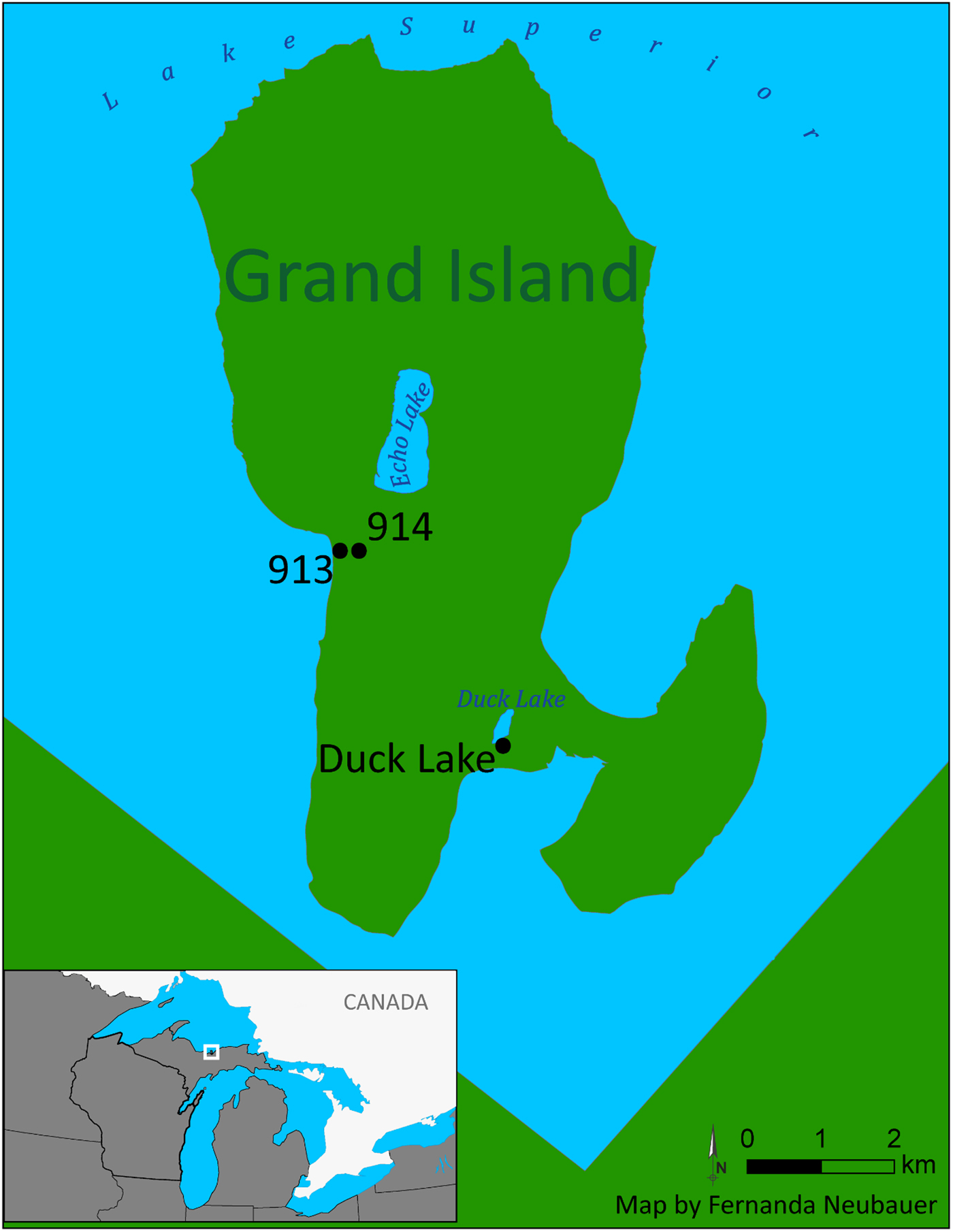
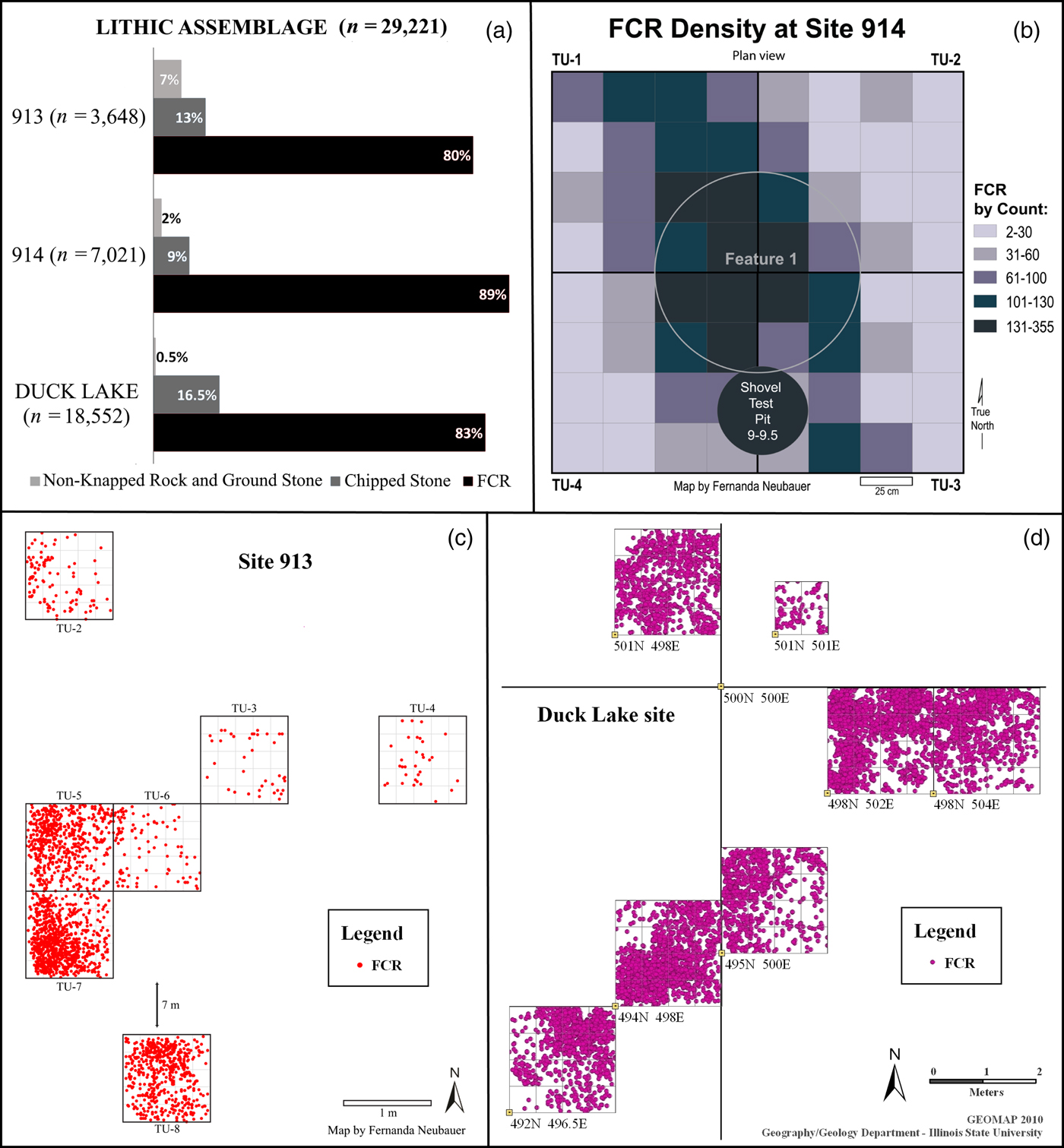
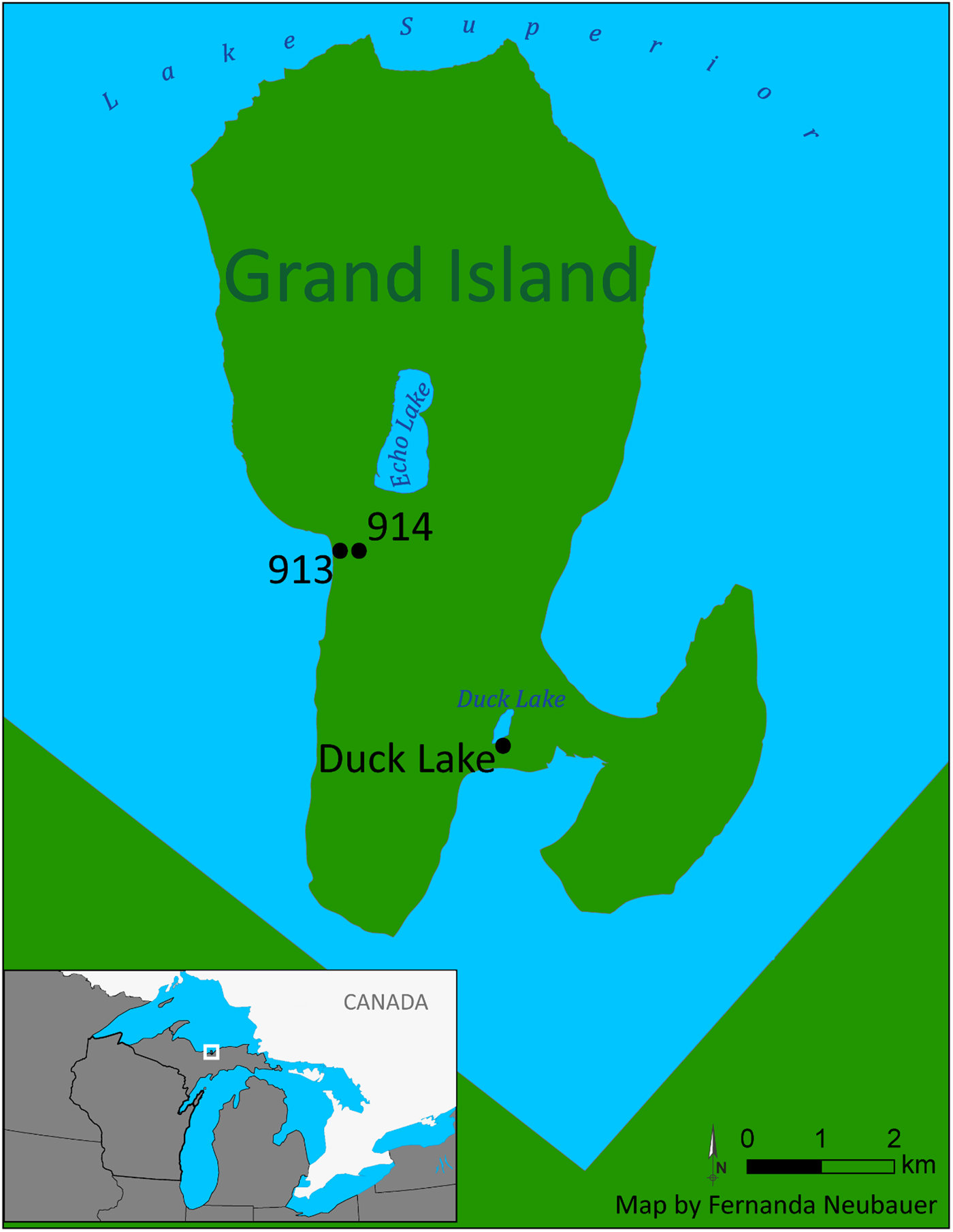
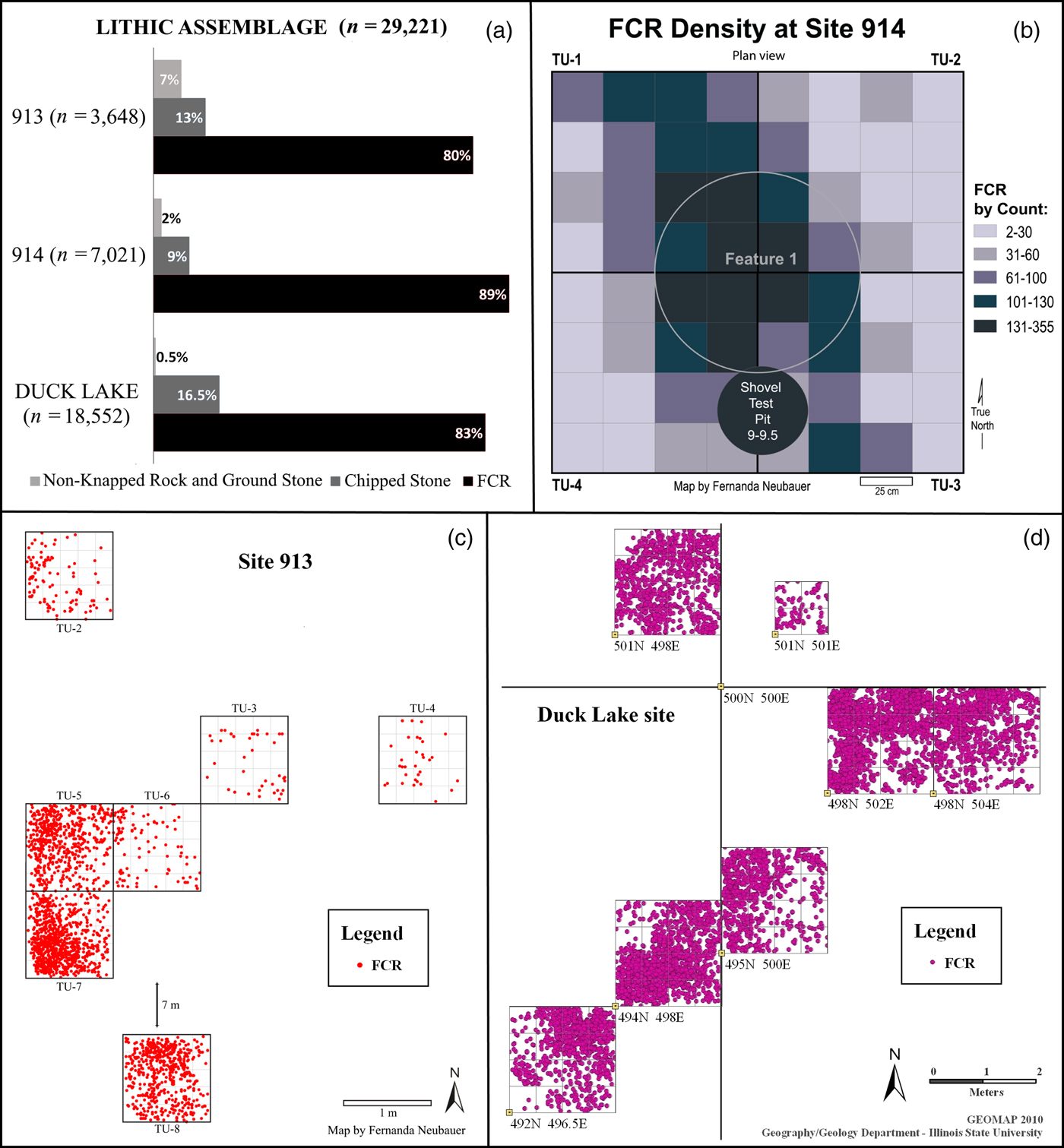
This section discusses a case study, analysis, and interpretation of FCR from three Late Archaic sites located on Grand Island in Michigan's Upper Peninsula (Figure 5). I codirected Phase II excavations at these sites with James M. Skibo and Eric C. Drake as part of the Grand Island Archaeological Program. I analyzed all 29,221 lithics (Figure 6a) from our excavations of 4 m2 at Site 914 (Figure 6b), 9.5 m2 at Site 913 (Figure 6c), and 25 m2 at Duck Lake (Figure 6d; Neubauer Reference Neubauer2016). These cooking and food processing sites contain a high density of FCR and a low frequency of chipped stone, including formal tools and debitage (Figure 6a). FCR represents 89% (n = 6,271) of the lithic assemblage at Site 914, 83% (n = 15,398) at Duck Lake, and 80% (n = 2,912) at Site 913 (Figure 6a).
Location of the studied sites on Grand Island in Michigan's Upper Peninsula. (Color online)
Frequencies and spatial distributions of fire-cracked rock (FCR) at the Duck Lake, 914, and 913 sites: (a) comparison of their lithic assemblages, which indicate similar distributions of FCR; (b) plan view of the four units excavated at Site 914 showing the generalized location of the feature and FCR density by count, indicating a heavier concentration of FCR in and around the feature; (c) plan view of the spatial distribution of FCR at Site 913; (d) plan view of the spatial distribution of FCR at the Duck Lake site. Rocks that contain one or more heat fractures are classified as FCR, while nonknapped rock describes stones that fit in one or more of the following categories: (1) rocks fractured by natural processes, (2) complete rocks that do not exhibit evidence of human interaction (i.e., unmodified rocks), and (3) complete rocks that were culturally modified by polish and/or use alteration with the exception of heat fracture. (Color online)
The geologic formation on Grand Island includes a basal unit of the Jacobsville Sandstone Formation, composed of sandstones of late Precambrian or early Cambrian age (Anderton Reference Anderton2004). The Munising Sandstone Formation lies stratigraphically above the Jacobsville Formation and is Cambrian in age. Ninety percent of the raw materials identified in its basal conglomerate consist of vein quartz, quartzite, and chert, with small amounts of slate, basalt, iron formation, granite, and sandstone. However, much of the basal conglomerate on the island consists of pebbles and cobbles of quartzite (Anderton Reference Anderton2004). Furthermore, other raw materials occur in small quantities in glacial till.
Quartzite cobbles are the primary raw material source for the FCR identified at the study sites, constituting 69% to 82% of the sample assemblages. Quartzite in the form of pebbles and cobbles is readily available, especially along the beaches and coastline of Grand Island. Other raw material types were also used but in much lower quantities: basalt, sandstone, slate, quartz, granite, gneiss, gabbro, and slate. Below, I focus on quartzite because it is fairly uniform and behaves in a predictable way when subjected to heating and cooling and because quartzite FCR was abundant in the sites. At Duck Lake and Site 914, I selected samples for analyses because FCR was recovered in large quantities at these sites. I analyzed all FCR at Site 913, with the exception of a limited amount recovered in the screen that was fairly small in size (Figure 7).
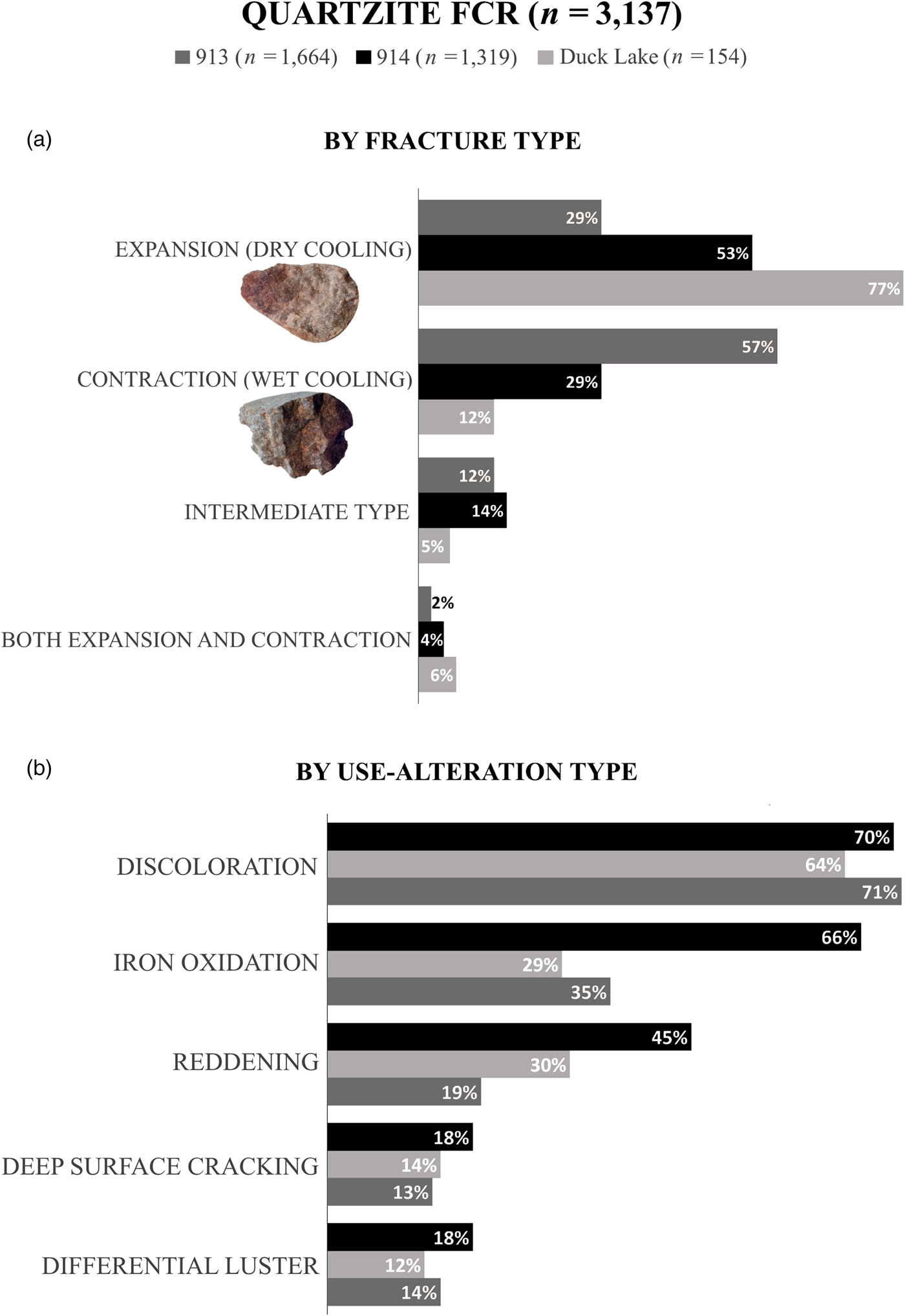
Attributes of quartzite fire-cracked rock (FCR): (a) comparison of the quartzite FCR fracture type percentages at Sites 913, 914, and Duck Lake; (b) the most frequent use alterations on quartzite FCR. (Color online)

Cooking Methods
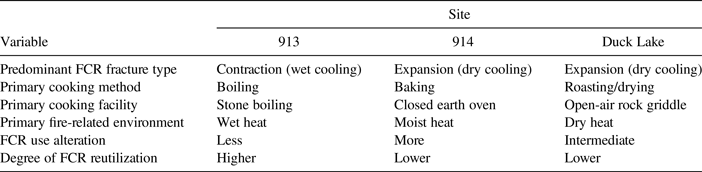
Generally, rocks may be subjected to three fire-related environments: (1) dry heat (e.g., open hearths), (2) moist heat (e.g., earth ovens), and (3) wet heat (e.g., stone boiling; Thoms et al. Reference Thoms, Laurence, Short, Kamiya, Thoms, Boyd and Kibler2015:161). The quartzite FCR fracturing characteristics from the total quartzite FCR samples analyzed for each site (Figure 7a) support an interpretation that stones were predominantly subjected to dry heat at Duck Lake, to moist heat at 914, and to wet heat at 913 (Table 1). Expansion fracturing (dry cooling) predominates at Duck Lake and Site 914, although it is much more frequent at the former. In contrast, contraction fracturing (wet cooling) predominates at Site 913 (Figure 7a).
Summary of Fire-Cracked Rock (FCR) and Cooking Evidence at Sites 913, 914, and Duck Lake.

Note: Notice the variability in FCR types and the domestic features with which they are associated.
At the Duck Lake site, FCR was distributed across dense localized pavements ~15–20 cm thick (Supplemental Figure 2). The high concentration of FCR pavements in association with a predominance of dry-cooled FCR (77%; Figure 7a) likely indicate that the FCR at Duck Lake resulted from roasting/drying foods in open-air rock griddle cooking facilities (Supplemental Figure 1b) on the surface and/or in shallow basins, where foods were cooked via dry heat with no added moisture. Rock griddles do not require permanent facilities, and therefore, their remnants can be difficult to discern archaeologically:
In particular, if hot coals were used, they might have broken into small fragments that either would not have preserved or would have completely dissipated. If heated stones were used, they probably would appear as small, isolated piles or scatters of burned, fractured, and/or discolored rocks that might not even be recorded as features during archeological excavation [Ellis Reference Ellis, Black, Ellis, Creel and Goode1997:62].
Furthermore, the studied sites are located in currently forested areas, where Late Archaic features may not preserve or are difficult to define and distinguish from features created by natural processes. In fact, the only possible feature identified at Duck Lake was heavily disturbed by small-mammal burrowing and/or tree roots. The feature contained 27 lithics, almost all FCR, was approximately 40 cm wide and 30 cm deep, and was oval in both plan and profile views. Two zones were identified: Zone I was a compact dark reddish brown sand (5 YR 2.5/2) containing charcoal, and Zone II was a brown sand (7 YR 5/3) containing most of the FCR recovered in the feature. A charcoal sample dated to 3610 ± 30 14C BP (Beta-348785, wood charcoal, δ13C = −25.4‰).
In comparison to Duck Lake, there were fewer expansion fractures (dry cooling) at Site 914, which represented 53% of the quartzite FCR (Figure 7a). The lithic materials at Site 914 appear to be associated with a feature (Figure 6b) consisting of a dark gray loamy sand (10 YR 4/1) layer containing charcoal. A charcoal sample yielded an age of 2950 ± 30 14C BP (Beta-423705, wood charcoal, δ13C = −25.5‰). The feature's diameter (1 m), depth (20 cm), basin-shaped morphology, FCR characteristics, and charcoal and charcoal-stained soils support an interpretation of a rock-filled earth oven (Supplemental Figure 1a). The evidence of a considerable quantity of contraction-fractured FCR (29%) indicates that there was moisture inside the oven, possibly provided by packing materials (e.g., leaves) and the foods themselves. The layer of vegetation is important to protect foods from the hot rocks and to provide moisture during the cooking process, ensuring an environment where steam permeates the food layer and cooks as convective heat, effectively preventing the food from burning (Leach et al. Reference Leach, Bousman and Nickels2005:202; Stark Reference Stark2002:12). This high percentage of contraction fracturing (wet cooling) also indicates that an earthen cap likely closed the pit (Supplemental Figure 1a), trapping moisture and heat inside, as opposed to an open pit that would be expected to produce a higher percentage of expansion-fractured FCR, as at the Duck Lake site.
The high frequency (57%) of contraction-fractured quartzite FCR (Figure 7a) indicates that rocks at Site 913 were cooled rapidly in a wet-cooking environment, in contrast to the evidence at Duck Lake and Site 914, where rocks were dry-heated slowly. The wet-cooking method most likely was stone boiling (Supplemental Figure 1c), a common wet-cooking method recorded in ethnographic and ethnohistorical accounts (e.g., Densmore Reference Densmore1928; Driver Reference Driver1952; Hutchings Reference Hutchings1888). Stone boiling results in rocks fracturing both during the initial dry heat of the fire and, more commonly, during the sudden cooling the rocks experience when placed in water. Evidence of stone boiling can be hard to detect archaeologically because often the only diagnostic residue is FCR (Petraglia Reference Petraglia2002; Thoms Reference Thoms2008, Reference Thoms2009), as in the case of Site 913, where no features were identified:
Typically, highly fractured and smaller fragment sizes are used as indicators of a stone boiling association. In addition, a lack of charcoal and evidence of in situ burning are also commonly used as likely indicators of stone boiling refuse, which as indirect heat sources would not be associated with these residues [Petraglia et al. Reference Petraglia, Bupp, Fitzell and Cunningham2002:11-6].
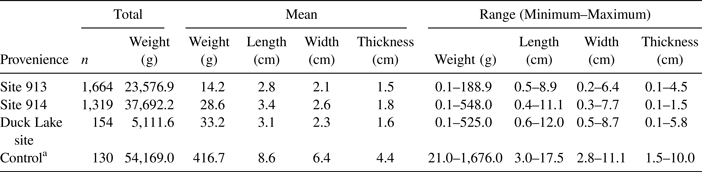
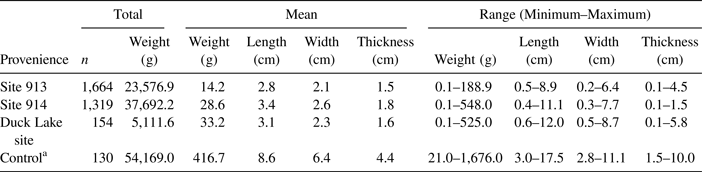
The quartzite FCR at Site 913 was small and highly fragmented. As I discuss below, the average weight of a quartzite FCR at Site 913 was 14.2 g, less than half the average weight of a quartzite FCR at the Duck Lake and 914 sites (Table 2).
Dimensions and Weight of Quartzite Fire-Cracked Rock.
a Complete quartzite cobbles from Trout Bay Beach on Grand Island.
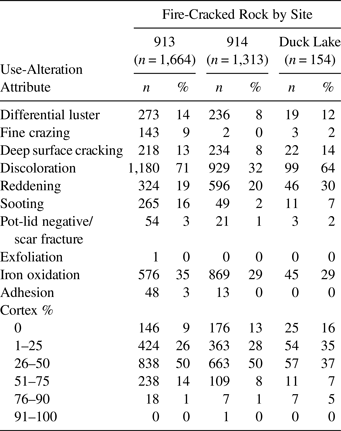
In addition, my FCR experiments found that fine crazing was visible on 65% of the quartzite cobbles used for stone boiling, but there was none on cobbles employed in the campfire/dry-cooling experiment, possibly due to their prolonged exposure to higher temperatures (Neubauer Reference Neubauer2016:244). Similarly, 9% (n = 143 of 1,664) of the quartzite FCR at Site 913 exhibited fine crazing; however, fine crazing was only visible on 0.05% (n = 2 of 1,313) of the quartzite FCR at Site 914 (Table 3). This suggests that stone boiling (wet cooling) was practiced at Site 913, while at Site 914, cooking resulted in the dry cooling of cobbles at higher temperatures for longer periods.
Frequencies of Use Alterations and Cortex Coverage on Quartzite Fire-Cracked Rock.

Note: Counts/percentages of use-alteration attributes do not sum to site totals or to 100%, because most specimens exhibit multiple attributes.
Evidence related to the extent of use alteration displayed on FCR resulting from different cooking techniques also supports these interpretations. As previously discussed, because of the amount of time they remained heated, rocks used in stone boiling are expected to exhibit significantly less use alteration than those used in steaming or roasting in an open fire, while those employed in earth ovens for prolonged baking periods are expected to exhibit the most use alteration (Thoms Reference Thoms2009:588). Indeed, this appears to be the case at the Grand Island sites. Generally, use alteration is more pronounced in the quartzite FCR at Site 914, which likely involved prolonged baking, when compared with the FCR at Site 913, which was primarily used in stone boiling, and also compared with the Duck Lake FCR, used primarily for lower-temperature roasting/drying (Figure 7b). Some types of use alteration (iron oxidation [66%] and reddening [45%]) occur about twice as often on quartzite FCR at Site 914, possibly due to their prolonged heat exposure in an earth oven, compared with 29%–35% iron oxidation and 19%–30% reddening on the Duck Lake and 913 sites’ FCR, respectively (Figure 7b). In comparison to Site 914, use alterations on quartzite FCR at Sites 913 and Duck Lake display similar percentages, probably due to the higher degree of reuse in stone boiling at Site 913 (Table 1).
Stone Reuse
Ethnographic literature documents the practice of reusing the same cooking facilities and the same rocks from year to year (Thoms Reference Thoms1989:404). Four attributes are used in order to determine the degree of FCR reuse at the sites: (1) the presence of cortex, (2) average size, (3) average weight, and (4) the fracturing pattern (the amount of blocky/pseudo-core and spall/pseudo-flake).
Cortex
The frequency of specimens with cortex should decrease with the continued fracturing and reduction in size of stone due to repeated use. Thus, the frequency of FCR lacking cortex should correlate with a higher degree of fracturing (Tennis et al. Reference Tennis, Hunziker and Leach1997:15). The low frequencies of FCR surfaces with cortex suggests that most FCR experienced multiple episodes of heating and cooling (Table 3), with Site 913 (9%) experiencing fewer episodes of reuse than Site 914 (13%) or Duck Lake (16%).
Size
When rocks are repeatedly reused in hearth features and boiling operations, they may become increasingly smaller and more angular (Thoms Reference Thoms1989), and their heat retention potential is reduced (Witkind Reference Witkind, Gunn and Mahula1977). Experiments demonstrate a correlation between increased frequency of FCR and decreased FCR size, supporting the use of size frequency as a measure of feature reuse (Mauldin et al. Reference Mauldin, Graves and Bentley1998; Pagoulatos Reference Pagoulatos1992; Tennis et al. Reference Tennis, Hunziker and Leach1997:5). The degree of fracturing (i.e., as rocks are exposed to repeated episodes of heating and cooling, they fracture into ever smaller pieces) can address questions of reuse and recycling of stones (Tennis et al. Reference Tennis, Hunziker and Leach1997:15). The average size of FCR fragments at a site should be a relative indicator of the extent and intensity of its use. Rocks that break into large pieces, such as quartzite, can be used and reused until they are too small to effectively retain heat any longer, which may be why quartzite was preferentially selected as hot rocks on Grand Island.
The average length, width, and thickness of quartzite FCR (Table 2) are low at Site 913 (2.8, 2.1, and 1.5 cm) compared with Site 914 (3.4, 2.6, and 1.8 cm) and Duck Lake (3.1, 2.3, and 1.6 cm). This indicates that, in contrast to data related to the cortex amount, more FCR was reused at Site 913, when compared with the other sites. Higher frequencies of fractured FCR and smaller FCR sizes at Site 913 are both hallmarks of the repeated submersion of heated stones in water, as opposed to open-air cooling (Cavallo Reference Cavallo1987).
Weight
In order to estimate the average rock size selected by Late Archaic peoples for use as hot rocks, I collected, measured, and weighed a haphazard sample of 130 quartzite cobbles from the modern Trout Bay Beach on Grand Island, located about 1 km north of the Duck Lake site, to compare their measurements with the FCR at the studied sites (Table 2). With one exception, all collected cobbles measured ≤15 cm in maximum length (average = 8.6 cm) and a mean weight of 416.7 g (Table 2). The high degree of lithic reuse is the most striking behavior evident at the studied sites when compared with the control cobbles (Table 2). Additionally, the average weights of individual quartzite FCR at Duck Lake (33.2 g) and Site 914 (28.6 g) were more than twice as heavy as that at Site 913 (14.2 g), indicating that there were considerably more episodes of reuse of FCR at Site 913 (Table 2). The amount of FCR reuse at Site 913 is remarkable, considering that quartzite cobbles do not break as frequently when cooled in a wet context, which was the predominant method employed there. The FCR pieces at Site 913 were so small (Table 2) that the majority likely could not have been reused as hot rocks, because they could no longer successfully perform the most basic function of cooking-related FCR, which is to retain and transfer heat. In other words, the FCR at Site 913 was fully exhausted and then discarded in concentrated areas (Figure 6c).
Fracturing Pattern
Rocks used in earth ovens or rock griddles often undergo fracturing via spalling, or they break into blocky chunks. There are higher amounts of blocky/pseudo-core quartzite FCR at Site 914 (21%) and Duck Lake (15%) compared with Site 913 (8%). Spall/pseudo-flake fractures appear in 92% of the FCR sampled at Site 913, 85% at Duck Lake, and 79% at Site 914. Of these spalls, pot-lid fractured quartzite FCR represent 4% at Site 913 and Duck Lake and 1% at Site 914. The high percentage of spall/pseudo-flake fractures at all sites indicates that FCR was used in multiple episodes of heating and cooling and that, again, the FCR at Site 913 experienced the most reuse.
Summary
The presence of cortex suggests that FCR at the Duck Lake and 914 sites exhibit more reuse compared with Site 913. In contrast, however, FCR size, weight, and fracturing pattern indicate heavier FCR reuse at Site 913 compared with Duck Lake and Site 914. In sum, the case study documents a high degree of lithic reuse at the Grand Island sites. It is possible that such reuse was widespread in the region but has heretofore gone unrecorded due to the relatively low importance placed on FCR in both field collection methods and laboratory analyses. Therefore, this case study demonstrates that by contextualizing FCR and hearth feature variability, archaeologists may reveal valuable information on past domestic and cooking behaviors.
Conclusion
Fire-cracked rocks are found in great quantities at hunter-gatherer and prehistoric sites around the world, but, as many archaeologists have lamented (e.g., Jackson Reference Jackson1998; Petraglia Reference Petraglia2002; Thoms Reference Thoms, Frère-Sautot, Vicherd, Villes, Bontemps and Chastel2003; Wilson and DeLyria Reference Wilson and DeLyria1999), they remain an understudied artifact type. To address this, I have described a range of attributes for the identification of use-alteration patterns on stone. The study of these patterns allows for the identification of FCR in the archaeological record, as well as the variation within collections of the material and the forces that shaped their formation.
A study of FCR, as proposed here, considers the range of variation in lithic use-alteration patterns resulting from cultural factors. Examination of the variation in use-alteration patterning provides a more comprehensive view of the range of thermal processes that affected stones and fills in gaps in our interpretations of archaeological sites. The study of FCR holds great potential for research of prehistoric cultural groups worldwide and lays the groundwork for future studies in much the same way that ceramic use alteration and lipid residue analyses have contributed so profoundly to our understanding of ancient foodways and daily life (e.g., Barnard and Eerkens Reference Barnard and Eerkens2007; Heron and Evershed Reference Heron, Evershed and Schiffer1993; Skibo Reference Skibo1992). And since some heat fractures create pseudo-cores and pseudo-flakes (Figure 2), a more detailed description of those fractures assists in the identification of FCR as opposed to true cores and flakes in archaeological contexts.
The FCR assemblage from Sites 913, 914, and Duck Lake on Grand Island, Michigan (Figure 5), provided a case study. The results indicate heavy reuse of artifacts, as well as intersite variability among FCR characteristics, cooking methods, and cooking facilities (earth oven, stone boiling, and rock griddle). At all three sites, people appear to have continued to use the same cooking facilities, with similar cooking practices (roasting/drying, baking, or boiling), demonstrating that food preparation behaviors and technologies persisted across generations.
Because FCR dominates the Late Archaic archaeological assemblages of Grand Island, as well as those of many prehistoric sites worldwide, it is imperative to appreciate FCR's importance in ancient life and to determine the types of activities with which it was associated. As highlighted by Jackson, FCR “contains information on the day-to-day activities of people, which makes it perplexing why FCR has been a mostly neglected data source among the archaeological community” (Reference Jackson1998:2). The behaviors resulting in the creation of FCR were likely important recurring daily activities; therefore, an expanded understanding of FCR may help explain both feature and site formation processes.
To investigate FCR properly, we need to advance our methods of analysis to contextualize its role in feature formation, midden accumulation, and domestic life. We must move beyond the practice of basic quantification or presence/absence reporting in the field (Brink and Dawe Reference Brink and Dawe2003:86), both of which obscure variability. More rigorous analyses of FCR are necessary to address the full range of variation present within assemblages, which speak directly of the past behaviors that resulted in the appearance of fire-cracked rock in the archaeological record (Petraglia et al. Reference Petraglia, Bupp, Fitzell and Cunningham2002:11-1).
Acknowledgments
This research was made possible by the financial support of the federal Brazilian Coordenação de Aperfeiçoamento de Pessoal de Nível Superior (grant No. BEX 5646-10-3), the University of Wisconsin–Madison (Conference Presentation Funds and Graduate Student Travel Award), and the Laboratory of Prehistoric Archaeology at Illinois State University. The figures in this article are derived from Late Archaic collections from Grand Island. I thank Eric Drake, James Skibo, the US Department of Agriculture Forest Service, the Hiawatha National Forest, and Illinois State University for granting access to the collections (no permits were required). I also thank James Skibo and Nam C. Kim for their comments during the progression of this essay and Michael J. Schaefer for contributing to, editing, and commenting on all drafts. I am grateful for the comments that I received from the participants of the 2016 Annual Midwest Archaeological Conference in Iowa City, where a preliminary version of this article was presented and received first place in the Midwest Archaeological Conference Student Paper Competition Award. Brigid Grund, Robert L. Kelly, Alston V. Thoms, and two other anonymous reviewers provided comments that greatly improved the manuscript.
Data Availability Statement
All archaeological materials from the Duck Lake, 913, and 914 sites excavated by the Grand Island Archaeological Program are currently housed in the Laboratory of Prehistoric Archaeology at Illinois State University, Normal, IL.
Supplemental Materials
For supplemental material accompanying this article, visit https://doi.org/10.1017/aaq.2018.33.
Supplemental Figure 1. (a–c) Idealized and ethnographic illustrations of cooking features.
Supplemental Figure 2. Spatial distribution of quartzite fire-cracked rock at Duck Lake.