Introduction
Experiencing critical illness profoundly alters the lives of patients and their families. Advances in knowledge and treatments have dramatically improved paediatric critical illness survival. Reference Ko, Poh and Heng1–Reference Watson, Choong and Colville3 However, this has resulted in a significant rise in associated comorbidities after critical illness including worse health-related quality of life. Reference Pollack, Holubkov and Funai2–Reference Meert, Reeder and Maddux7 As focus shifted towards survivorship and outcome optimisation, the creation of the Post-Intensive Care Syndrome in Paediatrics framework was fundamental to describe the physical, cognitive, social, and emotional impairments that may impact children who experience critical illness. Reference Manning, Pinto and Rennick8 This unique constellation of impairments is not limited to the immediate recovery phase and may impact development, social interactions, and school performance long-term. Reference Watson, Choong and Colville3,Reference Long and Fink6
CHD is the most common birth defect and one of the most common diagnoses for children admitted to the ICU. Children with CHD can have a varied medical experience during their lifetime ranging from a single infant heart surgery and short hospitalisation to multiple palliative heart surgeries and ICU exposures throughout childhood and adolescence. This ICU population makes up a significant portion of children in the United States experiencing critical illness with increasing survival due to the improvements in surgical and catheter-based interventions and advances in care in the paediatric cardiac ICU. Reference Oster, Lee and Honein9,Reference Williams10 Physical, cognitive, social, and emotional deficits are common and impact outcomes in individuals with CHD Reference Marino, Lipkin and Newburger11–Reference Sood, Newburger and Anixt13 and map onto the Post-Intensive Care Syndrome in Paediatrics framework. There are few studies assessing the prevalence of Post-Intensive Care Syndrome in Paediatrics or the association between Post-Intensive Care Syndrome in Paediatrics and health-related quality of life in the CHD population.
In this study, we explored the relationship between Post-Intensive Care Syndrome in Paediatrics on paediatric patients with CHD assessing the prevalence of Post-Intensive Care Syndrome in Paediatrics in children with CHD, examining the associations between demographic, CHD severity, and ICU course and the presence of Post-Intensive Care Syndrome in Paediatrics. In addition, our secondary aim was to assess the relationship between Post-Intensive Care Syndrome in Paediatrics and health-related quality of life.
Materials and methods
Study design
This single centre retrospective case study, conducted at a large paediatric hospital in the Midwest, was approved by the Institutional Review Board at Ann & Robert H. Lurie Children’s Hospital (IRB# 2021-4362).
Patient population
Patients with CHD between the ages of 5–18 years of age, who have had one or more surgical or catheter-based interventions and had at least one cardiac ICU admission, were evaluated in the NICU-Cardiac Neurodevelopmental Program from September 2017 to September 2020. The education liaison in the NICU-Cardiac Neurodevelopmental Program partners with families and patients of school age to ensure that their school is aware and understands the child’s evaluation so that they can provide appropriate educational support specifically for that child. Additionally, the clinic provides therapies to help address speech/language difficulties, nutritional support, and interventions to help address behavioural or emotional problems. Majority of interventions revolve around on-going therapies as well as re-evaluation for additional medical specialties that may need to be involved in the overall care of the child. The NICU-Cardiac Neurodevelopmental Program uses developmental questionnaires, standardised assessments, and longitudinal clinic visits to evaluate children’s cognitive, behavioural, emotional, motor, speech/language, feeding, and academic functioning. Through ongoing assessments at key developmental stages, the multidisciplinary team identifies each child’s strengths and areas of vulnerability and partners with families to provide individualised recommendations, interventions, and supportive services aimed at optimising development and long-term success.
For this study, patients were excluded if they had incomplete psychosocial questionnaires, missing data from their ICU course, had genetic abnormalities with known developmental delays associated, and/or non-English speaking as the Paediatric Cardiac Quality of Life Inventory was only available in English. Of the 393 patients seen in the NICU-Cardiac Neurodevelopmental Program during the enrollment period, 169 were eligible for the study. One hundred seventeen (69%) of eligible patients had evaluable data to be included.
Data collection
Outcomes
There were two outcome variables for this study: Post-Intensive Care Syndrome in Paediatrics and health-related quality of life. The Post-Intensive Care Syndrome in Paediatrics diagnosis was identified using the algorithm as outlined by Manning Reference Manning, Pinto and Rennick8 : The study team identified specific questionnaires and subscale measures to represent each domain of Post-Intensive Care syndrome in Pediatrics (PICS-p). Multiple measures were intentionally included within each domain to provide redundancy and reduce reliance on any single questionnaire in determining PICS-p classification. The broader assessment battery used within the clinic was originally developed by the lead neuropsychologist and physician team during creation of the clinic program. A patient was classified as having Post-Intensive Care Syndrome in Paediatrics if any of the four specific domains (physical health, cognitive health, social health, and emotional health) was impaired.
Impairment in a domain was defined as having an impaired score in two of the three questionnaires used for that domain. Reliable and valid questionnaires for each Post-Intensive Care Syndrome in Paediatrics domain are summarised in Supplemental Table S1. Impairment in Physical Health was defined as having an Adaptive Behavioural Assessment System 3rd Edition Practical domain score (score range 40–160) of 80 or below; or Behaviour Assessment System for Children 3rd Edition Activities of Daily Living score (score range 10–120) of 30 or below; or Patient Reported Outcomes Measurement Information System Mobility score (score range 10–120) of 45 or below. Reference Harrison, Oakland, Kreutzer, DeLuca and Caplan14–Reference Stallwood, Elsman and Monsour17 Impairment in Cognitive Health was defined as having a Paediatric Quality of Life Inventory Cognitive Fatigue score (score range 0–100) of 70 or below; or Patient Reported Outcomes Measurement Information System Cognitive Function score (score range 10–120) of 45 or below; or Behaviour Rating Inventory of Executive Function 2nd Edition Cognitive Regulation Index score (score range 10–120) of 60 or above. Reference Varni, Burwinkle and Katz18–Reference Hendrickson and McCrimmon21 Impairment in Social Health was defined as having an Adaptive Behavioural Assessment System Social domain score (score range 40–160) of 80 or below; or Behaviour Assessment System for Children −3 Social Skills score (score range 10–120) of 30 or below; or Patient Reported Outcomes Measurement Information System 25 Peer Relationships score (score range 10–120) of 45 or below. Reference Harrison, Oakland, Kreutzer, DeLuca and Caplan14–Reference Stallwood, Elsman and Monsour17 Impairment in Emotional Health was defined as having a Behaviour Assessment System for Children -3 Resiliency score (score range 10–120) of 30 or below; or Patient Reported Outcomes Measurement Information System Anxiety score (score range 10–120) of 55 or above; or Patient Reported Outcomes Measurement Information System Depressive Symptoms score (score range 10–120) of 55 or above. Reference Reynolds and Kamphaus15,Reference Bamer, McMullen and Humbert16,Reference Quinn, Thissen and Liu22 For our exploratory aim, health-related quality of life was measured using the Paediatric Cardiac Quality of Life Index [Total Score (0–100), Disease Impact Score (0–50), and Psychosocial Impact Score (0–50)]. Reference Marino, Tomlinson and Wernovsky23 Even though the Pediatric Cardiac Quality of Life Index (PCQLI) questionnaire is administered to patients 8 or older, thus excluding younger patients in this exploratory analysis, the PCQLI assesses broader HRQOL while PICS-p assessment may identify more subtle or multi-dimensional impairments experience following critical illness.
These questionnaires were administered to patients and/or caregivers, as developmentally appropriate, during the initial clinic visit and were used by the multidisciplinary program team to identify areas of concern, guide individualised clinical recommendations, and inform patient-specific interventions and follow-up care planning. The questionnaires have patient and parent-proxy self-report options allowing for evaluation of wider age ranges. Patients and/or parents completed these questionnaires in the clinic setting and the average length of time for questionnaire completion was 40 minutes. Questionnaire data utilised to create the two outcome variables (Post-Intensive Care Syndrome in Paediatrics and health-related quality of life) were scored and validated by the NICU-Cardiac Neurodevelopmental Program neuropsychologist and obtained from the NICU-Cardiac Neurodevelopmental Program patient database.
Predictors
Predictor variables included markers of disease severity. CHD severity was categorised as follows: moderate biventricular CHD or cardiomyopathy requiring surgical or catheter-based intervention; or single ventricle CHD. We included the Society of Thoracic Surgeons-European Association for Cardio-Thoracic Surgery score (range 1–5), with higher score indicating greater surgical intervention complexity. Reference O’Brien, Jacobs and Pasquali24 The Society of Thoracic Surgeons-European Association for Cardio-Thoracic Surgery category chosen was based on the child’s index operation documented in the Society for Thoracic Surgeons database. ICU predictor variables included time since first ICU admission, time since last ICU admission, cumulative ICU days, number of ICU admissions (1, 2, or ≥3 admissions), need for mechanical ventilation, in-hospital cardiac arrest, concern for neurological injury requiring neurological consultation, and need for ventricular assist device, extracorporeal membrane oxygenation, and/or heart transplantation for any ICU admission. All clinical predictor variables were obtained from hospital electronic medical record.
Covariates
Covariates, derived from medical records, included age, sex, race, ethnicity, and marital status. Median family income was estimated using zip code data from the family’s address and dichotomised into higher versus lower income based on the median household income for the city of Chicago. Parental education was collected but not included in the analysis due to the large number of missing values.
Statistical analysis
Frequencies (percents), means [standard deviations], or medians [interquartile range] describe the distribution of the data. To fully assess a patient’s Post-Intensive Care Syndrome in Paediatrics status all assessment questionnaires needed to be completed, therefore patients with missing data were not included in the analysis. In order to contextualise and better understand our cohort’s performance, we compared the average scores of our study sample with those of healthy controls for the PICS-p measures and with mild CHD patients who can be viewed as a proxy for healthy controls on the PCQLI. Using the established normative scores for each questionnaire in the Post-Intensive Care Syndrome in Paediatrics profile, Student t-tests were used to assess differences between the study cohort and healthy controls. Student t-tests were also used to compare the study population and paediatric patients with mild CHD Reference O’Connor, Cassedy and Wray25 for the Paediatric Cardiac Quality of Life Index. Univariate analyses using Fisher’s Exact, Student t-, and Wilcoxon Rank Sum tests assessed associations between demographic, CHD severity, and ICU course on the presence of Post-Intensive Care Syndrome in Paediatrics and impairment in each individual domains comparing impaired and non-impaired patients. Categorical predictors with <5% in one category were excluded from these analyses. Predictors with a p < 0.10 from the univariate analysis were placed into the full multivariable model. Logistic regression evaluated the associations between predictors and the identification of Post-Intensive Care Syndrome in Paediatrics and individual domains. Using a backward elimination process, non-significant (p > 0.05) variables were removed from the final models. All data were analysed using SAS 9.4©.
Results
Of the 117 patients in this study (Table 1), 50% were male, 44% were White, and 39% were Hispanic. Patient age was 8.4 ± 3.2 years. Forty-six (39%) patients had single ventricle CHD and 67% of the patients had a Society of Thoracic Surgeons-European Association for Cardio-Thoracic Surgery category of 4 or 5. The median time since index ICU admission was 7.0 years (interquartile range 6.0–9.0), and the median time since last ICU admission was 5.0 years (interquartile range 2.0–6.0). Most patients (56%) had 3 or more ICU admissions. Thirty-one percent of the patients had neurological injury requiring neurological consultation and 27% needed ventricular assist device support, extracorporeal membrane oxygenation, and/or heart transplantation (Supplemental Table S2). There were no statistically significant sex, age, or STAT differences between eligible excluded and included participants.
Sample characteristics and comparison on PICS-p total and domains

Table 1. Long description
The table presents sample characteristics and comparisons on PICS-p total and domains for 117 patients. It has 45 rows and 5 columns. The columns are labeled as Variable, N (percent), PICS-p total, and PICS-p domains. The rows include various patient characteristics and their corresponding values. For example, Row 1: Sex, Male, 50; Female, 50. Row 2: Race, White, 44; Black, 12; Asian, 3; Other, 41. Row 3: Ethnicity, Hispanic, 39; Non-Hispanic, 61. Row 4: Age, 8.4 3.2 years. Row 5: Single ventricle CHD, Yes, 39; No, 61. Row 6: STAT category 4 or 5, Yes, 67; No, 33. Row 7: Time since index ICU admission, 7.0 years (interquartile range 6.0-9.0). Row 8: Time since last ICU admission, 5.0 years (interquartile range 2.0-6.0). Row 9: ICU admissions, 3 or more, 56; Less than 3, 44. Row 10: Neurological injury requiring consultation, Yes, 31; No, 69. Row 11: Ventricular assist device support, ECMO, and/or heart transplantation, Yes, 27; No, 73. The table continues with additional rows detailing other variables and their respective values.
Note: *There were too few patients in each cell to include in the multivariable analysis.
Key: BV = biventricular; ECMO = extracorporeal membrane oxygenation; STAT = Society of Thoracic Surgeons-European Association for Cardio-Thoracic Surgery; VAD = ventricular assist device.
Comparisons to normative samples
Study patients had worse Paediatric Cardiac Quality of Life Index Total score compared to mild CHD patients (p < 0.001) (Supplemental Table S3). Compared to healthy children, study patients had significantly worse physical, cognitive, social, and emotional outcomes (Supplemental Table S3). In the physical health domain, the Adaptive Behavioural Assessment System Practical domain and the Behaviour Assessment System for Children—Activities of Daily Living scores in the study population were significantly lower than healthy controls (p < 0.001). In the cognitive health domain, the study population had significantly lower Paediatric Quality of Life Inventory Cognitive Fatigue and Patient Reported Outcomes Measurement Information System Cognitive Function scores and significantly higher Behaviour Rating Inventory of Executive Function Cognitive Regulation Index scores compared to health controls (p ≤ 0.006). In the social health domain, the Adaptive Behavioural Assessment System Social domain score was significantly lower than health controls (p < 0.001). In the emotional health domain, the Behaviour Assessment System for Children Resiliency score in the study population was significantly lower than healthy controls (p < 0.001). However, study patients had less anxiety (p = 0.031) and depression (p < 0.001) compared to healthy controls.
Univariate analysis
Eighty percent of the sample met criteria for Post-Intensive Care Syndrome in Paediatrics with impairments in physical (36%), cognitive (68%), social (26%), and emotional (33%) domains (Table 1). The proportion of impairment/not impaired for each measure can be found in Supplemental Table S4. There was a trend towards the presence of Post-Intensive Care Syndrome in Paediatrics in males (p = 0.07) and a trend between longer time since ICU admission and the presence of Post-Intensive Care Syndrome in Paediatrics (p = 0.05). When Post-Intensive Care Syndrome in Paediatrics domains were isolated, males were significantly more likely to have an impairment in physical (p = 0.034), cognitive (p = 0.046), and social health (p = 0.019) compared to females. Longer time since index ICU admission was significantly associated with worse cognitive impairment (p = 0.027) and trended towards worse physical impairment (p = 0.069). Shorter time since last ICU admission was significantly associated with worse physical impairment (p = 0.012) and trended towards worse emotional impairment (p = 0.050).
Multivariable analysis
No variables predicted the presence of Post-Intensive Care Syndrome in Paediatrics in this cohort, however, when examining individual domains, sex was consistently present in the final models (Supplemental Table S5). Males were 2.3–3.0 times more likely to be impaired in physical, cognitive, and social health domains compared to females (p ≤ 0.041). Time since last ICU admission was significantly related to physical and emotional domains with patients having a longer time since last ICU admission being less likely to be physically impaired (p = 0.14) and less likely to be emotionally impaired (p = 0.043) than those with a more recent ICU admission.
Secondary aim
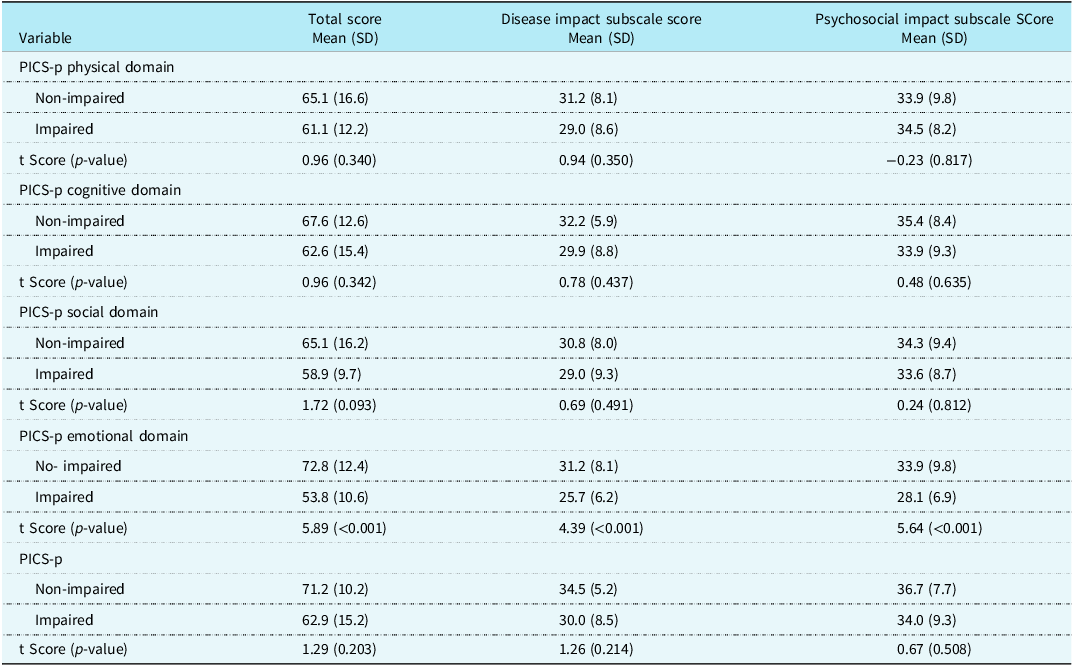
Of the 117 patients in the study, 54 had PCQLI scores. There was an association between the emotional health domain of Post-Intensive Care Syndrome in Paediatrics and health-related quality of life (Table 2) with impaired patients on the Post-Intensive Care Syndrome in Paediatrics emotional domain reporting significantly lower Paediatric Cardiac Quality of Life Index Total, Disease Impact and Psychosocial Impact (p < 0.001) subscale scores compared to patients who were not emotionally impaired.
PCQLI Scores by PICS-p (n = 54)

Table 2. Long description
The table presents PCQLI scores categorized by different PICS-p domains, including physical, cognitive, social, and emotional domains. It has 12 rows and 7 columns. The columns are labeled as Variable, Total score Mean (SD), Total score Mean, Disease impact subscale score Mean (SD), Disease impact subscale score Mean, Psychosocial impact subscale score Mean (SD), and Psychosocial impact subscale score Mean. The rows are grouped by PICS-p domains: physical, cognitive, social, and emotional. Each domain is further divided into Non-impaired and Impaired categories, with corresponding scores and standard deviations. The table also includes t Scores (p-value) for each domain comparison. Notable trends include lower scores in the Impaired categories across all domains, with significant p-values in the emotional domain.
Key: PCQLI = pediatric cardiac quality of life inventory; PICS-p = post intensive care syndrome in pediatrics; SD = standard deviation.
Discussion
This exploratory study examined the prevalence and predictors of Post-Intensive Care Syndrome in Paediatrics in a CHD-specific ICU population. In our study, 80% of CHD patients followed in a cardiac neurodevelopmental program had Post-Intensive Care Syndrome in Paediatrics. These patients had significantly worse physical (activities of daily living), cognitive (fatigue, cognitive, and executive functioning), social (social interaction and relationship maintenance), and emotional (resiliency) outcomes compared to healthy children. When examining individual domains, one-quarter to two-thirds of the cohort had impairment on any individual domain. Additionally, we observed that a shorter duration from the most recent ICU admission was associated with increased impairments in both physical and emotional domains of Post-Intensive Care Syndrome in Paediatrics. Longer time since the patient’s first ICU admission was associated with worse cognitive and physical outcomes. Finally, our results indicated an association between emotional impairment in Post-Intensive Care Syndrome in Paediatrics and poorer health-related quality of life.
In our cohort, with a median time since their last ICU admission of five years, 4 out 5 children exhibited impairment in at least one domain of Post-Intensive Care Syndrome in Paediatrics. Specifically, two-thirds had cognitive impairment, one-third had physical and emotional impairment, and one-quarter of the cohort had social impairment. Our findings indicated higher rates of cognitive impairment when compared to the general paediatric ICU population. Reference Woodruff and Choong26 Existing studies on Post-Intensive Care Syndrome in Paediatrics have consistently shown that the most common and persistent long-term impacts in the general paediatric ICU population are cognitive and emotional impairments. Reference Watson, Choong and Colville3 Patients in this CHD cohort are more likely to have greater cognitive impairment than the general paediatric ICU population due to pre-existing developmental brain differences, chronic cyanosis, significant CHD complexity requiring multiple operations on cardiopulmonary bypass, periods of low cardiac output and brain perfusion during their perioperative period, high prevalence of white matter injury, unique mechanical support requirements (extracorporeal membrane oxygenation and ventricular assist device), and long and multiple ICU stays that impact normal brain development. Reference Marino, Lipkin and Newburger11,Reference Sood, Newburger and Anixt13 Consistent with the study by Vogel et al. showing 90% of CHD patients in a cardiac neurodevelopmental program having significantly worse motor skills compared to the general population, Reference Vogel, Hinkle and Cassedy27 our sample also demonstrated physical impairments. While previous studies demonstrated that approximately 25% of children and adolescents with complex CHD exhibit emotional impairments with greater anxiety and depression at a higher prevalence than the general paediatric population, Reference Abda, Bolduc and Tsimicalis28 our cohort of children with CHD did not show an increased rate of anxiety and depression. This may be an indication of the higher socio-economic status (66% above the median income) and family support (79% married) of our cohort, both of which are associated with reducing depression in adoloscents. Reference Zou, Xu, Hong and Yuan29 Our study population did show less resiliency than healthy controls, which is consistent with the findings of Kramer et al. Reference Kramer, Ewert and Hager30 Similar to our cohort, prior research has shown that 25% of children with CHD also have difficulties with social interactions as reported by their parents. This is likely related to frequent hospitalisations and limitations from other physical, cognitive, and emotional impairments, which can increase social isolation. Reference Werninger, Ehrler and Wehrle31 The high prevalence of these comorbidities requires that these CHD survivors be followed closely in neurodevelopment follow-up programmes to identify and address issues as these children age into adult congenital patients. Reference Sood, Newburger and Anixt13,Reference Cassidy, Butler and Briend32
Of the demographic, CHD severity, and ICU course predictors studied only sex and length of time since their most recent ICU admission were associated with Post-Intensive Care Syndrome in Paediatrics. Our study found that males had a higher risk of having physical, cognitive, and social impairments. The research to date is mixed when discussing sex-based differences in recovery trajectories after critical illness in children. The limited paediatric research in this area suggests trends in differences between externalising and internalising behaviours between males and females but remains inconsistent when evaluating the other domains in Post-Intensive Care Syndrome in Paediatrics. Reference Kramer, Ewert and Hager30,Reference Choong, Fraser and Al-Harbi33 The impact of gender differences on the prevalence of Post-Intensive Care Syndrome in Paediatrics and its domains requires more research to clarify these findings and inform future rehabilitation strategies. We found time-based association patterns, with patients having a shorter length of time from their last ICU admission being more likely to show impairments in domains related to physical and emotional outcomes aligning with previous research in paediatric ICU patients indicating that these specific domains tend to improve over time. Reference Watson, Choong and Colville3 Finally, longer times since index ICU admission were significantly associated with worse cognitive impairment in our cohort. This is consistent with the high prevalence of white matter injury in children with complex CHD and its impact on brain development and neurocognitive outcome over time. Reference Marino, Lipkin and Newburger11,Reference Sood, Newburger and Anixt13
Findings from our secondary aim indicate patients with emotional impairments reported worse health-related quality of life outcomes. While follow-up studies have documented recovery in health-related quality of life for children post-ICU discharge, these investigations have typically had a limited follow-up period. Reference Ducharme-Crevier, La and Francois34 In contrast, our study benefitted from a longer follow-up time frame revealing significant on-going emotional impairments that impact health-related quality of life in the cardiac ICU population. The specific influence of emotional impairment on overall recovery in Post-Intensive Care Syndrome in Paediatrics is not yet well understood. While there was a limited association between PICS-p and PCQLI scores, this may reflect differences in the constructs measured. PICS-p measures adaptive processes and domain-specific impairments, while the PCLQI measures broader quality of life issues. PICS-p can measure clinically meaningful deficits that may not translate into a perceived reduction in quality of life. However, research has indicated that children with persistent psychiatric concerns following ICU discharge experience higher readmission rates which may help explain the association with worse health-related quality of life outcomes. Reference Ko, Poh and Heng1,Reference Hartman, Williams and Hall35 These results underscore the importance of early recognition, support, and appropriate referral for psychological consultation before their discharge from the ICU.
Cardiac neurodevelopmental follow-up clinics have become a vital component in the care of children with CHD. The establishment of these clinics has made notable impact in detection of physical, cognitive, social, and emotional impairments before they manifest in an educational setting, allowing for timely referrals and earlier interventions to improve developmental trajectories. Organisations such as the Cardiac Neurodevelopmental Outcome Collaborative have supported on-going research which has been critical to demonstrating improved long-term outcomes with the structured surveillance and interventions these clinics provide. Reference Cassidy, Butler and Briend32,Reference Marino, Sood and Cassidy36 Paediatric ICU follow-up programmes are emerging into this space to help with the broad assessment of Post-Intensive Care Syndrome in Paediatrics, but the models utilised are heterogeneous and few programmes exist. Reference Herrup, Wieczorek and Kudchadkar37 Integration and collaboration between these two models may offer more support in capturing the broad impact of critical illness experienced in children and adolescents.
Our exclusive focus on post-ICU outcomes precludes the collection of pre-ICU baseline data limiting our ability to evaluate the trajectory of functional decline or recovery and to attribute observed impairments specifically to the ICU stay. In addition, our sample included a higher proportion of English-speaking Hispanic patients than is reflected in the general population of the city of Chicago. While this provides valuable insight into an often-under-represented demographic, it may limit the generalisability of our findings. Cultural, socio-economic, and systemic factors specific to this group may influence outcomes and should be interpreted with caution when applying results to broader or differently composed populations. While our cohort represents one of the largest to date examining CHD within the context of Post-Intensive Care Syndrome in Paediatrics, the sample size remains modest and is drawn from a single tertiary care centre limiting the external validity of our findings and raising concerns about selection bias, due to institutional practices or varying patient demographics. Future multicentre studies with standardised baseline assessments are essential to validate and expand upon our findings. Of note, all the domains identified in the Post-Intensive Care Syndrome in Paediatrics framework have been shown to be common comorbidities in patients with complex CHD who have undergone surgery and have recovered in the paediatric ICU. It is difficult to tease apart how much of the Post-Intensive Care Syndrome in Paediatrics prevalence and affected domains at mid-term follow-up result from multiple ICU admissions or whether they are part of the long-term phenotype of having complex CHD and receiving the appropriate interventions and concomitant brain injury that may result.
Importantly, this study was a retrospective review of clinical data collected as part of first intake within the neurodevelopmental follow-up clinic rather than a prospectively designed research study. Additionally, this follow-up clinic and study were both started before the publication of the core outcomes measures for PICS-p. Consequently, the assessment battery was developed for clinical evaluation purposes and did not systematically include measures of parental mental health, life stressors, or other psychosocial and environmental factors. The absence of these variables limits the ability to attribute all observed symptomatology exclusively to PICS-p, particularly given the extended interval between ICU admission and follow-up assessment for some patients.
Conclusion
This study characterises the impact of Post-Intensive Care Syndrome in Paediatrics in a CHD population, demonstrating that a substantial proportion of this cohort experience persistent, multi-domain impairments that can affect long-term health-related quality of life. Our findings highlight how the Post-Intensive Care Syndrome in Paediatrics framework may be utilised to identify long-term impairments that may be amenable to remediation. The continued presence of impairments years after ICU discharge underscores the urgent need for targeted, modifiable interventions immediately after the ICU stay. Addressing specific domains of Post-Intensive Care Syndrome in Paediatrics in real time may offer a critical opportunity to optimise outcomes and improve long-term trajectories for the high-risk paediatric CHD population.
Supplementary material
The supplementary material for this article can be found at https://doi.org/10.1017/S1047951126123543.