INTRODUCTION
Most large-scale studies of phonological development of children with typical and atypical acquisition are based on single-word productions of a set of target words; this type of study has several advantages: (a) use of carefully selected words ensures that all phonemes are assessed; (b) children's performance can be compared on the same set of words; and (c) target words can be identified even when produced by children with unintelligible speech (see Morrison & Shriberg, Reference Morrison and Shriberg1992). In contrast, samples of conversational speech provide a complementary, but different, view of a child's phonological patterns: they (a) include the words in the child's current vocabulary; (b) reflect effects of syntax and morphology; and (c) provide information on the frequency of occurrence of phoneme targets in the child's productions (e.g. Stoel-Gammon & Dunn, Reference Stoel-Gammon and Dunn1985, among others).
Our understanding of a child's phonological system benefits from assessment of both conversational speech and targeted single words, as the findings may differ across the two contexts. For example, several studies have shown greater accuracy of production in conversational speech, which has been attributed to young children's avoidance of words including certain target phonemes they have difficulty producing (e.g. Morrison & Shriberg, Reference Morrison and Shriberg1992; Stoel-Gammon, Reference Stoel-Gammon2011; Wolk & Meisler, Reference Wolk and Meisler1998). Other studies have reported more errors and different types of error patterns in conversational speech (e.g. DuBois & Bernthal, Reference DuBois and Bernthal1978; Healy & Madison, Reference Healy and Madison1987), and some have reported more similarities rather than differences (e.g. Andrews & Fey, Reference Andrews and Fey1986; Hua & Dodd, Reference Hua and Dodd2000; Masterson, Bernhardt & Hofheinz, Reference Masterson, Bernhardt and Hofheinz2005). Reduced accuracy in conversational speech may be ascribed to the increased linguistic complexity in conversational speech versus single-word productions. Many researchers have argued that conversational samples are more representative of the child's everyday speech (e.g. DuBois & Bernthal, Reference DuBois and Bernthal1978; Masterson et al., Reference Masterson, Bernhardt and Hofheinz2005; Morrison & Shriberg, Reference Morrison and Shriberg1992), and collecting both single-word productions and conversational speech was proposed for a full evaluation of a child's productive phonology (Bernthal, Bankson & Flipsen, Reference Bernthal, Bankson and Flipsen2013; Williams, Reference Williams2003).
As for Korean, most studies of the acquisition of consonants have been based on productions of a set of preselected words and none have examined similarities or differences in developmental patterns between these productions and conversational speech. Therefore, whether or not phonological assessment of single-word productions can well represent a child's phonological profile is unknown. In addition, language-specific aspects of Korean also need to be considered in phonological evaluation. Most words in single-word tests of Korean consist of lexical morphemes only (e.g. moja ‘hat’ or chaek ‘book’), although a few words may contain verb endings (e.g. apha-jo ‘sick’, with the polite ending). In contrast, in conversational speech, words with lexical and grammatical morphemes occur frequently. The frequent occurrence of grammatical morphemes containing certain specific phonemes may increase accuracy of production of such phonemes in conversational speech compared to single-word productions.
In the current study, acquisition of Korean consonants is described using conversational speech samples, and the findings are compared with previous studies based on single-word articulation tests. With these two types of samples, we can compare the role of linguistic complexity. In conversational speech, increased accuracy may be due to higher frequency of certain word types and grammatical morphemes; in single-word assessments, higher accuracy may be associated with reduced linguistic complexity. As background for the study, the following section provides a brief review of the consonantal phonemes of Korean and of previous studies of the acquisition of Korean consonants.
The phonological system of Korean consonants
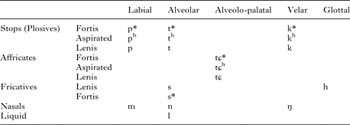
Korean has a total of nineteen consonants, as shown in Table 1. Korean obstruents have an unusual system in terms of variations in laryngeal types (see, e.g. Cho, Jun & Ladefoged, Reference Cho, Jun and Ladefoged2002; Kagaya, Reference Kagaya1974; M. Kim, Reference Kim, Peter and MacLeod2013; M. Kim & Stoel-Gammon, Reference Kim and Stoel-Gammon2011; Shin, Cha & Kiear, Reference Shin, Cha and Kiear2012, for descriptions). Korean stops have a three-way contrast (fortis, aspirated, and lenis) and are produced at three places of articulation (labial, alveolar, and velar). Alveolo-palatal affricates also have a three-way laryngeal contrast and alveolar fricatives a two-way contrast (fortis and lenis). All these obstruents are voiceless phrase-initially, and word-initially in single-word productions. Word-finally, laryngeal distinctions among obstruents are neutralized: stops at the three places of articulation are produced as lenis stops /p, t, k/; alveolo-palatal affricates and alveolar fricatives are neutralized to a lenis stop /t/ (C.-W. Kim, Reference Kim1979; H. Kim & Jongman, Reference Kim and Jongman1996). Korean obstruents are characterized by unique acoustic properties for the three-way or two-way distinction. More details regarding acoustic realization of Korean obstruents can be found in M. Kim and Stoel-Gammon (Reference Kim and Stoel-Gammon2011).
Korean consonants

In addition to the large set of obstruents, there are four non-obstruent consonants: /m, n, ŋ, l/. Phonetically, liquid /l/ is realized as a lateral in syllable-final position, but as a tap or flap in syllable-initial position (e.g. [ɑ-ɾε], English ‘below’) (Shin et al., Reference Shin, Cha and Kiear2012). All consonants except the nasal /ŋ/ occur in syllable-initial position; /l/ appears word-initially only in loan words. In contrast, only seven consonants, /p, t, k, m, n, ŋ, l/, can occur in syllable-final position. In word-medial position, based on the ‘onset first principle’ in Korean syllable structure, a coda becomes an onset of the following syllable when the following syllable has no onset through a resyllabification process. Consequently, syllable-final consonants occur in word-medial position only when an initial consonant is present in the following syllable. Korean does not have consonant clusters within the same syllable; consonant sequences only occur across syllables in word-medial position (e.g. /kɑm-tɕɑ/ English ‘potato’).
Acquisition of Korean consonants
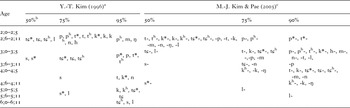
Findings from two large-scale normative studies of the acquisition of Korean consonants are shown in Table 2. Y.-T. Kim (Reference Kim1996) provided normative data from 155 typically developing Korean children ranging in age from two to six years using a picture-naming test. More recently, M.-J. Kim and Pae (Reference Kim and Pae2005) provided normative data on phonemic development of 220 Korean children speaking the Seoul dialect, aged 2;6 (year;month) to 6;5. The Korean-test of articulation for children (M.-J. Kim, 2005) was used to elicit single-word productions.
Summary of data from two normative studies on the acquisition of Korean consonants

notes: a Age of acquisition of consonants was reported for all positions combined; b % of children with correct production of the target phoneme; c Age of acquisition of consonants was reported for syllable-initial and syllable-final positions, respectively. The fricatives /s/ and /s*/ did not reach 75% criterion until 6;5, when distortions were counted as errors; these phonemes were acquired by more than 75% of children by 5;6 when distortions were counted as correct.
M. Kim and Stoel-Gammon (Reference Kim and Stoel-Gammon2011) investigated phoneme development in children aged 2;6, 3;0, 3;6, and 4;0, focusing on the acquisition of word-initial obstruents, with particular interest in the acquisition of different laryngeal types. The results indicated that the order of acquisition of stops was fortis > aspirated > lenis. Using a 75% criterion (75% of children and 75% accuracy), all fortis and aspirated stops were acquired by ages 2;6 and 3;6, respectively, but lenis stops were not acquired until age 4;0. The three types of affricates were acquired by 75% of children at age 3;6, but the fricatives /s/ and /s*/ were not acquired by age 4;0 (the oldest age tested). M. Kim and Stoel-Gammon (Reference Kim and Stoel-Gammon2009) suggested that the late acquisition of lenis obstruents may be related to the phonetic characteristics of these consonants; namely, that they are: (i) perceptually less salient; (ii) produced with weaker articulation; and (iii) articulatorily more complex, with an additional laryngeal adjustment for lowering f 0, compared to fortis or aspirated stops which typically have a high f 0 (Löfqvist, Baer, McGarr & Story, Reference Löfqvist, Baer, McGarr and Story1989).
Korean fricatives appear to be acquired in a different order than stops and affricates, with regard to laryngeal characteristics, as the lenis category emerges first. M. Kim and Stoel-Gammon (Reference Kim and Stoel-Gammon2011) proposed that the earlier development of this category may be attributed to the acoustic and articulatory properties that are common between the lenis /s/ and aspirated obstruents in word-initial position. The frequent substitution of the aspirated obstruents, [th] or [tɕh], for the lenis /s/ (e.g. /sa-gwa/ becoming /tha-gwa/ or / tɕha-gwa/) supports this view. Later acquisition of the tense fricative may be associated with increased articulatory complexity: /s*/ is produced with longer frication that is often followed by glottalization at the onset of the following vowel, a relatively smaller cavity in front of the constriction, and possibly greater velocity of airflow in the front cavity (see Cho et al., Reference Cho, Jun and Ladefoged2002).
The purpose of this study
The current study investigated the acquisition of Korean consonants in conversational speech produced by Korean children aged 2;0 to 4;11. The study attempts to answer the following research questions:
-
1. What are the developmental patterns of Korean consonants observed in conversational speech?
-
2. How do findings from conversational speech compare with those from single-word assessments?
Phonemic acquisition based on conversational speech is presented and compared with findings of previous studies involving single-word productions of Korean.
METHOD
Participants
Sixty typically developing monolingual Korean children whose parents identified themselves as middle class and as speakers the Seoul dialect participated in this study. There were three age groups with twenty children per group at ages two years (2;0–2;11), three years (3;0–3;10), and four years (4;0–4;11). Each group had an equal number of male and female children. The children had no speech, language, hearing, or cognitive problems as reported by their parents, and scored above the 16th percentile on the Korean Receptive and Expressive Vocabulary Test (Kim, Y.-T., Hong, Kim, K., Chang & Lee, Reference Kim, Hong, Kim, Chang and Lee2009) and Urimal (Korean) Test of Articulation and Phonology (Y.-T. Kim & Shin, Reference Kim and Shin2004). Participants were recruited through a university community and the second author's acquaintances.
Data collection
Speech samples were collected at the participants' homes during daily activities including play and regular conversation with their parents or siblings. The recordings were made over a one-week period for approximately a total of 10 hours. Parents were instructed to record their children's conversational speech using a Click Voice Premium S300 recorder, which was placed in the pocket of a small apron worn by the child; if the child refused to wear the apron, the recorder was placed nearby.
A grammatical unit of Korean language, referred to as ‘eojeol’, was used to count individual tokens. Korean is an agglutinative language, and contains a chain of particles or suffixes with constant form and meaning attached to nominals or predicate stems (Sohn, Reference Sohn1999). An eojeol, as a constituent of a sentence, can be a lexical morpheme only or can be composed of lexical morphemes and grammatical morphemes (i.e. postpositional particles or verb endings). Eojeols are separated by a space in Korean orthography.
Examples of utterances with three eojeols are provided below. The first includes lexical morphemes only, whereas the second has both lexical and grammatical morphemes for the first two eojeols. Lexical morphemes are in bold and grammatical morphemes are in italics.
-
na sagwa joaha-e-jo.
I an apple liking-do
na-neun sagwa-leul joaha -e-jo.
I–subject particle an apple–object particle liking-do
‘I like apples.’
In the present study, the first 100 different eojeols from the conversational samples of each child were selected for analysis, except for one two-year-old boy who produced only 80 different eojeols in the recorded samples. Unintelligible eojeols, imitations of other speakers' speech, exclamations, and responsive utterances (e.g. ‘yes’ and ‘ok’) were excluded from the analyses. In addition, the analyses included a maximum of two eojeols that contained the same word but with a different postpositional particle.
Examples of eojeols produced by a two-year-old and a four-year-old are shown below.
-
(1) A two-year-old child: one utterance with three eojeols
na-to mul ju-se-jo.
me–inclusion water give–subject hornorific-polite
‘Please give me water too.’
-
(2) A four-year-old child: one utterance with seven eojeols
eomma, na oneul sipo cheung okssang-e
Mom, I today fifteen floor rooftop–location
ga-at-neunde,
go–past tense-connective
‘Mom, I went to the rooftop of the fifteen floor today, and …’
The final dataset included 5,980 tokens (3 groups × 20 participants × mostly 100 eojeols) that were phonetically transcribed by the first author and four graduate students who are native speakers of Korean.
Data analysis
Phonemic acquisition patterns were analyzed for the nineteen consonants of Korean: all consonants except /ŋ/ in syllable-initial position, and seven consonants, /p, t, k, m, n, ŋ, l/, in syllable-final position. The percentage of children and the percentage of correct productions per phoneme were calculated in both syllable-initial and syllable-final positions. In the analyses, word-initial syllable-initial (WISI) and word-medial syllable-initial (WMSI) positions were combined, whereas separate analyses were conducted for final consonants in word-medial position (WMSF) and word-final position (WFSF) because previous studies reported differences in acquisition patterns: deletion of WMSF consonants occurs at a later age relative to WFSF consonants in both typically developing and disordered children (Hong & Pae, Reference Hong and Pae2002; S.-J. Kim, Reference Kim2010). As for /t/, it was analyzed only for WFSF since it tends to be either omitted or assimilated to the initial consonant in the following syllable (Woo & S.-J. Kim, Reference Woo and Kim2013).
We assessed the acquisition of individual phonemes by each child using the criterion of 75% correct production by the child. Because the data were based on conversational speech samples collected at different ages, the number of tokens for each target phoneme varied across children, and not all children produced every target phoneme. In addition, there were cases in which a target phoneme was produced with fewer than four tokens, specifically /p*, ph, tɕ*/ in initial position and /p, t, k, m, ŋ/ in final position. In such cases, only children who produced all tokens of the target phoneme with 100% accuracy were counted as meeting the 75% criterion for accuracy.
To assess reliability, two transcribers analyzed speech samples from two randomly selected children in each age group. Point-to-point reliability was obtained by comparing the transcriptions between the primary and secondary transcribers for all the consonants from a total of 600 eojeols, approximately 10% of the data. Mean inter-transcriber reliability was 86·8%, 93·2%, and 95·7% for children aged two, three, and four years, respectively.
RESULTS
Tables 3 and 4 show the percentage of children who produced each target phoneme using the 75% criterion of accuracy in syllable-initial (WISI and WMSI) and syllable-final (WMSF and WFSF) positions. As shown, a majority of children produced words including eighteen different target phonemes in syllable-initial position. Using the criteria of 75% of children who produced the target with at least 75% accuracy for acquisition of a phoneme, we see that two-year-olds have acquired five stop consonants /p*, ph, p, t*, k/, nasals /m, n/, and the glottal fricative /h/ in syllable-initial position, and three-year-olds have acquired all nine stop consonants and the fortis alveolo-palatal affricate. The group of four-year-olds has acquired all initial consonants including the aspirated and lenis affricates /tɕh, tɕ/, alveolar fricatives /s, s*/, and the liquid /l/.
Percentage (%) and number of children, by age group, achieving the 75% criterion of accuracy for phonemes in syllable-initial position (word-initial syllable-initial and word-medial syllable-initial positions); percentage meeting the criterion for the acquisition of each target phoneme is asterisked

note: a Number of children who reached criterion / total number of children who attempted words with the target phoneme.
Percentage (%) and number of children achieving the 75% criterion of accuracy for individual phonemes in syllable-final position for each age group; percentage meeting the criterion for the acquisition of each target phoneme is asterisked

note: a Number of children who reached criterion/total number of children who produced words with the target phoneme.
With respect to the seven consonants in syllable-final position, more than 75% of two-year-olds have acquired /m, n/ in WMSF position and /ŋ/ in WFSF position; three-year-olds have acquired /m, n, ŋ/ in both WMSF and WFSF positions, and /k, l/ in WFSF position only. Excluding the lenis /t/, which was attempted by 30% or less of the total number of children at each age, all other phonemes in WMSF and WFSF positions (i.e. /p, m, n, ŋ, l/), except for lenis /k/ in WMSF position, were acquired in both positions by four-year-olds with a 75% criterion. The same consonants tended to be more accurately produced in WFSF position than in WMSF, perhaps because syllable-final consonants in word-medial position (i.e. WMSF) always form part of a sequence with the initial consonant of the following syllable, thus occurring in more complex word structures (VC-CV). In terms of articulation, it is presumably more difficult to produce a syllable-final consonant as part of a consonant sequence rather than a single consonant in word-final position. The percentage of correct productions per phoneme in both syllable-initial and syllable-final positions were also calculated and the results tend to be similar to those obtained using the percentage of children (see online supplementary materials, available at journals.cambridge.org/JCL).
In general, consonants were acquired earlier in syllable-initial position compared to syllable-final position, except for the liquid /l/. Later acquisition of /l/ may be associated with its allophonic variants across different syllable positions; /l/ is realized as the flap [ɾ] syllable-initially and as a lateral [l] syllable-finally. The flap [ɾ] tends to be acquired later than the lateral [l]. The percentage of correct productions of each target phoneme was also calculated for all children at each age, and results show similar patterns to the data reported in Tables 3 and 4.
DISCUSSION
Comparing conversational speech and single-word assessments
A summary comparison of our findings of conversational speech with those from the single-word test of M.-J. Kim and Pae (Reference Kim and Pae2005) appears in Table 5. It shows that acquisition patterns of syllable-initial stops and nasals tend to be similar except for the earlier acquisition of /m, n, kh, k/ in the current study. As for /m, n/, Y.-T. Kim's (Reference Kim1996) study reported a similar finding as the current study; /m, n/ were acquired by children aged 2;0–2;11. However, differences are present in the age of acquisition of affricates and fricatives: in conversational speech, affricates are acquired about one year later, and alveolar fricatives about one year earlier (M. Kim & Stoel-Gammon, Reference Kim and Stoel-Gammon2011; M.-J. Kim & Pae, Reference Kim and Pae2005). We suggest that these differences may be due to their usage patterns in our conversational samples. Affricates occurred in many different word types and thus are influenced by a variety of phonetic contexts. This usage may increase errors in production. In contrast, the alveolar fricatives /s, s*/, occur in several commonly used grammatical morphemes, including the propositional particle -eseo, ‘from, at, or in’; verb endings such as -se-jo ‘subject honorific-polite’ and ass/eoss-eojo, ‘past tense-polite’; and the conjunctive suffix -seo ‘and, and then’; this more consistent phonetic framework may increase accuracy of production. The same phenomenon may underlie the earlier acquisition of initial /l/, which also occurs frequently in grammatical morphemes in conversational speech. These hypotheses should be explored more in future studies.
Comparison of age of acquisition for each phoneme between conversational speech and single-word assessment (M.-J. Kim & Pae, Reference Kim and Pae2005) using the 75% criterion of the acquisition of each target phoneme (C: conversational speech; S: single-word assessment)

notes: a two years (2;0–2;11), three years (3;0–3;10), and four years (4;0–4;11); b 2;6 (2;6–2;11), 3;0 (3;0–3;6), 3;6 (3;6–3;11), 4;0 (4;0–4;6), 4;6 (4;6–4;11), 5;0 (5;0–5;6), and 5;6 (5;6–6;0); c The ages of acquisition for word-medial syllable-final position vs. word-final syllable-final position (WMSF/WFSF) are provided respectively if the ages for both positions are not the same.
When compared to the study of single words by M. Kim and Stoel Gammon (Reference Kim and Stoel-Gammon2011), which focused exclusively on target phonemes in word-initial position rather than both word-initial syllable-initial (WISI) and word-medial syllable-initial (WMSI) positions, the age of acquisition for lenis stops appears to be earlier in the current study; lenis stops were not acquired by 75% of children until age four in M. Kim and Stoel-Gammon's (Reference Kim and Stoel-Gammon2011) study. One account for the earlier acquisition of the lenis category in the current study may be associated with the phonetic variation of the lenis stops in different phonetic contexts. Korean lenis stops are produced with slight aspiration in word-initial position of single words, whereas they become voiced in inter-vocalic position. The production of slightly aspirated lenis stops requires additional laryngeal adjustment for lowering f 0, which might make young Korean children acquire word-initial lenis stops later than fortis and aspirated stops. However, this additional gesture is not needed in the production of lenis stops in inter-vocalic position, and therefore children tend to produce inter-vocalic lenis stops more accurately. The frequent occurrence of inter-vocalic lenis /k/ in grammatical morphemes, such as a subject particle -ka, and a conjunctive suffix -ko, can explain the earlier acquisition of /k/ in the current study compared to M.-J. Kim and Pae's (Reference Kim and Pae2005) study as presented in Table 5.
Implications and future directions
The current study has both theoretical and clinical implications. The study highlights the fact that linguistic differences across languages can result in different patterns of phonological acquisition in conversational speech versus single-word assessments. In Korean, differences in two different sampling modes appear to be associated with the unique morphological system of Korean. For conversational speech, the earlier acquisition of phonemes that occurred frequently in grammatical morphemes was noted. In contrast, the phonemes that occurred in many different lexical morphemes were acquired later in conversational speech. It would be interesting to see if the same patterns occur in other languages. Clinically, this study implies that phonological evaluation should be conducted through both conversational speech and a single-word test in order to assess a child's phonological profile properly, and to provide appropriate intervention. Assessment based only on findings from single-word tests does not provide a full picture of a child's productive phonology and could lead to delayed intervention for fricatives and the liquid.
This study does have some limitations. First, the age range was somewhat broad, with one-year intervals rather than six-month intervals, and the number of children was only twenty per age. Investigation with an increased number of participants at a smaller age interval will provide more robust data and detailed information on developmental trajectory. Second, this study examined development patterns of all Korean consonants across different syllable and word positions. However, some of the consonants (e.g. /p, t/ in syllable-final position) were analyzed from only a few children per age group, as well as from a relatively small number of tokens because the tokens were selected from a total of 100 eojeols. Future studies should consider including a certain minimum number of tokens for all consonants produced by all children in order to make the data more solid for comparison across target phonemes and ages. Last, future studies can investigate developmental patterns of speech sounds from bilingual Korean children. It is still unknown whether Korean children exhibit any different developmental patterns than monolingual children when they learn more than one language.
SUPPLEMENTARY MATERIALS
For supplementary materials for this paper, please visit journals/cambridge.org/JCL.