

Introduction
The Sierra Madre Sparrow Xenospiza baileyi is an ‘Endangered’ species (SEMARNAT 2010, BirdLife International 2017) and a Mexican endemic specialist of subalpine bunchgrasses of two physiographic regions: the Trans-Mexican Volcanic Belt and the Sierra Madre Occidental, where the species faces the loss and degradation of its habitat due to agriculture conversion and cattle management practices that have been occurring historically and continue up to the present (e.g. Dickerman et al. Reference Dickerman, Phillips and Warner1967, Oliveras de Ita and Rojas-Soto Reference Oliveras de Ita and Rojas-Soto2006, González-Elizondo et al. Reference González-Elizondo, González-Elizondo, Tena-Flores, Ruacho-González and López-Enríquez2012, Vázquez de la Torre Reference Vázquez de la Torre2015). This had led the species to occur in two limiting and disjunct ranges and populations corresponding with the two physiographic regions.
The population in the Trans-Mexican Volcanic Belt has been more continuously and thoroughly studied (Dickerman et al. Reference Dickerman, Phillips and Warner1967, Oliveras de Ita et al. Reference Oliveras de Ita, Gómez de Silva and Grosselet2001, Cabrera-García et al. Reference Cabrera-García, Velázquez Montes and Escamilla Winmann2006, Ortega-Álvarez et al. Reference Ortega-Álvarez, Calderón-Parra, Martínez Molina, Martínez Molina, Martínez Molina, Martínez Molina, Martínez Villagrán, Martínez-Freire, Vázquez Robles, García Loaeza, Martínez García, García Loaeza, Garduño López and Sánchez-González2020a), with a current estimation of 4,089 individuals (Ortega-Álvarez et al. Reference Ortega-Álvarez, Calderón-Parra, Molina, Molina, Molina, Molina, Villagrán, Freire, Robles, Loaeza, García, Loaeza, López, Marín and Sánchez-González2020b). The population of the Sierra Madre Occidental has been poorly studied with the most optimistic approximation of its size being up to 40–50 individuals (Rojas-Soto et al. Reference Rojas-Soto, Martínez-Meyer, Navarro-Sigüenza, Oliveras de Ita, Gómez de Silva and Peterson2008, Berlanga et al. Reference Berlanga, Rodríguez, Oliveras de Ita, Sánchez and Íñigo-Elías2009). In this region, records were absent from 1951 to 2004, when a four-state survey confirmed only one small and apparently isolated population (at least three breeding pairs) in an 80-ha marshy-meadow with scattered patches of bunchgrass in Ejido Ojo de Agua-El Cazador, Durango (Oliveras de Ita and Rojas-Soto Reference Oliveras de Ita and Rojas-Soto2006). In addition to the limited abundance and habitat availability, several anthropogenic threats such as livestock overgrazing and military activities posed a high risk of local extinction for this newly discovered population (Oliveras de Ita and Rojas-Soto Reference Oliveras de Ita and Rojas-Soto2006). Subsequent studies on the same site provided evidence supporting this idea, with a maximum observation of 18 individuals between 2010 and early 2011 (Guevara Herrera Reference Guevara Herrera2012, Rosas Ruiz Reference Rosas Ruiz2012), only six during the 2012 breeding season (Mancinas Labrador Reference Mancinas Labrador2017), and none in 2015 and 2016 (Carlos Aguirre-Calderón, Armando Sanchéz-Escalera pers. obs.). Also in Durango, Bajío de Aguinaldos locality was later confirmed on two occasions (Rojas-Soto et al. Reference Rojas-Soto, Martínez-Meyer, Navarro-Sigüenza, Oliveras de Ita, Gómez de Silva and Peterson2008, Mancinas Labrador Reference Mancinas Labrador2017), and additional sites were discovered in June 2012, with minimal numbers: two individuals in Paraíso de la Sierra and one in La Herradura (Mancinas Labrador Reference Mancinas Labrador2017).
This highlighted the need to conduct a more thorough search of the area, and we therefore aimed to generate information on the current distribution and population size of the disjunct Sierra Madre Occidental population of the Sierra Madre Sparrow through a survey in the Sierra Madre Occidental of Durango, defining and finding new localities and including known sites with suitable habitat.
Methods
Study area
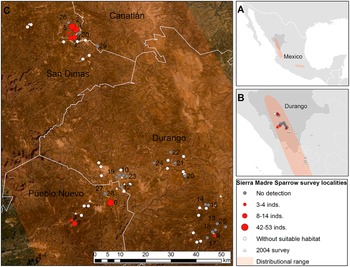
We delimited a 952,348-ha polygon mostly within the Gran Meseta y Cañadas Duranguenses (Durango Great Plateau and Ravines) physiographic subprovince in the Sierra Madre Occidental at the municipalities of Durango, Pueblo Nuevo, San Dimas, and Canatlán within the state of Durango (Figure 1). The Durango municipality included the four known localities for the species at the time: Ojo de Agua-El Cazador, Paraíso de la Sierra, La Herradura, and Bajío de Aguinaldos (Oliveras de Ita and Rojas-Soto Reference Oliveras de Ita and Rojas-Soto2006, Rojas-Soto et al. Reference Rojas-Soto, Martínez-Meyer, Navarro-Sigüenza, Oliveras de Ita, Gómez de Silva and Peterson2008, Guevara Herrera Reference Guevara Herrera2012, Rosas Ruiz Reference Rosas Ruiz2012, Mancinas Labrador Reference Mancinas Labrador2017); while the rest of the municipalities were adjacent (and hence more likely to harbour current Sierra Madre Sparrow populations) and had also been predicted as potential sites of occurrence through ecological niche modelling (Rojas-Soto et al. Reference Rojas-Soto, Martínez-Meyer, Navarro-Sigüenza, Oliveras de Ita, Gómez de Silva and Peterson2008). To define the study area, we also considered the type of vegetation (open-areas or grassland meadows that may include bunchgrasses surrounded by pine, pine-oak, oak, and oak-pine forests), mean temperature (10–12 °C), annual rainfall (600–800 mm), and elevation (2,334–2,390 m) at confirmed current locations.
A) Sierra Madre Sparrow Xenospiza baileyi disjunct range in Mexico (Ridgely et al. Reference Ridgely, Allnutt, Brooks, McNicol, Mehlman, Young and Zook2003, based on Howell and Webb Reference Howell and Webb1995). B) Study site during the 2016–2017 Sierra Madre Sparrow survey in Durango (red and grey dots), and the 2004 survey (white triangles) in Jalisco, Zacatecas, and Durango (Oliveras de Ita and Rojas-Soto Reference Oliveras de Ita and Rojas-Soto2006). C) Localities with Sierra Madre Sparrow records (red dots), without records but with suitable habitat (grey dots), and without suitable habitat (white dots) in four municipalities of Durango during the 2016–2017 resurvey in the Sierra Madre Occidental (numbers correspond to localities with suitable habitat described in Table 1).

Identification of potential sites
For the Sierra Madre Occidental, habitat with confirmed recent records consisted of patches of bunchgrass dominated by Muhlenbergia macroura in grassland meadows (locally known as “bajíos”) surrounded by pine-oak forests (Rosas Ruiz Reference Rosas Ruiz2012, Mancinas Labrador Reference Mancinas Labrador2017). To identify such sites, we first downloaded Bing Map satellite images of the study area using SAS.Planet (2007). We used images obtained during the dry season (March 2014) to identify grassland meadows more easily with the unsupervised classification tool of QGIS Geographic Information System (QGIS Development Team 2016). This classification and its further visual exploration resulted in 57 open-areas patches surrounded by forest. We then conducted visits to these sites to confirm the presence of bunchgrasses (locally known as "pajón”) and considered it as a potential distribution area with suitable habitat for the Sierra Madre Sparrow (Dickerman et al. Reference Dickerman, Phillips and Warner1967, Rojas-Soto et al. Reference Rojas-Soto, Martínez-Meyer, Navarro-Sigüenza, Oliveras de Ita, Gómez de Silva and Peterson2008, Rosas Ruiz Reference Rosas Ruiz2012, Mancinas Labrador Reference Mancinas Labrador2017). This process resulted in 30 sites with an average area of 25.2 ha (SD = 25.7, range = 2.3–121). Furthermore, on each meadow we defined the bunchgrass areas by walking their limits with a GPS, calculating an average of 2.8 ha (SD = 3.2, range = 0.1–11.5).
Sierra Madre Sparrow survey
From January 2016 to August 2017, we conducted field surveys in 30 sites with suitable habitat, including the four previously known localities for the species at the time (Oliveras de Ita and Rojas-Soto Reference Oliveras de Ita and Rojas-Soto2006, Rojas-Soto et al. Reference Rojas-Soto, Martínez-Meyer, Navarro-Sigüenza, Oliveras de Ita, Gómez de Silva and Peterson2008, Guevara Herrera Reference Guevara Herrera2012, Rosas Ruiz Reference Rosas Ruiz2012, Mancinas Labrador Reference Mancinas Labrador2017). We made intensive searches of 3–5 hours, counting every Sierra Madre Sparrow by exhaustively walking throughout the sites; when the presence of the species was not initially detected, we played the species’ song with a speaker once or twice in a non-systematic way. Once the species was detected at a site, at least two more censuses were made on each locality repeating the intensive search. Given logistical constraints, if we did not detect the species on the first occasion, we did not conduct additional searches, except for a few sites that were more conveniently located for us to conduct further visits (i.e. closer to confirmed localities, more accessible). Additionally, we conducted a non-systematic effort with 1–3 mist-nets for up to two hours per site with confirmed presence, to detect and colour-band individuals with unique combinations to facilitate counts and the possible detection of inter-site movements. We also recorded the main species of grasses and bunchgrasses in the sites where the presence of the species was confirmed.
Statistical analyses
A posteriori, based on the data from the sites with suitable habitat (n = 30), we used R (R Core Team 2020) with the packages MASS (Venables and Ripley Reference Venables and Ripley2002) and pscl (Jackman Reference Jackman2020) to understand the association between presence and abundance (highest count of individuals) of the Sierra Madre Sparrow and habitat availability through the variables meadow area (ha) and bunchgrass area (ha). We tested the generalized linear models used for count data: Poisson, Negative Binomial, Zero-inflated Poisson, and Zero-inflated Negative Binomial, and selected the latter based on the lowest Akaike Information Criterion value (AICc; Burnham and Anderson Reference Burnham and Anderson2002) using MuMIn package (Bartoń Reference Bartoń2020). This is a mixture model, used for count data that exhibit overdispersion and excess zeros, which includes a binomial distribution (logit-link) to model the “true absences” and a negative binomial distribution to model the zeros obtained by chance (false zeros) and the non-zero counts (Martin et al. Reference Martin, Wintle, Rhodes, Kuhnert, Field, Low-Choy, Tyre and Possingham2005). We included meadow area as an explanatory variable of the abundance (count of individuals; if several visits were made, we used the highest count among them) and bunchgrass area (ha) to model the assumed “true absences”. Although this model is not the best to address imperfect detection, it was the best approach given the type of field-survey that was conducted.
Results
New localities
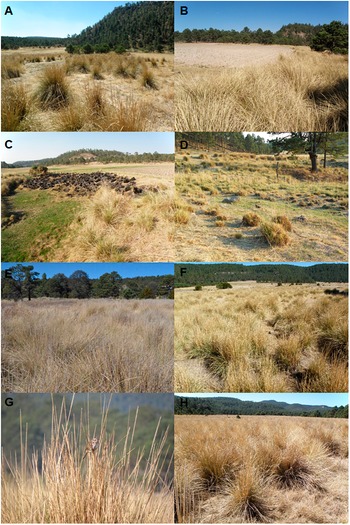
We detected Sierra Madre Sparrows in nine of the 30 sites with suitable habitat (bunchgrass), estimating a naïve occupancy of 30% (Figures 1, 2). The main bunchgrass species in these sites were Muhlenbergia macroura, M. rigida, M. speciosa, M. emersleyi and Piptochaetium fimbriatum. Seven of the areas are new localities for the Sierra Madre Sparrow, except for Bajío de Aguinaldos (Rojas-Soto et al. Reference Rojas-Soto, Martínez-Meyer, Navarro-Sigüenza, Oliveras de Ita, Gómez de Silva and Peterson2008, Mancinas Labrador Reference Mancinas Labrador2017) and La Cantera, which was found later than our survey but published earlier (Martínez-Guerrero et al. Reference Martínez-Guerrero, Nocedal, Sierra-Franco, Arroyo-Arroyo and Pereda-Solís2018). We did not detect any Sierra Madre Sparrows in any of the previously known localities: Ojo de Agua-El Cazador, Paraíso de la Sierra, and La Herradura (Oliveras de Ita and Rojas-Soto Reference Oliveras de Ita and Rojas-Soto2006, Guevara Herrera Reference Guevara Herrera2012, Rosas Ruiz Reference Rosas Ruiz2012, Mancinas Labrador Reference Mancinas Labrador2017; Table 1).
Localities with detections of the Sierra Madre Sparrow (Xenospiza baileyi) in Durango, Mexico in 2016–2017: A) La Lobera, B) La Cantera, C) El Rincón, D) La Mocha, E) Ex Hacienda Coyotes, F) La Cañada, G) Piloncillos, H) Bajío de Aguinaldos (A-D, F-H: Armando Sánchez-Escalera; E: Carlos Aguirre-Calderón).

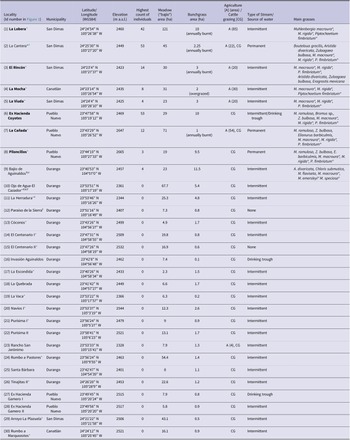
Surveyed localities between 2016 and 2017 and maximum number of detected individuals on a single visit of Sierra Madre Sparrow Xenospiza baileyi in the Sierra Madre Occidental of Durango. New localities are shown in bold.

a Martínez-Guerrero et al. Reference Martínez-Guerrero, Nocedal, Sierra-Franco, Arroyo-Arroyo and Pereda-Solís2018, bRojas-Soto et al. Reference Rojas-Soto, Martínez-Meyer, Navarro-Sigüenza, Oliveras de Ita, Gómez de Silva and Peterson2008, cMancinas Labrador Reference Mancinas Labrador2017, dOliveras de Ita and Rojas-Soto Reference Oliveras de Ita and Rojas-Soto2006, eGuevara Herrera Reference Guevara Herrera2012, fRosas Ruiz Reference Rosas Ruiz2012
* Ejidos, °Bunchgrasses
Seven out of the nine sites with Sierra Madre Sparrow detections are social properties communally owned called “ejidos”, where most of the meadows’ surface (40–95%) is used for non-irrigated crops and where the bunchgrass is commonly burnt every year to promote regrowth for cattle grazing and prevent the bunchgrass advancement on croplands (Table 1).
The nine localities form three spatial clusters (Figure 1). The northernmost one consists of five localities within the limits of San Dimas and Canatlán, whose maximum linear distance among them is 4.5 km, but they are more than 70 km away from Ojo de Agua-El Cazador (Oliveras de Ita and Rojas-Soto Reference Oliveras de Ita and Rojas-Soto2006, Guevara Herrera Reference Guevara Herrera2012, Rosas Ruiz Reference Rosas Ruiz2012). It is noteworthy that two of the sites (La Lobera and La Cantera) comprise almost 50% of the counted individuals (Figures 1, 2; Table 1). It is also notable that in La Cantera, one of the individuals was using non-bunchgrasses, and five were feeding on the agricultural areas (Jan 2016); similarly, in La Viuda (June 2017) we also observed three of the individuals foraging on agricultural lands.
The second cluster of localities (3) are 65 km south of the first, in Pueblo Nuevo municipality and with a maximum distance among them of 15.5 km (Figures 1, 2). In particular, Ex Hacienda Coyotes showed the highest count of individuals of the area, with ~27% of the total (Table 1); it is a privately-owned area with no signs of overgrazing, adjacent to the municipal waste and garbage dump, and it is the closest (11 km) to Ojo de Agua-El Cazador (Oliveras de Ita and Rojas-Soto Reference Oliveras de Ita and Rojas-Soto2006, Mancinas Labrador Reference Mancinas Labrador2017). It is not managed with controlled burning; however, there was an accidental fire in 2012. In other site, La Cañada, sparrows were observed using mostly open grassland areas, and not bunchgrasses. Piloncillos is not annually burnt as occur in the rest of the ejidos (with agricultural activity; Table 1).
The last area, Bajío de Aguinaldos, where we detected two and four sparrows in two visits, is located in Durango municipality, 39 km south-east from Ex Hacienda Coyotes. There is little cattle grazing and it is not managed with controlled burning. This site was visited on the 2004 survey (Oliveras de Ita and Rojas-Soto Reference Oliveras de Ita and Rojas-Soto2006), but without any detection; however, posterior observations were made in the same area up to 2012 (Gómez de Silva pers. comm. in Rojas-Soto et al. Reference Rojas-Soto, Martínez-Meyer, Navarro-Sigüenza, Oliveras de Ita, Gómez de Silva and Peterson2008, Mancinas Labrador Reference Mancinas Labrador2017), providing evidence that this site is occupied by the species at a very low density that may be in the process of local extinction or even that recolonisation events have been occurring.
Population estimate
We considered the highest count of individuals among visits to the same site to sum a total of 193 individuals as a minimum population size (considering detectability is imperfect), occurring in 392 ha of meadows with approximately 52 ha of bunchgrasses (Table 1). Two of the new localities, those with the greater amount of available habitat, Ex-Hacienda Coyotes and La Lobera, comprised ~49% of the detected individuals (Table 1). All maximum counts were made during the breeding season, when, as expected, detectability was higher due to singing males and overall breeding activity.
Sierra Madre Sparrow was found in meadows of at least 19 ha with intermittent or permanent streams, and at least 1 ha of bunchgrasses (Table 1). The best model associated the increase of 1 ha of bunchgrass in a site with a decrease in the odds of being in the “true zero” group (absence) by a factor of 0.5597 (P = 0.03); in other words, as the bunchgrass area increased it was significantly less likely to have no record of the Sierra Madre Sparrow. There was no association of species counts with meadow size (P = 0.29).
Movements among sites
We banded 40 Sierra Madre Sparrows, 26 in Ex Hacienda Coyotes, 10 in La Cantera, three in La Lobera and one in Piloncillos. We resighted only one individual banded in La Cantera during the wintering season (30 January 2016), ~2 km away in La Lobera site during the breeding season (3 June 2017), which represents the first confirmed inter-site movement for the species. Previous intra-site and inter-seasonal movements of territorial males and “floaters” were recorded in La Cima locality, in the Trans-Mexican Volcanic Belt region, with a maximum confirmed distance of ~450 m (Oliveras de Ita and Gómez de Silva Reference Oliveras de Ita and Gómez de Silva2007).
Discussion
The observed number of individuals (193) is higher than any previous count (up to 28 individuals; Oliveras de Ita and Rojas-Soto Reference Oliveras de Ita and Rojas-Soto2006, Guevara Herrera Reference Guevara Herrera2012, Rosas Ruiz Reference Rosas Ruiz2012, Mancinas Labrador Reference Mancinas Labrador2017, Martínez-Guerrero et al. Reference Martínez-Guerrero, Nocedal, Sierra-Franco, Arroyo-Arroyo and Pereda-Solís2018) or approximation (40–50 individuals; Rojas-Soto et al. Reference Rojas-Soto, Martínez-Meyer, Navarro-Sigüenza, Oliveras de Ita, Gómez de Silva and Peterson2008, Berlanga et al. 2009) made for the Sierra Madre Occidental population of the Sierra Madre Sparrow. However, the currently disjunct distribution of the Sierra Madre Sparrow has kept the two main populations, which are separated by ~800 km, genetically structured (Oliveras de Ita et al. Reference Oliveras de Ita, Oyama, Smith, Wayne and Milá2012) and differentiated, and show local adaptive genetic variation (Ham-Dueñas et al. Reference Ham-Dueñas, Canales-del-Castillo, Voelker, Ruvalcaba-Ortega, Aguirre-Calderón and González-Rojas2020). The absence of genetic flow also causes a very small effective population size, particularly in the Sierra Madre Occidental (Durango; Oliveras de Ita et al. Reference Oliveras de Ita, Oyama, Smith, Wayne and Milá2012), which may cause inbreeding and loss of genetic diversity for future adaptations, which may increase the risk of extinction (Frankham Reference Frankham2005, Mathur et al. Reference Mathur, Tomeček, Heniff, Luna and DeWoody2019). Evidence from the temporal analysis of neutral genetic variation (mitochondrial locus) suggests that such processes may be already occurring, with a documented loss of 46% of the genetic diversity in the Sierra Madre Sparrow population of Durango in just 20 years, resulting from local extirpations (Ham-Dueñas et al. Reference Ham-Dueñas, Canales-del-Castillo, Voelker, Ruvalcaba-Ortega, Aguirre-Calderón and González-Rojas2020). The unique genetic variation of each population must be maintained avoiding translocation from one main population to the other (e.g. Mexico City to Durango) which could potentially cause a sweep of the local adaptive variants in the Sierra Madre Occidental (Whiteley et al. Reference Whiteley, Fitzpatrick, Funk and Tallmon2015). On the other hand, the first confirmed evidence of movement (~2 km) among sites suggests there is no genetic substructure within the Sierra Madre Occidental population, and therefore the management of translocation of individuals between these may be feasible; however, further evidence is required. Such a scenario urges the preservation of most (if not all) of the meadows with known and potential (with suitable habitat) populations in the Sierra Madre Occidental, as well as increasing habitat availability and connectivity.
The positive association of bunchgrass area with the presence of the species was expected given its acknowledged dependency on bunchgrasses for nesting and cover (Dickerman et al. Reference Dickerman, Phillips and Warner1967, Oliveras de Ita et al. Reference Oliveras de Ita, Gómez de Silva and Grosselet2001, Rosas Ruiz Reference Rosas Ruiz2012). Bunchgrasses in the Sierra Madre Occidental differ, except for M. macroura, from those used as habitat in the Trans-Mexican Volcanic Belt, where the highest abundances of the species occur in Festuca lugens-M. quadridentata, Stipa ichu, and Senecio cinerarioides-Muhlenbergia macroura bunchgrass communities (Cabrera-García et al. Reference Cabrera-García, Velázquez Montes and Escamilla Winmann2006). Other ecological differences have been contrasted between Sierra Madre Occidental and Trans-Mexican Volcanic Belt populations, the former with a wider range of conditions: higher mean temperature, lower mean rainfall, and lower altitude (Rojas-Soto et al. Reference Rojas-Soto, Martínez-Meyer, Navarro-Sigüenza, Oliveras de Ita, Gómez de Silva and Peterson2008).
The use of intentional burning of bunchgrasses by communal owners of the land (ejidos) is similar to that reported in sites of occurrence of the Sierra Madre Sparrow in the Trans-Mexican Volcanic Belt, (Cabrera-García et al. Reference Cabrera-García, Velázquez Montes and Escamilla Winmann2006, Oliveras de Ita and Gómez de Silva Reference Oliveras de Ita and Gómez de Silva2007); however, it has been assessed that the species nested on a burnt area after one year but with a lower breeding success rate (Cabrera-García Reference Cabrera-García2006). The effects of control burning on the Sierra Madre Occidental population have not been evaluated.
It is noteworthy that there are relatively common detections of the Sierra Madre Sparrow using non bunchgrasses zones, such as open grasslands in one of the sites (La Cañada) and agricultural plots in four of the five sites of the northernmost cluster. The use of crops for foraging had been recorded in La Cantera in the Sierra Madre Occidental (Martínez-Guerrero et al. Reference Martínez-Guerrero, Nocedal, Sierra-Franco, Arroyo-Arroyo and Pereda-Solís2018), and in La Cima (Oliveras de Ita et al. Reference Oliveras de Ita, Gómez de Silva and Grosselet2001), and Milpa Alta-San Juan Tlaltelolco (Cabrera-García et al. Reference Cabrera-García, Velázquez Montes and Escamilla Winmann2006) in the Trans-Mexican Volcanic Belt; however, our data show the regularity of this behaviour, probably driven by the fact that most of the remaining meadows with non-irrigated agricultural lands dominate suitable habitat.
Also, it is important to highlight that the meadows without an initial observation may still have Sierra Madre Sparrows that went undetected, as occurred in three of the confirmed sites: La Mocha, La Viuda, and Bajío de Aguinaldos (unsuccessfully surveyed by Oliveras de Ita y Rojas-Soto Reference Oliveras de Ita and Rojas-Soto2006); however, in all of these sites, the maximum number of observed sparrows was eight, and it is therefore unlikely that abundant populations had been overlooked in surveyed meadows. A model that takes into account detectability to estimate density and population size is advised in future research efforts. In addition, locally intensive searches in other predicted regions of potential distribution in northernmost Durango, Zacatecas, and Jalisco may lead to the discovery of further Sierra Madre Sparrow populations (Rojas-Soto et al. Reference Rojas-Soto, Martínez-Meyer, Navarro-Sigüenza, Oliveras de Ita, Gómez de Silva and Peterson2008); however, sites with suitable habitat are expected to be limited, many of the meadows of the Sierra Madre Occidental have disappeared or been markedly reduced over the last two decades due to natural or artificial desiccation and been converted to oat crops (González-Elizondo et al. 2012). In addition, based on our survey, the naïve occupancy is relatively low (30%), and therefore, even if suitable habitat is present, occupancy is not certain.
This survey provided invaluable updated knowledge on the status of the Sierra Madre Sparrow genetically and ecologically distinct population in the Sierra Madre Occidental of Mexico, and urges conservation efforts to preserve its habitat, while continuing its study and long-term monitoring to guide management and conservation actions.
Acknowledgements
We are grateful to the landowners for providing all the facilities to conduct the field visits. We thank Adán Oliveras de Ita for his comments and suggestions on the manuscript.