Several fish species display the behaviour of scraping themselves against a sandy bottom, presumably to get rid of external parasites (Wicklund, Reference Wicklund1969; DeLoach, Reference DeLoach1999; our personal observations). Four species of jacks (Carangidae) are recorded to rub themselves against the body of requiem sharks (Carcharhinidae), whose abrasive skin would provide an adequately rough surface for this purpose. In the Atlantic, Caranx crysos and C. ruber are recorded to display this behaviour towards the shark Carcharhinus galapagensis, and Elagatis bipinnulata rubs itself against the latter shark and C. falciformis (Eibl-Eibesfeldt, Reference Eibl-Eibesfeldt1955; Wicklund, Reference Wicklund1969). In the Pacific, the jack Caranx melampygus is recorded to scrape against C. galapagensis and E. bipinnulata displays this behaviour towards Carcharhinus amblyrhynchos (Papastamatiou et al., Reference Papastamatiou, Meyer and Maragos2007). To the best of our knowledge, no fish seems presently recorded to scrape this way on another marine animal aside from sharks. Here we record the barracuda Sphyraena barracuda (Sphyraenidae) while rubbing itself against the carapace of two species of marine turtles, Eretmochelys imbricata and Chelonia mydas (Cheloniidae) in the south-western Atlantic.
Field observations were made at Fernando de Noronha Archipelago (03°50′S 32°15′W), an oceanic group of islets off north-eastern Brazil, during studies on the natural history of reef fish and sea turtles (e.g. Sazima et al., Reference Sazima, Grossmann, Bellini and Sazima2004; Grossman et al., Reference Grossman, Sazima, Bellini and Sazima2006). All rubbing records were made at the site known as Pedras Secas, where both turtle species and the barracudas are a common sight. As the rubbing against turtles is apparently a fleeting and rarely recorded behaviour (our personal observations), it was digitally photographed and videoed. Straight carapace length (SCL) of turtles and total length (TL) of the fish were estimated to the nearest 5 cm using as reference objects of known size close to the animals. Copies of the digital photographs and the video are on file at ZUEC (Museu de Zoologia da Universidade Estadual de Campinas).
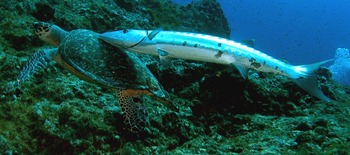
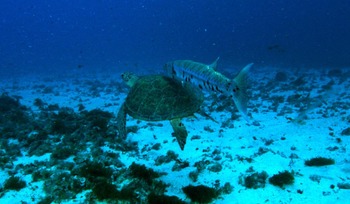
Most of the time barracudas remained stationary, hovering at mid-water and occasionally darted after a potential prey fish. The turtles moved over the area generally swimming close to the bottom and occasionally foraged on algal turf (green turtles) or sponges (hawksbills). On 20 March 2006 a barracuda about 85 cm TL was recorded to follow (‘shadow’) a swimming hawksbill, E. imbricata, about 40 cm SCL and to twice rub its snout against the turtle's carapace (Figure 1). Each rubbing bout was very quick and the fish's body arched fleetingly. While rubbing, the fish moved along the carapace from the rear to the front of the turtle, thus making contact with the posterior edge of the scutes. The fish withdrew afterwards, the whole episode lasting about 20 seconds. On 8 August 2006 a barracuda of the same size was recorded to shadow a green turtle, C. mydas, about 50 cm SCL (Figure 2) and to once rub itself against the carapace, again moving from the rear to the head, the whole episode lasting about 15 seconds. In the middle of June 2008 three barracudas (about 75 cm TL) were recorded to queue at the rear of a slowly swimming green turtle (about 65 cm SCL). The first barracuda rubbed its snout twice against the turtle's carapace while the other two waited their turn. The behaviour displayed by the fish while scraping against the carapace was similar to the two rubbing bouts described above. When the first fish withdrew, the second fish advanced towards the turtle and almost touched it but the approach of a diver interrupted its behaviour and the two remaining fish withdrew. The whole episode, from the first fish rubbing twice to the interruption by a diver and the withdrawing of the second fish lasted 27 seconds. Similarly fleeting contact seems habitual for jacks rubbing against sharks (Papastamatiou et al., Reference Papastamatiou, Meyer and Maragos2007), although a group of six bar jacks was recorded following a silky shark for about 15 minutes and rubbing against the shark periodically (Wicklund, Reference Wicklund1969).
A barracuda (Sphyraena barracuda) rubs its snout against the carapace of a swimming hawksbill turtle (Eretmochelys imbricata) at Fernando de Noronha Archipelago, off north-eastern Brazil. Photograph: Zaira Matheus.

A barracuda (Sphyraena barracuda) ‘shadows’ a swimming green turtle (Chelonia mydas) at Fernando de Noronha Archipelago, off north-eastern Brazil. Photograph: Zaira Matheus.

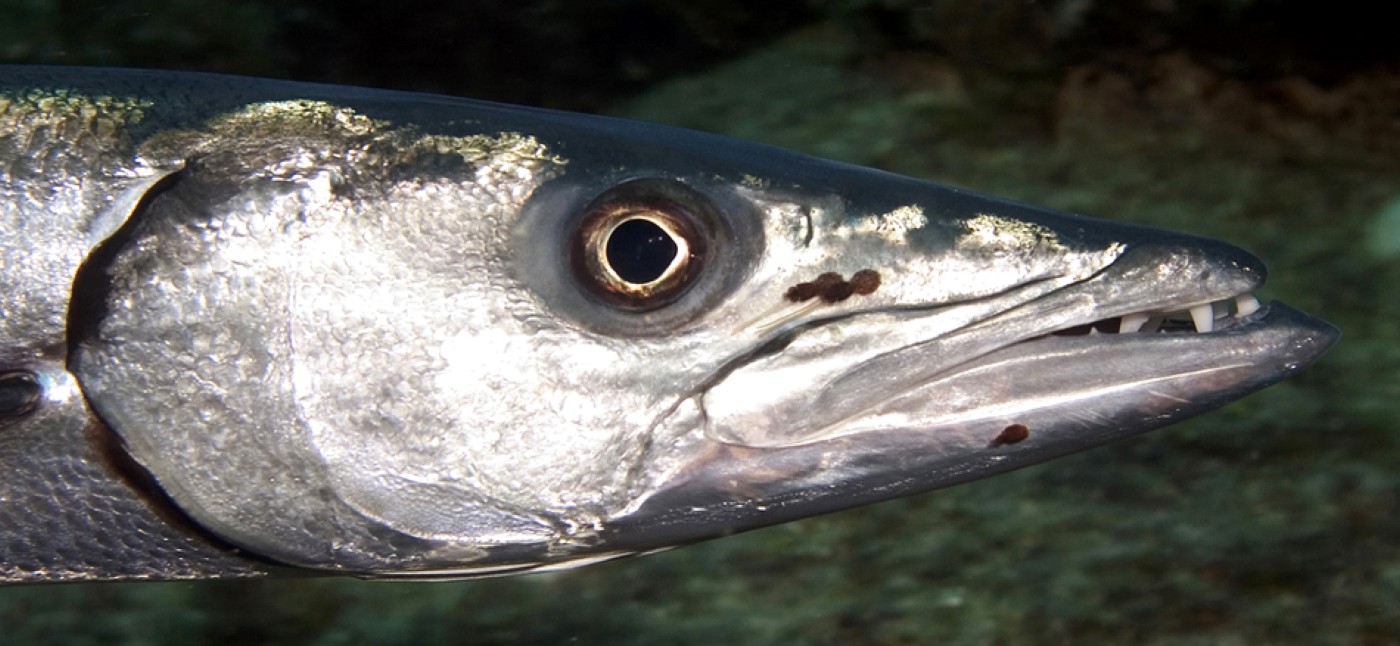
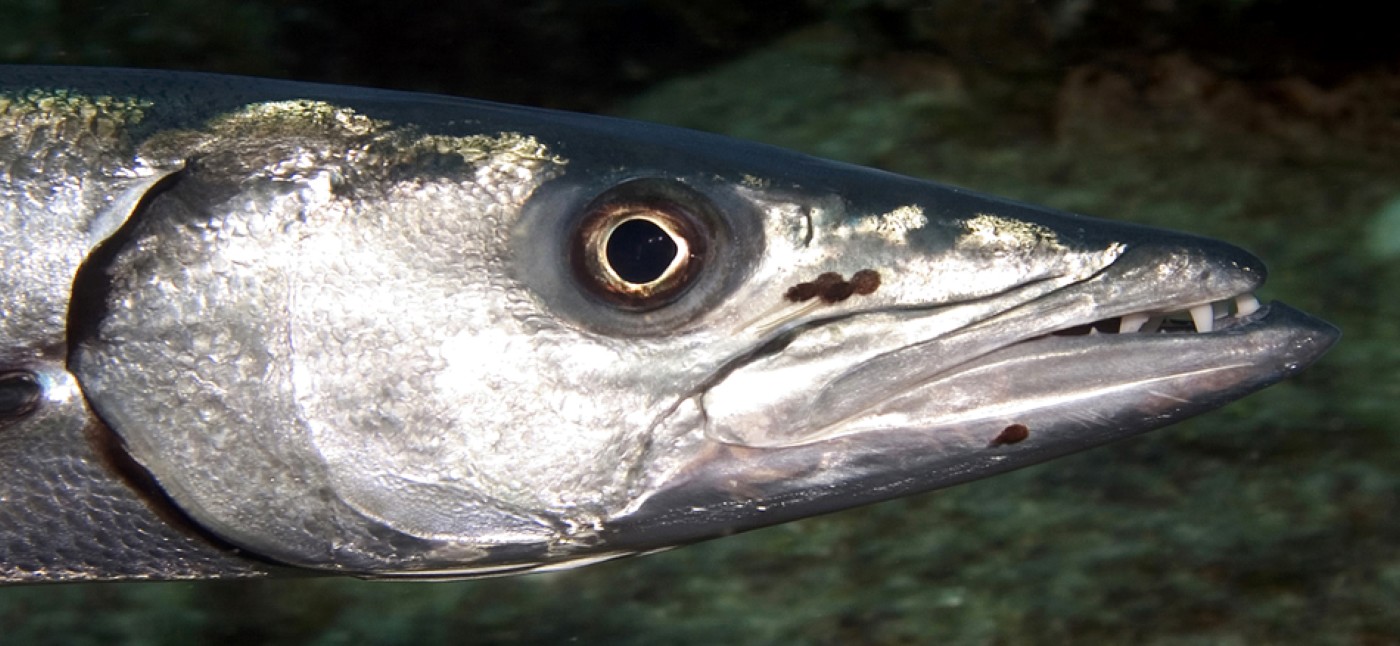
Like sharks, sea turtles offer a rough surface for fish to rub against and thus remove external parasites and/or diseased tissue. A barracuda photographed with three parasitic copepods attached to its snout (Figure 3) lends support to the suggestion that the fish rubs against turtles to remove this noxious animal type. The scutes of the hawksbill are particularly well suited for this purpose, since their posterior edge is free and thus has the potential to scrape away a larger and/or prominent parasite. Additionally, the carapace of a swimming turtle is a more convenient surface to rub against than a rock, for instance, as the torpedo-shaped barracudas display a somewhat limited manoeuvrability.
Close-up of the head of a barracuda (Sphyraena barracuda) from Fernando de Noronha Archipelago, off north-eastern Brazil, showing three parasitic copepods of the Caligidae on the snout. Photograph: João Paulo Krajewski.
A cleaner role is ascribed to sharks against which jacks rub themselves (Papastamatiou et al., Reference Papastamatiou, Meyer and Maragos2007) and, following this view, the same could be said about sea turtles. However, cleaners generally display elaborate behaviours while interacting with their clients and their role in reef communities is a complex and mutualistic one (Bshary, Reference Bshary2003; Bshary et al., Reference Bshary, Oliveira, Oliveira and Canário2007; Grutter, Reference Grutter and Rohde2005; Guimarães et al., Reference Guimarães-Jr, Sazima, Reis and Sazima2007). Therefore, the concept of cleaning symbiosis can hardly be applied to a shark or a turtle against which a fish merely rubs itself. Thus, sharks and sea turtles would best be viewed as convenient coarse surfaces roughly equivalent to sandy or rocky bottoms fish use to presumably get rid of external parasites, although a fish that rubs itself against swimming turtles and sharks must adjust its speed and rubbing behaviour according to the moving animal.
Future studies in the archipelago may indicate whether barracudas rubbing against moving turtles are a localized or a more widespread behaviour. Although there are sites in the archipelago where turtles forage and interact with several reef fish (e.g. Sazima et al., Reference Sazima, Grossmann, Bellini and Sazima2004; Grossman et al., Reference Grossman, Sazima, Bellini and Sazima2006) and barracudas occur there as well (our personal observations), at these sites we recorded no barracudas rubbing themselves against turtles or even approaching them.
ACKNOWLEDGEMENTS
We thank José Martins Silva Jr (Centro Golfinho Rotador) for logistic support; Zaira Matheus for the photographs of barracudas with turtles; João Paulo Krajewski for the photograph of the barracuda's head and valuable suggestions on the manuscript; Leonora (Lola) Fritzche for the video sequence; the ICMBio for permission to study fish in the National Marine Park of Fernando de Noronha; the CNPq and FAPESP for essential financial support.