At the height of the Occupy Central protests in Hong Kong in October 2014, when thousands of residents peacefully occupied the streets to demand universal suffrage, unidentified thugs and goons were deployed to dismantle barricades, tear down posters, and assault peaceful protestors. Rumors speculated that the thugs were hired by the pro-Beijing Hong Kong Special Administrative Region government to intimidate protestors into giving up their activism. Some of the gangsters were reported to have links with the underground criminal groups or triads in Hong Kong, while others were hired from the neighboring Guangdong province in China.Footnote 1
Why do states recruit third parties such as thugs and gangsters to carry out state policies and to coerce and repress citizens? Who are these thugs and what are their characteristics? How are these thugs different from other non-state violent agents, such as the mafias, paramilitaries, and vigilantes? When do states hire these thugs? How sustainable is this strategy of outsourcing violent repression to third-party agents? What are the costs of deployment and the implications for state capacity and legitimacy? These are the questions that animate this study.Footnote 2
I conceptualize the notion of “thugs-for-hire” (TFH), an understudied phenomenon. It brings into focus the nature of these thugs—who they are, what they do, what functions they serve—by drawing comparisons with underground criminals and other violent agents. Like the mafias, violence or threat of violence is central to what they do. TFH serves as an extension of the state, bolstering the state’s coercive capacity. I contribute to the literature on state repression by augmenting the discussion of the use of thugs and gangsters as a private repressive measure. Most studies of state coercion and repression focus on overt or observable actions carried out by state agents.Footnote 3 As DavenportFootnote 4 and EarlFootnote 5 have noted, we currently know very little about private repressive measures or the circumstances under which the state deploys them.
TFH augments the state’s coercive capacity to induce acquiescence in addition to its traditional repressive capacity, such as the military, the police, and the intelligence agencies.Footnote 6 However, it diverges in a few dimensions from the traditional coercive institutions undergirding illiberal states. First, a private agent as the actor is distinct from state agents such as the military and police connected with political elites. Second, in contrast to the formal coercive apparatus that forms part of the state’s permanent coercive capacity, “thugs-for-hire” (while serving useful functions under certain conditions), are dispensable at other times. The third-party nature of TFH allows the state to shed and disengage it when it is not in use. This is strategic from the perspectives of costs and evasion of responsibility.
Third, the acts performed by TFH are at times covert, such as intimidation and physical abuses carried out late at night to avoid public attention. At other times they are performed in broad daylight. TFH’s covert actions can be contrasted with overt coercion and repression, such as police arrest or military attacks on civilians.Footnote 7
To shed light on these issues, I focus on a common phenomenon in China, the hiring of thugs by the Chinese state to coerce citizens into complying with its policies as well as to repress them. Thugs are regularly recruited to evict homeowners in demolition projects and to dislodge farmers from their land. This pattern of thuggish state behavior and the consequential human right violations are well documented.Footnote 8 Thugs were also hired to intimidate families and to force sterilizations on women in the implementation of the state’s one-child policy. Before the abolition of rural taxes and fees in the early 2000s, the use of thuggish violence in extracting payments from peasants was also pervasive. The state also regularly deploys third-party violence to intercept petitioners who try to lodge petitions with the central authority and to threaten activists who take their grievances into the streets. In general, the state employs extralegal coercive force by thugs when implementing unpopular and illegal policies and when taking repressive actions by the use of violence or threat of violence in execution.
My empirical focus is China, but the theoretical implications are not specific to any country or authoritarian regime. In the Philippines, a country that holds regular elections, the thuggish group Abu Sayyaf—notorious for kidnapping for ransoms—offers local politicians the service of harassing voters and opposition members during election seasons.Footnote 9 The post-authoritarian state of South Korea similarly hired gangsters to evict slum dwellers to clear urban space for the Asian Games and the Olympics in the 1980s.Footnote 10 In the “liberalized” authoritarian state of Jordan, a government that preserved limited civil liberties and political autonomy, similarly paid thugs and individuals known to be convicted criminals to intimidate activists.Footnote 11 Ukraine under President Yanukovych also hired Titushky, who were skinheads in tracksuits to assault political opponents, journalists, and peaceful protestors.Footnote 12 Russia under the Putin administration is notorious for its use of criminal gangs to assassinate dissidents abroad.Footnote 13 Indeed, a wide range of regimes from autocracies to semi-authoritarian countries have deployed TFH to repress activists and contain members of opposition groups.
“Thugs-for-Hire” are most frequently engaged by weak states, defined by their low capacity or their relative strength from dominant societal forces, though their use by strong states is not ruled out. In this respect, China may seem like a paradoxical case. Why does a seemingly strong state like China need to subcontract coercion to third parties? Instead, I argue that local states in China, which are actually in charge of policy implementation, are weak in their capacity, and their autonomy is frequently usurped by key societal forces. Since the 1990s, endemic corruption and chronic fiscal deficits have negatively affected the extractive, administrative, and coercive capacities of a growing number of local authorities, though the Chinese state at the national level is still relatively strong. As case study evidence suggests, the rudimentary organizations consisting of a few thugs often developed over time into full-scale criminal organizations. When local thuggish and criminal gangs grow stronger and progressively more organized, local governments become correspondingly weaker. In Migdal’s “state-in-society” framework, the state’s relative weakness vis-à-vis the society necessitates its reliance on these dominant societal forces for policy execution.Footnote 14 By way of contrast, strong states are most likely to use TFH for the purpose of blame avoidance, rather than to bolster their capacity.
While the “state” in this study refers to the government entity as a whole, it is subject to a slight caveat. Admittedly, this definition can be problematic in a multi-level country such as China where the central and local governments may operate under different sets of conditions. Despite the fact that TFH is exercised mostly by local governments, it is often with the knowledge of and hence implicitly sanctioned by the central government. Local governments hire thugs to get a job done owing to the central government-imposed pressure to maintain social stability. Accordingly, “state weakness” in China’s context refers to local states’ declining capacity, as I will illustrate. Yet it is only by aggregating the state as a collective unit that the utility of the concept can be extended to a wide range of countries beyond China.
A key implication of my argument is that though serving useful functions, “thugs-for-hire” are most likely a stopgap measure. Equilibrium in the relations between the state and TFH is maintained only when the former as principal is able to continuously exert control over the latter as agent. Intensification of the use of TFH will likely result in a disequilibrium in which the thugs are no longer “for hire” either because they have grown too powerful to become independent from the state or have become capable of usurping the state. In other words, weak states that deploy TFH to bolster their coercive capacity risk becoming weaker as these societal forces grow stronger.
The primary data in the paper were drawn from my interviews conducted with residents and villagers affected by housing demolition, land expropriation, and party cadres over the period 2012–2014.Footnote 15 The field sites included the city centers and rural outskirts of Kunming, Chengdu, Zhengzhou, and Beijing municipalities. A total of 105 semi-structured interviews were conducted as part of my broader project on contentious politics surrounding state-led urbanization in China. During a visit to the infamous “petition village” in Beijing in the summer of 2014, I interviewed petitioners who traveled from afar to channel their grievances through the official petition system. I also draw on Chinese-language scholarly literature and media reports as secondary evidence. (Refer to the online appendix for details on methodology and fieldwork.)
The article is organized as follows. The first three sections elaborate on a general theory of “thugs-for-hire”, first by placing it in a larger framework of violent agents, then conceptualizing it as a form of repressive measure carried out by third-party agents, and followed by a description of its scope conditions and the costs of deployment. The next section situates TFH in the context of the literature on the mafias, as they similarly rely on violence or threat of violence in their services. I then offer three scope conditions under which TFH is the preferred strategy compared to other forms of repression. The conditions are when state actions are illegal or policies are unacceptably unpopular; when evasion of state responsibility becomes highly desirable; and when states are relatively weak in their capacity or are less strong than their societies. While the presence of any of the three conditions will explain deployment of TFH, thugs are most likely used when all three conditions are met. What follows examines the costs of TFH and the implications for regime legitimacy. The next section draws on empirical evidence from China as a case illustrating TFH as a coercive strategy and the conditions under which it is deployed. My conclusion draws implications for regime legitimacy and state weakness.
Who Are the “Thugs-for-Hire”?
How is TFH different from the much-studied mafia groups found in Italy, Russia, and Japan? What is new about TFH that we do not already know about mafias?
Mafias, which are a specific type of organized crime, specialize in the provision of private protection or security.Footnote 16 The Sicilian Mafia in southern Italy,Footnote 17 the Yakuza in Japan, and the “violent entrepreneurs” in Russia in the 1990s converted organized force into profit-making enterprises.Footnote 18 TFH and mafias are similar in that violence or the threat of violence is essential and central to what they deliver. They need to demonstrate their ability to employ coercive force and use sufficient ruthlessness that such acts entail. Therefore, members of both groups tend to be individuals who have a penchant for and the capacity to use violence.
TFH refers to ruffians, hooligans, and unorganized stragglers—thugs as well as legalized professionals who render violence as a form of service for profit or in exchange for in-kind benefits. They are most commonly the unemployed or those lacking regular salaried jobs who depend on “making troubles” to make a living. They stand in contrast to the mafias in Sicily and Japan or those who joined the ranks of “violent entrepreneurs” in Russia. The Yakuza in Japan were formerly Samurai, and the Sicilian Mafias were previously disbanded soldiers.Footnote 19 The mafias belong to complex organizations that attempt to monopolize protection in a given space.Footnote 20 They also have a specific code of conduct and rules and admission rituals that all gang members have to observe.Footnote 21 The “violent entrepreneurs” in Russia were former police or state security officers, including ex-KGB officers, retrenched from the state system.Footnote 22 These former professional identities, complex organizations, and code of conduct of the mafias and “violent entrepreneurs” are not typically found in TFH.
In the Weberian context where the state is the territorial monopoly of legitimate violence, and the monopoly is the key enabler for state enforcement of law and order and exercise of justice, both the mafias and TFH arise from a situation of state weakness and they similarly fill the vacuum in state power. Organized crime emerges due to the existence of “a power vacuum and the shortage or absence of ultimate enforcement.”Footnote 23 “Violent entrepreneurs” in Yeltsin’s Russia came about to fill the institutional vacuum from economic transition that eroded the rule of law necessary for business operation.Footnote 24
TFH fulfill two functions. Most frequently, they help to augment the state’s lack of capacity to implement policies, to execute day-to-day tasks, and to subjugate its citizens. This does not rule out TFH also being hired as helping hands by the opposition or private individuals, or any party who is willing and able to pay for their service, but it primarily serves an extension of the state’s coercive capacity. Less frequently, when they are engaged by states that are not lacking capacity, they serve the strategic purpose of evading responsibility due to their third-party nature.
In short, both TFH and the mafias arise out of similar conditions and most of the time fulfill the comparable function of supplanting the state’s functions in power vacuum. TFH exchange violent service for a profit, primarily to the state, whereas the mafias offer a range of additional services to private individuals such as contract enforcement, dispute settlement mechanisms, and protection of property rights. TFH and the mafias alike are underground criminals, though only the latter belongs to the category of organized crime.
It should be emphasized that TFH is a market exchange—the thugs provide violent coercion to the state, which pays for their service. This differentiates it from other non-state violent agents, such as the ultranationalist skinheads in Russia, who commit violent crimes against immigrants for the sake of ethnic cleansing.Footnote 25
“Thugs-for-Hire” as Private Violent Repressive Agents
This study joins the state repression literature that casts repression as the dependent variable. “Thugs-for-hire” can be distinguished from the existing forms of repression along the following dimensions.Footnote 26 First, the repressive agent is a private individual as opposed to state agents associated with national governments, such as the militaryFootnote 27 or the police force.Footnote 28 Second, the repressive agent deploys low-level violence or threat of violence in executing the act. TFH use their bare hands and fists, and at times, iron rods, knives, and other relatively low-intensity weapons to extract compliance and acquiescence from the subjects. This stands in contrast to the machetes and AK–47-wielding paramilitaries involved in ethnic cleansing and genocidal wars.Footnote 29 Third, the repressive action is at times intended to be covert or concealed from the public as compared to the overt repressive acts such as murders or political arrests,Footnote 30 the massacre in Tiananmen Square,Footnote 31 or counter-movements.Footnote 32
The first dimension differentiates TFH from the uniformed police and other security officers, and from private agents instructed to carry out counter-movements. The second dimension separates TFH from the extremely violent agents such as militias and paramilitaries involved in mass killings. TFH augments a new variation to the study of repression as a dependent variable with respect to the type of agent, nature of action, and intensity of violence.
Scope Conditions for the Deployment of “Thugs-for-Hire”
I outline three scope conditions under which states prefer using TFH over other means of repression: when states are carrying out illegal actions or unpopular policies; when evasion of responsibility for state actions becomes highly desirable; and that weak states are more likely than strong states to engage TFH. State strength is defined in terms of its capacity or relative dominance vis-à-vis the society.
Scope Condition I: When Actions Are Illegal or Policies Are Unpopular
TFH are third-party agents defined by the centrality of violence or threat of violence in their actions. The state employs third-party violence in dealing with certain citizen groups and in the execution of selected tasks, particularly illegal state directives or unpopular state policies. TFH’s third-party and violent nature are expedient when wading into the illegal territory in which the state desires citizen’s compliance and submissiveness. In this situation the military, police, or other state coercive forces cannot be deployed due to the illegal and unlawful nature of the tasks in hand. Examples include but are not restricted to the state’s collection of illegal exactions from citizens, illegitimate violent crackdown on protestors, or the kidnap of and threatening phone calls to activists. The illegal nature of the actions calls for intervention by non-state or state-hired private agents. To the extent that it is more difficult to acquire citizens’ compliance with illegal directives compared to unpopular policies, the use of TFH is thus likely.
Scope Condition II: When Evasion of Responsibility Becomes Highly Desirable
Private agents who perform violent acts offer distinct advantages to states. When private agents instead of uniformed personnel such as the police are deployed to carry out unpopular coercive acts, states stand a better chance of evading responsibility. The identity of private agents is often elusive, which allows states to maintain an arms-length relationship with them and the violent acts they commit. Private agents being external parties allow states to more easily sever the relationship if they need to. Additionally, as an on-demand service, private agents can be employed on a contract basis for certain projects and disbanded when the projects are completed.
What undergirds this condition is a growing body of literature that addresses why some states prefer using privatized violence as a repressive measure. “Privatized state violence, as a subset of state violence, is coercion orchestrated by the state . . . but carried out by nonstate actors, such as vigilantes, paramilitaries, and militias, who are directly or indirectly supported by the government.”Footnote 33 State involvement, including the state’s sponsorship of weapons, personnel, logistics, intelligence, or finances, or its condonation of these violent activities for political gainsFootnote 34 distinguishes privatized state violence from violence perpetrated by private organizations that act upon their own self-interest. These complicit relationships can be found in autocracies, such as Myanmar and Zimbabwe, and in procedural democracies, such as India and Turkey.
After the Cold War, states that rely on foreign aid such as Kenya, Rwanda, and Malawi, regularly deploy non-state actors to counter political challengers. Other governments in Africa secretly utilize surrogate agencies, such as ethnic or religious militias, to attack government critics.Footnote 35 Oppenheimer’s The Act of Killing portrayed the Suharto regime in Indonesia making use of the Pancasila Youth, a paramilitary organization, and young hoodlums who were movie-ticket scalpers to massacre at least a million civilians loosely labeled “Communists.”Footnote 36 During the civil war in China in 1927, the Kuomintang instrumentally co-opted the Green Gang, an underground criminal group, to brutally suppress Communist opponents in Shanghai.Footnote 37
By implication, states operating in the international spotlight such as those relying on foreign aid are more likely to use third-party agents than to deploy their own police or military to crush dissent.Footnote 38 Semi-democratic governments that face voters on a regular basis may also have a predilection for third-party repression to avoid being adversely affected in elections.Footnote 39 Using third-party agents—a dispensable proxy—allows states to distance themselves from the atrocious acts committed for their benefit.
Even though TFH are different from the paramilitaries, militias and other non-state actors in the degree of violence exercised, they share the common characteristic of being third-party agents whose ties with the state could be more easily severed, and hence offering the state the distinct advantage of responsibility evasion.
Scope Condition III: Weak States Are More Likely Than Strong States to find TFH an Attractive Option
The logic behind weak states subcontracting violence is that borrowed violence is able to augment the existing deficiencies in state capacity. State strength refers to its ability to extract resources,Footnote 40 to administer and execute policies,Footnote 41 and to coerce rivals,Footnote 42 which could be referred to respectively as the state’s extractive, administrative, and coercive capacities.Footnote 43 I argue that states weak in either one or more of these dimensions will find third-party coercive force attractive. TFH can augment the state’s capacity to extract revenue from citizens under coercion, to acquire citizen’s compliance in policy execution, as well as to coerce dissidents and rivals.
Weak or weakening states across Europe, Africa, and the Middle East have subcontracted violence to private armies due to shrinking government revenue and national armed forces.Footnote 44 Inadequate coercive capacity of these states calls for the recruitment of irregular forces. Nevertheless, the use of third-party coercion by strong states is not ruled out, though they do it for its potential for deniability rather than augmentation of its capacity. A range of countries from the United States to Sierra Leone have engaged private security companies. The advantages these companies offer to strong states such as the United States, aside from lower price and cost of political mobilization, is the ability to maintain a distance from the agents’ actions. The abuses of prisoners at Abu Ghraib by security personnel working for Blackwater, the private security company contracted by the U.S. government, was just such a case.Footnote 45
All states, regardless of their level of strength, may find TFH an attractive strategy for preserving state legitimacy while implementing illegal and unpopular policies. Yet weak states are more likely to contract their violence because it also helps to augment their capacity.
In other words, strong and weak states engage TFH to further different ends. Strong states are also more capable of managing the risks from the subcontracting of coercive force, including agency problems and undisciplined violence. When weak states hire thugs, they are less capable of exerting control over targets of thug actions and the intensity of violence exercised by the agents.Footnote 46
State strength can also be defined as its relative dominance vis-à-vis the society. As part of the “state-in-society” framework,Footnote 47 the state could become weaker if the society grows stronger either because of declining state capacity as outlined earlier, or independent of it. When thugs, mafia or underground criminal groups acquire strength, the state could be “captured” by these key societal forces that usurp state autonomy. As such, the state has to rely on these non-state violent specialists to implement day-to-day policies.
Rather than a dichotomous variable, state weakness exists along a continuum from minor weak states to collapsed warlord states. Operating under varying degrees of state weakness, TFH and other underground criminals are still reliant upon the continued autonomous exercise of state power and state provision of the rule of law. Yet if state weakness is taken to its extreme, a condition akin to state collapse in various African countries, warlords may seek to replace the state’s provision of order in its entirety.Footnote 48
Placed in this context of state fragility, TFH—which arise from a state’s weakness or lack of capacity in getting things done—is the precursor to organized crime and the extreme case of warlord states. The state is still the dominant party in the state-TFH relationship in which it seeks to control the target and intensity of violence, though to varying degree of success (as I discuss in the following section). Put simply, TFH still operate within the confines of state power, at least in the early developmental stage.
The states in which TFH and mafias operate are variants of—and are more realistic than—the ideal-type Weberian definition of states as entities that hold a “territorial monopoly” over violence.Footnote 49 Yet by subcontracting violence to third parties, states are voluntarily ceding their monopoly on violence. This form of subcontracting runs the risk of eroding states’ legitimacy or of further compromising their monopoly of legitimate violence.Footnote 50
Costs of “Thugs-for-Hire”
TFH is distinct from other perpetrators of illegitimate violence such as the paramilitaries, vigilantes, or militias by the relatively low level of violence they deploy. The intent of TFH is not so much to decimate the enemy, which is what the militias or vigilantes typically set out to achieve when waging war, but to subjugate a recalcitrant population and to quell dissent. TFH sometimes employ threats of violence, such as intimidation and harassment, on recalcitrant citizens in order to secure their compliance with government directives. At other times, they brutally assault activists to achieve compliance. But they do not commit massive killings, ethnic cleansing, or genocide, as the militias or paramilitary groups in fragile and divided states do.
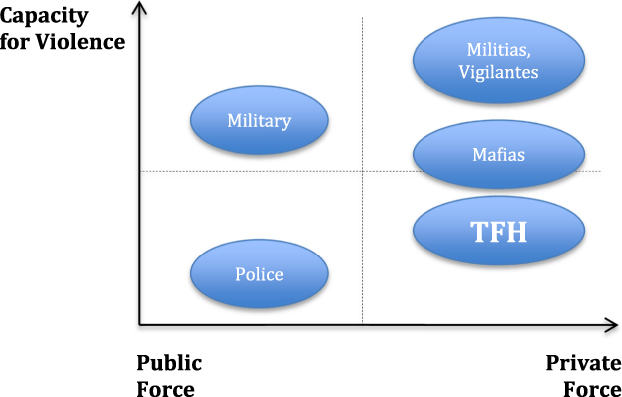
Figure 1 situates various violent agents along two dimensions: public/private force and capacity for violence. On the one hand, TFH, along with the mafias, militias, paramilitaries, and vigilantes, are perpetrators of private, and by implication, illegitimate violence. They can potentially be prosecuted for their illegitimate and illegal use of force. On the other hand, the police and the military, when they use justifiable degrees of force to maintain social order or to protect the country’s border and citizens, are agents of public and legitimate violence. TFH therefore fall into the lower right-hand quadrant in the 2x2 matrix of public/private force versus capacity for violence. TFH are characterized by their use of private force and low capacity for violence.
Public/private force versus capacity for violence

The various advantages of TFH notwithstanding, deployment of third-party violent agents necessarily imposes costs on the state. One of the costs is a decline in state legitimacy even though the third-party agent provides the state with some scope for responsibility evasion. The victims are often aware of who gives the order even if the identities of the perpetrators are obscured. Additionally, the subcontracting of violence is often subject to agency problems.Footnote 51 When private militias are engaged by the state as repressive agents, agent-centered human rights violations such as excessive violence and sexual abuse of repressed citizens are commonplace.Footnote 52 The consequence is uncontrolled and undisciplined violence, with more violence committed than is needed to get the job done. This sort of behavior is often privately motivated, beyond the instruction of the state. Excessive violence may help to attract sympathizers, which in turn garners support for citizens’ actions, rather than deterring them.Footnote 53
“Thugs-for-Hire”in China
TFH in China are commonly referred to as dashou, xiao hunhun, dipi, and liumang, meaning thugs, ruffians, hooligans, or hoodlums. They are most frequently recruited by local states to be involved in housing demolition and evictions, land expropriations, collection of taxes and illegal fees, and to deal with protestors and citizen activists.Footnote 54 They render services ranging from issuing violent threats, harassment, and beatings to physical abuses and murders. They may also be referred to euphemistically as shehui xianzarendeng, meaning those unemployed or lacking regular salaried jobs who depend on “making troubles” to make a living.
These thugs assume different identities when they carry out their tasks. When they are hired to demolish houses, “they call themselves ‘patrol officers’ (xunfang renyuan) and don camouflaged uniforms (micaifu)”, as told by a villager in Zhengzhou.Footnote 55 The uniforms provide them with a pseudo-military or government security identity. In other cases, they were the “‘law enforcement officers’ (zhifa renyuan) in charge of implementing local authority’s demolition directives, but they carried no official pass” said another villager in Zhengzhou.Footnote 56
TFH in China generally have not received any previous military or security training. Some of them have criminal records that create obstacles to their acquiring proper jobs or being reintegrated into society. Becoming a hired thug is therefore a means of making a living for these individuals. Prior to being hired, they might be independent and unaffiliated, taking up odd jobs or doing petty crimes to eke out a living; others may have belonged to some loosely organized gangs. The level of organization is generally low or uncomplicated, except for private security companies that were hired to deal with petitioners who lodge complaints against local governments in Beijing.
“Intercepting” Petitioners and “Black Jails”
In addition to its efficacy in forcing compliance when state policies are unpopular and its actions illegal, the use of hired violence also serves as an effective repressive measure. Thugs and private security companies are widely engaged by local governments to “intercept” and “retrieve” petitioners who lodge complaints of local official malfeasance with the central authority. The petition system, originating in imperial times, allowed commoners wronged by local officials to seek intervention from the Imperial Court. In contemporary China, the rights to petition are constitutionally enshrined.
Black jails (heijianyu) are illegal detention centers operated by local government-hired non-state agents, mostly private security companies, for handling petitioners. They emerged after the closure of the official custody-and-repatriation centers (shourong qiansong zhongxin) in 2003 following the controversial death of a migrant worker while in official custody. The closure of the official centers prompted the emergence of black jails infamous for human rights abuses of petitioners held captive. The official detention system, while holding captive petitioners and dissidents, along with beggars and vagrants whom the authorities wanted to keep off the streets,Footnote 57 also allowed local governments to retrieve petitioners directly from the police and civil affairs bureaus in Beijing.Footnote 58 While its closure was seen an improvement in human rights and the rule of law,Footnote 59 the number of Beijing-bound petitioners skyrocketed. Subsequently, the central government made the number of petitions an essential criterion of local cadre evaluation and promotion in 2005, motivated by the desire to preserve social stability. This in turn contributed to the emergence and prevalence of black jails as an informal strategy to lock up petitioners before repatriating them home.Footnote 60
The most highly publicized black jail was the infamous Anyuanding security company. The personnel who worked for the company did not have any military or security background, and their profiles were not significantly different from the unemployed hooligans and thugs hired for demolition projects.Footnote 61 The other high-profile cases included “Changping black jail” and the Li Leilei case that similarly involved government-hired security companies to handle petitioners.Footnote 62
Petitioners held in black jails typically suffer from widespread torture and human rights abuses, which are intended to deter them from lodging complaints in the future. A female petitioner I interviewed in Beijing told me that “I was stripped naked and held captive in a windowless room with no light for 30 days. I was delivered one meal per day. The thugs kicked me in my stomach, poured cold water over my naked body and routinely raped me.”Footnote 63 A male petitioner recounted that “I was held captive in an underground room in a guesthouse for an extended period of time. I was routinely tortured with cigarette burns and was forced to write confessions about falsely accusing local government officials of wrongdoing.”Footnote 64
Why does the Chinese state use hired thugs and black jails to deal with petitioners? Here I illustrate how the scope conditions operate. First, because “intercepting” petitioners is, strictly speaking, an illegal action, the state cannot deploy the police or other uniformed officers, which it could with the official detention system. The illegal nature of state actions calls for illegitimate responses to the problem. Borrowed violence provides an efficient and effective solution to what is otherwise a lawful right of citizens. Second (and relatedly), black jails operated by private security companies allow the state to distance itself from the illegitimate actions. Black jails, or extralegal temporary detention centers, can take the form of secluded private residences, guesthouses, or basement apartments. The makeshift nature of these facilities and the muzzling of abused victims make accountability tracing onerous.Footnote 65 Thus they are a covert private repressive measure that allows for greater scope of evading responsibility by the state. In contrast, the official detention and repatriation centers were an overt repressive state institution for dealing with petitioners.
Third, the proliferation of black jails was a response to the rising number of petitioners flooding to Beijing following the abolition of the repatriation system in 2003. It reflects the lack of state coercive capacity, particularly that of local states, in dealing with an increasing number of discontented citizens. An alternative to private security companies is the secret police, an arm of the police force. But deploying the secret police is relatively more costly because they are under official government payroll (bianzhi).Footnote 66 The fluctuating demand for professional interceptors surges during politically sensitive periods, such as when the “two sessions” (of the National People’s Congress and the Chinese People’s Political Consultative Conference) are held, but ebbs in other times, making clear the preference for on-demand market agents.
Housing Demolition and Land Expropriation
With skyrocketing land and real estate prices in the last two decades, land sale revenue has become the major contributor to the revenue streams of local and municipal governments in China.Footnote 67 Local governments that are starved of revenue are strongly incentivized to expropriate land and to lease it to property developers.Footnote 68 In recent years, municipal governments have also been feverishly clearing “urban villages” (chengzhongcun) or “urban slums” located in prime locations to make way for new construction as land has become more scarce.Footnote 69
This strong revenue drive results in hasty government policy actions and sometimes even illegal actions. Local governments face tight deadlines to complete urban development projects as the costs of resettling residents, interest payments from bank loans, and the burden of unsold real estate properties rise as the projects drag on. Citizens become resistant when monetary compensation is too low or is unreasonable. Others refuse to comply because of inferior resettlement housing, corruption and embezzlement by officials, and procedural concerns such as lack of notice or consultation over the eviction process. To successfully implement these projects, (forced) consent of the entire community is often required. An urban development project stalls if only a few families out of an entire village or neighborhood refuse to vacate their properties. Therefore, hired violence provides a swift and effective solution to the deadlocks. A prominent researcher at the Chinese Academy of Social Sciences, Yu Jianrong, has estimated that 90% of all demolition and relocation cases involve thug violence.Footnote 70
An interviewee in Chengdu who had recently undergone housing demolition informed me that “unless you could withstand harassment or physical abuses by the thugs on a regular basis, you do not want to be a nail household.” By “nail households”, he meant stubborn households that refuse to comply with the government’s relocation notice and are as immovable as “nails on a wall”. He continued:
Thugs bang on our door in the middle of the night asking us to sign on the consent papers (to relocate). When we refused to comply, they intimidated us by tailing us when we went out at night. On one occasion, the thugs, a few masculine tattooed guys, cornered us in a dark alley, threatened to kidnap our 6-year old son, and harassed my wife at her workplace if we did not sign the papers.Footnote 71
At other times, grassroots officials may decide to expropriate farmland without higher-level approvals because they want to personally pocket a larger share of the proceeds.Footnote 72 When illegal actions take place, government officials are unable to produce official eviction notices, and their actions will encounter even more fierce resistance from villagers. Violence becomes an increasingly necessary means of effecting acquiescence in these illicit cases.
Some infamous underground kingpins, such as Qiaosi, of Harbin in northeast China, made their fortunes by offering hired thug services to state agents in demolition and eviction projects. Qiaosi was known as the “underground mayor” of Harbin. He began making money as TFH when the city underwent urban development and renewal in 1987. Working with various construction companies, he became a government contractor in demolition projects where he organized and sent teams of hooligans and ruffians to assist the municipal government in demolition works.Footnote 73 Qiaosi’s success could be attributed to his ability to supply the void in market demand for swift evictions. Demolition work in urban renewal projects is outsourced to these “professional thugs” who deploy the most effective means to carry out swift evictions. The state cannot send uniformed government officials, including the police, to forcefully evict legal residents from their homes, but outsourcing illegal actions to third parties makes them a feasible solution.Footnote 74
Collection of Rural Taxes and Fees
Local governments also engaged thugs to assist in the collection of rural taxes and fees and other illegal exactions before their abolition in the early 2000s. Not dissimilar to cases of housing demolition and land expropriation, compliance was vexatious for local officials. Imposed illegally and arbitrarily by grassroots governments, the wide-ranging exactions included an agriculture tax and various rural surcharges, such as fines for violating the one-child policy, education surcharges, and mandatory contributions towards local infrastructure building. These exactions reached as high as 30 to 40% of a farm household’s total annual income.Footnote 75 Accordingly, third-party violence was deployed when villagers refused to comply with officials’ instructions.Footnote 76 Thuggish violence had also been blatantly used against women in forced abortion cases before the abolition of the one-child policy in late 2015.Footnote 77
In addition to their illegal nature, the deployment of TFH in housing demolition and collection of illegal exactions also illustrates the scope condition of responsibility evasion. Despite its pervasiveness, the use of low-level violence and pedestrian suppression in these situations has never been formally sanctioned. My interviewees in Kunming recounted that “the thugs are recruited from different villages or towns within the same regions. While they are relatively familiar with the locales and speak local dialects, they have an escape route if they get into trouble.”Footnote 78 Outsiders also have an advantage of not being recognizable to the locals or subjects under attack, which is useful in blame shifting. When thugs donning camouflaged uniforms are sent to manhandle activists, they are seen as people with dubious identities. This allows the state to deny having direct responsibility in the actions. As such, TFH offers the state a distinct advantage over the police or other uniformed security officers such as guobao in collecting exactions, intimidating residents, or beating up protestors.
When caught red-handed, third-party agents allow local governments to shift responsibility more easily. In an “urban village”Footnote 79 (chengzhongcun) in Zhengzhou that I visited in 2014, the villagers resisting evictions had violently clashed with local government-hired thugs, resulting in the death of an elderly woman and scores of injuries. The violent clash was recorded by closed-circuit television cameras privately installed by villagers. Yet as the activist-interviewee told me, “when the higher-up governments pressed the local authority for the culprits responsible for the casualties, it claimed that the thugs who were not wearing official uniforms, were not on its payroll.”Footnote 80 Thus, with that, the local authority was able to shrug off responsibility.
State capacity in China has eroded since the launch of liberal market reform in the late 1980s. Without co-opting extralegal coercive forces of violent agents, the state is increasingly incapable of carrying out routine policy measures. In its transition from a communist to market system without the concomitant political reforms, the state’s “ability to implement policy and enforce rules is severely limited by its coherence, internal tensions, and weaknesses.”Footnote 81 Its incomplete transition has created “conditions for systemic corruption,” which has undermined state capacity. The result is a state incapable of performing its basic functions, such as enforcing rules and contracts and protecting property rights.Footnote 82
At the local level, signs of weakening states started to emerge in the mid-1990s, manifested in their declining extractive and administrative capacity. Aside from endemic corruption, more recent scholarly works point to “hollowing out” of local government functions as they were progressively incapacitated by budget cuts and mounting debts.Footnote 83 Local governments’ fiscal conditions have deteriorated since the fiscal recentralization in 1994, which has negatively affected state administrative capacity since then.Footnote 84 Local authorities are starved of revenue to provide basic public goods, such as paying for teachers’ salaries, bureaucrats’ pay, and hospital beds. Local authorities often have to yield to and are increasingly held hostage by cronyism.Footnote 85 After the mid-2000s, the local fiscal situations may have improved owing to increased central transfers, but many local authorities are still starved of independent sources of revenue, with implications for their ability to function.
This leads to another form of state weakness, which stems from the state’s relative strength vis-à-vis dominant societal forces. China in the post-reform era has seen a rise in “local mafia states,”Footnote 86 denoting collusion of interests between Chinese officialdom and thuggish groups.Footnote 87 More specifically, territorial-based criminal groups have proliferated. These criminal groups forge ties with local authorities and control territories through three key mechanisms: protection umbrellas, buying official positions, and village elections or getting elected into local people’s congresses.
My field research corroborates evidence of a weakening state and one in which its autonomy and relative strength have been usurped by thuggish groups. The state has to rely increasingly on third-party violence to execute routine tasks. In an “urban village”Footnote 88 in Kunming city where I conducted field research in the summer of 2012, the local authority, severely incapacitated by a fiscal shortfall, suffered diminished capacity in policy implementation, and in providing public goods and services. It colluded with local thuggish groups by providing the latter with “protection umbrellas” for their illegal business activities, such as gambling, entertainment and prostitution rings. The local authority is paid protection fees in return. Stripped of its capacity to carry out basic functions, it had to co-opt the coercive force of the thuggish group for expropriation of land, evictions of residents in housing demolition projects, and collection of local exactions.
In other circumstances, thuggish and criminal groups penetrate into the state system by “buying and selling office” (maiguan maiguan), getting elected into the local legislature or the local people’s congresses, or rigging village elections to control village committees.Footnote 89 Since the 1990s, there has been increasing collusion between the police and criminal gangs, resulting in the penetration of criminals into government institutions, and damaging the state’s capacity to carry out law and order.Footnote 90 The collusion between the state and local criminal groups can be found throughout all administrative levels from village, township, to county- and provincial-level cities. Similarly, the criminologist Xia has observed “weakening local state capacity” and organized criminal groups filling the vacuum left by the state and in many places functioning as “the second government,” “the second court,” or “the second police station.”Footnote 91
A common origin of many of these state-backed criminal business organizations was TFH. Aside from Qiaosi in Harbin described earlier, Liu Yong in Shenyang is another kingpin who had made his initial fortunes in TFH services since the late 1980s. In 1999, when a drug store owner failed to obey an eviction order, Liu mobilized thugs armed with lethal weapons to break into the dispensary, where they killed the employees. He had similarly deployed indiscriminate violence against other evictees. By the time Liu was arrested in the late 1990s, the Jiayang Group—the company he founded—had ventured into legal businesses such as clothing, food, entertainment, and real estate. He was also an elected deputy of the People’s Congress in Shenyang municipality.Footnote 92
Other prominent TFH/criminal figures include Hao Wei in Changchun, Zhou Qiang in Nanjing, and Wang Ping in Chongqing.Footnote 93 They share a common characteristic in which their criminal activities began with TFH services in urban renewal projects. The rudimentary organizations, often consisting of a handful of armed fighters, thugs, or gangsters, then developed into full-scale criminal organizations with wide-ranging business interests traversing legal and illegal areas. Scholars in criminal studies have identified a common pattern of hoodlums evolving from vagrants to a criminal underworld through a process of metamorphosis.Footnote 94
To be sure, purely contractual TFH still exists in China. While it is beyond the scope of this paper to systematically establish the pattern of “local mafia states” across the country, what my fieldwork evidence and secondary literature have underlined is a common pathway by which, as TFH grew over time, they were involved in a variety of illegal businesses other than offering violent service at a profit. As they seek “protection umbrellas” from local governments for their illegitimate activities, the politics-crime nexus is established. The implication is that states relying on TFH to carry out policies and to get a job done risk feeding the forces that end up usurping their capacity.
Costs of Deploying “Thugs-for-Hire” in China
Deploying TFH imposes other costs on the state; employing thugs to carry out unpopular everyday policies has also hurt the Chinese regime’s legitimacy. In the eyes of the citizens, these thugs are state-hired violent agents used to coerce them into doing things against their will—encroaching on their rights to protect their property, their basic human dignity, and on their right to protection from bodily harm. Excessive and undisciplined violence deployed by third-party agents further compounds the problem. During my field visits to communities that have endured state-hired violence, I heard my interviewees using unflattering and debasing adjectives, such as “Communist thugs” (gongfei) and “bandits” (tufei), to describe local officials.Footnote 95 One family in Zhengzhou who had suffered forced eviction told me that “we would rather be lackeys for the Japanese, than be the subject of the local authorities.”Footnote 96 In a country where the citizens had endured enormous humiliation and hardship under Japanese colonization and where anti-Japanese sentiment still runs high, the greater disdain and indignation for local officials is telling. Other informants in Chengdu lamented that “we would rather return to the Kuomintang rule!”Footnote 97 These aggrieved may not literally want to return to the Japanese or KMT rule, but what is evident is their exasperation and indignation with the Communist state’s blatant abuse of power, which far exceeds the excesses of other regimes in living memory.
In comparison to uniformed officers, hired thugs—consisting of untrained violent agents—are more likely to deploy excessive, uncontrolled, and undisciplined brute force in doing the job. In the case of petition interception, the job of the interceptors is to deploy all necessary means to ensnare petitioners before they reach the central petition bureau in Beijing. There are widespread reports of rapes and deaths of petitioners while in custody.Footnote 98 These reports explain how routine the excessive violence used against evictees and petitioners had become. It also illuminates why sexual violence, an unnecessary means for intercepting petitioners, is common among captives of black jails.Footnote 99 Reports of casualties are also widespread among eviction cases due to excessive and undisciplined violence used against residents and “nail households”.
These costs have profound implications for the practicality of TFH as a long-term repressive measure. The state can still hire thugs on a contractual basis and dismiss them when their service is not needed. Yet subcontracting violence as a repressive strategy is sustainable only so far as the state is capable of maintaining an upper hand in the relationship. The state must have the ability and capacity to ensure that the thugs it hires do not become so robust that they end up usurping the state’s autonomy—the state must remain the principal and thugs the agent, and not the reverse. The emergence of “local mafia states” in China suggests that some local authorities are progressively losing the upper hand and they are increasingly being held ransom by the nefarious and illegitimate social forces they have fed over time.
Conclusion
By bringing into focus “thugs-for-hire”, I have introduced a new dimension to the literature on state coercion and repression, particularly on how TFH demonstrates the impact of private violent repression, an area where we currently know relatively little. Compared to the other perpetrators of privatized repression, such as militias and vigilantes, TFH employ a relatively low level of violence as their intention is to induce compliance and subjugate a recalcitrant population, rather than eradicate political opponents altogether. In comparison to uniformed officers, TFH offer hiring states the advantage of plausible deniability and of responsibility evasion, irrespective of their state strength.
Along with the military and the police, TFH is an integral part of the Chinese authoritarian state’s coercive apparatus, albeit on an informal basis. TFH’s third-party status makes it easier for the state to sever their relationship if and when its services are not in demand. Its use of low-level violence also makes covering up of the coercive and repressive acts relatively easy. Under some circumstances, TFH offer the authoritarian state unique advantages in blame avoidance and cost minimization not afforded by the traditional coercive state machinery.
States that are weak in their extractive, administrative, or coercive capacities will find the coercive force of third-party agents useful. Evidence can be found across weak states in Eastern Europe, Africa, and the Middle East. The Chinese state, traditionally seen as strong, may seem like a paradoxical case. Instead, I show that TFH has helped to bolster the local states’ capacity to extract revenue from citizens under coercion, to acquire citizens’ compliance in policy execution, as well as to coerce dissidents and rivals. In China, TFH serves the central and local governments’ priorities to preserve social stability, suppress dissent, and minimize blame at the same time.
Yet, by subcontracting out violence, states increasingly lose their territorial monopoly on violence, and risk becoming weaker states. In China, the outsourcing of violence to TFH weakens the relative strength of local states vis-à-vis these societal forces, and fuels the growth of “local mafia states.” Even though China may seem far from a warlord state with multiple regional chieftains ruling different territories as in many Africa countries, or far from a return to the warlord-ism that characterized the nation during the years of Civil War between the CCP and KMT, continuous subcontracting of violence to third-party violent specialists has reversed—to no small extent—the exemplary strong state the country inherited in the early reform era of the 1990s and the painstaking state-building efforts by the party under Deng and Mao.
In summary, the benefits TFH confers are in bolstering state capacity to implement illegal and unpopular policies, which are particularly useful for weak states. The potential of deniability is a unique advantage to both strong and weak states. Yet the use of TFH as a repressive measure hurts state legitimacy. The decline in state capacity as thug activity grows over time into organized criminal groups is the cost of relying on TFH. What I have demonstrated is the common pathway by which TFH can develop into criminal organizations and “local mafia states.” The pervasiveness of the problem and the regional patterns in China are worthy of further research.
Supplementary Materials
Methodology and Fieldwork Notes
To view supplementary material for this article, please visit https://doi.org/10.1017/S1537592718000981