





Introduction
Older people living with chronic physical and cognitive challenges frequently use a range of health and social services delivered in home-based services (i.e., that provide nursing care and additional supports such as shopping and housekeeping), semi-institutional (e.g., day programs), and congregate living (e.g., assisted living and nursing homes) settings (Morton-Chang et al., Reference Morton-Chang, Majumder and Berta2021). While these care options, hereafter referred to as ‘care continuums’, exist in most developed countries, there is limited knowledge about how to best deliver and coordinate these services while also ensuring that people get timely access to primary, specialized, and tertiary care (Doupe et al., Reference Doupe, Finlayson, Khan, Yogendran, Schultz, McDougall and Kulbaba2016; Khatri et al., Reference Khatri, Endalamaw, Erku, Wolka, Nigatu, Zewdie and Assefa2023). This is especially important in Canada; while federal legislation (the Canada Health Act, R.S.C., 1985, c. C-6, n.d.) helps ensure that publicly funded medically necessary services (e.g., hospitals and physicians) are reasonably similar and accessible across all Canadian provinces and territories, extended services such as home-based services and nursing homes are excluded from this Act. Healthcare planners across Canadian jurisdictions have thus developed diverse care continuum services, policies governing their use, and funding schemes. As a result, while some form of home-based services and nursing home care is available in all Canadian provinces and territories, other forms of congregate living care designed to bridge these services – e.g., assisted living in British Columbia (Government of British Columbia, 2025), Continuing Care Home Type B (formerly known as Designated Supportive Living) in Alberta (Assisted Living Alberta [ALA], n.d.), and Supportive Housing in Manitoba (Doupe et al., Reference Doupe, Finlayson, Khan, Yogendran, Schultz, McDougall and Kulbaba2016) – vary substantially across Canada (Marchildon et al., Reference Marchildon, Allin and Merkur2021).
These different approaches profoundly affect older people’s use of care continuums and the quality of care delivered. As examples, nursing home bed supply varies greatly across Canada (Sivananthan et al., Reference Sivananthan, Doupe and McGregor2015) and depending on the jurisdiction in which they live, older Canadians experience up to a two-fold difference in lengths of stay in nursing homes (Hoben et al., Reference Hoben, Chamberlain, Gruneir, Knopp-Sihota, Sutherland, Poss, Doupe, Bergstrom, Norton, Schalm, McCarthy, Kashuba, Ackah and Estabrooks2019), a three-fold difference in hospitalizations preceding home-based services use (Canadian Institute for Health Information [CIHI], 2023a), and a two-fold difference in their risk of being admitted to a nursing home potentially prematurely (CIHI, 2023b). Similarly, assisted living programs in the United States differ substantially by their eligibility criteria (Hua et al., Reference Hua, Smith, Zimmerman, Gadkari, Carder, Wretman and Thomas2023), resident profiles, staff composition, and types of care offered (American Health Care Association/National Center for Assisted Living [AHCA/NCAL], 2024). These different approaches, along with limited knowledge about the advantages and challenges of each, have led some people to describe US-based care continuums as ‘a patchwork of programs that often falls well short of meeting people’s needs and budgets’ (Horstman et al., Reference Horstman, Gumas and Jacobson2023). Likewise, research shows that nursing home inspections (Choiniere et al., Reference Choiniere, Doupe, Goldmann, Harrington, Jacobsen, Lloyd, Rootham and Szebehely2016) and approaches to medical care (Ågotnes et al., Reference Ågotnes, McGregor, Lexchin, Doupe, Müller and Harrington2019) are organized differently across certain countries, and critiquing this diversity requires broader knowledge about care continuum programs, structures, and processes.
To critically assess and learn from these diverse care approaches, frameworks are needed to more systematically describe care continuums by government policies (e.g., funding guidelines and admission criteria), structural factors (e.g., services provided; caregiver type, volume, and responsibilities), and operational processes (e.g., procedures to support care transitions). This article presents such a framework that (a) describes and maps the major structures and processes of care continuums; (b) provides a common language that enables users to critique the underlying assumptions of care continuums in totality and by service; and (c) creates generalized knowledge about care continuum promising practices. This knowledge, especially when combined with other forms of evidence (e.g., healthcare use patterns from registry data, patient and provider perspectives), can (a) identify redundancies, gaps, and barriers within a care continuum; (b) facilitate systematic cross-jurisdictional comparisons that help stakeholders learn from one another and adopt promising practices in their own contexts; and (c) support more transparent and evidence-informed reform by linking system features to observed outcomes. Further use of this typology (e.g., applying it to other Canadian and international jurisdictions) will help refine its content and expand its value. Improvements to care continuums are paramount given trends in population aging and chronic disease trajectories (Doupe et al., Reference Doupe, Fransoo, Chateau, Dik, Burchill, Soodeen, Bozat-Emre and Guenette2011), and longstanding calls to create more evidence-based continuing care reform plans (Chatterji et al., Reference Chatterji, Byles, Cutler, Seeman and Verdes2015).
Literature on healthcare system comparisons
Healthcare systems are often compared without established frameworks that allow for more structured and meaningful learning opportunities. Instead, most literature compares healthcare systems by unidimensional factors such as nomenclature, performance outcomes, funding models, organizational and government regulations (Marmor & Wendt, Reference Marmor and Wendt2012), healthcare spending (e.g., expressed per capita or as a percentage of gross domestic product) (CIHI, 2011), bed and service supply (Sivananthan et al., Reference Sivananthan, Doupe and McGregor2015), provider human resources (Reibling et al., Reference Reibling, Ariaans and Wendt2019), and patterns or durations of use (CIHI, 2017; Hoben et al., Reference Hoben, Chamberlain, Gruneir, Knopp-Sihota, Sutherland, Poss, Doupe, Bergstrom, Norton, Schalm, McCarthy, Kashuba, Ackah and Estabrooks2019). While valuable, this information provides fragmented insights that do not consider how these and other factors intersect to support effective continuing care.
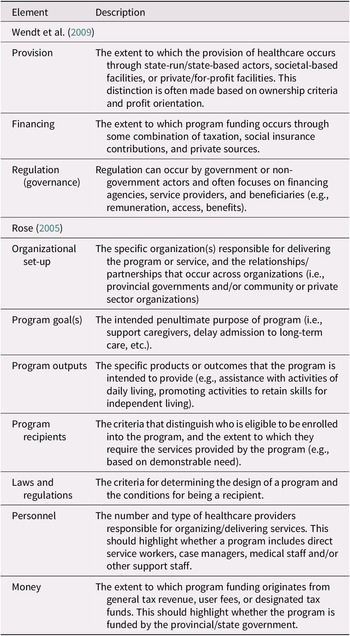
Some researchers have used either Wendt et al.’s (Reference Wendt, Frisina and Rothgang2009) Conceptual Typology for comparison or Rose’s (Reference Rose2005) ‘elements of a model’ to guide comparisons in healthcare. Key aspects of these frameworks are shown in Table 1. The scope and detail of these approaches vary considerably, and while using broad criteria can miss important details, highly specific criteria can overlook how exogenous forces (e.g., macro government policies) affect healthcare use (Zimmerman & Sloane, Reference Zimmerman and Sloane2007). Furthermore, Wendt et al.’s (Reference Wendt, Frisina and Rothgang2009) typology was designed for healthcare systems in general and does not provide details specific to care continuums. Likewise, Rose’s (Reference Rose2005) ‘elements of a model’ was developed for public policy programs and not specifically for healthcare systems. Building on this knowledge, we propose a typology that characterizes key structures and processes specific to care continuums.
Dimensions from select existing comparative frameworks

Table 1. Long description
The table is divided into two main sections based on the authors of the frameworks.
Section 1: Wendt et al. 2009
* Provision: The extent to which healthcare occurs through state-run, societal-based, or private facilities based on ownership and profit orientation.
* Financing: The extent to which funding occurs through taxation, social insurance contributions, and private sources.
* Regulation (governance): Focuses on financing agencies, service providers, and beneficiaries, managed by government or non-government actors.
Section 2: Rose 2005
* Organizational set-up: The organizations responsible for delivery and their partnerships across provincial, community, or private sectors.
* Program goal(s): The intended purpose, such as supporting caregivers or delaying long-term care admission.
* Program outputs: Specific products or outcomes like assistance with daily living or retaining independent living skills.
* Program recipients: Eligibility criteria and the extent of demonstrable need.
* Laws and regulations: Criteria for program design and recipient conditions.
* Personnel: The number and type of providers, including direct service workers, case managers, and medical staff.
* Money: Funding origins from general tax revenue, user fees, or designated tax funds, highlighting provincial or state government funding.
Theoretical framing, materials, and methods
Comparative research enhances our understanding of one system by examining key aspects of another to identify effective practices, avoid duplicating problems, and promote learning and idea sharing (Esser & Vliegenthart, Reference Esser and Vliegenthart2017). This process requires that the systems being compared are defined using a common language and framework. Typologies are well-established analytical tools for systematically organizing and classifying concepts across various dimensions, helping us to describe and compare care continuums. The main purpose of a typology is to identify, simplify, and organize constructs in ways that promote systematic comparisons (McKinney, Reference McKinney1969). The typology outlined in this article serves the same purpose – to identify and organize key aspects of care continuums in ways that facilitate more systematic comparisons both vertically (e.g., within a given sector across jurisdictions) and horizontally (e.g., across the sectors of a given care continuum), thus promoting information sharing and learning.
Our approach was guided by Collier et al.’s (Reference Collier, LaPorte and Seawright2012) key elements of a multidimensional typology. These authors propose that effective typologies should clearly define the constructs being measured (i.e., the main sectors of care continuums), demonstrate how these constructs can be defined using specific dimensions, and provide an organizational matrix that shows the relationships among typology components. Using these criteria, we developed and refined a typology using iterative stages of data collection and analysis based on well-established comparative research approaches (Freeman & Frisina, Reference Freeman and Frisina2010; Zimmerman & Sloane, Reference Zimmerman and Sloane2007). A team of researchers and healthcare planners created an initial version of the typology based on the foundational work of Wendt et al.’s (Reference Wendt, Frisina and Rothgang2009) Conceptual Typology for Comparison and Rose’s (Reference Rose2005) ‘elements of a model’. The first version was then refined and expanded through iterative consensus-building sessions held with a larger group of researchers and policy planners. Subsequently, we held a full-day workshop with additional researchers, policy planners, and community-dwelling older people to refine and finalize the typology.
Results
Phase 1: Typology development
Four researchers and two healthcare planners met several times over 6 months to review the goals and purpose of the typology, compare the types of care continuum services offered across selected Canadian regions, and discuss how existing academic knowledge could inform typology development. The first version of this typology included the following five dimensions.
-
1. Organizational structure: This dimension defines the services packaged into unique programs (sectors) along care continuums. While the team discussed several programs (e.g., respite and rehabilitation programs, day programs) that could potentially be compared, we agreed to curtail discussions and analyses to the core sectors of publicly governed care continuums (i.e., home-based services, various forms of assisted living, and nursing homes) to help simplify vertical and horizontal comparisons.
-
2. Care type: Unlike acute care services, which focus mainly on medical treatment, team members felt it was important to describe each care continuum sector by the type of care and supports provided. This includes efforts to promote independent living (such as assisting with activities of daily living, helping to shop for food and prepare meals), to strengthen social support (e.g., offering recreational programs), or to enhance medical care (e.g., through wound management or rehabilitation).
-
3. Care access: Consistent with the philosophy of aging in place that emphasizes extending community-based care options and delaying institutional care (Chatterji et al., Reference Chatterji, Byles, Cutler, Seeman and Verdes2015), team members felt it was important to define each care continuum sector by how quickly access to care is available. Healthcare planners used this dimension to distinguish between institutional care (e.g., nursing homes where care is usually accessible when needed) and community-based care (e.g., home-based services, certain congregate living settings, where care is scheduled and might take days to arrange).
-
4. Paid staffing: Team members created this dimension to define the number and type of frontline providers, including professionally designated staff (e.g., nurses) and non-professionally designated staff (e.g., care aides), working within care continuum sectors.
-
5. Funding: This dimension describes who pays for health and social care, and how (e.g., publicly with or without co-payments, or privately). Team members discussed how these different funding models and the presence or type of co-payments may impede effective horizontal transitions along care continuum sectors.
The initial group of researchers and healthcare planners presented the first version of the typology to a larger team of senior policy analysts and care continuum program managers (n = 4 people). Through a series of follow-up group meetings and one-on-one discussions over the next 2 months, we enhanced the initial typology by refining its dimensions (e.g., ensuring that all staff types were adequately represented). We also created five additional dimensions to capture key constructs that were not initially addressed. These include: (a) care focus, defining whether care was intended for the recipient or family/friend caregivers; (b) staff hiring and employment practices, documenting if paid staff were hired by the public system, contracted services, or directly by care recipients; (c) centralized admission processes, including the presence and types of criteria used to guide admissions and discharges; (d) audit and standard practices for monitoring structure, process, and outcome quality measures; and (e) the availability of registry and clinical data systems, like the Resident Assessment Instrument–Minimum Data Set (RAI-MDS 2.0), available in most of Canada (or its successor, the MDS 3.0, in the United States) (CIHI, 2012). At this stage, team members also recommended grouping the typology dimensions into related constructs, such as defining ‘care’ by its type, access, and focus. After this phase, the team felt the refined typology contained the necessary features to support comprehensive vertical and horizontal comparisons.
Phase 2: Refinement and content validation
A primary concern with typologies is the premature ‘freezing’ of dimensions without exposing them to a ‘goodness of fit’ test (McKinney, Reference McKinney1969). To help minimize this, and as the last consensus-building step, we presented and discussed the typology at a one-day workshop attended by a larger group of multidisciplinary researchers (n = 12), policy planners (n = 7), and community-dwelling older people (n = 6). At the time of this workshop, each research team member had 10+ years of experience investigating older-person healthcare reform, and collectively, our research team had expertise in epidemiology, analyses of administrative healthcare use databases, sociology, implementation science, qualitative research methods, palliative care, and including clinical scientists in the areas of primary care and geriatric medicine. Similarly, policy planners on our team had extensive (15+ years) policy and program experience in older person care and included executive and medical continuum-of-care directors from government and healthcare regions. Lastly, each community-dwelling expert had extensive experience as a family/friend carer and either had served or continued to serve in a formal capacity advocating for older-person healthcare reform (e.g., as Executive Directors of community organizations, as Patient Advisors on national advocacy groups). Workshop activities included both team-wide and small-group discussions to interrogate the overall value of the typology and its dimensions; clarify, streamline, and expand dimensions as needed; and identify typology gaps, including the need for additional dimensions.
Feedback from this workshop led to further subdivisions within the ‘funding’ dimension of the typology. This included establishing categories entitled (a) direct care funding to specify whether medical and/or social services are paid for publicly, privately, or through co-payment strategies; (b) client living costs to determine if and how much individuals must pay for living expenses like accommodation and meals; and (c) ownership type to identify whether care is provided by private for-profit, or public/private not-for-profit organizations, given the documented challenges in delivering quality care within some for-profit sectors (Geraedts et al., Reference Geraedts, Harrington, Schumacher and Kraska2016).
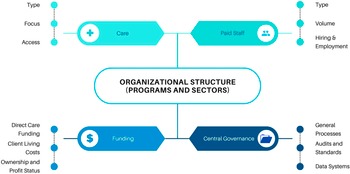
The final version of the typology is presented in Figure 1. It consists of 12 dimensions grouped into four overarching clusters labelled (a) care, which describes the type of services provided, the care recipient, and how services are accessed; (b) paid staffing, which describes provider type, volume, and hiring/employment practices; (c) funding, which describes how care is paid for and any additional client costs; and (d) central governance, which describes regulatory processes, audits and standards, and the availability of data monitoring systems. These four clusters can be applied to each organizational sector of care continuums (e.g., home-based services, assisted living, nursing homes) to promote both vertical (e.g., defining how a given care continuum sector differs across jurisdictions) and horizontal (e.g., defining facilitators or impediments to good transitional care from one sector to another across a given care continuum) comparisons.
Final Typology with Dimensions.

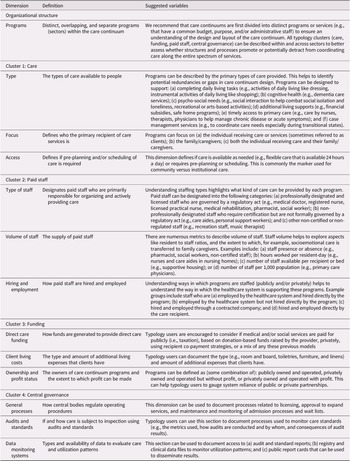
Table 2 provides conceptual ideas for operationalizing each typology dimension, including, in some instances, measurement examples. These variables were suggested during consensus-building consultations and are intended as building blocks to help guide typology enactment and future research directions.
Final typology details including variables that can be used to measure each dimension
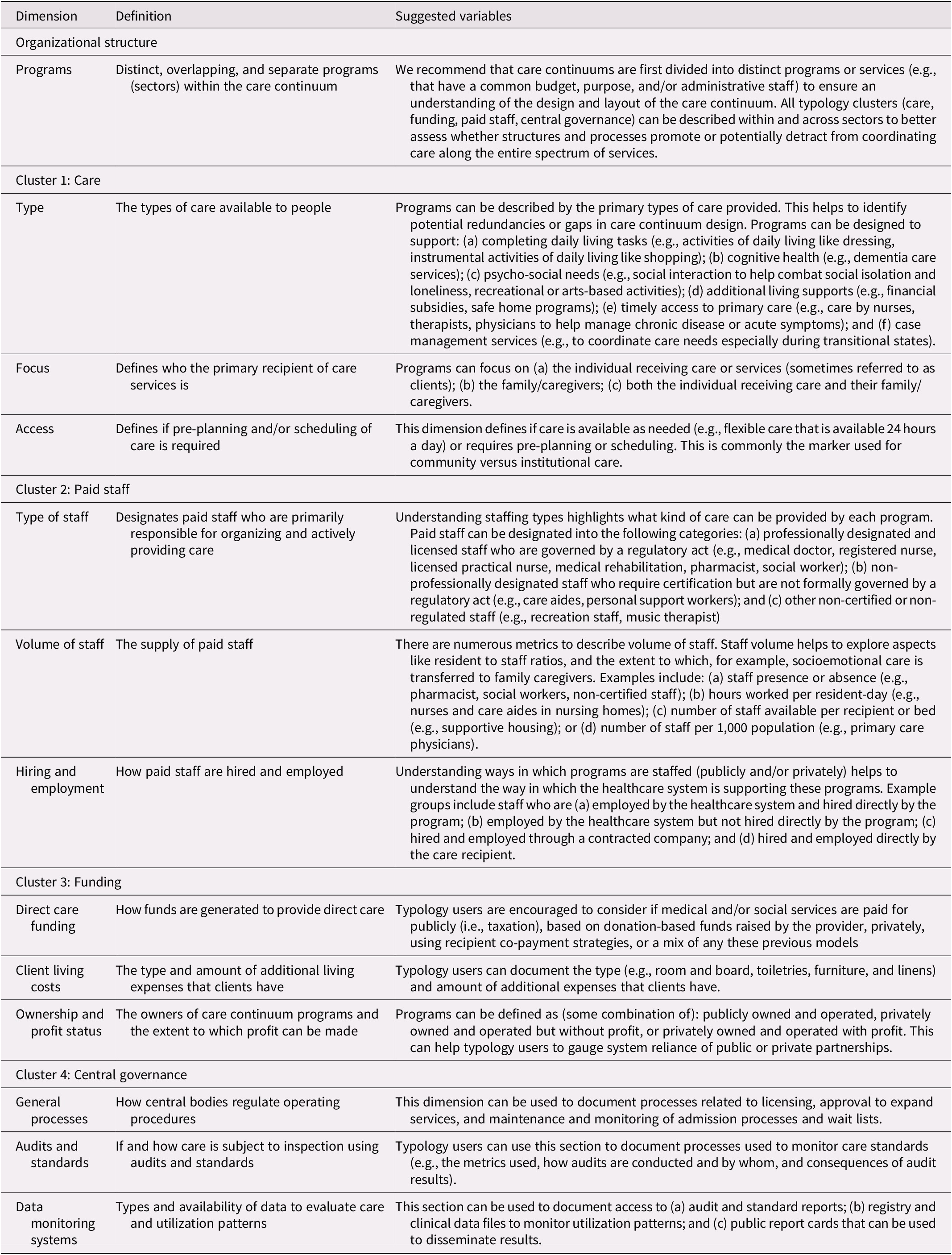
Table 2. Long description
The table is organized into three columns: Dimension, Definition, and Suggested variables. It is structured by an overarching category and four subsequent clusters.
Organizational structure:
* Programs: Defined as distinct or overlapping sectors. Variables include dividing continuums into services with common budgets or staff to assess coordination.
Cluster 1: Care:
* Type: Types of care available. Variables include daily living tasks, cognitive health, psycho-social needs, living supports, primary care, and case management.
* Focus: Primary recipient of care. Variables include the individual, family/caregivers, or both.
* Access: Requirement for pre-planning. Variables distinguish between flexible 24 hour care and scheduled care.
Cluster 2: Paid staff:
* Type of staff: Personnel responsible for care. Categories include licensed professionals (e.g., M D, R N), non-professionally designated certified staff (e.g., personal support workers), and non-regulated staff.
* Volume of staff: Supply of staff. Metrics include staff-to-resident ratios, hours worked per resident-day, or staff per 1,000 population.
* Hiring and employment: Employment models. Includes staff hired directly by programs, contracted companies, or directly by care recipients.
Cluster 3: Funding:
* Direct care funding: Generation of funds. Models include taxation, donations, private funds, or co-payments.
* Client living costs: Additional expenses. Includes room, board, and personal items.
* Ownership and profit status: Program owners. Categories include public, private non-profit, or private for-profit.
Cluster 4: Central governance:
* General processes: Regulation of operations. Includes licensing, service expansion, and waitlist monitoring.
* Audits and standards: Inspection methods. Focuses on metrics used for monitoring and the consequences of audit results.
* Data monitoring systems: Evaluation data. Includes audit reports, clinical registries, and public report cards.
Discussion
The shift towards care in the community (Arling et al., Reference Arling, Kane, Cooke and Lewis2010), trends in population aging (United Nations Department of Economic and Social Affairs [UN DESA], 2020), rising healthcare costs (Maresova et al., Reference Maresova, Javanmardi, Barakovic, Husic, Tomsone, Krejcar and Kuca2019), calls to improve the quality of care for older people (Harney, Reference Harney2023), and significant healthcare staffing and workforce challenges (Fick, Reference Fick2021) highlight the need to examine more systemically how continuums of care are organized and delivered. This article provides a typology that helps planners systemically map existing care continuum structures and processes, creates a common language to better identify promising practices and system inefficiencies, supports cross-jurisdictional comparisons and learning opportunities, and promotes evidence-informed reform that guides targeted improvements. It was developed in consultation with partners from two Canadian provinces (Manitoba and Alberta) and focuses solely on the core facets of care continuums (i.e., home-based services, various models of assisted living, nursing homes). We are thus positioning this typology as a ‘first step’ that will require further modification once applied to other care continuum programs (e.g., adult day programs) and healthcare jurisdictions.
Informed by the relevant literature (Rose, Reference Rose2005; Wendt et al., Reference Wendt, Frisina and Rothgang2009) and guided by comparative research methods, our typology (Figure 1 and Table 2) proposes that care continuums can be defined using four overarching clusters to describe how care is organized, staff are provided, funding is allocated, and whether centralized regulations and standards exist and how they are used. Dimensions within each cluster more richly define how services are made available to people (i.e., whether care needs to be scheduled, what type of care is provided, and to whom); describe the type, volume, and strategies used to hire and employee paid staff; assess direct care and client living cost funding structures; describe central governance processes including the presence and type of centralized admission guidelines, regulations, and standards (e.g., auditing); and define data systems available to profile residents and describe care quality.
The knowledge gained from this typology can be used to compare key features of a care continuum program (e.g., nursing homes) across jurisdictions, to examine potential gaps or impediments to care across programs within a given care continuum, and to help understand the more relational aspects of care (e.g., how governance processes influence staffing volume and types, which in turn influence care focus and processes). To illustrate, during our workshop, Manitoba partners used the typology to discuss the role of supportive housing in Manitoba’s care continuum. Participants noted that select government policies (central wait lists and admission criteria) helped ‘lower-need’ people to use supportive housing versus nursing homes. However, participants also noted that a lack of other government policies (e.g., unregulated client fees, a lack of care standards, and limited staff personnel) contributed to diverse supportive housing practices, potentially limiting how well this care sector contributes to Manitoba’s care continuum program, especially for some individuals (e.g., with lower income and few social supports). Examples of these challenges include diverse but generally high client fees, inter-facility differences in care packages and available services, a reliance on the Home Care Program for professional care, and a reliance on users to have family/friend caregiver supports.
Similarly, workshop participants used the typology to compare Manitoba’s Supportive Housing Program to the Continuing Care Home Type B (formerly known as Designated Supportive Living program) in Alberta – Edmonton Zone (ALA, n.d.). While both provinces have congregate care options other than nursing homes, participants discussed how these options differ considerably by their organizational structure, funding model, and staffing mix, underscoring the diversity of care continuum approaches. To illustrate, Manitoba has one level of Supportive Housing, while Alberta, at the time of the study, provided three levels of designated supportive living (i.e., levels 3, 4, and 4D [dementia]) (Alberta has recently refined and renamed these services to include two levels of Continuing Care Home [Type B and Type B Secure Space]) (ALA, n.d.). Further, while participants reported that client fees are unregulated in most Supportive Housing facilities and hence are higher than nursing home per diems in Manitoba, Continuing Care Home client fees are regulated and align with nursing home fees in Alberta. Lastly, study participants discussed how Supportive Housing provides onsite tenant staff who assist with meals, laundry, and light housekeeping, while Continuing Care Homes provide onsite scheduled and unscheduled personal care and support from Health Care Aides and Licensed Practical Nurses. In these ways, the typology can help move beyond differences in labels assigned to the various care continuum options, to define key structural and process similarities and differences, suggest future research directions (e.g., identify the healthcare use and clinical profiles of supportive housing versus designated supportive living clients), and identify policy reform ideas.
Strengths and limitations
Researchers have previously examined how individual typology dimensions vary across healthcare systems (e.g., by inspection and audit processes) (Ågotnes et al., Reference Ågotnes, McGregor, Lexchin, Doupe, Müller and Harrington2019; Choiniere et al., Reference Choiniere, Doupe, Goldmann, Harrington, Jacobsen, Lloyd, Rootham and Szebehely2016). Building on the existing literature, the present typology provides a mechanism for comparing care continuums using a multidimensional lens. It was created by an interdisciplinary team of researchers, healthcare planners, and community members with extensive knowledge about how care continuums are organized and navigated. It also incorporates many perspectives and voices to ensure a comprehensive comparative tool. Community members were particularly interested in comparing out-of-pocket costs within and across care continuums, and in defining how the reliance on family/friend caregiver support varies across care continuum sectors. Policy planners were particularly interested in better understanding the function and organization of the ‘middle’ care continuum options and how these may delay admission into nursing home care for different groups of people (e.g., those with and without family/friend supports).
Five potential limitations exist. First, the typology does not consider how exogenous forces (i.e., historical and cultural aspects of care) influence care continuum structures and processes. Second, engagement with community-dwelling older people did not occur in earnest prior to the team workshop, and, in retrospect, these partners should have been involved in earlier typology iterations. Third, to limit the complexity of our analyses, the typology was restricted to three care continuum programs (i.e., home-based services, middle-care options such as supportive housing, and nursing homes). Applying the typology to a broader array of care continuum programs (e.g., day programs, community senior centres) may expand the current typology dimensions. Similarly, our multidisciplinary team represents two Canadian jurisdictions and applying the typology to other Canadian and international jurisdictions is required to refine and expand its dimensions. This could include further defining care by its location (e.g., acute hospital versus community-based rehab centres) and intended duration (days, weeks, years). Fourth, the typology does not explicitly examine care transition processes despite the well-documented challenges associated with helping people successfully segue across diverse care settings and cultures (Zhang et al., Reference Zhang, Greig, Darton, Saloniki and Towers2024). Fifth, our typology dimensions were not developed using formal consensus-building techniques (e.g., Delphi Methods), and using this approach in future projects will help content-validate them (Niederberger et al., Reference Niederberger, Schifano, Deckert, Hirt, Homberg, Köberich, Kuhn, Rommel and Sonnberger2024). In the interim, the present and initial typology introduces a structured way to understand how care continuum programs and services are designed both within and across healthcare jurisdictions, as one means to help guide evidence-based healthcare reform and inter-jurisdictional learning.
Conclusion
Researchers, healthcare planners, and policy analysts regularly engage in data-gathering activities to inform ongoing care reform strategies. The typology outlined in this article provides an initial or ‘first step’ tool that helps to enable more systematic comparisons of care continuums, hence fostering a more structured approach to learning and information sharing. Insights gained from applying this tool can help prioritize future research topics and evaluate both the intended and unintended effects of various care continuum systems. Expanding or refining the typology can enhance its usefulness across a wider range of care continuum services and healthcare jurisdictions. Future research is thus required to apply this initial tool across (a) a broader range of continuing care programs and services (e.g., adult day programs, additional congregate housing options), (b) additional healthcare settings (e.g., other Canadian provinces, internationally), and (c) groups with additional perspectives and expertise, including frontline providers to understand the effect of belonging to a union, and diverse groups of older people that healthcare systems struggle to care for (e.g., immigrants including people who speak diverse languages, those who are isolated geographically or socially, older people with intellectual or developmental disabilities). These additional perspectives will help adjudicate the present typology value and continue to expand and refine its content.

 Open access

