Introduction
Wild oat (Avena fatua L.) is one of the top 18 most serious weeds in world agriculture (Holm et al. Reference Holm, Plucknett, Pancho and Herberger1991). Western Canadian crop producers spend more on herbicides for A. fatua control than on any other weed (Beckie et al. Reference Beckie, Francis and Hall2012). Avena fatua competition in wheat (Triticum aestivum L.) and lentils (Lens culinaris Medik.) can cause >80% and >60% yield loss, respectively, dependent on time of emergence, A. fatua density, and length of competition time with the crop (Curran et al. Reference Curran, Morrow and Whitesides1987; O’Donovan et al. Reference O’Donovan, de St Remy, O’Sullivan, Dew and Sharma1985). In addition, A. fatua has become resistant to more herbicide mechanisms of action than any other weed on the Canadian Prairies (Beckie et al. Reference Beckie, Thomas, Legere, Kelner, Van Acker and Meers1999; Heap Reference Heap2019). In western Canadian fields where A. fatua was found, post-herbicide management weed surveys indicated that over a very short time period, herbicide-resistant A. fatua increased from 15% (2001 to 2003) to 44% (2007 to 2009) (Beckie et al. Reference Beckie, Lozinski, Shirriff and Brenzil2013) to 69% (2014 to 2017) (HJ Beckie, personal communication). There are fields in central Alberta where the majority of A. fatua seeds collected several weeks after herbicide application are resistant to all major Group 1 (acetyl-CoA carboxylase inhibitor) and Group 2 (acetolactate synthase inhibitor) herbicides available to Alberta growers (AAF 2017; D Fedoruk, personal communication). Because no new major herbicide mode of action has been registered for more than 25 yr (Duke Reference Duke2012), there is an urgent need for new A. fatua management options other than herbicides.
Demographic modeling has suggested that A. fatua population growth rate is more sensitive to changes in the overwinter seedbank than it is to seedling survival (Tidemann et al. Reference Tidemann, Hall, Harker and Alexander2016). Focusing on seedbank inputs is an easier life cycle stage to target. Harvest weed seed control is a relatively new approach that attempts to reduce input into the weed seedbank as opposed to killing emerged A. fatua seedlings (Walsh et al. Reference Walsh, Newman and Powles2013). For example, the Harrington Seed Destructor effectively devitalizes more than 99% of A. fatua seed (Tidemann et al. Reference Tidemann, Hall, Harker and Beckie2017a; Walsh et al. Reference Walsh, Harrington and Powles2012).
Applying a selective herbicide to A. fatua in the reproductive stage (“crop topping”) has reduced A. fatua seed production (Medd et al. Reference Medd, McMillan and Cook1992). Late-season crop topping with nonselective herbicides was similarly effective on rigid ryegrass (Lolium rigidum Gaudin) seed production and seed viability (Gill and Holmes Reference Gill and Holmes1997; Steadman et al. Reference Steadman, Eaton, Plummer, Ferris and Powles2006; Walsh and Powles Reference Walsh and Powles2007). Nevertheless, opportunities to reduce A. fatua seed production or seed viability with herbicides before crop harvest in Canada have been unsuccessful due to nonsynchronous crop and weed timing, crop damage, and concerns with herbicide residues (Zhang et al. Reference Zhang, Johnson, Mueller and Willenborg2017) in the harvested crop seed.
For crop topping or harvest weed seed management to be effective, sufficient weed seed must be retained on the plant at management timing to be targeted and affected by the management treatment. Unfortunately, seed shatter begins early in A. fatua, and it loses too much of its seed (i.e., does not retain enough) to provide an opportunity to substantially reduce weed seed input into the seedbank (Beckie et al. Reference Beckie, Blackshaw, Harker and Tidemann2018; Burton et al. Reference Burton, Beckie, Willenborg, Shirtliffe, Schoenau and Johnson2016, Reference Burton, Beckie, Willenborg, Shirtliffe, Schoenau and Johnson2017; Shirtliffe et al. Reference Shirtliffe, Entz and Van Acker2000; Tidemann et al. Reference Tidemann, Hall, Harker, Beckie, Johnson and Stevenson2017b).
Differential morphology between A. fatua and grain crops, including common cereals (wheat and barley [Hordeum vulgare L.]), oilseeds (canola [Brassica napus L.]), and pulses (peas [Pisum sativum L.] and lentils) in western Canada, may allow for an alternative method to reduce A. fatua seed input into the seedbank. As A. fatua develops, the panicles emerge above many crop canopies and could potentially be mechanically cut (clipped). However, the viability of A. fatua seed at the time of panicle extension above crop canopies is not known. Should clipping treatments be completed before A. fatua seeds become viable, this could be an effective tool for reducing input of A. fatua into the seedbank. We are not aware of research reporting mechanical clipping of A. fatua panicles in western Canadian cropping systems. The objective of this study was to determine the viability of A. fatua seed at successive time intervals after elongation above a wheat or lentil crop canopy. We hypothesized that panicle clipping would be less effective with increased time after panicle extension above the crop canopy and that it would be more effective in shorter-statured lentil than in wheat. The likelihood of earlier clipping opportunities in lentil versus wheat should allow clipping access to full panicles and prevent A. fatua seed maturity and viability.
Materials and Methods
Experiments were conducted in 2015 and 2016 at Lacombe, AB (52.5°N, 113.7°W), and Saskatoon, SK (52.1°N, 106.3°W) on clay loam black chernozem and silty clay loam dark brown chernozem soils, respectively. Before crop seeding, glyphosate (900 g ae ha−1) was applied to the experimental sites to control weeds. Spring wheat (‘AC Harvest’) was seeded at 300 seeds m−2 and lentil (‘CDC Dazil’) at 140 seeds m−2 in 25-cm rows at a depth of 2 cm with a disk seeder (Fabro Enterprises, Swift Current, SK, Canada) in Saskatoon; an air seeder with knife openers was used (Conserva Pak, Indian Head, SK, Canada) in Lacombe. At both locations, crops were seeded in mid-May in conservation tillage plot areas where A. fatua seed had just been broadcast on the soil surface (200 seeds m−2). Soil samples were collected at each site before seeding and analyzed for soil nutrients. On the basis of soil analyses, fertilizer (N, P2O5, K2O) was mid-row banded at a depth of 3 to 4 cm according to soil test recommendations. Small amounts of nitrogen and phosphorous (30 kg ha−1 of 11-51-0) were also placed directly with crop seeds. Metribuzin at 204 g ai ha−1 was applied in both crops for broadleaf weed control. Any surviving weeds other than A. fatua were hand weeded. Monthly precipitation and temperature data were collected from weather stations near each experimental site.
The experimental design was a split plot with four replications. Crops (wheat and lentil) served as main plots and clipping times as subplot treatments. Subplot dimensions were 2 by 6 m. Plots were seeded to accommodate up to six weekly clipping times; the first clipping time occurred when several A. fatua panicles were visible above the respective crop canopies, while the last clipping occurred when seed shed began. A no-clipping treatment (untreated check) and a treatment combining the first and last clipping times were also included for a maximum of eight possible subplot treatments. Over the study, different environmental conditions between locations and years led to differ maturation rates for the crops and A. fatua. As a result, the number of weekly clipping timings based on A. fatua stage ranged from three to six. Clipping in this study was completed via hand clipping with hand shears immediately above the crop canopy to ensure all panicles could be collected.
Data Collection
Crop emergence counts in the second and third replications (2 rows by 1 m) were completed 1 wk after visible crop rows were apparent (approximately 2- to 3-leaf wheat, 3- to 4-node lentils). After A. fatua emergence, A. fatua density was determined by counting plants in 0.5-m2 quadrats at the front and back of each plot. Before panicle clipping, lentil height and wheat height were measured at the front and back of each plot. Lentil height was measured to the uppermost node, while wheat height was measured to the top of the spike, excluding awns. Two A. fatua height measurements were also made at the front and back of each plot. First, the distance from the soil surface to the lowest spikelet was determined. Second, canopy height (distance to top of A. fatua panicles) was also determined (usually the top of the uppermost spikelet, but sometimes the highest point of a bent panicle). When clipping with hand clippers (full and partial panicles above respective crop canopies), panicles were held and collected rather than allowing them to fall to the ground. Panicles were clipped and removed from the entire plot. All collected panicles from a plot were divided into two equal samples. From one sample, awn angle was determined with a protractor from 25 randomly selected seeds by recording degrees from the longitudinal axis of the floret relative to proximal axis of each awn. From the other sample, seed biomass was determined as a fresh weight. The seed biomass was then dried in an air and heat drier at 70 C and weighed after the weight stabilized. The difference between these two biomass weights was used to calculate the moisture content of the sample. At crop maturity, the entire plot was harvested with a plot combine, and seed moisture and seed yield were recorded. Avena fatua seed was separated from an approximately 1-kg sample of the harvested crop to determine percent A. fatua dockage. Avena fatua seed viability was determined through germination of 25 seeds per plot from the original clipped panicle samples in 16.6 by 24.1 by 4.4 cm germination boxes with blue blotter paper (Seedburo Equipment, Des Plaines, IL, USA) on the bottom and Ahlstrom 601 white filter paper (Fischer Scientific, Ottawa, ON, Canada) on top to ensure moisture levels were maintained. Distilled water was added so that some free water was available initially and at each counting. Seeds were allowed to germinate in the dark at room temperature (~22 C) for 2 wk and were checked for germination every 2 to 3 d, at which time germinated seeds were removed and recorded as viable. Seeds were evaluated as germinated once a visible radicle was produced. Seeds that did not germinate in the 2-wk time frame were subjected to a press test to determine integrity of the seed (Sawma and Mohler Reference Sawma and Mohler2002); if the seed was structurally sound and the embryo looked healthy, the seeds were deemed viable, whereas if the seeds were empty or decayed, they were deemed unviable.
Statistical Analysis
An ANOVA was conducted using the GLIMMIX procedure in SAS v. 9.4 (SAS Institute, Cary, NC, USA) for yield and A. fatua density, with location, crop, clip timing, location*crop, location*clip timing, and crop*clip timing as fixed effects and replicate nested in location and year as a random effect. A β-spline regression in PROC GLIMMIX was used to determine the effect of clip timing by Julian date on A. fatua seed viability, A. fatua seed moisture, A. fatua awn angle, A. fatua dockage, the height of the lowest A. fatua spike, and the height of the A. fatua canopy. This model allowed the flexibility necessary to accurately represent the data while also managing variability in the data. The β-spline with 2 knots yielded better fit (lesser Akaike information criterion model fit criterion) compared with a 3-knot model. The 2-knot model also provided a smoother fit than the 3-knot model. Fixed effects for the β-spline regression included crop and the spline*crop interaction. Replicate nested in location and year and replicate by main plot random effects were included with the β-spline regression analysis. Results were summarized across the location and year combinations to simplify the interpretation and broaden the inference space. Clipping times varied over years and locations due to clipping based on A. fatua stage not calendar date, differences in rate of maturity between years and locations related to growing season weather, and differences in relative heights of crops and weeds between years. As a result, five Julian dates were selected to allow comparison of responses for A. fatua grown in two different crops across the range of clip timings.
Results and Discussion
Weather
Lacombe in 2015 experienced relatively normal temperatures, but a relatively dry spring (April to June) (Figure 1). With above-average precipitation in July, overall precipitation for the growing season was close to the long-term average (97% of the long-term average; long-term average = 377.4 ml from April through September). In 2016, the growing season was significantly warmer than is typical, particularly in April. Limited precipitation in June was balanced by higher than normal precipitation in May and July, leading to an overall growing season of near-normal precipitation (107% of long-term average). Saskatoon experienced four straight months of below-normal precipitation in 2015, combined with above-average temperatures in June and July, resulting in drought conditions. In 2016, both precipitation and average temperature were closer to the long-term average. Aside from the drought in Saskatoon in 2015, growing conditions were generally good for the study.
Monthly growing season precipitation (circles) and temperature (bars) deviation from long-term averages (1981–2010) at Lacombe and Saskatoon in 2015 and 2016. Precipitation or temperature deviations ≥ 50 mm or 2 C have filled circles or bars, respectively.

General Crop and Avena fatua Growth Patterns
Both A. fatua and crop populations established well. There was no significant difference in A. fatua populations between lentil and wheat plots (P = 0.104). On average, there was greater A. fatua emergence in 2016 than in 2015 (106 vs. 41 m−2), and it was generally greater at the Saskatoon location than in Lacombe (data not shown). Differences between A. fatua emergence over years is likely related to early growing season weather being more ideal in 2016 for A. fatua establishment, in particular the precipitation received in May (Figure 1). Lentil crop density averaged 96 plants m−2, and wheat density averaged 188 plants m−2 (data not shown). Clipping in lentil was initiated between Julian dates of 187 and 195 (July 5 to 14). Clipping in wheat began between Julian dates 187 and 202 (July 5 to 21). The latest clipping date in both crops was Julian date 230 (August 14, 2016). Generally, A. fatua panicles were visible above the lentil crop canopy earlier than in the wheat due to the lower height of lentil (see section “Avena fatua and crop height”).
Avena fatua Seed Viability
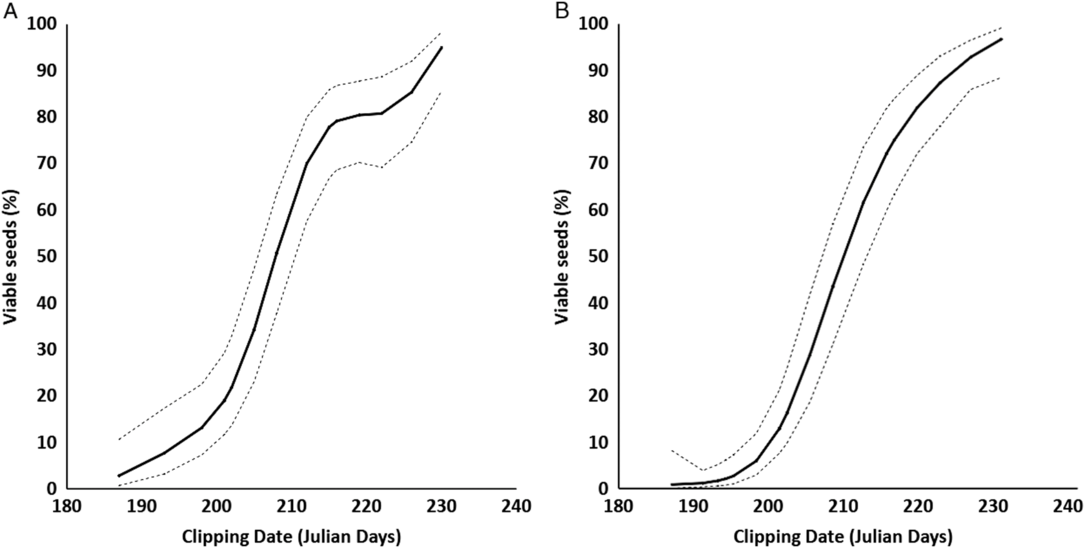
There was a significant interaction of the spline coefficient and crop type (P < 0.001); as a result, A. fatua seed viability across increasing Julian dates is presented by crop. As expected, A. fatua seed viability increased in both crops as Julian dates progressed and crop and weeds matured (Figure 2A and B). Avena fatua showed a less variable increase in viability across Julian dates in lentil; however, regardless of crop, approximately 95% viability of A. fatua was measured by the final clipping date when seeds were beginning to be shed (Figure 2). Considering the earliest clipping occurred on a Julian date of 187 (around July 5), between 0% and 10% of the A. fatua seeds were viable when clipping first became an option, typically in early July. At the latest clipping time (Julian date 230, August 14), the majority of seeds in the panicle would be viable and could add to the overwintering seedbank and propagate the A. fatua population. Thill et al. (Reference Thill, O’Donovan and Mallory-Smith1994) suggested that A. fatua should be rogued near the heading stage before viable seeds are produced; our data suggest that in order to preclude viable seed production, clipping A. fatua panicles or roguing should be done very soon after A. fatua panicles emerge above the crop canopy, or as early as the flag leaf–boot stage in a shorter-statured crop such as lentil. It is possible that with such early clipping A. fatua would regrow or tiller and still set seed; this was not tested in our study.
Avena fatua viability based on a 2-knot β-spline regression for clipping date averaged across site-years. (A) Avena fatua viability after growing and being clipped from wheat. (B) Avena fatua viability after growing and being clipped from lentil. Dotted lines indicate the 95% confidence interval, while the solid line indicates the mean.

Avena fatua Seed Moisture
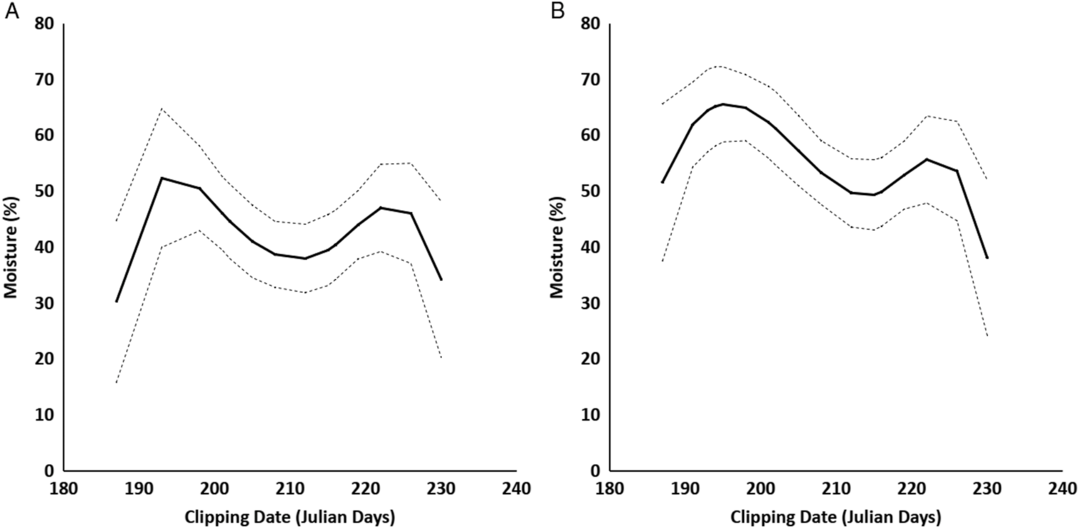
There was a significant interaction of spline coefficient and crop type (P = 0.001) on A. fatua seed moisture, so data are presented separately by crop. Avena fatua seed moisture initially increased with an increase in Julian date (Figure 3). While initially surprising, this may be the result of the initiation of the seed-filling stage in the plant. Subsequently, moisture begins to decline followed by a secondary spike in moisture at a clipping Julian date of 225 (mid-August) (Figure 3). This is likely correlated to the emergence of less mature panicles from tillers and the subsequent initiation of seed filling. Seed moisture then sharply declines to the last clipping date as the main stem panicles begin to desiccate and initiate seed rain and the tiller panicles begin to mature (Figure 3). Avena fatua seed moisture tended to be higher when removed from lentil plots than from wheat plots, until closer to the final clipping (Figure 3). This may be because more tiller panicles were available for clipping in the lentil plots, providing an increased amount of immature, and therefore higher-moisture, seed. The relationship of moisture and Julian date does not closely resemble the relationship of A. fatua seed viability and Julian date, indicating that measurement of seed moisture alone will not be sufficient to indicate seed viability and whether or not clipping is a realistic option to reduce A. fatua population growth rather than aid it.
Percent moisture of Avena fatua from panicle emergence to beginning of seed shed, based on a 2-knot β-spline regression averaged across sites and years. (A) Avena fatua seed moisture when clipped and removed from wheat. (B) Avena fatua seed moisture when clipped and removed from lentil. Dotted lines indicate the 95% confidence interval, while the solid line indicates the mean.

Avena fatua Awn Angle
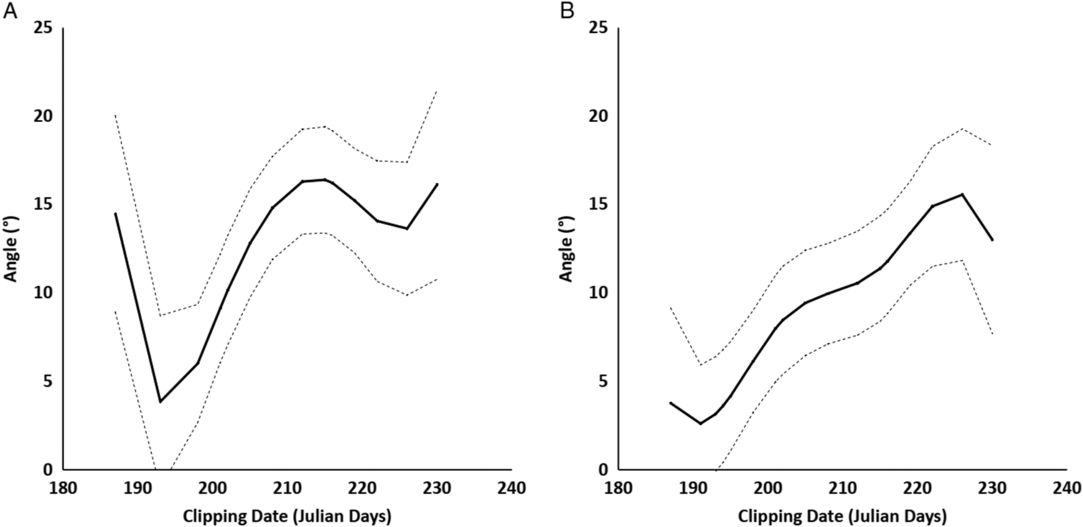
The spline by crop interaction was significant for A. fatua awn angle (P < 0.001). The general trend is for A. fatua awn angle to increase as Julian date increases, with the awn angle increasing faster in wheat than in lentil (Figure 4). There is a drop in average angle toward the end of the clipping timing in both crops (Figure 4). This may be due to seeds from less mature tillers being included or the effect of moisture or precipitation around the clipping timing. The greater awn angles at the beginning of the clipping times is unclear; this may be an artifact of the analysis or variability in the initial measurements of awn angle, as it is a nontraditional measurement. There were some higher angles (~20°) measured at the first clipping timing in Saskatchewan in 2016 that may also have contributed to the initial greater angles; this may be due to an early flush of A. fatua that began maturing earlier than in the other plots. While the general response of awn angle is similar to that of A. fatua viability, small differences in awn angles (15° range) are equivalent to a 95% change in viability. The awn angle average never approached the 90° angle that we typically associate with mature A. fatua seeds. Therefore, measuring awn angles is unlikely to prove to be a useful tool for producers to estimate the viability of A. fatua seeds when considering clipping as a management technique.
Avena fatua awn angle based on a 2-knot β-spline regression at the time of clipping averaged across sites and years. (A) Awn angle from Avena fatua removed from wheat. (B) Awn angle from Avena fatua removed from lentil. Dotted lines indicate the 95% confidence interval, while the solid line indicates the mean.

Crop Yield and Dockage
Unsurprisingly, there was no effect of clipping A. fatua panicles on crop yield (P = 0.074). The largest impact of weed competition on crop yield is typically very early in the season (Harker et al. Reference Harker, Blackshaw and Clayton2001; Smitchger et al. Reference Smitchger, Burker and Yenish2012); the late implementation of panicle clipping likely occurs after the most significant competition between weed and crop occurs and results in limited removal of leaf biomass. While clipping did not affect the in-season crop yield, it has the potential to affect the yields of subsequent crops through management of the weed seedbank inputs and, therefore, populations that will compete with subsequent crops. Yield was also not affected by location, year, or any of the interactions of the fixed effects (P > 0.05).
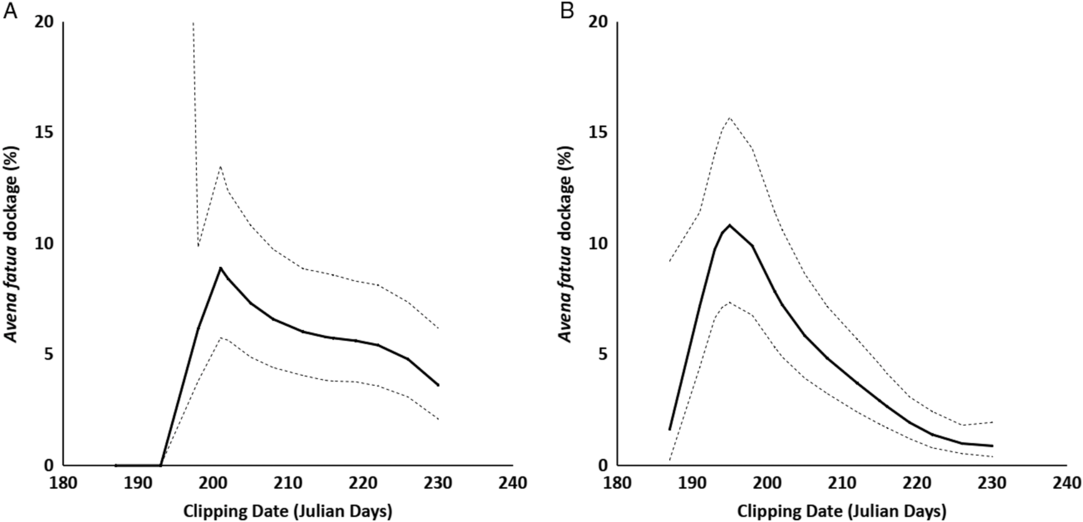
The spline by crop interaction was again significant (P < 0.001) for A. fatua dockage (Figure 5). The highest level of A. fatua dockage in wheat occurred with clipping times near Julian date 200 (July 18 to 19), while in lentil it occurred near Julian date 195 (July 13 to 14) (Figure 5). The Avena fatua dockage pattern is interesting, as it first increases and then decreases (Figure 4). Our initial hypothesis was that A. fatua dockage would increase with clipping at later dates, as later clipping would mean later regrowth, and thus more seeds retained on the plant when crops were harvested. It is unclear whether the decrease in dockage is due to more seeds being removed via clipping or more limited regrowth by plants subjected to clipping at a more mature stage or simply less seed retention and earlier maturity in the clipped plants than anticipated. In comparison to the unclipped plots (~6.2% and 5.7% dockage in wheat and lentils, respectively; data not shown), dockage was increased at approximately the clipping at Julian date 200 (July 18 to 19) in wheat and 196 (July 14 to 15) in lentil. This suggests that the initial increase in dockage is due to increased seed retention following regrowth in the earlier clipping treatments, and then less seed production at the later clipping dates, although this cannot be confirmed.
Percent Avena fatua dockage after clipping was implemented at various Julian dates, based on a 2-knot β-spline regression averaged across sites and years. (A) Avena fatua dockage after clipping treatments in wheat. (B) Avena fatua dockage after clipping treatments in lentil. Dotted lines indicate the 95% confidence interval, while the solid line indicates the mean.

Avena fatua and Crop Height
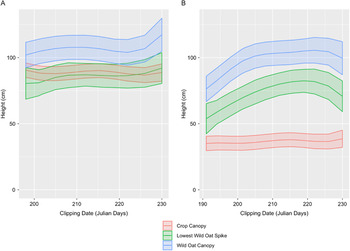
Avena fatua panicle availability for clipping was unsurprisingly more limited in wheat (Figure 6A) than in lentil (Figure 6B). At the initial clipping timing, average A. fatua canopy height was just above the wheat canopy; based on a typical gaussian curve, there would have been some panicles above the crop and some below, resulting in an average height slightly above the crop canopy. The lowest A. fatua spikelet was not available for clipping until Julian date 225 (August 12 to 13) and then was just above the crop canopy; any method aside from hand clipping panicles would present challenges for cutting the lowest spikelet without injuring the crop. Clipping efficacy in wheat may therefore be limited, because some of the panicles will not be above the crop canopy at clipping times before A. fatua seeds become viable. Over the entire clipping period, the A. fatua canopy was above the wheat canopy, but the lowest spike tended to remain within the canopy range (Figure 6A). In lentil, the entire A. fatua panicle was above the crop canopy for the entire clipping period (Figure 6B). In this study, clipping only occurred at panicle emergence; however, the A. fatua plant was above the lentil canopy and available for clipping even at earlier stages in lentil. Therefore, it may be possible to have even greater effect on A. fatua seed set through earlier clipping. Panicle regrowth would need to be monitored carefully, and it is possible that multiple clippings may be required to fully manage seed production. Shorter crops such as lentil provide far more opportunities for clipping management of A. fatua than taller crops such as wheat (Figure 6).
Avena fatua panicle availability when growing in (A) wheat and (B) lentil from panicle emergence to the initiation of seed shed, based on a 2-knot β-spline regression. For each variable, the center line indicates the average and the shaded area surrounding the line indicates the 95% confidence interval.

Overall, A. fatua seed from early panicle clipping had low viability, indicating that further investigation into panicle clipping as a management strategy is warranted. However, the amount of panicle that can be clipped may be limited in taller crops such as wheat due to a limited height differential. In addition, it will be necessary to clip very early after panicle emergence to limit the inputs of viable seeds into the seedbank. In this study we were assuming that viable seeds at panicle clipping would lead to viable weed seedbank inputs; however, seeds that are exposed to the soil surface from early panicle clipping also have a longer exposure period to microbial decay or predation (Kulkarni et al. Reference Kulkarni, Dosdall and Willenborg2015), which may decrease the impact of these viable seeds on seedbank additions. It will be important to quantify the addition of viable seeds into the seedbank and to monitor future populations to fully understand the effects that clipping may have on A. fatua management.
Several equipment manufacturers have begun selling weed-clipping machines, even though optimal implementation is still being researched. The CombCut (Just Common Sense, Karlskrona, Sweden) is a stationary knife clipping machine that has been developed in 6- and 8-m widths (Just Common Sense 2019). It can be used for selective clipping of broadleaf weeds in cereal crops or of any weeds that are accessible above a crop canopy (Just Common Sense 2019). The BTT Weed Clipper (Bourgault Tillage Tools, St Brieux, SK, Canada), is more than 15-m wide, PTO driven, and made of mower blades to clip weeds above crop canopies (Weed Clipper 2019). The Weed Surfer (CTM Root Crop Systems, Harpley, Norfolk, UK) is another example of machinery manufactured specifically for clipping of weeds for weed management. Producers have also been innovative and developed their own versions of weed clippers by modifying swathers or windrowers. Organic producers in particular have shown interest in this method of weed control; however, conventional producers may also be interested in using this methodology to manage herbicide-resistant weeds. Therefore, research into seed viability and timing of clipping is crucial to allow the adoption of this method of weed management to continue.
Clipping A. fatua as a management practice is far more efficient and practical in short-statured crops such as lentil, as the entire panicle is above the crop canopy. While you can clip some of the seeds in taller-statured crops, you cannot effectively remove the entire A. fatua panicle. Cultivar choice of generally shorter-statured crops may be important to optimize the ability to clip A. fatua panicles. Clipping must be done soon after panicle emergence to prevent the production of viable seed, although plant regrowth may limit the overall impact on seedbank inputs. Additional research into the effects of clipping on subsequent A. fatua populations are necessary.
It is time to seriously consider preserving herbicide efficacy (Davis and Frisvold Reference Davis and Frisvold2017) by developing much more diverse weed management strategies (Owen Reference Owen2016). Combining these strategies with other integrated weed management techniques (Liebman and Gallandt Reference Liebman, Gallandt and Jackson1997) in integrated cropping systems (Davis et al. Reference Davis, Hill, Chase, Johanns and Liebman2012) could increase the sustainability of our cropping systems in the face of herbicide resistance. Early clipping of A. fatua panicles before seeds are viable, in short-statured crops, may be a valuable tool for integrated A. fatua management strategies.
Acknowledgments
We acknowledge technical support from L. Michielsen, P. Reid, E. Sroka, and J. Zuidhof. We also appreciate technical support from A. Syrovy, H. Duddu, and S. Campbell. We thank F. C. Stevenson for his assistance with the statistical analysis. We are grateful to B. Hennig for her assistance in creating Figure 6. Funding for this project was provided by Alberta Crop Industry Development Fund. No conflicts of interest have been declared.