Introduction
Flexible employment has been on the rise in advanced capitalist democracies. Since the 1980s, both left- and right-wing governments have contributed to the expansion of non-standard employment by relaxing the rules on fixed-term contracts and temporary work agencies, especially in countries with high restrictions in the past (King and Rueda, Reference King and Rueda2008; Beramendi et al., Reference Beramendi, Häusermann, Kitschelt, Kriesi, Beramendi, Häusermann, Kitschelt and Kriesi2015: 11). These developments have been predominantly studied by the dualization literature, according to which flexibilization is enabled by targeting politically weak groups of labor market ‘outsiders’ (temporary workers, long-term unemployed, involuntary part-time workers) while protecting the privileged position of ‘insiders’ in standard employment (Rueda, Reference Rueda2005, Reference Rueda2007; Palier and Thelen, Reference Palier and Thelen2010; Emmenegger et al., Reference Emmenegger, Häusermann, Palier, Seeleib-Kaiser, Emmenegger, Häusermann, Palier and Seeleib-Kaiser2012). Recently, the dualization literature has introduced more fine-grained distinctions between insiders and outsiders based on unemployment risk (Schwander and Häusermann, Reference Schwander and Häusermann2013; Marx and Picot, Reference Marx and Picot2020; Vlandas, Reference Vlandas2020). Still, all these approaches conceptualize insiders as a homogenous group in secure employment, whose position should hardly be affected by flexibilization ‘at the margins’.
This crucial premise behind the dualization literature has been contested. Case studies, often focusing on Germany, have highlighted that precarious employment conditions can have adverse repercussions on core workers (Streeck, Reference Streeck2010; Eichhorst and Marx, Reference Eichhorst and Marx2011; Benassi and Dorigatti, Reference Benassi and Dorigatti2015; Benassi, Reference Benassi2016; Bosch, Reference Bosch2018). Comparative studies have associated the deregulation of non-standard employment with lower labor shares (Deakin et al., Reference Deakin, Malmberg and Sarkar2014; Damiani et al., Reference Damiani, Pompei and Ricci2018) and rising income inequality (OECD, 2015: ch. 4; Vlandas, Reference Vlandas2018). A recent study of 13 European countries from 2003 to 2010 found that temporary employment had large ‘knock-on effects’ on permanent workers’ wages (Bellani and Bosio, Reference Bellani and Bosio2019). Taken together, these studies cast doubt on core assumptions of the dualization literature, but they do not yet provide a framework why flexibilization should leave some insiders better-off than others. If flexibilization is associated with wage inequality, it is not clear whether and why flexibilization adversely affects workers at the bottom, middle or top of the wage distribution.
Against this background, this paper explores how the deregulation of non-standard employment affects wage inequality among labor market insiders, and whether it negatively affects the position of specific groups of insiders. I argue that flexibilization at the margins exposes insiders to a set of wage-related risks, including low-wage competition, job replacement, and adverse long-term income prospects. Specifically, I hypothesize that these risks vary across income groups and create downward wage pressure on low-income and middle-income insiders. First, insiders in the lower- and middle-income classes are under pressure to defend their wage levels in competition with lower-paid workers on non-standard contracts. Second, low- and middle-income insiders are typically lower-skilled compared to high-income groups, increasing their replacement risks. Third, the skills disadvantage of low- and middle-income insiders compared to some high-skilled outsiders, who use flexible employment for their career advancement, threatens long-term wage prospects. The unequal distribution of these wage risks explains how the trend towards non-standard employment results in varying degrees of wage pressure on insiders. At the macro level, this leads to the expectation that both levels and changes of non-standard employment deregulation are associated with systematic variation in insiders’ wage shares.
I test this argument using Luxembourg Income Study earnings data for 22 OECD countries between 1985 and 2016. Flexibilization ‘at the margins’ is operationalized using an indicator for the deregulation of temporary employment. This approach seeks to capture dualization at the macro level of policies and is especially well-suited to study trends in dualization in the context of a general liberalization process (Busemeyer and Kemmerling, Reference Busemeyer and Kemmerling2020: 377-378). Apart from temporary employment regulation, other policies also matter for dualization: employment protection for permanent contracts (EPL) is the most prominent example. However, changes in EPL over time have been extremely limited, while many countries have moved towards more deregulated temporary employment since the 1980s (Beramendi et al., Reference Beramendi, Häusermann, Kitschelt, Kriesi, Beramendi, Häusermann, Kitschelt and Kriesi2015: 11). Hence, focusing on temporary employment deregulation allows the analysis to leverage variation within countries over time.
The findings show that flexibilization at the margins is associated with increasing wage inequality among insiders, by reducing the wage share of insiders at the bottom and, more strikingly, the middle of the wage distribution. Wage gains from deregulated non-standard employment exclusively benefit top-income insiders. These results hold in a dynamic perspective with fixed effects models focusing on changes within countries; and they hold across a variety of contexts in terms of union density and EPL for permanent contracts.
Overall, these findings imply an important qualification of the dualization literature: rather than pitting insiders against outsiders, flexibilization ‘at the margins’ seems to exacerbate divides among different groups of insiders. Unless wage inequality is taken into account, insider-outsider frameworks based on employment security are likely to dramatically overestimate the homogeneity of the position of labor market insiders. Even if fine-grained measures to distinguish insiders and outsiders are used, insiders with low unemployment risks are still likely to be affected by divergent wage trajectories. Hence, these findings question whether insiders in secure employment can be seen as a coherent actor in the arena of labor market reforms and electoral politics (e.g. Marx, Reference Marx2015; Picot and Menéndez, Reference Picot and Menéndez2017; Schwander, Reference Schwander2020; Häusermann et al., Reference Häusermann, Kemmerling and Rueda2020).
Theory
The dualization literature uses two main approaches to distinguish between insiders and outsiders in the labor market: status-based and occupational risk approaches (see Rovny and Rovny, Reference Rovny and Rovny2017; Marx and Picot, Reference Marx and Picot2020; Vlandas, Reference Vlandas2020). The status-based approach divides labor into two groups based on their labor market status. Following Rueda (Reference Rueda2007), insiders are workers in secure jobs with permanent full-time contracts, while outsiders are often unemployed or holding non-standard contracts. Others have distinguished specific types of non-standard workers, such as temporary workers (Vlandas, Reference Vlandas2013; Marx, Reference Marx2015). The second approach distinguishes outsiders based on their occupational risk. Workers in occupations with high levels of unemployment or non-standard employment are conceptualized as outsiders (Schwander and Häusermann, Reference Schwander and Häusermann2013). The occupational unemployment approach gives a more fine-grained and realistic picture away from the ideal-typical dichotomy between insiders and outsiders (Busemeyer and Kemmerling, Reference Busemeyer and Kemmerling2020: 376-377). Arguably, however, the two approaches should be seen as ‘complementary rather than substitutes’ and are associated with similar policy preferences (Vlandas, Reference Vlandas2020: 363).
According to the dualization literature, flexibilization at the margins should affect labor market outsiders much more than insiders. ‘Flexibilization at the margins’ refers to the process of relaxing restrictions on non-standard employment. This encompasses work arrangements that deviate from the norm of ‘standard employment’ with unlimited contract duration, obligations for social contributions and legal protections against dismissal. Such jobs are disproportionally held by outsiders. However, in the following section, I argue that flexibilization at the margins has unequal consequences on the wage position of insiders – no matter whether insiders are defined as workers with permanent full-time contracts (status-based approach) or workers in occupations with low unemployment and atypical employment.
To assess how flexibilization at the margins can affect insiders across different income groups, I argue that flexibilization exposes insiders to a set of wage risks that are concentrated among low- and middle-income insiders and lead to wage pressure on these groups. More specifically, I discuss three mechanisms by which specific wage risks – low-wage competition, job replacement and adverse income prospects – can contribute to wage pressure on low- and middle-income insiders.
The first mechanism contributing to wage pressure on insiders is low-wage competition. It can arise when insiders are threatened by the possible expansion of workers with non-standard contracts competing on lower wages. The wage penalty in temporary employment is well established (OECD, 2015: 135-198); empirical estimates show that wages in permanent employment exceed those in temporary employment between 7% (UK) and 45% (Sweden) (Boeri, Reference Boeri, Ashenfelter and Card2011: 1202). While the dualization literature assumes that insiders and outsiders do not directly compete with each other (Palier and Thelen, Reference Palier and Thelen2010: 122), these wage differentials give rise to indirect competition, whereby a deregulated environment of non-standard employment makes it more likely to increase wage pressure on insiders with wages above those of outsiders.
This appears to apply especially to insiders in the middle of the earnings distribution, which are at risk of substantial wage losses given the significant average earnings gap between insiders and outsiders. In contrast, at the bottom and the top end of the distribution, low-wage competition might be somewhat more muted. At the bottom end, the wage gap between low-income insiders and outsiders is likely to be smaller in absolute terms, limiting the scope for wage underbidding. At the top end, it is unlikely that outsiders can achieve insiders’ level of top salaries in non-standard contracts, so the scope of competition between insiders and outsiders is indeed limited for top earners. Thus, high-income insiders are unlikely to be affected by low-wage competition.
A second mechanism contributing to wage pressure is job replacement, which concerns the incentives for employers to replace permanent workers by temporary workers. A large literature has identified workers’ skill profiles as the main determinant of replacement risks (Goldthorpe, Reference Goldthorpe2000: 206-229; Emmenegger, Reference Emmenegger2009; Eichhorst and Marx, Reference Eichhorst, Marx, Eichhorst and Marx2015). Low-skilled workers typically perform tasks that require little investment in training or education, which are easy to substitute. Hence, low-skilled jobs are more at risk to be ‘outsourced’ to non-standard employment. High-skilled jobs generally have lower replacement risk, though there is some debate whether the risk of replacement is higher for workers with high ‘general’ or high ‘specific’ skills (see Emmenegger, Reference Emmenegger2009 for an overview). This is primarily an empirical question; the point is that workers with high skills can be considered more secure against outsourcing to temporary jobs because of incentives for employers to convert their skills in a long-term employment relationship.
Because of the close correlation between skills and income, I expect that the risk of job replacement is most severe for low-income groups and least severe for high-income groups (in line with findings on subjective job insecurity, e.g. Burgoon and Dekker, Reference Burgoon and Dekker2010; Mau et al., Reference Mau, Mewes and Schöneck2012). These replacement risks then translate into wage pressure by inducing wage concessions from insiders at risk of job replacement, hoping to avoid the likelihood of substitution with low-paid non-standard workers (Rebien and Kettner, Reference Rebien and Kettner2011; Bellani and Bosio, Reference Bellani and Bosio2019).
A third mechanism reflects adverse long-term income prospects. Here, wage pressure can arise because some insiders have little bargaining power vis-a-vis their employers to count on future wage improvements in a deregulated environment, while others – including some outsiders – can expect high wage growth in the future. The role of skills – signaled by educational attainment – is crucial for long-term income prospects. Similar to the risk of job replacement, the role of skills becomes even more important in the context of expanding non-standard employment. Higher education degrees not only signal the attainment of skills that reduce the likelihood of job replacement, but also signal the ability to adapt to flexible work environments in the long-term, transition between jobs, and pursue careers that do not depend on having a single job over one’s lifetime (see e.g. Scherer, Reference Scherer2004; Morel et al., Reference Morel, Palier and Palme2012). As flexible employment becomes more available in deregulated environments, high-educated individuals will try to use jobs on non-standard contracts as ‘stepping stones’ to better-paid permanent employment in the future (Booth et al., Reference Booth, Francesconi and Frank2002). It has been shown that there are non-negligible and increasing shares of high-skilled outsiders, especially among women and younger individuals (Häusermann et al., Reference Häusermann, Kurer and Schwander2015; Schwander, Reference Schwander2020). But many of these high-skilled outsiders might succeed to move into permanent positions later in their career.
If high-skilled outsiders manage to move into the insider labor market, they are not necessarily a threat to high-skilled insiders at the top of the income distribution, because they lack the cumulative advantages of long-term employment relationships. But high-skilled outsiders are likely to threaten lower-skilled insiders in the lower and middle parts of the income distribution, who might be seen as too costly compared with high-skilled outsiders. In other words, an employer would not replace a high-skilled insider with a high-skilled outsider, because the latter lacks job-specific skills and does not offer better value for the same pay. However, an employer might consider replacing a low-skilled insider with a high-skilled outsider, who lacks job-specific skills but offers better value for the same pay. This long-term competition dynamic, enhanced by flexibilization, threatens the prospects of lower-skilled insiders to secure long-term wage increases over their careers.
Taken together, these mechanisms represent how wage risks are likely to vary systematically between insiders at different income levels, which in turn carries implications for wage pressure on these insiders. High-income insiders are facing few wage risks from flexibilization. With wages much above those paid in temporary work they are hardly in direct low-wage competition with temporary employees, and their high skill levels leave them at low risk for job replacement and with favorable outlooks for future income prospects. In contrast, low-income and middle-income insiders are facing considerable wage risks from flexibilization. For low-income insiders, the main source of wage pressure lies in their lower skill levels, putting them at disadvantage not only against high-income insiders but also against the non-negligible share of high-skilled outsiders. For middle-income insiders, the main source of wage pressure is low-wage competition, since middle-income insiders will have to defend higher wage levels against typical wages in non-standard employment.
As non-standard employment is deregulated, the unequal distribution of wage risks then leads to increasing wage pressure on lower-income and middle-income insiders. Previous studies have shown that such changes in risk exposure translate into wage concessions and wage moderation by insiders concerned about the potential substitution with non-standard workers (Rebien and Kettner, Reference Rebien and Kettner2011; Eichhorst and Marx, Reference Eichhorst and Marx2011; Bellani and Bosio, Reference Bellani and Bosio2019). Hence, the observable implication at the macro-level is that the deregulation of non-standard employment results in changes in the aggregate earnings of different income groups among insiders. This leads to the main hypothesis:
H1: Deregulated non-standard employment is associated with lower wage shares among low-income and middle-income insiders, and higher wage shares among high-income insiders.
The argument so far has focused on individual-level wage risks associated with non-standard employment. But this argument might vary along with the degree that wage risks differ in a context of encompassing trade unions. Trade union representation is an important determinant of wage compression (Pontusson, Reference Pontusson2013; Vlandas, Reference Vlandas2018). Where unions are encompassing, representing a sizeable share of lower- and middle-income workers, they can limit the negative externalities of low-wage competition under deregulated non-standard employment. Workers in the lower and middle parts of the income distribution will benefit from more compressed wage disparities, limiting the scope for cheaper workers to underbid insiders’ wages. If the need for internal flexibility arises, to the extent that unions strive for encompassing agreements at the industry level, wage concessions can be shared evenly among all income groups. Moreover, unions will try to extend wage agreements to also cover non-standard workers (Benassi and Vlandas, Reference Benassi and Vlandas2016). This moderating effect of high union density leads to the second hypothesis:
H2: High union density attenuates the unequal effects of deregulated non-standard employment.
Finally, an important alternative explanation from the dualization literature could be that the effect of flexibilization depends on the level of employment protection for permanent contracts (EPL). In cross-national perspective, there is some correlation between EPL for permanent contracts and the regulation for non-standard employment: both tend to be low in Anglo-Saxon countries and high in Mediterranean countries, for example (Beramendi et al., Reference Beramendi, Häusermann, Kitschelt, Kriesi, Beramendi, Häusermann, Kitschelt and Kriesi2015: 11). In contrast, in countries like Germany or Sweden, non-standard employment is now much more deregulated than standard employment. Therefore, in this alternative view, the regulation of non-standard employment is an incomplete (or even irrelevant) indicator for the labor market risks that insiders are confronted with. However, the capacity of EPL to reduce some of the wage risks associated with flexibilization should mainly be limited to high levels of EPL. Under high EPL, stringent dismissal protection rules protect the positions of insiders and the threat of job replacement becomes less credible no matter the level of regulation of non-standard employment. High EPL for permanent contracts might also reduce the incentives to rely on workers on non-standard contracts in the first place (Polavieja, Reference Polavieja2003). Following this line of reasoning, the third hypothesis expects that high EPL attenuates the effects of flexibilization, but that its effects still hold in contexts of low and medium EPL:
H3: High EPL for permanent contracts attenuates the unequal effects of deregulated non-standard employment.
Data
The empirical analysis assesses the distributional effects of the deregulation of non-standard employment for a sample of 22 advanced capitalist democracies between 1985 and 2016.Footnote 1
The dependent variables are the wage shares for each quintile, i.e. the percentage of total labor earnings going to the bottom, lower-middle, middle, upper-middle and top twenty percent of the wage distribution. Wage shares are an alternative to standard inequality indicators, allowing for a neat differentiation of trends in the lower-middle, middle or upper-middle of the income distribution. Aggregated wage shares are calculated from Luxembourg Income Study (LIS, 2019) microdata from harmonized income surveys. Earnings used to calculate wage shares comprise individual-level income from paid employment before taxes and excluding capital income.Footnote 2 Each LIS sample is restricted to full-time dependent employees aged 25 to 59, in order to test distributional shifts specifically among labor market insiders – excluding part-time and self-employed individuals.
Unfortunately, data constraints do not allow to distinguish between permanent and temporary employees without dramatically reducing the sample size. That said, in those LIS datasets where information on job contracts is available, the correlation of wage shares in the full sample (including both permanent and temporary workers) and the reduced sample (permanent workers only) is extremely high, above r = 0.955 for all five quintiles (N = 80 each). I also show below that the estimated association between non-standard employment regulation and wage shares is largely unchanged in the reduced samples comprising only permanent employees (Appendix 2). Hence, wage shares can be operationalized including both permanent and temporary employees without a high risk of bias.
The main explanatory variable is the deregulation of non-standard employment. To operationalize it, I rely on the OECD Employment Protection Legislation indicators (OECD, 2017) for temporary employment contracts. The indicator distinguishes three sub-items for fixed-term contracts (valid cases, number of successive contracts and maximum cumulated duration) and three sub-items on temporary work agencies (types of agency work allowed, number of renewals and maximum cumulated duration of assignments). While this is not the only relevant indicator for dualization in the dualization literature, low levels of regulation are associated with a higher likelihood of temporary employment (OECD, 2015: 135-198). More importantly, the indicator captures an important movement over time towards more deregulated arrangements of temporary employment, which can be seen as part of the broader institutional turn towards flexibilization and the deregulation of non-standard employment that have certainly contributed to dualization outcomes.
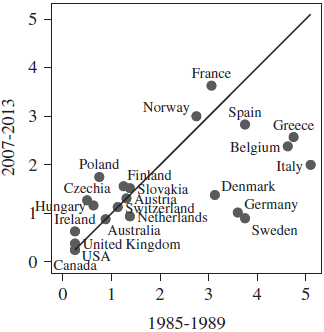
To illustrate this point, Figure 1 shows the levels of temporary employment regulation across the sample of 22 countries in the late-1980s and from 2007-2013. Except for France and Norway, several countries with high restrictions in the 1980s have moved towards more deregulated non-standard employment (below the 45-degree-line). The graph shows a clear convergence towards lower levels of temporary employment regulation; the coefficient of variation over this period declined from 0.81 to 0.61. On balance, the regulation of temporary employment is a suitable indicator to leverage variation in flexibilization both across countries and over time. In the analysis, I use the negative value of the OECD index, so that higher values indicate ‘deregulation’ of temporary employment.
Regulation of temporary employment from the late-1980s to the 2010s
Notes: Based on OECD (2017). Data for the early-1990s used for Czech Republic (1993), Hungary (1990), Poland (1991) and Slovakia (1993).

The analysis includes several control variables. I use union density (union members as a share of all employees) as a measure for the encompassing organization of workers across the income distribution (see Vlandas, Reference Vlandas2018). Union density is both an important determinant of wage inequality and may moderate the effect of temporary employment deregulation. The data are from Visser (Reference Visser2015). From the same source, I added a measure for the centralization of wage bargaining. Next, I control for unemployment rates, which have been associated with higher market inequality (Pontusson and Weisstanner, Reference Pontusson and Weisstanner2018), trade openness (measured as the sum of exports and imports in proportion to GDP), government partisanship (percentage of left-wing parties in cabinet) and real GDP growth. These variables are obtained from Armingeon et al. (Reference Armingeon, Wenger, Wiedemeier, Isler, Knöpfel, Weisstanner and Engler2018). Because LIS data are available in waves, all explanatory variables are averaged across the period between a given LIS survey year back to one year after the previous LIS survey was fielded (Lupu and Pontusson, Reference Lupu and Pontusson2011: 324).
Model specification
I use an error correction model (ECM) of the relationship between temporary employment deregulation and wage shares. ECMs are appropriate for both stationary and cointegrated data, and are increasingly popular in comparative political economy (De Boef and Keele, Reference De Boef and Keele2008; Beck and Katz, Reference Beck and Katz2011). The main reason why I choose the ECM is that it allows a careful look at dynamics which characterize the cross-national variation in the trend towards more deregulated non-standard employment. The ECM does not rely on the restrictive assumption that the effects of my independent variables immediately fade away after a single time period. I use the following, simplified version of the ECM, which estimates only one parameter for each independent variable and is called the ‘partial adjustment’ ECM model (De Boef and Keele, Reference De Boef and Keele2008: 190):
 $$\Delta {{\rm{Y}}_{{\rm{it}}}} = {\alpha _0} + {\alpha _{{1}}}{{\rm{Y}}_{{\rm{it}} - {{1}}}} + {\beta _0}{{\bf{X}}_{{\rm{it}}}} + {\varepsilon _{{\rm{it}}}}$$
This ECM variant is functionally equivalent to a lagged dependent variable (LDV) model (Beck and Katz, Reference Beck and Katz2011). The coefficient β0 captures the effect of independent variables on the equilibrium in wage share levels over one LIS survey period.Footnote 3 The ECM is estimated using OLS with panel-corrected heteroskedastic standard errors. Due to some remaining autocorrelation, all models include country-specific AR(1) error processes (estimated through Prais-Winsten transformation). I do not include time indicators, but the results are robust with year or LIS-wave dummies.
My preferred methodological specification does not include country fixed effects. Fixed effects would have the problem of a potential selection bias, as all the countries with time-invariant temporary employment deregulation, among them all Anglo-Saxon countries, ‘drop out’ of the analysis. In addition, wage risks from non-standard employment do not necessarily have to be limited to reform instances, but may be influenced by both the level of deregulation and the direction of change. Having said that, the next section shows that the findings are largely robust with country fixed effects. This is in line with the theoretical expectations that mostly within-country changes are driving the effects.
Wage risk mechanisms
The theoretical argument hinges on micro-level assumptions about the wage risks from non-standard employment. Before discussing the regression results, I first present descriptive evidence on mechanisms that identify why low- and middle-income insiders are more exposed to wage risks than others in a context of deregulated temporary employment.
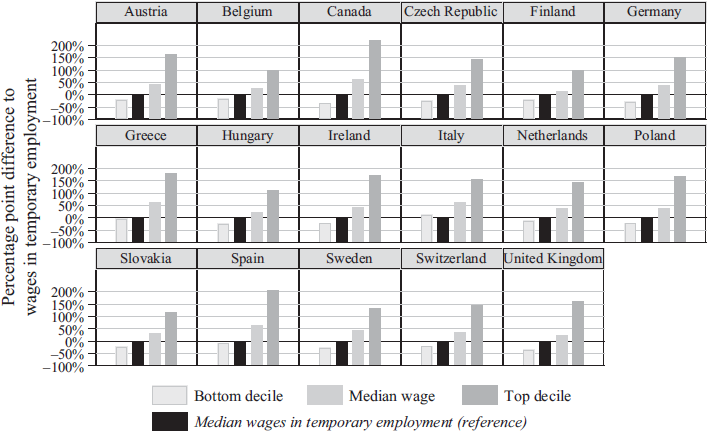
One such mechanism discussed in this paper is low-wage competition. Using LIS data for a restricted sample of 17 countries for which I have information on the permanency of job contracts, Figure 2 displays the wage premium of permanent employment (i.e. the wage differentials between permanent workers’ wages relative to the median wage in temporary employment) between 1999-2013. In all countries except Italy, low-income permanent workers (bottom decile) tend to earn less than typical (median) wages in temporary employment. In contrast, middle-income earners in permanent employment earn more than temporary workers in all countries. The wage premiums for middle-income permanent workers exceed 60% in Greece, Italy and Spain; but the premiums are not exceedingly large for the remaining countries (36% on average).
Wage premium of permanent employment
Note: LIS data, averages 1999-2013.

For middle-income workers, this pattern of wages ‘close but above’ wages in temporary employment can clearly become a source of low-wage competition. The potential for downward wage pressure, by underbidding permanent workers’ wages, is more uncertain for low-wage workers, which tend to earn less than typical temporary employees. Finally, permanent workers at the top of the wage distribution tend to earn more than double the typical wages in temporary employment. In stark contrast to low- and middle-income workers, top earners are unlikely to be in direct wage competition with temporary workers.
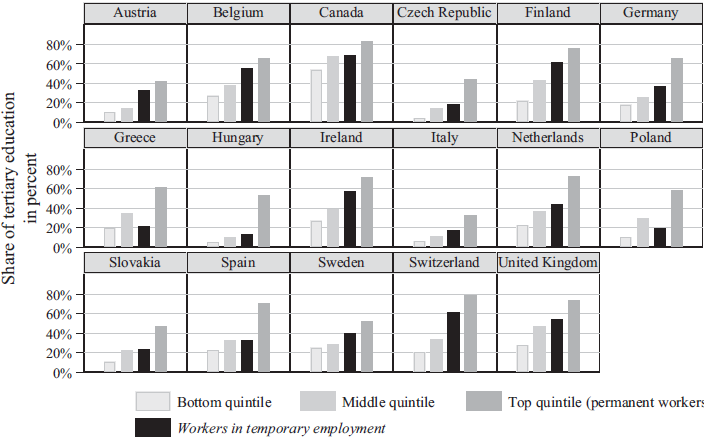
Two other mechanisms discussed in this paper have to do with wage risks that are strongly related to skills: job replacement and adverse long-term income prospects. These mechanisms are particularly relevant for insiders that are identified to have a skills disadvantage compared to other insiders, but also compared to high-skilled outsiders. Figure 3 presents data on the relative skills (dis)advantages between insiders and outsiders, assessed by the share of tertiary education attainment in each group. The grey bars confirm that among permanent workers, unsurprisingly, the share of tertiary degrees increases with wage levels. But the more striking observation from Figure 3 is that temporary workers do not appear to have any skills disadvantage compared to lower- and middle-income permanent workers. Quite to the contrary, in all 17 countries, temporary workers have a higher incidence of tertiary education than permanent workers in the bottom quintile.
Share of tertiary education in permanent and temporary employment
Note: LIS data, averages 1999-2013.

Most notably, the share of temporary workers with tertiary degrees exceeds the share of permanent workers in the middle quintile in all countries except Greece, Poland and Spain. In many cases, temporary workers have quite substantially higher shares of tertiary education than middle-income workers in permanent employment. Top-income permanent workers, in contrast, evidently have the highest shares of tertiary education. This hints again that top earners hardly compete directly with temporary workers. Overall, the evidence in Figures 2 and 3 is broadly in line with the argument that non-standard employment carries tangible wage risks among both low-income and middle-income insiders, which then become a source of wage pressure on them.
Regression findings
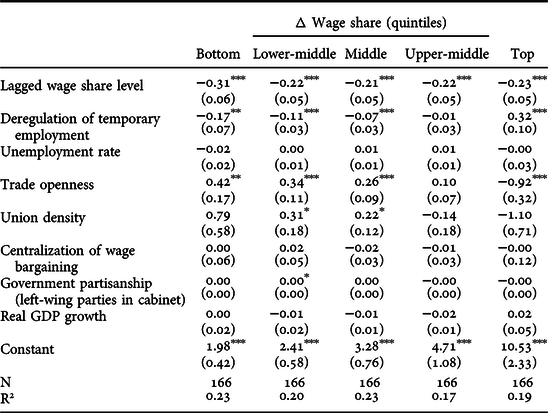
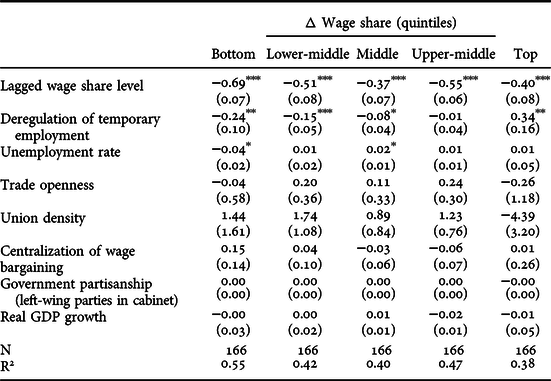
Table 1 presents error correction model (ECM) regressions of each quintile’s wage share in 22 OECD countries between 1985 and 2016. The result for the main independent variable of interest shows a negative and statistically significant effect of temporary employment deregulation on wage shares in the bottom (p<0.05), lower-middle and middle quintiles (p<0.01). In other words, more deregulated non-standard employment policies are associated with lower wage shares for the lower- and middle-income groups. The opposite holds for the top quintile: deregulation decreases the wage shares of top earners (p<0.01). There is no significant effect of deregulation on upper-middle wage shares. These results support the general claim that the effects of non-standard employment deregulation are unequally distributed among insiders.
Error correction models of wage shares (without country fixed effects)

Notes: OLS estimates with panel-heteroskedastic standard errors (in parentheses) and panel-specific AR(1) processes estimated with Prais-Winsten transformation. *p<0.1; **p<0.05; ***p<0.01.
Of the remaining explanatory variables, unemployment and GDP growth have no clear effect. Trade openness, somewhat surprisingly, tends to increase lower- and middle-income wage shares at the cost of top-income wage shares. The same tends to be the case for union density, in line with theoretical expectations. However, these results are sensitive to adding country fixed effects, which moves the focus on changes within countries. With country fixed effects included in Table 2, unemployment now tends to reduce wage shares of bottom earners. Trade openness has no clear effect anymore; and union density still tends to increase wage shares in the lower-middle parts of the distribution. Centralized wage bargaining and left government partisanship tend to increase lower-income groups’ wage shares and decrease wage shares at the top, but the associations are not statistically significant.
Error correction models of wage shares (with country fixed effects)

Notes: OLS estimates with panel-heteroskedastic standard errors (in parentheses) and panel-specific AR(1) processes estimated with Prais-Winsten transformation. Fixed effects not shown. *p<0.1; **p<0.05; ***p<0.01.
More importantly, Table 2 shows that the effects of temporary employment deregulation remain largely robust in the fixed-effects specification, which can be interpreted as changes within countries over time. The effects of deregulation are negative on bottom and lower-middle wage shares (p<0.05 and p<0.01) and on the middle quintile’s wage shares (p<0.1). In turn, deregulation increases wage shares of top earners (p<0.05). The evidence in Tables 1 and 2 is in line with the first hypothesis: deregulated non-standard employment adversely affects the position of lower- and middle-income insiders in the earnings distribution and benefits top-income insiders.
The substantive magnitude of the effects of temporary employment deregulation can be assessed with standardized beta coefficients. The standardized coefficients based on Table 1 unveil that the effects of deregulation are largest for the lower-middle and the top income quintile. A one-standard-deviation increase in deregulation is expected to reduce lower-middle wage shares by 27% of a standard deviation. The expected reduction is 23% for the bottom quintile and 21% for the middle quintile; while the same amount of deregulation is expected to increase the top quintile’s wage share by 27% of a standard deviation. The effect magnitude across the different quintiles is similar in the fixed-effects models in Table 2. These sizeable effects of non-standard employment deregulation are generally larger in magnitude than the other explanatory variables (with the notable exception of a strong substantive effect of union density in the fixed-effects models from Table 2).
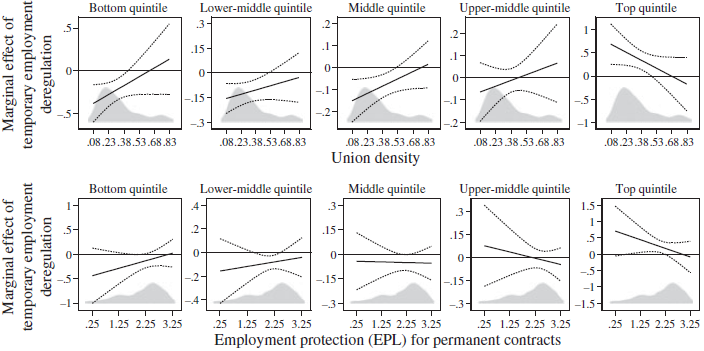
The second and third hypotheses are concerned about possible conditional effects of non-standard employment policies across different contexts of unionization and employment protection (EPL) for permanent contracts. Figure 4 graphically plots the results of the interactions (full models in Appendix 1). The plots with union density reveal that temporary employment deregulation has statistically significant effects at low and medium levels of union density. In contrast, where unions are highly encompassing, the effect of deregulation weakens or becomes statistically insignificant. For values of union density above 70% – which applies to average levels in Denmark (73%), Finland (75%) and Sweden (79%) between 1995 and 2007 – temporary employment deregulation loses any statistically discernible effect on wage shares. This corroborates the second hypothesis: encompassing unions mitigate individual-level wage risks that arise from deregulated non-standard employment.
The moderating role of encompassing unions and employment protection
Note: Marginal effects plots with 95% confidence intervals and kernel densities. Full interaction models in Appendix 1.

The bottom part in Figure 4 plots similar interaction results with the OECD’s indicator for employment protection legislation (EPL) for permanent contracts. Although the interaction terms are not statistically significant (p>0.1), the marginal effects reveal some notable patterns. At above-average levels of employment protection, the marginal effects of temporary employment deregulation become substantively weaker and insignificant for all wage share quintiles. In contrast, temporary employment deregulation generally tends to have significant effects at medium and low levels of EPL. These findings need to be taken with a degree of caution due to multicollinearity as a result of the strong correlation between EPL for permanent and temporary contracts (r = 0.52, N = 166), but they are consistent with the third hypothesis. More broadly, the conditional effects in Figure 4 demonstrate that the effects of non-standard employment deregulation are robust across a variety of labor market contexts in terms of union organization and employment protection.
Appendix 2 documents several robustness checks. First, the effects of non-standard employment deregulation hold up to using a reduced sample based exclusively on wage shares of workers with permanent contracts (ensuring that only insiders are included). Second, the results are substantively unaltered if controlling for potential confounders (the share of workers in temporary employment; unemployment benefit replacement rates) or choosing different methodological specifications. Finally, an important finding in Appendix 2 is that the effects found are robust for standard measures of wage inequality: deregulated temporary employment significantly exacerbates overall wage inequality (measured by the p90/p10 decile ratio), top-end (p90/p50 ratio) and bottom-end (p50/p10 ratio) wage inequality, which closely mirrors the findings from the analysis of wage share quintiles.
Conclusion
Can flexibilization ‘backfire’ on labor market insiders? I have argued that lower- and middle-income insiders become exposed to a set of wage risks in deregulated contexts of non-standard employment, which in turn create downward wage pressure on these groups. These wage risks are represented by mechanisms such as low-wage competition, the threat of job replacement and adverse outlooks for long-term income prospects. This article provides empirical evidence that the deregulation of temporary employment has adverse consequences on the earnings position of lower- and middle-income workers. Therewith, flexibilization contributes to wage inequality among insiders. The unequal effects of deregulation on insiders’ wages hold across a variety of contexts as well as in within-country perspective. The only clear exception is in the case of encompassing unions, who can mitigate wage risks by taking an inclusive stance towards workers in non-standard employment (see Benassi and Vlandas, Reference Benassi and Vlandas2016).
The claim that flexibilization ‘at the margins’ undermines the wage position of insiders is strikingly at odds with the dualization literature. In recent years, the dualization literature has refined the crude analytical dichotomy between insiders and outsiders by developing continuous risk-based measures of ‘outsiderness’ (Schwander and Häusermann, Reference Schwander and Häusermann2013; Marx and Picot, Reference Marx and Picot2020; Vlandas, Reference Vlandas2020). Nonetheless, these more fine-grained approaches still assume that insiders in low-risk permanent employment do not experience severe forms of labor market vulnerability. By treating labor market disadvantages mostly in terms of employment insecurity, the dualization perspective overlooks important variation in terms of income disadvantages or other forms of stratification. Employment risks and income disadvantages do not always overlap. They can be cross-cutting (Rehm et al., Reference Rehm, Hacker and Schlesinger2012; Rehm, Reference Rehm2020): for example, in the precarious wage situation of low-paid workers despite low unemployment (Thelen, Reference Thelen2019).
Combining employment-related notions of labor market disadvantage (as in the dualization literature) with income-related disadvantage (the contribution of this paper) could be part of developing a broader understanding about the implications of labor market inequality for mass politics (cf. Häusermann et al., Reference Häusermann, Kemmerling and Rueda2020). There is abundant evidence that policy attitudes and voting behavior differ between insiders and outsiders (e.g. Marx, Reference Marx2015; Rovny and Rovny, Reference Rovny and Rovny2017; Vlandas, Reference Vlandas2020), and political parties pursue labor market reforms in accordance with these preferences (Picot and Menéndez, Reference Picot and Menéndez2017; Bürgisser and Kurer, Reference Bürgisser and Kurer2019; Häusermann et al., Reference Häusermann2020). In contrast, the implications of increasing heterogeneity in labor market vulnerability, as non-standard employment has been deregulated in post-industrial societies, for mass electoral politics are less straightforward and more open to research.
There is some evidence that the political behavior of cross-pressured groups (income-advantaged outsiders and income-disadvantaged insiders) differs from the traditional insider-outsider model of the dualization literature. On the one hand, the increasingly sizeable group of high-skilled outsiders (one main example for a cross-pressured group) has been politically successful in implementing outsider-friendly policies through left-wing parties (Häusermann et al., Reference Häusermann, Kurer and Schwander2015; Bürgisser and Kurer, Reference Bürgisser and Kurer2019; Schwander, Reference Schwander2020). On the other hand, low-skilled insiders within the manufacturing working class – who have seen significant relative declines in terms of their socio-economic standing – have been a driving force behind the rising support for radical right parties (Bornschier and Kriesi, Reference Bornschier, Kriesi and Rydgren2013; Häusermann, Reference Häusermann2020). In line with my argument about their exposure to wage risks and changes in their relative wage position, these cross-pressured groups seem to have become a major force for the electoral realignments of the past decades (Häusermann, Reference Häusermann2020; Häusermann et al., Reference Häusermann, Kemmerling and Rueda2020).
It is beyond the scope of this article to combine the macro-level distributional analysis about how different groups are affected by labor market changes with a micro-level analysis of these groups’ policy preferences and political behavior. This should be addressed in future research. However, this article identifies a critical cross-pressured group: insiders in secure employment but exposed to wage risks and declines in their relative wage position. As a result, political divides are likely to become more contested not only between insiders and outsiders, but also between different groups of insiders.
Acknowledgements
For helpful comments, I thank Klaus Armingeon, Niccolo Durazzi, Sarah Engler, David Hope, Lukas Lehner, Zach Parolin, Jonas Pontusson, two anonymous reviewers, as well as participants at the ESPAnet Conference in Lisbon (September 2017) and workshops at the University of Geneva and University of Oxford (both May 2019).
Supplementary material
To view supplementary material for this article, please visit https://doi.org/10.1017/S0047279420000409