While studies of bilingual speakers have made important contributions to the field of variationist sociolinguistics, the majority of work in this area focuses on monolingual speakers (Nagy & Meyerhoff, Reference Nagy, Meyerhoff, Meyerhoff and Nagy2008). The Heritage Language Variation and Change in Toronto project (HLVC; Nagy, Reference Nagy2009) investigates the types of interspeaker and cross-generational grammatical variation that occur in a set of heritage languages spoken in Toronto, a city where 46% of the population (2.8 million people) report a language other than English as their mother tongue (Statistics Canada, 2013a). The goals of the project are to better understand the types of variable patterns that are found in bilinguals' conversational speech and to understand the roles of social factors at the individual and community levels. In particular, this project addresses the question of whether linguistic variation and change in minority languages are governed by the same factors as the more frequently studied majority languages.Footnote 1
In this domain, it is important to consider the possible interplay of language-internal and language contact-influenced effects. With that goal, this paper compares a variable pattern that exists in both the homeland and heritage varieties of Korean. We show that Heritage Korean speakers continue a change in progress that exists in Homeland Korean, though its trajectory differs among younger speakers, particularly young women.
As bilingual speakers have their very choice of language as a resource for constructing identity, they need not rely solely on language-internal variation for this work. Stanford and Preston (Reference Stanford and Preston2009:8) observed that social factors may behave differently in minority languages than in the majority languages that have been subject to more variationist sociolinguistic analysis. Stanford and Preston (Reference Stanford and Preston2009:10) noted that “a number of studies of indigenous languages support the notion that women are frequently leaders in change from above and below,” but also provide several counterexamples. Blainey (Reference Blainey2013:35) noted that sociolinguistic variables “like sex, socio-economic class, literacy, ethnic identity, speech register, and home town,” in contrast to age, lose their influence on language patterns in languages whose sphere of use is contracting. She supported this generalization with examples from regional French varieties discussed in Dubois and Noetzel (Reference Dubois and Noetzel2005:135), King (Reference King and Dorian1989), and Rottet (Reference Rottet1995:309). Blainey (Reference Blainey2013) noted also that where sex differences do correlate with linguistic patterns (cf. work reported in Dubois, Noetzel, & Salmon [Reference Dubois, Noetzel, Salmon, Brasseur and Falkert2005] again on patterns in Louisiana Regional French and acquisition research reported in Treiman, Bowey, & Bourassa [Reference Treiman, Bowey and Bourassa2002]), education seems to play a mediating role.
Additionally, the heritage varieties may not exactly mimic homeland varieties because the input received by the speakers is deficient, if only quantitatively, as some of the input that learners in a heritage context receive is in the majority language (Polinsky, Reference Polinsky2008). In a case of deficient input, we would expect diminishing effect sizes as well as a change in the conditioning effects on the variable, much as proposed in Labov (Reference Labov2007) for the diffusion of a phonological variable when multiple dialects are in contact. It is also plausible that in contact situations, some social factors, relating to language attitudes and degree of contact, may be more important than sex, a factor that is regularly shown to be statistically significant in variation in monolingual contexts.
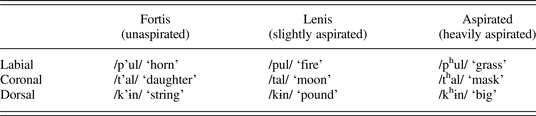
The variable we investigate here is voice onset time (VOT). VOT is defined as the duration of the interval between the release of a stop and the onset of vocal fold vibration for the following vowel. It is a primary cue that distinguishes voiced (indicated by negative or short positive VOT values) and voiceless (indicated by positive VOT values) obstruents in many languages (Lisker & Abramson, Reference Lisker and Abramson1964). VOT is present in all languages and it is particularly susceptible to change due to contact (Antoniou, Best, Tyler, & Kroos, Reference Antoniou, Best, Tyler and Kroos2010; Chang, Reference Chang2012; Flege, Reference Flege1987; Flege & Eefting, Reference Flege and Eefting1987; Fowler, Sramko, Ostry, Rowland, & Hallé, Reference Fowler, Sramko, Ostry, Rowland and Hallé2008; Nagy & Kochetov, Reference Nagy, Kochetov, Siemund, Gogolin, Schulz and Davydova2013; Sancier & Fowler, Reference Sancier and Fowler1997). In this paper, we examine VOT values of stops in Korean, a language with the three series of stop consonants shown in Table 1. The sets of minimal triplets in Table 1 illustrate the three-way phonemic contrast at each place of articulation.
Minimal triplets illustrating the three series of Korean stops

The three-way contrast of these stops in Heritage Korean presents a particularly interesting case of variation in a language contact situation. In most cases of stop variation examined in previous language contact studies, the two languages in contact both make a two-way contrast between voiceless/aspirated versus voiced/unaspirated stops (e.g., contact of English with French, Spanish, Portuguese, Greek, Italian, Dutch, Mandarin), where a single acoustic dimension of VOT is sufficient to make a binary distinction within a language reliably. These previous studies focus on adjustment of VOT values due to cross-language influence.
In contrast, Korean has a three-way laryngeal contrast and VOT alone does not distinguish the stop categories reliably. Instead, the three-way laryngeal contrast of Korean stops is signaled by a combination of acoustic cues, including VOT of the stop, and the fundamental frequency (F0) and amplitude difference between the first and the second harmonics (H1 − H2) of the following vowel. Fortis stops have the shortest VOT values; aspirated stops have the longest VOT values; and lenis stops, often described as “slightly aspirated,” have intermediate VOT values. Aspirated and fortis stops have raised F0 values on the following vowel compared to lenis stops. Aspirated and lenis stops are marked by breathier vowel quality of the following vowel than fortis stops, as indicated by higher H1 – H2 values (Cho, Jun, & Ladefoged, Reference Cho, Jun and Ladefoged2002; Han & Weitzman, Reference Han and Weitzman1970; Hardcastle, Reference Hardcastle1973; Kang & Guion, Reference Kang and Guion2008; Kim, Reference Kim1965; Kim, Reference Kim1994; Kim, Reference Kim2004).
Recent studies suggest that Seoul Korean is undergoing a tonogenesis-like sound change. Tonogenesis is a sound change in which consonant-induced pitch perturbation develops into a tonal contrast, eventually replacing the original voicing or phonation contrast of consonants (Hombert, Ohala, & Ewan, Reference Hombert, Ohala and Ewan1979; Kingston, Reference Kingston, van Oostendorp, Ewen, Hume and Rice2011; Thurgood, Reference Thurgood2002). In Seoul Korean, pitch differences on the following vowel are replacing VOT differences as the key cue to a phonemic contrast between phrase-initial aspirated and lenis stops (Bang, Sonderegger, Kang, Clayards, & Yoon, Reference Bang, Sonderegger, Kang, Clayards and Yoon2015; Beckman, Li, Kong, & Edwards, Reference Beckman, Li, Kong and Edwards2014; Choi, Reference Choi2002; Kim, Beddor, & Horrocks, Reference Kim, Beddor and Horrocks2002; Silva, Reference Silva2006; Wright, Reference Wright2007; Kang, Reference Kang2014; Kang & Guion, Reference Kang and Guion2008; Kang & Han, Reference Kang and Han2013) and this sound change is led by female speakers (Bang et al., Reference Bang, Sonderegger, Kang, Clayards and Yoon2015; Beckman et al., Reference Beckman, Li, Kong and Edwards2014; Kang, Reference Kang2014). In other words, in Seoul Korean, the VOT differences between lenis and aspirated stops show age- and sex-based variation; younger and female speakers produce a more reduced contrast in VOT and a more enhanced F0 contrast compared to older and male speakers, respectively.
This ongoing sound change and related synchronic variation makes the laryngeal contrast in Korean stops particularly interesting as it allows us to examine whether and how an ongoing sound change and related age- and sex-based variation in a homeland variety of a language is mirrored in a heritage variety. This paper analyzes age- and sex-based variation of the stop contrast in Heritage Korean in Toronto and compares it to the Seoul pattern, based on the data from Kang (Reference Kang2014), following parallel methods.
The acoustic realization of the laryngeal contrast in Korean differs from the English voicing contrast. While English also exhibits consonant-induced F0 perturbation, that is, F0 of the following vowel is higher for voiceless than voiced stops (Haggard, Ambler, & Callow, Reference Haggard, Ambler and Callow1969; Hombert Reference Hombert and Fromkin1978; Kingston & Diehl, Reference Kingston and Diehl1994; among others), the role of F0 in voicing contrast is far more limited than in Korean and VOT is the primary cue for the contrast (Abramson & Lisker, Reference Abramson, Lisker and Fromkin1985; Haggard et al., Reference Haggard, Ambler and Callow1969; Jun, Reference Jun1996).
DATA
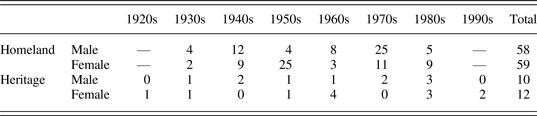
The analysis of Homeland Korean is based on data from a read speech corpus, consisting of well-known short stories and essays, distributed by the National Institute of the Korean Language (NIKL, 2005). Our homeland data contain speech from a reading task by 117 speakers (58 male and 59 female) living in the Seoul metropolitan area. The breakdown of the homeland speakers analyzed in the current study, by sex and year of birth, is given in the top of Table 2.
Year of birth and sex of speakers in the Homeland and Heritage Korean data
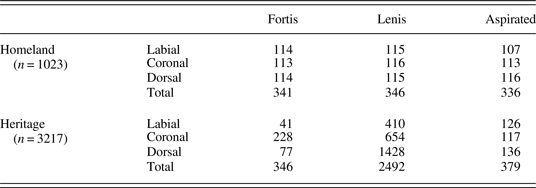
We selected nine sentences that begin with each of the nine stop phonemes of Korean. The sound change under investigation—merger of VOT distinction and concomitant rise of F0 distinction—specifically targets the accentual phrase (AP)-initial consonants (Jun, Reference Jun1993, Reference Jun1996). Sentence-initial stops are selected as this is the position guaranteed to be phrase-initial for all speakers, regardless of the individual variation in accentual phrasing patterns. We analyzed 1023 tokens of stops, including all three places and all three laryngeal categories. A breakdown of the homeland tokens by place of articulation and laryngeal category is provided in the top half of Table 3.
Stop token distribution (n = 4240)
Our study of the heritage variety is situated in the Greater Toronto Area (GTA), a metropolitan area of over 5.5 million people. Speakers represent a community of approximately 64,800 people who defined themselves as ethnically Korean in the 2011 National Household Survey. About 51,000 people in the GTA claim Korean as their mother tongue (Statistics Canada, 2013b). There has been a community of Korean speakers in Toronto since ~1967 (Nagy, Reference Nagy2011:66). The speech data come from the Heritage Language Documentation Corpus (Nagy, Reference Nagy2009, Reference Nagy2011), consisting of sociolinguistic interviews with Toronto speakers in several generations of eight heritage languages, stratified by age and representing both sexes. All Korean speakers in the corpus (or their parents) come from Seoul. They were recorded between 2009 and 2011. Speakers were recruited from the personal networks of research team members who are Toronto heritage language speakers. Participants self-identify as “fluent enough to participate in an hour-long conversation in the heritage language.” The interviews were conducted in the heritage language and produced about an hour of conversational speech from each participant, covering topics ranging from speakers' upbringing and interests to their attitudes toward ethnic communities in Toronto. This approach allows us to describe naturalistic speech and requires us to carefully examine (or control) contextual effects. Data from 22 Heritage Korean speakers (10 male and 12 female) are analyzed for the current study. The breakdown of the speakers in the heritage language data by sex and year of birth are given in Table 1.
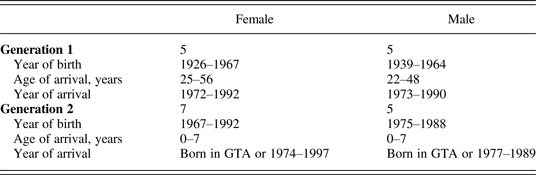
Heritage speakers are further categorized by generation. In the HLVC Project (Nagy, Reference Nagy2009, Reference Nagy2011), generation 1 is defined to include people born in the homeland (here, Seoul), who lived there until at least age 18, and subsequently have lived in Toronto for at least 20 years. Generation 2 speakers are born in Toronto, or came from the homeland before age 7, for whom both parents qualify as generation 1. Table 4 describes the distribution of the 22 heritage speakers by generation and information about their arrival in Toronto. As the Korean community in Toronto is relatively new, all generation 2 speakers are relatively young, with the oldest generation 2 speaker in our data having been born in 1967. Generation 1 speakers, on the other hand, are all older by definition and the youngest generation 1 speaker was also born in 1967. So, the two generations of heritage speakers are also largely distinct in their age profile. In our analysis, we use the speakers' year of birth as a predictor but will come back to the generation effect in the discussion.
Distribution of Heritage Korean speakers by generation
In contrast to most published studies of VOT in adult bilingual contexts that are based on experimental elicitations involving read words or sentences (cf. Caramazza, Yeni-Komshian, Zurif, & Carbone, Reference Caramazza, Yeni-Komshian, Zurif and Carbone1973; Fowler et al., Reference Fowler, Sramko, Ostry, Rowland and Hallé2008; Kessinger & Blumstein, Reference Kessinger and Blumstein1997; Ringen & Kulikov, Reference Ringen and Kulikov2012; Sorianello, Reference Sorianello1996; Sundara, Reference Sundara2005; Sundara, Polka, & Baum, Reference Sundara, Polka and Baum2006), we investigate Heritage Korean VOT in conversational speech. Speakers participated in a sociolinguistic interview (methodology as in Labov, Reference Labov, Baugh and Sherzer1984).Footnote 2 The goal of this task was to collect naturalistic in-group conversational speech. All interviews are conducted by heritage language speakers whose background is from the same region of origin as the participant (here, Seoul). An ethnic orientation questionnaireFootnote 3 and a picture description task were also conducted.
The interviews were transcribed in Korean orthography (Hangul) in ELANFootnote 4 (Wittenburg, Brugman, Russel, Klassmann, & Sloetjes, Reference Wittenburg, Brugman, Russel, Klassmann and Sloetjes2006) by native Korean speakers. This creates time-stamped transcriptions that are linked to the .wav file of the interview recording. Tokens of word-initial stops were then manually located in the transcribed speech.
For maximal comparability to the homeland NIKL data, we restrict our examination to AP-initial words beginning with one of the nine Korean stops. APs in Korean are defined as beginning with LH (for words beginning with a lenis stop or a sonorant) or HH (for words beginning with fortis or aspirated stops, /h/, or coronal fricatives) initial boundary tones and ending with LH final boundary tones (Jun, Reference Jun1993, Reference Jun1996). All sociolinguistic interview tokens that were unambiguously AP-initial and were clearly audible and free of speech errors and background noise were selected. A total of 3222 AP-initial tokens were analyzed. Of these, five outlier tokens with a VOT above 200 msec were excluded from further analysis. A breakdown of the remaining 3217 tokens by place of articulation and laryngeal category is provided in the bottom half of Table 3.
ANALYSIS
Methods of analysis of the homeland and heritage varieties are the same. For each target word, the onset of the stop release, the onset of voicing of the following vowel and the offset of the vowel were manually identified. Acoustic measurements of VOT and F0 were made in Praat (Boersma & Weenink, Reference Boersma and Weenink2011). VOT was defined as the duration from the onset of the stop release to the zero crossing of the first periodic cycle of the following vowel. Figure 1 illustrates the phonetic realization of VOT for one token of lenis stop /t/ from the Heritage Korean corpus. The highlighted segment is the time period between the release of the coronal constriction and the onset of periodic voicing of the following /ʌ/. The curve with dots at approximately 144 Hz indicates the F0 of the following vowel.
VOT intervals labeled in Praat for a token of /t/ in the word ‘더’ [tʌ] produced by speaker K1M45A, a 45-year-old generation 1 male (65 msec; release highlighted).
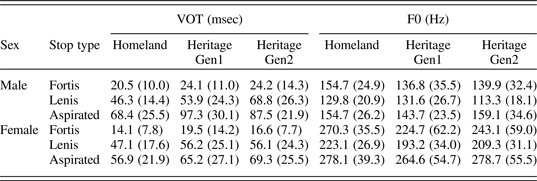
F0 measurements were taken at the midpoint of vowels following the stop consonants using Praat's pitch tracking function with pitch range set at 75–300 Hz for male speech and at 100–500 Hz for female speech. Pitch measurements were inspected and corrected manually for pitch tracking errors, which are common particularly for vowels following a fortis consonant, which involves a constricted glottis gesture. F0 measurements in hertz were converted to semitones (St), a logarithmic scale of pitch, to allow for comparison of pitch intervals across sex and age (Oh, Reference Oh2011; Whalen & Levitt, Reference Whalen and Levitt1995). The semitone value was calculated with 100 Hz as a reference pitch using the formula semitone = log(Hz/100) × 12. Table 5 provides mean and standard deviation values (in parenthesis) of VOT and F0 (Hz) of each stop category by sex for each dataset.
Mean and standard deviation values (in parentheses) of VOT and F0 (Hz) of each stop category by sex for each speaker group
For statistical analyses, VOT and F0 values were converted to z-scores within each speaker's productions. This normalization factors out speaker-dependent variation in VOT and F0 ranges and allows us to examine how speakers of different age and sex are similar or different in the relative distribution of the stop categories in their acoustic space. For example, the same difference in VOT duration in millisecond values may be a substantial difference for a fast talker whose VOT values are overall reduced and similar but may be a relatively small difference for a slow talker whose VOT values are overall longer and more dispersed. Similarly, the same F0 difference expressed as a semitone value may be a large or a small difference depending on the overall pitch range a particular speaker uses. The normalized scales allow a controlled comparison of stop contrasts across speakers of different speaking rates and pitch ranges.
Additionally, while the Heritage Korean data is from conversational speech, the homeland comparison data is from read speech. The normalized scales also mitigate the potential problem of comparing the data of different speech types by allowing us to compare the relative distribution of categories within individual speakers' speech rather than the absolute values.
Mixed-effects linear regression analyses (Baayen, Davidson, & Bates, Reference Baayen, Davidson and Bates2008; Pinheiro & Bates, Reference Pinheiro and Bates2000) are conducted using the lmer function in the lme4 package (Bates, Maechler, Bolker, Walker, Christensen, Singamann, Dai, & Grothendieck, Reference Bates, Maechler, Bolker, Walker, Christensen, Singmann, Dai and Grothendieck2015) for R (version 3.2.1, R Development Core Team, 2015). Models are built for VOT and for F0 separately for the homeland data and the heritage data. In the VOT models, the dependent variable is the speaker-normalized VOT values and similarly, in the F0 models, the dependent variable is the speaker-normalized F0 values. The same set of fixed-effect predictors, summarized in Table 6, and their interactions, are included in all models.Footnote 5
List of fixed-effect predictors
The laryngeal category (Lar) refers to the three types of stops in Korean: fortis, lenis, and aspirated. The factor is Helmert-coded to compare fortis versus nonfortis (lenis + aspirated) and then lenis versus aspirated, the latter comparison being our main interest.Footnote 6 There are two speaker-level predictors: year of birth (Yob) and sex (Sex). Previous studies of this sound change (Bang, et al., Reference Bang, Sonderegger, Kang, Clayards and Yoon2015; Silva, Reference Silva2006) report some nonlinear effects of speaker's year of birth and so a quadratic term is also included (Yob2) to model potential nonlinear effects in our data.Footnote 7 Yob is centered by subtracting the mean of YOB from each speaker's YOB.Footnote 8 For Sex, simple coding (male: –.5; female: .5) is used.
To examine how the contrast among the laryngeal categories, between lenis and aspirated stops in particular, differs by speakers' age and sex, the models also include the two-way interaction of laryngeal category (Lar) with speakers' year of birth (Yob + Yob2), and with sex (Sex). The models also include the three-way interaction of laryngeal category (Lar), year of birth (Yob + Yob2), and sex (Sex) to examine whether and how the interaction of the effect of sex on laryngeal category varies by speakers' age. By-speaker random intercept and by-speaker interaction with laryngeal category are included in the models.
RESULTS: VOT
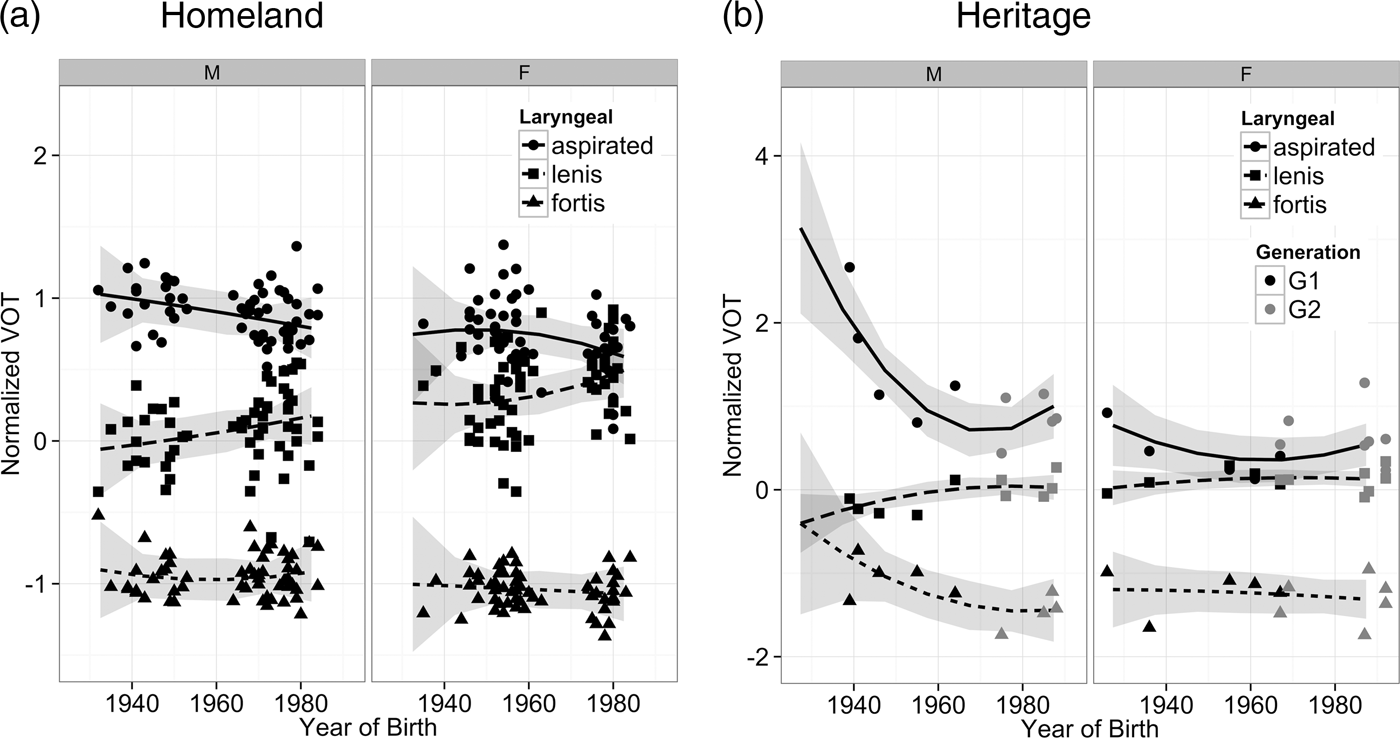
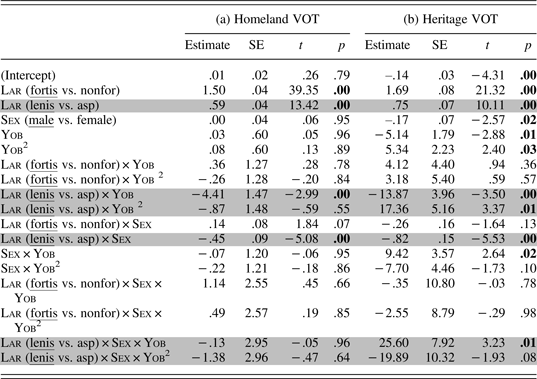
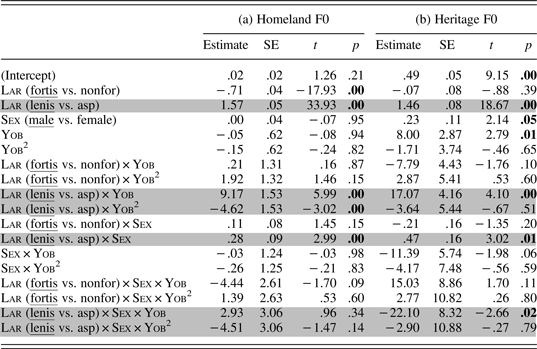
We first report how the age and sex of speakers affect the VOT realization of laryngeal categories in the Homeland and the Heritage Korean data. Table 7 summarizes the output of the two VOT models.Footnote 9 The factors that are of interest to our current discussion are shaded in gray and the p-values below .05 are bolded. Figure 2 shows the prediction plots based on the model output with 95% confidence intervals. By-speaker mean values of each stop categories are overlaid on the prediction plots.
Homeland (a) versus heritage (b) VOT prediction plots with 95% confidence interval shown in gray shading and with individual speaker means for each stop category overlaid.
Homeland vs. heritage VOT models
Note: Reference levels in each comparison are underlined.
First, the main effect of laryngeal category (Lar) is statistically significant in both models: nonfortis stops have longer VOT values than fortis stops and aspirated stops have longer VOT values than lenis stops, as expected. One unit of VOT difference in the normalized scale roughly corresponds to 25.0 msec in the heritage data and 27.3 msec in the homeland data, although the actual corresponding VOT values in milliseconds will differ from speaker to speaker. So, in the homeland data overall, the average VOT for aspirated stops is longer than for lenis stops by 14.8 msec (=25.0 msec × .59) and in the heritage data, the difference is 20.5 msec (=27.3 msec × .75).
The interaction of year of birth (Yob) and Lar is significant both in the homeland and in the heritage data: the VOT contrast between lenis and aspirated stops is larger for older than for younger speakers overall. In other words, the trend of VOT merger between lenis and aspirated stops found in homeland Seoul Korean is replicated in the Toronto heritage data. The two models differ, however, in that the interaction between the quadratic term of Yob (Yob2) and Lar is significant only in the heritage data (p = .01), not in the homeland data (p = .55). This indicates that the reduction of VOT contrast between the lenis and aspirated stops persists at a fairly constant rate from the oldest to the youngest speakers in the homeland data—to the extent that for many younger speakers, especially female, the VOT values of the two stop categories are indistinguishable or even in the opposite order (see Figure 2a). On the other hand, for the heritage speakers, the merger seems to slow down and possibly reverse its direction in younger speakers, as visually illustrated by the curved shape of the prediction lines for aspirated stops in Figure 2b.
Now, turning to the effect of Sex on the stop contrast realization, the interaction of Sex and Lar (lenis vs. asp) is significant in both models; the VOT contrast between lenis and aspirated stops is larger for male speakers than females, indicating that this sound change of VOT merger is led by female speakers in both Homeland and Heritage Korean. The two datasets differ in a crucial way, however: in the homeland data, the three-way interaction of Lar, Yob, and Sex is not significant (p = .96), while in the heritage data it is (p = .01). This means that in the homeland data, the effect of Sex on laryngeal contrast holds similarly for younger and older speakers, with females further ahead in the change than males. But, for the heritage data, the sex effect is carried mostly by the older speakers. Younger speakers show a far reduced sex contrast.
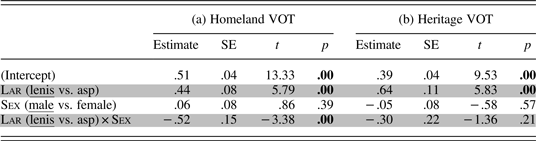
Note that the younger speakers of the Toronto population are also the generation 2 speakers, who were born in Toronto (or arrived very young). To probe the sex-based variation of VOT realization in this population more directly, we conducted a follow-up analysis, building a model with generation 2 speakers only with lenis and aspirated stops data only. The model included Lar, Sex, and the interaction of the two as predictors, which is our main interest. By-speaker random intercept and by-speaker interaction with laryngeal category are included in the model. For comparison, we also built a corresponding model for the homeland data, including data from speakers born in 1967 or later, matching the age of the generation 2 speakers in the Toronto data. Table 8 summarizes the output of the two VOT models. In the homeland model, the interaction of Lar (lenis vs. asp) and Sex is significant and the negative coefficient (β = –.52) indicates that the VOT contrast is more reduced in female speech than in male speech. In the heritage model, the interaction is not significant. In other words, unlike the younger homeland speakers, where a robust sex-based difference in VOT realization persists into the younger speakers, the generation 2 heritage speakers do not show the sex-based difference.
Homeland vs. heritage VOT models for younger/generation 2 speakers
Note: Reference levels in each comparison are underlined.
RESULTS: F0
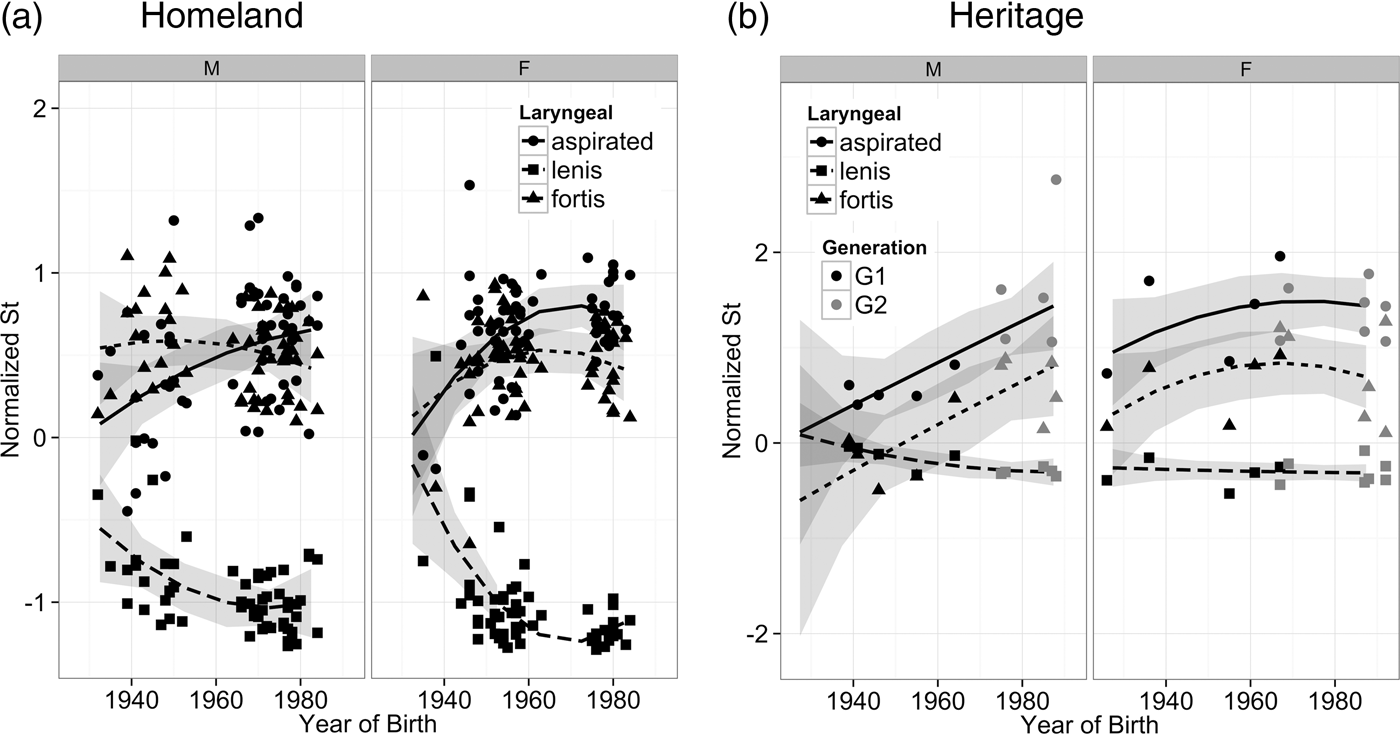
Now we turn to the pattern of age and sex-based variation in the realization of F0 in Homeland and Heritage Seoul Korean. Recall that in the current tonogenetic sound change in Seoul Korean, the VOT contrast between the lenis and the aspirated stops in phrase-initial position is merging and the primary acoustic marker of the phonemic contrast is shifting to the F0 difference on the vowel following the stop, with vowels following aspirated stops realized with a higher F0 than those following lenis stops. The F0 models are identical to the VOT models except that the dependent variable is the normalized F0 values. Table 9 summarizes the output of the two models, for homeland and for heritage data. Figure 3 shows the prediction plots based on the model output with by-speaker mean values of each stop categories overlaid. The factors that are of interest to our current discussion are again highlighted in gray shading and the p-values below .05 are bolded.
Homeland versus heritage F0 prediction plots with 95% confidence interval shown in gray shading and with individual speaker mean for each stop category overlaid.
Homeland vs. heritage F0 models
Note: Reference levels in each comparison are underlined.
The main effect of Lar (lenis vs. asp) is again significant in both models: aspirated stops induce a higher F0 on the following vowel than lenis stops, as expected. One unit of F0 difference in the normalized scale roughly corresponds to 2.09 semitones in the heritage data and 3.20 semitones in the homeland data, although the actual corresponding F0 values in semitones will differ from speaker to speaker. So, in the homeland data overall, the vowels following aspirated stops are produced with a higher F0 than lenis stops by 3.28 semitones (=2.09 semitones × 1.57, which is roughly a 30 Hz difference in male speech and an 80 Hz difference in female speech) and in the heritage data, the difference is 4.67 semitones (=3.20 semitones × 1.46).
The interaction of Lar and Yob is also significant in both models, indicating that the F0 difference between the two stops is increased in younger speakers' speech compared to older speakers' speech. In other words, the F0 difference is replacing the VOT difference as a primary acoustic cue for the laryngeal contrast between lenis and aspirated stops in younger speakers' speech in both communities. Interestingly, the quadratic term of Yob is significant in the homeland data (p < .01) but not in the heritage data (p = .51). This means that the rate of F0 contrast expansion slows down in the younger speakers' speech in the homeland data, likely a ceiling effect due to the F0 contrast reaching the maximum range. For the heritage data, on the other hand, we do not find statistical evidence that the change is slowing down for the younger speakers.
The interaction of Lar and Sex is also significant in both homeland (p < .01) and heritage (p = .01) models: the F0 contrast between lenis and aspirated stops is larger in females than in males, again showing that this change—expansion of the F0 contrast—is led by female speakers. As with the VOT models, the F0 models of the homeland and the heritage datasets differ in that the three-way interaction of Lar (lenis vs. asp), Sex, and Yob is significant in the heritage data but not in the homeland data. In other words, the sex difference in laryngeal contrast persists from older to younger speakers in the homeland data, but in the heritage data, the sex effect, robust in older speakers' speech, is substantially reduced in younger speakers' speech.
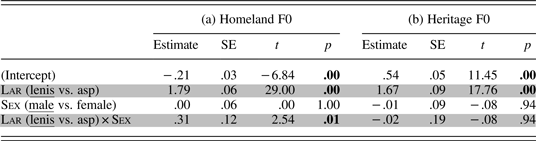
To probe the sex-based variation in the younger heritage speakers' speech more directly, we conducted a follow-up analysis, building F0 models for the generation 2 speakers including lenis and aspirated stops only, as we did for the VOT data in Table 8. A corresponding model was built for younger speakers of the homeland data for comparison. The model outputs are summarized in Table 10. The predictor of our main interest here is the interaction of Lar (lenis vs. asp) and Sex. The result is similar to the VOT patterns: the interaction is significant in the homeland model (p = .01) but not in the heritage model (p = .01), indicating that the F0 contrast is significantly modulated by speaker's sex in the speech of younger speakers in homeland but no such sex effect is found in the young heritage speakers.
Homeland vs. heritage F0 models for younger/generation 2 speakers
Note: Reference levels in each comparison are underlined.
To summarize, we found that the tonogenetic sound change in progress in Homeland Seoul Korean is also mirrored in heritage speakers' speech in Toronto, but there are some crucial differences. In both datasets, there is a clear effect of age such that the merger of VOT and the concomitant expansion of F0 contrast between lenis and aspirated stops are more advanced in younger speakers than in older speakers. But, the two communities differ in the shape of the trajectory in VOT change. While the VOT merger does not show a sign of slowing down in the homeland data and is progressing toward a complete merger in the younger speakers' speech, in the heritage data, we find that the younger generations do not push the change further ahead toward a complete merger and possibly reverse the direction of change such that the VOT contrast between the lenis and the aspirated stops is not completely lost.
We also find a clear effect of sex in both communities with female speakers being further along in the change than males. While this sex effect is robust across all age groups in the homeland data, in the heritage data, the sex effect is carried by the older speakers but is not found in the younger speakers' speech, the generation 2 speakers. We also tested whether heritage speakers' attitudes toward their language and culture and reported patterns of use of Korean and English significantly correlate to these phonetic patterns but found no effect. (The HLVC project's methods of analyzing speakers' attitudes, language use, and ethnic orientation are discussed in Nagy, Chociej, and Hoffman [Reference Nagy, Chociej and Hoffman2014]). Relevant data is provided in the appendix. This echoes the lack of correlation of ethnic orientation to other variable linguistic patterns examined in the HLVC project (Lyskawa, Reference Lyskawa2015; Lyskawa, Maddeaux, & Melara, Reference Lyskawa, Maddeaux and Melara2015; Nagy et al., Reference Nagy, Chociej and Hoffman2014).
DISCUSSION
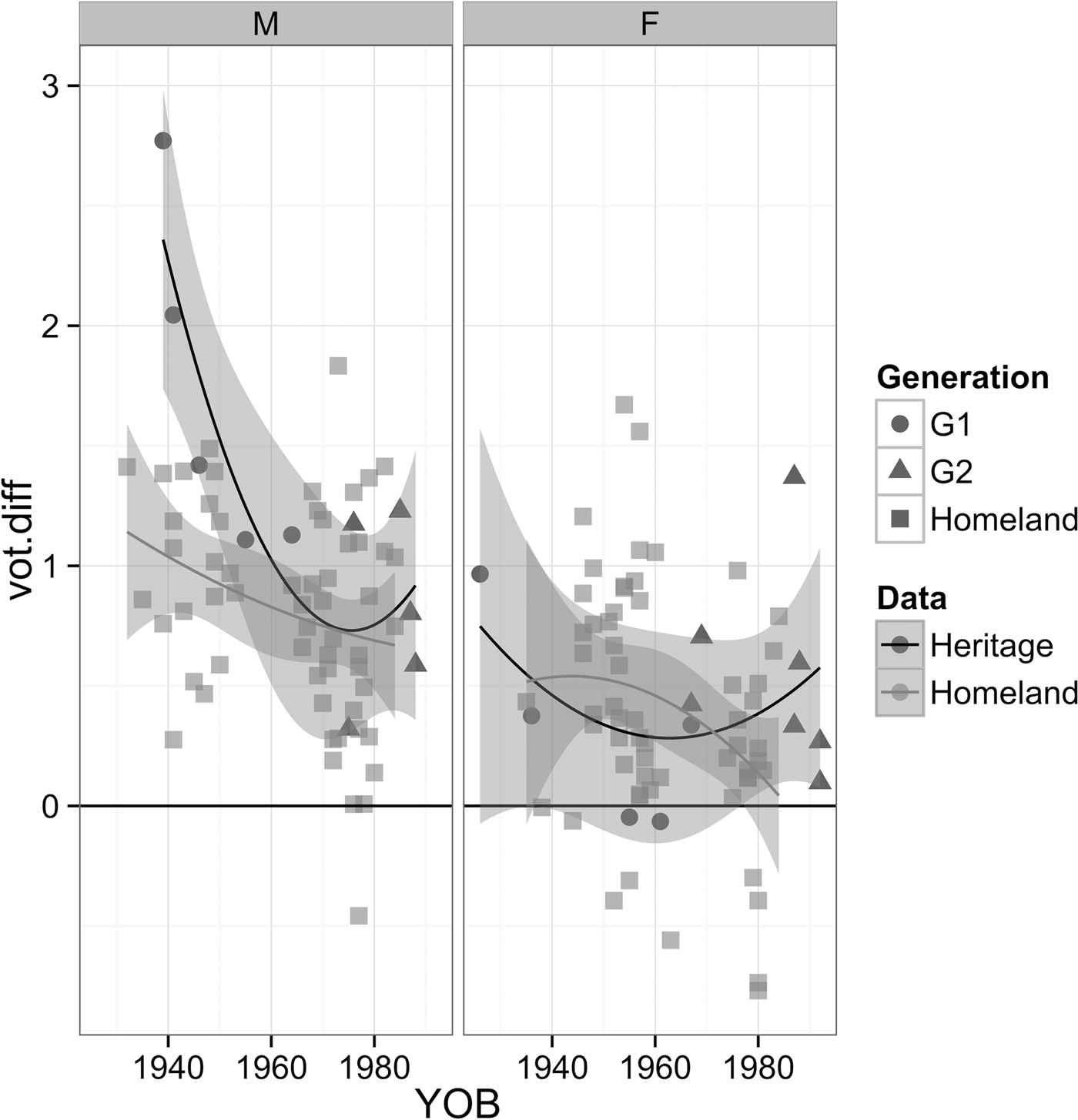
We now turn to a discussion of the implications of our findings for the Heritage Korean data. Figure 4 shows the mean VOT difference between lenis and aspirated stops, by speaker, plotted by Yob and Sex. This provides another look at the different diachronic trends in the two datasets. Particularly notable is the fact that we find a number of homeland female speakers and a couple of generation 1 heritage female speakers who have a mean VOT difference below zero indicating that they produce lenis stops with a longer VOT value than aspirated stops. In contrast, all generation 2 heritage speakers stay above zero.
By-speaker mean VOT difference between lenis and aspirated stops by speaker's Yob and Sex with trend lines and ribbons showing the 95% confidence interval.
In situations of contact between a majority and minority language, it is reasonable to expect influence of the former on the latter (e.g., VOT increases on short-lag heritage languages like Russian when spoken in an English-majority environment, Nagy & Kochetov [Reference Nagy, Kochetov, Siemund, Gogolin, Schulz and Davydova2013]). English is clearly not the cause of the ongoing VOT merger in Heritage Korean since it is documented in Homeland Korean as well. However, one might attribute the different trajectory of VOT merger in Toronto to greater English influence in Toronto than in Seoul. We conjecture that the importance of VOT as the primary cue between “voiced” and “voiceless” stops in English, the dominant language of many generation 2 speakers,Footnote 10 may influence their Korean, preventing them from entirely giving up VOT as a cue for aspirated versus lenis stop contrast.
Moreover, there is ample evidence that Korean-English bilingual speakers equate the voiceless and voiced contrast of English stops with aspirated versus lenis (or more generally nonaspirated) contrast of Korean. In English loanwords in Korean and in cross-language perception studies, English voiceless stops are systematically mapped to aspirated stops and English voiced stops vary between lenis and fortis stops of Korean with lenis stops emerging as the more dominant norm for younger speakers (Kang, Reference Kang2008; Kang & Guion, Reference Kang and Guion2006; Kang, Han, Kochetov & Kong, Reference Kang, Han, Kochetov and Kong2012; Park & de Jong, Reference Park and de Jong2008; Schmidt, Reference Schmidt1996). Our cross-language perception experiment with 20 young heritage speakers of Korean in Toronto (10 male and 10 female, Yob 1980–1993) confirms this correspondence in the population of interest. They were asked to listen to nonsense words beginning with /k/ (n = 360) or /g/ (n = 900) pronounced by three male speakers of English and choose a Korean sound (out of /k’/, /k/, and /kh/) that best matches the initial sound that they heard. The speakers consistently chose the Korean aspirated stop for English /k/ (99%) and chose the Korean lenis stop (86%) and less frequently the Korean fortis stop (12%) for English /g/. This cross-linguistic correspondence between the sound categories of bilinguals' two languages (aspirated = voiceless; lenis = voiced) may deter the complete merger of VOT contrast in the Korean categories. Moving farther along the trajectory found in Seoul would require giving up (or even reversing) a cue to a phonemic contrast that is important in English, the dominant language of many of Heritage Korean speakers. In contrast, English is not the dominant language in Seoul, so it does not act as a roadblock to this change in progress there.
Here, it is instructive to examine two other studies on VOT change in contact varieties of Korean that found the change progressing to a complete merger, similar to Seoul. Silva (Reference Silva2006) examined the VOT realization of word-initial stops produced by Korean speakers of various age groups residing in Dallas, Texas. He found that while older speakers make a clear VOT distinction between lenis and aspirated stops, younger speakers do not. Many of the speakers born in the 1970s or 1980s show a reversed VOT pattern, producing lenis stops with a longer VOT values than aspirated stops. But, note that the speakers in his study were different from our population in that they were all born, raised, and educated in the Seoul metropolitan area and moved to the United States after the age of 18. So, these younger speakers who merge the VOT of lenis and aspirated stops are essentially Seoul speakers who acquired their VOT patterns in Seoul. Silva did not discuss sex effects in his study.
Another study that examined the VOT change in a contact variety of Korean is Jin (Reference Jin2008), who examined the acoustic realization of word-initial stops produced by ethnic Koreans in Shenyang, China, which has one of the biggest Korean Chinese communities in China. Speakers were all heritage speakers of the Phyengan variety of Korean, were Chinese citizens (not temporary visitors from North Korea), and self-reported speakers of both Chinese and Korean. The study finds that Shenyang Heritage Korean is undergoing the same change of VOT merger as Seoul Korean. Jin (Reference Jin2008) found it unlikely that the change in Shenyang is due to contact with the Seoul dialect, given the geographical distance and “completely different political and cultural settings,” but rather is likely an independent internal development. In contrast to Heritage Korean spoken in Toronto, in Heritage Korean spoken in Shenyang, where English plays no dominant role, the lax ~ aspirated merger for VOT goes to completion (Jin, Reference Jin2008:99, Figure 4.3) with many speakers in their 20s (born in 1970s and 1980s) showing the reversed mean VOT values for aspirated and lenis stops. However, note that these speakers are bilinguals that speak Korean and Mandarin Chinese. Mandarin Chinese also makes a two-way laryngeal contrast of aspirated and unaspirated stops that is primarily distinguished by VOT difference, and one may wonder why Mandarin does not interfere with the VOT merger in Shenyang Korean, the way we claim English influences VOT merger in Toronto Korean.
One possibility is that the pattern of cross-linguistic correspondence between Mandarin and Korean stops is different from that of English and Korean stops. We do not have relevant cross-linguistic perception data but we have relevant evidence from loanwords. In Mandarin loanwords used in Korean communities in China, the dominant mapping pattern for word-initial stops is Mandarin aspirated stops to Korean aspirated stops and Mandarin unaspirated stops to Korean fortis stops (Ito & Kenstowicz, Reference Ito and Kenstowicz2009), leaving Korean lenis stops relatively free from interlanguage influence. Therefore, unlike the English-to-Korean influence, where the English voicing contrast may interfere with the merger of aspirated-lenis contrast, in Mandarin-to-Korean influence, the VOT contrast between Mandarin aspirated and unaspirated stops does not deter the aspirated-lenis merger.
Another possible explanation for the difference between the Heritage Korean in Toronto and Shenyang is the sociolinguistic context. The Korean community in Shenyang has a history of over 150 years and is well known for its maintenance of Korean ethnicity. It has a complete ethnic education system from kindergarten to higher education, a Korean-language newspaper, publisher and hospital, as well as churches and large shopping centers. In comparison, the Korean community in Toronto has a short history and no ethnic educational system, outside of Sunday schools and extracurricular programs. Therefore, all generation 2 speakers are raised in an English-based education system.
Available data underdetermines the choice between these alternatives. Future studies can examine other heritage Korean communities in contact with a different linguistic system or different sociolinguistic or historical contexts, such as Korean spoken by ethnic Koreans in Japan (Zainichi Korean) or by ethnic Koreans in former Soviet Union states (Koryo-mar) as well as Korean spoken in major Korean communities in the United States (cf. Brown & Yeon, Reference Brown, Yeon, Brown and Yeon2015).
Now we turn to the sex patterns in Heritage Korean in Toronto. Recall that a sex difference in laryngeal contrast realization found in all age groups of homeland speakers and the older (generation 1) speakers of Toronto is not found in the younger (generation 2) speakers. We consider two possible explanations. The first possibility is that that the generation 2 heritage speakers (the first generation of speakers that acquired Korean outside the homeland context) are simply not acquiring the sex-conditioned variation (Gerard van Herk, personal communication, May 2012). This replicates the findings discussed in the introduction in which language-internal sex effects pattern differently in language contact situations, perhaps because of the availability of switching between varieties as a marker of identity. Alternatively, the decrease in effects may result from the diffusion of the variety (Labov, Reference Labov2007)—heritage speakers have multiple varieties in their input, necessarily resulting in less heritage input because of the presence of the majority language. The Korean input may be insufficient for full replication of the previous generation's patterns.
Interestingly, Newlin-Łucowicz (Reference Newlin-Łukowicz2014:372) reported the emergence of a sex effect in English VOT patterns in the second generation of a Heritage Polish sample of speakers in New York City. In a sense, this is a mirror image of the findings we report here. That is, our speakers, speaking their heritage language, have VOT patterns more differentiated by sex in the first generation while her speakers, speaking English, have VOT patterns differentiated by sex only in the second generation. She also notes that in (British monolingual) English, there is a sex effect for VOT: women produce longer VOTs than men (Whiteside, Henry, & Dobbin, Reference Whiteside, Henry and Dobbin2004). Extrapolating from these three sets of findings, it seems that bilingual speakers are more likely to show sex differentiation in their dominant language than in their lesser-used language. Further exploration of these first two possibilities should include examining the VOT patterns in the English of Toronto's Korean community (and/or the Heritage Polish speech in the community studied by Newlin-Łucowicz (Reference Newlin-Łukowicz2014)).
The other possible explanation for the lack of a sex effect is due to the onset of a female-led change in the reverse direction, in other words, female speakers are actively (re)introducing the VOT contrast due to the influence of English. This follows the sociolinguistic expectation that in female-led changes, males more fully retain the speech pattern they inherit from their caregivers and their speech remains more stable through adolescence while females push changes ahead further during the teenage years (Labov, Reference Labov2001). This behavior on the part of the females resembles that observed in at least one other situation. Kera, a Chadic language spoken in Chad and Cameroon, is a language that has recently undergone a tonogenesis-like change, as reported in Pearce (Reference Pearce2009). The “voicing” contrast is now signaled primarily by F0 and secondarily by VOT. Speakers who live in towns are in contact with French (a contrastive VOT language) and they show increased sensitivity to VOT, in contrast to monolingual speakers living in villages. In both towns and villages, females lead: they are more Kera-like in the villages and more French-like in the towns. The pattern has made a U-turn in towns—the VOT contrast that was on its way out in the monolingual (villager) speech is reintroduced due to the influence of French, a more prestigious language with which Kera is in contact.
Here again, the available data underdetermines the choice of alternatives but the two explanations make different predictions about the future trajectory of this change. The first view predicts that the sex contrast will be largely neutralized in later generations and additionally predicts concomitant change in other conditioning factor effects. The second predicts that females will be a step ahead in reintroducing the VOT contrast, but that males will follow. To determine which explanation best accounts for the data, we must wait and see what trajectories emerge in the future.
Before closing the paper, we would be amiss if we do not point out some limitations of our findings. The number of heritage language speakers examined in the study is small, compared to the homeland sample. Also, the homeland and the heritage data come from speech of different styles—the homeland data comes from reading passages while heritage data is conversational speech. Most other studies on the VOT change in Korean are based on word reading tasks. But, note that if different styles were to affect the pattern of VOT productions, one may predict a more careful production (and better preservation of contrast) in read speech than in conversational speech, which is the opposite of our findings: we found a more conservative VOT pattern in the heritage data (conversational speech) than in the homeland data (reading passage). Also, it is noteworthy that a recent study on the California vowel shift that compares various elicitation methods found that, contrary to expectation, a traditional sociolinguistic interview and a reading passage produced comparable results as far as the vowel shift is concerned (Boyd, Elliott, Fruehwald, Hall-Lew, & Lawrence, Reference Boyd, Elliott, Fruehwald, Hall-Lew and Lawrence2015). But, it should be acknowledged that we do not know enough about how the speech style interacts with language change. It is possible that the VOT contrast in Korean may be more susceptible to prosodically conditioned variation than vowel quality in stressed vowels of English.
In sum, the present study is a departure from most previous studies that focus on contact between two-way systems where variation along a single dimension of VOT was compared. In spite of the limitations just noted, this study makes a contribution to sociolinguistic investigation of language contact, by examining how the multiple acoustic dimensions involved in the system of three-way contrast interacts with the majority language's system of two-way contrast.
APPENDIX: HERITAGE KOREAN SPEAKER SAMPLE
This table provides individual production patterns and additional background information about the Heritage Korean speakers, to show the range of speaker types constituting the sample. The VOT.diff column provides a normalized difference of the average VOT duration for lenis versus aspirated tokens for each speaker. The F0.diff column does the same for the fundamental frequency (in semitones) measured at the midpoint of the following vowel.
The EOQ column provides an average over responses to the Ethnic Orientation Questionnaire. Values are provided for speakers who answered more than half the questions. See Nagy et al. (Reference Nagy, Chociej and Hoffman2014) for methodological details.