Introduction
Seeds with morphophysiological dormancy (MPD) have small underdeveloped embryos that are physiologically dormant and must grow inside the seed before radicle emergence. The small embryos may be differentiated into cotyledon(s) and hypocotyl/root or be a mass of undifferentiated cells. In the latter case, the undifferentiated embryo develops organs and thus becomes a differentiated underdeveloped embryo that grows prior to germination. Thus, germination involves the breaking of physiological dormancy (PD) as well as growth, or differentiation and growth, of the embryo. Deep simple double dormancy is one of the nine known levels of MPD, and seeds with this kind of dormancy are sometimes referred to as ‘two-year seeds’ (Baskin and Baskin, Reference Baskin and Baskin2014). Early studies on germination phenology (MacDougal, Reference MacDougal1901; Rennert, Reference Rennert1902; Pickett, Reference Pickett1913) revealed that the root emerges the first year and the shoot the second year following seed dispersal.
Barton and Schroeder (Reference Barton and Schroeder1942) conducted the first physiological studies on seeds with deep simple double MPD and showed that cold stratification was required for root production in seeds of Convallaria majalis and Smilacina racemosa. Further, they found that a second cold treatment was required to break dormancy of the shoot bud, but seeds with an emerged root (which they called seedlings) required a 2- to 3-month period of warm treatment before cold was effective in promoting shoot growth. In a subsequent study, Barton (Reference Barton1944) showed that seeds of Trillium grandiflorum required cold stratification for root emergence, a warm treatment (during which the root system developed) and then a second cold stratification period for elongation of the cotyledon. The few studies on seeds with deep simple double MPD since the 1940s have focused primarily on germination phenology and on the cold and warm treatments required for complete germination, i.e. both root and shoot emergence (e.g. Platt, Reference Platt1951; Reference TakagiTakagi, 2001a, Reference Takagib). However, some attention also has been given to embryo growth (Gyer, Reference Gyer1997; Kondo et al., Reference Kondo, Mikubo, Yamada, Walck and Hidayati2011; Baskin and Baskin, Reference Baskin and Baskin2014).
We are aware of only three studies in which the phenology of embryo growth was described in seeds with deep simple double MPD. Embryos grew prior to root emergence in seeds of T. grandiflorum given 90 d of cold stratification at 5°C and then moved to 25°C (Gyer, Reference Gyer1997). For seeds of Trillium camschatcense dispersed in summer and subsequently exposed to natural (low) winter temperatures, embryo growth occurred the following summer before the roots emerged (Kondo et al., Reference Kondo, Mikubo, Yamada, Walck and Hidayati2011). After seeds of Paris quadrifolia had been cold stratified at 5/1°C for 12 weeks, embryos grew at 25/15°C just before root emergence (Baskin and Baskin, Reference Baskin and Baskin2014). T. camschatcense is the only one of these three species in which both embryo growth and germination phenology (root and shoot emergence) have been studied in detail (Kondo et al., Reference Kondo, Mikubo, Yamada, Walck and Hidayati2011).
With the exception of some species of the eudicot genera Caulophyllum, Clematis, Corydalis and Sanguinaria that have deep simple double MPD, species known to have this kind of dormancy are monocots (Baskin and Baskin, Reference Baskin and Baskin2014). Since the morphology of germination in monocots and eudicots differs, we need to pay close attention to the sequence of morphological events in studies on the germination of seeds with deep simple double MPD. For example, whereas the first structure to emerge from a germinating seed of a eudicot is typically the primary root (Bewley and Black, Reference Bewley and Black1994), in many monocots it may be the cotyledonary petiole/sheath with the embryonic root–shoot axis inside it, the hypocotyl or even the shoot. Further, a primary root may not be formed in some monocots (e.g. Boyd, Reference Boyd1932; Barton and Schroeder, Reference Barton and Schroeder1942; Kaul, Reference Kaul1978; Tillich, Reference Tillich, Rudall, Cribb, Cutler and Humphries1995, Reference Tillich2007). In the two monocot genera, Convallaria and Trillium, which were the subjects of some of the earliest detailed studies of deep simple double MPD, the primary root emerges from the root–shoot axis following emergence of the cotyledonary petiole (hereafter, emergence of cotyledonary petiole/primary root will be referred to as root emergence).
Following root emergence in Trillium, which has epigeal germination (Boyd, Reference Boyd1932; Tillich Reference Tillich, Rudall, Cribb, Cutler and Humphries1995; Ohara and Kawano, Reference Ohara and Kawano2005; Suzuki and Kawano, Reference Suzuki and Kawano2010; Kondo et al., Reference Kondo, Mikubo, Yamada, Walck and Hidayati2011), the cotyledon elongates above ground in the second spring and turns green; however, the tip of the cotyledon remains inside some seeds and acts as a haustorium (Tillich, Reference Tillich, Rudall, Cribb, Cutler and Humphries1995, Reference Tillich2007). The cotyledon grows and withers within the year, and the first true leaf emerges the next (third) year for Trillium. However, in Convallaria, which has hypogeal germination (Barton and Schroeder, Reference Barton and Schroeder1942; Tillich, Reference Tillich, Rudall, Cribb, Cutler and Humphries1995), the cotyledon blade remains inside the seed underground following root emergence, and a bud is formed from the apical portion of the embryonic root–shoot axis. The first non-cotyledon leaf (shoot) emerges above ground from the bud after the second winter.
Since Convallaria is in the Asparagaceae (Asparagales) and Trillium is in the Melanthiaceae (Liliales), it should not be too surprising that the morphology of seed germination in the two genera differs (Tillich, Reference Tillich, Rudall, Cribb, Cutler and Humphries1995). However, the differences in morphology raise questions about the timing of embryo growth. From studies by Kondo et al. (Reference Kondo, Mikubo, Yamada, Walck and Hidayati2011), we know that the embryo grows in seeds of T. camschatcense prior to root emergence, but no detailed studies have been done on embryo growth in seeds of Convallaria. Thus, one purpose of our research was to determine the time of embryo growth in Convallaria in relation to root emergence and to compare it with that in Trillium. Thus, since (1) Convallaria and Trillium have different germination morphologies, and (2) there is much variation in timing of embryo growth in seeds of species with MPD (Baskin et al., Reference Baskin, Chien, Chen and Baskin2009; Chien et al., Reference Chien, Chen, Tsai, Baskin, Baskin and Ku-Huang2011), we hypothesized that the timing of embryo growth would differ in species of Convallaria and Trillium.
The species of Convallaria used in this study was C. keiskei Miquel (or C. majalis L. var. manshurica Komar., C. majalis L. var. keiskei Makino; Ohwi, Reference Ohwi1983), which grows in northern Japan, especially in Hokkaido. Since seeds of C. majalis have deep simple double MPD (Barton and Schroeder, Reference Barton and Schroeder1942), we inferred that those of C. keiskei also have this kind of dormancy, but no previous experimental work was available to confirm this inference. Thus, another purpose of our research was to determine if seeds of C. keiskei have deep simple double MPD. Our study was designed to obtain detailed information on: (1) the phenology of embryo growth and of root and shoot emergence; and (2) the requirements for embryo growth and for root and shoot emergence. Phenology of embryo growth and of root and shoot emergence was monitored under natural conditions outdoors in Hokkaido. In the laboratory, we conducted experiments to determine if two periods of cold stratification are required for seedling production: the first one for root emergence and the second one for shoot emergence. Further, we tested whether gibberellic acid (GA3), which does not break deep PD (Baskin and Baskin, Reference Baskin and Baskin2014), would substitute for a cold requirement for root emergence. Finally, we compared our results to those previously obtained for T. camschatcense, which also grows in Hokkaido, to determine if subdivisions within deep simple double MPD are needed.
Materials and methods
Preparation of seeds
Ripe, red, soft-pulped fruits of C. keiskei were collected from a natural population in an urban park in Sapporo, Japan, on 4 and 15 October 2008 and on 7 October 2009. The fruits were stored in polyethylene bags at 15/5°C (12 h light/12 h dark) for 1–6 d, and then they were scrubbed by hand with gauze under running water to remove the pulp. To keep the environment of the seed similar to that experienced inside a fruit, seeds were placed in Petri dishes and kept moist at 15/5°C in darkness until the experiments were started (as described below). Seeds with a diameter of 3–5 mm were used in experiments, because those with a diameter of < 3 mm rotted in preliminary experiments.
Outdoor studies
Fresh seeds were buried on 23 October 2008 in soil (1:1 v/v mixture of leaf mould and red clay granules 2–4 mm in diameter) in pots or trays, depending on the experiment. The pots and trays were placed in an open-top framehouse on the campus of Hokkaido University, Sapporo. This structure is shaded by trees during summer and receives natural amounts of snowfall and rainfall; thus, the environment inside the framehouse is very similar to that in a natural forest. Soil was kept continuously moist either by natural rainfall or by hand-watering; soil was covered by snow from early December to early April and did not receive supplemental watering during this period. Temperatures at the soil surface were measured in three places every 15 min throughout the study using thermo data loggers (RT-30S, Espec Mic, Aichi, Japan). Daily mean, maximum and minimum temperatures were determined from these data.
Phenology of embryo growth
On 23 October 2008, ten fresh seeds were cut longitudinally into thin sections using an auto-microtome (Plant Microtome Automatic MT-2, Nippon Medical and Chemical Instruments, Osaka, Japan). Then, initial length and width of the embryo and of the endosperm of each seed were measured using an optical microscope equipped with a micrometer. The size of C. keiskei seeds varied between 3 and 5 mm in diameter; therefore, the percentage of embryo length to endosperm length and percentage of embryo width to endosperm width were calculated for each seed.
Fifteen fresh seeds were placed into each of 17 bags made with non-woven fabric and buried 1 cm deep in soil in a nursery tray. One bag was removed from the soil approximately monthly from 23 October 2008 to 28 May 2009, and approximately weekly from 28 May 2009 until 11 September 2009. Soon after removal, embryo and endosperm length and width of ten seeds were measured as described above.
Because embryos were fragile in August and September 2009, it was difficult to cut them with the auto-microtome. Therefore, they were removed from seeds by cutting the seed surface at a shallow depth with a razor blade, and then measuring the embryo and endosperm length and width with a digital caliper.
Phenology of root emergence
Four bags containing 50 fresh seeds each were buried 1 cm deep in soil in a nursery tray. Root emergence was monitored approximately monthly between 23 October 2008 and 9 June 2009, and approximately weekly between 9 June 2009 and 9 September 2009. At each observation, bags were taken from the soil and brought to the laboratory, and seeds with an emerged root were counted and removed from the bags under fluorescent light (c.10 μmol m− 2s− 1; 400–700 nm) within 10 min. Then the remaining seeds were reburied.
Growth of roots and buds
Fifteen fresh seeds were placed in each of 16 bags and buried 1 cm deep in soil in a nursery tray. One bag each was removed from the soil about weekly from 17 June 2009 to 7 August 2009, and about monthly from 7 August 2009 to 18 May 2010, and maximum root and bud length were measured.
Phenology of shoot emergence
Approximately 100 fresh seeds were placed in each of 20 bags and buried 1 cm deep in soil in a nursery tray. On 10 July 2009, all bags were removed from the soil, and seeds with a root 1.5–3.5 cm long were selected. Four replicates of 30 seeds each with an emerged root were planted about 1 cm deep in soil in pots. The number of emerged shoots was recorded on 7 April 2010 and weekly from 30 April to 10 June 2010.
Laboratory experiments
Unless otherwise stated, seeds were sown as follows. They were placed in 90-mm-diameter plastic Petri dishes on three sheets of filter paper moistened with distilled water. The dishes were sealed with Parafilm (Pechiney Plastic Packaging, Menasha, Wisconsin, USA) and enclosed in transparent polyethylene bags (Ziploc, Asahi Kasei Home Products, Tokyo, Japan) to reduce water loss during incubation. For incubation in darkness, Petri dishes were wrapped additionally with two layers of aluminium foil. Experiments were conducted at constant temperature regimes or at 12 h/12 h alternating temperature regimes. Distilled water was supplied to the dishes as needed.
Seeds of C. keiskei buried in soil germinated to high percentages in darkness in a preliminary experiment. Therefore, laboratory studies were conducted in darkness except for the experiment on ‘Effects of light on root emergence’. When germination was monitored for seeds incubated in darkness, seeds were exposed to fluorescent light with a photon flux density of about 10 μmol m− 2s− 1 (400–700 nm) for about 1 min every week or every 30 d, depending on the experiment.
At each observation, seeds with an emerged root and dead seeds (brown and soft) were removed from the dishes, and Parafilm was exchanged; aluminium foil and filter papers were also replaced if necessary. Percentages of seeds with an emerged root and of dead seeds were calculated based on the total number of seeds sown per dish. The highest percentage of dead seeds in any experiments was 4.6.
Embryo growth and root emergence under simulated seasonal temperature sequences
To better understand germination phenology outdoors, embryo growth and root emergence in seeds collected in 2008 were investigated using temperature sequences that simulated the progression of seasons. Monthly temperature data for Sapporo were compiled from the Japan Meteorological Agency (2011) to determine the temperatures to be used in the simulated sequences of seasonal temperatures.
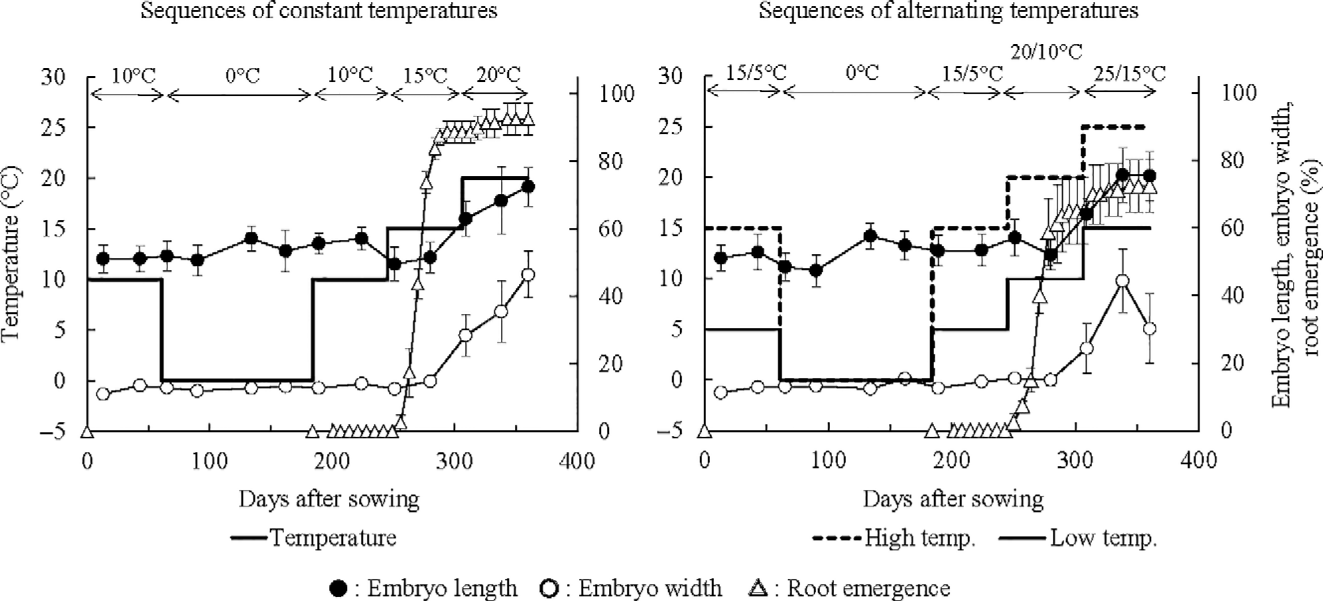
Starting with autumn, when seeds of C. keiskei mature, seeds were moved ( → ) through simulated monthly temperature sequences. Two temperature regimes were used: alternating regimes approximating the wide amplitude of fluctuation on the soil surface (Kondo et al., Reference Kondo, Sakai and Sasaki2002) and constant regimes resembling the narrow fluctuation below ground (Kondo et al., Reference Kondo, Sakai and Sasaki2002). The sequence was set up in duplicate, with one set of seeds receiving constant temperatures and the other set alternating temperatures: autumn (10°C or 15/5°C for 60 d) → winter (0°C, i.e. under snow for 120 d) → spring (10°C or 15/5°C for 60 d) → early summer (15°C or 20/10°C for 60 d) → late summer (20°C or 25/15°C for 60 d).
Fifty seeds were placed in each of four dishes at the two temperature sequences on 28 October 2008. At approximately monthly intervals from 28 October 2008 to 7 October 2009, ten seeds were chosen randomly from the four dishes under fluorescent light and embryo and endosperm lengths and widths measured as described above. Four replicates of 25 seeds per dish were incubated at each of the two temperature sequences, starting on 16 October 2008. After exposure to winter temperature (i.e. 180 d after seed sowing), seeds with an emerged root were counted and removed from the dishes weekly.
Effects of single temperature regimes on root emergence
On 15 October 2009, four replicates of 50 fresh (collected 2009) seeds per dish were incubated at constant (5°C, 10°C, 15°C, 20°C, 25°C and 30°C) and alternating (15/5°C, 20/10°C, 25/15°C and 30/20°C) temperature regimes for 356 d. Seeds with an emerged root and dead seeds were counted and removed from the dishes weekly.
Effects of constant and alternating temperatures on root emergence
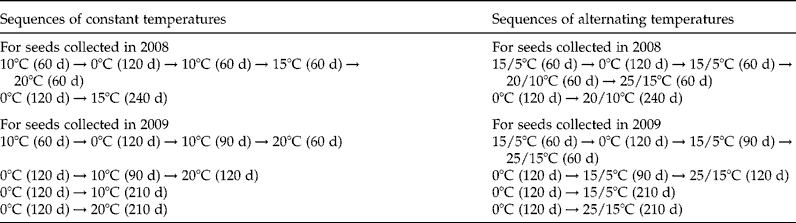
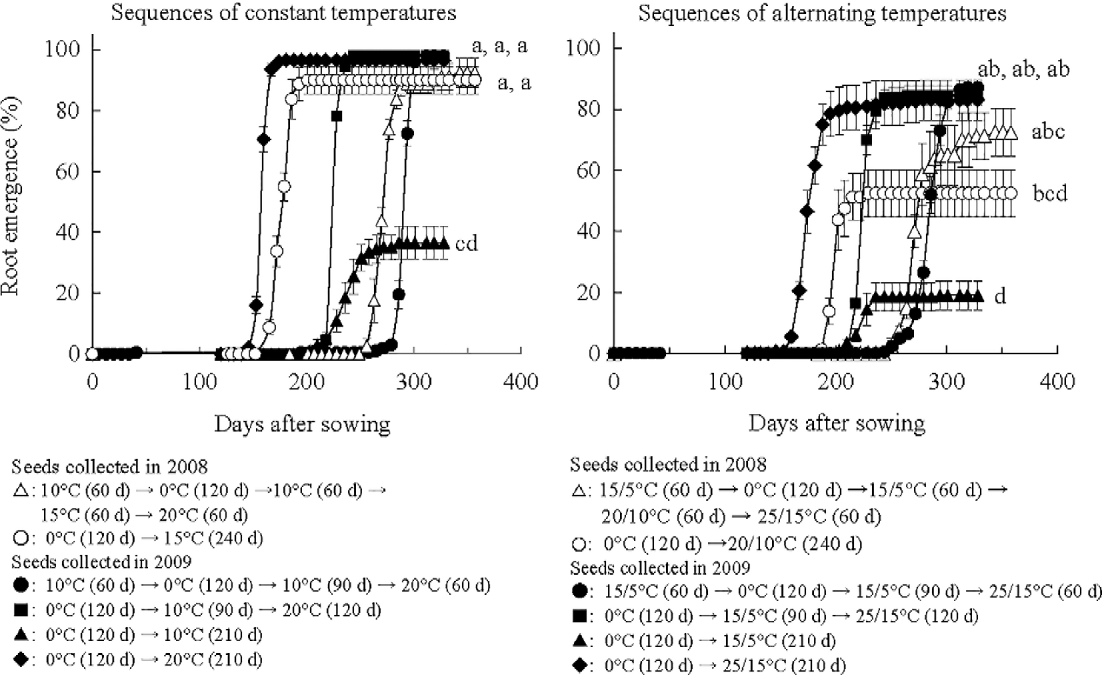
A series of temperature sequences (Table 1) was used to examine the effects of constant and alternating temperature sequences on root emergence from seeds collected in 2008 and 2009.
Sequences of constant and alternating temperatures used to test root emergence from seeds of Convallaria keiskei collected in 2008 and 2009

For experiments conducted on seeds collected in 2008, four replicates of 25 seeds per dish were incubated for 360 d starting on 16 October 2008, and for experiments on seeds collected in 2009 four replicates of 50 seeds per dish were incubated for 330 d starting on 15 October 2009. Seeds with an emerged root were counted every week, except when seeds were at 0°C.
Temperature requirements for shoot emergence from seeds with an emerged root
On 23 October 2008 about 100 fresh seeds were placed in each of 20 bags and buried about 1 cm deep in soil in a nursery tray. On 18 June 2009, the bags were removed from the soil and seeds with a root 1–10 mm long were selected. Twenty-five of these seeds were planted at a depth of approximately 1.5 cm in polyethylene containers (15 × 10 × 5 cm deep with eight 5-mm-diameter drainage holes in the bottom) filled with soil and placed in a tray. Then, the tray and containers were enclosed in a transparent plastic bag with small holes punctured in it to allow air exchange.
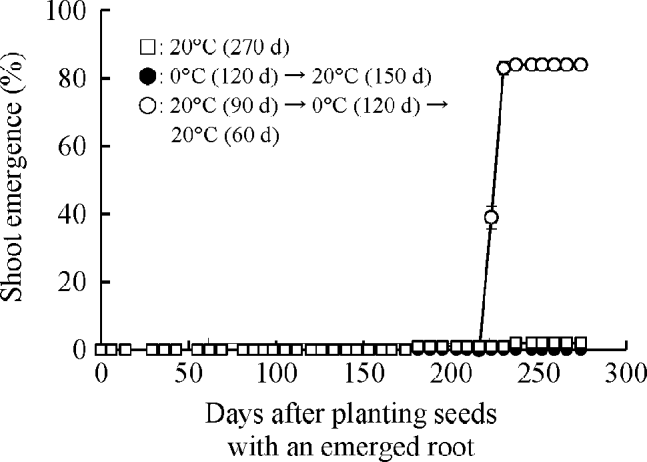
Four replicates of the containers were subjected to each of three temperature treatments under fluorescent light (15–24 μmol m− 2s− 1) for 12 h d− 1 except during the period at 0°C (continuous darkness): (a) 20°C (270 d); (b) 0°C (120 d) → 20°C (150 d); and (c) 20°C (90 d) → 0°C (120 d) → 20°C (60 d). Distilled water was added to the soil as required to keep it moist. Shoots that had emerged above ground were counted approximately weekly, except during the period at 0°C. After initiation of shoot emergence, the plastic bag was removed from the containers to prevent exposure of the shoots to excessively high humidity. At the end of the experiment, conditions of the seeds remaining in the soil [i.e. numbers of rotten seeds, of seeds with a bud and well-developed roots (i.e. grown beyond 1–10 mm) and of seeds without a bud but with well-developed roots] were determined.
Effects of light on root emergence
On 15 October 2009, two sets of four replicates of 50 seeds each, collected in 2009, were incubated on filter paper moistened with distilled water at 0°C for 120 d and then moved to 20°C for 180 d. During incubation at 0°C, seeds were in darkness (irrespective of light/dark conditions at 20°C) and not monitored. In the light treatment, aluminium foil was removed from the one set of dishes after the 120-day period at 0°C, and then the dishes were placed at 20°C under fluorescent light (15–24 μmol m− 2s− 1) for 12 h d− 1 with root emergence monitored approximately weekly. In the dark treatment, the Petri dishes of the other set were kept wrapped with aluminium foil when moved to 20°C and kept in darkness throughout the experiment. However, seeds in darkness were exposed to fluorescent light (c.10 μmol m− 2s− 1) in the laboratory each week for about 1 min when they were checked for root emergence.
Effects of GA3 on root emergence
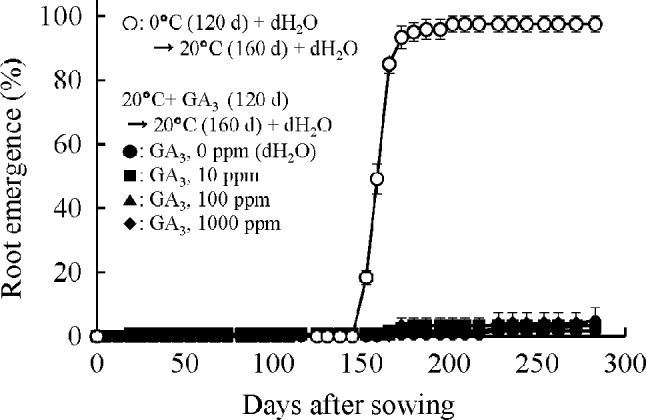
To determine if GA3 substitutes for a low temperature requirement for root emergence, four replicates of 30 seeds (2009 collection) each were used in the following treatments, starting on 17 October 2009: 0°C with distilled water (0 ppm GA3) (120 d) → 20°C with distilled water (160 d); and 20°C with 10, 100 or 1000 ppm GA3 (120 d) → 20°C with distilled water (160 d). Two to three drops of ethyl alcohol were added to the distilled water to dissolve GA3. Filter papers in the dishes were moistened with 5 ml of distilled water or with 5 ml of a GA3 solution. To prevent changes in concentration of GA3 by water loss, Petri dishes containing seeds were sealed with Parafilm and placed in closed polyethylene bags. After the 120-day treatment, the seeds were rinsed with distilled water and placed on filter papers moistened with distilled water. Seeds with an emerged root and dead seeds were counted and removed weekly.
Statistical analyses
The program SPSS Statistics 17.0 (IBM, Somers, New York, USA) was used for the statistical analyses. To compare values, a t-test was applied when two treatments were involved (P < 0.05) and a one-way analysis of variance (ANOVA) followed by Scheffé's test (P < 0.05) when three or more treatments with one factor were involved. Percentages were arcsine square-root transformed for analyses, but non-transformed data are shown in the figures.
Results
Outdoor studies
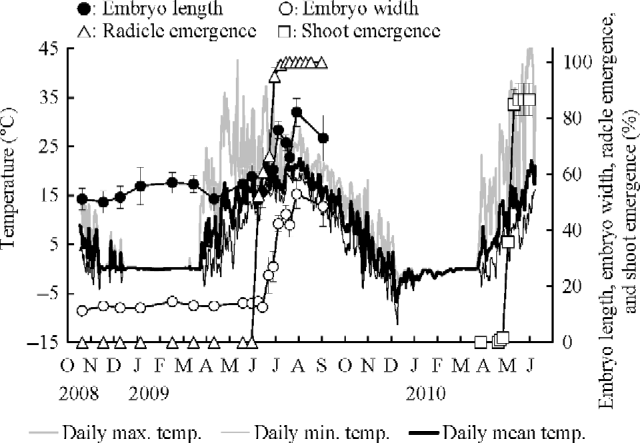
Initial embryo length in fresh seeds on 28 October 2008 was 51.1% of endosperm length, and initial embryo width was 11.3% of endosperm width (Figs 1 and 2). Embryos were linear in shape, and they began to grow soon after the roots emerged, on 17 June 2009. Thereafter, they became spherical, filling the interior of the seed. By 7 August 2009, embryos had reached a maximum of 82.2% and 52.9% of endosperm length and width, respectively, and they were easy to detach from the remaining endosperm (Fig. 2). On 11 September 2009, embryos in some seeds had begun to disintegrate (Fig. 2). Between 17 June 2009 and 7 August 2009, when embryos grew, average maximum, minimum and mean daily temperatures were 24.7°C, 15.9°C and 18.8°C, respectively (Fig. 1).
Phenology of embryo growth and of emergence of roots and shoots from seeds of Convallaria keiskei outdoors in Hokkaido, Japan. Embryo length and width are expressed as a percentage of the endosperm length and width, respectively. Error bars are ± 1 SE.

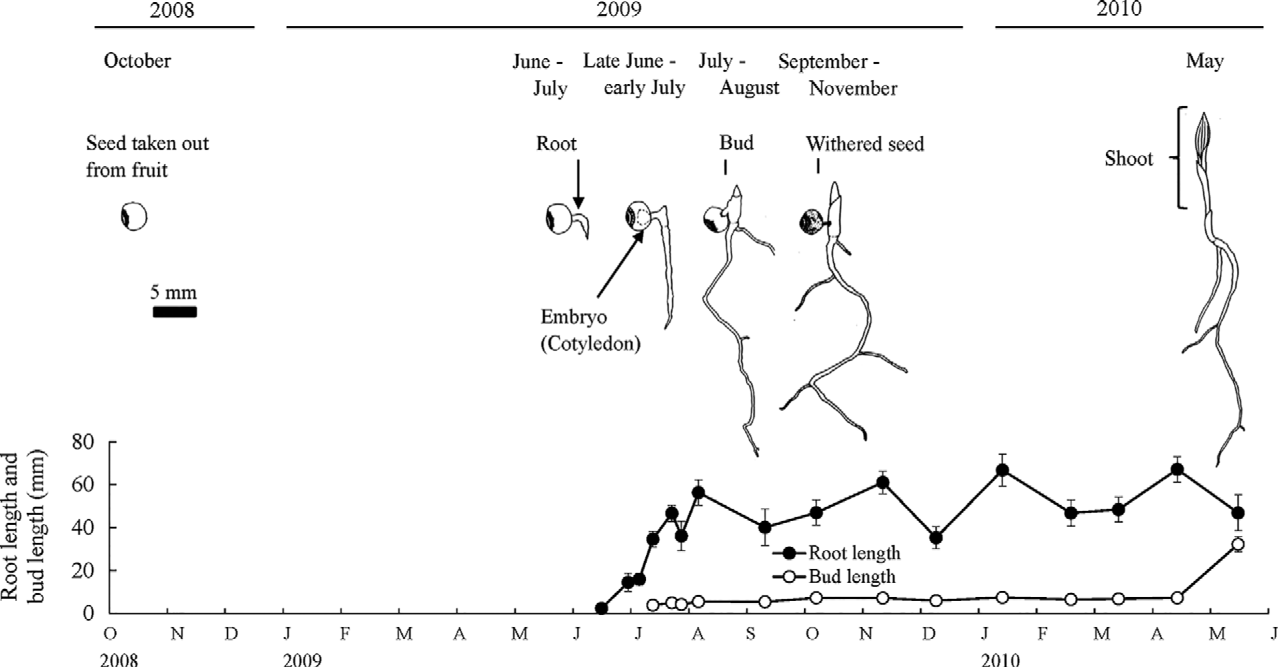
Development of the embryo in seeds of Convallaria keiskei collected in 2008 and sown outdoors.

For seeds buried on 23 October 2008 no roots emerged during autumn 2008, winter 2008–2009 or spring 2009; seeds were under snow (0°C) from 19 November 2008 to 2 April 2009 (Fig. 1). Roots had not emerged by 9 June 2009, but they had done so in 52.5% of the seeds by 17 June, just prior to embryo growth. By 24 July 2009, the root had emerged from 100% of the seeds. Average maximum, minimum and mean daily temperatures between 9 June and 24 July 2009, when roots emerged rapidly, were 24.5°C, 14.5°C and 17.6°C, respectively (Fig. 1). After 17 June 2009, when root emergence was first observed, roots grew rapidly and reached 56.3 ± 6.0 mm (average ± 1 SE, n= 14) by 7 August 2009, after which they stopped growing (Fig. 3).
Growth of roots and underground buds from Convallaria keiskei seeds collected in 2008 and sown outdoors. Error bars are ± 1 SE. Data for root growth were collected from four seeds on 17 June and from 10–15 seeds on all other dates. No seeds had buds from 17 June to 7 July; bud growth data were collected from 11–15 seeds for all other dates. The term ‘root’ on the second drawing of a seed (from left) in the figure refers to the cotyledonary petiole/sheath that contains the root–shoot axis.

Bud formation underground was first observed on 14 July 2009, and buds grew to 5.5 ± 0.4 mm (n= 14) by 7 August 2009. No further bud growth was observed until 16 April 2010. By 18 May 2010, buds had reached a maximum length of 32.2 ± 3.6 mm (n= 11). The first shoot (i.e. first true, non-cotyledonous leaf) that had emerged above ground was observed on 3 May 2010, after the second winter following seed maturation (Fig. 1). Then, shoot emergence increased rapidly to 86.7% by 27 May 2010. Average maximum, minimum and mean daily temperatures between 3 May 2010 and 27 May 2010 were 24.5°C, 7.0°C and 12.4°C, respectively (Fig. 1).
Laboratory experiments
Embryo growth and root emergence under simulated seasonal temperature sequences
In the constant and alternating temperature sequences, roots emerged from seeds at 15°C and 20/10°C, respectively, during early summer after incubation at the autumn → winter → spring temperature sequence (Fig. 4). Final percentage of root emergence at the constant temperature sequence (92.5%) was marginally significantly different from that at the alternating temperature sequence (72.5%) (t-test, P= 0.054). In both temperature regimes, roots emerged from seeds prior to embryo growth. At the end of the two sequences, embryo length and width were about 1.4 and 3.5 times their initial size, respectively.
Embryo growth and root emergence from Convallaria keiskei seeds collected in 2008 under simulated seasonal temperature sequences. Embryo length and width are expressed as a percentage of the endosperm length and width, respectively. Error bars are ± 1 SE.

Effects of single temperature regimes on root emergence
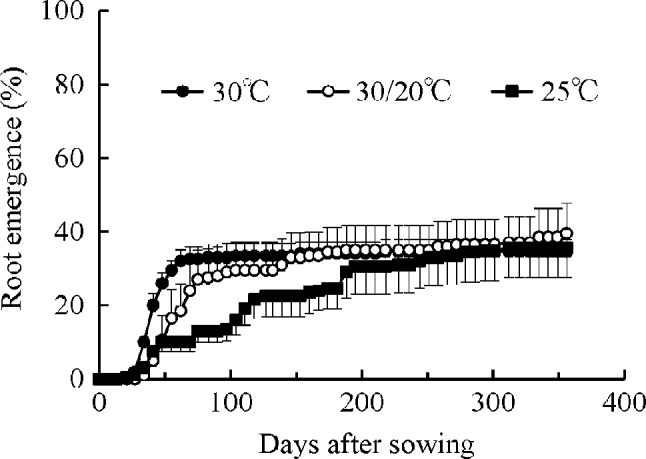
Roots had emerged from 10% of the seeds at 30°C, 3% at 25°C and 1% at 30/20°C by 34 d after sowing; however, they had not emerged from seeds at any other temperature (Fig. 5). At 30°C and 30/20°C, roots had emerged from about 30% of the seeds by 75 d after sowing and from 13% at 25°C. Even after >350 d of incubation at 30°C, 30/20°C and 25°C, roots had emerged from < 40% of the seeds. Less than 1.5% of the seeds produced roots at 5°C, 10°C, 15°C, 20°C, 15/5°C, 20/10°C and 25/15°C.
Effects of single temperature regimes on root emergence from Convallaria keiskei seeds collected in 2009. Root emergence at 5°C, 10°C, 15°C, 20°C, 15/5°C, 20/10°C and 25/15°C was < 1.5%. Error bars are ± 1 SE.

Effects of constant and alternating temperatures on root emergence
In both alternating and constant temperature regimes, roots emerged from seeds after incubation at 0°C (Fig. 6). Roots emerged from < 37% of seeds at 10°C and 15/5°C following incubation at 0°C for 120 d. In the other constant temperature regimes, roots emerged from 90.0–98.0% of seeds collected in both 2008 and 2009 after incubation for 120 d at 0°C but from 52.5–83.0% of those in the alternating temperature regimes.
Effects of constant (left) or alternating (right) temperature sequences on root emergence from Convallaria keiskei seeds collected in 2008 and 2009. Final percentages of root emergence with different letters are significantly different in comparisons among all constant and alternating temperature sequences (one-way ANOVA followed by Scheffé's test, P < 0.05). Error bars are ± 1 SE.

Temperature requirements for shoot emergence from seeds with an emerged root
Shoots emerged from < 2% of seeds with an emerged root when incubated continuously at 20°C (270 d) and at 0°C (120 d) → 20°C (150 d) (Fig. 7). In contrast, 84.0% of the shoots emerged from seeds with an emerged root within 27 d at 20°C following 20°C (90 d) → 0°C (120 d).
Temperature requirements for shoot emergence from Convallaria keiskei seeds with an emerged root. Seeds were collected in 2008. Error bars are ± 1 SE.

At the end of the experiment, all seeds without a shoot at 20°C (270 d) had developed roots 4–8 cm in length. Of these seeds, 31.5% had well-developed roots and a bud, and 68.5% had well-developed roots but a rotten bud. At 0°C (120 d) → 20°C (150 d), 17.4% of the seeds had well-developed roots and a bud, 40.6% did not have well-developed roots and 42.0% had well-developed roots but a rotten bud. At 20°C (90 d) → 0°C (120 d) → 20°C (60 d), 16.0% of the seeds that did not sprout shoots were rotten.
Effects of light on root emergence
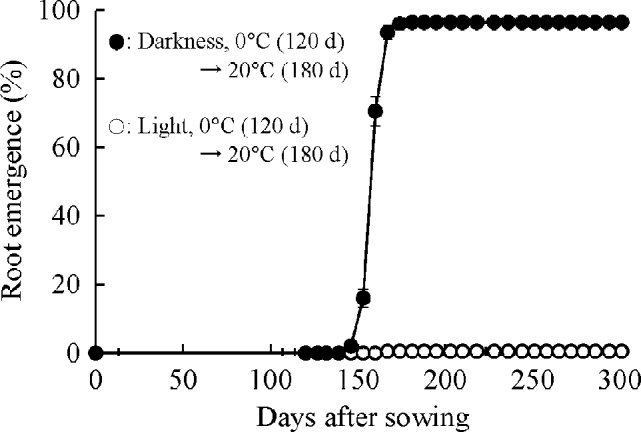
Roots emerged from 96.5% of seeds at 20°C in darkness (seeds exposed to light for about 1 min each week) following incubation at 0°C for 120 d in darkness, but from only 2.5% of those incubated in light (exposed to light for 12 h d− 1) (Fig. 8).
Effects of light (light for 12 h d− 1) and darkness (seeds were exposed to fluorescent light in the laboratory for about 1 min each week) on root emergence from Convallaria keiskei seeds collected in 2009. All seeds were in darkness while at 0°C. Error bars are ± 1 SE.

Effects of GA3 on root emergence
Roots emerged from 97.5% of the seeds incubated in distilled water (0 ppm GA3) at 20°C following 0°C (120 d) (Fig. 9). Only 1.7% of the seeds were rotten in this treatment. However, in the GA3 treatments, roots emerged from < 5% of the seeds, and percentages of rotten seeds were 1.7, 2.5, 5.0 and 5.8 in 0 (distilled water), 10, 100 and 1000 ppm of GA3, respectively.
Effects of GA3 on root emergence from seeds of Convallaria keiskei collected in 2009. Error bars are ± 1 SE.

Discussion
The phenological pattern of dormancy break in seeds of C. keiskei is similar to that in seeds of C. majalis and in those of other species with deep simple double MPD. That is, seeds require low (winter) temperatures for root emergence, and those with an emerged root require high (summer) temperature for root development and shoot bud formation and then a (second) low temperature for shoot emergence (Baskin and Baskin, Reference Baskin and Baskin2014). Thus, seeds of C. keiskei have deep simple double MPD.
In the framehouse, roots emerged in early summer after C. keiskei seeds were exposed to their first winter following dispersal in late autumn (Fig. 1). The embryo (cotyledon) grew inside seeds after the root emerged; as embryos grew inside seeds, roots grew and shoot buds were formed (Figs 2, 3); embryos disintegrated and roots and buds discontinued growth after summer (Figs 2, 3). The cotyledon remained inside the seed and presumably acted as a haustorium. Following exposure of seeds with roots and shoot buds to a second winter, green shoots emerged above ground in late spring (late April to late May) (Figs 1, 3). In laboratory experiments, roots had emerged from < 10% of C. keiskei seeds at 30°C, 30/20°C or 25°C by 34 d after sowing, and they had emerged from only about 40% of the seeds at these temperatures after 104 d (Fig. 5); root emergence increased to about 100% when seeds were incubated at a low temperature (0°C) followed by a relatively high constant temperature (20°C) (Fig. 6); and seeds with an emerged root required a high → low → high temperature sequence for shoots to emerge (Fig. 7).
In our study, light for 12 h d− 1 almost completely inhibited root emergence of seeds (Fig. 8). In Japan, C. keiskei grows in sunny lowland or coastal grasslands and on the semi-shaded forest floor of deciduous forests. Inhibition of germination by light suggests that seeds would need to be buried in soil for radicle emergence in these habitats. Since seeds of C. keiskei have been observed to be eaten by small rodents (Ohara et al., Reference Ohara, Araki, Yamada and Kawano2006), it is assumed that seeds may also be hoarded and buried by the rodents. Thus, the dark burial environment provides conditions conducive for germination.
In seeds with a deep level of PD, GA3 does not substitute for cold stratification. However, until now there was no information about its effects on breaking dormancy in seeds with deep simple double MPD (Baskin and Baskin, Reference Baskin and Baskin2014). If GA3 had substituted for cold stratification in seeds of C. keiskei, then we would have expected a high percentage of root emergence from GA3-treated seeds incubated at >10°C, i.e. outside the range of cold stratification. This was not the case (Fig. 9). Our study clearly demonstrated for the first time that GA3 does not substitute for cold stratification in seeds with this level of MPD.
Baskin and Baskin (Reference Baskin and Baskin2014) stated that two things must happen before seeds with MPD can germinate: (1) the embryo must grow to a species-specific critical size (inside the seed); and (2) PD of the embryo must be broken. However, in C. keiskei roots emerged from seeds prior to embryo (cotyledon) growth within the seed (Figs 1, 2, 3 and 4), and then embryos grew and filled the interior of the seed before shoots emerged above ground. Thus, embryo growth in C. keiskei does not fit the standard definition of MPD. That is, although the embryo clearly is underdeveloped and requires further growth inside the seed to produce a seedling with both root and shoot, it does not grow prior to root emergence. Thus, for seeds with MPD, we propose to expand the definition with regard to embryo growth as follows: the embryo must complete growth either before and/or after the root emerges but before the shoot emerges.
Although both C. keiskei (this study) and T. camschatcense (Kondo et al., Reference Kondo, Mikubo, Yamada, Walck and Hidayati2011) have deep simple double MPD, they differ considerably in the morphology of germination and in the timing of embryo growth relative to root emergence. Following dispersal in late autumn (C. keiskei) or summer (T. camschatcense), embryos inside seeds of both species grow at relatively high temperatures during the summer following the first winter. However, whereas embryos of C. keiskei grow after root emergence (Fig. 1), those of T. camschatcense do so before root emergence (Kondo et al., Reference Kondo, Mikubo, Yamada, Walck and Hidayati2011). Further, germination in C. keiskei is hypogeal and that of T. camschatcense epigeal. Finally, the first true foliage leaf of C. keiskei emerges above ground the second spring after seed dispersal, and that of T. camschatcense the third spring after seed dispersal.
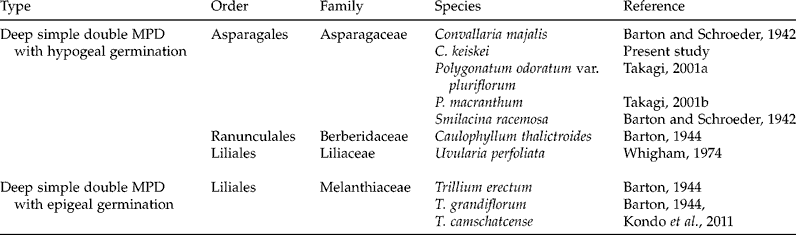
Considering the differences in germination of C. keiskei and T. camschatcense, we propose two types (sensu Baskin and Baskin, Reference Baskin and Baskin2014) of deep simple double MPD: ‘deep simple double MPD with hypogeal germination and embryo growth after root emergence’(C. keiskei) and ‘deep simple double MPD with epigeal germination and embryo growth before root emergence’ (T. camschatcense). Thus, the deep simple double level (sensu Baskin and Baskin, Reference Baskin and Baskin2014) of MPD would be expanded to include these two types. Our literature survey indicates that deep simple double MPD with hypogeal germination is found mostly in monocots, with Caulophyllum thalictroides being the only non-monocot reported to have this kind of dormancy. Trillium species are the only taxa clearly identified as having deep simple double MPD with epigeal germination (Table 2). However, it should be noted that detailed studies of embryo growth are required before the species listed in this table, except for C. keiskei and T. camschatcense, can be classified to type of deep simple double MPD.
Examples of species with deep simple double MPD and with either hypogeal or epigeal germination

Financial support
This work was supported by JSPS (Japan Society for the Promotion of Science) KAKENHI Grant Number 23580028.
Conflicts of interest
None.