Introduction
Red rice is often considered one of the most problematic weeds hindering rice production in the southern United States (Carlson et al. Reference Carlson, Webster, Salassi, Hensley and Blouin2011; Craigmiles Reference Craigmiles and Eastin1978; Smith Reference Smith1981). Smith (Reference Smith1968) reported that rice yield loss from season-long competition of dense populations of red rice could be as high as 82%. Red rice can also result in reductions in milling yields and grade (Webster Reference Webster and Saichuk2014). Because of its genetic similarities to modern cultivated rice, red rice is difficult to control with traditional labeled herbicides (Carlson et al. Reference Carlson, Webster, Salassi, Hensley and Blouin2011; Pellerin et al. Reference Pellerin, Webster, Zhang and Blouin2003, Reference Pellerin, Webster, Zhang and Blouin2004). However, with the commercialization of imidazolinone-resistant (IR) rice in 2002, producers finally had the means to manage red rice with a herbicide while producing a rice crop (Pellerin et al. Reference Pellerin, Webster, Zhang and Blouin2003, Reference Pellerin, Webster, Zhang and Blouin2004; Webster and Masson Reference Webster and Masson2001). Hybrid IR rice was released in 2003 (RiceTec Inc., Alvin, TX). Acceptance of IR rice was quick, and by 2004, 27% of rice acreage in Louisiana was planted with IR rice (Shivrain et al. Reference Shivrain, Burgos, Anders, Rajguru, Moore and Sales2007).
The seeds of IR rice hybrids have a history of seed shattering and dormancy, which can become problematic during succeeding growing seasons as a volunteer weed (Rustom et al. Reference Rustom, Webster, Blouin and McKnight2018; Sudianto et al. Reference Sudianto, Beng-Kah, Ting-Xiang, Saldain, Scott and Burgos2013). Cultivated rice and red rice are sexually compatible, and IR rice can transfer the herbicide-resistant gene to red rice (Shivrain et al. Reference Shivrain, Burgos, Anders, Rajguru, Moore and Sales2007). Several researchers have reported this type of outcrossing (Chen et al. Reference Chen, Lee, Song, Suh and LU2004; Shivrain et al. Reference Shivrain, Burgos, Anders, Rajguru, Moore and Sales2007; Song et al. Reference Song, Lu, Zhu and Chen2003).
Barnyardgrass is another problematic weed that negatively affects rice production across the rice-producing areas of the United States (Smith Reference Smith1974). Producers can expect up to a 79% yield reduction from barnyardgrass competition that occurs from rice emergence to maturity. Baltazar and Smith (Reference Baltazar and Smith1994) reported one of the first cases of barnyardgrass resistance to propanil. This was quickly succeeded by documented cases of barnyardgrass resistance to quinclorac in 1999, clomazone in 2007, and imazethapyr in 2008 (Dilpert et al. Reference Dilpert, Norsworthy, Srivastava, Nandula, Bond and Scott2013; Malik et al. Reference Malik, Burgos and Talbert2010).
After the development of IR weedy rice and several documented cases of barnyardgrass resistance to multiple modes of action, BASF launched an acetyl coenzyme A carboxylase (ACCase)-inhibiting herbicide-resistant (ACCase-R) rice system (Provisia® Rice; BASF Corp., Research Triangle Park, NC). The ACCase-R rice technology uses quizalofop as the target herbicide applied at rates of 92 to 155 g ai ha−1, and not to exceed 240 g ha−1 per year. Quizalofop provides POST control of weedy rice and other annual and perennial grasses. The ACCase enzyme is responsible for catalyzing the first committed step of de novo fatty acid synthesis (Burton et al. Reference Burton, Gronwald, Somers, Gengenbach and Wyse1989; Focke and Lichtenthaler Reference Focke and Lichtenthaler1987). Researchers in Mississippi recognized the utility of quizalofop applied at 70 to 280 g ha−1 to manage red rice populations in a soybean and rice rotation (Askew et al. Reference Askew, Shaw and Street2000; Minton et al. Reference Minton, Shaw and Kurtz1989).
Mixing herbicides with differing sites of action (SOAs) in a single application is a cost-effective way for producers to apply herbicide programs. A simple application with multiple herbicides in a mixture reduces costs, saves time, reduces wear and tear on equipment, and may broaden the weed control spectrum (Carlson et al. Reference Carlson, Webster, Salassi, Bond, Hensley and Blouin2012; Hydrick and Shaw Reference Hydrick and Shaw1995; Minton et al. Reference Minton, Shaw and Kurtz1989; Webster and Shaw Reference Webster and Shaw1997). Mixing herbicides can result in three different responses: synergism, antagonism, or an additive or neutral response (Berenbaum Reference Berenbaum1981; Blouin 2010; Colby Reference Colby1967; Fish et al. Reference Fish, Webster, Blouin and Bond2015, Reference Fish, Webster, Blouin and Bond2016; Rustom et al. Reference Rustom, Webster, Blouin and McKnight2018, Reference Rustom, Webster, Blouin and McKnight2019). Antagonism was defined by Colby (Reference Colby1967) as an interaction of two or more agrichemicals such that the effect, when the chemicals are combined, is less than the predicted effect based on the activity of each chemical applied separately. ACCase-inhibiting herbicides can often be antagonized when mixed with other broadleaf herbicides (Barnwell and Cobb Reference Barnwell and Cobb1994; Rustom et al. Reference Rustom, Webster, Blouin and McKnight2018, Reference Rustom, Webster, Blouin and McKnight2019; Zhang et al. Reference Zhang, Webster, Blouin and Leon2005). Rustom et al. (Reference Rustom, Webster, Blouin and McKnight2018, Reference Rustom, Webster, Blouin and McKnight2019) observed antagonism of quizalofop in ACCase-R rice. Quizalofop activity was reduced when applied in a mixture with the acetolactate synthase–inhibiting herbicides bensulfuron, bispyribac, halosulfuron, imazosulfuron, orthosulfamuron plus halosulfuron, orthosulfamuron plus quinclorac, penoxsulam, and penoxsulam plus triclopyr in ACCase-R rice production (Rustom et al. Reference Rustom, Webster, Blouin and McKnight2018). Quizalofop activity was also antagonized by propanil, bentazon, and saflufenacil (Rustom et al. Reference Rustom, Webster, Blouin and McKnight2019).
In 2000, clomazone was labeled for use in rice production. Clomazone (Command®; FMC Corp., Philadelphia, PA) is a Group 3 diterpene synthesis–inhibiting herbicide that interferes with chloroplast development and reduces the accumulation of plastid pigments in susceptible weed species (Ferhatoglu and Barrett Reference Ferhatoglu and Barrett2005). Clomazone applied PRE at 390 to 440 g ai ha−1 to rice on a coarse-textured soil controlled barnyardgrass 96% to 97%, and clomazone applied POST at 390 to 440 g ai ha−1 to barnyardgrass at the one- to two-leaf stage controlled barnyardgrass 85% (Willingham et al. Reference Willingham, Falkenberg, McCauley and Chandler2008). The first reported confirmation of clomazone-resistant barnyardgrass occurred in Arkansas in 2008 (Norsworthy et al. Reference Norsworthy, Scott, Bangarwa, Griffith, Wilson, Still and Wells2008).
Pendimethalin (Prowl® H20; BASF Corp.) is a Group 3 dinitroaniline herbicide that disrupts mitotic cellular division through inhibition of microtubule proteins in susceptible weed species (Vaughn and Lehnen Reference Vaughn and Lehnen1991). Pendimethalin is a soil-applied herbicide that is absorbed by germinating plant roots and coleoptiles, causing highly susceptible weed species not to emerge or to die soon after emergence. Pendimethalin is active on grass and small-seeded broadleaf weeds infesting rice when applied at different timings (Bond et al. Reference Bond, Walker and Koger2009; Malik et al. Reference Malik, Burgos and Talbert2010). RiceOne® (RiceCo LLC, Memphis, TN) is a prepackaged mixture of clomazone plus pendimethalin, 130 and 313 g ai L−1, respectively, in a formulated, dual, aqueous capsule suspension; this herbicide was labeled for use in rice in 2017.
ACCase-R rice will help preserve the IR rice system by allowing rice producers to rotate between the two systems while providing a mechanism of control for weedy rice and troublesome grass species. However, it is important for producers to know what type of interaction will occur when mixing herbicides with quizalofop in ACCase-R rice production. The objective of this research was to determine whether an antagonistic, synergistic, or neutral interaction occurs when quizalofop is mixed with clomazone, pendimethalin, clomazone plus pendimethalin, or a prepackaged mixture of clomazone plus pendimethalin.
Materials and Methods
A study was conducted in 2017 and 2018 at the Louisiana State University Agricultural Center’s H. Rouse Caffey Rice Research Station near Crowley, LA (30.177147°N, 92.3477430°W) to evaluate quizalofop applied independently or in a mixture with other herbicides with residual activity. The soil texture at the research station is a Crowley silt loam with a pH of 6.4 and 1.4% organic matter. Field preparation consisted of a fall and spring disking followed by two passes in opposite directions with a two-way bed conditioner consisting of rolling baskets and S-tine harrows set at a 6-cm depth. The research area received a preplant fertilizer application of 280 kg ha−1 8-24-24 (N-P2O5-K2O) fertilizer followed by an application of 280 kg ha−1 urea fertilizer 46-0-0 immediately before establishment of the permanent flood.
Long-grain ACCase-R rice cultivar ‘PVL01’ was drill seeded at 84 kg ha−1 on April 26 and April 12 in 2017 and 2018, respectively. Plot size was 5.1 m by 1.5 m, with eight 19.5-cm–wide rows. To simulate a weedy rice population, eight rows of IR ‘CL-111’ long-grain rice, 84 kg ha−1, was drill seeded perpendicular to the PVL01 rice in the front third of each plot, and eight rows of IR ‘CLXL-745’ hybrid long-grain rice, 84 kg ha−1, was drill seeded perpendicular to the ACCase-R rice in the back third of each plot. All drill-seeded rice was planted to a depth of 15 mm. Awnless red rice was broadcast across the study area at a rate of 50 kg ha−1 immediately before planting. The research area had a natural population of barnyardgrass. The research area was surface irrigated to a depth of 3 cm 24 h after planting.
The experimental design was two-factor factorial in a randomized complete block with four replications. Factor A consisted of quizalofop applied at 0 or 120 g ha−1. Factor B consisted of no mixture herbicide, 335 g ai ha−1 clomazone, 810 g ha−1 pendimethalin, 335 g ha−1 clomazone mixed with 810 g ha−1 pendimethalin, and 1,145 g ha−1 prepackaged mix of clomazone plus pendimethalin. Clomazone and pendimethalin rates applied alone were equal to the rates found in the prepackaged mixture. To stay within the recommended BASF stewardship guidelines to prevent outcrossing with red rice and resistance development, a second application of quizalofop was applied to the entire research area at a rate of 120 g ha−1 at 21 d after the initial quizalofop treatment (DAIT) (Anonymous 2017). A crop oil concentrate (Agri-Dex®; Helena Agri-Enterprises, Collierville, TN) was added to each herbicide treatment at 1% vol/vol.
Herbicide applications were applied with a CO2-pressurized backpack sprayer calibrated to deliver 140 L ha−1 at 190 kPa. The spray boom consisted of five flat-fan 110015 nozzles (AirMix Venturi® Flat Fan Nozzle; Greenleaf Technologies, Covington, LA) at 38-cm spacing. Each herbicide application was applied when PVLO1 rice was at the two- to three-leaf growth stage. Red rice, CL-111, and CLXL-745 were also at the two- to three-leaf stage and barnyardgrass was at the two- to four-leaf stage, with a population of 30 to 40 plants m−2.
An activating 5-cm surface irrigation was applied to the entire research area within 5 d after the POST application in 2017 and 2018. The surface irrigation water was held for 24 h before draining. An 8-cm permanent flood was established when the rice reached the one- to two-tiller growth stage, 24 h after final quizalofop application, and maintained until 21 d before harvest.
Visual evaluations of crop injury and barnyardgrass, red rice, CL-111, and CLXL-745 control on a scale of 0% to 100%, where 0% indicates no injury or control and 100% indicates complete plant death, were recorded at 7, 14, 28, and 42 DAIT. Rice plant height was recorded immediately before harvest by measuring four plants in each plot from the ground to the tip of the extended panicle. The center four rows of each plot were harvested with a Mitsubishi VM3® (Mitsubishi Corp., Tokyo, Japan). Grain moisture was adjusted to 12%.
Control data were analyzed using the guidelines described the Blouin et al. (Reference Blouin, Webster and Bond2010) augmented mixed model to determine synergistic, antagonistic, or neutral responses for herbicide mixtures by comparing an expected control calculated on the basis of the activity of each herbicide applied alone to an observed control (Fish et al. Reference Fish, Webster, Blouin and Bond2015, Reference Fish, Webster, Blouin and Bond2016; Rustom et al. Reference Rustom, Webster, Blouin and McKnight2018; Webster et al. Reference Webster, Carlson, Salassi, Hensley and Blouin2012). Rough rice yield and plant height data were analyzed using the MIXED procedure of SAS (SAS 2013). The Tukey honestly significant difference test was used to separate yield means at the 5% probability level.
The fixed effects of the model were the herbicide treatments and evaluation timings. The random effects for the model were location by year and replications within location by year, and treatment by replication interactions. The dependent variables in the separate analyses were barnyardgrass, CL-111, CLXL-745, and red rice control, along with plant height and rough rice yield. The analyses for control were by DAT. Normality of effects over all DAT was checked using the UNIVARIATE procedure of SAS. Assumptions of normality were met (SAS 2013).
Results and Discussion
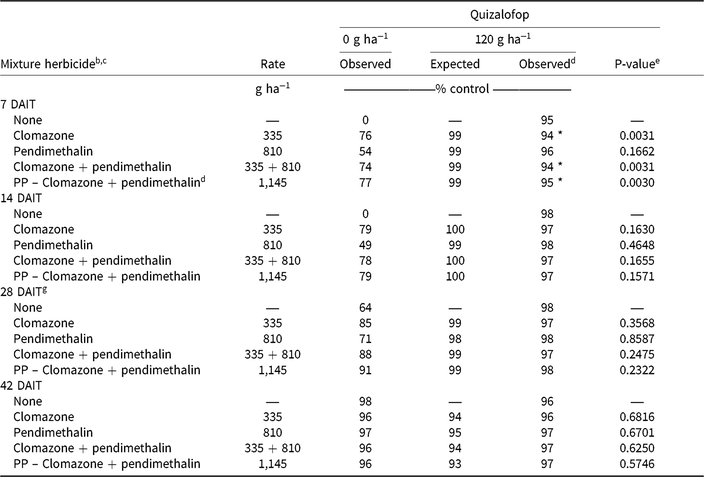
An antagonistic response was observed at 7 DAIT for barnyardgrass control when quizalofop was mixed with clomazone, clomazone plus pendimethalin, or the prepackaged mixture of clomazone plus pendimethalin, with observed controls of 94%, 94%, and 95%, respectively, compared with an expected control of 99% (Table 1). The data indicate the antagonism may be caused by the addition of clomazone, because pendimethalin applied alone with quizalofop resulted in neutral responses. Even though antagonism occurred at 7 DAIT, control of barnyardgrass was 94% to 98% across all rating dates. These data indicate that the addition of one of the residuals can be mixed with quizalofop with little negative impact. At 14, 28, and 42 DAIT, no antagonism of quizalofop occurred for barnyardgrass, with observed control of 96% to 98%. The sequential application of quizalofop at 120 g ha−1 controlled the antagonized barnyardgrass observed at 7 DAIT and late-emerging barnyardgrass. However, a second application of quizalofop at 28 DAT did not overcome barnyardgrass antagonism when treated with an initial application of quizalofop plus penoxsulam (Rustom et al. Reference Rustom, Webster, Blouin and McKnight2018) or propanil (Rustom et al. Reference Rustom, Webster, Blouin and McKnight2019).
Barnyardgrass control and interactions with quizalofop applied alone or mixed with residual herbicides, 2017 and 2018.a

a Evaluated using Blouin’s modified Colby’s analysis.
b Evaluation dates for each respective herbicide mixture.
c Abbreviations: DAIT, days after initial treatment; PP, prepackaged mixture.
d Observed means followed by an asterisk are significantly different from Blouin’s modified Colby’s expected responses at the 5% level indicating an antagonistic response. No asterisk indicates a neutral response.
e P < 0.05 indicates an antagonistic response; P > 0.05 indicates a neutral response.
f RiceOne® contains 130 g ai L−1 clomazone plus 313 g ai L−1 pendimethalin in a dual-encapsulated suspension.
g Control observed for each mixture herbicide with an additional independent application of quizalofop applied at 120 h ai ha−1 21 DAIT.
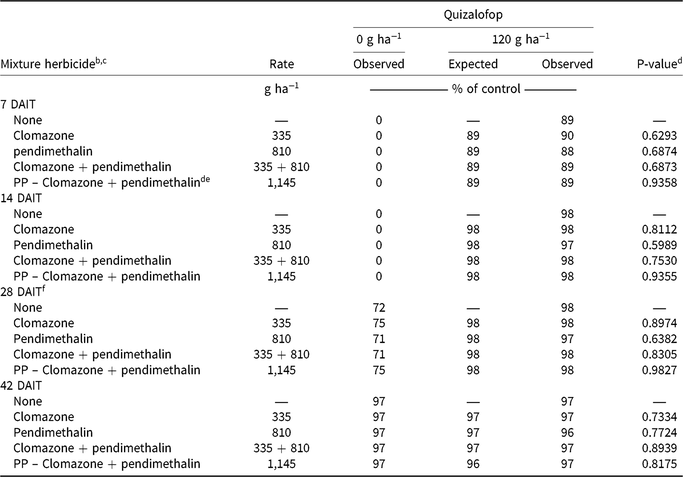
A neutral herbicide interaction occurred for CL-111 across all herbicide mixtures and evaluation dates (Table 2). At 7 DAIT, observed control of CL-111 was 88% to 90% when treated with either quizalofop plus any residual herbicide mixture evaluated, compared with an expected control of 89%. However, by 14, 28, and 42 DAIT, control increased to 96% to 98%. These results are similar to those of Minton et al. (Reference Minton, Shaw and Kurtz1989), who reported increased red rice control: 91% with quizalofop at 21 DAT compared with 83% control at 7 DAT, indicating quizalofop takes longer than 7 d to control weedy rice.
CL-111 rice control and interactions with quizalofop applied alone or mixed with residual herbicides, 2017 and 2018.a

a Evaluated using Blouin’s modified Colby’s analysis.
b Evaluation dates for each respective herbicide mixture.
c Abbreviations: DAIT, days after initial treatment; PP, prepackaged mixture.
d P < 0.05 indicates an antagonistic response; P > 0.05 indicates a neutral response.
e RiceOne® contains 130 g ai L−1 of clomazone plus 313 g ai L−1 of pendimethalin in a dual-encapsulated suspension.
f Control observed for each mixture herbicide with an additional independent application of quizalofop applied at 120 h ai ha−1 21 DAIT.
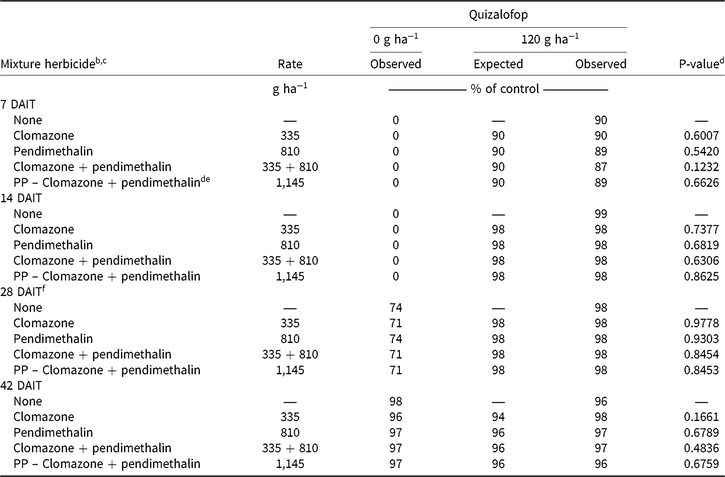
A neutral herbicide interaction occurred for CLXL-745 across all herbicide mixtures and evaluation dates (Table 3). Similar results occurred for CL-111 (Table 2), and control of CLXL-745 was 87% to 90% at 7 DAIT when treated with either quizalofop plus any residual herbicide mixture evaluated (Table 3). However, at 14, 28, and 42 DAIT, control increased to 96% to 99%. These results are similar to those reported by Minton et al. (Reference Minton, Shaw and Kurtz1989).
Hybrid CLXL-745 rice control and interactions with quizalofop applied alone or mixed with residual herbicides, 2017 and 2018.a

a Evaluated using Blouin’s modified Colby’s analysis.
b Evaluation dates for each respective herbicide mixture.
c Abbreviations: DAIT, days after initial treatment; PP, prepackaged mixture.
d P < 0.05 indicates an antagonistic response; P > 0.05 indicates a neutral response.
e RiceOne® contains 130 g ai L−1 of clomazone plus 313 g ai L−1 of pendimethalin in a dual-encapsulated suspension.
f Control observed for each mixture herbicide with an additional independent application of quizalofop applied 21 DAIT.
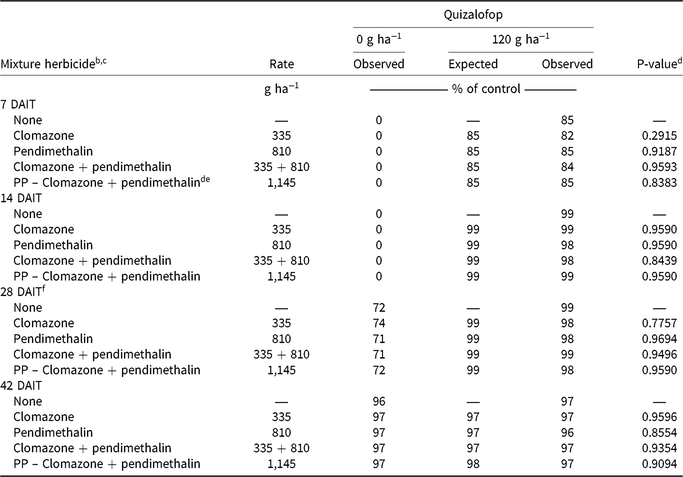
A neutral herbicide interaction occurred for red rice across all herbicide mixtures and evaluation dates (Table 4). At 7 DAIT, control of red rice was 82% to 85% across all herbicide mixtures; however, by 14, 28, and 42 DAIT, control increased to 96% to 99%. Red rice has been reported to have faster emergence, a higher tillering rate, taller growth habit, and to produce more straw material than cultivated rice (Diarra et al. Reference Diarra, Smith and Talbert1985). These morphological features may be a factor in herbicide translocation by having more vegetative growth, making the herbicide translocate farther to the SOA, and ultimately lowering the control of red rice compared with CL-111 (Table 2) and CLXL-745 (Table 3) at 7 DAIT. A neutral interaction occurred when the prepackaged was mixed with quizalofop or the addition of the individual components of clomazone plus pendimethalin for control of CL-111 (Table 2), CLXL-745 (Table 3), and red rice (Table 4) across all evaluation dates.
Red rice control and interactions with quizalofop applied alone or mixed with residual herbicides, 2017 and 2018.a

a Evaluated using Blouin’s modified Colby’s analysis.
b Evaluation dates for each respective herbicide mixture.
c Abbreviations: DAIT, days after initial treatment; PP, prepackaged mixture.
d P < 0.05 indicates an antagonistic response; P > 0.05 indicates a neutral response.
e RiceOne® contains 130 g L−1 of clomazone plus 313 g L−1 of pendimethalin in a dual-encapsulated suspension.
f Control observed for each mixture herbicide with an additional independent application of quizalofop applied at 120 h ai ha−1 21 DAIT.
Crop injury did not exceed 5% across all herbicide treatments and evaluation dates (data not shown). Rice plant height, 104 to 107 cm, was similar across all herbicide treatments (data not shown). A main affect occurred for rough rice yield over quizalofop rate (Table 5). Rice treated with an initial application of quizalofop yielded 5,440 kg ha−1. Rice yield was 4,360 kg ha−1 when not treated with the initial application of quizalofop. The decrease in yield was likely due to the increased competition from the CL-111, CLXL-745, and red rice; however, the second application of quizalofop helped manage the weedy rice complex, resulting in a slight increase in rice yield.
Rough rice yield when treated with 0 or 120 g ha−1 of quizalofop, 2017 and 2018.a

a Means followed by a common letter are not significantly different at P = 0.05 with the use of the Tukey honestly significant difference test.
b Yield data averaged over residual herbicide program.
c Rough rice yield with an additional independent blanket application of quizalofop at 120 g ai ha−1 applied at 21 d after the initial treatment across the entire research area.
In conclusion, the addition of a prepackaged mixture of clomazone plus pendimethalin in mixture with quizalofop resulted in a neutral interaction for control of barnyardgrass (Table 1), CL-111 (Table 2), CLXL-754 (Table 3), and red rice (Table 4) at 14, 28, and 42 DAIT. Combining quizalofop with clomazone plus pendimethalin offers producers the ability to apply a POST herbicide to control already emerged grasses while providing residual activity for later in the growing season.
The addition of multiple herbicides with differing SOAs in a single mixture can help prevent or reduce the development of herbicide-resistant weeds as part of a full-season weed management program. These mixtures can also be part of a strategy to manage existing herbicide-resistant weeds (Norsworthy et al. Reference Norsworthy, Ward, Shaw, Llewellyn, Nichols, Webster, Bradley, Frisvold, Powles, Burgos, Witt and Barrett2012). Multiple weed species infest rice fields in Louisiana and rarely is there single monoculture of weed species (Webster Reference Webster and Saichuk2014). The ACCase-R rice production system can be effective for controlling problem grasses found in Louisiana rice production. A prepackaged mixture of clomazone plus pendimethalin can be a useful residual herbicide in the ACCase-R rice production system. In addition, the application of multiple SOAs herbicide mixtures can be an excellent weed management tool (Carlson et al. Reference Carlson, Webster, Salassi, Hensley and Blouin2011, Reference Carlson, Webster, Salassi, Bond, Hensley and Blouin2012; Webster and Masson Reference Webster and Masson2001; Norsworthy et al. Reference Norsworthy, Burgos, Scott and Smith2007; Pellerin et al. Reference Pellerin, Webster, Zhang and Blouin2004; Webster et al. Reference Webster, Carlson, Salassi, Hensley and Blouin2012).
Acknowledgments
This report is published with the approval of the director of the Louisiana Agricultural Experiment Station and the Louisiana State University Agricultural Center, Baton Rouge, LA, under manuscript number 2019-306-33789. The authors would like to thank the staff of the Louisiana State University Agricultural Center’s H. Rouse Caffey Rice Research Station. The Louisiana Rice Research Board provided partial funding for this project. No conflicts of interest have been declared.