INTRODUCTION
The hawksbill marine turtle, Eretmochelys imbricata, is listed under the IUCN Global Red List as critically endangered (IUCN, 2011). In the Caribbean, this species has been exploited historically for its meat, eggs and shell (Meylan, Reference Meylan1999; Carrillo et al., Reference Carrillo, Webb and Manolis1999; Fleming, Reference Fleming2001) leading to a noticeable reduction in nesting populations in the region (Meylan, Reference Meylan2002; McClenachan et al., Reference McClenachan, Jackson and Newman2006). However, the regional management unit of Caribbean hawksbill is currently characterized as low risk but as high threat (Wallace et al., Reference Wallace, Dimatteo, Hurley, Finkbeiner, Bolten, Chaloupka, Hutchinson, Abreu-Grobois, Amorocho, Bjorndal, Bourjea, Bowen, Briseño Dueñas, Casale, Choudhury, Costa, Dutton, Fallabrino, Girard, Girondot, Godfrey, Hamann, López-Mendilaharsu, Marcovaldi, Mortimer, Musick, Nel, Pilcher, Seminoff, Troëng, Whiterington and Mast2010), and some populations are thought to be increasing (Puerto Rico: Meylan, Reference Meylan1999; Antigua: Richardson et al., Reference Richardson, Hall, Mason, Andrews, Bjorkland, Cai and Bell2006; Barbados: Beggs et al., Reference Beggs, Horrocks and Krueger2007; Guadeloupe: Kamel & Delcroix, Reference Kamel and Delcroix2009). However, rookeries without protection in this basin are seriously threatened, particularly due to egg take (Lagueux & Campbell, Reference Lagueux and Campbell2005).
Increasing hatchling production is a necessary component of any strategy to recover depleted marine turtle populations (Dutton et al., Reference Dutton, Dutton, Chaloupka and Boulon2005; Sarti Martínez et al., Reference Sarti Martínez, Barragán, García Muñoz, García, Huerta and Vargas2007). When clutches are at risk, relocation to different sections of the beach or to protected hatcheries have been common management tools in many marine turtle conservation programmes (Pritchard, Reference Pritchard and Bjorndal1995; Kornaraki et al., Reference Kornaraki, Matossiana, Mazarisa, Matsinosa and Margaritoulis2006; Marcovaldi et al., Reference Marcovaldi, Lopez, Soaresi, Santos, Bellini and Barata2007). However, this is not a perfect solution, as it has been reported that relocated clutches may experience lower hatching success and altered sex-ratios (Godfrey & Mrosovsky, Reference Godfrey, Mrosovsky, Eckert, Bjorndal, Abreu-Grobois and Donnelly1999; Mortimer, Reference Mortimer, Eckert, Bjorndal, Abreu-Grobois and Donnelly1999; Pintus et al., Reference Pintus, Godley, McGowan and Broderick2009). Nevertheless, the intense pressures from human egg take in undeveloped countries leaves them with no other option than relocating clutches and using hatcheries (García et al., Reference García, Ceballos and Adaya2003; Liles et al., Reference Liles, Jandres, López, Mariona, Hasbún and Seminoff2011) or even, in extreme situations, to incubate clutches in boxes (Dutton et al., Reference Dutton, Whitmore and Mrosovsky1985). Therefore, clutch conservation strategies should rely on the evaluation of local characteristics, and should be adapted to the specific scenarios where they are intended to be applied (Eckert, Reference Eckert, Eckert, Bjorndal, Abreu-Grobois and Donnelly1999; Kornaraki et al., Reference Kornaraki, Matossiana, Mazarisa, Matsinosa and Margaritoulis2006).
In the Dominican Republic (DR, North Caribbean), current estimates suggest a severe decline of the hawksbill nesting population, with sporadic nesting in few places around the country and only one remaining stable stock on the south coast of Saona Island, south-east DR (with a mean of 23 females nesting per year: Revuelta et al., Reference Revuelta, León, Feliz, Godley, Raga and Tomás2012). According to the estimation of 5000 females nesting annually in the Caribbean (Meylan, Reference Meylan1999), Saona Island hawksbill stock would represent close to 0.5% of the total number of nesting females in the region. The greatest threat to this nesting rookery comes from illegal egg take and deliberate capture of adults for meat (Revuelta et al., Reference Revuelta, León, Feliz, Godley, Raga and Tomás2012). Preliminary surveys in 2006 revealed that up to 60% of 41 nests recorded on the island were taken by humans, with up to 100% (N = 13) taken near the principal human settlement, Mano Juan (Revuelta et al., unpublished data). This occurs even though it is illegal to harvest turtles or their products in the DR since 1966, and that Saona is part of a protected area since 1975 (Del Este National Park). This situation could potentially impact rookeries on a regional scale since Dominican hawksbills seem to disperse to several feeding grounds throughout the Caribbean after nesting; including distant areas in waters of Nicaragua and Honduras (Hawkes et al., Reference Hawkes, Tomás, Revuelta, León, Blumenthal, Broderick, Fish, Raga, Witt and Godley2012).
It is well known that artificial incubation in boxes may introduce masculinizing biases in resulting hatchlings (Morreale et al., Reference Morreale, Ruiz, Spotila and Standora1982; Dutton et al., Reference Dutton, Whitmore and Mrosovsky1985; Whitmore & Dutton, Reference Whitmore and Dutton1985). This is because sex in marine turtles is determined by the temperature at which eggs are incubated during the middle third of incubation, which is referred to as the thermosensitive period (Yntema & Mrosovsky, Reference Yntema and Mrosovsky1982). When boxes are used, the temperature during this period is often lower than pivotal temperature (that which produces 1:1 sex ratio: Mrosovsky & Pieau, Reference Mrosovsky and Pieau1991), thus resulting in a greater proportion of male hatchlings (Mrosovsky, Reference Mrosovsky1994). However, given the high predation levels observed, in 2007, we initiated a programme of artificial incubation in boxes as an urgent measure to protect the clutches and increase hatchling recruitment while implementing other conservation measures, such as beach patrolling and education.
Here we present the results of a four year monitoring and conservation programme of the hawksbill nesting population of Saona Island, including the artificial incubation programme. Our main research questions were twofold: (1) are there differences in hatching and emergence success between artificially incubated clutches and in situ incubated clutches?; and (2) what is the sex-ratio produced in the artificially incubated clutches?
MATERIALS AND METHODS
Study site
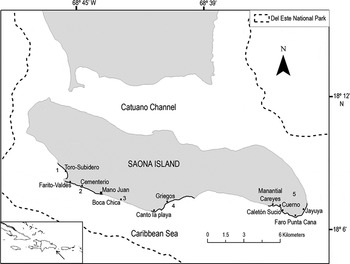
The present study was conducted from 2007 to 2010 in Saona Island (18°07′N–68°44′W; Figure 1), which is included in the Del Este National Park (south-east DR). With an area of 110 km2, Saona is the largest island adjacent to the DR. There is one permanent human settlement in Saona, Mano Juan village, with a population of 300 inhabitants (Figure 1). Hawksbill nesting occurs across all of the 26.6 km of the south coast sandy beaches of Saona Island. However, nesting activity is concentrated in 12 narrow fine-grained coralline, white sand beaches (altogether comprising a total of 15 km; Table 1) interspersed with rocky areas. The neritic sea adjacent to the nesting beach is composed of coral reefs and seagrass beds. For the most part, beach vegetation is dominated by coconut (Cocos nucifera) plantations, sea purslane (Sesuvium portulacastrum), sea rosemary (Suriana maritima), sea grape (Coccoloba uvifera), goat's foot creeper (Ipomoea pes-caprae) and native grasses.
Hawksbill turtle nesting areas (N = 5) and beaches surveyed (N = 12) in Saona Island in Del Este National Park, Dominican Republic. Inserted in the map is shown the location of the study area within the Caribbean Sea.

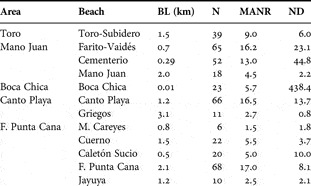
Number of nests and distribution of hawksbill turtle nesting density per beach in Saona Island, during 2007–2010. BL, beach length (km); MANR, mean annual nests rate (nests.years−1); ND, nesting density (nests. years−1.kms−1).

Beaches were grouped into 5 sampling areas: (1) Del Toro, with 1530 m length and mean beach width (range) of 7.9 (4–18) m; (2) Mano Juan, 2990 × 8 (2–20) m; (3) Boca Chica, with 12.9 × 4.4 m; (4) Canto de la Playa area, 4263 × 18 (8–30) m; and (5) Faro Punta Cana, 6084 × 10 (3–20) m (Figure 1). We patrolled the beaches at least once per week throughout the year, but in 2008 this was increased to 3–4 surveys per week during the peak nesting period (June to November). Also, in 2009, the farthest area (Faro Punta Cana; see Figure 1) was visited only monthly due to logistic limitations. We patrolled the beaches, by foot to detect all recent tracks of nesting females. All emergences of turtle females to nest were recorded. Clutches were confirmed by the presence of eggs in the nest chamber, or by signs of egg predation at the nesting site (see below). For each nest we recorded its GPS location, and position on the beach (open sand, vegetation border and within vegetation). We measured minimum distances from the nest to the high tide line. We classified nests as intact (eggs in nest chamber), or predated (no eggs in nest chamber, presence of probing sticks, eggshells and human footprints littering the nesting site). Owing to high levels of human egg take, the majority of clutches detected (N = 163) were removed for artificial incubation. In order to investigate the potential effects of artificial incubation on hatching and emergence success we studied 49 clutches incubated in situ, using them as controls. To reduce predation, all nests left in situ were camouflaged by erasing turtle tracks and other signs of nesting activity.
Clutches moved for artificial incubation were carefully excavated by hand, and the eggs were relocated into polyethylene exterior boxes with polyurethane foam filling. Two to three centimetres of beach sand was put at the bottom and sides of the box to prevent contact of eggs with walls. We placed a TinyTag temperature logger (Gemini Data Loggers UK Ltd., Model TGP-4017; accuracy ±0.3°C) inside a sub-sample of 22 artificially incubated clutches. Loggers were programmed to record temperatures at sampling intervals of 1 hour throughout the incubation duration. Extra care was taken when moving clutches, limiting shake and vibrations to avoid dislodging the embryo (Chan, Reference Chan1989; Almeida & Mendes, Reference Almeida and Mendes2007). Each box was labelled with a code indicating beach name, the laying date and number of eggs incubated. Boxes were placed in a facility located about 50 m from the beach of Mano Juan village. This facility (4 × 3 m (length × width)) had a sand-beach floor, walls made of wire mesh and corrugated metal panels, and roof made from palm leaves to protect boxes against rain and flooding. The boxes were checked daily throughout the incubation duration and lids opened for two to three hours a day to allow air to circulate in the otherwise air-tight box. Hatchlings were released at sunset one day after they emerged when they enter into frenzy.
To detect effects on hatchling fitness that might be due to artificial incubation, we compared the size and weight of hatchlings produced in boxes with those of hatchlings from other nesting rookeries in the Caribbean (e.g. Mona island, Puerto Rico: van Dam & Diez, Reference van Dam and Diez1998; Cuba: Moncada et al., Reference Moncada, Carrillo, Saenz and Nodarse1999; British Virgin Islands: Hillis & Phillips, Reference Hillis and Phillips1996). Random samples of 20 hatchlings each from 24 artificially incubated clutches in 2008 and 8 artificially incubated clutches in 2009 were measured (straight carapace length (SCL)) to the nearest 0.1 cm with a calliper, and weighed to the nearest 0.1 g with an electronic scale.
Artificially incubated and in situ clutches were studied, and clutch size, hatching and emergence success were considered according to definitions in Miller (Reference Miller, Eckert, Bjorndal, Abreu-Grobois and Donnelly1999). In this study, it could not be known in advance whether the clutches we collected for artificial incubation were a random subset of all the clutches on the beach. A way to shed light on this question could be to check whether clutch size differed between artificially incubated and in situ clutches (note that, in the latter, clutch size could only be determined after emergence of hatchlings). A two-way analysis of variance (ANOVA) revealed that the mean number of eggs per clutch did not differ with incubation type (F(1,157) = 0.85, P = 0.357) or among years (F(3,157) = 2.46, P = 0.06).
We tested whether incubation type affected hatching success or emergence success. Since data were gathered in 4 years, we used a full factorial two-way ANOVA, with ‘incubation type’ (in situ, artificial) and ‘year’ as fixed and random factors, respectively. Before statistical testing, data about hatching and emergence success were arcsin-transformed to achieve normality and homoscedasticity (Sokal & Rohlf, Reference Sokal and Rohlf1995).
For each clutch, incubation duration was defined as the number of days between egg-laying and the first emergence recorded. We used temperature data to provide an estimation of sex-ratio produced in the artificially incubated clutches. Since pivotal temperature has not been determined for hawksbill turtle in Saona, we used the published curve relating incubation temperature and hatchling sex-ratio derived from laboratory incubated eggs from the closest hawksbill nesting area at Mona Island, Puerto Rico (Mrosovsky et al., Reference Mrosovsky, Kamel, Diez and van Dam2009). We read off the means of temperature recorded in the thermosensitive period of the 22 clutches on the Mona laboratory curve to estimate female proportions. Examples of the use of this method and its validation are given in Wibbels (Reference Wibbels, Lutz, Musick and Wyneken2003) and Öz et al. (Reference Öz, Erdogan, Kaska, Düsen, Aslan, Sert, Yavuz and Tunc2004).
RESULTS
Nesting density and nest site selection
Hawksbill turtles laid a mean of 100 nests.years−1 (+/− standard deviation (SD) 8.4: range 93 to 111) on Saona Island. The highest mean annual nesting rate occurred at Mano Juan area (33.7 nests.years−1) followed by Faro Punta Cana area (31.5 nests.years−1), Canto de la Playa area (19.2 nests.years−1) and Del Toro area (9.0 nest.years−1). The mean nesting linear density over the 15 km of available nesting habitat was 6.6 nests·years−1·kms−1. Apart from Boca Chica, an isolated small beach surrounded of rocky areas, with an average of 5.7 nests.years−1, the highest nesting density reported was on Mano Juan area (11.3 nests.years−1.kms−1), followed by Del Toro area (6 nests.years−1.kms−1), Faro Punta Cana (5.2 nests.years−1.kms−1) and Canto de la Playa (4.5 nests.years−1.kms−1) (see Table 1). We did not find significant correlation between beach width and number of clutches laid (rs = 0.451, P = 0.141, N = 12).
Saona hawksbills laid their eggs mainly in zones with at least some vegetation (within vegetation: 26.5%, N = 75; vegetation border: 56.0%, N = 158; open sand: 17.4%, N = 49). Overall, the mean distance from the nest to the high tide line was 8.9 m (SD = 5.3; range: 0.5–35 m). The beach with highest mean distance (16.7 m; SD = 7.0; range: 8–30) was Canto de la Playa beach, in Canto de la Playa area; and the beach with lowest mean distance (5.7 m; SD = 3.2; range: 2–13) was Cementerio beach, located in the Mano Juan area (Figure 1).
Predation levels and fate of clutches
In the four-year period we recorded a total of 400 hawksbill clutches in the 5 sampling areas. Considering the extensive experience detecting hawksbill tracks by the team and the low levels of nesting activity, we believe that weekly surveys allowed us to record close to 100% of clutches laid.
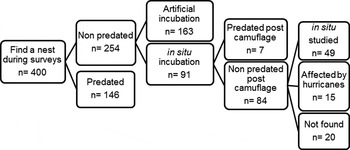
The majority of recorded clutches were artificially incubated (N = 163), while 146 clutches had already been predated by humans when found and 91 were left in situ (Figure 2). Humans took an additional 7 of these 91 clutches left in situ, and other 15 clutches of them were affected by tropical storms. We could not find (likely due to erosion and wash-out) another 20 of the 91 clutches left in situ. These events left a total of 49 clutches incubated in situ for the study.
Clutch fate: number of clutches laid and their fate in Saona Island during the period 2007–2010. N, total number of clutches; predated, number of clutches predated by humans; artificial incubation, number of clutches removed for their incubation in boxes; in situ incubation, number of clutches camouflaged and left incubating on the beach; predated post-camouflage, number of clutches predated by humans after we camouflaged it; in situ studied, clutches found and studied after being camouflaged; affected by hurricanes, number of clutches incubating on beach when a hurricane made landfall in the island; not found, number of camouflaged clutches we could not find again due to beach dynamics.

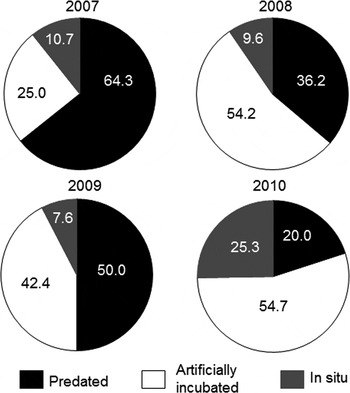
Hence, in total we include in the study 365 clutches of three different fates: (i) predated by humans (N = 153); (ii) incubated artificially (N = 163); and (iii) incubated in situ (N = 49). However, for the estimations of hatching and emergence success we only considered clutches that were studied by the authors (N = 119) and (N = 46) artificially incubated clutches and in situ clutches, respectively. Figure 3 shows the annual variation on the percentages of these categories. All the clutches that were not artificially incubated or camouflaged in situ were found predated by humans in all beaches of the five areas of study. When humans predated a clutch, 100% of eggs were always taken. No evidence of natural predation (i.e. by crabs, ants, or feral pigs) on eggs was observed during the study period.
Percentages of clutches that were incubated artificially, clutches that were poached and clutches that hatched successfully in situ from the total of studied clutches every year (N = 84; N = 94; N = 92 and N = 95) respectively.

Hatching success and emergence success
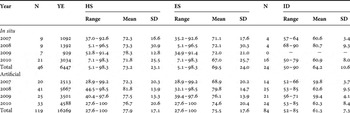
Hatching and emergence success of 46 in situ incubated clutches and 119 artificially incubated clutches are shown in Table 2.
Number of yolked eggs (YE), hatching success (HS), emergence success (ES) and incubation duration (ID) per clutch of hawksbill turtles reared under natural (in situ) and artificial conditions in Saona Island during the four years of study. N, number of clutches.

We did not detect significant effects of artificial incubation in hatching success between years (two-way ANOVA: F (3,157) =1.45, P = 0.383), incubation type (F(1,157) = 0.7, P = 0.45); or their interaction (F(3,157) = 0.52, P = 0.669). Likewise, there was no significant difference in emergence success between years (two-way ANOVA: F (3,157) = 1.1, P = 0.469), incubation type (F(1,157) = 1.28, P = 0.327); or their interaction (F(3,157) = 0.68, P = 0.563) compared to in situ incubation.
In total, 12,340 hatchlings were produced under artificial conditions and released to the sea (1731 in 2007, 4522 in 2008, 2664 in 2009 and 3423 in 2010). Mean carapace length and weight of hatchlings was 3.8 ± 0.1 cm (range: 3.2–4.2) and 14.8 ± 1.2 g (range: 10.5–18.7) in 2008 (N = 480) and 3.8 ± 0.2 cm (range: 3.0–4.0) and 15.1 ± 1.1 g (range: 12.6–18.2) in 2009 (N = 160).
Incubation temperature and incubation duration
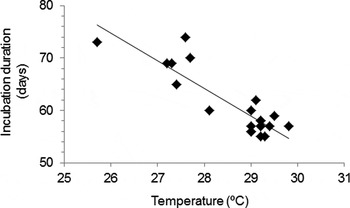
Since beaches were not daily patrolled, recording the exact laying date was not possible in all cases. However, we were able to determine incubation duration for 84 out of the 119 artificially incubated clutches and 24 out of 46 in situ incubated clutches studied (Table 2). Temperatures in artificially incubated clutches ranged from 22.2 to 36.4°C, with mean values ranging from 26.8 to 30.2°C (N = 22). During the thermosensitive period temperatures recorded ranged from 22.2 to 33.8°C, with mean values ranging from 25.7 to 29.8°C. Incubation duration was strongly correlated with mean temperature during the thermosensitive period (F = 70.7, P < 0.001, df = 1; Figure 4).
Relationship between incubation duration and mean temperature during the thermosensitive period in the 22 artificially incubated clutches controlled during the study (Equation: ID = 211−5.26 mean temperature during the thermosensitive period, r-square = 0.78).

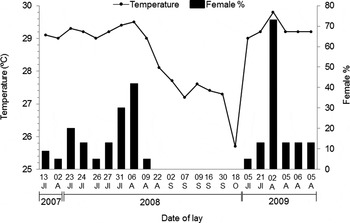
In 21 of the 22 artificially incubated clutches mean temperature during the thermosensitive period was lower than the pivotal temperature derived from laboratory studies (29.6°C: Mrosovsky et al., Reference Mrosovsky, Kamel, Diez and van Dam2009) (Figure 5), suggesting a male bias in artificially incubated clutches. The highest estimated female percentages (42% and 73%) were recorded in two clutches laid during the first half of August, and the estimated percentage of females was 0% in all artificially incubated clutches laid after the second half of August (Figure 5). Accordingly, we found a great intra-seasonal variation in incubation duration in artificially incubated clutches every year, with longer incubation duration during colder months (October–December).
Laying date, mean incubation temperature during thermosensitive period (dots) and estimated female proportion (bars) of artificially incubated clutches (N = 22) in which temperature was monitored during the study period.

DISCUSSION
The present study provides, for the first time, detailed information about the reproductive biology of the remaining, threatened hawksbill nesting population of Saona Island, as well as the results of the conservation programme that we carried out to mitigate egg take.
Nesting density and nest site selection
Hawksbill females on Saona mainly nest in vegetated areas, this has also been noted in other studies of the species in other Caribbean rookeries (Pérez-Castañeda et al., Reference Pérez-Castañeda, Salum-Fares and Defeo2007; Kamel & Delcroix, Reference Kamel and Delcroix2009). Other authors have proposed that this could be because areas with vegetation might be less compact making hatchling emergence easier; also, the shade provided by vegetation might help keep temperature constant (Horrocks & Scott, Reference Horrocks and Scott1991; Kamel & Mrosovsky, Reference Kamel and Mrosovsky2006). Moreover, the two beaches with the highest nest density in Saona (Boca Chica and Cementerio) have certain characteristics which make them suitable for nesting: an accessible vegetation area, a reef in front of the beach which protects them against surf and makes beach access easier, and fine grain sand that allows turtles digging their nests easily.
Predation levels and fate of clutches
Our results show the need to continue patrol and conservation work in Saona, since most in situ clutches not promptly camouflaged or relocated for artificial incubation, were predated by humans. In fact, in 2009, as a result of the decrease in surveys at the Faro Punta Cana area, 28 out of the 30 clutches laid were taken. In other words, the current level of egg take is unsustainable for the long term preservation of this nesting population.
Nesting beaches in Saona are scattered along the coastline and some of them can only be reached by boat, considerably raising monitoring costs. Also, the funding available did not allow the employment of personnel to make daily patrols over all the nesting beaches or nest surveillance. This left us with two options, i.e. relocating or camouflaging all clutches that were non-predated at the time of finding. Camouflage was considered to be an insufficient conservation measure since substantial amounts of camouflaged clutches were eventually predated by humans. The same situation has been described in other studies with similar conditions (Sato & Madriasau, Reference Sato and Madriasau1991; Lagueux et al., Reference Lagueux, Campbell and McCoy2003). On the other hand, tropical storms that hit the island affected camouflaged clutches (4 affected by Noel in 2007, 7 by Hanna in 2008 and 4 by Earl and Fiona in 2010) making excavation and study impossible. It has been reported that excessive rainfall and floods can greatly reduce egg viability, thus reducing clutch survivorship (Martin, Reference Martin1996; Kamel & Delcroix, Reference Kamel and Delcroix2009). Obviously, these threats are natural and unavoidable, but they add significant losses to the already depleted population. For all these reasons, and due to shortage of human and economic resources, we decided to incubate clutches in polyurethane hermetic boxes with constant monitoring and protection, as an alternative option to ensure hatchling recruitment.
Effects of artificial incubation
Physical handling of eggs can reduce hatching and emergence success in relocated clutches (Eckert & Eckert, Reference Eckert and Eckert1990; Pintus et al., Reference Pintus, Godley, McGowan and Broderick2009). However, in the present study, we found no significant differences in hatching and emergence success between in situ and artificially incubated clutches, indicating that handling was correctly carried out and that incubation conditions in boxes was suitable for hawksbill embryos development, as reported also for other species (e.g. Whitmore & Dutton, Reference Whitmore and Dutton1985).
Concerning hatchling fitness, our results suggest that artificially incubated hatchlings from Saona are smaller than hatchlings from other Caribbean natural nesting rookeries, Mona Island (SCL = 4.0 cm: van Dam & Diez, Reference van Dam and Diez1998), Cuba (SCL = 4.0 cm: Moncada et al., Reference Moncada, Carrillo, Saenz and Nodarse1999) and the Virgin Islands (SCL = 4.1 cm: Hillis & Phillips, Reference Hillis and Phillips1996). However, the weight of Saona hatchlings seems to be similar to those from other Caribbean rookeries (14.8 g, Mona Island and 14.7 g, Virgin Islands).
Nonetheless, the use of boxes for incubation entails the risk of bias in the sex-ratio in favour of males (Dutton et al., Reference Dutton, Whitmore and Mrosovsky1985; Whitmore & Dutton, Reference Whitmore and Dutton1985). Mean temperatures of 21 artificially incubated clutches during the thermosensitive period were below the pivotal temperature reference value from Mona Island (29.6°C), suggesting that those temperatures are likely to have resulted in a male-skewed clutch sex-ratio. Moreover, since we found a clear relationship between temperature and incubation duration recorded in Saona, the long incubation durations recorded are also indicative of a male-skewed sex-ratio. The low percentages of female hatchling production inferred from our clutch temperature data, calls for urgent changes in the conservation strategy adopted in Saona, since a lengthy lack of female production would prevent population growth.
Forward strategies
Due to the rampant egg take, in situ incubation on the beaches is not an acceptable management practice for a long term conservation of this population. Hence, the primary goals in the near future would be: (1) to increase female production in boxes; and (2) to start a programme of relocation of clutches to safer areas (Pritchard, Reference Pritchard and Bjorndal1995; DeGregorio & Southwood Williard, Reference DeGregorio and Southwood Williard2011) while progressively reducing incubation in boxes. For the first goal, boxes are being exposed to direct sunlight during a few hours a day to raise incubation temperatures and increase the proportion of females produced (see Chantrapornsyl, Reference Chantrapornsyl1992). For the second goal, financial resources must be invested to strengthen the protection of a beach section near Mano Juan village as a safe area for clutch relocation.
Further research on beach temperature patterns is needed to increase understanding of the natural sex-ratio at Saona in order to improve conservation measures.
Together with the artificial incubation programme we carried out additional measures such as hiring people from the local community to work as field technicians, organizing workshops and meetings with authorities, as well as environmental education and awareness programmes. These measures have apparently positively influenced local attitudes and perceptions toward marine turtles in Saona (White et al., Reference White, Jhonson Camacho, Bloom, Lancho Diéguez and Sellares2011) which we strongly believe will favour a future programme of clutch relocation on the beach.
ACKNOWLEDGEMENTS
The present study is included as part of a conservation programme funded by the Spanish International Cooperation Agency (AECI, projects: A/2991/05 and A/5641/06), the Spanish Ministry of Education and Sciences (CGL2006-02936-BOS), the General Foundation of the University of Valencia, and the European Union (Marie Curie grants, FP6 & 7). We specially thank the support of the Dominican non-governmental organization Grupo Jaragua and of The Nature Conservancy (TNC). The project counts on the support of the Dominican Environmental authorities (Office of Protected Areas and Biodiversity of the Environmental Ministry) and the rangers of the Del Este National Park. We are very grateful to fieldwork assistants especially to Pelagio Paulino ‘Negro' and Bernardo Paulino ‘Mico' for their help during fieldwork in Saona and their hard work in the conservation of Saona marine turtles. We extend our thanks to the Dominican and international students, volunteers and local villagers who helped in different tasks of the project and who lent their help and friendship during the work in the Dominican Republic. J. Azar, J.A. Raga and J. Tomás are supported by project Prometeo/2011/40 of Conselleria de Educacio (Generalitat Valenciana) and project CGL2011-30413 of the Spanish Ministry of Sciences and Innovation. We thank an anonymous referee for helpful comments and suggestions that improved the manuscript.