Introduction
Mass gatherings are events at a specific location with greater than 1,000 patrons or attendees.Reference Crabtree, Mo, Ong, Jegathees, Wei, Fahey and Liu 1 These include a diverse range of events with varying patron demographics, such as music festivals, fetes, and sporting events. This may result in a diverse range and volume of injuries or illnesses requiring medical aid, placing unpredictable strain on prehospital care services. Planning based on an individual organization’s experience without formal retrospective study and analysis of patient characteristics has been the mainstay in the allocation of personnel and equipment for these events.Reference Arbon, Bridgewater and Smith 2 , Reference Bledsoe, Songer, Buchanan, Westin, Hodnick and Gorosh 3 However, this approach can fail to reliably predict the correlation between event factors and patient presentation rates (PPRs; defined as presentations per 1,000 patrons).Reference Grant, Nacca, Prince and Scott 4 This important correlation is integral in predicting the logistical requirements to deploy adequate prehospital care. Hence, statistical review and study of factors which influence PPR, as well as trends in the types of presentations and relationships with patient demographics, are necessary to develop more reliable prediction tools.
The Sydney Royal Easter Show (SRES; Sydney Olympic Park, New South Wales, Australia) is a mass gathering where St John Ambulance (Australian Capital Territory, Australia) staff provide prehospital care.Reference Nable, Margolis and Lawner 5 As the event attracts upwards of 800,000 patrons, including a large media presence, a successful deployment is essential for both safety and public image. 6 St John Ambulance consists of first responders (defined as staff trained in advanced first aid and advisory defibrillation) and health care professionals. St John Ambulance has five first aid posts around the venue with high visibility to patrons at the SRES, and also provides two methods for emergency response. These include the Bicycle Emergency Response Team and the health care professional Medical Emergency Response Team. In addition, an Advanced Clinical Management Centre (ACMC) is located onsite at SRES, which has triage, resuscitation, and acute treatment facilities staffed by health care professionals (doctors, nurses, and paramedics) in addition to first responders. Transport to the ACMC from the first aid posts is provided by two medicabs which are equipped with stretchers. New South Wales Ambulance are available to transport patients to two local hospitals (Concord Hospital and Westmead Children’s Hospital), both major tertiary metropolitan teaching hospitals.
The SRES is the largest single duty for St John Ambulance nationally with over 1,000 patients treated per year over a two-week period. As identified by a previous observational study of the Suffolk Show (Trinity Park; Suffolk, England), 7 agricultural shows pose unique logistical and clinical challenges in terms of the delivery of quality onsite prehospital care, as both patient demographics and clinical presentations can be diverse with a large proportion of patrons from rural/regional areas engaging in high-risk activities (eg, show jumping and wood chopping). Combined with a large area within Sydney Olympic Park (420,000 m2),Reference Pakravan, West and Hodgkinson 8 successful deployment of prehospital care is a unique and challenging endeavor. To ensure the appropriate allocation of resources, it is of utmost importance that the preparation of mass-gathering events includes risk assessments and planning to ensure that there is sufficient capability and capacity to attend to medical presentations. Many variables have been identified as important factors in predicting the types and numbers of presentations at an event. They include weather conditions, event type, duration of the event, location of the event (indoor or outdoor), mobility of the patrons at the event, containment of the event (fenced or uncontained), crowd mood, crowd density, the availability of drugs and/or alcohol, and the demographics of the attendees.Reference Crabtree, Mo, Ong, Jegathees, Wei, Fahey and Liu 1 , Reference Logic 9 However, few studies have performed in-depth analyses of demographics of the specific attendees who present to prehospital services and relationships with treatment and disposition.
This study involved a retrospective analysis of patient records from all patients treated at the SRES between 2012-2014 inclusive to better understand the relationships between patient demographics, clinical presentations, and weather, and their impact on disposition over a three-year period. Such information would be useful to predict future trends in patient presentations to guide ongoing training of first responders and plan the staffing skill mix at mass-gathering events.
Materials and Methods
This study was designed to be a retrospective, descriptive review of cases. A total of 4,141 St John Ambulance patient record forms (OB12s) were retrospectively analyzed to examine demographics and treatment characteristics for patients who presented to St John Ambulance at the SRES between 2012 and 2014 inclusive. The St John Human Research Ethics Committee (West Perth, Western Australia, Australia) reviewed and approved the study (No 14/07).
Data were collected on standard St John Ambulance patient record forms at the time and location of treatment by St John personnel. All personnel had, at a minimum, undergone standard St John patient record form induction training. All patients who had been treated by St John Ambulance on the 14 days of the event over the study years and had an OB12 submitted were included in the study. Patients who had not had an OB12 submitted were excluded.
Patient record forms were de-identified and data entered into a Microsoft Excel (Microsoft Corporation; Redmond, Washington USA) spreadsheet by the authors. Authors were familiarized with the data entry system before data abstraction commenced. Demographic information obtained included date and time of presentation, length-of-stay (time of presentation – time of discharge from St John), age, gender, and suburb/postcode of residence. The clinical presentation type was classified using a minimum data set published by Ranse and Hutton in 2012.Reference Lund, Turris and Bowles 10 Patient discharge disposition was recorded as: transfer to hospital by ambulance, patient referral to hospital by own means, discharge home, discharge to family physician, return to event, or discharge against medical advice. The database also recorded whether patients required assessment by a health care professional and advanced medical assessment/treatment (that beyond the scope of first aid). Given the use of Ranse and Hutton’s minimum dataset to interpret presentations in a standardized manner and the objective nature of all other data collected, inter-observer variability between authors in the data entry process was judged to be minimal.
The Australian Standard Geographical Classification was used to classify patients’ residential suburb/postcode as either metropolitan (RA1), regional/rural (RA2-5), and other/overseas. Total daily crowd attendance was obtained from the Royal Agricultural Society (Sydney Olympic Park, New South Wales, Australia) website and weather reports (maximum daily temperature and total daily precipitation) were collected from the Australian Bureau of Meteorology (Melbourne, Victoria, Australia). Attendance data were used to calculate transport to hospital rate (TTHR; defined as ambulance transports to hospital per 1,000 patrons), referral to hospital rate (RTHR; defined as referrals to hospital by all means per 1,000 patrons), and PPR as previously described.Reference Lund, Turris and Bowles 10
Statistical analyses were performed using SPSS v22.0 (IBM; Armonk, New York USA). Trends in the baseline demographics, patient presentation type, and disposition over time were analyzed. T-tests were used to analyze mean age, duration of treatment data, and weather analyses. Linear regression was used to analyze trends in patients requiring advanced care, or health care professional assessment over time, in addition to changes in PPR, TTHR, and RTHR over the study period. Chi-squared tests were used for all other analyses presented, including relationships between presentation type and day of week or time of day. Statistical significance was defined as P<.05. Missing data were excluded from analysis using pairwise deletion.
Results
From 2012-2014, a total of 4,141 patients were treated at the SRES. The Easter public holiday long weekend was April 6-9 in 2012, March 29-April 1 in 2013, and April 18-21 in 2014. On Easter days, there was a mean of 149 (SD=20.5) patients presenting for medical care compared to a mean of 89 (SD=28.8) patients per non-Easter day (P<.0001).
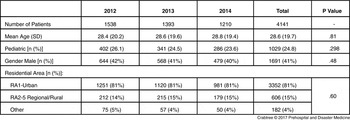
The mean age of patients was 28.6 years (SD=19.7). Over the three years of the study, 24.8% of patients were pediatric (14 years or younger). The majority of patients were female (59%). A total of 81% had an urban (RA1) residential address and 15% had a regional/rural residential address (RA2-5); four percent were from other areas (overseas or unspecified). There were no differences in the baseline demographics of patients across the different years (Table 1).
Baseline Demographics of Patients in the Study

Abbreviation: RA, residential area.
Patient Presentations
The most common patient presentations were injuries (49% of all presentations across the three years) and illnesses (46% of all presentations). Environment-related injuries accounted for five percent of presentations while psychiatric presentations accounted for less than one percent. There were no significant differences in the distribution of presentation types from 2012 to 2014 (P=.153; Figure 1). The most common types of illnesses were headache (40%), “other” minor illnesses (23%), pain (15%), and gastrointestinal (nausea/vomiting/diarrhea; 13%). More severe illness such as cardiac, respiratory, and neurological symptoms accounted for less than 10% of illness presentations. The most common types of injuries were minor wounds (69%), soft tissue injuries (sprains/strains; 20%), review of old injuries (6%), and foreign bodies (3%). Of environment-related injuries, 69% were bites/stings reviews while 31% were heat-related illnesses. Anxiety accounted for the vast majority of mental health presentations.
Patient Presentation Type by Year. Patient presentations were categorized as injury, illness, environmental and mental health as per Ranse and Hutton specifications.Reference Lund, Turris and Bowles 10 The number of each presentation type as a percentage of the total presentations that year are shown for 2012 to 2014. The distribution of patient presentation types did not differ from 2012 to 2014 (P=.153).

Influence of Time of Day and Day of Week on Patient Presentations
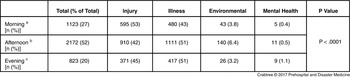
Overall, the afternoon period (12:30 pm to 5:30 pm) had the highest number of patient presentations (2,172), almost double that of morning presentations (prior to 12:30 pm; 1,123) and three times that of evening presentations (after 5:30 pm; 823). There was a higher proportion of injuries in the morning (53%), while there was a higher proportion of illnesses in the afternoon (51%) and evening (51% [Table 2; P<.0001]). In the evening, there were also more mental health presentations (1.1%) compared to only 0.4% and 0.5% in the morning and afternoon, respectively.
Relationship between Time of Day and Presentation Type

a Morning was defined as time of patient arrival any time prior to 12:30 pm.
b Afternoon was defined as time of patient arrival between 12:31 pm and 5:30 pm.
c Evening was defined as time of patient arrival after 5:31 pm.
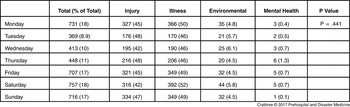
Table 3 shows the number and type of patient presentations by day of the week. As expected, there were more presentations on Mondays (18%), Fridays (17%), Saturdays (18%), and Sundays (17%) than there were during the middle of the week. A similar trend was observed in presentation types with the majority of injuries, illnesses, environmental, and mental health complaints occurring on Mondays and Fridays and the weekend; however, there were no significant relationships between the distribution of the type of presentation and the day of the week (P=.441).
Relationship between Presentations and Day of Week

Note: Values under the columns injury, illness, environment, and mental health show the absolute number and percentage within presentation type.
Patient Treatment and Disposition Trends Over Time
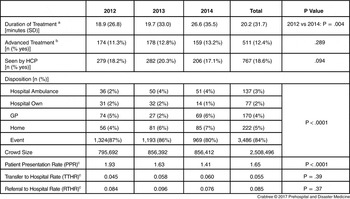
Across the three years studied, patients were found to have increased duration of clinical assessment by St John Ambulance. The duration of treatment increased from a mean of 18.9 (SD=26.8) minutes in 2012 to 26.6 (SD=35.5) minutes in 2014 (P=.004; Table 4). A substantial proportion (18.6%) of patients were seen by a health care professional at the SRES, with 12.4% requiring advanced treatment (treatment beyond the scope of a St John first responder) over the three-year period. However, there were no statistically significant changes in the percentage of patients requiring advanced treatment or health care professional review from 2012 to 2014.
Patient Treatment and DispositionFootnote d by Year at Sydney Royal Easter Show

Abbreviations: GP, General Practitioner; HCP, health care provider.
a Duration of treatment was calculated from the difference between time of arrival and time of discharge.
b Advanced treatment was defined as any treatment beyond the scope of first aid. Disposition was recorded based upon documented discharge method.
c PPR, TTHR and RTHRs were defined as described previously.Reference Logic 9
d Statistical analyses to examine trends in treatment and disposition over time included t tests for continuous variables and chi squared tests for categorical variables.
Patient disposition also changed significantly over the study period. A higher proportion of patients were transported to hospital by ambulance or discharged home, alongside a substantial decrease in the proportion of those being discharged back to the event from 2012 to 2014 (Table 4; P<.0001). While attendance at the SRES increased from 2012 to 2014, the PPR decreased from 1.93 in 2012 to 1.41 in 2014 (P<.0001). However, the RTHR or TTHR remained unchanged.
Relationship between Residential Area and Treatment/Disposition
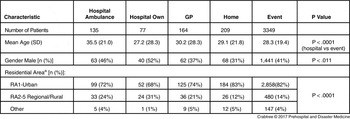
There was a significant interaction between the patient’s residential area and their treatment and disposition. Patients living in rural/regional areas were twice as likely to require advanced treatment (21.0% for rural/regional versus 10.8% for metropolitan; P<.0001) and twice as likely to be seen by a health care professional (29.4% for rural/regional versus 16.6% for metropolitan; P<.0001).
Table 5 shows the demographics of patients by their disposition. The mean age of those patients transported to hospital by ambulance (35.5 years [SD=21]) was higher compared to those referred back to the event (28.3 years [SD=20]). Patients transported to hospital also were more likely to be male compared to those discharged home or back to the event. Patients from rural/regional areas were over-represented amongst those who were referred to hospital (31%) or transported to hospital (24%) by ambulance. Accordingly, only 12% of those referred home and 14% of those returned to the event were from rural/regional locations, suggesting a significant relationship between patient residential area and disposition.
DemographicsFootnote b of Patients by Disposition Status

Abbreviations: GP, General Practitioner; RA, residential area.
a The Australian Standard Geographical Classification was used to clarify patient’s usual residential area as either urban (Residential Area 1) or regional/rural (Residential Area 2-5).
b This table shows the mean age, gender distribution, and residential area of patients by their disposition status after discharge from a St John post at the Royal Easter Show from 2012-2014.
Relationships between Weather and Patient Presentations
Mean temperature during the SRES held over the Autumn months of March-April in Sydney across the three years was 24°C (SD=4.0). The time period during which the SRES was held also was considerably dry, with only 11/42 days having >1.0 mm of precipitation. Median precipitation was 0.0 mm (range 0.0-84.0 mm). Extremes in temperatures for the season (defined as temperature greater or less than one standard deviation from the mean; ie,<20°C or >28°C) were associated with substantially lower attendance (46,178 attendees/day) compared to the days when the temperature was moderate (66,428 attendees/day; P=.012). In contrast, the PPR was higher when temperature was extreme (2.07 compared with 1.58; P=.001). However, there was no association between temperature and TTHR or RTHR (data not shown). There was a trend towards a lower attendance rate on days when there was some precipitation but no significant associations between precipitation and the TTHR or the RTHR (data not shown).
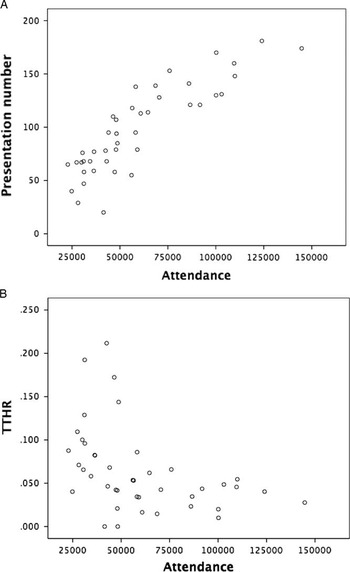
As expected, there was a high correlation between the crowd attendance and the absolute number of patient presentations (R2=0.75; P<.0001; Figure 2A). However, a non-linear relationship was found between attendance and TTHR (Figure 2B).
Relationships between Crowd Size and Patient Numbers. A: Relationship between crowd attendance and the absolute number of patient presentations. Each dot represents a single day at the SRES between 2012-2014. B: Relationship between the crowd attendance and the transport to hospital rate (TTHR). Each dot represents a single day at the SRES between 2012-2014. Abbreviations: SRES, Sydney Royal Easter Show; TTHR, transfer to hospital rate.

Discussion
There is a growing body of literature on mass-gathering medicine, with a focus on reporting the type and frequency of presentations,Reference Crabtree, Mo, Ong, Jegathees, Wei, Fahey and Liu 1 , Reference Bledsoe, Songer, Buchanan, Westin, Hodnick and Gorosh 3 , 7 , Reference Ranse and Hutton 11 - Reference Morimura, Katsumi and Koido 16 the impact of event factors and environmental factors on presentations and PPR,Reference Crabtree, Mo, Ong, Jegathees, Wei, Fahey and Liu 1 , Reference Bortolin, Ulla, Bono, Ferreri, Tomatis and Sgambetterra 12 - Reference Morimura, Katsumi and Koido 16 and the relationship between patient demographics, presentations, and PPR.Reference Crabtree, Mo, Ong, Jegathees, Wei, Fahey and Liu 1 - Reference Grant, Nacca, Prince and Scott 4 , 7 , Reference Ranse and Hutton 11 - Reference Zeitz, Schneider, Jarrett and Zeitz 17 There is a good understanding of factors affecting the PPR, including weather, crowd size, crowd profile, and event type, and models have been developed to predict workload and PPRsReference Crabtree, Mo, Ong, Jegathees, Wei, Fahey and Liu 1 , Reference Zeitz, Haghighi, Burstein and Williams 18 with varying success. The events reported include sporting events,Reference Arbon, Bridgewater and Smith 2 , Reference Zeitz, Zeitz and Arbon 19 , Reference Perron, Brady, Custalow and Johnson 20 state fairs,Reference Burton, Corry, Lewis and Priestman 21 music events, and agricultural shows. 7 Studies have reported the rate of treatment requiring a health care professional.Reference Nacca, Scott and Grant 22 , Reference Lund and Turris 23 Previous studies have analyzed the overall rate of different dispositions,Reference Lund and Turris 23 the relationship between event type and disposition,Reference Flabouris and Bridgewater 14 the nature of presentation and disposition,Reference Flabouris and Bridgewater 14 treatment level and disposition,Reference Milsten, Seaman, Liu, Bissell and Maguire 15 and the effect of disposition on final patient outcome.Reference Milsten, Seaman, Liu, Bissell and Maguire 15 However, few studies have analyzed the impact of patient demographics on both the treatment and discharge disposition provided by prehospital care organizations.
This study reported the results of a retrospective analysis of patient presentations to the SRES between 2012-2014. The results show that St John Ambulance at SRES manage patients from broad demographic backgrounds presenting with a range of clinical presentations, including injuries and medical illnesses of varying severity. The distribution of patient presentation types is similar to that reported previously at agricultural shows. 7 , Reference Morimura, Katsumi and Koido 16 Supplementary Table 1 (available online only) summarizes previous mass-gathering studies which examined relationships between patient demographics and clinical presentations. As shown in Supplementary Table 1, the majority of similar mass-gathering events had minor injuries and illnesses as the most common reason for presentation.Reference Crabtree, Mo, Ong, Jegathees, Wei, Fahey and Liu 1 , Reference Bledsoe, Songer, Buchanan, Westin, Hodnick and Gorosh 3 , 7 , Reference Bortolin, Ulla, Bono, Ferreri, Tomatis and Sgambetterra 12 , Reference Flabouris and Bridgewater 14 - Reference Morimura, Katsumi and Koido 16 Although patient demographics and the distribution of presentation types have not changed over time, the results show that the average treatment time has increased. This may reflect a higher proportion of patients presenting with more severe health problems, corresponding with the changing patient disposition as fewer patients are being discharged back to the event in more recent years (80% in 2014 versus 87% in 2012; P<.0001; Table 2).
The average PPR across the study of 1.65 patients per 1,000 patrons is comparable with previously reported PPRs ranging 0.5-2.0 for similar events, as can be seen in Supplementary Table 1.Reference Crabtree, Mo, Ong, Jegathees, Wei, Fahey and Liu 1 , Reference Zeitz, Haghighi, Burstein and Williams 18 , Reference Stagelund, Jans, Nielsen, Jans and Wildgaard 24 Two studies reported significantly higher PPR and TTHR, which may be due to the higher-risk nature of these events, both being multi-day music/arts festivals with the majority of patrons residing onsite for the duration of the event.Reference Arbon, Bridgewater and Smith 2 , Reference Lund and Turris 23 However, the PPR in this study was found to be significantly decreasing in more recent years, although the transport and referral rates to hospital remained unchanged. As expected, there was a near-linear correlation between crowd size and nominal patient presentation, again consistent with literature.Reference Stagelund, Jans, Nielsen, Jans and Wildgaard 24 , Reference Michael and Barbera 25 This study also reported a non-linear, inverse relationship between attendance and TTHR (Figure 2B). This result suggests that a portion of transports and referrals to hospital are from performers and staff at the SRES, rather than patrons which may have important implications on Occupational Health and Safety policies at the event. Existing literature investigating the relationship between crowd size and PPR has yielded mixed conclusions with three articles incorporated in the literature review (Supplementary Table 1) finding either an inverse relationship or no conclusive relationship between increasing crowd size and PPR, while Zeitz et al (2006) and Zeitz et al (2013) reported a strong correlation between the two.Reference Crabtree, Mo, Ong, Jegathees, Wei, Fahey and Liu 1 , Reference Feldman, Lukins, Verbeek, MacDonald, Burgess and Schwartz 13 , Reference Milsten, Seaman, Liu, Bissell and Maguire 15 - Reference Zeitz, Schneider, Jarrett and Zeitz 17 More investigation into the demographics of patients versus those of the attendees may yield greater insight into this disparity.
This study revealed novel findings on the relationship between residential demographics and the nature of patient presentation and treatment required. This study found that patients from rural/regional areas were twice as likely to require advanced treatment and review by health care professionals. This can be explained by the generally poorer socio-economic status of residents in RA2-5 regional/rural compared to those in RA1-urban, with a higher incidence of chronic illness, recent injuries requiring medical review, and risk taking behaviors.Reference Milsten, Maguire, Bissell and Seaman 26 , Reference Phillips 27 In the context of the agricultural show, patients from regional/rural areas also were more likely to be residents onsite for the duration of the event, contestants, exhibitors, and performers engaged in higher risk activities (eg, wood chopping, rodeo, and show jumping) compared to urban-based spectators. Furthermore, limited access to health care services could lead to patients presenting later with more advanced disease. In turn, an awareness of poorer health care access for those from regional/rural locations may influence discharge decisions by health care providers at SRES, with these individuals being more likely to be referred to hospital rather than back home or to a family physician. These findings place emphasis on a better training of health care staff and the need for establishing care models and follow-up for patients from regional/rural areas presenting to agricultural shows.
The findings from this study show that Event Health Services workload increases significantly over the Easter weekend. This correlates closely with greater attendance over these days. Additionally, higher numbers of patient presentations are encountered in afternoon shifts (12:30 pm to 5:30 pm) compared to mornings and evenings. The finding that Friday, Saturday, Sunday, and Monday were busier than other days (in terms of patient numbers) are different to the findings reported from a similar Australian agricultural show, also staffed by St John Ambulance, where Wednesdays (half-priced admissions) and Saturdays had the highest number of patient presentations.Reference Morimura, Katsumi and Koido 16 This study also demonstrated differences in presentation type by time of day, with a higher proportion of injuries in the morning but a higher proportion of illnesses in the afternoon and evening. In contrast, a similar recent review of prehospital presentations by time of arrival at the New York State Fair (Syracuse, New York USA) found a higher proportion of orthopedic complaints in the afternoon and evening.Reference Burton, Corry, Lewis and Priestman 21 These findings emphasize the need to study individual events which have unique demographics, event activities, and patterns for patient presentations in order to guide appropriate staffing in future years.
Weather is frequently reported in mass-gathering studies as having a significant influence on PPR and presentation types. The results from this study largely corresponded with trends identified in existing literature, as can be seen in Supplementary Table 1. When temperature was more than one standard deviation from the mean, there was a statistically significant increase in the PPR. Existing literature has similarly established a link between high maximum daily temperature and increased presentations.Reference Crabtree, Mo, Ong, Jegathees, Wei, Fahey and Liu 1 , Reference Zeitz, Haghighi, Burstein and Williams 18 , Reference Michael and Barbera 25 While earlier studies attributed higher temperature with increased heat-related illnesses, there was no significant correlation between temperature and the type of patient presentation in this study. This may be due to the fact that the temperature in the months of the SRES was mild, with patrons not being subjected to any strenuous activity, and having ample access to shade and hydration. Hence, the increased PPR may have been due to a combination of many factors that were not detected by this study. There also was no correlation between patient presentations and precipitation. This contrasts with results in other studies suggesting more falls and cold-related illnesses would be expected.Reference Michael and Barbera 25 Relatively dry conditions during the study years, with a median precipitation of 0.0 mm (range 0.0-84.0 mm) may have contributed, thus affecting the power of this study to examine relationships between weather and patient presentations.
Limitations
The retrospective design of this study presented limitations in data quality and collection. The quality of OB12s was variable due to records being completed by a large number of different personnel. While all data collectors had undergone standard induction in appropriate patient record form completion, most St John Ambulance personnel do not have a professional medical background. As a result, information regarding clinical characteristics of patients involved in the study varied in detail and specificity. The retrospective design of the study meant that data collected were limited to the information provided on existing OB12s. Data regarding demographics of the attendees of the event overall were therefore not able to be collected, and hence a comparison of patient demographics to overall crowd demographics was not possible. In addition, data regarding whether patients were patrons or staff of the SRES were not available.
The Ranse and Hutton minimum data set had limitations in classifying some patient presentations and distinguishing the severity of patient presentations, as identified in a more recent review and modification of the database.Reference Lagace, Desmeules, Pong and Heng 28
Conclusion
The duration of treatment and disposition trends for patients presenting at the SRES is changing over time. A higher proportion of rural/regional patients required advanced onsite care, health care professional review, and transport or referral to hospital. Future prospective studies should include better categorization of the severity of patient presentations using revised versions of the minimum dataset. There also is a need to investigate the requirements for health care professionals onsite at mass-gathering events, and its potential impact on reducing emergency department presentations and General Practitioner presentations, including a cost-benefit analysis to better guide resource distribution.
Supplementary Material
To view supplementary material for this article, please visit https://doi.org/10.1017/S1049023X16001540