Introduction
Recently there has been much research attention focused on the conservation of animal genetic resources and the maintenance of genetic biodiversity. In the case of domestic livestock, the Domestic Animal Diversity Information Service (DAD-IS) of the FAO has been developed for the documentation of the statistics and characteristics of local breeds of animals, including endangered species (http://dad.fao.org/). As a result of such initiatives, a diverse collection of animal genetic resources and detailed management regimes have been regarded as high priorities for many national governments. Within this context, there is an assumption that the recent high incidence of diseases, including avian influenza, is related to high genetic homozygosity in commercial chickens, even though their meat production and growth performance is high. In this regard, conservation of local animal breeds and varieties, which may have natural disease resistance, is very important for all animal-based industries, including poultry. Additionally, as the world population is projected to reach 10 billion within the current century, conservation of the diverse animal genetic resources is ultimately needed for the sustainable supply of animal protein sources.
The consumption of Korean native chicken (KNC) has continuously increased among Korean consumers who are seeking better taste and healthier rearing conditions of their livestock. For many, the activity of raising KNC is not only for the conservation of animal resources but also for the provision of primary business income. KNC have been classified into two types; the original KNC that has inhabited the Korean Peninsula for centuries, and imported chicken breeds introduced in the 1960s and 70s and their progeny since that time, which are called ‘adapted KNC’.
The chicken meat market in Korea is primarily based on whole chicken (~1.5 kg is standard), and is different from the cut up meat market in many other countries. For this reason, the slaughter age for poultry in Korea tends to be earlier than that in Western countries. KNC became almost extinct during the Korean War, and this, combined with the breed's characteristically slow growth, has limited commercialisation, confining KNC to small-scale production until the 1990s. However, in 1992, the National Livestock Research Institute (currently the National Institute of Animal Science; NIAS) in Korea launched a project regarding maintenance of purebred KNC lines and the promotion of commercial KNC production and distribution. As a result, KNC currently constitutes approximately 10% of total poultry consumption, and the number of birds reached 3.6 million in 2014. This number is expected to steadily increase in the near future (Korean Native Chicken Association, http://www.knca.kr/).
Native chicken consumption has increased in countries in Asia, such as Taiwan, Japan, Thailand, and China. In the case of Taiwan, native chicken has more than 50% of the market share of total chicken consumption (Lee, Reference LEE2006; Chumngoen and Tan, Reference CHUMNGOEN and TAN2015). In Japan, customers want differentiated chicken meat and, as a result, approximately 150 Japanese chicken brands have been produced, of which 46 have been developed using local native breeds. The meat from these Japanese native chicken brands is approximately two to five times more expensive than those from the commercial broilers. However, these are regarded as regional specialties, and demand is increasing (Yukio, Reference YUKIO2005). In China, native chicken meats constitute 20% of the total poultry meat market, and are also more expensive (Tang et al., Reference TANG, GONG, WU, JIANG, WANG and LI2009).
This review covers the past half century of KNC history to give directions for science and industry regarding using native chicken breeds, not only for Korea but also to meet other Asian consumers’ demands.
History of KNC
There is controversy surrounding the origin of domesticated chicken worldwide based on reports using mitochondrial DNA displacement (mtDNA D) loop variation and microsatellite (MS) marker analyses. DNA sequence analysis has been used for investigating the origin of the domestic chicken. Until recently, major scientific opinion was that the red jungle fowl (Gallus gallus) had been the main contributor to the genetic makeup of the domestic chicken, which has been supported by mtDNA analysis, MS marker analysis (Fumihito et al., Reference FUMIHITO, MIYAKE, TAKADA, SHINGU, ENDO, GOJOBORI, KONDO and OHNO1996; Hillel et al., Reference HILLEL, GROENEN, TIXIER-BOICHARD, KOROL, DAVID, KIRZHNER, BURKE, BARRE-DIRIE, CROOIJMANS and ELO2003) and whole-genome resequencing data (Rubin et al., Reference RUBIN, ZODY, ERIKSSON, MEADOWS, SHERWOOD, WEBSTER, JIANG, INGMAN, SHARPE and KA2010). However, multiple domestication events have been suggested by mtDNA data (Liu et al., Reference LIU, WU, YAO, MIAO, LUIKART, BAIG, BEJA-PEREIRA, DING, PALANICHAMY and ZHANG2006; Miao et al., Reference MIAO, PENG, WU, OUYANG, YANG, YU, LIANG, PIANCHOU, BEJA-PEREIRA and MITRA2013). Moreover, based on the analysis of the gene governing yellow-coloured skin, BCDO2, both red jungle fowl and grey jungle fowl are related to the domestic chicken (Eriksson et al., Reference ERIKSSON, LARSON, GUNNARSSON, BED'HOM, TIXIER-BOICHARD, STRÖMSTEDT, WRIGHT, JUNGERIUS, VEREIJKEN and RANDI2008).
The historical record for KNC was first established when chicken bones from the Stone Age were excavated in North Korea. In addition, eggs were identified in Cheonmachong, an ancient tomb in Gyeongju, South Korea, dating to approximately 400 to 500 C.E.. Based on excerpts from the Samkukji Wheezie Dongijeon, an ancient book written in the middle of third century CE, there were beautiful long-tailed chickens in Korea with tails approximately 150 cm in length. Various evidence has indicated that the KNC originated about 2,000 years ago, either from China or directly from India or Southeast Asia.
In recent years, research on the origin of KNC has been mainly carried out using the D-loop region in mtDNA. Haplotype analysis using the mtDNA D-loop region suggested that KNC are closely related to red jungle fowl (Hoque et al., Reference HOQUE, JUNG, PARK, CHOI and LEE2009). Based on the results of Cho et al. (Reference CHO, LEE, KO, KIM, PARK and YEON2011) using the mtDNA D-loop variation, at least five maternal lineages, which do not share a common ancestor, were derived from China and transferred to Japan. Based on the results of phylogenetic analysis using whole mitochondrial genome sequencing from five KNC lines, the breed has multiple maternal origins from Myanmar, Japan, and China, and these results were in agreement with other historical evidence (Kwak et al., Reference KWAK, SONG, OH, HEO, LEE, LEE, YOON, KIM, CHO and LEE2014).
development of five lines of KNC
The population of KNC dramatically decreased after the Korean War and, due to the importation of exotic breeds, it remained the only available in remote rural areas. Since the end of the 1970s, NIAS started the KNC restoration project, initially with a collection of the breeds. In the 1980s, the national income of Korea increased which lead to higher interest in the rearing of KNC, even in private farms. These developments led to the rise of KNC in the revitalised local poultry industry. Since 1992, project has focused on the refinement of physical characteristics. In 1994, an official nationwide ‘project for generating high-quality and commercially viable KNC’ was launched with the help of the Korea Poultry Association. This project focused on the restoration and establishment of lines and production systems for superior commercial KNC. This project continued for 15 years, until 2007. As a result, five KNC lines were established based on feather colour, body shape, and external appearance. These lines, namely White (Baeksaek Jarae-jong), Black (Heuksaek Jaerae-jong), Grey (Hoegalsaek Jaerae-jong), Yellow (Hwanggalsaek Jaerae-jong), and Red KNC (Jeokgalsaek Jaerae-jong) have been registered with the DAD-IS system of FAO (http://dad.fao.org/).
morphological characterisation of KNC
Based on the KNC restoration project, continuous selection and culling has been performed and the five lines fully established. The general characteristics of a KNC are a red-coloured single comb, rectangular body shape, yellow skin and grey shanks. The mature body weight is 2.5 to 3.1 kg for males and 1.6 to 2.0 kg for females. Hens produce a light brown egg shell (http://dad.fao.org/). Previously, the characteristics of 11 body parts were documented for these five lines of KNC (Sang et al., Reference SANG, KONG, KIM, CHOI, KIM, CHO, SANG, LEE, JEON and LEE2006). For more than 20 years, birds with undesirable characteristics have been culled, and true-breeding types generated.
Genetic characterisation of KNC
The first cytogenetic report for KNC was started in 1989 by analysing the karyotype of males and females (Chung et al., Reference CHUNG, CHEONG, PARK and YEO1989). Following this, chromosomal length and characteristics of KNC and White Leghorn chickens were compared to investigate structural characteristics. In addition to cytogenetic characteristics, documentation of morphological characteristics has also been performed (Yeo, Reference YEO1992).
Since the 1990s, DNA markers have been applied for the investigation of genetic characteristics only observed in the KNC breeds. Eight blood protein and enzyme loci were compared with those of other native and commercial breeds. Results suggested that KNC were more closely related to New Hampshire, Plymouth Rock, and Rhode Island Red breeds than to the White Leghorn (Lee et al., Reference LEE, CHUNG, OH, CHUN, YOU, CHUN, KIM, LEE, HAN and CHUNG1996a). Using DNA fingerprinting, the estimation of genetic relationships with other exotic breeds and genetic variations within the population suggest that KNC has large genetic diversity. Results confirmed that KNC was closely related to Rhode Island Reds than to White Leghorn and Cornish breeds (Lee et al., Reference LEE, LEE, HWANG, CHEONG, PARK, SHON, SHIN, OHH and HAN1996b).
Based on increased household income and consumer preference for high-quality livestock products, the demand for KNC has gradually increased. Along with increased demand, identification of breeds and individuals has become more important. Since the year 2000, studies using MS markers have been conducted in order to investigate the identification of KNC-specific markers. This has been done for the purpose of individual and breed identification, which can be used for the traceability system (Kong et al., Reference KONG, OH, LEE, JO, SANG, CHOI, KIM, LEE, YEON and JEON2006; Choi et al., Reference CHOI, HOQUE, SEO, SULTANA, PARK, LIM, HEO, KANG, JO and LEE2012; Reference CHOI, SEO, JEMAA, SULTANA, HEO, JO and LEE2015; Seo et al., Reference SEO, HOQUE, CHOI, SULTANA, PARK, HEO, KANG, LIM, LEE, JO and LEE2013; Reference SEO, OH, LEE, SEO and KONG2015a; Suh et al., Reference SUH, SHARMA, LEE, CHO, KIM, CHOI, KIM, SEONG, YEON, KIM and KO2014). In addition, DNA markers in the major histocompatibility complex (MHC) were investigated for their possible roles in disease resistance. In this regard, MS marker, LEI0258, located in the MHC region, has been investigated in KNC and exotic breeds, and results suggested that this marker can be used for breed discrimination (Jung et al., Reference JUNG, HOQUE, SEO, PARK, CHOI and LEE2009; Hoque et al., Reference HOQUE, LEE, JUNG, KANG, PARK, LIM, CHOI and LEE2011).
In addition, mtDNA analysis has been used for the identification of genetic relationships within KNC due to their high polymorphism and maternal inheritance (Niu et al., Reference NIU, FU, LUO, RUAN, YU, CHEN and ZHANG2002). A study using mtDNA in KNC was begun based on analysis of the variation in the cytochrome C oxidase I (COI, cox1) gene by Jin et al. (Reference JIN, SEO, SIM, BAEK, JUNG, JANG, CHOI and LEE2009). COI has been widely used for DNA barcoding systems in various species (Hebert et al., Reference HEBERT, CYWINSKA and BALL2003; Meusnier et al., Reference MEUSNIER, SINGER, LANDRY, HICKEY, HEBERT and HAJIBABAEI2008). mtDNA D-loop region in KNC has been used for phylogenetic analysis and discrimination between breeds (Hoque et al., Reference HOQUE, JUNG, PARK, CHOI and LEE2009; Reference HOQUE, CHOI, SULTANA, KANG, HEO, HONG, JO and LEE2013a; Sultana et al., Reference SULTANA, HOQUE, SEO, KANG, HEO, JO and LEE2012). Moreover, phylogenetic analysis have suggested that KNC has similar genetic variations with the native chickens in China, and has possibly five different maternal origins (Cho et al., Reference CHO, LEE, KO, KIM, PARK and YEON2011) and the whole mitochondrial genome sequencing results have indicated that KNC were derived from the multiple genetic origins of chickens (Kwak et al., Reference KWAK, SONG, OH, HEO, LEE, LEE, YOON, KIM, CHO and LEE2014).
Recently, many molecular genetic technologies have been developed, and these technologies are being applied to the identification and molecular characterisation of KNC. Copy number variation (CNV) as structural variation was investigated in KNC (Cho et al., Reference CHO, CHUNG, CHOI, JANG, PARK, KIM, KIM and LEE2014) and whole genome sequencing was performed on five lines and aligned with reference genome sequences in the database in order to identify novel SNPs and InDels (Kwak et al., Reference KWAK, SONG, OH, HEO, LEE, LEE, YOON, KIM, CHO and LEE2014; Seo et al., Reference SEO, OH, JIN, SONG, PARK, HEO, SHIN, JUNG, PARK, JO, LEE and LEE2014). In particular, Kwak et al. (Reference KWAK, SONG, OH, HEO, LEE, LEE, YOON, KIM, CHO and LEE2014) investigated highly variable regions for auditory sense, growth rate, and egg shell traits and identified olfactory receptor-related genes in five KNC lines. In addition, the first linkage (genetic) map for KNC was constructed using 131 MS and eight SNP markers in 2015. The length of linkage map was 2,729.4 cM, and the average map distance between markers was 19.64 cM. The marker order and genetic distances are similar to those obtained from previous linkage map results, and identified average number of alleles, heterozygosity values, and polymorphic information content (PIC) values, which were 5.5, 0.63, and 0.58, respectively, indicating that these markers have sufficient polymorphism to be used for the construction of genetic maps (Seo et al., Reference SEO, PARK, CHOI, JIN, YOO, SULTANA, HEO, JO and LEE2015b).
Exterior phenotypic characteristics investigated feather development (fast and slow) and colours, as these are a primary trait for sex-linked inheritance and widely used for autosexing breeds. These were compared for KNC, black Cornish, Rhode Island Red and Red KNC breeds, which have both fast- and slow-feathering phenotypes and genotypes and thus can be used for autosexing (Sohn et al., Reference SOHN, PARK, SONG, CHO, KANG and SUH2012). In addition, feather development has not been shown to affect production traits (Sohn et al., Reference SOHN, KIM, PARK, SONG, CHO, CHOI, HEO and CHOI2013).
Five lines of KNC were classified according to feather colour. Initially, genome wide association studies (GWAS) were carried out using 60K SNP chips for the identification of variations in feather colour. Twelve significant genes were identified, including pigment-related AKT7, PAP2, DDX6, and KRT7 (Park et al., Reference PARK, CHOI, LEE, LEE, CHOI, KIM, KIM, CHO and LEE2013). Moreover, the variations of the chicken MC1R gene were identified and their relationships with feather colours were investigated (Hoque et al., Reference HOQUE, JIN, HEO, KANG, JO and LEE2013b). This gene has an effect on KNC shank colour, especially the yellowness (b*) (Jin et al., Reference JIN, PARK, SEO, CAHYADI, CHOI, HEO, JO and LEE2014) and controls eumelanin and pheomelanin and affects skin and feather colours in various species (Andersson, Reference ANDERSSON2003; Klungland and Våge, Reference KLUNGLAND and VÅGE2003; Lin and Fisher, Reference LIN and FISHER2007).
Studies on quantitative trait loci (QTLs), which affect various economic traits in KNC, have been carried out using genome-wide mapping technologies. Seo et al. (Reference SEO, PARK, JUNG, CAHYADI, CHOI, JIN, HEO, JO and LEE2015c) identified QTL regions for meat quality-related traits of KNC, and Cahyadi et al. (Reference CAHYADI, PARK, SEO, JIN, CHOI, HEO, KANG, JO and LEE2016) identified QTLs that affect weekly body weight- and growth.
In the future, these findings can be used for the selection of desired traits and development of breeding strategies in KNC.
Development of the commercial KNC
Along with those examining the maintenance and breeding of pure KNC lines, many studies have examined the development of commercial lines, which has a higher growth rate and better meat quality. In the 1990s, heterosis effects were investigated by crossings between KNC and exotic breeds. Kang et al. (Reference KANG, CHEONG, LEE, KIM, OHH and CHOI1997a) investigated hatchability, growth and heterosis for KNC crossings using Rhode Island Red as the female line. All of these crosses had higher 20-week body weights than pure lines. As for laying performance, age at point of lay was significantly shorter in crosses, and survival and weekly body weights were higher than those of the pure breeds (Kang et al., Reference KANG, CHEONG, LEE, KIM, OHH and CHOI1997b). Growth performance for the three-way cross-breeds, wherein the male line was the Cornish breed and the female line was KNC × Rhode Island Red, were investigated (Kang et al., Reference KANG, LEE, KIM, KIM and OHH1998a; Reference KANG, LEE, KIM, SUH, NA, JANG, PARK, LEE and OHH1998b). Since 2000, original and adapted KNC breeds have been widely used for diverse crossbreeding experiments, the focus of which has been to increase meat and egg production and to improve meat qualities (Park et al., Reference PARK, HONG, KANG, KIM, SEO, CHOO, NA, SEO, HAN and HWANGBO2010; Reference PARK, HONG, KANG, HWANGBO and KIM2011; Kang et al., Reference KANG, HONG, KIM, YU, PARK, SEO, CHOO, NA, SEO and HWANGBO2010; Lee et al., Reference LEE, KIM, HEO, KIM, CHOI, HONG, CHOO and KIM2013; Reference LEE, HEO, CHOI, HONG and KIM2014). Based on these diverse experiments, NIAS has announced the development of a commercial KNC breed, called ‘Woorimatdak.’ This breed was developed based on the three-way crosses and is currently available in the Korean market.
Meat quality of KNC
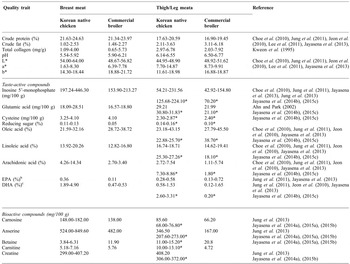
Typically, meat from indigenous chickens including KNC has a unique taste and texture that attracts domestic consumers more than meat from commercial broilers (CB) (Jayasena et al., Reference JAYASENA, JUNG, KIM, BAE, YONG, LEE, KIM and JO2013). This has been carefully evaluated via scientific analyses over the past few years. Table 1 summarises the findings of such studies related to general composition, physicochemical traits, and taste-active and endogenous bioactive compound content of breast and thigh/leg meat from KNC and CB.
General composition, physicochemical traits, and taste-active and bioactive compound contents of breast and thigh/leg meat from Korean native chickens and commercial broilers.

a Values with the mark (*) represents those from leg meat; bEicosapentaenoic acid; cDocosahexaenoic acid
general composition and physicochemical traits of KNC meat
Several studies have shown that KNC has a better general composition than CB, irrespective of the meat cut ( Table 1 ; Kweon et al., Reference KWEON, YEO and SUNG1995; Choe et al., Reference CHOE, NAM, JUNG, KIM, YUN and JO2010; Jeon et al., Reference JEON, CHOE, JUNG, KRUK, LIM and JO2010; Jung et al., Reference JUNG, JEON, JUNG, CHOE, LEE, HEO, KANG and and JO2011; Jayasena et al., Reference JAYASENA, JUNG, KIM, BAE, YONG, LEE, KIM and JO2013). Regarding meat colour, the L* (lightness) value of breast meat was significantly higher in KNC, but is higher in thigh meat from CB ( Table 1 ). A significantly higher a* (redness) value was seen in the thigh meat of KNC compared to CB ( Table 1 ; Choe et al., Reference CHOE, NAM, JUNG, KIM, YUN and JO2010; Jeon et al., Reference JEON, CHOE, JUNG, KRUK, LIM and JO2010; Jung et al., Reference JUNG, JEON, JUNG, CHOE, LEE, HEO, KANG and and JO2011; Jayasena et al., Reference JAYASENA, JUNG, KIM, BAE, YONG, LEE, KIM and JO2013). However, moisture, crude ash content (Kweon et al., Reference KWEON, YEO and SUNG1995; Choe et al., Reference CHOE, NAM, JUNG, KIM, YUN and JO2010; Jeon et al., Reference JEON, CHOE, JUNG, KRUK, LIM and JO2010; Jung et al., Reference JUNG, JEON, JUNG, CHOE, LEE, HEO, KANG and and JO2011) and water-holding capacity (Jung et al., Reference JUNG, JEON, JUNG, CHOE, LEE, HEO, KANG and and JO2011; Jayasena et al., Reference JAYASENA, JUNG, KIM, BAE, YONG, LEE, KIM and JO2013) of meat were comparable between the two breeds, regardless of meat cut. In addition, breast and thigh meat of KNC had significantly lower pH values than CB ( Table 1 ; Kweon et al., Reference KWEON, YEO and SUNG1995; Choe et al., Reference CHOE, NAM, JUNG, KIM, YUN and JO2010; Jeon et al., Reference JEON, CHOE, JUNG, KRUK, LIM and JO2010; Jung et al., Reference JUNG, JEON, JUNG, CHOE, LEE, HEO, KANG and and JO2011; Jayasena et al., Reference JAYASENA, JUNG, KIM, BAE, YONG, LEE, KIM and JO2013). For meat texture, KNC had higher cohesiveness, gumminess, and chewiness values (Choe et al., Reference CHOE, NAM, JUNG, KIM, YUN and JO2010; Jung et al., Reference JUNG, JEON, JUNG, CHOE, LEE, HEO, KANG and and JO2011) as well as hardness values (Choe et al., Reference CHOE, NAM, JUNG, KIM, YUN and JO2010) than CB.
taste-active and endogenous bioactive compound contents of KNC meat
KNC has significantly higher content of taste-active compounds than CB (Choe et al., Reference CHOE, NAM, JUNG, KIM, YUN and JO2010; Jeon et al., Reference JEON, CHOE, JUNG, KRUK, LIM and JO2010; Jung et al., Reference JUNG, JEON, JUNG, CHOE, LEE, HEO, KANG and and JO2011; Jayasena et al., Reference JAYASENA, JUNG, KIM, BAE, YONG, LEE, KIM and JO2013, Reference JAYASENA, KIM, LEE, JUNG, LEE, PARK and JO2014b), except for cysteine and oleic acid. Ahn and Park (Reference AHN and PARK2002) demonstrated that KNC (2.68 to 4.55) had a higher ratio of tasty to bitter amino acids than CB (1.60 to 3.64). Based on these results, Jayasena et al. (Reference JAYASENA, KIM, LEE, JUNG, LEE, PARK and JO2014b) suggested that the higher levels of taste-related compounds present in KNC meat than in CB meat resulted in its unique taste. However, it was reported that the availability of these taste-active compounds in KNC meat is governed by several factors, including line and sex (Jung et al., Reference JUNG, BAE, KIM, JAYASENA, LEE, PARK, HEO and JO2013), age, meat cut and cooking process (Jayasena et al., Reference JAYASENA, JUNG, PARK, LEE, NAM, LEE and JO2015c).
Recently, Jung et al. (Reference JUNG, BAE, KIM, JAYASENA, LEE, PARK, HEO and JO2013) and Jayasena et al. (Reference JAYASENA, JUNG, BAE, KIM, LEE, LEE and JO2014a; Reference JAYASENA, JUNG, BAE, PARK, LEE and JO2015a; Reference JAYASENA, JUNG, KIM, KIM, ALAHAKOON, LEE and JO2015b) provided useful information regarding the availability and amounts of bioactive compounds in KNC meat and some of the determinants that affect these compounds. The studies showed that KNC meat contained a considerable amount of endogenous bioactive compounds such as carnosine, anserine, creatine, betaine and carnitine, which is dependent on the age and line of KNC, meat cut, sex and cooking process (Jung et al., Reference JUNG, BAE, KIM, JAYASENA, LEE, PARK, HEO and JO2013; Jayasena et al., Reference JAYASENA, JUNG, BAE, KIM, LEE, LEE and JO2014a; Reference JAYASENA, JUNG, BAE, PARK, LEE and JO2015a; Reference JAYASENA, JUNG, KIM, KIM, ALAHAKOON, LEE and JO2015b). Jayasena et al. (Reference JAYASENA, JUNG, BAE, PARK, LEE and JO2015a) conducted an in-depth study revealing that meat from KNC was a significantly better source of carnosine, anserine, and carnitine than that from CB, which has a higher content of betaine. The effect of age of KNC on the availability of these compounds was only observed for betaine (Jayasena et al., Reference JAYASENA, JUNG, BAE, KIM, LEE, LEE and JO2014a).
sensory quality of KNC meat
Several studies have shown that sensory characteristics such as colour, odour, taste, texture, and overall acceptance did not differ substantially between KNC and CB (Choe et al., Reference CHOE, NAM, JUNG, KIM, YUN and JO2010; Jeon et al., Reference JEON, CHOE, JUNG, KRUK, LIM and JO2010; Jayasena et al., Reference JAYASENA, JUNG, KIM, BAE, YONG, LEE, KIM and JO2013). However, the thigh meat from KNC scored significantly higher values for odour, taste, and overall acceptance than CB (Jung et al., Reference JUNG, JEON, JUNG, CHOE, LEE, HEO, KANG and and JO2011).
Conclusions
Various projects have examined the benefits of locally grown chicken in Korea and how these can be cross bred to provide commercial lines, whilst maintaining its unique characteristics and flavour. Using funding from the Korean government, a new 10-year research project, called the Golden Seed Project, has been launched in 2012 in order to develop and maintain basal breeding stocks in animals and plants. In livestock animals, this project only focuses on pigs and chickens. The ultimate goals for this project are to generate US $200 million income from the exportation of breeding stock (including plants and fisheries) until 2020 and US $300 million income by 2030. One of the main aims is to ensure that Korea becomes an important contributor to the global breed market. Once this is accomplished, 30% of chicken imports can be replaced by new, local chicken breeding stocks, and US $100 million income can be generated from the exportation of breeding stock by 2020. Therefore the use of KNCs is expected to be considerably profitable in the future (http://www.gsp.re.kr/).
Acknowledgement
This work was supported by a research fund from the Golden Seed Project (No. PJ009925032016), Korea Institute of Planning & Evaluation for Technology in Food, Agriculture Forestry & Fisheries (IPET), Republic of Korea.