Peripherally inserted central catheters are types of central venous access lines inserted in peripheral superficial or deep veins that often terminate in the superior vena cava, right atrium or proximal third of the inferior vena cava. Reference Gonzalez and Cassaro1 In recent decades, these catheters have seen increased usage over other types of central lines due to perceived advantages such as prolonged venous access, ease of site placement, increased cost-effectiveness, lower complication rates and safer infusion of irritants and hypertonic solutions. Reference Gonzalez and Cassaro1 Common indications include long-term medication or infusion administration, blood sampling, etc. Reference Westergaard, Classen and Walther-Larsen2
While data on specific paediatric populations are abundant, there is a paucity of information regarding peripherally inserted central catheters’ use and complications in children with CHD or acquired heart disease. Given this lack of knowledge, the present study aims to characterise the use of these catheters in paediatric cardiac patients and identify risk factors associated with line complications in this population.
Materials and methods
Study setting and design
The study was conducted in a tertiary-level multidisciplinary cardiac ICU. It was designed as an observational, retrospective cohort study. Approval from the Institutional Review Board was obtained, with a waiver of informed consent granted before study initiation.
Study population and data collection
All paediatric cardiac patients 1 day to 18 years of age who underwent peripherally inserted central catheter placement between January 2000 and June 2018 were included in the study. Study population included pre-operative and post-operative congenital heart disease patients as well as heart failure patients. Data were obtained from an institutional database utilised by the vascular access team to monitor patients with peripherally inserted central catheters during their hospitalisation and after discharge.
The database included patient characteristics, catheter information, data regarding line placement, and complications. Patient characteristics included age, gender, history of previous peripherally inserted central catheters, total number of these lines, and survival to hospital discharge. Catheter characteristics included French size, number of lumens, and line indications. Information regarding placement included the year of attempt, success rate, sedation used for placement, service placing the line, location and time, insertion point and tip location, as well as duration of the line until removal or home discharge. Complications recorded included thrombosis/occlusion, infiltration, migration/malposition, dislodgement, infection, and damage. The database also contained information regarding time to complications, as well as management of these. When multiple complications occurred after a single-line placement, only the first complication was accounted for in the study.
Definitions
Thrombosis/occlusion was defined as the inability to infuse through the line. Infiltration was defined as fluid extravasation into the soft tissue around the catheter tip. Migration/malposition was defined as catheter tip located outside the area between superior vena cava and the cavoatrial junction with a functional line, while dislodgement was utilised if the line was nonfunctional. Damage was defined as any physical damage to the actual line (i.e. catheter break). Central line-associated bloodstream infections were defined according to the 2008 Centers for Disease Control definition (confirmed primary bloodstream infection with fever, hypothermia, apnoea, or bradycardia and the presence of the line at the time of or within 48 hours before the onset of infection). Reference Bashir, Swarnam, Vayalthrikkovil, Yee and Soraisham3,Reference Horan, Andrus and Dudeck4 Placement was considered successful when attempt was accomplished resulting in a functional line that did not require immediate removal. Peripheral tip location included those lines with catheter tip terminating peripherally not beyond the axillary vein junction.
Statistical analysis
Patient characteristics, catheter data, placement outcomes, and complications for the overall cohort of patients were described using medians and interquartile ranges for continuous variables and frequencies and percentages for categorical variables. Bivariate analysis using generalised linear models was used to ascertain the association between covariates and successful catheter placement and to address the association between covariates and each complication type. Logistic regression was utilised to ascertain if the number of catheters was associated with increased complications. Multivariable generalised linear models were used to analyse the effects of potential variables. Backward selection with an alpha level of removal of 0.05 was utilised. Odds ratios and 95% confidence intervals were calculated. All p-values were two-sided, and p < 0.05 was considered statistically significant. Statistical analyses were performed using SAS (version 9.4, SAS Institute Inc., NC, USA).
Results
Patient population, indications, and placement
A total of 1822 cardiac patients underwent 2952 peripherally inserted central catheter placements during the same or different hospital admissions between January 2000 and June 2018. The median age of the cohort was 29 days (interquartile range 4–224), with neonatal patients (<30 days old) accounting for 50.2% of patients. Males were predominant (54.9%). Cardiac diagnoses were lacking in this institutional database. Patients with only one catheter accounted for 65.5%, while the remaining had multiple catheters placed at different time points (range, 2–11). Overall survival to hospital discharge was 96.4%. On 258 occasions (8.7% of catheters), patients were discharged home with a peripherally inserted central catheter for treatment continuation. Median time to catheter removal or home discharge with the line was 12 days (interquartile range 6–21).
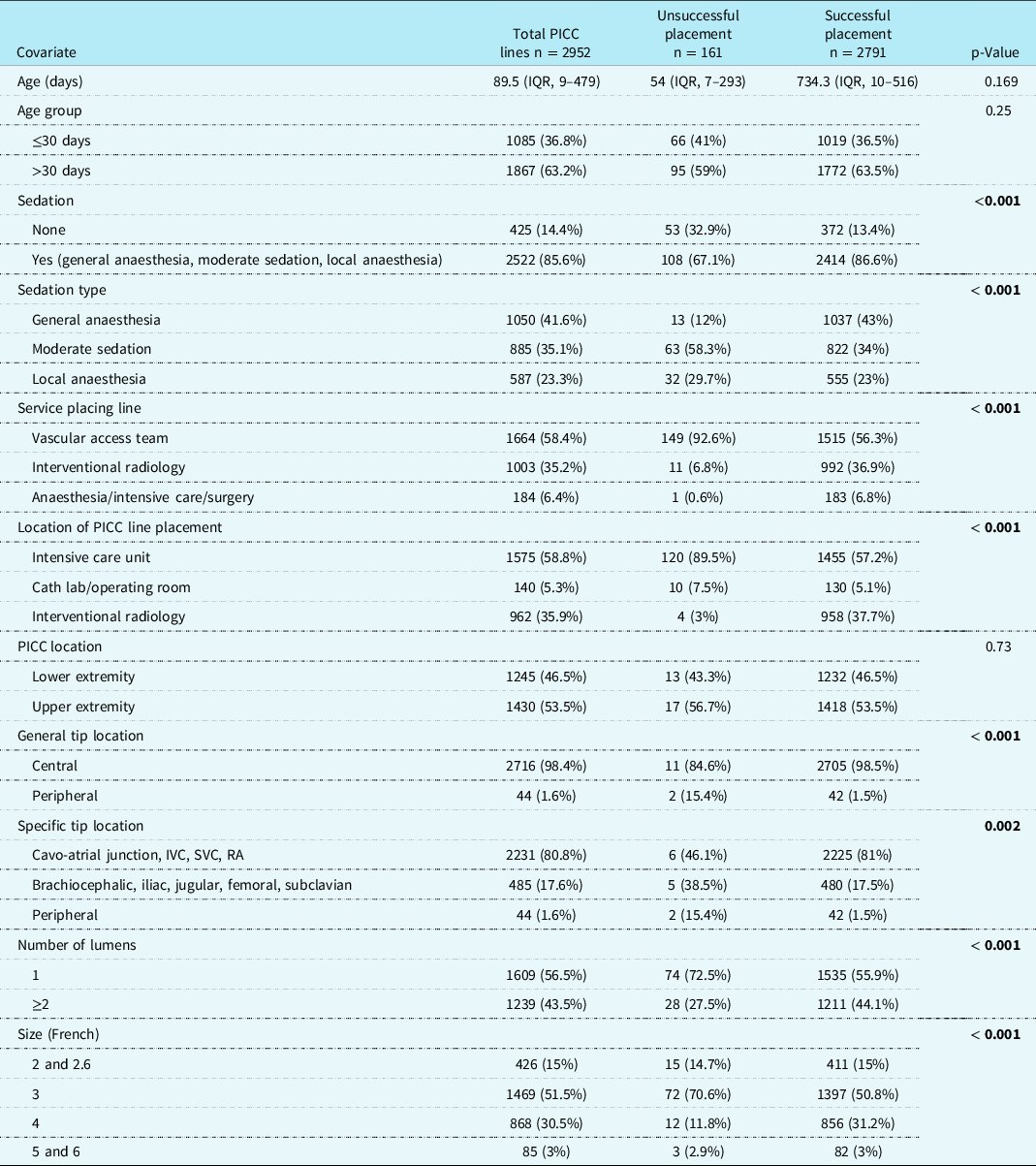
Data regarding peripherally inserted central catheter indication were available in 466 lines and included infusion of antibiotics in 41.6%, infusion of total parenteral nutrition in 21.6%, frequent laboratory sampling in 15.6%, infusion of intravenous sedation and analgesia in 7.5%, maintenance fluids in 6.4%, blood products in 4.1%, and other medications in 3.2%. Most of these lines (80.3%) were placed during the weekdays (Monday to Friday) and from 7 am to 5 pm (70.8%). Sedation was used in 85.6% of placements, with the most common type being general anaesthesia (41.6%), followed by moderate sedation (35.1%). Most of the peripherally inserted central catheters were placed by the vascular access team (58.4%), followed by the interventional radiology team (35.2%) and other services (6.4%). Most of these catheters were placed in the ICU (58.8%), followed by the interventional radiology suite (35.9%). Upper extremity lines were more frequent (53.5%). Tip location was most common (80.8%) at the cavo-atrial junction, inferior vena cava, superior vena cava, and right atrium. Peripherally located catheters were the least frequent (1.6%). Single-lumen catheters (56.5%) and those with 3-Fr size (51.5%) were most common. Table 1 summarises these characteristics.
Characteristics between unsuccessful and successful PICC line placement

IQR = interquartile range; IVC = inferior vena cava; PICC = peripherally inserted central catheter; RA = right atrium; SVC = superior vena cava
Significant p values are bolded
Factors associated with successful peripherally inserted central catheter placement
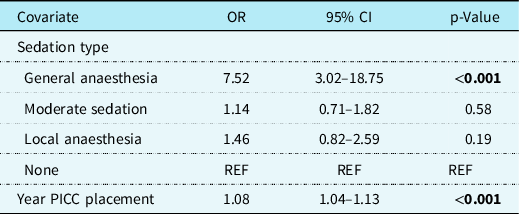
The success rate for peripherally inserted central catheter placement was 94.5%. Table 1 summarises the differences between successful and unsuccessful attempts. Factors associated with successful line placement were initially evaluated in bivariate analyses. After backward selection, multivariable analysis demonstrated that sedation type for line insertion and year of placement were significantly associated with successful line placement (Table 2). The odds of successful peripherally inserted central catheter placement using general anaesthesia was 7.52 times the odds of using no sedation (p < 0.001). For each year increase, the odds of successful catheter placement increased by 8% (p < 0.001).
Multivariable analysis assessing associations for successful PICC line placement
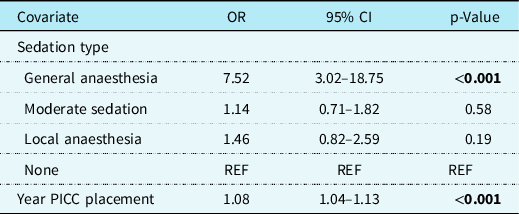
CI = confidence interval; OR = odds ratio; PICC = peripherally inserted central catheter; REF = reference
Significant p values are bolded
Peripherally inserted central catheter complications and contributors
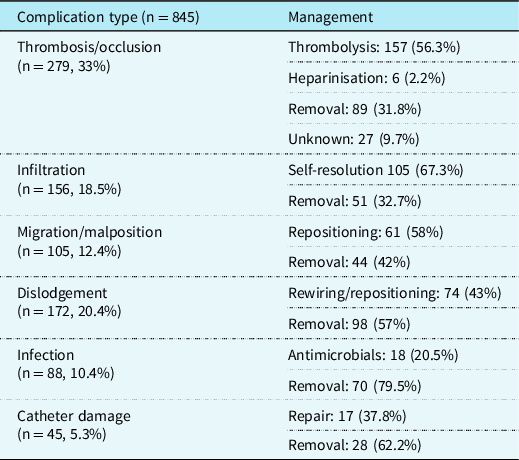
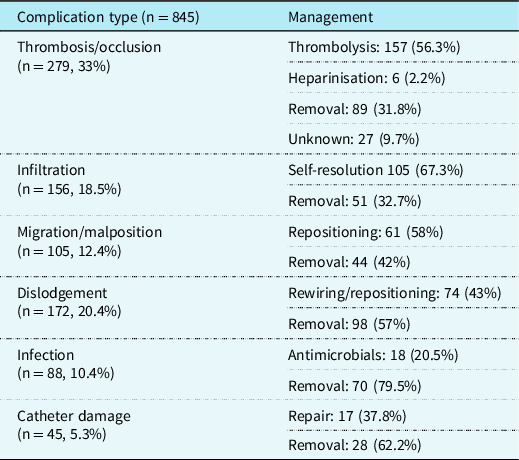
Complications occurred in 845 of 2952 peripherally inserted central catheters (28.6%), with documented adverse events to the patients in 136 (4.6%). These adverse events (n = 136) were described as culture-positive bloodstream infection (n = 88, 64.7%), venous thromboembolism due to line thrombosis (n = 28, 20.6%), arrhythmias due to line migration/dislodgement (n = 16, 11.8%), and medication infiltration into the subcutaneous tissue (n = 4, 2.9%). Line thrombosis/occlusion was the most frequent complication (33%), followed by dislodgement (20.4%) and infiltration (18.5%). Migration/malposition occurred in 12.4% of lines, followed by infection (10.4%) and line damage (5.3%). Microbiological data were present in 65 of the 88 documented infected lines (gram-positive cocci in 66.2%, gram-negative rods in 27.7%, and yeast in 6.1%). Median time to complication was 6 days (interquartile range 3–15.5). Most of these complications (55%) resolved with appropriate treatment or on their own, while the remaining (45%) required removal of the line. Table 3 summarises complication types and their management.
Complication type and management
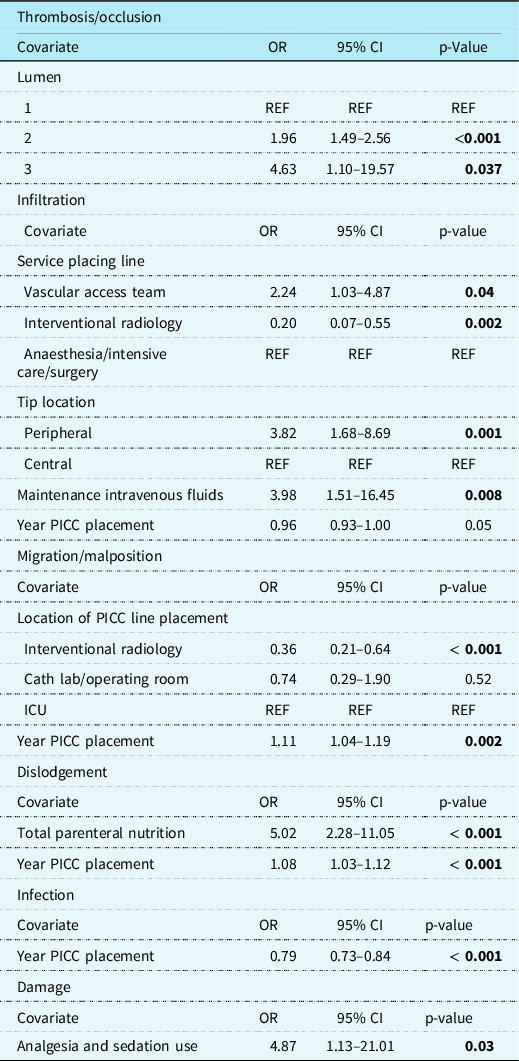
Factors associated with each of the defined catheter complication types were initially evaluated in bivariate analyses. Table 4 summarises the results of multivariable generalised linear models for each complication after backward selection. Thrombosis/occlusion was significantly associated with lines having two and three lumens (odds ratio 1.96, p < 0.001 and odds ratio 4.63, p = 0.037, respectively). Peripherally inserted central catheters placed by the interventional radiology team had significantly decreased infiltration (odds ratio 0.20, p = 0.002), while those placed by the vascular access team had increased infiltration (odds ratio 2.24, p = 0.04). Other significant factors associated with increased infiltration were the use of maintenance intravenous fluids through the line (odds ratio 3.98, p = 0.008) and peripheral tip position (odds ratio 3.82, p = 0.001). Placement of these catheters in the interventional radiology suite was significantly associated with decreased migration/malposition (odds ratio 0.36, p < 0.001), while the likelihood of this complication increased by 11% for each year increase in line placement (odds ratio 1.11, p = 0.002). Catheter dislodgement was significantly associated with the use of total parenteral nutrition (odds ratio 5.02, p < 0.001) and with each year increase in placement (odds ratio 1.08, p < 0.001). Using sedation and analgesia through the line was significantly associated with increased catheter damage (odds ratio 4.87, p = 0.03). The likelihood of catheter infection decreased by 21% for each year increase in line placement (odds ratio 0.79, p < 0.001). When the number of catheters was evaluated against complications, we found that for each extra peripherally inserted central catheter placed on the same patient, the likelihood of having any complication increased by 170% (p = 0.01).
Multivariable analyses to ascertain associations between covariates and each PICC line complication
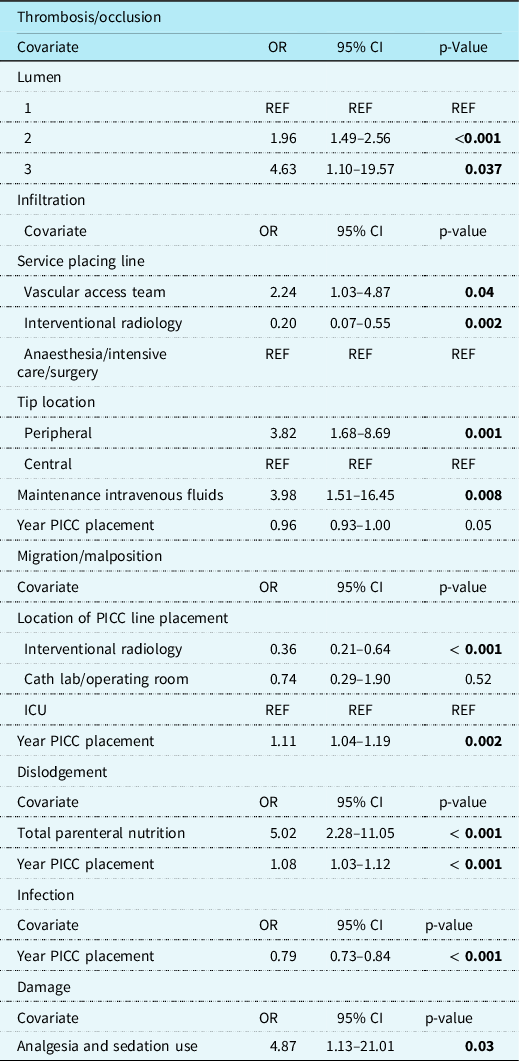
CI = confidence interval; OR = odds ratio; PICC = peripherally inserted central catheter; REF = reference
Significant p values are bolded
Discussion
The primary finding of our study is that our cohort of neonates and children with congenital or acquired heart disease had an overall incidence of successful peripherally inserted central catheter placement of 94.5%. Our success rate is similar to previously reported paediatric literature (95–100%). Reference Gonzalez and Cassaro1,Reference Conlon, Himebauch and Cahill5 General anaesthesia use during the insertion and year of peripherally inserted central catheter placement seemed to be significant contributors to this success. Our secondary finding is that the incidence of line complications in our cohort reached 28.6%. Previous paediatric studies noted broad complication rates ranging from 2.2 to 31.3%. Reference Gonzalez and Cassaro1,Reference Jain, Deshpande and Shah6,Reference Tan, Hess and Diaz7
While studies note that physician experience increases procedure success and decreases complication odds, only a few examine this specifically as an effect of time and quantify complication rate. Reference Alexandrou, Spencer, Frost, Mifflin, Davidson and Hillman8,Reference Costello, Morrow, Graham, Potter-Bynoe, Sandora and Laussen9 While one recent paediatric study noted decreased peripherally inserted central catheter complications from 22 to 8% over 6 years, this study did not focus on paediatric cardiac patients. Reference Alexandrou, Spencer, Frost, Mifflin, Davidson and Hillman8 In our study, we found increasing rates of successful line placement and decreasing infection rates with each subsequent year. However, some complications, such as migration/malposition and dislodgement, continued to rise over time. This increase could be attributable to the vascular complexity of patients requiring long-term usage of these lines. Sedation and analgesia are often used in paediatric patients to place peripherally inserted central catheters, especially in the younger population. Reference Westergaard, Classen and Walther-Larsen2,Reference Pitts10 One study noted that successful placement significantly increased in children under the age of 5 years with the use of sedation and analgesia for placement; however, only 7.3% were cardiac patients. Reference Pitts10 Uniquely, we found that general anaesthesia, unlike other sedation methods, was significantly associated with successful line placement in our cohort. This differs from a study that found no difference, regardless of analgesic modality. Reference Costa, Bueno, Oliva, de Castro, de Camargo and Kimura11 However, the use of general anaesthesia for line placement in paediatric cardiac patients must be individually evaluated given the high risks for life-threatening complications with anaesthesia in this patient population. Reference Laing, Burgoyne, Muncaster, Taranath and Taverner12
In our study, thrombosis and occlusion occurred in 9.45% of all peripherally inserted central catheters (i.e. accounted for 33% of the complications), with about one-third of those requiring line removal. Previous paediatric studies demonstrated peripherally inserted central catheter occlusion secondary to thrombotic and non-thrombotic origin to occur at a rate of 1.35 per 1000 catheter days. Reference Shah, Kalyn and Satodia13–Reference Fratino, Molinari and Parodi15 Reported risk factors included catheter tip position (i.e. increased thrombosis risk in superior portion of superior vena cava, as compared to inferior portion and right atrium), small diameter veins, malignancy, line characteristics (e.g. triple lumen, narrow lumen), and type of medication (e.g. calcium, heparin, total parenteral nutrition, etc.). Reference Westergaard, Classen and Walther-Larsen2,Reference Liem, Yanit and Moseley14,Reference Fratino, Molinari and Parodi15 Our study demonstrated thrombosis/occlusion to be significantly associated with an increased number of lumens. Mechanisms explaining this finding include more manipulation, leading to increased bacterial seeding and decreased blood flow, leading to thrombosis and occlusion from mechanical and inflammatory aetiologies. Reference Baxi, Shuman and Scipione16–Reference Chopra, Fallouh and McGuirk18 Multiple lumen lines are also most often required and utilised in patients with more complicated diseases, and this might represent a population at higher risk for overall complications. Most thrombotic events are asymptomatic, so symptom onset is not a reliable way of detecting venous thromboembolism. Reference Dubois, Rypens, Garel, David, Lacroix and Gauvin19 Incidence of venous thromboembolism associated with paediatric peripherally inserted central catheters ranges from 2.6 to 9%. Reference Westergaard, Classen and Walther-Larsen2,Reference Dubois, Rypens, Garel, David, Lacroix and Gauvin19 In our cohort, 28 of the 279 thrombotic events (10%) had venous thromboembolism and required anticoagulation (n = 5, 17.9%), thrombolysis (n = 10, 35.7%), or line removal (n = 13, 46.4%).
Neonatal studies have reported rates of peripherally inserted central catheter infiltration ranging from 4.7 to 12.5%. Reference Bashir, Swarnam, Vayalthrikkovil, Yee and Soraisham3,Reference Jain, Deshpande and Shah6 These studies demonstrated that infiltration was associated with peripheral catheter position and upper extremity placement. Reference Bashir, Swarnam, Vayalthrikkovil, Yee and Soraisham3,Reference Jain, Deshpande and Shah6 In our study, infiltration occurred in 5.2% of all peripherally inserted central catheters (i.e. accounted for 18.5% of the complications), requiring line removal in about one-third of those events. We also found significantly increased infiltration with peripheral tip location and with the infusion of maintenance intravenous fluids. This could be due to fluid composition and high-flow infusion rates. Reference Park, Jeong and Jun20,Reference Singh, Kalyan, Kaur, Jayashree and Ghai21 Furthermore, our study demonstrated significantly decreased infiltration when lines were placed by the interventional radiology team, likely due to the more precise positioning under fluoroscopy.
Catheter malposition can be defined as primary (e.g. initial malposition secondary to patient moving or vascular anomalies, etc.) and secondary or migration (e.g. despite correct initial placement, catheter migrates secondary to rapid infusion rates, increased physical exertion, or rapid ventilation, etc.), both with a functional line. Reference Gonzalez and Cassaro1 This differs from dislodgement (i.e. accidental line movement or removal resulting in a non-functional catheter). Reference Gonzalez and Cassaro1 Dangerous sequela related to malposition or dislodgement can include cardiac tamponade, arrhythmias, arterial puncture, hemothorax, pneumothorax, etc. Reference Westergaard, Classen and Walther-Larsen2 In our cohort, migration/malposition occurred in 3.5% of the peripherally inserted central catheters (i.e. accounted for 12.4% of complications), with 42% of these patients requiring line removal. We found decreased migration/malposition when lines were placed in the interventional radiology suite, likely due to the frequent use of sedation to prevent patient movement and fluoroscopy for precise positioning in this location. Interestingly, a recent study examining peripherally inserted central catheter placement at the bedside with ultrasound compared to the interventional radiology suite found no difference in success or complications but found a significantly faster placement and less cost when placed at the bedside. Reference Conlon, Himebauch and Cahill5 A recent study also found decreased central line-associated bloodstream infections rates and odds of occurring when peripherally inserted central catheters were placed in the interventional radiology suite compared to other hospital locations. Reference Koo, Cooper, Monroe, Reis, Shivaram and Zerr22 Peripherally inserted central catheter dislodgement has reported rates varying from 2.4 to 17.5% and seems to be associated with age < 5 years old, increased activity level, securement with tape, and improper tip positioning. Reference Tan, Hess and Diaz7,Reference Pittiruti, Hamilton, Biffi, MacFie and Pertkiewicz23 In our cohort, dislodgement occurred in 5.8% of the lines (i.e. 20.4% of the complications) and required line removal in more than half of the cases. Dislodgement was significantly associated with the use of total parenteral nutrition in our study. Dislodgement with total parenteral nutrition has not been described and its biological plausibility is unclear. Possible mechanisms for this association are the use of inappropriate high pressures to flush the line due to intraluminal precipitate of lipid aggregates, inappropriate securing at the time of insertion or inadequate care of the exit site in these patients. Reference Pittiruti, Hamilton, Biffi, MacFie and Pertkiewicz23
Central line-associated bloodstream infections from peripherally inserted central catheters are most often from coagulase-negative Staphylococci, Staphylococcus aureus, enterococci, and Candida species, with infections manifesting from site cellulitis to systemic infection. Reference Gonzalez and Cassaro1,Reference Westergaard, Classen and Walther-Larsen2 The reported incidence rates of these catheter infections vary from 0.2 to 6.4 per 1000 catheter days. Reference Westergaard, Classen and Walther-Larsen2,Reference Shah, Kalyn and Satodia13 In our study, infection occurred in 2.9% of peripherally inserted central catheters (i.e. accounted for 10.4% of the complications), with gram-positive cocci being the most frequent microorganism group isolated. Only 20.9% of these infections were cleared with antimicrobials (repeat blood cultures yielded negative results, along with clinical and laboratory resolution of the infection), with the remaining 79.5% requiring catheter removal. The peripherally inserted central catheter placement-to-infection time has been found to be 21 days in regular paediatric age groups and 35 days in neonates. Reference Barrier, Williams, Connelly and Creech24–Reference Sengupta, Lehmann, Diener-West, Perl and Milstone27 Median placement-to-infection time in our cohort was shorter, 8 days (interquartile range 5–18); however, we found 21% decreased odds of infection with each additional year of line placement. In the literature, factors associated with peripherally inserted central catheter infection are young age, smaller-sized and double-lumen catheters, polyurethane composition, femoral vein access site, incorrect tip positioning, multiple catheters, and a greater number of daily doses of medication administered. Reference Barrier, Williams, Connelly and Creech24,Reference Bourgeois, Lamagna and Chiang28 We examined the effect of age, size and lumens, access site, and tip position and did not find statistical significance.
There is scant data on peripherally inserted central catheter damage in the literature, with incidence ranging from 0.6 to 1.9%. Reference Chow, Friedman and Macarthur29,Reference Paulson and Miller30 Some reports have demonstrated peripherally inserted central catheter damage due to excessive syringe pressure when giving medications, traction on the catheter-hub junction, and iatrogenic aetiologies. Reference Pittiruti, Hamilton, Biffi, MacFie and Pertkiewicz23,Reference Bashir, Bhat, Manzoor, Bashir and Ahmad31,Reference Graham, Keldermans, Klemm, Semenza and Shafer32 In our study, damage occurred in 1.5% of all peripherally inserted central catheters (i.e. accounted for 5.3% of the complications) and was significantly associated with the use of sedation and analgesia. There is not published data on this association or knowledge of the mechanism explaining the cause-effect. Chemical damage to the line material due to the use of solvents, or the use of medication boluses with inappropriate high pressures on the line wall could explain this finding. Reference Pittiruti, Hamilton, Biffi, MacFie and Pertkiewicz23 Only one-third of those damaged lines were successfully repaired, while the remaining ones required removal.
Our study has a few limitations. First, it is a retrospective database review of a single-center experience with limited data including lack of primary cardiac diagnosis, so the results cannot be extrapolated to all paediatric cardiac patients. Second, we could not adjust for factors associated with peripherally inserted central catheter complications such as the severity of illness, comorbidities, and diagnosis. Third, the absence of standardised line placement and monitoring guidelines in our patients may be an important confounder. Finally, some of the identified associations may not have clinical plausibility.
In conclusion, our study demonstrated that peripherally inserted central catheters in paediatric cardiac patients are feasible and safe, with an incidence of complications similar to other paediatric populations. Identifying factors associated with complications prospectively for this population subset will help shed light on ways further to decrease rates of line-related complications and improve successful insertion.
Acknowledgements
We acknowledge the vascular access team at Phoenix Children’s Hospital for the great work and care provided to the patients and families.
Financial support
The statistical work was supported by the Saint Jude Pediatric Research Recruitment Support Fund hosted by H.R.M. (R079700270).
Conflict of interest
The authors declared no conflicts of interest with respect to the authorship and/or publication of this manuscript.