In the current climate, employees are more likely than ever to be concerned with how to manage their work and family lives. The changes in the composition of the workforce (e.g., increased number of women), demographic shifts (e.g., single-parent families), and changes in technology (e.g., increased use of cell phones) have generated some difficulties in managing work and family lives (e.g., Dugan, Matthews, & Barnes-Farrell, Reference Dugan, Matthews and Barnes-Farrell2012; Magee, Stefanic, Caputi, & Iversion, Reference Magee, Stefanic, Caputi and Iversion2012). These changes have contributed to a blurring of boundaries between work and family and to greater permeability between these domains. Consequently, managing work and family is increasingly complex and more and more difficult (e.g., Magee et al., Reference Magee, Stefanic, Caputi and Iversion2012), leading workers to perceive more work-to-family conflict (WFC – referring to situations where work demands affect one's abilities to meet family demands; Netemeyer, Boles, & McMurrian, Reference Netemeyer, Boles and McMurrian1996).
Work-related variables (i.e., job demands and resources) have been found to be important predictors of WFC (e.g., Michel, Kotrba, Mitchelson, Clark, & Baltes, Reference Michel, Kotrba, Mitchelson, Clark and Baltes2011). Indeed, workload was found to increase workers’ perception of WFC (e.g., Molino, Cortese, Bakker, & Ghislieri, Reference Molino, Cortese, Bakker and Ghislieri2015), whereas opportunities for development make it possible to improve workers abilities to manage work and family responsibilities leading them to reduce their perception of WFC (e.g., Mache, Bernburg, Vitzthum, Groneberg, Klapp, & Danzer, Reference Mache, Bernburg, Vitzthum, Groneberg, Klapp and Danzer2015). However, the theoretical mechanisms underlying these relationships are far from clear.
Through the present research, we investigated why these work-related variables (i.e., workload and opportunities for development) and WFC are related. We considered that one possible mechanism refers to two types of heavy work investment, i.e., workaholism and work engagement (Schaufeli, Taris, & Bakker, Reference Schaufeli, Taris, Bakker and Burke2006). We postulated that, the work environment may lead workers to invest heavily in work and that this heavy work investment has an impact on their family life. In other words, we tested the mediating role of workaholism and work engagement between workload, opportunities for development and WFC. Using a three-wave longitudinal design, we investigated the causal relationships among these concepts.
We decided to focus on workload (having a lot of work to do within a restricted time span; Baeriswyl, Krause, Elfering, & Berset, Reference Baeriswyl, Krause, Elfering and Berset2016: 3) because it is a well-known job stressor (Bakker & Demerouti, Reference Bakker, Demerouti, Chen and Cooper2014) and an important antecedent of WFC (e.g., Michel et al., Reference Michel, Kotrba, Mitchelson, Clark and Baltes2011). Opportunities for development (intrinsic and extrinsic aspects of the job allowing individuals to develop themselves at work, Stinglhamber & Vandenberghe, Reference Stinglhamber and Vandenberghe2004) were included because of their motivational qualities (Schaufeli, Bakker, & van Rhenen, Reference Schaufeli, Bakker and van Rhenen2009). Moreover, opportunities for development appear to be crucial to workers’ needs. Indeed, Travaglianti, Orianne, Pichault, and Hansez (Reference Travaglianti, Orianne, Pichault and Hansez2015) identified several categories of specific work-related needs linked to employment quality. Among these categories, we find development opportunities.
In this study, we focused only on the work-to-family direction of the conflict mainly because works antecedents are generally considered as the primary predictors of WFC. Indeed, according to the domain specificity (Frone, Russell, & Cooper, Reference Frone, Russell and Cooper1992), predictors of WFC stem from the originating role domain (Shockley & Singla, Reference Shockley and Singla2011). In line with this within-domain effect, empirical studies largely found that work variables have a stronger and more robust influence on WFC than on family-to-work conflict (e.g., Byron, Reference Byron2005; Mesmer-Magnus & Viswesvaran, Reference Mesmer-Magnus and Viswesvaran2005). Moreover, WFC is more likely to occur because work issues intrude into the family domain more readily than family issues into the work domain (Theory of asymmetric, Pleck, Reference Pleck1977) due to a difference of permeability between work and family domain boundaries (i.e., occupational boundaries are more clearly defined and more strictly enforced whereas family boundaries are more subject to change). Therefore, by adopting an organizational point of view by considering workload and opportunities for development as predictors of WFC, we considered only the work-to-family direction.
The present research contributes to the existing literature in several ways. Firstly, only a handful of studies have considered workaholism or work engagement in relationship with WFC (e.g., Bakker, Demerouti, & Burke, Reference Bakker, Demerouti and Burke2009; Hakanen & Peeters, Reference Hakanen and Peeters2015). Moreover, even if (very) few studies consider workaholism as a mediator in the workload–WFC relationship (Huyghebaert, Fouquereau, Lahiani, Baltou, Gimenes, & Gillet, Reference Huyghebaert, Fouquereau, Lahiani, Baltou, Gimenes and Gillet2016; Molino, Bakker, & Ghislieri, Reference Molino, Bakker and Ghislieri2016), the design used (respectively two-wave cross-lagged panel design; cross-sectional design) does not allow for a parsimonious test of this mediated model. Indeed, three measurement times could allow for a better appreciation of the temporal relationships between the studied dimensions, as well as a more precise evaluation of the observed mediations (Cole & Maxwell, Reference Cole and Maxwell2003).
Furthermore, to the best of our knowledge, we are not aware of any study considering workaholism and work engagement together as underlying processes (i.e., mediators) in the work environment (i.e., workload and opportunities for development) – WFC relationships. Indeed, it is only recently that research has begun to investigate the concomitant effects of these two types of working hard (e.g., Del Líbano, Llorens, Salanova, & Schaufeli, Reference Del Líbano, Llorens, Salanova and Schaufeli2012). Considering workaholism and work engagement together is relevant to shed light on the differences between these concepts. Indeed, if behaviors of workaholics and engaged workers appear to be similar (i.e., in both cases they often work harder and longer than other people), research suggests key differences between workaholism and work engagement notably in terms of motivation underlying these behaviors (e.g., van Beek, Hu, Schaufeli, Taris, & Schreurs, Reference van Beek, Hu, Schaufeli, Taris and Schreurs2012; van Beek, Taris, Schaufeli, & Brenninkmeijer, Reference van Beek, Taris, Schaufeli and Brenninkmeijer2014).
Moreover, our research responds to calls to consider the work environment as contributing to work investment (e.g., Johnstone & Johnston, Reference Johnstone and Johnston2005; Schaufeli, Shimazu, & Taris, Reference Schaufeli, Shimazu and Taris2009; Mäkikangas, Schaufeli, Tolvanen, & Feldt, Reference Mäkikangas, Schaufeli, Tolvanen and Feldt2013; Molino, Bakker, & Ghislieri, Reference Molino, Bakker and Ghislieri2016) and to investigate workaholism–WFC relationships through longitudinal designs (Andreassen, Hetland, & Pallesen, Reference Andreassen, Hetland and Pallesen2013). Considering mixed findings were found between work engagement and WFC (i.e., positive or negative relationship), Listau, Christensen, & Innstrand (Reference Listau, Christensen and Innstrand2017) call for more empirical studies on these variables to better understand how they influence each other. Giving that work-family literature is largely focused on the buffering effects of job resources (Bakker, ten Brummelhuis, Prins, & van der Heijden, Reference Bakker, ten Brummelhuis, Prins and van der Heijden2011), this study also tend to improve our knowledge about the role of opportunity for development by investigating this concept as a predictor of WFC.
Work-to-family conflict
In their everyday lives, people have to perform in multiple social roles (i.e., parent, husband/spouse, employee, etc.). According to the scarcity hypothesis (Sieber, Reference Sieber1974; Marks, Reference Marks1977), people have limited resources (i.e., time and energy) and are therefore unable to satisfy the demands of all their roles. When too many demands are placed on an individual's limited resources, he/she may experiment work-family conflict generally defined as ‘a form of inter-role conflict in which the role pressures from the work and family domains are mutually incompatible in some respect’ (Greenhaus & Beutell, Reference Greenhaus and Beutell1985: 77). When work-role demands impede the performance of family responsibilities, workers may experiment WFC (Netemeyer, Boles, & McMurrian, Reference Netemeyer, Boles and McMurrian1996).
On one side, research showed that work-related variables were important antecedents of WFC (Michel et al., Reference Michel, Kotrba, Mitchelson, Clark and Baltes2011). Among these determinants, the workload is highlighted by numerous studies as importantly associated with WFC. According to the Conservation of Resources theory (COR) theory (Hobfoll, Reference Hobfoll1989, Reference Hobfoll2001), the negative effect of workload on employees’ functioning in their family domain is due to the depletion of resources resulting from the important efforts required by the workload. Through a cross-sectional study, Molino et al. (Reference Molino, Cortese, Bakker and Ghislieri2015) and Mache et al. (Reference Mache, Bernburg, Vitzthum, Groneberg, Klapp and Danzer2015) found that workload was positively related to WFC. In their study, Ilies, Schwind, Wagner, Johnson, DeRue, and Ilgen (Reference Ilies, Schwind, Wagner, Johnson, DeRue and Ilgen2007) notably examined the effects of daily workload on WFC over a representative 2-week period through a sample composed of full-time employees of a large midwestern university. Their results show that employees’ perceptions of workload strongly predicted WFC over time. More recently, using daily measures for 10 consecutive workdays on school employees from the Midwest region of the USA, Ilies, Huth, Ryan, and Dimotakis (Reference Ilies, Huth, Ryan and Dimotakis2015) found that the effect of daily workload on WFC was mediated by participant reports of emotional fatigue. These results support a resource depletion framework for how the workload can affect WFC. As mentioned by Ilies et al. (Reference Ilies, Huth, Ryan and Dimotakis2015: 1137), ‘if an individual possesses little energy at the end of the day because of energy depletion at work, he or she is less likely to be able to fully contribute to his or her family role at home, resulting in work–family conflict.’
Thus, a high workload implies that employees devote such time and efforts to their job that they left with insufficient time and energy for their personal and familial activities. Over time, this situation will deplete more and more workers’ resources. Indeed, in line with the COR theory (Hobfoll, Reference Hobfoll2001), excessive demands harm personal resources, contributing to the loss of resources. Consequently, workers perceiving workload are more prone to consider that their professional life impedes the quality of their private life, leading them to perceive WFC (Frone, Reference Frone, Quick and Tetrick2003). Therefore, it is reasonable to assume that perceiving workload will lead workers to experiment more WFC over time.
On the other side, opportunities for professional development can be viewed as an organizational resource allowing employees to deal with changes and increasing demands, to reach their professional goals and, consequently, prevent negative consequences (Molino, Ghislieri, & Cortese, Reference Molino, Ghislieri and Cortese2013). Rego and Cunha (Reference Rego and Cunha2009: 336) mentioned that ‘high opportunities for learning and personal development allow people to satisfy their needs for development and personal growth, and reinforce their senses of determination, impact, competence, and enjoyment (Kets de Vries, Reference Kets de Vries2001).’ When they have the opportunity to learn new things, workers ‘also develop stronger senses of job competence, self-efficacy and autonomy’ leading them ‘to feel more enthusiastic and comfortable in the presence of the job requirements’ and to increase their ‘senses of employability and job security and, thus, engender psychological capital’ (Rego & Cunha, Reference Rego and Cunha2009: 336).
All of these (personal) resources acquired or developed throughout opportunities for development at work should allow workers to cope with demanding situations, leading them to manage their work and family domains. However, to the best of our knowledge, very little research has been conducted on the relationships between the opportunity for learning and development at work and work-to-family interface. Through cross-sectional studies, Bakker et al. (Reference Bakker, ten Brummelhuis, Prins and van der Heijden2011; medical residents in The Netherlands) and Mache et al. (Reference Mache, Bernburg, Vitzthum, Groneberg, Klapp and Danzer2015; clinical doctors working in German hospitals) found that possibilities for development were negatively related to WFC. Molino, Ghislieri, and Cortese (Reference Molino, Ghislieri and Cortese2013; employees and self-employed workers from different occupational sectors in Italy) notably found that opportunities for professional development strongly increased work-to-family enrichment (i.e., the extent to which experiences at work enhance performance in the family domain; Greenhaus & Powell, Reference Greenhaus and Powell2006).
In line with the resource gain process (COR theory, Hobfoll, Reference Hobfoll2001), initial resources can help to generate more resources that accumulate over time, ultimately creating a gain spiral of resources. Therefore, it is reasonable to assume that having opportunities for professional development will lead workers to better manage their work and family domains over time, due to the gained/accumulated resources, reducing, therefore, their perception of WFC.
Workaholism and work engagement
Workaholism refers to ‘the tendency to work excessively hard and being obsessed with work, which manifests itself in working compulsively’ (Schaufeli, Shimazu, & Taris, Reference Schaufeli, Shimazu and Taris2009: 322). Andreassen, Griffiths, Hetland, and Pallesen (Reference Andreassen, Griffiths, Hetland and Pallesen2012: 265) viewed workaholism as ‘being overly concerned about work, being driven by an uncontrollable work motivation, and spending so much energy and effort on work that it impairs private relationships, spare-time activities and/or health.’ However, rather than positioning workaholism as a compulsion or a stable individual characteristic (e.g., Scott, Moore, & Miceli, Reference Scott, Moore and Miceli1997; Balducci, Cecchin, Fraccaroli, & Schaufeli, Reference Balducci, Cecchin, Fraccaroli and Schaufeli2012), many scholars have conceptualized workaholism as a behavioral addiction (Porter, Reference Porter1996; Sussman, Reference Sussman2012; Wojdylo, Baumann, Buczny, Owens, & Kuhl, Reference Wojdylo, Baumann, Buczny, Owens and Kuhl2013) which may be stimulated by the work environment (e.g., Burke, Reference Burke2001; Ng, Sorensen, & Feldman, Reference Ng, Sorensen and Feldman2007; Fry & Cohen, Reference Fry and Cohen2009; Van Wijhe, Schaufeli, & Peeters, Reference Van Wijhe, Schaufeli, Peeters, Burke and Cooper2010). In the present study, we adopted the perspective that workaholism may vary as a function of the working context.
Work engagement is usually defined as a positive, fulfilling, work-related state of mind that is characterized by vigor (i.e. high levels of energy and mental resilience while working, the willingness to invest effort in one's work, and persistence even in the face of difficulties), dedication (i.e. a sense of significance, enthusiasm, inspiration, pride, and challenge), and absorption (i.e. being fully concentrated and engrossed in one's work) (Schaufeli, Salanova, González-Romá, & Bakker, Reference Schaufeli, Salanova, González-Romá and Bakker2002: 74). Engaged employees are vigorous, persistent, dedicated, and fully immersed in their jobs, and their engagement is mainly guided by autonomous motivation.
In contrast to workaholics, engaged employees are not addicted to work. As mentioned by Schaufeli, Taris, and Van Rhenen (Reference Schaufeli, Taris and Van Rhenen2008), ‘unlike workaholics, engaged employees enjoy doing things outside work, they do not feel guilty when not working, and they do not work hard because of a strong and irresistible inner drive but because for them work is fun’ (p. 176). Work engagement and workaholism characterize thus two different forms of psychological states, showing different associations with work attitudes and indicators of well-being: whereas work engagement is largely associated with positive consequences, workaholism is largely associated with negative ones. Therefore, work engagement and workaholism are traditionally viewed as respectively good and bad forms of heavy work investment (van Beek, Taris, & Schaufeli, Reference van Beek, Taris and Schaufeli2011; Astakhova & Hogue, Reference Astakhova and Hogue2013; Bakker, Shimazu, Demerouti, Shimada, & Kawakami, Reference Bakker, Shimazu, Demerouti, Shimada and Kawakami2014; Taris, Van Beek, & Schaufeli, Reference Taris, Van Beek, Schaufeli, Harpaz and Snir2015).
Relationships with the work environment
Workload drains employees’ energy and resources (Schaufeli & Bakker, Reference Schaufeli and Bakker2004). According to the COR theory (Hobfoll, Reference Hobfoll1989), when people perceive a (threat of) loss of resources, and when no action is taken (no coping behaviors used), a loss spiral appears, in which more and more resources are depleted and lost over time. In order to protect their remaining resources, workers perceiving a drain on their personal resources due to workload tend to engage less in their work. Accordingly, through cross-sectional studies, Coetzer and Rothmann (Reference Coetzer and Rothmann2007; employees of a small manufacturing firm) and Tomic and Tomic (Reference Tomic and Tomic2010; nurses from a general hospital) found that workload was negatively related to work engagement. In line with the COR theory (Hobfoll, Reference Hobfoll2001) and the job demands-resources (JD-R) model (Demerouti, Bakker, Nachreiner, & Schaufeli, Reference Demerouti, Bakker, Nachreiner and Schaufeli2001), individuals losing resources will experience psychological distress, negative affect, and lack of motivation, so that their energy resources will deplete (Gorgievski & Hobfoll, Reference Gorgievski, Hobfoll and Halbesleben2008). When the work environment is demanding, employees must attain their goals through important efforts, which may deplete employees’ psychological energy (Meijman & Mulder, Reference Meijman, Mulder, Drenth and Thierry1998). Over time, the drain of psychological energy resources will cause employees to experiment a loss spiral of resources, leading to adverse outcomes such as lower motivation to work hard (Hobfoll, Reference Hobfoll2001). Therefore, it is reasonable to assume that working in a demanding work environment, such as a situation of workload, will lead workers to consume their psychological energy resources over time, ultimately leading them to be less engaged in their work.
In contrast, strong positive relationships were found between workload and workaholism (e.g., Kanai & Wakabayashi, Reference Kanai and Wakabayashi2001; Burke & Koksal, Reference Burke and Koksal2002; Molino, Bakker, & Ghislieri, Reference Molino, Bakker and Ghislieri2016). Research suggests that people can develop workaholism because their environment facilitates or even rewards this form of heavy work investment (Ng, Sorensen, & Feldman, Reference Ng, Sorensen and Feldman2007; Schaufeli, Shimazu, & Taris, Reference Schaufeli, Shimazu and Taris2009). Indeed, individuals who perceived their work environment as highly pressured were more likely to feel driven to work hard (Johnstone & Johnston, Reference Johnstone and Johnston2005). Accordingly, Taris, Geurts, Schaufeli, Blonk, and Lagerveld (Reference Taris, Geurts, Schaufeli, Blonk and Lagerveld2008) and Beckers, Van der Linden, Smulders, Kompier, van Veldhoven, and Van Yperen (Reference Beckers, Van der Linden, Smulders, Kompier, van Veldhoven and Van Yperen2004) found significant positive relationships between diverse job demands and workaholism. Mäkikangas et al. (Reference Mäkikangas, Schaufeli, Tolvanen and Feldt2013; Finnish managers employed in a wide range of industries) found that workload was associated with workaholism. Kanai and Wakabayashi (Reference Kanai and Wakabayashi2001) showed that high workload was related to increased levels of workaholism in both white and blue-collar Japanese employees. Based on these elements, we postulate that high workload could yield to an increase in workaholism behaviors over time. Indeed, workers perceiving a high workload might be preoccupied about it and feel the need or even the obligation to fulfill all of their tasks for fear to have a greater workload if they stopped working. In such a situation, workers might become over time obsessed and start working compulsively in an effort to relieve that cognitive tension.
Work settings in which employees have opportunities for development provide an important resource because of opportunities for growth increase employee motivation (Hackman & Oldham, Reference Hackman and Oldham1976; Ryan & Deci, Reference Ryan and Deci2000). Indeed, employees are challenged when they can learn new skills. Such challenges result in increased motivation and vigor, absorption and dedication to the job (Bakker, Hakanen, Demerouti, & Xanthopoulou, Reference Bakker, Hakanen, Demerouti and Xanthopoulou2007). By perceiving high opportunities for learning and personal development at work, workers are more prone to invest more cognitive and emotional resources and dedicate their efforts and abilities to the job. A work environment facilitating learning or personal development provide instrumental help or specific information for goal achievement (Schaufeli & Bakker, Reference Schaufeli and Bakker2004). Therefore, employees may become more engaged in their work, because they derive fulfillment from it (Hackman & Oldham, Reference Hackman and Oldham1976).
Indeed, opportunities for professional development have been found as an important antecedent of work engagement in several studies. Schaufeli and Bakker (Reference Schaufeli and Bakker2004) and Schaufeli, Bakker, and van Rhenen (Reference Schaufeli, Bakker and van Rhenen2009) found that if employees are provided with development opportunities they are more likely to engage in their work. Coetzer and Rothmann (Reference Coetzer and Rothmann2007) found that growth opportunities positively related to work engagement. Schaufeli, Bakker, and van Rhenen (Reference Schaufeli, Bakker and van Rhenen2009; one-year follow-up of Dutch telecom managers) and Xanthopoulou, Bakker, Demerouti, and Schaufeli (Reference Xanthopoulou, Bakker, Demerouti and Schaufeli2009; 18 months follow-up of employees) both found that some job resources (among them opportunities to learn and feedback) were predictive of work engagement over time. In other words, workers having opportunities for professional development are intrinsically motivated to achieve their work goals and are more likely to be vigorous, dedicated, and absorbed in their work tasks over time. These positive relationships could also be explained by the social exchange theory (Cropanzano & Mitchell, Reference Cropanzano and Mitchell2005) postulating that employees could repay their organization for the resources they receive, such as opportunities for professional development, by increasing their levels of work engagement and showing higher levels of engagement. Based on these elements, we postulate that opportunities for development will lead workers to be more engaged at work over time.
The relationships between opportunities for development and workaholism have been studied less often. According to McMillan, O'Driscoll and Burke (Reference McMillan, O'Driscoll, Burke, Cooper and Robertson2003), workaholism could be viewed from an operant learning perspective as a learned behavior that originates from continuous reinforcement (i.e., the learning theory paradigm). Different tangible rewards, such as promotions, bonuses, fringe benefits, or salary increases, could reinforce the desired behavior (i.e., the working hard behavior) (McMillan, O'Driscoll and Burke, Reference McMillan, O'Driscoll, Burke, Cooper and Robertson2003). These obtained rewards confirm workaholic's perception of being a person greatly needed and appreciated by the organization. Indeed, as mentioned by Patel, Bowler, Bowler, and Methe (Reference Patel, Bowler, Bowler and Methe2012: 2), ‘within our society workaholics are frequently rewarded for their work-related behaviors, thus perpetuating the behavior of existing workaholics and encouraging others to become workaholics under the societal label of virtue (McMillan & Northern, Reference McMillan and Northern1995). Thus, workaholism is ultimately a societal predicament as much as an individual dilemma.’ However, to the best of our knowledge, previous studies have never tested longitudinally the potential influence of opportunities for professional development on workaholism. Nevertheless, based on the learning theory paradigm, it reasonable to assume that individuals perceiving opportunities for development (e.g., fringe benefits, salary increases) would more likely to feel driven to work hard over time, and ultimately develop or adopt workaholism behaviors.
Relationships with WFC
Previous studies found that work engagement had a negative influence on WFC. Babic, Stinglhamber, Bertrand, and Hansez (Reference Babic, Stinglhamber, Bertrand and Hansez2017; two-wave cross-lagged panel design on a sample composed of workers from a Belgian Federal Public Service) and Hakanen and Peeters (Reference Hakanen and Peeters2015; three-wave 7-year follow-up data set of a large sample of Finnish dentists) found that work engagement was negatively related to WFC over time. Ilies, Liu, Liu, and Zheng (Reference Ilies, Liu, Liu and Zheng2017) found that employees’ daily work engagement exerts a positive influence on work-family balance through a behavioral mechanism of sharing positive work experiences with their spouses. Engaged employees are energetic, effective at work, feel able to deal with work-related demands, are motivated to perform well at work, but also receive good evaluations and higher levels of gratitude due to their dedication in work (Schaufeli et al., Reference Schaufeli, Salanova, González-Romá and Bakker2002). Engaged workers also possess high levels of energy, work hard, and tend to be involved and happily absorbed in their work (Hakanen, Peeters, & Schaufeli, Reference Hakanen, Peeters and Schaufeli2018). Therefore, by being engaged in their work, employees acquire more and more resources (i.e., skills, positive emotions, improved self-esteem; Hobfoll, Reference Hobfoll2002). According to the resource gain process of the COR theory (Hobfoll, Reference Hobfoll1989, Reference Hobfoll2001, Reference Hobfoll2002), initial resources generate more resources that accumulate over time, ultimately creating a gain spiral of resources. Individuals possessing a strong pool of resources are more able to manage stressful situations (Hobfoll, Reference Hobfoll2002), such as situations of juggling work and family roles, reducing their perception of WFC.
However, one might also think that work engagement could have a positive influence on WFC. Indeed, some studies have shown that employees who are highly engaged at work tend to experience high WFC. By collecting data from diverse US samples and at multiple measurement times (but without assessing all variables at each time), Halbesleben, Harvey, and Bolino (Reference Halbesleben, Harvey and Bolino2009) found that work engagement was positively associated with WFC. In a cross-sectional study, Wang (Reference Wang2018; employees working in a Chinese organization in the automobile industry) found that work attention and work absorption (i.e., two facets of work engagement, Rothbard, Reference Rothbard2001) are each related positively to WFC. Balogun and Afolabi (Reference Balogun and Afolabi2018) found that working mothers in Nigeria who are highly engaged at work reported high WFC. Workers who are highly engaged at work tend to devote excess resources to work activities than family role (Halbesleben, Harvey, & Bolino, Reference Halbesleben, Harvey and Bolino2009). However, considering that individuals have limited personal resources of time, energy and cognitive attention (i.e., scarcity hypothesis, Marks, Reference Marks1977), the overinvestment of resources to work limit resources available to manage family responsibilities (Halbesleben, Harvey, & Bolino, Reference Halbesleben, Harvey and Bolino2009), and consequently leads to high WFC (Edwards & Rothbard, Reference Edwards and Rothbard2000).
As we can see, results concerning the valence of the work engagement-WFC relationships are ambivalent (i.e., work engagement increases resources and is beneficial for family life, e.g., Babic et al., Reference Babic, Stinglhamber, Bertrand and Hansez2017; Ilies et al., Reference Ilies, Liu, Liu and Zheng2017 – work engagement depletes resources and is unprofitable for family life, Halbesleben, Harvey, & Bolino, Reference Halbesleben, Harvey and Bolino2009; Wang, Reference Wang2018). However, given that through the present study we consider work engagement as a positive, fulfilling, work-related state of mind, we would expect work engagement to have mostly positive effects on the family domain (due to the gain spiral of resource – Hobfoll, Reference Hobfoll2002), leading to reduce the perception of WFC. Therefore, we postulate that being engaged in work will reduce the perception of WFC over time due to the gain of resources resulting of engagement.
The reverse causation (i.e., the fact that WFC predicts work engagement) can also be considered (e.g., Wilczek-Ruzyczka, Basinska, & Dåderman, Reference Wilczek-Ruzyczka, Basinska and Dåderman2012; Opie & Henn, Reference Opie and Henn2013). Based on data coming from a National Study of the Changing Workforce collected in the USA, Yucel (Reference Yucel2018) found that WFC was associated with lower work engagement. By using a two-wave cross-lagged panel design, Babic et al. (Reference Babic, Stinglhamber, Bertrand and Hansez2017) notably found that WFC negatively influenced work engagement over time. In order to protect their remaining resources in situations of resources’ depletion (Hobfoll, Reference Hobfoll1989), workers perceiving WFC are more likely to reduce their level of work engagement. Moreover, according to the source attribution perspective of WFC (Shockley & Singla, Reference Shockley and Singla2011), workers perceiving WFC psychologically attribute blame to the domain that was the source of the conflict (i.e., work) and are dissatisfied with this domain because of its responsibility in the conflict's emergence. Facing such situations of dissatisfaction, workers react by adjusting their attitudes (i.e., reducing their engagement toward their work). Therefore, we could reasonably assume that workers perceiving WFC will reduce their level of engagement in their work over time.
Workaholism has a positive influence on WFC (e.g., Bakker, Demerouti, & Burke, Reference Bakker, Demerouti and Burke2009; Andreassen, Hetland, & Pallesen, Reference Andreassen, Hetland and Pallesen2013; Bakker et al., Reference Bakker, Shimazu, Demerouti, Shimada and Kawakami2014; Molino, Bakker, & Ghislieri, Reference Molino, Bakker and Ghislieri2016). As pointed by Molino, Bakker, and Ghislieri (Reference Molino, Bakker and Ghislieri2016: 3), ‘workaholics spend a lot of time and energy on their work, also in the evening and weekend, at the cost of other life activities and social relations.’ Indeed, the compulsive tendencies underlying the cognitive aspect of workaholism make it difficult for workers to stop working, even when they have the opportunity to do so (Porter, Reference Porter2001). Workaholics are also more inclined to think and worry about their work when at home, to give priority to their work, and neglect their domestic obligations (Bakker, Demerouti, & Burke, Reference Bakker, Demerouti and Burke2009: 30). These main characteristics of workaholics are, in essence, incompatible with work-life balance (Porter, Reference Porter2001). According to the COR theory (Hobfoll, Reference Hobfoll2002), compulsive tendencies of workaholics to attribute more resources to work reduce the quantity of resources available for their family. Through their studies, Hakanen, Perhoniemi, and Rodríguez-Sánchez (Reference Hakanen, Perhoniemi and Rodríguez-Sánchez2012) and van Wijhe, Peeters, Schaufeli, and Ouweneel (Reference van Wijhe, Peeters, Schaufeli and Ouweneel2013) both found that workaholics perceived more WFC because they recover poorly (i.e., they do not detach themselves mentally from work while at home). On a sample of working adults participating in a two-wave study (but without assessing all variables at each time), Clark, Michel, Stevens, Howell, and Scruggs (Reference Clark, Michel, Stevens, Howell and Scruggs2014) notably found that workaholism was positively related to WFC. By using a three-wave 7-year follow-up data set of a large sample of Finnish dentists, Hakanen and Peeters (Reference Hakanen and Peeters2015) found that workaholism positively impacted WFC over time.
Therefore, considering that workaholics are obsessed with their work, have persistent work-related thoughts, give constantly priority to the work and are consequently less cognitively and emotionally available for their family, we assume that workers with such compulsive tendencies will perceive over time conflict with their family members. The fact that their obsession with work surpasses their non-work requirements will also affect their family responsibilities and impede their performance in their private sphere over time.
However, the reverse causation, the influence of WFC on workaholism, can also be considered. Considering that WFC is the result of a process whereby job demands deplete personal resources and impede accomplishments in the family domain (Ten Brummelhuis & Bakker, Reference Ten Brummelhuis and Bakker2012), a situation of WFC leads workers to loss (personal) resources. According to the resource investment (COR theory, Hobfoll, Reference Hobfoll2011), workers must invest resources in order to protect against resource loss but also to recover from losses. Workers can use different mechanisms of resource investment, among them the resource substitution postulating that a ‘lost resource may be substituted by a second resource of generally equivalent value, from another resource domain’ (Hobfoll, Reference Hobfoll2001: 350). Therefore, by perceiving WFC, workers may work harder to find a substitute of resources lost in the process of juggling both work and family, and ultimately adopt workaholism’ behaviors. Moreover, in line with the compensation theory (supplemental compensation, Edwards & Rothbard, Reference Edwards and Rothbard2000), workers perceiving negative experiences in their family domain (e.g., reduction of performance) due to WFC may increase their efforts at work to experiment positive experiences in this domain in order to counter negative experiences of the private sphere. However, as mentioned by Hakanen and Peeters (Reference Hakanen and Peeters2015: 603), ‘this possibility of a reversed effect has often been suggested in the workaholism literature (Seybold & Salomone, Reference Seybold and Salomone1994; van Wijhe et al., Reference van Wijhe, Peeters, Schaufeli and Ouweneel2013) although thus far it has not been longitudinally tested.’ Therefore, they investigated longitudinally the impact of WFC on workaholism but found a non-significant influence. They explained this result by the fact that when workers experiment WFC (thus a loss of resources), they may have no enough or surplus resources to further increase investments into work. Nevertheless, considering that a long time lag may result in an underestimation of the causal effect (Zapf, Dormann, & Frese, Reference Zapf, Dormann and Frese1996), and as suggested by the authors, it would be interesting to use shorter time than 7-year time lag to reinvestigate the reciprocal relationship between workaholism and WFC. Thus, based on these elements, it reasonable to assume that workers perceiving WFC will increase their efforts at work, and ultimately develop workaholism’ behaviors over time in order to offset negative experiences in the family domain and to recover the loss of resources.
As we can see, results concerning the work engagement–WFC and the workaholism–WFC relationships are not so clear. Some authors found that work engagement/workaholism impacted on WFC (e.g., Hakanen & Peeters, Reference Hakanen and Peeters2015; Molino, Bakker, & Ghislieri, Reference Molino, Bakker and Ghislieri2016; Wang, Reference Wang2018) whereas others found the reverse causation (e.g., Wilczek-Ruzyczka, Basinska, & Dåderman, Reference Wilczek-Ruzyczka, Basinska and Dåderman2012; Yucel, Reference Yucel2018). Taken together, these findings led us to consider work engagement and workaholism globally as mediators in the work environment–WFC relationships. However, we could not deny that WFC may also act as a mediator in the work environment–work engagement/workaholism relationships. Therefore, we tested the following four hypotheses through a longitudinal design with repeated measures:
Hypothesis 1a
Work engagement at T2 will mediate the relationships between workload at T1 and opportunities for development at T1 and WFC at T3.
Hypothesis 1b
Workaholism at T2 will mediate the relationship between workload at T1 and opportunities for development at T1 and WFC at T3.
Hypothesis 2a
WFC at T2 will mediate the relationships between workload at T1 and opportunities for development at T1 and work engagement at T3.
Hypothesis 2b
WFC at T2 will mediate the relationships between workload at T1 and opportunities for development at T1 and workaholism at T3.
Method
Sample and procedure
A three-wave longitudinal study was conducted among employees from one Belgian public administration. All of our study variables were assessed at each measurement time. The time-lag between each measurement times was 8 months. A final sample of 464 (blue-collar and white-collar) workers completed a paper-and-pencil questionnaire at each time. One month prior to the beginning of the study, all workers received a letter explaining its goals. Paper-and-pencil questionnaires were then sent to their home address. Completed questionnaires could be dropped in a ballot box or sent using a prepaid envelope provided with the questionnaire.
From the 3484 questionnaires sent, 954 were returned completed at time 1 (27.38%). From the 954 employees approached at time 2, 633 responded (66.35%). At time 3, 464 of the 633 distributed questionnaires were returned (73.30%). Among our final sample (N = 464), 60% were women. The majority of respondents were aged between 46 and 55 (45.47%), worked full-time (81.47%), had a high school diploma (31.90%), and had been employed by their company for more than 25 years (52.80%). On average, the number of hours actually worked was 34.08 (SD = 6.94) at T1, 33.92 (SD = 7.17) at T2, and 33.94 (SD = 6.96) at T3. For items with missing values, we used a Full Information Maximum Likelihood approach (Newman, Reference Newman2014). We conducted logistic regressions in order to see if dropping out occurred according to socio-demographic variables or to the study variables (Goodman & Blum, Reference Goodman and Blum1996). We did not find any significant selective dropout that might have biased our results.
Measures
Opportunities for development were measured with six items developed by Stinglhamber and Vandenberghe (Reference Stinglhamber and Vandenberghe2004). Answers were given on a Likert scale ranging from 1 (totally disagree) to 4 (totally agree). Sample items are ‘My job offers me the opportunity to use my competencies’ and ‘My job offers me opportunities for career advancement.’
Workload was measured with the nine items of the Job Content Questionnaire (JCQ – Karasek, Reference Karasek1985). Answers were given on a Likert scale ranging from 1 (totally disagree) to 4 (totally agree). Sample items are ‘My job requires working very hard’ and ‘My work requires intense concentration.’
Workaholism was measured with the working compulsively subscale of the Dutch Work Addiction Scale (DUWAS – Schaufeli, Taris, & Bakker, Reference Schaufeli, Taris, Bakker and Burke2006). Even if two dimensions (i.e., working excessively and working compulsively) are often required to describe workaholism, literature highlighted that working compulsively alone might be used as a representative measure of workaholism and that working excessively would be a relatively weak variable because it could be explained by many different other processes such as poor marriage or financial problems (e.g., Taris, Schaufeli, & Verhoeven, Reference Taris, Schaufeli and Verhoeven2005; Schaufeli, Taris, & Van Rhenen, Reference Schaufeli, Taris and Van Rhenen2008; Taris et al., Reference Taris, Geurts, Schaufeli, Blonk and Lagerveld2008). Therefore, through the present study, we considered only the working compulsively dimension of workaholism. This subscale is composed of seven items. People responded on a 4-point Likert-type scale (1: never or nearly never to 4: nearly always or always). Sample items are ‘I feel guilty when I take time off work’ and ‘I wish I weren't so committed to my work.’
Work engagement was measured with the Positive Occupational State Inventory subscale developed by Barbier, Monseur, Bertrand, and Hansez (Reference Barbier, Monseur, Bertrand and Hansez2012). This unidimensional scale has been previously used in diverse fields to capture this work engagement (e.g., Babic, Stinglhamber, & Hansez, Reference Babic, Stinglhamber and Hansez2015; Babic et al., Reference Babic, Stinglhamber, Bertrand and Hansez2017). People responded to the eight items on a 4-point Likert-type scale (1: never to 4: always). Sample items are ‘I'm full of energy at work’ and ‘When I'm working, I forget my tiredness.’
WFC was measured using the validated French version of the ad hoc subscale of the Survey Work-Home Interaction – Nijmegen (Hansez, Etienne, & Geurts, Reference Hansez, Etienne and Geurts2006). Respondents replied to the nine items on a 4-point Likert-type scale (0: never to 3: always). Sample items are ‘I'm irritable at home because my work is demanding’ and ‘My work obligations make it difficult for me to feel relaxed at home.’
Demographic variables. Gender, age, organizational tenure, rhythm of work, and qualification were assessed using categorical variables. We assessed number of hours worked per week using open questions.
Covariates
Several sociodemographic variables (i.e., gender, age, organizational tenure, rhythm of work, hours worked at Time 1, Time 2 and Time 3, and qualification) were considered as potential control variables. Consistent with the semi-partial method (Little, Reference Little2013), we pointed out that, after removing the nonsignificant effects, three socio-demographic variables were significantly related to the constructs of our model: hours worked at Time 1 were significantly positively related to workload at Time 1; hours worked at Time 2 were significantly positively related to workaholism at Time 2; organizational tenure was significantly negatively related to opportunities for development at Time 1. As recommended by Becker, Atinc, Breaugh, Carlson, Edwards, and Spector (Reference Becker, Atinc, Breaugh, Carlson, Edwards and Spector2016: 162), the inclusion of control variables has to be based on ‘relevant theory, or at least on sound reasoning and empirical evidence.’ Some empirical studies suggested a strong positive link between workload and hours worked (e.g., Lockwood, Teevan, & Walters, Reference Lockwood, Teevan and Walters1992; Benbow, Reference Benbow1996). According to Taris et al. (Reference Taris, Geurts, Schaufeli, Blonk and Lagerveld2008), workaholics tend to invest a lot of time in their work. According to lifespan theories (e.g., selection optimization and compensation model – Baltes & Baltes, Reference Baltes, Baltes, Baltes and Baltes1990), growth and development HR practices (e.g., continuous on the job development, regular training, promotion …) are less important for older workers than for younger ones. Consequently, in our analyses, we included these socio-demographic variables as covariates to control for their effects.
Data analyses
Mplus 6 (Muthén & Muthén, Reference Muthén and Muthén1998–2010) was used. We reduced to three the number of indicators for each latent variable using a parceling strategy – the balancing technique (Little, Cunningham, Shahar, & Widaman, Reference Little, Cunningham, Shahar and Widaman2002). We used parcels to limit the number of parameters to be estimated (Landis, Beal, & Tesluk, Reference Landis, Beal and Tesluk2000), to maintain the robustness of the analysis and preserve common construct variance while minimizing unrelated specific variance (Little et al., Reference Little, Cunningham, Shahar and Widaman2002). We compared the AIC of the two competitive structural models to assess the relationships between work environment, work investment and WFC (Byrne, Reference Byrne2012).
Results
Measurement model
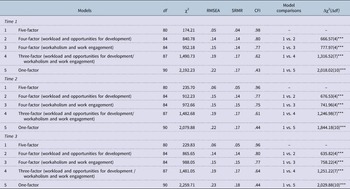
We performed a confirmatory factor analysis with maximum likelihood estimation to evaluate the fit of the hypothesized measurement model ensuring that the measures (i.e., workload, opportunities for development, work engagement, workaholism, and WFC) were distinct latent constructs (Bentler & Bonett, Reference Bentler and Bonett1980). The hypothesized five-factor model was found to yield a good fit to the data at each measurement time (Table 1) and was significantly better than all more constrained models. All items loaded reliably on their predicted factors, with standardized loadings higher than the recommended cutoff score of .50 (Kline, Reference Kline2011).
Fit indices for measurement models at each measurement time

Note. N = 464. df = degrees of freedom; χ2 = Minimum Fit Function Chi-Square; RMSEA = Root-Mean-Square Error of Approximation; SRMR = Standardized Root Mean square Residual; CFI = Comparative Fit Index; Δχ2 = Chi-square difference tests. ***p < .001.
Factorial invariance
We also tested the measurement invariance (Little, Reference Little2013). The configural (equivalence between the pattern of fixed and free parameters), weak (equivalence between corresponding factor loadings), and strong (equivalence between the corresponding indicator means) invariances of our measurement model were tested over time. The CFI differences tests between the three types of invariance were <.01 (Table 2), indicating that the measurement of each scale was invariant over time (Little, Reference Little2013).
Factorial invariance

Note. N = 464. df = degrees of freedom; χ2 = Minimum Fit Function Chi-Square; RMSEA = Root-Mean-Square Error of Approximation; SRMR = Standardized Root Mean square Residual; CFI = Comparative Fit Index.
Mediation model and indirect effects
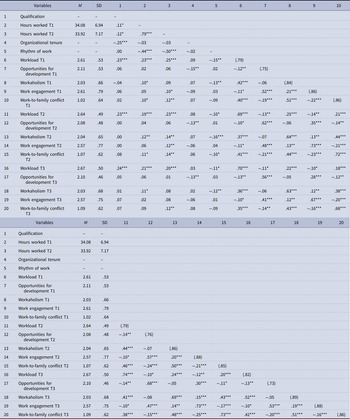
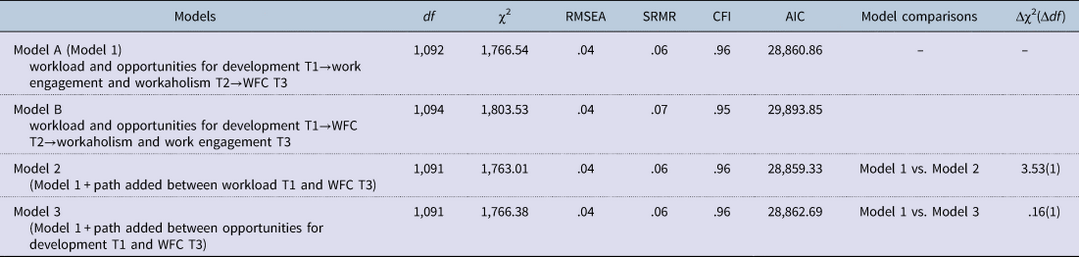
Means, standard deviations, Cronbach's α and correlations among variables are presented in Table 3. We compared two competitive structural models (i.e., Model A and B) to assess the causal relationships between work investment and WFC (Table 4). Both models contained autoregressive paths within constructs (i.e., a path from each Time 1 variable to the corresponding variable at Time 2 and from each Time 2 variable to the corresponding variable at Time 3, in order to estimate the stability effects of each variable over time). Model A (Hypotheses 1a and 1b) included indirect paths from workload T1 and opportunities for development T1 to WFC T3 through work engagement T2 and workaholism T2 (AIC = 28,860.86). Model B (Hypotheses 2a and 2b) included indirect paths from workload T1 and opportunities for development T1 to workaholism T3 and work engagement T3 through WFC T2 (AIC = 29,893.85). The comparison of AIC suggested that Model A better represented the relationships among constructs. These results did not support Hypotheses 2a and 2b. Therefore, we refer to this model as the retained structural model (Model 1).
Descriptive statistics and intercorrelations among variables

Note. N = 464. Correlations among variables are provided below the diagonal and Cronbach's α are provided on the diagonal. Absence of means and standard deviations for qualification, organizational tenure and rhythm of work because the answers were beforehand categorized in the questionnaire. *p < .05, **p < .01, ***p < .001.
Fit indices for structural models

Note. N = 464. WFC = Work-to-family conflict; df = degrees of freedom; χ2 = Minimum Fit Function Chi-Square; RMSEA = Root-Mean-Square Error of Approximation; SRMR = Standardized Root Mean square Residual; CFI = Comparative Fit Index; AIC = Akaike Information Criteria.
To evaluate whether Model 1 offered the best depiction of our data, we successively added paths from workload T1 to WFC T3 (Model 2), and from opportunities for development T1 to WFC T3 (Model 3). These two latter models did not have a significantly better fit than Model 1 (Table 4). Standardized parameter estimates for Model 1 are shown in Figure 1. For the sake of clarity, the effects of the covariates are described in the text. Number of hours actually worked at Time 1 was positively related to workload T1 (γ = .19, p < .001); organizational tenure was negatively related to opportunities for development T1 (γ = −.09, p < .05); number of hours actually worked at Time 2 was positively related to workaholism T2 (γ = .23, p < .001). Stability effects ranged from .66 to .86.
Completely standardized path coefficients for Model 1. *p < .05, **p < .01, ***p < .001.

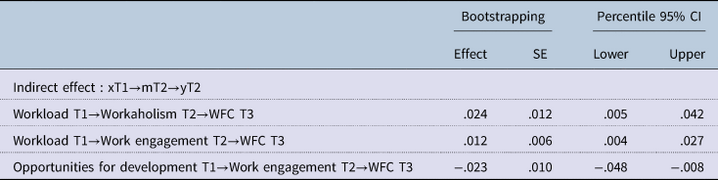
Workload T1 and opportunities for development T1 were respectively negatively and positively associated with work engagement T2, which in turn was negatively associated with WFC T3. Results of the bootstrap analyses (Hayes, Reference Hayes2013) indicated that the indirect effects of workload T1 and opportunities for development T1 on WFC T3 through work engagement T2 were significant (Table 5). These findings supported Hypothesis 1a. Only workload T1 was positively associated with workaholism T2, which in turn was positively associated with WFC T3. The indirect effect of workload T1 on WFC T3 through workaholism T2 was significant. These findings partially supported Hypothesis 1b.
Indirect pathways using bootstrapping

Note. N = 464. WFC = Work-to-family conflict; 10,000 bootstrap samples.
Discussion
Through a three-wave longitudinal study, we considered two types of working hard (i.e., work engagement and workaholism) to see how they mediated the relationships between work environment variables (i.e., workload and development opportunities) and WFC.
On the one hand, we found that workload and opportunities for development respectively decrease and increases the level of work engagement, which in turn negatively influences the perception of WFC over time. These results are consistent with some previous cross-sectional and longitudinal research (e.g., Coetzer & Rothmann, Reference Coetzer and Rothmann2007; Schaufeli, Bakker, & van Rhenen, Reference Schaufeli, Bakker and van Rhenen2009; Xanthopoulou et al., Reference Xanthopoulou, Bakker, Demerouti and Schaufeli2009; Tomic & Tomic, Reference Tomic and Tomic2010; Hakanen & Peeters, Reference Hakanen and Peeters2015; Babic et al., Reference Babic, Stinglhamber, Bertrand and Hansez2017). By working in a demanding work environment, workers’ personal resources (notably energy resources) deplete over time because of individuals make important efforts to attain their goals when facing a high workload (Meijman & Mulder, Reference Meijman, Mulder, Drenth and Thierry1998). By perceiving a drain on their personal resources, workers experience psychological distress, negative affect, and lack of motivation (Gorgievski & Hobfoll, Reference Gorgievski, Hobfoll and Halbesleben2008) also tend to engage less in their work in order to protect their remaining resources (Hobfoll, Reference Hobfoll2002). On the contrary, opportunities for development challenge and motivate workers both intrinsically and extrinsically, leading them to foster their willingness to dedicate their efforts and abilities to the job (Bakker et al., Reference Bakker, Hakanen, Demerouti and Xanthopoulou2007; Hackman & Oldham, Reference Hackman and Oldham1976; Ryan & Deci, Reference Ryan and Deci2000; Schaufeli & Bakker, Reference Schaufeli and Bakker2004). Employees perceiving opportunities for professional development become more engaged in their work over time, because they derive fulfillment from it (Hackman & Oldham, Reference Hackman and Oldham1976) and because they want to repay their organization to receive such opportunities to learn and develop (Cropanzano & Mitchell, Reference Cropanzano and Mitchell2005). By working enthusiastically and energetically (i.e., work engagement), workers gain new resources over time such as for example self-esteem, self-efficacy, optimism, sense of commitment, positive feelings (gain spiral of resource – Hobfoll, Reference Hobfoll2002), ultimately leading them to better manage their work and family lives and therefore reducing their perception of WFC.
On the other hand, we also found that the only workload increases the level of workaholism, which in turn positively influences the perception of WFC over time. These results are consistent with another part of previous cross-sectional and longitudinal research (e.g., Beckers et al., Reference Beckers, Van der Linden, Smulders, Kompier, van Veldhoven and Van Yperen2004; Taris et al., Reference Taris, Geurts, Schaufeli, Blonk and Lagerveld2008; Hakanen, Perhoniemi, & Rodríguez-Sánchez, Reference Hakanen, Perhoniemi and Rodríguez-Sánchez2012; Mäkikangas et al., Reference Mäkikangas, Schaufeli, Tolvanen and Feldt2013; Van Wijhe, Peeters, & Schaufeli, Reference Van Wijhe, Peeters and Schaufeli2013; Clark et al., Reference Clark, Michel, Stevens, Howell and Scruggs2014; Hakanen & Peeters, Reference Hakanen and Peeters2015; Molino, Bakker, & Ghislieri, Reference Molino, Bakker and Ghislieri2016). By perceiving a high workload, workers are preoccupied about it, become obsessed and feel the need to fulfill all of their tasks for fear to have a greater workload if they stopped working. Therefore, individuals who perceive their work environment as highly pressured were more likely to feel driven to work hard (Johnstone & Johnston, Reference Johnstone and Johnston2005) and start working compulsively in an effort to relieve that cognitive tension. Workaholics’ compulsive tendencies to devote more resources (i.e., time and energy) to work, to think and worry about their work when at home, to give priority to their work and neglect their domestic obligations, leave them with fewer resources for their family (Hobfoll, Reference Hobfoll2002), leading them to perceive more WFC over time.
Against our expectations, opportunities for development was found to be unrelated to workaholism. This non-significant result might possibly be explained by the fact that opportunities for development would play a moderating effect rather than a direct effect on workaholism. Indeed, according to Ryan and Deci (Reference Ryan and Deci2000), opportunities for development satisfy workers’ basic need for competence and contribute to their intrinsic motivation to achieve results. Such job resources ensure workers that they are capable of dealing with their job demands without feeling compelled to create more challenges at work or take over tasks to improve their skills (Tims & Bakker, Reference Tims and Bakker2010). This issue should be investigated in future studies.
Limitations and future research directions
The present study is not without limitations. First, although we included some covariates, other factors could have influenced the investigated associations, making it impossible to guarantee that the relationships were isolated from spurious influences (Bollen, Reference Bollen1989). Second, the use of self-reported data may lead to common-method bias (Podsakoff, MacKenzie, & Podsakoff, Reference Podsakoff, MacKenzie and Podsakoff2012). However, such influences should be less likely to occur in longitudinal data, ‘because only a few participants might be able to recall their Time 1 scores during the second or the third wave of the study’ (Demerouti, Le Blanc, Bakker, Schaufeli, & Hox, Reference Demerouti, Le Blanc, Bakker, Schaufeli and Hox2009: 63). Thirdly, this research focused only on the negative side of work–home interface (i.e., WFC). However, in view of research concerning the positive side of work–home interface (Greenhaus & Powell, Reference Greenhaus and Powell2006), it would be interesting to investigate both positive and negative influences of the work domain on family life. Indeed, work and family can also complement each other. Experience or participation in one role may increase the individual's performance or functioning in another, referring to the concept of work–family enrichment (Greenhaus & Powell, Reference Greenhaus and Powell2006). Conflict and enrichment are not opposites to each other but coexist (Grzywacz & Butler, Reference Grzywacz and Butler2005). One may experience more conflict or enrichment at certain times in life, but both are always present (e.g., Rantanen, Kinnunen, Mauno, & Tement, Reference Rantanen, Kinnunen, Mauno and Tement2013). Therefore, focusing only on one of the two sides of the work–family interface may limit the understanding of the processes influencing work–family issues (Boz, Martínez-Corts, & Munduate, Reference Boz, Martínez-Corts and Munduate2016).
Practical implications
In order to decrease workaholism and increase work engagement, and consequently reduce WFC, interventions should aim at decreasing workload. To address this, organizations should provide workers adequate opportunities to gain control of the amount of time available to spend on various job requirements. Providing training programs focusing, for example, on time and stress management skills could help employees set realistic goals and prioritize them so as to better cope with a high workload. This is particularly important for employees at risk of workaholism considering that ‘they take on more work than they can handle and accept new tasks before completing previous ones’ (Van Wijhe, Schaufeli, & Peeters, Reference Van Wijhe, Schaufeli, Peeters, Burke and Cooper2010: 162). Organizations should also ensure that tasks are fairly distributed among workers. Managers can, for example, ask their team members periodically if the current workload is well balanced. If it is not, workers should be invited to propose (concrete) solutions that would help rebalance the workload. It is also important to ensure that workers do not experience too many conflicting requests/demands from superiors. Samra, Gilbert, Shain, and Bilsker (Reference Samra, Gilbert, Shain and Bilsker2012) suggested different actions to manage workload, notably: promoting a work culture that clearly values the quality rather than the quantity of the work done; ensuring equitable distribution of workload among workers with consideration for varying levels of responsibility associated with different positions; allowing staff flexibility according to task prioritization and deadlines; ensuring that the necessary equipment and supports are available (e.g., tools, technology, support staff) to help complete work competently and efficiently; generating, communicating and implementing timely strategies for dealing with peak periods of demand (e.g., temporary staff); and actively involving employees in the development of strategies to better manage workload (e.g., reduction or elimination of redundant or unnecessary tasks).
Increasing work engagement is also made possible by providing opportunities for development. Among the 10 employee engagement strategies identified by Markos and Sridevi (Reference Markos and Sridevi2010), the sixth (i.e., ‘Give employees appropriate training’) refers to the fact that managers should ‘help employees update themselves increasing their knowledge and skills through giving appropriate trainings’ (p. 93). Considered as a traditional HRM strategy, work training programs should be directed particularly at personal growth and development instead of being exclusively content-directed (Schaufeli & Salanova, Reference Schaufeli, Salanova and Albrecht2010). The key issue for employees to remain engaged in their job is to keep developing themselves throughout their career.
Disclosure of interest
No potential conflict of interest was reported by the authors.
Author ORCIDs
Audrey Babic, 0000-0003-4500-7938.