

Introduction
Bacterial fruit blotch (BFB) of cucurbits, caused by Acidovorax avenae subsp. citrulli, is one of the most devastating diseases of watermelon, and responsible for significant economic losses in melon crops, including rockmelon, watermelon and honeymelon (Somodi et al., Reference Somodi, Jones and Hopkins1991; O'Brien and Martin, Reference O'Brien and Martin1999; Zhao et al., Reference Zhao, Sun, Wang and Hui2001). To date, few effective bactericides and methods are available to control BFB of melons.
It has become apparent that bacterial cells can sense their local population density through a cell–cell communication process mediated by small, diffusible molecules. This phenomenon is known as quorum sensing (QS) (Fuqua et al., Reference Fuqua, Winans and Greenberg1994; Miller and Bassler, 2001). Generally, Gram-negative bacteria use N-acyl homoserine lactones (AHLs) [also called autoinducers (AIs)] as QS signal molecules. As bacterial cells grow, the AHL signal accumulates to a threshold level in a population-density-dependent manner and initiates QS-dependent gene expression (Fuqua et al., Reference Fuqua, Winans and Greenberg1994). Dong et al. (Reference Dong, Xu, Li and Zhang2000) have shown that an AHL lactonase, AiiA, isolated from Bacillus sp. A24 could reduce Erwinia carotovora virulence by AHL degradation. In addition, transgenic tobacco and tomato plants with the aiiA gene enhanced the plants' resistance to Erwinia infection, and few maceration areas were observed in these two transgenic plants when inoculated with E. carotovora (Dong et al., Reference Dong, Wang, Xu, Zhang, Zhang and Zhang2001). Such a strategy for control of bacterial plant diseases was defined as AHL interference (also called quorum quenching).
The objectives of this work were to detect whether A. avenae subsp. citrulli strain NJF10 could produce AHL-like molecules by using an efficient AHL-bioassay strain JZA1 of Agrobacterium tumefaciens, and to express the aiiA gene in A. avenae subsp. citrulli strain NJL10 to investigate the role of the QS system in A. avenae subsp. citrulli. In the present study, we showed that the AHL-type QS system played a key role in the pathogen's virulence.
Materials and methods
Materials
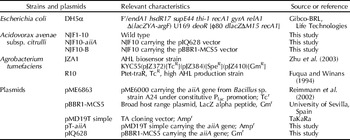
The bacterial strains and plasmids used in this work are described in Table 1. Acidovorax avenae subsp. citrulli strains were routinely grown on Luria–Bertani (LB) medium at 28°C. Escherichia coli DH5α and S17-1 were grown on LB medium at 37°C. When required, the following antibiotics were added: ampicillin, 100 μg/ml; tetracycline, 100 μg/ml; and gentamycin (Gm), 100 μg/ml.
Strains and plasmids

Methods
DNA manipulation
The plasmid extraction, total DNA extraction and competent cell preparation of E. coli and A. avenae subsp. citrulli were performed as described previously (Sambrook and Russell, Reference Sambrook and Russell1989). In brief, A. avenae subsp. citrulli strain NJL10 was streaked on LB agar, and incubated at 28°C overnight. A single colony was inoculated into 50 ml of LB broth and incubated at 28°C overnight. After that, 1 ml of overnight culture was inoculated into 200 ml of LB broth, and cells were harvested at early log stage [optical density at 600 nm (OD 600)=0.4–0.6] and suspended with an equal volume of sterile water (4°C). In the following steps, the cells were harvested and suspended with 50% (v/v) volume of sterile water. Finally, the cells were suspended in 0.2–0.3% (v/v) volume of 10% (v/v) glycerol, and each 50 μl of competent cells was added to a PCR tube, and stored at −70°C for further study. The ligase mixtures were treated with ethanol, and were transformed into A. avenae subsp. citrulli electrocompetent cells, and cells were grown on LB agar plates containing Gm and 5-bromo-4-chloro-3-indolyl β-galactoside (X-gal).
AHL bioassay
Acidovorax avenae subsp. citrulli (strain NJF10) were cultured in 100 ml of LB broth at 28°C to stationary phase (OD600≈0.5), and the cells were removed from the broth by centrifugation (12 000 g for 15 min). The supernatant was prepared for further AHL bioassay (Zhu et al., Reference Zhu, Chai, Zhong, Li and Winans2003). Briefly, 20 μl of supernatant of A. avenae subsp. citrulli was added into 180 μl AT medium (Fuqua and Winans, Reference Fuqua and Winans1994) and approximately 107 colony-forming units (CFU)/ml of AHL-bioassay strain JZA1 together with X-gal (300 μg/ml) (Zhu et al., Reference Zhu, Chai, Zhong, Li and Winans2003) were added. These cultures were incubated with aeration for 12 h and assayed for β-galactosidase specific activity (AHL-like molecules could induce β-galactosidase in the bioassay-reporter strain to hydrolyse X-gal, and a blue colour would be observed).
Thin-layer chromatography (TLC) analysis of AHLs was performed as previously described (Shaw et al., Reference Shaw, Ping and Daly1997). Five microlitres of the supernatant from A. avenae subsp. citrulli were applied to C18 reversed-phase TLC plates (Whatman), chromatographed, and developed as described previously. Here, the supernatant from Agrobacterium tumefaciens R10 (pCF218), which produces 3-O-C6-homoserine (HSL) and 3-O-C8-HSL (Zhu et al., Reference Zhu, Chai, Zhong, Li and Winans2003) was used as a positive control.
Cloning of aiiA gene and construction of plasmid pIQ628
According to the aiiA gene sequence from Bacillus sp. A24, a pair of primers:
aiiAF: 5′-GGCGAATTCATGACAGTAAAGAAGCTT-3′ (EcoRI site is underlined); and
aiiAR: 5′-GCCTCTAGACTATATATATTCAGGGAA-3′ (XbaI site is underlined)
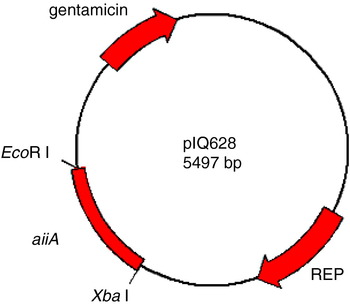
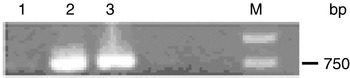
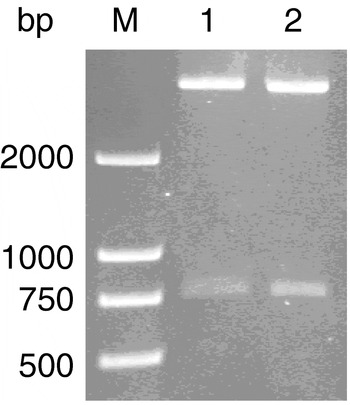
was designed to clone the aiiA gene from plasmid pME6863 by polymerase chain reaction (PCR) amplification. All PCRs were performed in 50 μl reaction volumes containing 5 μl 10× Taq buffer and 1 unit of rTaq DNA polymerase, 2 mmol/l of MgCl2, 100 μmol/l of each dNTP, 0.4 μmol/l of each primer and 5 ng/μl of genomic DNA. The PCR programme was described as follows: 95°C for 15 s, 56°C for 40 s and 72°C for 50 s for 35 cycles, with an initial denaturation step at 94°C for 5 min and a final extension step at 72°C for 7 min. The PCR fragments were purified and cloned into pMD-19T simple vector (TaKaRa, Dalian, China), and sequenced by TaKaRa Biotechnology Company (Dalian, China). After that, the PCR product (aiiA) was digested with enzymes EcoRI/XbaI, and cloned into the corresponding sites of broad-host vector pBBR1-MCS5, resulting in plasmid pIQ628. The plasmid pIQ628 was verified by PCR and enzyme digestion (Figs 1–3).
Construction of plasmid pIQ628. REP, replication elements.

PCR test of positive plasmids. Lanes: 1, pBBR1-MCS5; 2, pME6863 (aiiA); 3, pIQ628. M, DNA marker.

Double digestion of pIQ628 plasmid. Lanes: 1 and 2, pIQ628; M, DNA marker.

In vitro pathogenicity tests
Fresh watermelon fruits were used for in vitro A. avenea subsp. citrulli pathogenicity test. The watermelon surfaces were washed with ddH2O and sterilized with 70% ethanol. Before inoculation, a 2 mm deep cut was made on the surface of each watermelon fruit, then 20 μl of the culture of A. avenae subsp. citrulli strain (≈1×10⁸ CFU/ml) was inoculated on the generated wounds. Here, LB broth was used as control. Inoculated watermelon fruits were placed in a box containing sterilized humid filter paper, and incubated at 28°C for 7 days. After incubation, pictures of the macerated areas were taken for further analysis.
Results and analysis
Cloning and sequencing of aiiA gene
A 753 bp DNA fragment was obtained by PCR amplification from pME6863 using primers aiiAF and aiiAR. Sequence analysis showed that the cloned aiiA gene had 100% similarity with that from Bacillus sp. A24 (accession number: AM235210) at the nucleotide level.
Measurement of AHL production in wild-type NJF10 and strain NJF10-aiiA
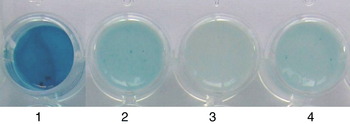
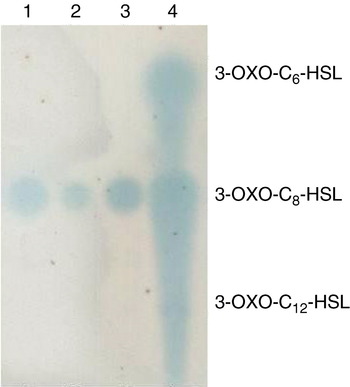
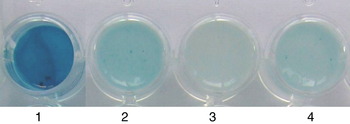
According to the intensity of blue colour in each well, it was observed that strain NJF10 gave a similar response to A. tumefaciens R10 (positive controls) in AHL production (Fig. 4), indicating that the AHL-type QS system existed in A. avenae subsp. citrulli. In contrast, few AHL molecules were detected in the supernatant of strain NJF10-aiiA (Fig. 4). We also performed the TLC assay to confirm this result. As shown in Fig. 5, the 3-O-C8-HSL-type signal was detected in wild-type NJF10, whereas strain NJF10-aiiA exhibited lower AHL production ability. This result showed that the AHL production in wild-type NJF10 was reduced by expression of the AHL lactonase gene aiiA. Therefore, the strain NJF10-aiiA, which was partially impaired in AHL production, was selected to perform a pathogenicity test to investigate the role of the AHL-type QS system on the virulence of the BFB pathogen.
AT medium agar bioassay (Fuqua and Winans, 1994). 1, R10 (positive control); 2, NJF10; 3, NJF10-aiiA; 4, NJF10-B. (See online for a colour version of this figure.)
Separation of signal molecules by TLC. Lanes: 1, NJF10; 2, NJF10-aiiA; 3, NJF10-B; 4, R10. 3-OXO-C6-HSL, 3-OXO-C8-HSL and 3-OXO-C12-HSL are N-acyl-homoserine lactones (AHLs). (See online for a colour version of this figure.)

AiiA attenuated the virulence of A. avenae subsp. citrulli
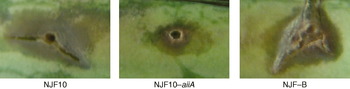
Fresh watermelons were used for the in vitro A. avenae subsp. citrulli pathogenicity assay. As shown in Fig. 6, the obvious maceration areas were observed on the surfaces of watermelon fruits inoculated with wild types NJF10 or NJF10-B (NJF10 carrying the plasmid pBBR1-MCS5). In contrast, few maceration areas were observed on the surfaces of watermelon fruits inoculated with strain NJF10-aiiA, indicating that AHL interference was effective in reducing the virulence of strain NJF10.
Pathogenicity test on watermelon fruit. (See online for a colour version of this figure.)

Discussion
Recently, increased attention has been given to the regulation of the QS system on pathogen virulence. AHL interference is becoming an important focus of research in controlling bacterial plant disease (Dong et al., Reference Dong, Zhang, Xu and Zhang2004). Interestingly, AHL interference had no effects on the pathogens' growth, but suppressed the expression of virulence genes, resulting in reduced pathogen virulence and increased plant resistance. Furthermore, it is difficult for pathogens to generate resistance to AHL lactonase (also called AHL interference). Therefore, AHL interference has broad potential for the control of bacterial plant diseases.
This study showed for the first time that A. avenae subsp. citrulli possessed an AHL-type QS system. This pathogen was able to produce stronger signal molecules (AHLs) possessing an eight carbon-atom chain. The wild type, NJF10, was sensitive to gentamycin and resistant to tetracycline; therefore, we were unable to transform plasmid pME6863 (carrying the aiiA gene, tetracycline-resistant) directly into NJF10. However, pBBR1-MCS5 is a broad-host vector (gentamycin-resistant), therefore, in this study, the aiiA gene was cloned into pBBR1-MCS5, producing plasmid pJQ618. The plasmid pJQ618 was transformed into wild-type NJF10, and the aiiA gene was expressed under the lacZ promoter. In the AHL bioassay, it was observed that AiiA protein partially degraded the AHLs in strain NJF10-aiiA, and that the strain NJF10-aiiA exhibited strongly reduced virulence on watermelon fruits. This result indicated that the AHL-type QS system played a key role in the virulence of A. avenae subsp. citrulli.
Generally, there are three methods to achieve AHL interference. The first one is to use an enzyme to degrade AHL molecules. Such a method was typically applied to construct transgenic plants or biocontrol agents using AHL lactonase. The second one is to use AHL molecule analogues. Such analogues could compete with the AHL signal molecules to conjugate LuxR protein (the acceptor of LuxI protein), thus stopping the signalling pathway and suppressing the expression of virulence genes. The last method is to suppress the synthesis of AHL molecules. For example, triclosan is an inhibitor of the enzyme acyl carrier protein (ACP) deoxidase, which is critical for synthesis of alkene acyl ACP, the key component for AHL synthesis. Therefore, AHL synthesis would be restrained by addition of triclosan. Overall, our results suggest a novel way to control BFB of watermelons by AHL interference.
Acknowledgements
We are grateful to Dr Suomeng Dong (Nanjing Agricultural University) for critical revisions of this manuscript. This work was supported by the National Basic Research program of China (‘973’ programme, No. 2009CB119200), a Science and Technology support XinJiang project (No. 200840102-03) and Special Primary National Basic Research (No. 2005CCA02800).