

1. Introduction
It is now conventional to let the economic slowdown in the 1970s divide the post-war period into the golden age and the post-golden age. Productivity and employment performance have evolved differently in Europe and the United States in the post-golden age. The 1970s and 1980s saw skyrocketing European unemployment levels although productivity rates were similar to those in the USA. It has been argued that Europe has increasingly been falling behind in productivity growth since 1995 and that a so-called transatlantic productivity gap has emerged (for example, Gordon Reference Gordon2004; van Ark et al. Reference Ark, van O'Mahony and Timmer2009). The European experience of remarkable economic catch-up during the golden age, followed by rising unemployment levels in the 1970s and a subsequent productivity decline during the 1990s, calls for an economic historical analysis. Assessing the factors behind this transformation is undoubtedly of importance for understanding the peculiarities of the European economic history of the post-war period.
Since Europe and not the USA had the largest fluctuations in employment and productivity levels, studies have tended to focus on explanations specific to the European economies. Indeed, various European labour market institutions have often been central in the debate on unemployment levels (see, for example, Bassanini and Duval Reference Bassanini and Duval2006 for a survey), and product market regulations and technology policies are said to be the cause of the recent productivity slowdown (for example, van Ark et al. Reference Ark, van O'Mahony and Timmer2009). For a long time, the debates on the European employment and productivity evolutions have remained largely separate, but lately some authors have suggested that there might be common reasons for the upward trend in European unemployment and the recent slowdown in European productivity growth (Daveri and Tabellini Reference Daveri and Tabellini2000; Allard and Lindert Reference Allard, Lindert, Hatton, O'Rourke and Taylor2007). This simultaneous approach to the employment and productivity puzzle involves finding out which institutions and policies (if any) are related to the increase in European unemployment since 1970 and the productivity stagnation since the mid 1990s. In addition, a growing literature concerned with the relationship between employment and productivity is now examining whether there has been a distinct European trade-off between the employment and productivity growth in the post-golden age (Gordon Reference Gordon, Snower and de la Dehesa1997; Dew-Becker and Gordon Reference Dew-Becker and Gordon2008; Horst et al. Reference Horst, Van Der Rojas-Ramagosa and Bettendorf2009). One hypothesis is that the root of this trade-off is found in institutional factors that increase the cost of labour and force GDP per worker to increase (Gordon Reference Gordon, Snower and de la Dehesa1997).
A major contribution of this emerging literature has been to tie the labour market institutions not only to unemployment, but also to productivity slowdown. The effects of labour market institutions on productivity may be both static and dynamic though. The static effects work through the labour-productivity trade-off since an employment contraction could lead to a static increase in labour productivity. The dynamic effects have been explored by Allard and Lindert (Reference Allard, Lindert, Hatton, O'Rourke and Taylor2007), who argue that employment protection laws actually reduce productivity by suppressing the human capital accumulation of outsiders, and that this effect occurs with a time-lag.
It is possible that the static effects dominate in the short run, while any dynamic effects of institutions on productivity may only become visible in the long run. This article will allow for this by using a longer sample period, 1960–2000, compared to previous studies, and by allowing the effects to vary between annual and decadal effects from institutions.
In addition, despite the considerable literature on institutional effects on employment and productivity, the results from empirical studies are often non-robust and contradictory when it comes to exactly which labour market institutions or taxation strategies cause unemployment to rise and productivity to stagnate. This problem of non-robustness is probably due, at least to some extent, to the endogeneity problem inherent in policy-response studies. That is, benefit levels, tax levels and employment protection laws could be correlated to unemployment due to their distortionary effects, but it could also be that these policies are changed in response to increased unemployment caused by external factors. Recently, Ederveen et al. (Reference Ederveen, de Groot and Nahuis2006) suggested using the regional level to resolve causality and endogeneity issues in policy studies. More specifically, they used the national level as an instrument for the economic effects of regional structural funds.
This article uses a novel panel data set for 88 regions in nine European countries (Belgium, Denmark, France, (Western) Germany, the Netherlands, Ireland, Italy, Spain, the UK) to gauge the productivity and employment effects of changes in national policies and institutions between 1960 and 2000. Since regions within countries share the same legal framework, but differ from each other with respect to economic structure, vulnerability to economic shocks, history, culture and geography, the causality of the national policy effects can be tested more directly. National institutional responses and policy changes may not necessarily reflect the specific economic conditions of every region in a country. If there are comparable responses to policy changes in otherwise economically heterogeneous regions, a more robust conclusion may be that the effects are indeed a result of implemented policy.
The methodology proposed is an econometric panel data model with fixed effects at the regional level. This involves estimating the effects of national policy changes on regional employment and productivity while controlling for region-specific unobserved characteristics that may influence the dependent variable. This article differs from Ederveen et al. (Reference Ederveen, de Groot and Nahuis2006) in that it uses the regional level to keep the effects of national policies separate rather than vice versa.
The main finding is that labour market institutions appear to have influenced European productivity only in the post-golden age period. These effects are split into two parts: (i) a static effect which involves institutions that trigger the employment-productivity trade-off by increasing the cost of labour and pushing up labour productivity while keeping employment levels low; and (ii) a dynamic effect where institutions slow down productivity, potentially by lowering the phase of human capital accumulation of labour market outsiders. While static effects operate through a trade-off and appear in the short run, dynamic effects appear to have a time-lag, potentially explaining why Europe's labour productivity performance was reasonably high during the 1980s and the beginning of the 1990s but slowed down thereafter. The labour market institutions that serve to contract the supply of labour in Europe are the net reservation wage and employment protection laws (EPLs). Tax wedges and high unionization rates also play a role, but the estimated effects are smaller.
This article suggests that some of the policy reforms to reduce unemployment, which are at the top of the European agenda today, may have negligible effects on productivity immediately because of a potential employment-productivity trade-off. However, these effects are merely short term. When capital accumulation adjusts to the new employment levels, negative trade-off effects should be overshadowed by the positive dynamic effects of increasing the number of labour market insiders in the European economy.
2. The comparative US experience
European catch-up during the post-war period has been much more impressive in terms of labour productivity than in terms of GDP per capita, as this latter ratio has stagnated at around 70 to 75 per cent since 1970. The difference in catch-up between GDP per worker and per capita is entirely driven by the evolution of the European labour market. While Europeans actually worked more hours per week than Americans until World War I, there was a more rapid fall in hours thereafter. During the 1950s and 1960s Americans and Europeans worked roughly similar hours, but since then there has been a decline in total hours per week in Europe (Huberman and Minns Reference Huberman and Minns2007). This led Prescott (Reference Prescott2004) to ask ‘Why do Americans work so much more than Europeans?’ His answer pointed towards Europe's high marginal taxes, which accounted for ‘the predominance of differences at points in time and the large change in relative labor supply over time’ (p. 1).
Blanchard (Reference Blanchard2004), on the other hand, explains the same reduction in working hours as a European taste for leisure, and that Europeans are taking out some of their productivity gains as longer vacations and shorter working hours, while Americans rather choose to consume more. An argument against the preference explanation by Blanchard (Reference Blanchard2004) is that it is hard to reconcile it with the fact that Europeans actually worked more than Americans until the 1950s, unless we are to believe in a sudden change in European tastes for leisure (Alesina et al. Reference Alesina, Glaeser and Scardote2006). Alesina et al. belong to a group of researchers who contend that the reduction in hours per capita was rather the result of the policies that were put in place to fight unemployment, since their side-effects on employment ratios turned out to be negative. A particular line of the argument, summarized in the term Eurosclerosis, claims that Europe's high unemployment may be traced back to labour market rigidities, especially the negative effects of employment protection laws (Lazear Reference Lazear1990), strong interest groups (Olson Reference Olson1982), the institution of wage bargaining (Eichengreen Reference Eichengreen, Crafts and Tonioli1996) and high unemployment benefits, high unionization and high overall taxes (Nickell Reference Nickell1997).
While Prescott (Reference Prescott2004) and Blanchard (Reference Blanchard2004) suggest that the reduction in European total hours per population was mostly due to a decrease in working hours per employee, a decomposition of the European reduction into hours per employee and employees per population shows that the decline was due to decreasing employment ratios rather than hours worked (Gordon Reference Gordon, Eichengreen, Landesman and Stiefel2008). Rather, differences in employment-to-population ratios have played a major role. Comparing the USA and Europe, Gordon (Reference Gordon, Eichengreen, Landesman and Stiefel2008) found that the European employment-to-population ratio fell from 42 per cent in the 1960s to 39.3 per cent in 1983, while the post-war period saw a dramatic increase in the USA (from around 35 per cent in early 1960 to 47.5 per cent in 1990). The American increase in employment ratios can be explained by the entry of females into the labour market, but for Europe it appears that this effect was offset by the sharp increase in unemployment during the same period.
Thus, Gordon (Reference Gordon, Eichengreen, Landesman and Stiefel2008) finds that the decline in hours per capita is a function of decreasing hours per worker and even more a function of employment ratios. Hence, the roots of the problem should be sought not only in one explanation of lower European hours per capita, but also in total hours or labour force participation or unemployment figures, or a combination of all.
2.1. Institutions and shocks 1960–2000
In order to disentangle the causal effects of Europe's post-war economic evolution, we need to take a look at its economic history with a beginning in the 1960s when the unemployment figures were low. Specifically, the role of institutions versus the role of the oil price shock must be examined. Blanchard and Wolfers (Reference Blanchard and Wolfers2000) address the issue by arguing that explanations focusing on the oil price shock alone cannot explain the heterogeneity of unemployment figures in Europe post-1973, while explanations focusing only on institutions cannot explain the timing of the increase in unemployment. The core of their argument is that many of these adverse institutions were already in place in the 1960s when unemployment was low. Using a panel data specification that allows for interaction effects from shocks and institutions, they find that they can account for much of the rise and the heterogeneity of European unemployment figures after the 1970s. However, as pointed out by Bassanini and Duval (Reference Bassanini and Duval2006, p. 34), Blanchard and Wolfers (Reference Blanchard and Wolfers2000) do not allow for the direct impact of time-varying institutions in their regressions, which may cast some doubt on the magnitude of the estimated effects.
Blanchard and Wolfers (Reference Blanchard and Wolfers2000) also point to some caveats in their study. Especially, time series evidence of labour market institutions that pre-date the oil-crisis is hard to come by and they are concerned about the endogeneity of institutions (pp. 31–2). This article attempts to address these issues by using longer and improved time series of institutions that have recently been made public. I have gathered data back to 1960 covering Employment Protection Legislation and net reservation wages from Allard (Reference Allard2005a, Reference Allard2005b), and levels of unionizations from the OECD and an index of wage coordination from Ochel (Reference Ochel2000).Footnote 1 These new time series show that the European labour market institutions have neither been stable over time nor similar across nations, and that there were enough variations in them before 1970 to enable disentangling the causality of their effects (see Allard and Lindert Reference Allard, Lindert, Hatton, O'Rourke and Taylor2007 for a discussion).
However, while many authors acknowledge that labour market institutions have been neither stable nor recent phenomena, a general image is that these institutions became increasingly employment-unfriendly in the late 1960s and early 1970s. Since then, the overall trend has been towards deregulation. This has led to some critique of the institutional hypothesis since European unemployment levels have remained high despite deregulation and decreasing union density (Rogerson Reference Rogerson2006). However, others argue that the critics ignore the typical inertia in the structure of the labour market since it is possible that labour markets are still affected by legislation put in place in the early 1980s when unions were strong (Gordon Reference Gordon, Eichengreen, Landesman and Stiefel2008). For example, labour market reforms often follow a two-tier track module, with the result that it takes time before they cover a large part of the population (Boeri Reference Boeri, Eichengreen, Landesman and Stiefel2008). In addition, authors have underlined the potential lagged effects of labour market institutions operating via human capital formation, and the delayed effects on productivity growth (Allard and Lindert Reference Allard, Lindert, Hatton, O'Rourke and Taylor2007).
Unionism and labour market regulations tended to peak in many countries around 1970–80, which makes it hard to completely separate the effects of the oil shock, in combination with the institutions in place around the 1970s, from the long-term effects of the adverse labour market institutions. This study will attempt to measure the first effect by splitting the sample around 1980.
First, the following sections will provide a brief institutional history and explanation of the main variables.
2.1.1. Net reservation wage. Unemployment benefit is commonly described as a work disincentive in the short run. Benefits are assumed to decrease the labour supply and reduce people's willingness to fill job vacancies by lowering the search intensity of the unemployed (Blanchard and Wolfers Reference Blanchard and Wolfers2000, p. 12). The effect of an increase in the net reservation wage on employment is therefore likely to be negative, which has also been documented empirically by, for example, Layard, Nickell and Jackman (Reference Layard, Nickell and Jackman1991).
Most empirical studies of the effects of unemployment compensation schemes use the OECD's indicator for gross replacement rates (1994), which has long been the most comprehensive indicator of the monetary unemployment benefits across nations. However, as pointed out by Allard (Reference Allard2005b), the indicator misses the impact of different tax treatments on unemployment benefits, the duration of the benefits, and what eligibility conditions they impose on the unemployed. Therefore, Allard (Reference Allard2005b) provides yearly time series of the net reservation wage from 1960 and onwards and incorporates the following three components: (i) benefits per recipient divided by market wage (net of taxes); (ii) the duration of coverage; (iii) eligibility of the unemployed for benefits.
The net reservation wage divided by the average wage rate in each country indicates large European differences, both in levels and timing of rises (Allard and Lindert Reference Allard, Lindert, Hatton, O'Rourke and Taylor2007). While the Danish net reservation wage has increased steadily since 1960, the German compensation schemes seem to have started at relatively high levels and rose only until 1970; they have remained flat since then. UK benefits peaked in 1980 when they were among the highest in Europe, but since then UK unemployment benefits have been vastly surpassed by Spain. In many countries, net reservation wages peaked around 1990 and fell somewhat thereafter, but Italy is an extreme case with almost non-existent unemployment compensation throughout the period.Footnote 2
2.1.2. Employment protection legislation (EPL). The rigidity of the European labour market has long been one of the strongest suspects for Europe's high and persistent unemployment levels since the 1970s. The employment protection laws (EPL) are generally considered to add friction to the functioning of the labour market by simultaneously reducing the inflow of new workers from unemployment (since they make it more costly and risky to hire) and the outflow of workers to unemployment (since they make it costly or impossible to fire). The net effect on employment ratios of these two forces is an empirical question (Nickell Reference Nickell1997).
Many studies have tried to estimate the impact of EPLs on employment, but EPLs are hard to quantify. A pioneering study by Lazear (Reference Lazear1990) used the statutory entitlements to severance payments as a proxy. Since then, measures of EPLs have been broadened to include restrictions on dismissals of workers with regular contracts, temporary contracts and working hours (Grubb and Wells Reference Grubb and Wells1993) and collective dismissals (OECD 1994). The comprehensive indicator of EPLs is from OECD (1994), but includes only two years. Allard (Reference Allard2005a) used the OECD's strategy to measure EPLs as a historical indicator that went back to 1950.
The EPL index from Allard (Reference Allard2005a) showed that the level of employment protection varied during the 1950s and 1960s, with a much higher job protection in Franco's Spain than in the rest of Europe. However, a general picture of fairly unregulated markets in the early period emerges. A significant tightening of EPLs took place in all countries between 1970 and 1980. Still, levels of EPLs varied considerably, ranging from high in Spain and Italy to moderately low in the UK and Ireland, even during the peak years around 1980. Since 1980, there has been a gradual relaxation of EPLs in most countries; however, the level in 2000 remained above the levels at the beginning of the period in all countries except Spain.
Employing the new EPL indicator, Allard and Lindert (Reference Allard, Lindert, Hatton, O'Rourke and Taylor2007) estimated the economic effects of EPLs jointly on employment and productivity and emphasized that the largest costs associated with such rigidities occurred on the productivity side. They argued that stable employment conditions encouraged insiders to accumulate human capital on the job, which may lead to productivity increases in the short run. But since strict EPLs deny employment to outsiders, they simultaneously delayed their human capital formation and reduced overall labour productivity. Although the productivity effects of EPLs on the job appear instantaneously, the effects of the outsiders’ human capital loss are likely to appear after some time and increase as unemployment duration persists.
2.1.3. Unionization and collective wage bargaining. There are vast differences in the degree of union density in European and American history, and the importance of unions has not been constant over time. Although the influence of trade unions is perhaps not perfectly measured by their density, data on union density from the OECD tell us that it fell from 31 per cent of the population to 11 per cent between 1960 and 2000 in the USA. According to Alesina et al. (Reference Alesina, Glaeser and Scardote2006), union influence peaked in Europe around the late 1970s and early 1990s. The national trade density figures show dispersed patterns: in Belgium and Denmark, trade union density increased sharply during the 1970s and remained constant thereafter, but in France and the Netherlands density had already started to decline in the 1970s and in Germany a decline came in the 1990s. Italy, Ireland and the UK peaked around 1980 and in Spain union density gradually increased up to the early 1990s, albeit from low levels, all according to OECD figures.
Although union density is past its peak levels, Alesina et al. (Reference Alesina, Glaeser and Scardote2006) still point out that union influence was a strong determinant in the reduction of European total hours between 1970 and 1995, and identify that the effect goes through two main channels: (i) keeping wages high and restricting employment and (ii) pursuing a political agenda to reduce work hours in order to force firms to hire more unionized workers.
Alesina et al. (Reference Alesina, Glaeser and Scardote2006) give several examples of union movements to decrease work hours under the slogan ‘work less work all’ in different European countries during the 1970s and 1980s, while there were no significant regulations about work hours for individuals older than 16 years in the USA. But unions not only influenced the regulation of vacations and the working week, they also promoted more generous early pension reforms in many European countries after the 1960s.
Still, unions need not only have direct effects on employment and hours worked. The literature recognized quite early on that the effects of unions and strong interest groups could be a major determinant of the slowdown in income per capita catch-up, often called Eurosclerosis. For example, Olson (Reference Olson1982) hypothesized that various interest groups built up power to promote their own interests in the post-war period. According to Olson, when interest groups become large enough to enjoy power, the efforts of certain selective interest groups to lobby the government, or to influence wages and prices in the marketplace, become a main threat to employment and economic growth.
However, unions need not have negative effects on society. Another aspect of unionization is the extent to which bargaining is coordinated. If bargaining is highly coordinated, the interest groups become large enough to internalize the effects of wage-increase demand for the survival of the industries in international competition and for consumer prices. Calmfors and Driffil (Reference Calmfors and Driffil1988) suggest that the relationship between increased wage bargaining and sluggish economic performance might not be linear, but rather hump-shaped, and that both wage-coordinated and non-wage coordinated countries would enjoy the benefits of wage moderation.
Eichengreen (Reference Eichengreen, Crafts and Tonioli1996) argues along similar lines, but adds the idea of time-inconsistent wage bargaining to the model to explain the timing of the sclerosis. He maintains that the productivity slowdown associated with structural change and institutional sclerosis refers to two mutually connected explanations that reinforced each other. In his view, the economic slowdown reduced the return on investment, and weakened the incentive for workers to act in a cooperative manner towards the management as the future gains of abstaining from current wage increases became more insecure. When the cooperative labour market agreements broke down, they gave way to intensified wage-pressure, which crowded out investment and depressed the rate of growth further (Eichengreen Reference Eichengreen, Crafts and Tonioli1996, p. 65).
Coordinated wage-bargaining may thus have a U-shaped effect on employment if wage moderation is most likely to occur at the two extremes of the scale. If strong unions are not able to internalize all effects from wage increases, it may also be expected that the effect on employment will be negative and linear, as in the Olsonian hypothesis. The variable included in this study to measure these effects is the wage coordination index (ranging from 1 to 3) provided by Ochel (Reference Ochel2000), and a measure of the share of the population belonging to unions obtained from the OECD.
2.1.4. The tax wedge. Apart from the effects of taxes on working hours and employment, general neoclassical economics implies that taxes give rise to ‘dead-weight’ losses that will reduce total national output. Taxing labour income is often regarded as one of the most distortionary taxes, since employees will supply less labour as the after-tax wage decreases and employers will demand less labour when the cost of hiring a person increases. The division of the burden depends on how the system is formulated, but the result is that production is cut when some productive efforts are not realized.
Daveri and Tabellini (Reference Daveri and Tabellini2000) show that high taxes on labour, in combination with unionization, were a common cause of Europe's high unemployment and subsequent productivity slowdown. The burden of taxation was shifted onto firms, which reduced labour demand and created unemployment. Daveri and Tabellini (Reference Daveri and Tabellini2000, p. 50) point out that firms, over the longer run, replaced the expensive workers with capital and that the capitalization of the economies eventually ran into diminishing returns and productivity stagnated. However, Lindert (Reference Lindert2004) has stated that empirical and historical evidence from high-taxing, high-spending societies does not suggest that the effects on growth and productivity are as harmful as neoclassical theory would suggest. For example, he states that high-taxing societies have in general chosen strategies that are more pro-growth than many free-market OECD countries.
The focus on high labour taxes as a cause of Europe's low labour supply was re-awakened by an article by Prescott (Reference Prescott2004). By calibrating a dynamic model of investment and labour supply, Prescott found that the marginal tax rate accounted for a major share of the European–American differences in hours per capita at points in time as well as changes over time.
This result has not escaped criticism. Alesina et al. (Reference Alesina, Glaeser and Scardote2006, p.13) show that Prescott's choice of a functional form yielded a very high elasticity of labour supply, and reject this assumption based on micro-labour supply literature. Others have criticized the Prescott claim for being inconsistent with the time series evidence. Gordon (Reference Gordon, Eichengreen, Landesman and Stiefel2008, p. 27) argued that most of the increases in tax rates occurred between the mid 1960s and the mid 1980s, while the declining hours per capita continued until the mid 1990s.
A final critique is that the high taxes in Prescott's simulations may be a proxy for other differences between Europe and the USA, such as unemployment compensation, employment protection laws and powerful unions (Alesina et al. Reference Alesina, Glaeser and Scardote2006). To disentangle the effects of these policies on unemployment, a multivariate regression model seems appropriate.
The variable included in the regression model to measure the effects of labour taxes on labour supply and productivity is the tax wedge (total tax wedge including employer's social security contributions in percentages) from the OECD but modified in some cases by Allard and Lindert (Reference Allard, Lindert, Hatton, O'Rourke and Taylor2007).
2.1.5. Product market regulations. A debate on product market regulations and their role for European productivity (Nicoletti and Scarpetta Reference Nicoletti and Scarpetta2003) and employment (Fiori et al. Reference Fiori, Nicoletti, Scarpetta and Schiantarelli2007) has recently emerged. The rationale is that a regulated product market may affect productivity by playing a role in firms’ governance structures (such as public or private ownership), entrepreneurial incentives and market access. The motive for deregulations is that economic research has found productivity-increasing effects of privatization and competition (Nicoletti and Scarpetta Reference Nicoletti and Scarpetta2003).
Nicoletti and Scarpetta (Reference Nicoletti and Scarpetta2003) present an index of product market regulations in the OECD countries since 1980. They focus either on regulations that influence the level of state control of economic activities (e.g. public ownership and restrictions on price setting), or on restrictions that create barriers to entrepreneurship in domestic markets (such as laws limiting the number of competitors, structural arrangements that make it difficult for competitors to access fixed networks, administrative burdens and policies that create obstacles to international trade and investment). The index then weighs together the differing aspects of product market regulation (see Nicoletti and Scarpetta Reference Nicoletti and Scarpetta2003 for a detailed description).
In this article, product market institutions and policies are measured by the OECD index of product market regulations ranging from 0 to 6 from 1980 and onwards (Nicoletti and Scarpetta Reference Nicoletti and Scarpetta2003). The index tells us that most European countries were heavily regulated around 1980, with indices around 6. However, since the late 1980s there has been a gradual decline in product market regulations in all of Europe, albeit at different levels. Regulations have decreased most sharply in the UK (index 4.7 to 1.6), which means that product market regulations were the lowest in the sample in 2000. In the USA there has also been a gradual decline since 1980, but starting from a lower level. In 2000 France and Ireland remained still rather regulated, with indexes just below 4.
2.2. A simultaneous approach to employment and productivity
As pointed out in the introduction, a growing literature is searching for a common factor in the European unemployment and productivity evolution. Nonetheless, the literature does not explicitly consider the fact that employment and productivity statically influence each other in the econometric specifications. The employment-productivity trade-off literature explicitly addresses this issue by estimating the two variables jointly in their regressions.
An early reference in the trade-off literature is Gordon (Reference Gordon, Snower and de la Dehesa1997), who interpreted the comparative European–American post-1970 evolution in the following fashion: the European productivity figures were to some extent artificial because, by making labour expensive, firms were forced to slide north-west up their labour demand curves. Since wages were high, firms cut low-productivity jobs and retained high-productivity workers. Low-productivity workers were forced into unemployment or were discouraged from being inside the labour force altogether. These productivity effects of restricting the labour supply should theoretically be static and only appear in the short run. Eventually, lower labour force participation should involve decreasing marginal returns to capital, which should suppress both investments and productivity. Until capital has adjusted to the new employment levels, the negative correlation is likely to persist.
Empirical studies have often focused on the opposite scenario, in which a boost in the employment ratio results in a slowdown of productivity growth (e.g. Bourles and Cette Reference Bourles and Cette2007). These studies conclude that employment growth has implied a slower growth in labour productivity in Europe than in the USA, possibly related to major institutional reforms affecting European labour markets, and that the negative correlation between employment and productivity has been persistent.
However, these estimations do not take the endogeneity of employment in the productivity regressions into account, something which is likely to bias the results. Recently, Dew-Becker and Gordon (Reference Dew-Becker and Gordon2008) and Horst et al. (Reference Horst, Van Der Rojas-Ramagosa and Bettendorf2009) have dealt with this problem by using instrumenting techniques, where labour market regulations and taxes have been used to instrument for employment. These studies argue that labour market institutions have only affected employment without being related to productivity (Dew-Becker and Gordon Reference Dew-Becker and Gordon2008, p. 22). While this assumption may hold in the short run (on a year-to-year basis), Allard and Lindert (Reference Allard, Lindert, Hatton, O'Rourke and Taylor2007) and Daveri and Tabellini (Reference Daveri and Tabellini2000) suggest that labour market institutions might actually have dynamic effects on productivity over the longer run. This article will explicitly test this hypothesis by using a longer historical data set and decennial data.
3. Data
This article is based on two data sets. The first data set consists of observations from 88 regions in nine European countries for each decade from 1960 to 2000. This data set was collected by the author and generally follows European Nomenclature of Territorial Units System (NUTS)-level 2 apart from Western Germany, Denmark and Ireland, where lack of historical data forced me to use NUTS-level 1.Footnote 3 The collection of employment, GVA and population figures for 1960–80 draws upon previous work by Molle et al. (Reference Molle, van Holst and Smit1980) for regions in the UK, France, the Netherlands, Belgium and Western Germany. The Italian data have been gathered from Molle et al. (Reference Molle, van Holst and Smit1980) as well, but have been quality-adjusted in a few cases using data from the CRENoS databank.Footnote 4 Data for 17 Spanish regions have been taken from Alcaide (Reference Alcaide2003). For 1980 onwards all regional and sectoral data have been collected from Cambridge Econometrics. Since Molle et al. (Reference Molle, van Holst and Smit1980) only report decennial data and Alcaide (Reference Alcaide2003) only reports data every fifth year, the constructed data set is not an annual time series, but a series of cross-sectional observations measured every tenth year since 1960. The decennial nature of the data means that only long-term changes in the variables can be analysed. To analyse year-to-year changes in the variables, I use a second data set that contains 169 regions in the same European countries and in the USA annually from 1980 to 2000. The European data set comes from Cambridge Econometrics, a database that builds heavily on Eurostat's regional accounts. From 1980 onwards, as there were no border changes in the data set, it was possible to also include regions from Belgium, Germany, Ireland, Denmark and the UK at NUTS-level 2, which is why the European regional sample increased from 88 to 118.Footnote 5 Adding the 50 American states and the District of Columbia increased the total sample size to 169 regions.
For the American states, data on population come from the US Census BureauFootnote 6 and data on employment come from the Bureau of Labour Statistics (BLS). All employment data have been gathered from Allen (Reference Allen2004). For the period 1980 to 1990 data on Total Gross Domestic Product by State (GSP) come from the BEA using the SIC standard, whereas GSP for 2000 has been linked to the SIC standard using the 1997 difference between NACE and SIC.
In order to arrive at regional estimates that are internationally comparable and time consistent, all data sets used in this article have been adapted to internationally comparable national figures in Maddison's data set.Footnote 7 Subsequently, regional GVA is measured in millions of 1990 US$ (converted at Geary Khamis PPPs). The Penn World Table was not used since it does not provide separate GVA estimates for Eastern and Western Germany.
4. The specification of the model
First, a panel regression with the log of employment to population and the log of total hours worked to population as the dependent variables is estimated. The inclusion of total hours as a dependent variable captures any institutional effects that affected total hours worked rather than the number of employed in the population, and makes it possible to ascertain if there are differing effects between the two dependent variables. Total hours are calculated by multiplying regional employment with hours worked from the Groningen data set. Since the Groningen data set does not provide regional data on hours worked, the calculation assumes that hours worked are regulated on a national basis and do not vary regionally.Footnote 8
The employment regression focuses on estimating institutional effects on regional employment and its specification is similar to earlier studies in the literature (e.g. Dew-Becker and Gordon Reference Dew-Becker and Gordon2008; Horst et al. Reference Horst, Van Der Rojas-Ramagosa and Bettendorf2009; Allard and Lindert Reference Allard, Lindert, Hatton, O'Rourke and Taylor2007) and has the following form (where subscript r denotes region and c denotes country):


where LM is the vector of institutional variables of interest, such as an index of EPL (Allard Reference Allard2005a), the net reservation wage (Allard Reference Allard2005b), union density (OECD) and wage coordination (Ochel Reference Ochel2000). From 1980 onwards the matrix also includes the tax wedge (Allard and Lindert Reference Allard, Lindert, Hatton, O'Rourke and Taylor2007) and an index of product market regulations (OECD). The control variables are the dependency ratio, Dep (calculated on a national level using statistics from the UN) and the productivity gap, Y/Ypot. All variables apart from the dependent variable and the productivity gap are measured at the national level. The productivity gap is generated by filtering the regional GDP series using a Hodrick-Prescott filter and thereafter dividing real GDP by ‘potential GDP’. All regressions include a vector of time dummies, D, to control for any contemporaneous correlation between the regions. In addition, all regressions include fixed effects at the regional level.
To control for a potential negative relationship between employment and productivity, I estimate the productivity regressions using 2SLS, instrumenting employment by means of those institutional variables that do not directly affect productivity, but have a direct effect on employment in the first regressions. Finding these variables is an important task in itself, as this article sets out to understand if the European institutional history may simultaneously influence employment and productivity growth, and whether the potential productivity effects are due to static trade-off or dynamic productivity effects, or a combination of the two.
The specifications of the productivity regressions have the following forms:


In addition to institutional variables, I also employ the dependency ratio as an instrument for employment when this is suitable.
5. Results
5.1. Employment and working hours 1960–2000
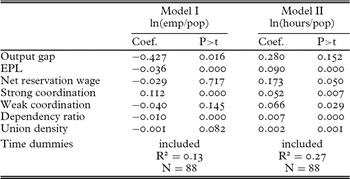
I start by analysing the effects of institutions on employment per capita and hours per capita in the full sample (1960–2000). The results are found in Table 1, where the regression referring to the employment ratio is presented as model I and the hours to population regression is presented as model II. From the table it appears that EPLs, the net reservation wage, the dependency ratio and union density all work to significantly restrict the employment ratio (although the net reservation wage is only significant in model II). Strong wage coordination, however, increases the employment ratio, while the effect of weak wage coordination is insignificant in model I and negative in model II, only providing weak evidence for the U-shape hypothesis suggested in Calmfors and Driffil (Reference Calmfors and Driffil1988). A unit increase in the EPL index involves a decrease in the employment per capita ratio by about 3.6 percentage points, and the hours worked to population by about 9 percentage points. The standard deviation of the EPL is 1.3. A unit increase in the net reservation wage has a point estimate of the coefficient which is close in size to EPL (-2.9 percentage points), but the standard errors are large enough to make the effect insignificant in the employment regression. The standard deviation of the net reservation wage is 0.8.Footnote 9
Regression results, 1960–2000

Note: Output gap measured as GDP/potential GDP, EPL is an index of employment legislation (Allard Reference Allard2005b), net reservation wage from Allard (Reference Allard2005a), dummies for coordination from Ochel's index (2000), 3 = strong coordination and 1 = weak coordination, dependency ratio is the share of population <15 and >65 from the UN, union density is the share of population belonging to the union, from the OECD.
Overall, the R2s of the regressions are not very large, indicating that factors other than institutions have influenced employment over the post-war period. However, R2s increase considerably when hours to population are considered. In general this points to the fact that we need to understand the effects institutions had not only on the total number of workers in employment, but also on the decision of how many hours to supply to the market (although potential regulations about working hours imply that this decision was not always taken by the household).
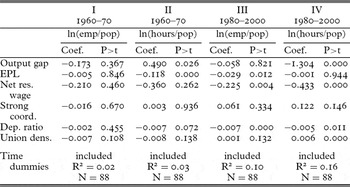
Splitting the sample into the golden age (1960–70) and the post-golden age (1980–2000), to account for changes before and after the oil crisis, lends some support to Blanchard and Wolfers’ hypothesis. It appears that variations in labour market institutions played an insignificant role in explaining the labour supply before 1980. Table 2 shows the results from the split samples, with results from 1960–70 in models I and II and 1980–2000 in models III and IV.
Regression result when sample is split into before and after the oil crisis

Note: Output gap measured as GDP/potential GDP, EPL is an index of employment legislation (Allard Reference Allard2005b), net reservation wage from Allard (Reference Allard2005a), dummies for coordination from Ochel's index (2000), 3 = strong coordination and 1 = weak coordination, dependency ratio is the share of population <15 and >65 from the UN, union density is the share of population belonging to the union, from the OECD.
From models I and II we find that their R2s are very low for the 1960–70 sample and that the only significant effect is the negative effect of EPLs on labour supply in the hours to population regression. These results corroborate Allard and Lindert's (2007) previous finding that it takes some time before institutions start to make a mark on productivity and employment, and therefore it is unsurprising that the effects of institutions on employment and productivity growth were insignificant during the 1960s and 1970s.
The same specifications in models III and IV show that the net reservation wage and the EPLs started to matter much more in restricting labour supply during the post-golden age. Both variables are significant in model III and the net reservation wage is also significant in model IV. The dependency ratio remains negative and significant, whereas the effects of union density and coordinated bargaining become insignificant in the post-golden age period.Footnote 10 Thus, apart from variables related to the power of unions, many of the results from the full period seem to be driven by the evolution of labour market institutions in the post-golden age, lending some support to the Blanchard and Wolfers (Reference Blanchard and Wolfers2000) argument that the European institutional setting only mattered after the oil shock had translated into a large rise in unemployment.
5.2. Productivity effects 1960-2000
The next step is to analyse the institutional effects on productivity. When testing whether any of the previously mentioned institutional variables can be used as instruments for employment by the Sargan test for over-identifying restrictions, I find that only the weak coordination dummy and the dependency ratio qualify. It thus appears that the other institutional variables have some direct effects on productivity, even after controlling for their effect on employment. This result contradicts previous studies by Dew-Becker and Gordon (Reference Dew-Becker and Gordon2008), who use tax wedges and union density as instruments, and Horst et al. (Reference Horst, Van Der Rojas-Ramagosa and Bettendorf2009) who use trade union density, average replacement rates and labour tax revenue as instruments for employment. I interpret the difference as an indication that, although labour market institutions in the above-mentioned studies may have been exogenous to productivity on a year-to-year basis, they are not when measured on a decadal basis, as in the current data set. Over this longer horizon, the dynamic effects from labour market institutions (going, for example, via human capital accumulation or decreasing marginal returns to capital) start to make an imprint on productivity growth and the effects of labour market regulations on productivity cannot solely be attributed to the employment-productivity trade-off.
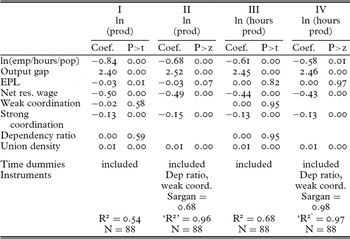
Models I and III in Table 3 display the labour productivity regression before instrumenting, with the dependent variable being labour productivity per employee and per hours worked, respectively. Models II and IV show the results from the regressions using the dependency ratio and the weak coordination dummy as instruments. The instruments could not be rejected using the Sargan test. The instrumented coefficients for employment in the first row of models II and IV were negative and significant, and similar in size to the ones obtained by Dew-Becker and Gordon (Reference Dew-Becker and Gordon2008), suggesting evidence of an employment-productivity growth trade-off in the period 1960–2000. These forces could potentially explain Europe's relatively beneficial labour productivity levels as a static consequence of labour market institutions that were restricting employment.
Results from productivity regressions, 1960–2000

Note: Employment ratios and hours worked to population, is being instrumented for in models II and IV respectively. Output gap measured as GDP/potential GDP, EPL is an index of employment legislation (Allard Reference Allard2005b), net reservation wage from Allard (Reference Allard2005a), dummies for coordination from Ochel's index (2000), 3 = strong coordination and 1 = weak coordination, dependency ratio is the share of population <15 and >65 from the UN, union density is the share of population belonging to the union, from the OECD. R2s in models II and IV do not retain their ordinary statistical interpretation.
Dynamic institutional effects on productivity, after controlling for the static effects from employment, are mostly found for the net reservation wage and the dummy for strong coordination. The coefficients for EPL become borderline significant after controlling for the effects on productivity from employment, and are not robust to using productivity per hours as the dependent variable. The evidence of dynamic productivity effects from EPLs going through human capital accumulation thus only receives weak support in these regressions, while it appears that the direct effects of the net reservation wage and strongly coordinated bargaining settings have mattered more. The finding that strong coordination had a negative and significant impact on productivity runs counter to previous results by Eichengreen (Reference Eichengreen, Crafts and Tonioli1996) and Allard and Lindert (Reference Allard, Lindert, Hatton, O'Rourke and Taylor2007). In this sample, it appears that while strong coordination did modify wage claims and kept employment high, the effects on productivity were not as positive. Potentially, societies with strong wage coordination lacked some of the dynamics and flexibility needed for productivity growth in the post-war era, as suggested in the Olsonian hypothesis (1982). Union density, on the other hand, appears to have influenced productivity positively, although the effect was rather limited in size.
5.3. What can we learn about the period after 1980? – using annual regional data
Since annual regional data from 1980 to 2000 are available, I can also test the institutional hypothesis on a year-to-year basis for the period. After 1980, there are also data on two more institutional variables that have been identified as key variables in the literature for this period: the tax wedge (emphasized by Prescott Reference Prescott2004) and the product market regulation index (emphasized by Nicoletti and Scarpetta Reference Nicoletti and Scarpetta2003).
These post-1980 regressions are able to disentangle the short-run effects of institutions on employment and productivity that I was not able to pick up with the decadal data set in the previous section. The difference between the regressions in the two data sets is thus that the latter is able to separately analyse the immediate effects of a change in institutions from the effects that occur any time during a decade.
Similar to Dew-Becker and Gordon (Reference Gordon, Eichengreen, Landesman and Stiefel2008, p. 13), I find that the residuals in the levels regressions seem to follow a random walk, and therefore I run the regressions in this section in growth rates rather than in levels. Non-stationarity in the panel data models might have been a problem in some previous studies of institutions and employment, and according to Dew-Becker and Gordon this might explain the R2 close to 1 in Bassanini and Duval's (Reference Bassanini and Duval2006) regressions.Footnote 11
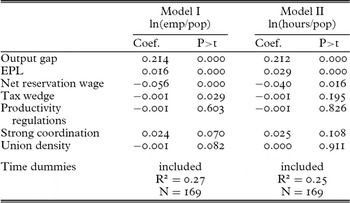
The result of the regression is found in Table 4. As previously, there are large and negative significant effects of the net reservation wage on employment. The effect is slightly larger in the employment regression than in the hours’, but significant in both specifications.
Institutional effects on employment and hours worked, 1980–2000

Note: Output gap measured as GDP/potential GDP, EPL is an index of employment legislation (Allard Reference Allard2005b), net reservation wage from Allard (Reference Allard2005a), dummies for coordination from Ochel's index (2000), 3 = strong coordination and 1 = weak coordination, dependency ratio is the share of population <15 and >65 from the UN, union density is the share of population belonging to the union, from the OECD.
The EPLs appear to have had a positive and significant effect on employment per capita during 1980–2000, which stands in contrast to the negative and significant effects that these laws had on employment in the full sample regressions. This result is broadly consistent with the ambiguous theoretical effects of EPLs on employment ratios mapped out by, for example, Nickell (Reference Nickell1997) and summarized in Bassanini and Duval (Reference Bassanini and Duval2006). Because some insiders will be protected at the expense of some outsiders, it is not always clear which effect will dominate in the change of the employment ratio.Footnote 12 To check the sensitivity of the Allard measure, I also ran the regression with the EPL measure that the OECD provides for the period 1985–2000, but the size and coefficient of the EPL variable remained similar. The Allard (Reference Allard2005a) measure and that provided by the OECD should not differ too much since they essentially employ the same methodology.
As suggested by Prescott (Reference Prescott2004), the tax wedge should matter in explaining employment decreases, and the coefficient sign is indeed negative and significant. However, the coefficient is rather small, and not significant in the hours’ regression. It appears that even if the tax wedge has had some negative effects on the employment ratio, the effect is not very robust and cannot solely explain the employment evolution post-1980. Rather, it appears that other institutional variables have also played a large role.
Contrary to Nicoletti and Scarpetta (Reference Nicoletti and Scarpetta2003) and Fiori et al. (Reference Fiori, Nicoletti, Scarpetta and Schiantarelli2007), I find no evidence that product market regulations have any significant impact on employment ratios. However, it may be that the positive employment effects of such regulations via increased competition and efficiency do not occur straightaway, but rather with some time lag.
However, again we find some evidence that strong wage coordination has had the expected internalizing effects on the labour market and has been increasing labour supply by potentially keeping wages down. Union density, however, appears to explain rather little of the variation in employment ratios in this period.
5.4. What were the effects of institutions on productivity?
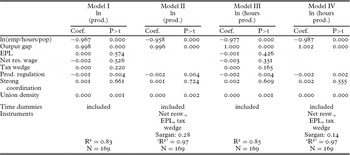
The productivity effects of institutions are found in Table 5. Models I and III in the table show that after having controlled for employment, it appears that none of the variables EPLs, tax wedges or the net reservation wage affect productivity on an annual basis.
Productivity effects, 1980–2000

Note: Output gap measured as GDP/potential GDP, EPL is an index of employment legislation (Allard Reference Allard2005b), net reservation wage from Allard (Reference Allard2005a), dummies for coordination from Ochel's index (2000), 3 = strong coordination and 1 = weak coordination, dependency ratio is the share of population <15 and >65 from the UN, union density is the share of population belonging to the union, from the OECD. R2s in models II and IV do not retain their ordinary statistical interpretation.
Models II and IV in Table 5 show that the net reservation wage, the EPL and the tax wedge cannot be rejected as instruments using the Sargan test in any of the equations (p-values are 0.28 and 0.14 respectively). Having instrumented for employment changes, in models II and IV, there is again evidence of a negative trade-off between employment and productivity. As estimated in the previous regressions, and as argued by Dew-Becker and Gordon (Reference Dew-Becker and Gordon2008), the trade-off appears to have been rather persistent and the process of adjustment of capital appears to have been rather slow.
But while EPLs, the net reservation wage and the tax wedge could be used to instrument for employment in the annual data set, the literature survey in the introduction suggests the potential presence of dynamic long-run effects of employment regulations and high unemployment benefits on productivity. This hypothesis gained support in Section 5.2, where it was found that most labour market institutions had a direct effect on productivity when measured with decadal data. In order to test whether the proposition still holds in the annual data set, I added 10-year lags of the institutional variable to the productivity regression and found negative and significant coefficients from two of the variables: the EPLs and the net reservation wage. The coefficients were rather small; a unit increase in the lagged EPL and net reservation wage decreases the employment ratio by about 1 percentage point, about the same effect as an increase in the product market variable.Footnote 13 Still, between 1960 and 1980 the average EPL index in the sample of countries included increased by more than one unit point and in some countries by much more, while the net reservation wages on average tripled. This means that increases in these variables at the turn of the 1980s may have had a significant dynamic impact on productivity 10 years later, effects that were not channelled through the static employment productivity trade-off.
6. Conclusion and discussion
This article makes a twofold contribution to the existing literature on the institutional roots of Europe's economic performance after the golden age. First, it uses a longer and more detailed data set by covering the period 1960–2000 and using regions instead of countries as units of observation. This allows the analysis to explicitly separate the period before and after the oil shocks and helps in addressing endogeneity issues present in the previous literature. Second, the article analyses the effects of labour market institutions on both employment ratios and labour productivity, explicitly addressing the issue of a potential trade-off between the two variables. Unlike previous employment-productivity trade-off studies, this article shows that some labour market institutions also have dynamic effects on productivity that appear to happen with a time-lag. The main findings of the article can be summarized as follows.
Labour market institutions appear to matter only after the oil shock hit. Similar to the argument by Allard and Lindert (Reference Allard, Lindert, Hatton, O'Rourke and Taylor2007), this article finds that labour market rigidities came at a low cost when these laws were new and the European economy was still booming. In addition, the interaction between a large shock to unemployment in the 1970s and the presence of institutions affecting the duration of long-run unemployment in Europe have created labour market outsiders and caused a permanent decrease in employment ratios, as suggested by Blanchard and Wolfers (Reference Blanchard and Wolfers2000).
The labour market institutions that mainly mattered for employment ratios were the net reservation wages and employment protection laws. The tax wedge and the union density also lowered employment, but the effects were smaller. These results appear much in line with the previous unemployment literature, summarized in Bassanini and Duval (Reference Bassanini and Duval2006). However, this article also finds that strong coordination had positive effects on the employment ratio, suggesting that unions and employers were able to internalize the adverse employment effect of excessive wage claims in coordinated bargaining settings. A similar result was previously found in Calmfors and Driffil (Reference Calmfors and Driffil1988) and Bassanini and Duval (Reference Bassanini and Duval2006). However, this article found no significant effects on employment, but some effects on productivity from product market regulations. The latter finding corroborates the results in Allard and Lindert (Reference Allard, Lindert, Hatton, O'Rourke and Taylor2007).
The productivity effects of the labour market institutions went through two channels: (i) via restricting the supply of labour (the static effect) and (ii) potentially via human capital accumulation rates of labour market outsiders (the dynamic effect). By restricting the supply of workers, European institutions created an employment-productivity trade-off that involved keeping productivity artificially high, at least transitorily before capital adjusted to the lower employment levels. Although this article does not claim that these institutions were responsible for the European productivity slowdown in the 1970s, or the general productivity pattern in the post-war period, the results do show that the institutions, by making labour more expensive, served to push the economy north-west along the labour demand curve, simultaneously lowering employment and increasing productivity. It is also possible that expensive labour in Europe made firms choose more productive strategies (Acemoglu and Shimer (Reference Acemoglu and Shimer2000) model such an outcome due to increases in unemployment insurance). This may be one reason why Europe's labour market performance was so much worse than its productivity performance compared to the USA.
However, in the longer run, these positive static effects on productivity were dominated by the negative dynamic effects of labour market institutions on productivity. Unlike previous studies of employment-productivity trade-off, this article finds that over a 10-year period, the institutional effects can no longer be considered to be exogenous to productivity performance. This was manifested in the productivity regressions, where many of the labour market institutions were no longer useful as instruments for employment. Rather, it appeared that the net reservation wage, the employment protection and strongly coordinated wage bargaining settings were directly influencing productivity in a negative way, even after controlling for their effect on employment.
In the late 1990s a number of deregulations appeared in Europe. Some of these involved deregulating the labour market and thereby increasing the number of workers. Authors have argued that this boost in employment created a new employment-productivity trade-off by simultaneously lowering productivity (see Dew-Becker and Gordon Reference Dew-Becker and Gordon2008 for a discussion). However, Europe's recent productivity slowdown may also be due to long-lasting dynamic effects of the institutions that were in place in the 1980s and 1990s. While Dew-Becker and Gordon argue that the recent European productivity slowdown came from an increase in the supply of workers with low education, they do not explicitly make the link between low human capital accumulation of employment market outsiders and the history of labour market rigidities. This article argues that the recent productivity slowdown could be a result of negative dynamic effects of labour market rigidities that have evolved over time. Further research should explore the institutional roots of the post-1995 productivity slowdown in more detail.