Introduction
Infection by gastrointestinal nematodes (GIN) is a major economic problem affecting grazing sheep worldwide (Hoste et al., Reference Hoste, Sotiraki and Torres-Acosta2011). Although control of GIN is commonly based on the regular use of chemical anthelmintic (AH) drugs (Wolstenholme & Kaplan, Reference Wolstenholme and Kaplan2012), this is leading to the development of anthelmintic resistance in parasite populations (Sadiqqi, Reference Sadiqqi2011; Torres-Acosta et al., Reference Torres-Acosta, Molento and Mendoza-de-Gives2012). Haemonchosis and other gastrointestinal nematodiases are complex diseases, control of which should be approached from different perspectives, based mainly on an adequate nutritional scheme. This simple measure can be combined with the use of other important sustainable control tools. A number of methods are being developed to control the GIN burdens of sheep (i.e. vaccination, selection of genetically resistant animals, nutritional management and plant secondary compounds) (Torres-Acosta & Aguilar-Caballero, Reference Torres-Acosta, Aguilar-Caballero, Rodríguez and Cob2005; Knox, Reference Knox2011; Mendoza-de-Gives et al., Reference Mendoza-de-Gives, López-Arellano, Liébano-Hernández, Aguilar-Marcelino and Ishwaran2012). Other alternative methods of GIN control, such as grazing management or biological control with nematophagous fungi, are based on the reduction of free-living parasitic stages, once they are expelled to the external environment as eggs within the faeces (Sagüés et al., Reference Sagüés, Fusé, Fernández, Iglesias, Moreno and Saumell2011; Colvin et al., Reference Colvin, Walkden-Brown and Knox2012; Mendoza-de-Gives & Torres-Acosta, Reference Mendoza-de-Gives, Torres-Acosta, Paz and Árias-Vázquez2012). However, any single method of GIN control on its own might not be sufficient to accomplish sustainable GIN control (Walkden-Brown et al., Reference Walkden-Brown, Colvin, Hall, Knox, Mackay and Scott2013). Thus, the use of combined approaches has been suggested as a more adequate option for GIN control (Hoste et al., Reference Hoste, Sotiraki and Torres-Acosta2011). One possible option of combined control might be the use of Duddingtonia flagrans chlamydospores inside nutritional pellets (NPs). Evidence obtained by several authors has confirmed that D. flagrans shows a clear antagonistic activity against GIN (Paraud et al., Reference Paraud, Lorrain, Pors and Chartier2011). Although most of the D. flagrans chlamydospores are digested inside the gastrointestinal tract of ruminants by the extreme digestive conditions (Ojeda-Robertos et al., Reference Ojeda-Robertos, Torres-Acosta, Ayala-Burgos, Sandoval-Castro, Valero-Coss and Mendoza-de-Gives2010), a sufficient quantity of spores may reach the faeces to germinate and colonize them, acting as good predators of GIN larvae in the faeces. The beneficial effect of using nematophagous fungi incorporated into NP will be reflected in low levels of infections in other potential hosts that enter the treated pastures later (Mendoza-de-Gives et al., Reference Mendoza-de-Gives, Zapata-Nieto, Hernández, López-Arellano, Rodríguez and Garduño2006; Arroyo-Balán et al., Reference Arroyo-Balán, Mendoza-de-Gives, López-Arellano, Liébano-Hernández, Vázquez-Prats, Miranda-Miranda and Ortiz de Montellano-Nolasco2008). Promising results have been reported for D. flagrans in the control of ruminant parasitic nematodes. Recently, chlamydospores have been added to NPs, which served as a suitable vehicle for the administration of D. flagrans to infected animals (Casillas-Aguilar et al., Reference Casillas-Aguilar, Mendoza-de-Gives, López-Arellano and Liébano-Hernández2008). Animals receiving NPs containing chlamydospores can eliminate viable spores in the faeces, and the NPs showed a shelf life of at least 8 weeks (Fitz-Aranda et al., Reference Fitz-Aranda, Mendoza-de.Gives, Torres-Acosta, Liébano-Hernández, López-Arellano, Sandoval-Castro and Quiroz-Romero2015). Furthermore, the NPs can be designed to provide a recommended quantity of nutrients, such as protein, metabolizable energy or any other nutrient needed by the animals. With this methodology, animals will simultaneously receive two tools of GIN control: (1) the nutritional supplement that may improve resilience and resistance against GIN, and (2) the spores of D. flagrans that may help to trap L3 larvae in the faeces. To the best of our knowledge, there has not been any study evaluating this combination of nutrition and D. flagrans on the quantity of infective larvae harvested from sheep faeces. Thus, an artificial infection trial evaluated the effect of feeding NPs containing D. flagrans chlamydospores on body weight gain (BWG), body condition score (BCS), packed cell volume (PCV), faecal excretion of Haemonchus contortus eggs (eggs/g of faeces (EPG)) and the quantity of L3 larvae harvested from faecal cultures of Saint Croix sheep.
Materials and methods
This trial was conducted at the Helminthology Department, National Centre of Disciplinary Research in Veterinary Parasitology (INIFAP-Mexico) in Jiutepec, Morelos, Mexico.
Twelve Saint Croix male lambs, 2–4 months old with an average weight of 23.5 ± 4.0 kg, were used. Animals received a conventional nutritional regime based on concentrate feed, chopped dried lucerne and water (ad libitum). Saint Croix lambs, nematode-free from birth, were maintained under confinement in pens with concrete floors for the duration of the experiment, and were confirmed to be free of GIN infection before the beginning of the trial by means of coprological diagnosis (flotation and McMaster technique).
Production of chlamydospores and nutritional pellets
The Mexican strain of the nematophagous fungi D. flagrans (FTHO-8) produced at CENID-PAVET-INIFAP was used (Llerandi-Juárez & Mendoza-de-Gives, Reference Llerandi-Juárez and Mendoza-de-Gives1998). Chlamydospore production was performed on wheatmeal agar plates that were maintained under dark conditions at room temperature (25–30°C) for 21 days. Chlamydospore counting was performed with Neubauer chambers following the procedure described by Paz-Silva et al. (Reference Paz-Silva, Francisco, Valero-Coss, Cortiñas, Sánchez, Francisco, Arias, Suárez, López-Arellano, Sánchez-Andrade and Mendoza-de-Gives2011).
Experimental infection of lambs
The H. contortus strain was originally obtained from naturally infected sheep at ‘Las Margaritas’ farm (Hueytamalco, Puebla, Mexico). The H. contortus infective larvae (L3) were obtained from a donor sheep previously infected with the parasite. Thereafter, the donor animal was kept under conditions that avoided further infection with GIN. Faecal cultures were prepared in plastic containers and mixed with polystyrene pellets, and were maintained under laboratory conditions for 6 days. Infective larvae were recovered from faecal cultures by means of the Baermann technique (Valcárcel-Sancho et al., Reference Valcárcel-Sancho, Rojo-Vázquez, Olmeda-García, Arribas-Novillo and Márquez-Sopeña2009).
NPs were manufactured following the methodology published by Casillas-Aguilar et al. (Reference Casillas-Aguilar, Mendoza-de-Gives, López-Arellano and Liébano-Hernández2008) and Rubio & Vidal (Reference Rubio and Vidal2000). The NP formula included the following ingredients: sorghum meal (7%), soybean meal (51%), wheat bran (20%), molasses (18%), mineral salts (2%) and calcium (2%). These NPs provided 89% of the dry matter, 2.59 MCal/kg metabolizable energy and 27% of the crude protein (Fitz-Aranda et al., Reference Fitz-Aranda, Mendoza-de.Gives, Torres-Acosta, Liébano-Hernández, López-Arellano, Sandoval-Castro and Quiroz-Romero2015). The NPs were prepared with D. flagrans chlamydospores. A hand-made manual press with cylinder-shaped moulds was specially designed for the manufacture of NPs. The press moulds were filled with the mixture and allowed to dry for 24 h at room temperature. NPs were 3.5 cm long × 2 cm wide and their average weight was 11 g. The quantity of chlamydospores contained in every pellet was estimated according to the individual body weight (BW) of each animal. Before preparing each individual ration of pellets, animals were weighed to decide the amount of chlamydospores that needed to be incorporated into the pellets for every individual lamb. The total dose of chlamydospores was distributed into ten pellets as a total ration per animal. The chlamydospore doses received by each animal ranged between 28 × 106 and 58 × 106.
The 12 Saint Croix male lambs were artificially infected with a single oral dose of 350 H. contortus larvae/kg BW. Larvae were suspended in water. Faecal samples were obtained directly from the rectum of lambs from day 21 post-inoculation onwards, to confirm the patency of infection and the number of nematode eggs eliminated (EPG). Faecal samples were processed using the McMaster technique, as described by Liébano-Hernández et al. (Reference Liébano-Hernández, López-Arellano, Mendoza-de-Gives and Aguilar-Marcelino2011). Once experimental lambs were diagnosed as being positive for the presence of H. contortus eggs, two study groups were formed with similar BW and H. contortus egg excretion. The treated group was fed with ten NPs plus sorghum meal and ground lucerne hay to achieve a weight gain of 174 g/day. The ten NPs contained the individual dose of 2 × 10⁶ D. flagrans chlamydospores/kg BW, adjusted for each individual lamb. The control group received a nutritional regime based on sheep commercial food, molasses and ground lucerne hay, also based on the individual BW of each animal. Food was offered every day for the duration of the study (11 weeks) and the daily amounts of food offered and refused were recorded. The quantity of food offered to the experimental lambs was adjusted weekly, considering their individual weight, for the whole duration of the study.
Body condition and food consumption of lambs
Lambs were weighed on a weekly basis. This procedure was performed in the morning before any feed was offered to the experimental animals.
Initially an individual food ration based on the body weight of each lamb was designed as follows: for live weight (15, 20 and 25 kg) the metabolizable energy was 6.4, 7.8 and 8.9 MCal/kg, respectively, and the metabolizable protein was 62, 66 and 70 g/kg, respectively. Diets were designed to obtain 174 g/day BWG. Sheep of both groups were maintained in individual metabolic cages and corresponding diets were supplied daily for 11 weeks.
The total BW for each individual lamb was divided by the number of days of the study to determine the daily weight gain.
The food conversion values were estimated considering individual food consumption divided by weight gain. The body condition score (BCS) was assessed every week by palpation, measuring the muscle mass and fat at the level of the rump and the lumbar region. The scale published by Pollot & Kilkenny (Reference Pollot and Kilkenny1976) was used in this study.
Packed cell volume
Blood samples were also obtained weekly before weighing the animals. Blood was obtained from the jugular vein of sheep from both groups using sterile heparin tubes. Blood samples were used to estimate the PCV using haematocrit micro-capillary tubes, according to the technique described by Arroyo-Balán et al. (Reference Arroyo-Balán, Mendoza-de-Gives, López-Arellano, Liébano-Hernández, Vázquez-Prats, Miranda-Miranda and Ortiz de Montellano-Nolasco2008).
Faecal egg counts and larval recovery of H. contortus
Faecal samples were obtained every week directly from the rectum of every lamb. Individual EPG values were estimated using the McMaster technique, which is able to detect a minimum of 50 eggs/g of faeces. Once a week three faecal cultures were processed for each lamb. Each faecal culture contained 7 g of fresh faeces and was deposited into plastic Petri dishes (60 × 15 mm). Faeces were macerated using a metal spoon, and 1 ml of sterile distilled water was added to the faecal material before mixing the paste. Faecal cultures were incubated for 15 days at room temperature (25–30°C) to allow the larvae to hatch and the fungus to germinate, followed by colonization and larval predation. Faecal cultures were aerated daily to favour the micro-environmental conditions for larval development. Larval recovery was obtained through the use of the Baermann technique for 24 h. The population of recovered H. contortus larvae was estimated by counting ten 5-μl aliquots of the aqueous larval suspension and mean numbers of larvae per treatment were estimated (Arroyo-Balán et al., Reference Arroyo-Balán, Mendoza-de-Gives, López-Arellano, Liébano-Hernández, Vázquez-Prats, Miranda-Miranda and Ortiz de Montellano-Nolasco2008; Fitz-Aranda et al., Reference Fitz-Aranda, Mendoza-de.Gives, Torres-Acosta, Liébano-Hernández, López-Arellano, Sandoval-Castro and Quiroz-Romero2015).
The reduction percentage (R%) of H. contortus infective larvae caused by fungal activity was estimated by applying the following formula (Fitz-Aranda et al., Reference Fitz-Aranda, Mendoza-de.Gives, Torres-Acosta, Liébano-Hernández, López-Arellano, Sandoval-Castro and Quiroz-Romero2015):
 $$\hbox{Nematode reduction percentage} =\displaystyle{{\bar X\,{\rm Control \; group} - \bar X\,\,\hbox{Treated group}}\over {\bar X\,{\rm Treated \; group}}}\, \times \,100$
where
 $\bar X$
Control group = mean of recovered nematodes from the control group, and
 $\bar X$
Treated group = mean of recovered nematodes from the treated group.
Viability of chlamydospores
The viability of chlamydospores obtained from the NP was determined in the faeces of each experimental sheep of the treated group. For that purpose, a faecal pellet was obtained from each lamb of that group and was placed on the surface of a Petri dish (60 × 15 mm) containing bacteriological water agar. Plates were sealed with Parafilm and were incubated for 10 days at room temperature (28–30°C). After this period, plate surfaces were observed under the microscope, searching for the presence or absence of three-dimensional adhesive nets or trapped larvae (Ojeda-Robertos et al., Reference Ojeda-Robertos, Torres-Acosta, Aguilar-Caballero, Ayala-Burgos, Cob-Galera, Sandoval-Castro, Barrientos-Medina and Mendoza-de-Gives2008). In the presence of any of these elements the result was considered to be positive, and in the absence of any or both elements the result was considered negative. The presence of free infecting larvae, conidia, conidiophores or mycelia was not considered for the diagnosis.
Data analysis
Data were analysed using a repeated measures experiment across time model (Herrera & García, Reference Herrera and García2010). Larval recovery data and EPG data values were log transformed (EPG + 25) to achieve the closest normalization of data (SAS Institute, 1998). The PCV data were normal, so no data transformation was required. Data were analysed using the MIXED and GLM procedures of SAS (SAS Institute, 1998).
Results
Condition of lambs and PCV values
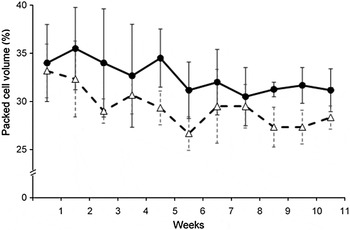
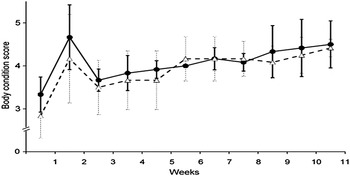
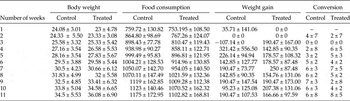
The BW values of lambs in the treated and control groups were similar (P > 0.05) (table 1). Also, the mean PCV values obtained for the two experimental groups were similar (30 vs. 32% for the treated and control groups, respectively; P > 0.05). In spite of variability throughout the study period, all the PCV values were considered to be within the normal PCV range of sheep (fig. 1). Regarding the BCS, statistical analysis showed that no difference was observed in both groups, except at the beginning of the experiment (weeks 1 and 2, and weeks 2 and 3) (P > 0.05). Finally, the BCS values of the treated and the control groups showed no statistical difference (control 3.6 ± 0.39 vs. treated 3.4 ± 0.46; P > 0.05) (fig. 2).
Packed cell volume in each of two groups of lambs: control (solid circles; fed on lucerne and commercial food) and treated (open triangles; fed on lucerne and nutritional pellets containing chlamydospores of D. flagrans) over an 11-week period.

The body condition scores of the two groups of lambs: control (solid circles; fed on lucerne and commercial food) and treated (open triangles; fed on lucerne and nutritional pellets containing chlamydospores of D. flagrans) over an 11-week period.

Mean values (± SD) of body weight (kg), food consumption (g), weight gain (g) and conversion (kg) in each of two groups of six lambs; control (fed on lucerne and commercial food) and treated lambs (fed on lucerne and nutritional pellets containing chlamydospores of D. flagrans) over an 11-week period.

Egg output/larval recovery and reduction of H. contortus
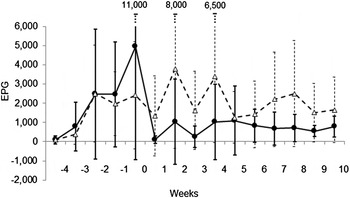
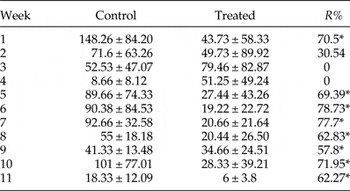
In relation to the average and standard deviation of the output of eggs of H. contortus, no statistical differences were observed between the two groups (P > 0.05) (fig. 3). In general, the R% varied from 30.5 to 78.7%. On weeks 3 and 4 no reduction was observed. The highest larval population reduction was observed during the first week (70.5%) and from weeks 6 to 11 after treatment, ranging from 57.8 to 78.73%. The mean R% obtained during this period was almost 70% (table 2).
Mean number (±SD) of Haemonchus contortus eggs/g faeces (EPG) in two groups of lambs: control (solid circles; fed on lucerne and commercial food) and treated (open triangles; fed on lucerne and nutritional pellets containing chlamydospores of D. flagrans) over an 11-week period.

Mean numbers (±) of Haemonchus contortus third-stage larvae in each of two groups of six lambs: control (fed on lucerne and commercial food) and treated lambs (fed on lucerne and nutritional pellets containing chlamydospores of D. flagrans) over an 11-week period; R%, proportion of larval reduction.

*Level of significance with P ≤ 0.05.
Fungal viability
The presence of fungal development and trapped nematodes on the surface of the water agar Petri dishes was positive in at least one of the three plates of each animal fed NPs containing D. flagrans for the duration of the trial. A sole exception was found in one lamb, which showed three negative culture plates on weeks 1, 2, 3, 4, and 6 of the study.
Discussion
The present study demonstrated that consumption of NPs containing D. flagrans chlamydospores clearly reduces H. contortus L3 in the faeces of Saint Croix sheep.
The animal parameters evaluated (BWG, PCV and BCS) showed that experimental lambs did not suffer any negative effect due to the H. contortus infection, even when the large number of H. contortus eggs in the faeces of the experimental lambs suggested a considerable infection. The daily BWG could be considered normal for animals fed a full diet indoors (c. 140 g/day). Also the mean BCS was always above 3 points, which is considered a very good value for growing animals. Finally, no signs of anaemia were evident throughout the study. Animals were always well above the 21% boundary that is considered to be indicative of anaemia in sheep. All the evidence from lambs in both groups clearly suggests that animals were fed enough nutrients to compensate for the negative effects of the H. contortus infection, which is the basis of the resilience against GIN infection (Torres-Acosta & Aguilar-Caballero, Reference Torres-Acosta, Aguilar-Caballero, Rodríguez and Cob2005). Furthermore, the absence of any difference between the two groups suggested that use of NPs can be an efficient feeding system for lambs, and that this is comparable to conventional feed.
Experimental lambs were assigned to each experimental group, aiming to achieve similar levels of initial EPG excretion. For the duration of the study the two groups showed variable levels of EPG. However, both groups had similar EPG excretions during the study (P > 0.05). This could be explained in at least two ways. (1) Lack of difference between the experimental groups due to the use of the NP showed the lack of any fungal activity against H. contortus eggs. The latter was expected since D. flagrans chlamydospores have no activity against GIN eggs (Mendoza-de-Gives & Torres-Acosta Reference Mendoza-de-Gives, Torres-Acosta, Paz and Árias-Vázquez2012). (2) Maintaining similar EPG excretions in both experimental groups throughout the study, together with the good BWG, BCS and PCV described above, suggested that both groups were equally well nourished. Thus, it is possible that the nutritional aspects involved in the development of immunity in experimental lambs were adequate in terms of quality and quantity (Behnke et al., Reference Behnke, Chiejina, Musongong, Fakae, Ezeokonkwo, Nnadi, Ngongeh, Jean and Wakeling2006; Bautista-Garfias, Reference Bautista-Garfias and Gutiérrez-Pabello2010). The latter is important, as the Saint Croix lambs used in the present study are known to be genetically resistant to GIN (Zajac et al., Reference Zajac, Krakowka, Herd and McClure1990; Gamble & Zajac, Reference Gamble and Zajac1992) and they can show an innate immune response through humoral and cellular mechanisms (Miller & Horohov, Reference Miller and Horohov2006).
The fact that most faecal pellets from the lambs in the treated group showed the development of typical D. flagrans structures (i.e. germinating chlamydospores, as well as trap formation and captured nematodes) demonstrated that the FTHO-8 D. flagrans strain is still capable of germinating and demonstrating predatory activity, in spite of the fact that it was isolated almost 20 years ago and since then has been maintained under lab conditions. The results of this study showed that D. flagrans chlamydospores contained in the NPs succeeded in passing through the digestive tract of sheep and were eliminated together with faeces, where they germinated and formed trapping structures enabling them to trap nematodes. Ojeda-Robertos et al. (Reference Ojeda-Robertos, Torres-Acosta, Ayala-Burgos, Sandoval-Castro, Valero-Coss and Mendoza-de-Gives2010) found that approximately 90% of D. flagrans chlamydospores are destroyed in the digestive tract of sheep. Thus, the latter has to be considered if successful and practical fungal application is intended. In spite of the adverse conditions of the sheep digestive tract, enough spores maintained their ability to survive and to display their predatory activity. Nematophagous fungi can develop exponentially from a reduced amount of viable spores that germinate, colonize the faecal material and eventually capture and destroy the nematode population in the faecal pellet before they abandon the faeces. The present study confirmed once more that NPs can be used as an adequate vehicle for chlamydospore dosing of sheep. The NPs resulted in a practical way of spore administration to lambs as they were readily accepted and no NPs were wasted.
Although the R% values of the faecal larvae throughout the experiment were variable (table 2), and even though two samplings, at weeks 3 and 4, showed no larval reduction, most weeks showed reductions close to or higher than 60% (59–78%), implying a potential benefit as an alternative method of GIN control. The present results are similar to those reported for the same D. flagrans isolate in previous in vitro studies. First, a study administrating chlamydospores (3.5 × 10⁶ per kg BW) to H contortus-infected goats resulted in an R% of 36 and 52.8% at 7 and 14 days post-administration, respectively (Ojeda-Robertos et al., Reference Ojeda-Robertos, Mendoza-de-Gives, Torres-Acosta, Rodríguez-Vivas and Aguilar-Caballero2005). Similarly, dosing 1, 2.5 or 5 × 10⁶ chlamydospores per kilogram BW as an aqueous suspension mixed with the feed resulted in 76.6, 84.5 and 32.0% larval reduction, respectively, where only the R% values found for the 1 and 2.5 × 10⁶ doses were significantly different compared to their respective control cultures (P < 0.05; Ojeda-Robertos et al., Reference Ojeda-Robertos, Torres-Acosta, Aguilar-Caballero, Ayala-Burgos, Cob-Galera, Sandoval-Castro, Barrientos-Medina and Mendoza-de-Gives2008). Likewise, seeding H. contortus L3 larvae to the faeces of sheep supplemented with NPs containing 2 × 10⁶ D. flagrans chlamydospores resulted in an 82% reduction of the larval population in faecal cultures maintained for 8 days under laboratory conditions (Casillas-Aguilar et al., Reference Casillas-Aguilar, Mendoza-de-Gives, López-Arellano and Liébano-Hernández2008).
Thus, the present results, obtained under controlled pen-fed conditions, suggest that NP consumption can result in a clear reduction of the number of nematode larvae in the faeces. These results offer good expectations for the use of NPs under field conditions, leading to a larval population reduction in pasture. A 51.1% reduction of GIN burden was reported in tracer lambs grazing a paddock previously grazed by sheep fed a daily oral regime containing 1 × 10⁶ chlamydospores/kg BW (Mendoza de Gives et al., Reference Sagüés, Fusé, Fernández, Iglesias, Moreno and Saumell2006). Casillas-Aguilar et al. (Reference Casillas-Aguilar, Mendoza-de-Gives, López-Arellano and Liébano-Hernández2008) reported a 73.5% reduction of infective larvae under field conditions when using 1 × 10⁶ D. flagrans chlamydospores/kg BW mixed with commercial food for 5 months in southern Brazil. More recently, a daily dose of 200,000 chlamydospores/kg BW of an Argentinian D. flagrans isolate resulted in parasitic burden reductions as follows: 100% against H. contortus, 89.9% against Teladorsagia circumcincta, 87.5% against Trichostrongylus colubriformis and 90% against Cooperia oncophora; no activity was recorded against T. axei (Sagüés et al., Reference Sagüés, Fusé, Fernández, Iglesias, Moreno and Saumell2011).
Regarding feed conversion; although some data (weeks 4 and 9) showed great variability, in general the feed conversion of both groups of the experimental flock was considered to be normal.
Future work should corroborate the potential larval reduction effect of the NPs under field conditions. The use and application of D. flagrans within NPs should be considered only as an additional tool that, together with other control measurements, could lead to the successful control of GIN.
The present study showed that NPs containing D. flagrans could be an effective source of nutrients, similar to that of conventional feed, for Saint Croix sheep. The NP diet and the conventional diet helped to maintain normal BWG, good BCS and normal PCV of the infected lambs throughout the study. Although NPs did not affect faecal H. contortus egg excretion, D. flagrans chlamydospores contained in the NPs provided an additional advantage for control of H. contortus, by reducing GIN infective larval populations in the faeces throughout the study. The latter may represent a considerable reduction of the health risk due to GIN for sheep flocks at field level.
Dedication
This paper is dedicated to the loving memory of our great friend Dr Enrique Liébano-Hernández, who was a member of the group of the Helminthology Department at the Centro Nacional de Investigación Disciplinaria (CENID)-Parasitología Veterinaria, INIFAP (Instituto Nacional de Investigaciones Forestales Agrícolas y Pecuarias), México.
Financial support
This study was supported by el Consejo Nacional de Ciencia y Tecnología (CONACYT) Proyecto SAGARPA-CONACYT No. 11990/2005. We are also thankful to CONACYT, Mexico for granting L.A.-M. a scholarship (211375).
Conflict of interest
None.
Ethical standards
The authors assert that all procedures contributing to this work comply with the ethical standards of the relevant Mexican guidelines regarding animal welfare and unnecessary animal suffering; these are Good Management Practices policies well established at our institution. The Norma Oficial Mexicana (Official Rule Number) NOM-051-ZOO-1995 (http:/www.senasica.gob.mx) as well as the Ley Federal de Sanidad Animal (Federal Law for Animal Health) DOF 07-06-2012 (http:/www.diputadpos.gob.mx/LeyesBiblio/ref/lfsa.htm) were strictly abided to and all the procedures performed in studies involving animals were in accordance with the ethical standards at INIFAP.