The Wisconsin Center for Film and Theater Research (WCFTR),Footnote 1 which is housed at the Wisconsin Historical Society in Madison, Wisconsin, and partners the historical society with the University of Wisconsin's Department of Communication Arts, was formed in 1960. It maintains a diverse collection of entertainment media, including collections of papers, audio and/or visual materials, and other creative documents such as scripts and designs. The majority of the WCFTR's collections feature film, radio, and television productions and various photographs and promotional material. The smaller theatre collections include papers related to notable actors and playwrights such as Alfred Lunt, Lynn Fontanne, Moss Hart, Langston Hughes, and George S. Kaufman; lyricists and composers such as Marc Blitzstein and Stephen Sondheim; and designers for film and theatre.Footnote 2 This article examines the WCFTR collections of three twentieth-century theatrical designers: Wolfgang Roth, Jean Rosenthal, and Gilbert Hemsley.
Research commences at the center's online Archives Catalog (ArCat).Footnote 3 The entry for each of these collections has a link to what ArCat calls a register. The online register links researchers to a finding aid and includes a “Scope and Content Note,” which lists the contents of the collection. These may include personal correspondence, written articles, design sketches, and production materials such as scenic ground plans and lighting plots and associated paperwork. The online register also includes a link to a Contents List, which provides information about the collection by container number, folder number, and title of document. One may also find reviews of noteworthy productions and tours or slides, videos, and photographs of shows in these collections. Often the bulk of a design collection consists of production materials that enable researchers to study closely the development of the designer's career over a lifetime as well as the changing trends in theatrical design practice. And occasionally one uncovers a gem such as a unique drawing, piece of correspondence, or undiscovered sketch that provides new insights about the featured subject.
Wolfgang Roth, Stage Designer and Architect: From Brecht to Broadway
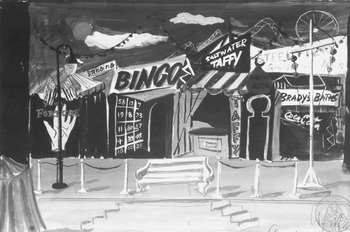
The Wolfgang Roth Papers is a relatively small collection comprising only four boxes, but it is rich in diversity. The collection arranges the design career of Wolfgang Roth (1910–88) chronologically, beginning with Massamilla [sic] Doni (1936). The last dated production is Kaspar, produced in New York in 1972. In addition to many sketches and draftings of set designs (Fig. 1), there is an autobiographical essay entitled “Reflections of a Stage-Builder.” In this eighteen-page document, Roth describes his journey from war-torn Germany to the United States, becoming a U.S. citizen in 1945, and his firm declaration, based on his forty-five years of experience, of the principles a designer should embody.
The Skin of Our Teeth. Boston, 1948. Photostat of stage model. Box 1, Folder 8, Wolfgang Roth Papers, “1936–1963,” Wisconsin Center for Film and Theater Research, Madison, Wisconsin.

Wolfgang Roth—stage designer, theatrical consultant, performer, artist, painter, sculptor, singer, and songwriter—was born in Berlin and studied decorative painting at the State Academy of the Arts. He was an apprentice to Erwin Piscator's stage designer Traugott Müller in the 1920s. Roth became a stage designer and “trained and collaborated with Bertolt Brecht [and] designed and performed in political reviews, cabarets, and experimental film.”Footnote 4 He left Germany in 1933 and moved to Vienna, where he briefly worked as a stage designer and architect. In 1934, he moved to Zurich, where he was involved with vaudeville, variety shows, and cabaret; designed sets for musicals, opera, and dramas; and occasionally performed in circus events as a clown. In 1938, Roth moved to North America, where he continued his stage design activities. He worked in the United States, Canada, and abroad for the rest of his career. Roth created the memorable stage design for the 1952 Robert Breen–Blevins Davis revival and international tour of Porgy and Bess.Footnote 5 His costume and set design work was also seen at the Metropolitan Opera production of Don Pasquale in 1955. From the late 1960s to 1972, Roth was a member of the faculty at the New York University School of the Arts, where he held an appointment as Master Teacher of Stage Design.
Scholars interested in Brecht, in his collaboration with designers, and in working conditions in Germany in the early 1930s would find inspiration in Roth's short but informative essay “Working with Brecht.” He writes of Brecht's approach to theatre work: “A man of knowledge, constantly curious, who believed in inventiveness and improvisation, he also was a man who believed in fun, joy, and jokes… . ‘If there isn't any fun or amusement or laughter in the theater,’ he said, ‘there shouldn't be any theater at all.’”Footnote 6 Roth explains his understanding of Brecht and epic theatre:
Brecht's genius and craftsmanship, his tremendous involvement, made it possible and necessary that he often contradicted himself. He was an intuitive man whose work came first, his theories later. There is no Brechtian method—the attempt by people less talented than Brecht to recreate a Brechtian theater by applying Brechtian theory can only lead to failure. This constant assumption that “Brecht-Theater” is only possible with the use of placards, exposed lighting equipment, half-high front curtains and similar devices leads to a great misunderstanding and is not necessarily epic theater. He himself often debunked the epic label.Footnote 7
Finally, Roth recalls Brecht's advice for stage builders (scene designers) and stage construction (scenery):
“Don't try to put everything into something where it doesn't belong. You only do that to cover up your inability. You substitute things for essence. The performers should be the greatest part of our scenery: when the setting becomes a comfortable place for actors to walk around in, only then is it meaningful; no effects, they're not necessary, no false moods.”Footnote 8
In examining the body of Roth's produced theatre and opera work in the United States and in Europe, one can sense that his early love for vaudeville and circus always remained an inspiration. In 1953, he devised an “Idea for Traveling Circus” in his production of Cirque magique. Roth created, designed, and performed in The Littlest Circus, which toured the United States and Canada in the early 1960s.Footnote 9 A pantomime created for children, it was the story of a poor family in Europe making its way from town to town as a traveling circus. Seven actors performed all of the circus troupe's roles, including clowns, jugglers, and animals. Roth played the featured clown in the play's early performances. In addition to the tour, the show was broadcast on WCBS television.
The Roth collection contains a number of design treasures. In addition to pen-and-ink drawings of Roth's set designs for Porgy and Bess, the collection includes design drawings, models, blueprints, elevations, scripts, and light plots for productions he designed for the New York City Opera, the Metropolitan Opera, and nearly a dozen Broadway productions.
Lighting by Jean Rosenthal
Jean Rosenthal (1912–69)—lighting designer, production manager, and theatre consultant—is considered by many to be the fountainhead of American lighting design. Given her multifaceted career, the Jean Rosenthal Papers, which cover the period 1941–66, is a significantly larger collection than the Roth archive; it consists of forty-one boxes, one package, and two oversize folders. The collection comprises two parts. The Original Collection includes twenty-four boxes containing material received from Rosenthal, with hand-titled folder files and lighting notes she created for productions she designed during the period 1949–61. However, the shows are not arranged in alphabetical or chronological order. The second part, titled Additions, contains seventeen boxes, one package, and one oversize folder with designs from 1941–66. This section also contains lighting notes as well as set designs and light plots, arranged alphabetically from Aida to Wozzeck.
Rosenthal was born in New York on 16 March 1912 to physician parents. As a child, she lived in Richmond Hill and Jamaica, Long Island. She was educated at William Fincke's Manumit School in Pawling, New York. There she contributed to a class project on Shaw's Arms and the Man as stage manager and director.Footnote 10 Fincke died in 1927, and by that time Rosenthal had returned to Manhattan and was living with her parents, attending Friends Seminary. In 1929 she was enrolled in the Neighborhood Playhouse School of the Theatre. She notes, “There I met the people who have had the most lasting and dominant influence on my life and way of thinking: Louis Horst, Martha Graham, Laura Elliot, Irene Lewisohn.”Footnote 11 Rosenthal attended Yale University, where she studied with faculty designers Frank Bevan, Donald Oenslager, and Stanley McCandless from 1930 to 1933, preceding other prominent female lighting designers from Yale who would later lend their talents to the American theatre: Peggy Clark (M.F.A. 1938) and Tharon Musser (M.F.A. 1950).
After leaving Yale, Rosenthal joined the Federal Theatre Project under the Works Progress Administration, where she worked with John Houseman and Orson Welles as technical director and lighting manager for the Mercury Theatre. In 1940, she opened the Theatre Production Service, “a mail-order house for theatrical supplies … [that] offered complete design service for shows and for theatres.”Footnote 12 Rosenthal had a successful career on Broadway and beyond, designing for musicals, plays, dance, and opera. Her dance collaborations included work with Martha Graham (1939–69), the José Limón Company, the New York City Ballet in New York and on national tours (1948–57), and the American Ballet Theatre (1960–8). She was lighting director at the New York City Opera for the 1951 season and production consultant and lighting director in 1953. From 1957 to 1969 Rosenthal was involved with the Dallas Civic Opera, where she worked as designer, production manager, and production director. Her most notable lighting designs for musicals include West Side Story (1957), The Sound of Music (1959), A Funny Thing Happened on the Way to the Forum (1962), Fiddler on the Roof (1964), and Cabaret (1966).
The researcher interested in production history and the touring aspects of American musicals will find that Cabaret and Fiddler on the Roof are particularly well documented in this archive. The files for these shows contain light plots, cue sheets, equipment specification sheets, and scene design sketches by set designer Boris Aronson. For example, several versions of Fiddler, including the original production, the production of the second touring company (bus and truck), the production of the second national tour, and productions into the year 1970 may be studied, providing the researcher an opportunity to examine the various minute or significant refinements to a production as it is performed at different venues across the country.
Jean Rosenthal was also a theatre consultant, advising over thirty projects for colleges and universities, the American Shakespeare Festival Theatre, the Los Angeles Music Theatre, and the St. Louis Municipal Opera, among others. Perhaps her most lasting contribution to lighting design is The Magic of Light, which she co-wrote with Lael Wertenbaker. Published posthumously in 1972, it is widely considered to be one of the earliest and most inspirational books about the art and practice of lighting design.
The strength of the Rosenthal archive is that it presents a clear sense of professional lighting design practice in America at its infancy and as a separate design contribution to live arts entertainment. The collection includes rich documentation of equipment orders, electrical hookup schemes, and focus charts. Although personal correspondence and documents that can be verified as having been written by Rosenthal are not well represented in this collection, the designer credit one reads in countless theatre playbills found in the archive—“Lighting by Jean Rosenthal”—reminds the scholar of Rosenthal's success in staking a rightful claim as a full-fledged design collaborator.
Gilbert Hemsley: From Broadway to Moscow and Beyond
Contrasting with the Wolfgang Roth and Jean Rosenthal collections, the Gilbert Hemsley Papers constitutes a sort of time capsule of a portion of his life, from 1948 to the early 1980s. It is the most expansive collection of the three. The Papers (36.6 cubic feet) consist of eighty-nine boxes and twelve oversize files. The Additions section (another 48.1 cubic feet) includes tape recordings, photographs, negatives, transparencies, video recordings, and one painting.
For its size and scope, the materials are well organized and logically ordered. A General series contains eight boxes of personal materials, such as correspondence, Hemsley's teaching materials from the University of Wisconsin, project materials from his student years, Hemsley's early design work, and materials from his association with various professional organizations. The collection also includes five sections that constitute the bulk of his extensive design activities, grouped by form: Ballet, Opera, Dance, Theater, and Specials. The Ballet section includes twenty-seven boxes of materials related to his work with the American Ballet Theatre, the Ballet Folklórico de México, the Bolshoi Ballet, the National Ballet of Cuba, the Stuttgart Ballet, and the Wisconsin Ballet, among others. The Opera section consists of twenty-five boxes of designs for the Opera Company of Boston, the Dallas Civic Opera, the Houston Grand Opera, the Lyric Opera Company, the Madison Civic Opera, the Metropolitan Opera, and the New York City Opera, among others. At the end of this section are files associated with Mass (1971), conducted by Leonard Bernstein, an opera–theatre event created to celebrate the opening of the Kennedy Center. The Dance section contains five boxes that document Hemsley's work with the Glen Tetley Dance Company, the Joffrey II Dancers, the Martha Graham Center for Contemporary Dance (the 1979 tour), and the Performing Arts Company of the People's Republic of China (the 1978 tour). The Theater section comprises materials arranged alphabetically by production name; it features regional designs as well as Broadway and university productions. The Specials section contains documentation of a mixed bag of projects. Perhaps the most notable feature in this section is material relating to the 1977 “New Spirit” Inaugural Concert at the Kennedy Center to celebrate President Carter's inauguration. A videotape of this event can be accessed in the Additions section, which is available in the archive but is not yet listed in the online finding aid. The Oversize Plots, Plans, and Designs section of the Papers includes oversize material (including ground plans) and light plots related to the other sections (ballet, opera, dance, theatre, and specials).
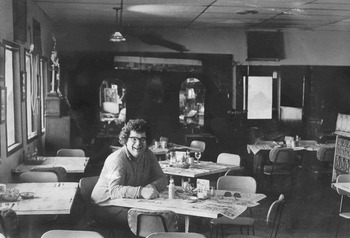
Gilbert Vaughan Hemsley Jr. (Fig. 2) was born in Bridgeport, Connecticut, in 1936 to an Episcopal minister and his wife, Dorothy. The eldest of four children, Gilbert enrolled at Yale University, receiving a B.A. in history in 1957 and an M.F.A. from the Yale School of Drama in 1960. One of his first appointments after he completed graduate school was at the McCarter Theatre in Princeton, New Jersey, where he worked as a production stage manager and lighting designer. He assisted lighting designer Tharon Musser at the American Theatre Festival in 1961. He designed productions for the newly merged Association of Performing Artists–Phoenix Repertory Company in the 1964–5 season and worked with Jean Rosenthal at the Dallas Civic Opera from 1966 to 1969.
An undated photo of Hemsley showing his trademark smile. Photo: Zane B. Williams. Gilbert Hemsley Papers, M94-097, Wisconsin Center for Film and Theater Research, Madison, Wisconsin.

Shifting gears and geography, Hemsley became a guest lecturer at the University of Wisconsin–Madison in 1969 and 1970. In the spring of 1970 he was offered a visiting associate professorship in the speech department. However, he was not content to “retire” to the Midwest: design opportunities drew Hemsley to New York and to Cuba and the Soviet Union for the rest of his career. Maintaining his teaching position, he regularly used his students as assistants, offering them real-life experience in Broadway theatres, dance venues, and opera houses. In the summer of 1975, Hemsley worked as production supervisor for Hurok Concerts and took twelve students to the Metropolitan Opera House to facilitate the Bolshoi Opera's first visit to the United States. He also designed the 1976 revival of Porgy and Bess for the Houston Grand Opera, which toured to Los Angeles, Philadelphia, Wolf Trap, Toronto, Ottawa, New York, and Europe. In 1978, Hemsley became production manager and resident lighting designer for the New York City Opera.Footnote 13
Unlike the Rosenthal archive, the Hemsley archive has many representations of his hand in the form of draftings, lighting paperwork, rehearsal scribbles, and boxes of personal and professional correspondence. A scholar interested in relations between American and Soviet artists would learn much from a study of Hemsley's travel journal for his trip to Moscow in 1974, while he was making preparations for the Bolshoi at the Met the following summer. Hemsley found humor in his Spartan accommodations as he drafted designs and logistics in his tiny hotel room: “From the size of my room—Bolshoi will have to go to the Boston Music Hall instead of the Met because the [hotel] room will only take that size plan.”Footnote 14
Documents in this collection reveal important relationships between research subjects. Studying the Hemsley archive led me to discover an early lighting design appointment he held, assisting Rosenthal at the Dallas Civic Opera. Upon further investigation, I uncovered correspondence between Hemsley and Rosenthal, which aided my understanding of his deliberate progression toward independence as an acclaimed designer in his own right. The strong production design history of Porgy and Bess in this collection links Roth and Hemsley: Roth designed scenery for the worldwide tour of the production (1952–6), and Hemsley designed lighting for the 1976 Houston Grand Opera revival. Both productions were successful in part due to highly effective theatrical design contributions. Well-documented designs, draftings, correspondence about productions, and critical reviews of Porgy and Bess from the collections enabled me to craft a visual timeline of productions for this important American opera. Documents such as those in this archive can help scholars identify significant historical facts about research subjects and better comprehend the intersections of their work, life, and art.