Introduction
Post-traumatic stress disorder (PTSD) develops in response to exposure to a traumatic event during which an individual feels extremely fearful, horrified or helpless. The diagnosis is characterized by persistent re-experiencing of the event, persistent avoidance of stimuli associated with the event, emotional numbing and hyper-arousal (APA, 1994). The public health consequences of PTSD are substantial, and include suicide (Kessler, Reference Kessler2000), secondary mental disorders, substance dependence (Breslau, Reference Breslau2002; Breslau et al. Reference Breslau, Davis and Schultz2003), impaired role functioning, health problems (Farley & Patsalides, Reference Farley and Patsalides2001; Simpson, Reference Simpson2002; Zayfert et al. Reference Zayfert, Dums, Ferguson and Hegel2002; Acierno et al. Reference Acierno, Ruggiero, Galea, Resnick, Koenen, Roitzsch, de Arellano, Boyle and Kilpatrick2007; Kubzansky et al. Reference Kubzansky, Koenen, Spiro, Vokonas and Sparrow2007, Reference Kubzansky, Koenen, Jones and Eaton2009; Koenen et al. Reference Koenen, Stellman, Sommer and Stellman2008) and reduced life course opportunities, such as unemployment and marital instability (Kessler, Reference Kessler2000). Identifying race/ethnic differences in PTSD and their origins is necessary to target public health interventions aimed at preventing the development of PTSD and improving its course. This paper examines race/ethnic disparities in PTSD in the general population of the USA.
PTSD is unique among psychiatric disorders, in that exposure to a traumatic event is a diagnostic criterion. Race/ethnic differences in risk for PTSD can therefore arise from two sources: (1) differences in exposure to a qualifying traumatic event and (2) differences in the risk for developing PTSD among those who are exposed to trauma. Epidemiologic studies have shown that trauma exposure varies by demographic characteristics including race (Bromet et al. Reference Bromet, Sonnega and Kessler1998; Breslau, Reference Breslau2002). Factors that lead to trauma exposure may be different from those that increase vulnerability to the effects of that exposure.
It is unknown whether in the general US population racial and ethnic differences exist in lifetime prevalence of PTSD, exposure to traumatic events, development of PTSD among exposed individuals, or treatment-seeking among people with PTSD. Two national studies of the prevalence of PTSD report conflicting results regarding racial differences. Breslau et al. (Reference Breslau, Aguilar-Gaxiola, Kendler, Su, Williams and Kessler2006 a) found no statistically significant difference in PTSD between Blacks or Hispanics and Whites, but Himle et al. (Reference Himle, Baser, Taylor, Campbell and Jackson2009) found Blacks had higher lifetime prevalence of PTSD than Whites. These studies did not decompose risk of PTSD by exposure to potentially traumatic events or the subsequent development of PTSD once exposed, however.
Studies of race/ethnic differences in exposure to potentially traumatic events are limited by their data collection from a specific geographic area or by their focus on a limited number of event types. Furthermore, reviews of this literature highlight its inconclusive results (Kilpatrick & Acierno, Reference Kilpatrick and Acierno2003; Hatch & Dohrenwend, Reference Hatch and Dohrenwend2007). Race/ethnic differences in type of event exposure, particularly elevated rates of exposure to violence, may account for possible differences in PTSD by race/ethnicity, because type of event exposure is an important determinant of PTSD. Furthermore, few studies examine race/ethnic differences in other characteristics of event exposure which increase risk of developing PTSD, such as exposure to multiple events or younger age at exposure (Kessler et al. Reference Kessler, Sonnega, Bromet, Hughes and Nelson1995; Breslau et al. Reference Breslau, Kessler, Chilcoat, Schultz, Davis and Andreski1998, Reference Breslau, Chilcoat, Kessler and Davis1999, Reference Breslau, Peterson, Poisson, Schultz and Lucia2004 a; Bromet et al. Reference Bromet, Sonnega and Kessler1998).
Existing studies of the conditional risk of developing PTSD once exposed to a traumatic event are limited in their generalizability by their focus on specific geographic regions, specific types of event exposures, and use of clinic-based samples. Moreover, a review of the literature emphasized discrepant findings among studies (Kilpatrick & Acierno, Reference Kilpatrick and Acierno2003). Two studies of specific localities found no difference in Whites and Blacks in their conditional risk of PTSD (Breslau et al. Reference Breslau, Davis, Andreski and Peterson1991; Norris, Reference Norris1992), while studies of hospital and clinic samples have found elevated rates of PTSD following event exposure in minorities (Santos et al. Reference Santos, Russo, Aisenberg, Uehara, Ghesquiere and Zatzick2008).
Several studies on race/ethnic differences in treatment-seeking following trauma exposure have found that Whites are more likely to seek treatment than minorities, but these studies include treatment-seeking for depression and anxiety as well as PTSD, and each focuses on only one type of trauma exposure (e.g. sexual assault, community violence) (Ullman & Brecklin, Reference Ullman and Brecklin2002; Boscarino et al. Reference Boscarino, Galea, Adams, Ahern, Resnick and Vlahov2004; Jaycox et al. Reference Jaycox, Marshall and Schell2004; Gavrilovic et al. Reference Gavrilovic, Schutzwohl, Fazel and Priebe2005; Lewis et al. Reference Lewis, Resnick, Ruggiero, Smith, Kilpatrick, Best and Saunders2005). One study using a national clinic-based sample found that non-Whites were less likely to seek treatment for PTSD than Whites but did not look specifically at different minority groups (Koenen et al. Reference Koenen, Goodwin, Struening, Hellman and Guardino2003).
This study aims to address these gaps using data from the National Epidemiologic Survey on Alcohol and Related Conditions (NESARC), a large national sample which includes information on a comprehensive set of traumatic events, including war-related events, violent victimization, and accidents and illnesses. First, we examined race/ethnic differences in lifetime prevalence of PTSD. Next, we decomposed risk of PTSD into: (1) risk of exposure to potentially traumatic events, and (2) risk of developing PTSD once exposed to an event. To do so, we first examined race/ethnic differences in exposure to 22 potentially traumatic events. We then examined race/ethnic differences in development of PTSD among people exposed to potentially traumatic events (i.e. the ‘conditional risk’ of PTSD). Finally, we looked at race/ethnic differences in mental health treatment-seeking among individuals with PTSD.
Method
Data
We used data from wave 2 (n=34 653) of the NESARC conducted in 2004–2005. The NESARC, established in 2001, entailed a multi-stage sampling design that yielded a representative sample of the civilian, non-institutionalized population aged 18 years and older residing in the USA (81% response rate) (Grant & Kaplan, Reference Grant and Kaplan2005; Ruan et al. Reference Ruan, Goldstein, Chou, Smith, Saha, Pickering, Dawson, Huang, Stinson and Grant2008). The current study uses data from the wave 2 follow-up interview (response rate, 86.7%; cumulative response, 70.2%) (Ruan et al. Reference Ruan, Goldstein, Chou, Smith, Saha, Pickering, Dawson, Huang, Stinson and Grant2008), conducted approximately 3 years after the original survey, which assessed potentially traumatic events and PTSD.
Measures
Traumatic events, PTSD and treatment-seeking
The National Institute on Alcohol Abuse and Alcoholism Alcohol Use Disorder and Associated Disabilities Interview Schedule DSM-IV version (Grant et al. Reference Grant, Dawson and Hasin2001) was administered to assess lifetime experience of traumatic events and PTSD. In a test–retest study of wave 2 NESARC, reliability for lifetime PTSD was in the fair to good range (κ=0.64) (Ruan et al. Reference Ruan, Goldstein, Chou, Smith, Saha, Pickering, Dawson, Huang, Stinson and Grant2008). The interview queried 27 specific events. Four events were merged with similar events to yield 22 traumatic event types. One event, indirect exposure to a terrorist attack through watching television or listening to the radio, was excluded. These 22 events were then grouped into six major categories based on prior research on PTSD (Breslau et al. Reference Breslau, Wilcox, Storr, Lucia and Anthony2004 b, Reference Breslau, Lucia and Alvarado2006 b): child maltreatment (three items); interpersonal violence (six items); war-related traumas (four items); other injury or shocking event (five items); learning of a trauma to a close friend or relative (three items); and learning of an unexpected death (one item).
Respondents who endorsed more than one traumatic event (85% of the sample) were asked to designate one of these as their ‘worst stressful event’. This worst event (for respondents with more than one event) or their only reported event (for respondents with one event) was used to diagnose PTSD. The worst event procedure has been widely used in epidemiologic studies to reduce respondent burden (Breslau et al. Reference Breslau, Davis, Andreski and Peterson1991, Reference Breslau, Kessler, Chilcoat, Schultz, Davis and Andreski1998; Kessler et al. Reference Kessler, Sonnega, Bromet, Hughes and Nelson1995, Reference Kessler, Chiu, Demler, Merikangas and Walters2005), because it is an efficient way to identify persons with lifetime PTSD and to estimate the conditional risk of PTSD associated with specific events (Breslau et al. Reference Breslau, Davis, Peterson and Schultz1997, Reference Breslau, Peterson, Poisson, Schultz and Lucia2004 a).
PTSD resulting from this event was diagnosed strictly according to the DSM-IV criteria (APA, 1994). This required respondents with a worst trauma to endorse each of six criteria: (1) having felt extremely frightened, helpless, or horrified during the event; (2) one re-experiencing symptom; (3) three avoidance or numbness symptoms; (4) two hyper-arousal symptoms; (5) duration of more than 1 month; and (6) functional impairment resulting from these symptoms. Functional impairment was defined in this study as an affirmative answer to at least one of five items from the interview. A sixth item judged as vague and insufficient was not included: ‘Were you uncomfortable or upset by any of these reactions?’.
Prior research has shown that characteristics of trauma exposure influence the conditional risk of PTSD following an exposure, and may explain race/ethnic differences in risk for the disorder (Breslau et al. Reference Breslau, Kessler, Chilcoat, Schultz, Davis and Andreski1998; Brewin et al. Reference Brewin, Andrews and Valentine2000; Acierno et al. Reference Acierno, Ruggiero, Galea, Resnick, Koenen, Roitzsch, de Arellano, Boyle and Kilpatrick2007; Dohrenwend et al. Reference Dohrenwend, Turner, Turse, Lewis-Fernandez and Yager2008; Roberts et al. Reference Roberts, Austin, Corliss, Vandermorris and Koenenin press). These include: (1) worst trauma type; (2) age at worst trauma, divided into: ⩽11 years, 12–17 years, 18–29 years, and ⩾30 years; and (3) number of event types prior to worst trauma, measured by number of different event types (e.g. serious accident, natural disaster) experienced before the worst trauma. Total number of prior events (e.g. number of serious accidents) could not be assessed from NESARC data.
Treatment-seeking among people with PTSD was defined as having seen a counselor, doctor, or therapist, or having visited a hospital to get help for PTSD symptoms related to their worst trauma.
Race/ethnicity
Respondents chose among the following race categories: (1) American Indian or Alaskan Native; (2) Asian; (3) Black or African American; (4) Native Hawaiian or other Pacific Islander; and (5) White. Respondents also indicated whether they were of Hispanic origin. Following a US Census Bureau algorithm, NESARC classified respondents to one race/ethnicity in the following preferential order: Hispanic, non-Hispanic Black, non-Hispanic American Indian/Native Alaskan, non-Hispanic Native Hawaiian/Pacific Islander/Asian, and non-Hispanic White (National Epidemiologic Survey on Alcohol and Related Conditions, 2004). Due to a small sample size (n=578) and availability of larger datasets of American Indians elsewhere (Beals et al. Reference Beals, Manson, Whitesell, Spicer, Novins and Mitchell2005a, Reference Beals, Novins, Whitesell, Spicer, Mitchell and Mansonb; Libby et al. Reference Libby, Orton, Novins, Beals and Manson2005; Sawchuk et al. Reference Sawchuk, Roy-Byrne, Goldberg, Manson, Noonan, Beals and Buchwald2005), we excluded non-Hispanic American Indian/Alaska Natives from these analysesFootnote †.
Covariate
Age at interview was measured continuously.
Missing data
The NESARC dataset includes assigned data for respondents missing race/ethnicity or age at interview (fewer than 1% of respondents) (Grant & Kaplan, Reference Grant and Kaplan2005). For respondents missing exposure to any specific traumatic event, we assigned ‘no exposure’ (1.4% of the sample). Respondents missing any PTSD symptoms were assigned as not experiencing those symptoms (1.8% of the sample). Results were unchanged in sensitivity analyses excluding respondents with missing data.
Analyses
We first examined whether there were race/ethnic differences in lifetime prevalence of PTSD, using χ2 tests of significance. The second set of analyses addressed race/ethnic differences in exposure to potentially traumatic events. Lifetime prevalence for any event, the six categories of events, and each individual event are reported by race/ethnicity. We used discrete-time survival analysis to estimate race/ethnic differences in the risk of each individual event and the six categories of events, adjusted for gender (Cox, Reference Cox1972). The dependent variable in these analyses is the age at which each event first occurred; person-time was censored at the age at interview. Because risk for particular traumatic event types varies significantly by age, and the age distribution among respondents is different in the race/ethnic groups, accounting for the underlying risk of traumatic events at each age is important. To see if risk of events differed for race/ethnic groups by gender, we tested gender×race/ethnicity interaction terms for each event. The gender×race/ethnicity interaction term was only significant for risk of war-related events; therefore we analyzed war-related events separately for men and women.
The third set of analyses addressed race/ethnic differences in the conditional risk of PTSD following exposure to a potentially traumatic event by fitting logistic regression models of PTSD among respondents reporting an event. We then added characteristics of event exposure, including worst trauma type, age at worst trauma, and number of event types prior to worst trauma, to see if differences in these characteristics of event exposure accounted for possible race/ethnic differences in the risk of developing PTSD.
The final set of analyses addressed race/ethnic differences in treatment-seeking among individuals with PTSD. We conducted χ2 tests for race/ethnic differences in the percentage of individuals with PTSD receiving treatment, and subsequently fitted logistic regression models of treatment-seeking among all individuals with PTSD, adjusting for gender and age at interview.
All analyses were conducted using sudaan software (2008; RTI International, USA), to account for the complex sampling design of the NESARC. We used the wave 2 sampling weights, which weight the data to reflect the US population in terms of age, geographic region, and race/ethnicity.
Results
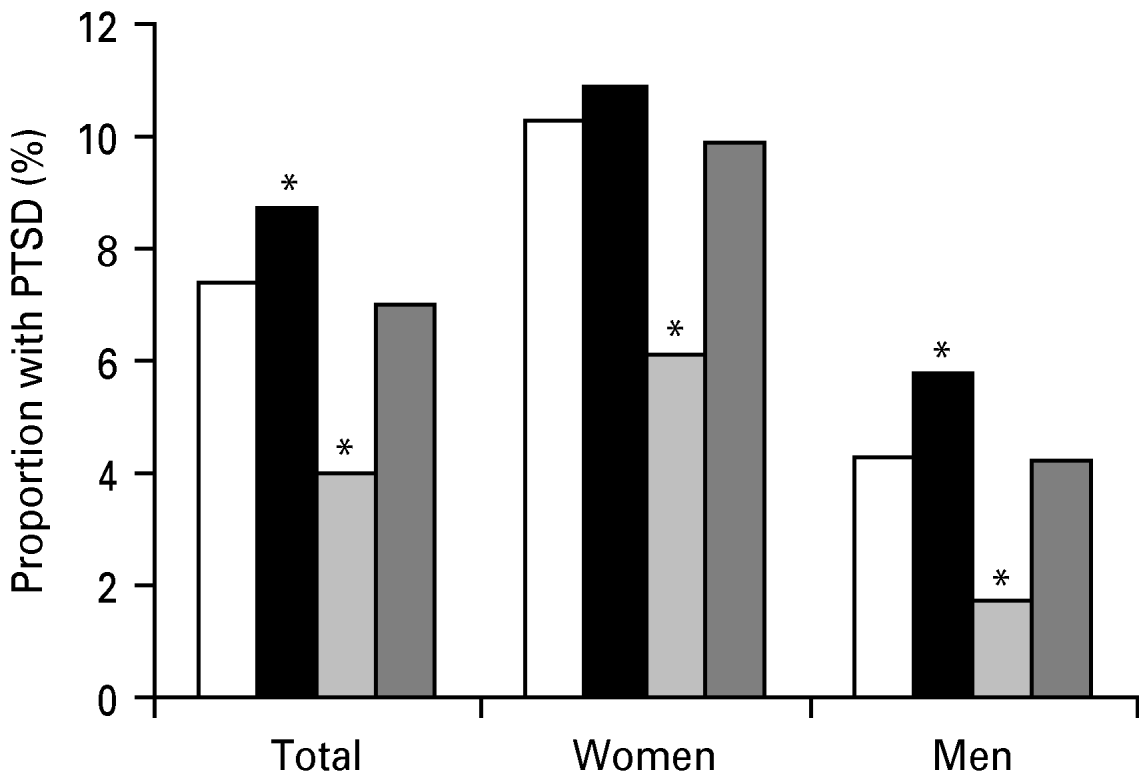
The NESARC wave 2 sample was 58.2% White, 19.0% Black, 2.8% Asian and 18.4% Hispanic. The lifetime prevalence of PTSD in the population was 7.3 [standard error (s.e.)=0.2]%. Blacks had significantly higher prevalence of PTSD than Whites [8.7 (s.e.=0.5)% v. 7.4 (s.e.=0.2)%, p=0.03], Hispanics [7.0 (s.e.=0.5)%, p=0.55] had a similar prevalence as Whites, and Asians had significantly lower prevalence [4.0 (s.e.=0.7)%, p=0.001] (Fig. 1).
Lifetime prevalence of post-traumatic stress disorder (PTSD) in non-institutionalized US residents, 2004–2005, by race/ethnicity (n=34 075). □, White, non-Hispanic; ▪, Black, non-Hispanic;  , Asian/Hawaiian/Pacific Islander, non-Hispanic;
 , Hispanic. * Significantly different from White, non-Hispanic (p<0.05).

Prevalence of exposure to traumatic events
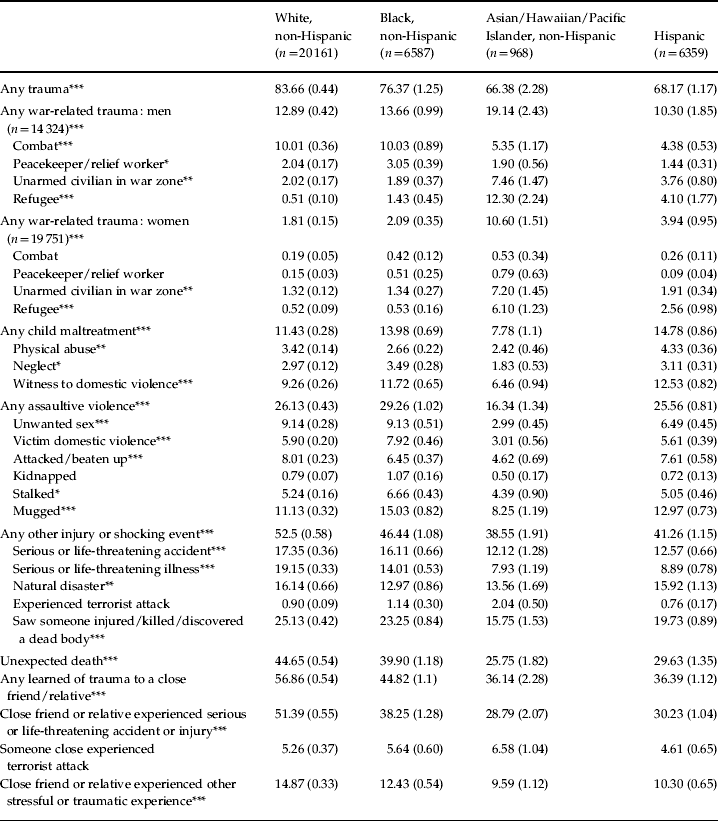
Table 1 presents the lifetime prevalence of exposure to each of the six categories and individual events by race/ethnicity. Whites had significantly higher exposure to any event, other injury or shocking event, learning of trauma to a close friend or relative, and learning of an unexpected death, compared with Blacks, Asians, or Hispanics. However, Hispanics and Blacks had significantly higher exposure to child maltreatment compared with Whites, due primarily to higher rates of witnessing domestic violence. Blacks also had significantly higher exposure to assaultive violence than Whites. Asian men and women had the highest rates for war-related events of the four race/ethnic groups, with 19.1% of men and 10.6% of women reporting an event. Compared with Whites, Asian men reported significantly higher prevalence of having been a refugee (12.3% v. 0.5%) or having been a civilian in a war zone (7.5% v. 2.0%), but lower prevalences of combat exposure (5.4% v. 12.9%). Asian women, like Asian men, had far higher rates than Whites of having been a refugee or having been a civilian in a war zone. For every major event category except war-related events, Asians had the lowest exposure of the four race/ethnic groups.
Lifetime exposure to potentially traumatic events by race/ethnicity: non-institutionalized US residents (n=34 075)
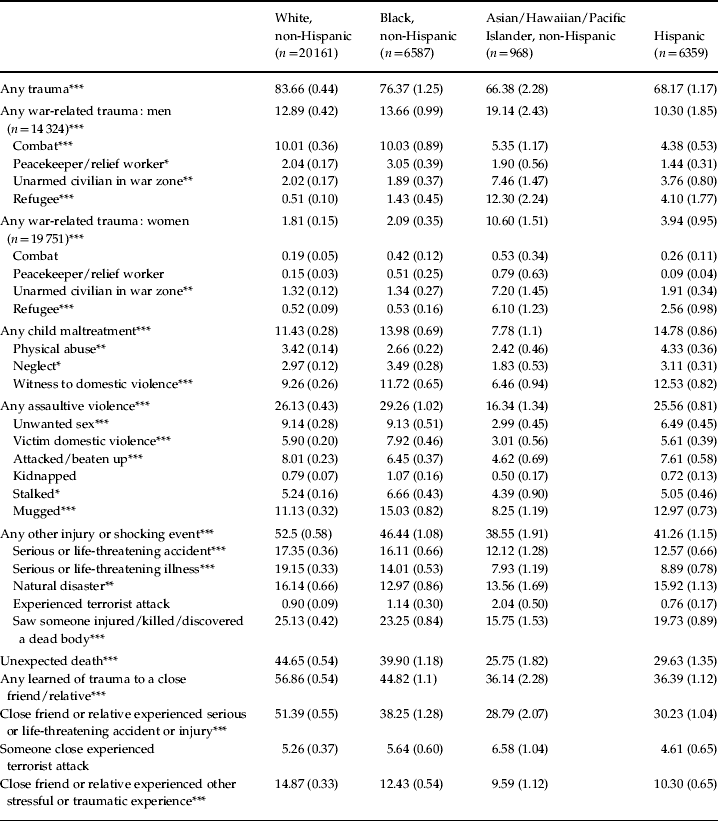
Values are given as percentage (standard error).
Significant difference for prevalence of traumatic event between race/ethnic groups, evaluated with a Cochran Mantel–Haenszel Wald F test:
* p<0.05, ** p<0.01, *** p<0.001.
Risk of exposure to traumatic events
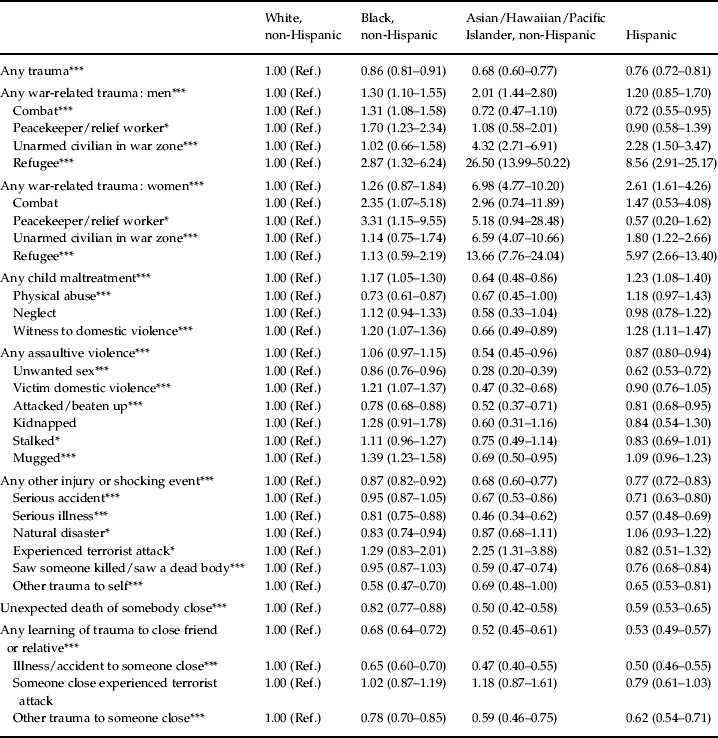
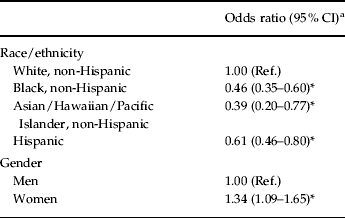
Table 2 presents results of the discrete time survival models predicting exposure to traumatic events adjusted for gender and age at interview. Blacks, Asians, and Hispanics had lower risk than Whites for any event, learning of trauma to a close friend or relative, learning of an unexpected death, and other injury or shocking event. Asians and Hispanics also had lower risk of assaultive violence than Whites. However, Hispanics and Blacks had significantly higher risk of child maltreatment than Whites. Risk for war-related events was substantially higher for both Asian men and women than for White men and women. Black men and Hispanic women also had higher risk for war-related events than Whites.
Survival models for risk of potentially traumatic event by race/ethnicity: non-institutionalized US residents, adjusted for gender and age at interview (n=34 075)

Values are given as odds ratio (95% confidence interval).
Significant difference for prevalence of traumatic event between race/ethnic groups, evaluated with a Cochran Mantel–Haenszel Wald F test:
* p<0.05, ** p<0.01, *** p<0.001.
Development of PTSD conditional on exposure to a traumatic event
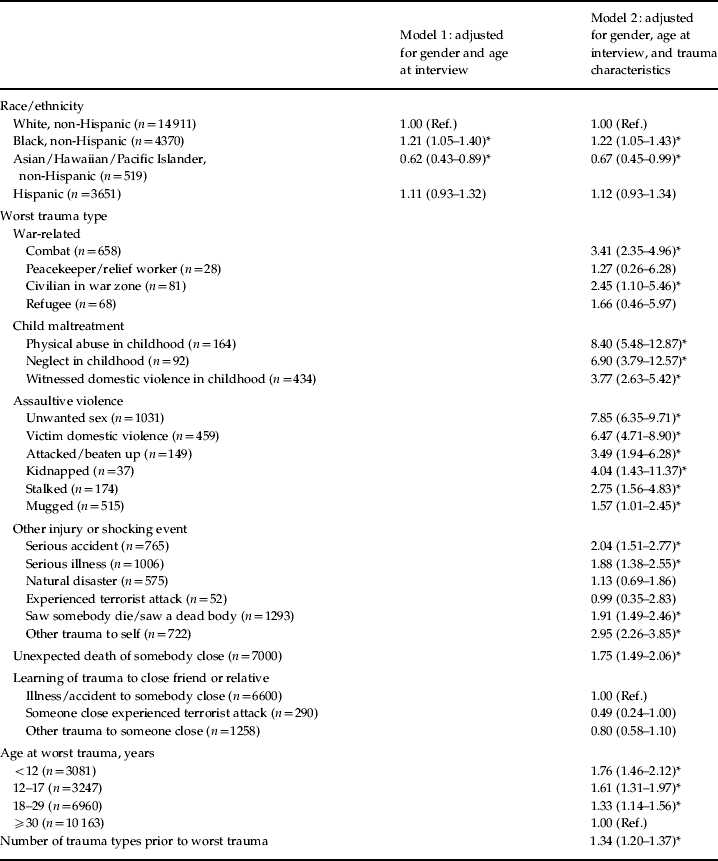
Table 3 presents the risk of developing PTSD among people exposed to a traumatic event. Among people experiencing an event (n=27 147), 9.1 (s.e.=0.2)% developed PTSD (n=2768). Similar to lifetime prevalences presented in Fig. 1, conditional risk of developing PTSD was significantly higher for Blacks, statistically equivalent for Hispanics, and lower for Asians compared with Whites, in a model adjusting for gender and age at interview. However, the excess PTSD risk for Blacks compared with Whites was small (adjusted odds ratio=1.21 v. 1.00). Race/ethnic groups differed significantly in some characteristics of exposure to potentially traumatic events, including worst event type [Wald F(15)=3.97, p=0.0000], and age at worst event [Wald F(12)=3.16, p=0.001], but not number of prior trauma types. Each of these factors was also significantly related to the probability of developing PTSD in a model adjusting for the other factors, race/ethnicity and gender (Table 3, model 2). However, characteristics of trauma exposure did not account for the relationship between race/ethnicity and conditional risk of PTSD once exposed to an event.
Logistic regression models of development of post-traumatic stress disorder among people exposed to a traumatic event: non-institutionalized US residents (n=27 147)

Values are given as adjusted odds ratio (95% confidence interval).
* Statistically significantly different from Ref. group (p<0.05).
Race/ethnic differences in treatment-seeking for PTSD
Among people with PTSD, a significantly lower percentage of all race/ethnic minority groups received treatment for PTSD symptoms in the form of visiting a doctor, counselor, or hospital than Whites, unadjusted for other factors, with 53.3 (s.e.=1.5)% of Whites receiving treatment, but only 35.3 (s.e.=2.6)% of Blacks, 42.0 (s.e.=2.9)% of Hispanics and 32.7 (s.e.=7.1)% of Asians. Table 4 presents logistic regression models for treatment-seeking, adjusted for gender and age at interview. Blacks, Asians and Hispanics were significantly less likely to receive treatment for PTSD symptoms than Whites in adjusted models.
Logistic models for receipt of treatment among people with post-traumatic stress disorder by race/ethnicity

CI, Confidence interval.
a Adjusted for gender and age at interview.
* Statistically different from reference group (p<0.05, Wald χ2).
Discussion
In this national survey, we found marked racial/ethnic differences in lifetime risk of PTSD and treatment-seeking for PTSD symptoms. Specifically, we found that Blacks had higher lifetime prevalence of PTSD (8.7%) and Asians (4.0%) considerably lower prevalence than Whites (7.4%). After partitioning risk of PTSD into (1) risk of exposure to potentially traumatic events, and (2) risk of developing PTSD once exposed to an event, we found that Asians had both lower risk of exposure to any traumatic event and lower risk of developing PTSD once exposed, compared with Whites. In contrast, although Blacks had lower rates of exposure to any traumatic event, their risk of developing PTSD once exposed was slightly higher than Whites.
Our finding that Asians were at lower risk for the development of PTSD once exposed to a potentially traumatic event, and that Blacks were at higher risk, has not been found in prior studies of specific events (Vogel & Marshall, Reference Vogel and Marshall2001; Adams & Boscarino, Reference Adams and Boscarino2005; Alim et al. Reference Alim, Charney and Mellman2006) or in non-representative samples from specific geographic areas (Breslau et al. Reference Breslau, Davis, Andreski and Peterson1991, Reference Breslau, Wilcox, Storr, Lucia and Anthony2004 b). Prior studies with smaller sample sizes may have lacked the power to detect the modest difference we found in conditional risk of developing PTSD for Blacks compared with Whites (Norris, Reference Norris1992; Vogel & Marshall, Reference Vogel and Marshall2001). Moreover, many prior studies were restricted by socio-economic status, geography, or other factors; therefore their findings may not reflect national circumstances (Breslau et al. Reference Breslau, Davis, Andreski and Peterson1991; Norris, Reference Norris1992; Vogel & Marshall, Reference Vogel and Marshall2001). The characteristics of exposure to potentially traumatic events that we examined (e.g. worst event type, age at worst event, and number of prior traumatic events) did not explain race/ethnic differences in conditional risk of PTSD.
Different patterns of adverse experiences outside of the events examined here, or protective factors among race/ethnic groups, may explain the differences that we found in risk of PTSD (Loo et al. Reference Loo, Ueda and Morton2007; Ellis et al. Reference Ellis, MacDonald, Lincoln and Cabral2008; Williams et al. Reference Williams, Neighbors and Jackson2008). For example, perceived discrimination, race-related verbal assault and racial stigmatization have been linked to PTSD symptoms and may partially account for the higher conditional risk of PTSD among Blacks (Loo, Reference Loo1994; Loo et al. Reference Loo, Fairbank and Chemtob2005; Ellis et al. Reference Ellis, MacDonald, Lincoln and Cabral2008). In contrast, higher socio-economic status has been found to reduce the conditional risk of developing PTSD (Brewin et al. Reference Brewin, Andrews and Valentine2000; Koenen et al. Reference Koenen, Harley, Lyons, Wolfe, Simpson, Goldberg, Eisen and Tsuang2002; Dohrenwend et al. Reference Dohrenwend, Turner, Turse, Lewis-Fernandez and Yager2008); thus higher educational attainment and higher income among Asians, and lower educational attainment and income among Blacks, may contribute to those race/ethnicities' respective risks of developing PTSD (Stoops, Reference Stoops2004; DeNavas-Walt et al. Reference DeNavas-Walt, Proctor and Smith2008). Finally, pre-existing anxiety and depression have been linked to higher conditional risk of PTSD (Breslau et al. Reference Breslau, Davis, Andreski and Peterson1991, Reference Breslau, Davis, Peterson and Schultz1997; Hapke et al. Reference Hapke, Schumann, Rumpf, John and Meyer2006), and epidemiologic research suggests that Asian Americans may have lower prevalence of these illnesses than Whites (Harris et al. Reference Harris, Edlund and Larson2005). However, Blacks also have lower reported rates of anxiety and depression than Whites, yet we found elevated conditional risk of PTSD among Blacks compared with Whites (Breslau et al. Reference Breslau, Aguilar-Gaxiola, Kendler, Su, Williams and Kessler2006 a; Himle et al. Reference Himle, Baser, Taylor, Campbell and Jackson2009). These explanatory factors would best be explored in prospective longitudinal studies, given that prior PTSD is associated with subsequent anxiety, depression and decreased socio-economic attainment (Breslau et al. Reference Breslau, Davis, Peterson and Schultz1997; Jayakody et al. Reference Jayakody, Danziger and Kessler1998; Perkonigg et al. Reference Perkonigg, Pfister, Stein, Hofler, Lieb, Maercker and Wittchen2005; Copeland et al. Reference Copeland, Keeler, Angold and Costello2007).
Minorities reported lower exposure to any potentially traumatic event, learning of a trauma to a close friend or relative, learning of an unexpected death, and other traumatic events compared with Whites. Furthermore, they had lower risk of experiencing unwanted sex, an event that was both fairly common and carried an extremely elevated risk of developing PTSD. However, among two of the event groups with the highest risk of development of PTSD, war-related events and child maltreatment, minority groups experienced some higher risks. Blacks and Hispanics had higher risk of witnessing domestic violence as children, Blacks had higher risk of active combat, and Asians had higher risk of having been a civilian in a war zone than Whites.
Our findings that Blacks experienced higher levels of violent victimization and Asians had substantially lower levels compared with Whites are supported by The US Department of Justice's National Crime Victimization Survey, an annual survey of crime victimization (Rand, Reference Rand2008; Harrell, Reference Harrell2009). We could find no studies comparing rates of other event exposures in Asians with Whites in a US general population, although a study of pregnant women found significantly lower prevalence of emotional stressors, such as loss of a loved one, in Asians compared with Whites (Lu & Chen, Reference Lu and Chen2004).
Our finding that Blacks in the USA have the same or lower exposure than Whites to unexpected deaths and traumas to friends and relatives is counterintuitive, given that Blacks experience higher mortality and higher crime victimization rates than Whites (Williams & Jackson, Reference Williams and Jackson2005; Harrell, Reference Harrell2007). However, two regional studies found Blacks at lower risk for some events: Breslau found Blacks had lower exposure to learning of a trauma to a close friend or relative (Breslau et al. Reference Breslau, Wilcox, Storr, Lucia and Anthony2004 b), and Norris found that lifetime exposure to any event, physical assault, tragic death, and disaster other than fire were lower for Blacks than for Whites (Norris, Reference Norris1992). However, several other regional studies have found no difference between Whites and Blacks in exposure to most event types (Norris, Reference Norris1992; Breslau et al. Reference Breslau, Davis and Andreski1995, Reference Breslau, Kessler, Chilcoat, Schultz, Davis and Andreski1998, Reference Breslau, Wilcox, Storr, Lucia and Anthony2004 b).
Asians' lower risk for exposure to all types of potentially traumatic events other than war-related events, compared with other race/ethnic groups, may be related to their relatively higher socio-economic status and lower rates of certain behavioral and substance problems (Stoops, Reference Stoops2004; DeNavas-Walt et al. Reference DeNavas-Walt, Proctor and Smith2008). High socio-economic status, including high education, high income and high maternal education are linked with lower exposure to assault, witnessing violence, and emotional abuse in childhood, and serious illness, traffic accidents, and any trauma (Hasselberg et al. Reference Hasselberg, Laflamme and Weitoft2001; Finkelhor et al. Reference Finkelhor, Ormrod, Turner and Hamby2005, Reference Finkelhor, Ormrod and Turner2007; Breslau et al. Reference Breslau, Lucia and Alvarado2006 b; Todd et al. Reference Todd, Armon, Griggs, Poole and Berman2006). However, Whites experienced higher risk for any traumatic event although they have higher average income and educational attainment than both Blacks and Hispanics in the USA (Stoops, Reference Stoops2004; DeNavas-Walt et al. Reference DeNavas-Walt, Proctor and Smith2008). Conduct disorder, hyperactivity, aggression and anti-social behavior have also been linked prospectively to greater exposure to potentially traumatic events (Koenen et al. Reference Koenen, Fu, Lyons, Toomey, Goldberg, Eisen, True and Ming2005, Reference Koenen, Moffitt, Poulton, Martin and Caspi2007; Breslau et al. Reference Breslau, Lucia and Alvarado2006 b; Storr et al. Reference Storr, Ialongo, Anthony and Breslau2007), mediated in part through alcohol and drug abuse (Koenen et al. Reference Koenen, Fu, Lyons, Toomey, Goldberg, Eisen, True and Ming2005). Asians have significantly lower rates of conduct disorder and substance dependence than Whites (Sakai et al. Reference Sakai, Ho, Shore, Risk and Price2005, Reference Sakai, Risk, Tanaka and Price2008), possibly further contributing to their lower risk of exposure to potentially traumatic events.
Minorities in this study had substantially lower odds of treatment-seeking for their PTSD-related symptoms than Whites, which agrees with findings from prior studies of mental illnesses (Wang et al. Reference Wang, Lane, Olfson, Pincus, Wells and Kessler2005; Huang et al. Reference Huang, Wong, Ronzio and Yu2007; Ta et al. Reference Ta, Juon, Gielen, Steinwachs and Duggan2008). Explanations for why race/ethnic minorities receive treatment less frequently than Whites vary by race/ethnic group, and include: shared group perceptions that mental illness is highly stigmatizing (Yamashiro & Matsuoka, Reference Yamashiro and Matsuoka1997); reluctance to seek help outside the family except in extreme circumstances (Yamashiro & Matsuoka, Reference Yamashiro and Matsuoka1997); mistrust of physicians (Alim et al. Reference Alim, Charney and Mellman2006); perception of racial or ethnic bias in care providers (Johnson et al. Reference Johnson, Saha, Arbelaez, Beach and Cooper2004); and reduced access to general- and mental-health facilities due to residence in poverty areas (Chow et al. Reference Chow, Jaffee and Snowden2003). Health professionals must continue to work to remove stigma from mental illness, particularly among minority groups, and to reduce minorities' barriers to mental health care.
Limitations
Current findings should be interpreted in the context of three notable limitations. First, this study relies on retrospective reporting of traumatic event exposure, PTSD symptoms and treatment-seeking for PTSD. Retrospective reporting results in lower prevalence estimates of events and illness than repeated contemporaneous reporting (Brewin et al. Reference Brewin, Andrews and Gotlib1993; Kruijshaar et al. Reference Kruijshaar, Barendregt, Vos, de Graaf, Spijker and Andrews2005; Moffitt et al. Reference Moffitt, Caspi, Taylor, Kokaua, Milne, Polanczyk and Poulton2009). However, reduced prevalences due to retrospective reports are unlikely to operate differentially across racial and ethnic groups to produce the differences reported here. Second, cultural differences between race/ethnic groups in willingness to disclose stigmatizing events, such as child maltreatment and sexual assault, may introduce bias (Zhai & Gao, Reference Zhai and Gao2009). Such bias could account for, in part, Asians' lower prevalences of trauma exposure for most events. However, US national data indicate that rates of reporting crimes to police are similar among race/ethnic groups for most types of crime (Harrell, Reference Harrell2009). Third, we used broad categories of race/ethnicity as defined by the US Census. Recent work on other mental disorders has found significant differences within race/ethnic groups based on age, gender, education, immigrant status, country of origin and length of stay in the USA (Dawson, Reference Dawson1998; Ortega et al. Reference Ortega, Rosenheck, Alegria and Desai2000; Alegria et al. Reference Alegria, Canino, Stinson and Grant2006, Reference Alegria, Canino, Shrout, Woo, Duan, Vila, Torres, Chen and Meng2008; Breslau et al. Reference Breslau, Aguilar-Gaxiola, Kendler, Su, Williams and Kessler2006 a; Breslau & Chang, Reference Breslau and Chang2006; Huang et al. Reference Huang, Wong, Ronzio and Yu2007; Takeuchi et al. Reference Takeuchi, Zane, Hong, Chae, Gong, Gee, Walton, Sue and Alegria2007). Future research needs to examine the ways in which the distribution of trauma exposure and PTSD varies within racial groups by ethnic background, nativity status, length of stay in the USA, and ancestry.
Acknowledgements
The National Epidemiologic Survey on Alcohol and Related Conditions (NESARC) is funded by the National Institute on Alcohol Abuse and Alcoholism (NIAAA) with supplemental support from the National Institute on Drug Abuse (NIDA). A. L. R. was supported by the Harvard Training Program in Psychiatric Genetics and Translational Research no. T32MH017119. K. C. K. was supported by US National Institutes of Health grant no. K08MH070627 and grant no. 5R01MH078928. J. B. was supported by National Institute of Mental Health grant no. MH082023. S. E. G. was supported by National Institutes of Health grant no. RO3DA20887. N. B. was supported by National Institute of Mental Health grant no. MH71395.
Declaration of Interest
None.