Introduction
Temperature is one of the most important factors affecting both evolution and distribution of ectothermic species (Huey and Kingsolver, Reference Huey and Kingsolver1993; Bowler and Terblanche, Reference Bowler and Terblanche2008; Dillon et al., Reference Dillon, Wang, Garrity and Huey2009). This factor is characterized by both spatial and temporal variations. As a result, organisms are frequently exposed to extreme temperatures (Krebs and Loeschcke, Reference Krebs and Loeschcke1994b; Hoffmann, Reference Hoffmann2010). To respond to this variation, ectothermic organisms, such as insects, have developed several mechanisms to tolerate stressful temperatures. Thus, thermal tolerance becomes a very important trait for their evolution (Randall et al., Reference Randall, Burggren and French1998; Neven, Reference Neven2000; Johnson et al., Reference Johnson, Cockerell, Carrington, Rako, Hoffmann and McKechnie2009). In insects, this topic has been widely studied in Drosophila species (Hoffmann et al., Reference Hoffmann, Sørensen and Loeschcke2003). Correlations have been found between upper and lower thermal tolerance limits with latitudinal (Magiafoglou and Hoffmann, Reference Magiafoglou and Hoffmann2003; Overgaard and Sørensen, Reference Overgaard and Sørensen2008), altitudinal (Rashkovetsky et al., Reference Rashkovetsky, Iliadi, Michalak, Lupu, Nevo, Feder and Korol2006) or regional climatic distribution (Hill et al., Reference Hill, Chown and Hoffmann2013).
In non-model ectodermic species, thermal adaptation is not well understood. However, there is increasing evidence of variation in thermal responses for some species including butterflies (Lycaena tityrus) (Karl et al., 2009), leaf beetles (Chrysomela aeneicollis) (Neargarder et al., Reference Neargarder, Dahlhoff and Rank2003), springtails (Orchesella cincta) (Bahrndorff et al., Reference Bahrndorff, Holmstrup, Petersen and Loeschcke2006), mosquitoes (Aedes albopictus) (Lounibos et al., Reference Lounibos, Escher and Lourenço-De-Oliveira2003) and others. In this study, we consider the whitefly Bemisia tabaci (Gennadius) (Hemiptera: Aleyrodidae), an invasive species in the tropics. This complex of species is rarely considered in these types of comparisons, where thermal resistance is particularly important to overcome heat stress consequences, given the insect's small size (high superficial/volume ratio) and low mobility of the immature stages (Perring, Reference Perring2001).
Bemisia tabaci is a widespread invasive species found in tropical and subtropical zones. It is considered to be one of the most important agricultural pests in the world (Oliveira et al., Reference Oliveira, Henneberry and Anderson2001; Perring, Reference Perring2001; Cuéllar and Morales, Reference Cuéllar and Morales2006; Wan et al., Reference Wan, Zhang, Liu, Luo, Chu, Zhang, Zang, Jiu, Lü, Cui, Zhang, Zhang, Zhang, Liu, Liang, Lei and Zhang2009), having extended to all continents (except Antarctica). The whitefly is polyphagous on over 1000 host plant species (Abd-Rabou and Simmons, 2014). Because there are several biotypes (Oliveira et al., Reference Oliveira, Henneberry and Anderson2001; Perring, Reference Perring2001) and/or cryptic species composing the B. tabaci complex, we used MEAM 1 (Middle East-Asia Minor 1) clade to refer to the invasive species previously known as biotype B, based on phylogenetic analyses (De Barro et al., Reference De Barro, Liu, Boykin and Dinsdale2011). This species is highly distributed and proliferates in geographic zones characterized by short periods of extremely high temperatures, withstanding environmental temperatures of up to 42 °C (Oliveira et al., Reference Oliveira, Henneberry and Anderson2001; Perring, Reference Perring2001).
Several studies have been conducted on thermal responses in B. tabaci (MEAM 1). Variations have been found in life-history traits related to temperature such as survival, longevity, fecundity, viability and development time, showing that B. tabaci can survive and reproduce even after heat shocks done at 45 °C (Cui et al., Reference Cui, Wan, Xie and Liu2008a, b; Elbaz et al., Reference Elbaz, Weiser and Morin2011; Muñoz-Valencia et al., Reference Muñoz-Valencia, Díaz-González, Del Rosario Manzano-Martínez, Toro-Perea and Cárdenas-Henao2013). This great tolerance is higher than that of Trialeurodes vaporariorum (Westwood) (Hemiptera: Aleyrodidae), another widespread whitefly species (Cui et al., Reference Cui, Wan, Xie and Liu2008a, b; Wan et al., Reference Wan, Xie and Cui2008).
So far, only the native NW 1 (New World 1, previously known as biotype A) and MEAM 1 have been reported in Colombia (Quintero et al., Reference Quintero, Rendón, García, Cardona, López Avila and Hernández2001; Rodríguez and Cardona, Reference Rodríguez and Cardona2001; Rodríguez et al., Reference Rodríguez, Morales, Bueno and Cardona2005). The species MEAM 1 of B. tabaci was detected invading the coastal Caribbean region of Colombia in 1995 (Quintero et al., Reference Quintero, Cardona, Ramírez and Jiménez1998; Quintero et al., Reference Quintero, Rendón, García, Cardona, López Avila and Hernández2001). Then, this species expanded to the Southwest region of Colombia (Valle del Cauca) between 1997 and 2003. The native NW 1 (biotype A) (De Barro et al., Reference De Barro, Liu, Boykin and Dinsdale2011) and the other agriculturally important whitefly, T. vaporariorum, were displaced from some localities as a result of this expansion (Rodríguez et al., Reference Rodríguez, Morales, Bueno and Cardona2005). Since the invasion by MEAM 1 species of B. tabaci, evidence of genetic differentiation for thermal responses among their populations in Colombia has been found (Díaz et al., Reference Díaz, Muñoz-Valencia, Juvinao-Quintero, Manzano-Martínez, Toro-Perea, Cárdenas-Henao and Hoffmann2014b). These responses were evaluated for the upper thermal limits, so there is no information about population variation and thermal responses under heat shocks below those limits or thermal reaction norms.
Thermal performance can be graphically represented as a reaction norm, a curve showing how the phenotypic value of a trait changes for a given genotype (Gupta and Lewontin, Reference Gupta and Lewontin1982; Schlichting and Pigliucci, Reference Schlichting and Pigliucci1998). At the population level, reaction norms can be useful in predicting the genetic base of the phenotypic differences among populations (Hutchings et al., Reference Hutchings, Swain, Rowe, Eddington, Puvanendran and Brown2007).
Here, we considered two whitefly populations that have diverged for thermal responses under temperature limits performed at 45 °C (Díaz et al., Reference Díaz, Muñoz-Valencia, Juvinao-Quintero, Manzano-Martínez, Toro-Perea, Cárdenas-Henao and Hoffmann2014b) in order to assess the thermal reaction norm below those limits. These populations are located in two different regions in Colombia: the Caribbean region with high thermal temperature and the Southwest region with lower thermal temperature. We assessed thermal responses using life-history traits involved in fitness – survival, fecundity and viability of the offspring – in response to 1 h heat shocks ranging from 37 to 44 °C.
Materials and methods
Collection and breeding of Bemisia tabaci
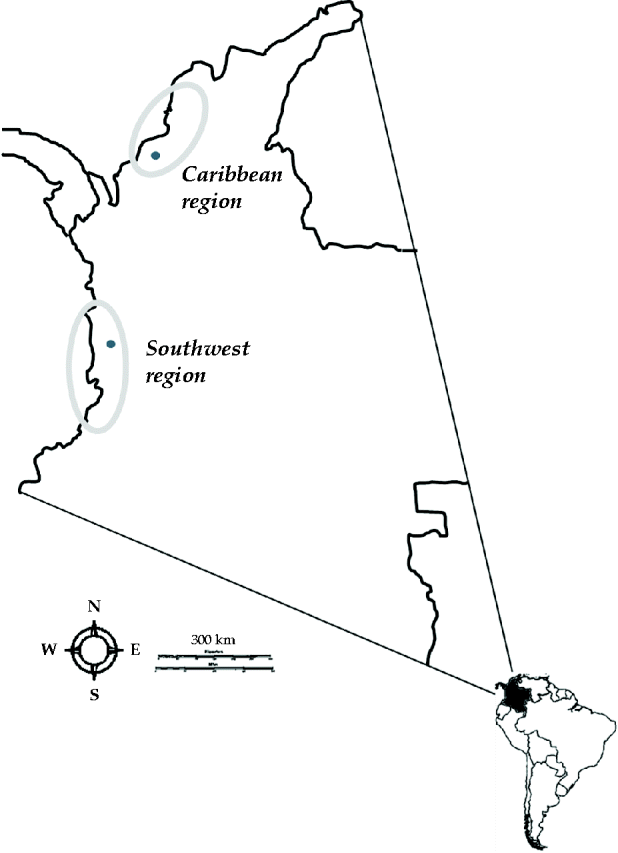
Bemisia tabaci nymphs were collected in eggplant (Solanum melongena) crops from Retiro de los Indios (RIN), Córdoba state (08°51′N, 75°48′W) in the Caribbean region (30 m above the sea level (masl)), and cucumber (Cucumis sativus) and green bean (Phaseolus vulgaris) crops from Cajamarca (CAJ), Valle del Cauca state (04°31′N, 76°14′W) in the Southwest region (1500 masl) of Colombia (Fig. 1). These two regions are separated by 480 km. Whiteflies were sampled in March 2011 in the Southwest region, and in September 2011 in the Caribbean region. Whiteflies in the sampled locations were identified as MEAM 1 clade (or biotype B) of the B. tabaci complex using mitochondrial Cytochrome Oxidase I (COI) gene sequences described by De Barro et al. (Reference De Barro, Liu, Boykin and Dinsdale2011) and Shatters et al. (Reference Shatters, Powell, Boykin, Liansheng and McKenzie2009) (see Díaz et al. Reference Díaz, Endersby and Hoffmann(2014a) for details of the COI identification of species).
Map showing the location of RIN in the Caribbean region and CAJ in the Southwest region of Colombia. Locations are indicated within the zones of the regions where adaptive differentiation was previously detected for tolerance to upper thermal limits in the whitefly B. tabaci (see Introduction section).

Leaves with nymphs were brought to the laboratory, where they continued their development until adults on P. vulgaris (ICA-Pijao) bean, under controlled laboratory conditions (65% relative humidity, 25 °C and 12 h light photoperiod). Whiteflies were always maintained on the same host plant P. vulgaris (ICA-Pijao) and heat shock experiments were conducted after the third generation in order to generate sufficient insects for the experiments and to avoid field-related maternal effects (such as host plants).
Heat shock experiments
Bemisia tabaci adults were subjected to 1 h heat shocks at five different temperatures (37, 39, 41, 43 and 44 °C), using 25 °C as a control, after Cui et al. Reference Cui, Xie and Wan(2008b) and Muñoz-Valencia et al. (Reference Muñoz-Valencia, Díaz-González, Del Rosario Manzano-Martínez, Toro-Perea and Cárdenas-Henao2013). For this, treatments were applied in a climatic chamber (MLR 351H; Sanyo Electric Company, Limited) and relative humidity was controlled at nearly 65% for all heat shocks performed. Adult whiteflies (1–24 h post-emergence) were confined in plastic vials covered with netting (2.0 × 0.5 cm diameter) and subjected to heat shocks for 1 h. A 3 h recovery time was permitted at 25 °C after the heat shock treatments, after which three life-history traits involved in fitness were measured: survival, fecundity and viability.
Survival
The number of surviving individuals was counted for groups of 20 adults (10 females and 10 males). Survival was determined by considering individuals with the capacity to support themselves and, hence, with the potential to reproduce. Five replicates of 20 adults were done for each heat shock treatment.
Fecundity
Pairs of whiteflies (male and female) from the survival tests were confined in clamp cages (1 cm3) on the underside of P. vulgaris (ICA-Pijao) leaves at 25 °C. Each pair was examined daily for 7 days. Not all females survived the 7-day period, in which case time to death post-heat shock (in days) was recorded. (All unstressed controls at 25 °C survived after the 7-day period.) The live adults were removed, and the eggs oviposited by each female were counted. Seven replicates were done for each heat shock treatment.
Viability
Groups of 20 eggs oviposited by all the females during the fecundity tests were used. Nymphs were counted 20 days post-heat shock (13 days after oviposition). Between 5 and 18 replicates were made for each heat shock treatment.
Statistical analyses
Survival and viability data were analysed using a generalized linear model with a logit link function performing a three-factor ANOVA: populations (CAJ and RIN), heat shock treatment and sex (in the case of survival). Post-heat shock fecundity was analysed using a general linear model because this trait followed a normal distribution and homogeneity of variances according to Kolmogorov–Smirnov and Bartlett tests. Because this trait is closely linked to the physiological state of the parental post-heat shocks (Scott et al., Reference Scott, Berrigan and Hoffmann1997), which is reflected in their post-heat shock longevity, the analysis was done in two ways: using parental longevity post-heat shocks as a covariable for an ANCOVA, and not considering this variable in an ANOVA with population and heat shock temperature as factors. When the ANOVA showed significant differences in at least one of the factors evaluated, a post-ANOVA by planned comparisons was made using linear contrasts to discriminate the differences among treatments. All analyses were done using the package GLIMMIX for SAS 9.2 and STATISTICA 8.0 (StatSoft, 2007) software.
Results
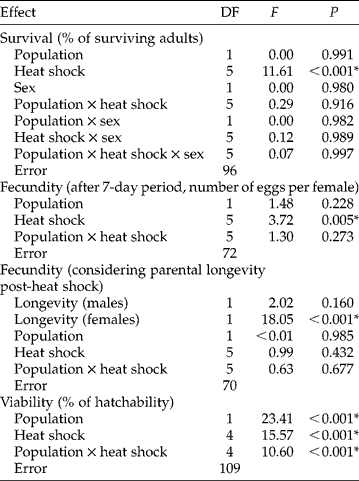
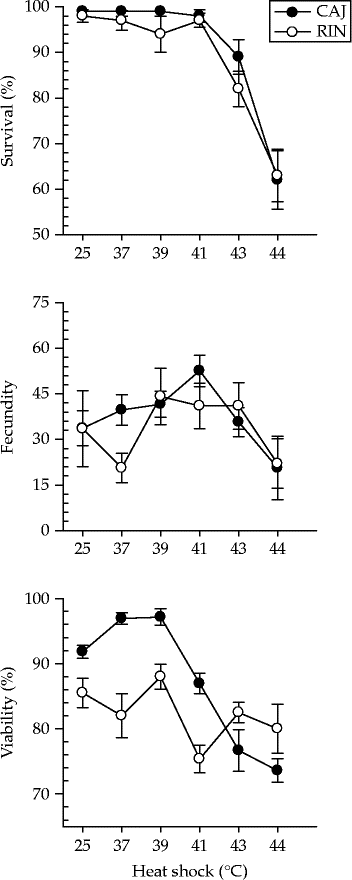
All traits (survival, fecundity and viability) showed a significant heat shock effect (Table 1). Survival decreased from nearly 100% at low temperatures to 62% at 44 °C as a result of this effect (Fig. 2). Fecundity after the 7-day period decreased from approximately 37 eggs per female at low temperatures to 21 eggs per female at 44 °C (Fig. 2). In this case, the heat shock effect was not detected after controlling for the parental longevity post-heat shocks (Table 1). This suggests that temperature does not affect daily fecundity at least during the post-heat shock period. This means that changes in this trait responded to heat shocks due to the oviposition time of the females as a prolonged effect of the heat shock treatment. Viability was the only trait showing significant population differences as well as a population × heat shock interaction effect (Table 1). This means that this trait performs differently between populations with respect to heat shocks. Viability for the Southwestern population decreased significantly from 87 to 74% at temperatures ranging from 41 to 44 °C, respectively (Fig. 2). For the Caribbean population, viability ranged from 74 to 88% for all the temperatures evaluated (Fig. 2), but no significant differences were noted among heat shock treatments. Linear contrasts also showed that viability was higher for CAJ than for RIN, but only at temperatures ranging from 25 to 41 °C. Then this relation changed, showing higher viability for the population from RIN at 43 and 44 °C (Fig. 2).
ANOVA for population and heat shock (1 h) effects on life-history traits of B. tabaci involved in fitness+
DF, degrees of freedom.
* Significant at P< 0.05.
+ Survival and viability were analysed using a generalized linear model, while fecundity was analysed using a general linear model (an ANCOVA was performed for considering parental longevity post-heat shocks).
Thermal reaction norms showing the effect of heat shocks (1 h) on three life-history traits of B. tabaci involved in fitness: survival (percentage of surviving adults), fecundity (number of eggs per female after a 7-day period) and viability (percentage of eggs hatch). Means and error bars ± standard errors are shown for each trait in the Southwest and Caribbean regions (CAJ and RIN) of Colombia. All traits were significantly affected for heat shocks (linear contrasts with P< 0.05), but population differences were found only for viability. Linear contrasts also showed that viability was higher for CAJ than for RIN at temperatures ranging from 25 to 41 °C, but was significantly lower at 43 and 44 °C (P< 0.05).
Discussion
Heat shock tolerance is an important trait for whitefly distribution and ecology, and MEAM 1 species (or biotype B) is particularly tolerant compared with other whiteflies such as T. vaporariorum (Cui et al., Reference Cui, Wan, Xie and Liu2008a, b). This pest's capacity to tolerate stress temperatures has been reported previously in various studies (Salvucci et al., Reference Salvucci, Stecher and Henneberry2000; Cui et al., Reference Cui, Wan, Xie and Liu2008a, b; Elbaz et al., Reference Elbaz, Weiser and Morin2011; Muñoz-Valencia et al., Reference Muñoz-Valencia, Díaz-González, Del Rosario Manzano-Martínez, Toro-Perea and Cárdenas-Henao2013). We selected two populations of this whitefly with known adaptive differentiation for upper thermal limits done at 45 °C (Díaz et al., Reference Díaz, Muñoz-Valencia, Juvinao-Quintero, Manzano-Martínez, Toro-Perea, Cárdenas-Henao and Hoffmann2014b) (as well as neutral genetic structure determined by microsatellites according to Díaz et al. Reference Díaz, Endersby and Hoffmann(2014a)), to determine whether this differentiation remains through the thermal reaction norm using temperatures below the upper thermal limits. We found population differentiation only for viability as a response to heat shocks. Survival and fecundity were affected by heat shocks, but no significant population differences were found for these traits. Fecundity was affected by the post-heat shock longevity of the ovipositing females rather than by their daily rate of oviposition, as was evident from the non-significant heat shock effect after controlling for the parental longevity post-heat shocks.
The MEAM 1 species was found for the first time in 1995 in the Caribbean and Southwest regions in Colombia (Quintero et al., Reference Quintero, Cardona, Ramírez and Jiménez1998; Quintero et al., Reference Quintero, Rendón, García, Cardona, López Avila and Hernández2001). Since then, the whitefly has diverged into upper thermal limits, and this differentiation detected for survival and fecundity was linked to local temperatures of populations (Díaz et al., Reference Díaz, Muñoz-Valencia, Juvinao-Quintero, Manzano-Martínez, Toro-Perea, Cárdenas-Henao and Hoffmann2014b). Although we did not find significant population differences for these traits, our results point to evolutionary changes in the thermal reaction norms in the offspring of heat shocked whiteflies. This was evident from the population and population × heat shock interaction effects in the viability of the offspring as a response to heat shocks. According to Delpuech et al. (Reference Delpuech, Moreteau, Chiche, Pla, Vouidibio and David1995) and Hutchings et al. (Reference Hutchings, Swain, Rowe, Eddington, Puvanendran and Brown2007), differences in reaction norms among genotypes or populations suggest differential adaptive changes.
The results for the Caribbean population were similar to those reported for B. tabaci population from Beijing (China) (Cui et al., Reference Cui, Xie and Wan2008b). Both locations could have much higher and constant temperature regimes than the Southwest region of Colombia, mainly because they are at sea level (RIN: 30 masl; Beijing: 55 masl), with mean temperatures up to 30 °C and maximum temperatures of 36 or 42 °C during day time (data for RIN taken in the field). The Southwestern population (1500 masl) is located at the upper altitudinal limit for the distribution of B. tabaci in Colombia, with a mean temperature of 20 °C and a maximum temperature of 26 °C (data taken in the field).
Viability after heat shocks performed at high temperatures (above 41 °C) appears to perform better for the population belonging to the Caribbean region. The reduction in fitness after survival for the Southwestern population suggests a negative effect of heat shock response at high temperatures. It may be a trade-off-like effect in the cost:benefit ratio of heat shock and fitness components (Scott et al., Reference Scott, Berrigan and Hoffmann1997) between populations. Physiological changes involved in the heat shock response such as heat shock protein expressions (Salvucci et al., Reference Salvucci, Stecher and Henneberry2000; Díaz, Reference Díaz2013) and synthesis of heat protection substances such as sorbitol (Wolfe et al., Reference Wolfe, Hendrix and Salvucci1998; Salvucci et al., Reference Salvucci, Hendrix and Wolfe1999; Salvucci, Reference Salvucci2000) have a high-energy investment. This could result in a trade-off where survival would occur, but fecundity and viability would be reduced (Parsell and Lindquist, Reference Parsell and Lindquist1993; Hoffmann, Reference Hoffmann1995; Yu and Wan, Reference Yu and Wan2009). Different types of trade-offs related to heat stress have been widely reported in insects such as Drosophila (Krebs and Loeschcke, Reference Krebs and Loeschcke1994a, b; Krebs and Feder, Reference Krebs and Feder1997). A similar trade-off was also reported when analysing tolerance to heat shocks between species of the B. tabaci complex. According to Elbaz et al. (Reference Elbaz, Weiser and Morin2011), MED species (Mediterranean, previously known as biotype Q) performs better at higher levels of heat stress, while the MEAM 1 does better at lower thermal conditions.
Although our results appear to be linked to climatic regions, it is also possible that fitness components are not explained only by temperature regimens. There are other environmental or evolutionary forces causing population differences for life-history traits. These populations are located in two regions with several differences such as host plants, topography and a distance of 480 km. Thus, different biotic, abiotic and regional factors, and historical processes such as isolation by distance can also contribute to the population differences detected in the fitness components (Lande, Reference Lande1991; Storz, Reference Storz2002). Moreover, adaptation to upper thermal limits detected previously using several populations per region (Díaz et al., Reference Díaz, Muñoz-Valencia, Juvinao-Quintero, Manzano-Martínez, Toro-Perea, Cárdenas-Henao and Hoffmann2014b) points to thermal adaptation to local temperatures of populations rather than regions.
Finally, we showed that adaptation under thermal limits does not involve similar responses throughout the complete reaction norm, as we showed for survival and fecundity in B. tabaci. We found population differences for the reaction norms of viability, suggesting a trade-off between these populations after 41 °C. These potential evolutionary changes help to explain the invasion of this pest in Colombia, particularly in the Southwest region. This also partly explains the displacement of T. vaporariorum and the NW 1 species of B. tabaci (biotype A), which has been observed in this region since 1997 (Quintero et al., Reference Quintero, Rendón, García, Cardona, López Avila and Hernández2001; Rodríguez et al., Reference Rodríguez, Morales, Bueno and Cardona2005). Potential ongoing displacement could increase and place crops for this region in danger, considering the spread of Begomoviruses by the MEAM 1 species of B. tabaci (Cuéllar and Morales, Reference Karl, Sørenson, Loeschcke and Fischer2006).
Acknowledgements
This research was financially supported by the Universidad del Valle (grant no. 7828). Fernando Díaz received a scholarship for PhD studies in Colombia from the Colombian Administrative Department of Science, Technology and Innovation (Colciencias). The authors thank the Molecular Biology and Ecogenetic Studies Team (Universidad del Valle), especially Biologists Diana L. Juvinao and Vanessa Muñoz, for their invaluable help with fieldwork; the Bean Entomology lab at the International Center for Tropical Agriculture (CIAT) in Colombia for providing P. vulgaris (ICA-Pijao) seeds and assistance with whitefly breeding; and the farmers for giving permission to collect the whitefly samples in their crops.