Introduction
Mesotrione is an herbicide registered for broad-spectrum control of broadleaf and grass weeds in multiple turfgrass species (Anonymous 2011; Brewer et al. Reference Brewer, Willis, Rana and Askew2017; Brosnan et al. Reference Brosnan, Armel, Klingeman, Breeden, Vargas and Flanagan2010; McElroy et al. Reference McElroy, Breeden and Sorochan2007; Tate et al. Reference Tate, Meyer, McCullough and Yu2019). For effective control of established weeds by mesotrione, initial herbicide application must be followed by a sequential application approximately 3 wk later (Anonymous 2011, 2018; Elmore et al. Reference Elmore, Brosnan, Breeden and Patton2013). Ideally, herbicide applications would provide desired results following a single treatment without the need of a sequential application.
Controlled-release (CR) formulations allow specific amounts of herbicide to be released over a given amount of time. Controlled release of herbicides also reduces the amount of leaching and offsite movement of herbicides (Collins et al. Reference Collins, Doglia, Mazak and Samulski1973; Galán-Jiménez et al. Reference Galán-Jiménez, Morillo, Bonnemoy, Mallet and Undabeytia2020; Prado et al. Reference Prado, Moura and Nunes2011). Schreiber et al. (Reference Schreiber, White, Wing, Trimnell and Shasha1988) reported that atrazine leaching was reduced using a CR starch granule. Similarly, Boydston (Reference Boydston1992) reported that 14C-norflurazon or 14C-simazine CR starch granule applications retarded the leaching depth of both herbicides compared to conventional applications. Other CR formulations have been tested using carriers such as organic and inorganic clays (Celis et al. Reference Celis, Hermosín, Carrizosa and Cornejo2002; Hermosin et al. Reference Hermosin, Calderón, Aguer and Cornejo2001), ethylcellulose (Sopeña et al. Reference Sopeña, Cabrera, Maqueda and Morillo2007), and zeolite and bentonite minerals modified with cetyltrimethylammonium surfactant (Shirvani et al. Reference Shirvani, Farajollahi, Bakhtiari and Ogunseitan2014). The pattern of herbicide release is related to particle size distribution, bead radius, polymer matrix, herbicide active ingredient, surface morphology, aqueous solubility, and lipophilicity of the herbicide or to the sorption of the herbicide to the clay mineral (Davis et al. Reference Davis, Wauchope, Johnson, Burgoa and Pepperman1996; Galán-Jiménez et al. Reference Galán-Jiménez, Morillo, Bonnemoy, Mallet and Undabeytia2020; Gerstl et al. Reference Gerstl, Nasser and Mingelgrin1998; Li et al. Reference Li, Li and Dong2008; Sopeña et al. Reference Sopeña, Cabrera, Maqueda and Morillo2005). Sulfur coating, in a urea fertilizer, for example, releases urea via diffusion in a two-stage process that is initially constant and rapid while urea is dissolving but then decreases logarithmically after all urea has dissolved (Jarrell and Boersma Reference Jarrell and Boersma1980). Similarly, in a study by Rashidzadeh et al. (Reference Rashidzadeh, Olad and Hejazi2017), 75% of paraquat was released from clinoptilolite clay in less than 48 h, whereas the same amount of release from montmorillonite clay took 168 h. Initial paraquat release in the first 24 h by both clay materials was at least 60%. Alginate polymer added to montmorillonite clay reduced the initial amount of paraquat released to as low as 40%, but total paraquat released after 60 d was only 55%. A sepiolite-based mesotrione CR formulation retained 65% of mesotrione after 96 h compared to only 29% retention of the commercial product and released mesotroine in a rate-descending pattern via controlled diffusion (Galán-Jiménez et al. Reference Galán-Jiménez, Morillo, Bonnemoy, Mallet and Undabeytia2020). Cumulative release of soil-applied fluometuron was 95% in 13 h from the commercial wettable granule formulation and was increased to 25 to 33 d using matrix granules on sequential solvent-extracted lignins (Zhao and Wilkins Reference Zhao and Wilkins2003). With bromacil, Zhao and Wilkins (Reference Zhao and Wilkins2000) demonstrated a release scenario from solvent-extracted lignins that was sigmoidal. Thus, examples of varied herbicide release scenarios of herbicides have been reported (Rashidzadeh et al. Reference Rashidzadeh, Olad and Hejazi2017; Zhao and Wilkins Reference Zhao and Wilkins2000, Reference Zhao and Wilkins2003). Given its dependency on sequential applications to improve weed control efficacy, mesotrione could be a candidate herbicide for CR liquid or granular formulations.
Generally, granular herbicides are less effective for POST weed control than foliar sprays (Duray and Davies Reference Duray and Davies1987; Koscelny and Peeper Reference Koscelny and Peeper1996). Granular herbicides have fewer points of contact with plant foliage or soil compared to foliar spray (Karnok Reference Karnok1986) and have limited opportunity to enter the plant through foliar absorption, especially when the foliage is dry. Foliar absorption can be enhanced by applying products when dew is present on foliage (Loughner and Nolting Reference Loughner and Nolting2010). Although performance can be enhanced by applying to wet foliage, root-and-shoot–absorbed herbicides are less dependent on foliar absorption and tend to dominate the granular herbicide market. Granular herbicides offer advantages, such as ease of application and reduced drift (Akobundu Reference Akobundu1981).
Mesotrione is absorbed by plant roots and foliage and possesses both PRE and POST herbicide activity (Anonymous 2011, 2018; Armel et al. Reference Armel, Wilson and Richardson2003; Elmore et al. Reference Elmore, Brosnan, Kopsell and Breeden2011; Mitchell et al. Reference Mitchell, Bartlett, Fraser, Hawkes, Holt, Townson and Wichert2001). Because of mesotrione’s soil activity, its applications are less dependent on leaf moisture for absorption. Although mesotrione is not dependent on leaf moisture for absorption, relative humidity will influence and increase turfgrass injury (Goddard et al. Reference Goddard, Willis and Askew2010; Gonçalves et al. Reference Gonçalves, Ricker and Askew2021). Goddard et al. (Reference Goddard, Askew, Willis, Keese and James2007) reported that dew presence at the time of application did not influence the control of dandelion or white clover by combination granules of mesotrione plus fertilizer in contrast to a dew-dependent granular product containing 2,4-D and MCPP.
Adapting CR technology for the production of a potential mesotrione formulation may reduce the number of applications needed to control undesirable weeds in turfgrass stands. Mesotrione would be an ideal candidate for CR liquid or granular formulations, because it is readily absorbed by foliage or roots. Therefore, the objectives of this study are to determine first the optimum mesotrione release scenario to maintain acceptable turfgrass tolerance and herbicide efficacy, and to determine further if initial application placement, to simulate foliar spray compared to granular products, affects herbicide efficacy.
Materials and Methods
Site Description and Plant Growing Conditions
Research was conducted at Virginia Tech Glade Road Research Facility (37.232017°N, 80.435746°W) at Blacksburg, VA in 2007 and 2008 to assess simulated-release scenarios that mimic a potential CR mesotrione formulation. Mature plugs of turf-type tall fescue (cv. ‘Falcon III’), nimblewill, and creeping bentgrass were taken from the field and thinned to two to three tillers. Smooth crabgrass, goosegrass, and white clover were seeded into trays for establishment. Seedlings were selected for two- to three-leaf stage crabgrass and goosegrass, and one fully expanded leaf for white clover. Plants were washed to remove any excess soil before being transplanted into 10- by 10-cm pots containing steam-sterilized sand and soil (50:50 v/v). Soil type was a Groseclose–Urban Land complex (Fine, mixed, semiactive, mesic, Typic Hapludults) with 1.8% organic matter and pH 6.6. Once transplanted, plants were irrigated as needed to maintain adequate growing conditions. Each pot was fertilized biweekly using water-soluble NPK (20-20-20) fertilizer (Peters Professional 20-20-20 General Purpose Water Soluble Fertilizer; The Scotts Company, 14111 Scottslawn Road, Marysville, OH 43041). Plants were allowed to acclimate in the greenhouse for 1 wk before treatments were initiated. Experiments were maintained at average temperatures of 22 C (±2 C) in a 12/12-h day/night photoperiod supplemented by mercury vapor bulbs (trial 1) and high-pressure sodium bulbs (trial 2) during the day to ensure a minimum light intensity of 300 and 500 µmol m–2 s–1 photosynthetically active radiation in trials 1 and 2, respectively.
Experimental Design and Chemical Treatments
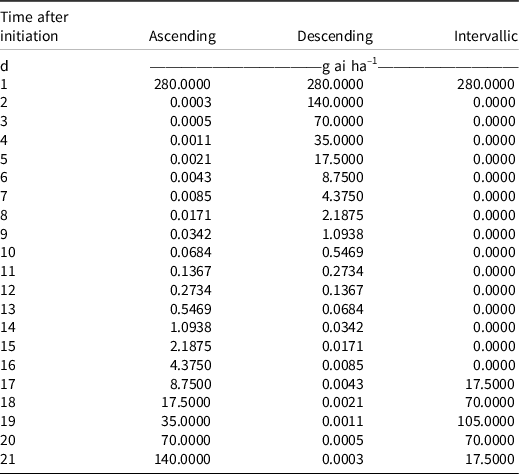
Two trials were conducted as randomized complete-block designs with four replications. Each experimental unit consisted of one pot containing one plant of a given species. Treatments included a nontreated check, a standard, and a three-by-two factorial arrangement that mimicked three hypothetical herbicide-release scenarios applied following an initial application to foliage or soil. The initial treatment was mesotrione at 280 g ai ha–1 applied broadcast to foliage and soil or syringed directly to soil. The release scenarios that followed consisted of an additional 280 g ai ha–1 mesotrione titrated at different rates applied daily to match ascending, descending, and intervallic patterns (Table 1) over a 3-wk period. Each daily treatment was carefully syringed onto the soil surface of each pot to reduce contact with the plant foliage and prevent herbicide splash during application. After daily treatments had been absorbed into the soil profile, each pot was lightly hand watered to reduce herbicide movement during watering events. Additionally, a standard treatment consisted of two broadcast applications of mesotrione at 280 g ai ha–1 applied at 3-wk intervals. The program consisting of 280 + 280 g ai ha–1 represents the maximum rate per application and the annual use limit for tall fescue turfgrass.
Three simulated mesotrione release scenarios consisting of mesotrione rate titrations where 280 g ai ha–1 was applied on the first day either as a foliar spray or by adding the herbicide to 5 ml water and syringing. Between days 2 and 21, the titrated rates total an additional 280 g ai ha–1, all applied via syringing.

Herbicide Application
Treatments were applied daily for 21 d to mimic the release scenario of each CR scenario (Table 1). Plants were watered as needed throughout the study. Both foliar treatments for the standard comparison and initial foliar treatments, where applicable for the scenarios, were applied using a handheld, CO2-pressurized boom equipped with 11004X spray tips and calibrated to deliver 280 L ha−1 at 206.8 kPa (11004XR Extended Range Flat Fan Spray Tip; TeeJet Technologies, P.O. Box 7900, Wheaton, IL 60187-7900, USA). Each foliar treatment was applied with a non-ionic surfactant at 0.25% v/v (Chem-Stik Nonionic Spreader-Sticker; Precision Laboratories, Inc. Waukegan, IL 60085 USA). For all CR scenarios, predetermined mesotrione rates were mixed in 5 ml of water and syringed to soil daily following initial treatment.
Data Collection
Turfgrass injury, leaf counts by color (green, pale, white, or necrotic), tiller counts, and control of creeping bentgrass, goosegrass, nimblewill, smooth crabgrass, and white clover were evaluated weekly following herbicide application. Green leaves are defined as those leaves without visible injury symptoms, pale leaves are defined as leaves with mild to moderate injury symptoms (foliar chlorosis or bleaching), white leaves are defined as leaves having severe tissue injury (completely white), and necrotic leaves are defined as leaves that are completely dead. These data are reported as a percentage of the number of leaves per plant. Tiller counts were taken for smooth crabgrass and goosegrass only. Injury and control ratings were recorded as a visually estimated percentage, with 0% indicating no injury or control, and 100% indicating complete death of all visible foliage or complete control (Frans Reference Frans1986). After 6 wk, all aboveground vegetative growth was removed and weighed. To facilitate analysis and discussion, pale, white, green, and necrotic leaf counts data were converted to percentage discolored leaves using Equation 1:
 $((P + W + N)/T) \times 100 $
where P, W, and N represent the number of pale, white, and necrotic leaves, respectively, and T is the total number of leaves per plant.
Statistical Analyses
Variance was tested for homogeneity by plotting residuals in SAS 9.2 (SAS 9.2 software; SAS Institute Inc., Cary, NC 27513-2414, USA). Data were subjected to a combined ANOVA with sums of squares partitioned to reflect trial effects and the factorial treatment arrangement. Trial was considered random, and the mean squares of placement, time-release scenario, and placement-by-time release scenario were tested using the mean square associated with their interaction with trial (McIntosh, Reference McIntosh1983). Appropriate means for significant main effects or interactions within the factorial treatment structure were separated using Fisher’s Protected LSD at P = 0.05. Comparison treatments were measured against appropriate means generated following ANOVA on the factorial treatments with single-degree-of-freedom contrasts.
Results and Discussion
Weed Control
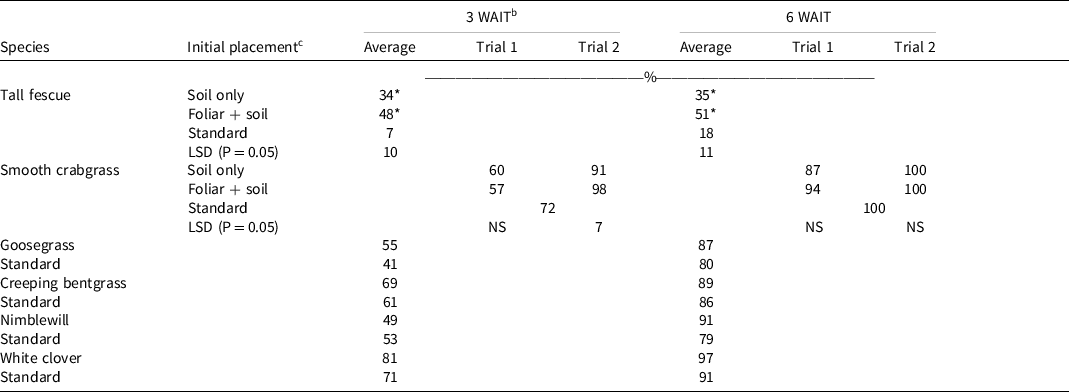
At 3 and 6 wk after initial treatment (WAIT), trial, CR scenario, and application placement were not significant for creeping bentgrass, goosegrass, nimblewill, and white clover control; therefore, data were pooled for comparison to the standard and check (Table 2).
Effect of initial mesotrione placement on tall fescue injury (%) and smooth crabgrass control (%) in two trials averaged over time-release scenarios. Placement, scenario, and trial were insignificant for creeping bentgrass, goosegrass, nimblewill, and white clover, so data were pooled for comparison with the standard treatment.a

a Means followed by an asterisk are different from the standard comparison treatment (two applications of mesotrione applied at 280 g ai ha-1 at 3-wk intervals).
b Abbreviations: NS, not significant; WAIT, wk after initial treatment.
c Initial placement indicates that the initial mesotrione treatment of 280 g ai ha–1 was applied only to soil (to mimic a granular treatment) or to foliar plus soil (to mimic a broadcast spray). Regardless of the initial application placement, all time-release scenarios were achieved by diluting titrated mesotrione rates in 5 ml water and syringing them to soil daily over a 3-wk period.
Regardless of scenario or application placement, treatments designed to mimic CR effectively controlled creeping bentgrass, goosegrass, nimblewill, and white clover greater than 87% at 6 WAIT and equivalent to the standard treatment. For smooth crabgrass, differences were observed for trial and application placement (Table 2). At 3 WAIT for trial 2, regardless of release scenario, initial treatment to soil controlled smooth crabgrass 91%, which was significantly less than initial treatment to foliar plus soil (98%). Although significant, these differences may be of minimal biological relevance as both application placements led to 100% control by 6 WAIT. The inconsistency noted between trials at 3 WAIT caused the trial-by-placement-by-CR scenario interaction for smooth crabgrass control. Galán-Jiménez et al. (Reference Galán-Jiménez, Morillo, Bonnemoy, Mallet and Undabeytia2020) recently reported a CR mesotrione formulation based on a sepiolite clay sorption method. The CR formulation created by Galán-Jiménez et al. (Reference Galán-Jiménez, Morillo, Bonnemoy, Mallet and Undabeytia2020) was rate-descending based on water-release kinetics, but the release scenario did not exactly match that of the rate-descending simulation in this study. Similar to our results, the CR formulation in the Galán-Jiménez et al. (Reference Galán-Jiménez, Morillo, Bonnemoy, Mallet and Undabeytia2020) study injured weedy sunflower (Helianthus annuus L.) equivalent to or more than the commercial formulation.
Tall Fescue Injury
Tall fescue injury was significantly influenced by initial application placement but not by trial or scenario (Table 2). Initial soil applications injured tall fescue less than foliar-plus-soil applications at 3 and 6 WAIT. All treatments designed to mimic time-release scenarios injured tall fescue two to seven times greater than the standard comparison treatment. Comparison treatments injured tall fescue 7% and 18% at 3 and 6 WAIT, respectively. All CR scenarios injured tall fescue at least 34% regardless of application placement. This increased injury could have occurred because more mesotrione was available to plants from 0 to 3 WAIT. Had release scenarios been initiated 1 to 2 wk after initial treatments, tall fescue injury might have been decreased. More research is needed to assess other release scenarios to reduce turfgrass injury.
Leaf Color
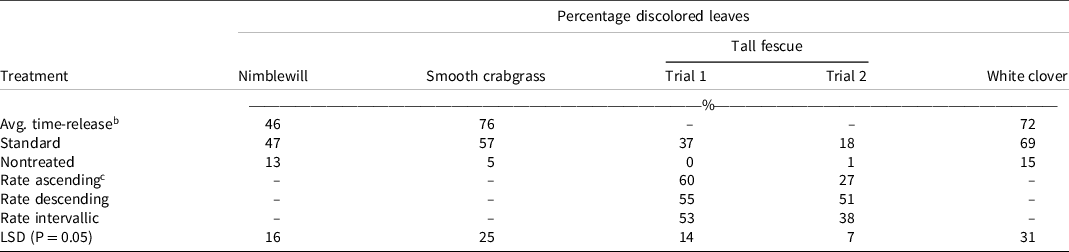
Trial repetition, application placement, and mesotrione release scenario had no effect on percentage discolored leaves of nimblewill, smooth crabgrass, and white clover 2 WAIT; therefore, data were pooled for comparison to the standard and nontreated check (Table 3). Regardless of initial application placement or release scenario, CR scenarios discolored 46%, 76%, and 72% of nimblewill, smooth crabgrass, and white clover leaves, respectively, and equivalent to the standard mesotrione treatment 2 WAIT. Both the average of CR treatments and the standard had more discolored leaves than the nontreated check. Tall fescue leaf discoloration was influenced by CR scenarios and trial but not by initial application placement (Table 3).
Average effect of time-release scenarios and application placement compared to standard treatment and nontreated check on percentage discolored leaves at 2 WAIT of nimblewill, smooth crabgrass, and white clover and effect of release scenario and trial on the percentage discolored leaves of tall fescue.a

a Percentage discolored leaves based on leaf counts of necrotic, pale, and white leaves converted to a percentage of total leaves per plant.
b Significant differences were not observed among the factorial structure of mesotrione time-release scenarios and application placement for nimblewill, smooth crabgrass, and white clover; therefore, data were pooled for comparison to the nontreated check and standard treatment (two applications of mesotrione applied at 280 g ai ha–1 at 3-wk intervals).
c Time-release scenarios included mesotrione rate titrations that were added to 5 ml water and syringed to soil each day during a 3-wk period. The titrated rates totaled 280 g ai ha–1 and were applied in a logarithmic ascent between day 2 and day 21 (“rate ascending”), a logarithmic descent between day 2 and day 21 (“rate descending”), and a curved pattern between day 17 and day 21 (“intervallic”).
The standard mesotrione comparison treatment discolored 37% and 18% of tall fescue leaves in trials 1 and 2, respectively (Table 3). As most of the discolored leaves were pale leaves, the percentage discolored leaves should not be viewed as percentage injury, which was only 7% from the comparison treatment at 3 WAIT when averaged over trials (Table 2). In each case, percentage discolored leaves from the standard comparison was less than that sustained from the simulated CR scenarios. In trial 1, the simulated CR scenarios did not differ from each other, but in trial 2, the rate-descending release scenario resulted in the most discolored leaves 2 WAIT. Although CR scenarios were insignificant for tall fescue injury in Table 2, the percentage leaf discoloration indicates that increased mesotrione rate in the first 3 wk could be responsible for tall fescue discoloration observed in these trials. The rate-descending pattern applies the equivalent of over 525 g ai ha–1 mesotrione in the first 4 d as a result of the logarithmic pattern chosen. It may be possible to reduce turfgrass injury by delaying CR treatments for at least 1 to 2 wk after the initial application or by reducing the initial rate, but more research is needed to test this theory. A sepiolite-based CR mesotrione formulation did not injure corn (Zea mays L.) when compared to a commercial formulation, but these treatments were applied at only 100 g ai ha–1 (Galán-Jiménez et al. Reference Galán-Jiménez, Morillo, Bonnemoy, Mallet and Undabeytia2020).
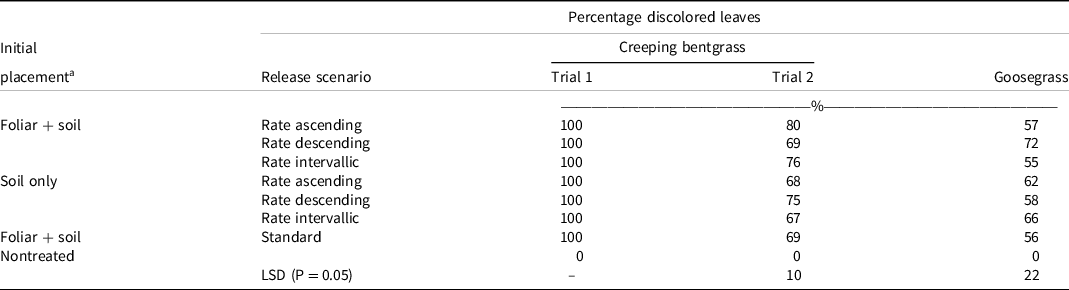
A three-way interaction of trial, application placement, and mesotrione release scenario was observed for creeping bentgrass 2 WAIT (Table 4). In trial 1, complete control of creeping bentgrass was observed for each application placement, release scenario, and standard mesotrione comparison treatment. In trial 2, differences in application placement and release scenario were observed. For the rate-ascending release scenario, foliar-initiated treatments were more effective (80%) than soil-initiating treatments (68%). The foliar-initiated ascending treatment was also more effective than the foliar-applied, rate-descending treatment, the soil-applied, rate-intervallic treatment, and the standard-comparison treatments. The differences noted between trials could be due to changes in supplemental lighting between the two years in which these trials were conducted. In the second trial, high-pressure sodium lights provided almost twice the photosynthetic active radiation of the mercury vapor lights used in trial 1. Increased heat of underlying surfaces of the high-pressure sodium lights or increased light intensity may have contributed to the trial interaction. Goosegrass leaf discoloration did not differ between treatments (Table 4).
Effect of release scenario and application placement of mesotrione on discolored leaves of creeping bentgrass and goosegrass. Significant differences in trial were observed for creeping bentgrass.

a Initial placement indicates that the initial mesotrione treatment of 280 g ai ha–1 was applied only to soil (to mimic a granular treatment) or to foliar + soil (to mimic a broadcast spray). Regardless of the initial application placement, all time-release scenarios were achieved by diluting titrated mesotrione rates in 5 ml water and syringing them to soil daily over a 3-wk period. Time-release scenarios included mesotrione rate titrations that were added to 5 ml water and syringed to soil each day during a 3-wk period. The titrated rates totaled 280 g ai ha–1 and were applied in a logarithmic ascent between day 2 and day 21 (“rate ascending”), a logarithmic descent between day 2 and day 21 (“rate descending”), and a curved pattern between day 17 and day 21 (“intervallic”).
Fresh Weights
Trial repetition, application placement, and mesotrione release scenario had no effect on plant fresh weight for creeping bentgrass, nimblewill, smooth crabgrass, and white clover 7 WAIT; therefore, data were pooled (Table 5). In each case, nontreated plant weights were significantly greater than the standard comparison or the average of application placement and mesotrione release scenario, which were statistically similar. In each case, mesotrione treatments were effective at controlling these species. The average of application placement and mesotrione release scenario reduced plant weight 93%, 90%, 99%, and 98%, whereas the standard treatment reduced plant weight 94%, 86%, 100%, and 95% for creeping bentgrass, nimblewill, smooth crabgrass, and white clover, respectively. For goosegrass, application placements were similar; therefore, data were pooled. Standard mesotrione application and the mesotrione release scenarios were similar and reduced plant weight 86% or greater when compared to the nontreated check (Table 5).
Average effect of time-release scenarios and application placement compared to standard treatment and nontreated check on aboveground fresh-plant weight of creeping bentgrass, nimblewill, smooth crabgrass, and white clover and effect of release scenario on aboveground fresh-plant weight of goosegrass and tall fescue.

a Significant differences were not observed among the factorial structure of mesotrione time-release scenarios and application placement for creeping bentgrass, nimblewill, smooth crabgrass, and white clover; therefore, data were pooled for comparison to the nontreated check and standard treatment (two applications of mesotrione applied at 280 g ai ha–1 at 3-wk intervals).
b Time-release scenarios included mesotrione rate titrations that were added to 5 ml water and syringed to soil daily during a 3-wk period. The titrated rates totaled 280 g ai ha–1 and were applied in a logarithmic ascent between day 2 and day 21 (“rate ascending”), a logarithmic descent between day 2 and day 21 (“rate descending”), and a curved pattern between day 17 and day 21 (“intervallic”).
Mesotrione CR scenarios reduced tall fescue fresh weight at least 51%. Each of these release scenarios was more injurious than the standard mesotrione treatment. Standard mesotrione treatments reduced tall fescue weight by 20% and were not different from the nontreated check.
In these studies, leaf discoloration was reported in Table 3 for the nontreated plants within nimblewill, smooth crabgrass, and white clover species. This injury was predominantly necrosis or chlorosis but occasionally consisted of a small amount of bleaching. Substantial effort was made during these trials to reduce the potential for herbicide movement from one plant to the other. Potential volatility of mesotrione has been observed in field and greenhouse trials at Virginia Tech (C.G. Gonçalves and S.D. Askew, personal observation). Species highly sensitive to mesotrione located in areas around field plots, such as Oxalis sp. and small Brassica sp., have been injured, although herbicide was applied with a shield to reduce drift potential. According to Dumas et al. (Reference Dumas, Giraudo, Goujon, Halma, Knhili, Stauffert, Batisson, Besse-Hoggan, Bohatier, Bouchard and Celle-Jeanton2017), mesotrione is weakly acidic, nonvolatile, and highly soluble in water. Though volatility is suspected, no reports of mesotrione volatility are known to exist. The high water solubility suggests co-distillation as a possible mechanism of movement in confined greenhouse conditions. Researchers evaluating other bleaching herbicides have reported volatility in their trials (Locke et al. Reference Locke, Smeda, Howard and Reddy1996; Thelen et al. Reference Thelen, Kells and Penner1988). Other causes of leaf phytotoxicity in nontreated plants could be due to tip necrosis following salt-concentrated guttation water or other stress factors, such as supplemental greenhouse lighting.
Tall fescue was injured more by treatments designed to mimic CR scenarios than by the standard comparison. This occurrence was unexpected but could be due to increased herbicide rate during the first 5 d following the CR treatments. The three release scenarios were chosen based on discussion with a Syngenta formulation chemist (L. Galiano, personal communication). The ascending, descending, and intervallic patterns are indicative of various formulations technologies available to a formulations chemist, and each CR scenario involves different technology and costs (Galán-Jiménez et al. Reference Galán-Jiménez, Morillo, Bonnemoy, Mallet and Undabeytia2020; Rashidzadeh et al. Reference Rashidzadeh, Olad and Hejazi2017; Zhao and Wilkins Reference Zhao and Wilkins2000, Reference Zhao and Wilkins2003). For example, impregnating herbicide onto a clay or peanut hull carrier that imparts a rate-descending CR scenario will be less expensive that a micro-encapsulated formulation designed for intervallic release by microbial degradation. Information about the extent of bioefficacy from each pattern can enable economically viable choices to be made for any future work on CR mesotrione formulations. The patterns were designed to apply 280 g ai ha–1 initially and another 280 g ai ha–1 over the next 21 d. Because the standard mesotrione broadcast treatment consists of two 280 g ai ha–1 treatments at a 21-d interval, a better choice might be to initiate the release scenarios at 2 WAIT and have them extend over a period of time between 2 and 5 WAIT. Such a release scenario could conceivably be produced using microbially degraded encapsulation.
In conclusion, a recent sepiolite-based CR mesotrione formulation with a rate-descending release scenario demonstrated that soil loading of mesotrione at 0 to 10 cm was dramatically increased, presumably as a result of changes in foliar absorption rates (Galán-Jiménez et al. Reference Galán-Jiménez, Morillo, Bonnemoy, Mallet and Undabeytia2020). Our results align with those of the sepiolite-based formulation in that simulations based on mesotrione CR scenarios applied singly with or without foliar exposure can control weeds as well as single or repeated foliar treatments. Although we did not identify an optimum CR scenario in this work, the data suggest that rate-descending patterns and soil-plus-foliar treatments may cause more leaf discoloration or injury to tall fescue when compared to rate-ascending, rate-intervallic, and soil-only treatments. Our work further demonstrates that mesotrione can control a variety of weeds when released into the soil environment in different ways.
Acknowledgments
The authors would like to thank Syngenta Crop Protection for supporting this research.
No conflicts of interest have been declared.