INTRODUCTION
The protozoan Giardia duodenalis is a common intestinal parasite of humans, domestic animals, and wildlife throughout the world. Although G. duodenalis displays no observable morphological variation, it is genetically variable and is now described as a species complex consisting of 7 distinct genotypic groups (termed assemblages A-G) (Monis et al. Reference Monis, Andrews, Mayrhofer and Ey1999). Most of these genetic assemblages demonstrate a degree of host specificity, while others infect a wide range of host species. Assemblages A and B are the only two G. duodenalis assemblages known to occur in humans, but they also demonstrate a low degree of host specificity and infect a wide range of other mammalian species (Thompson, Reference Thompson2004). Despite the large amount of comparative genetic data available for assemblages A and B little research has been conducted on phenotypic differences between the genetic groups. Differences at the genetic level may not fully reveal the level of phenotypic variation as translation and post-translation modifications of proteins can only be verified using proteomic techniques (Gorg et al. Reference Gorg, Weiss and Dunn2004). Therefore proteomic studies enable the visualization and identification of the proteins being produced by trophozoites at a specific point in time, and allow for the relative quantification and the identification of assemblage-specific variants, which may be overlooked using standard genetic studies (Gygi et al. Reference Gygi, Rochon, Franza and Aebersold1999). These data may provide additional information as to the level of diversity within and between the G. duodenalis assemblages of both biological and taxonomic relevance.
There is limited information on phenotypic differences between the assemblages available. Several recent studies have examined the relationship between clinical symptoms and the genetic assemblage of G. duodenalis infecting human patients with contrary conclusions (Homan and Mank, Reference Homan and Mank2001; Read et al. Reference Read, Walters, Robertson and Thompson2002; Haque et al. Reference Haque, Roy, Kabir, Stroup, Mondal and Houpt2005; Sahaqun et al. Reference Sahaqun, Cavel, Goni, Seral, Llorente, Castillo, Capilla, Arias and Gomez-Lus2008). Studies in Australia, Spain and Bangladesh all found that infections with assemblage A were commonly associated with acute infections, and assemblage B with chronic and asymptomatic infections (Read et al. Reference Read, Walters, Robertson and Thompson2002; Haque et al. Reference Haque, Roy, Kabir, Stroup, Mondal and Houpt2005; Sahaqun et al. Reference Sahaqun, Cavel, Goni, Seral, Llorente, Castillo, Capilla, Arias and Gomez-Lus2008). A study from the Netherlands found the opposite, with assemblage B more likely to be involved in acute infections (Homan and Mank, Reference Homan and Mank2001).
Isoenzyme analysis has also demonstrated different migration patterns of key metabolic enzymes between assemblages A and B indicating phenotypic differences between the assemblages (Meloni et al. Reference Meloni, Lymbery and Thompson1988; Moss et al. Reference Moss, Visvesvara, Mathews and Ware1992; Mayrhofer et al. Reference Mayrhofer, Andrews, Ey and Chilton1995). The majority of these studies were performed before genetic characterization of isolates; however, some include isolates for which we have genetic information available now. One study by Meloni et al. (Reference Meloni, Lymbery and Thompson1988) investigated 30 isolates from Western Australia and found that the isolates formed 2 major groups based on their isoenzyme pattern. These groups correspond to assemblages A and B. Differences in the isoenzyme migration indicate differences in protein coding and post-translational modification.
Several studies have previously examined proteomic differences between G. duodenalis trophozoites from different geographical regions, hosts and individuals with varying clinical symptoms (Moore et al. Reference Moore, Sogandares-Bernal, Dennis, Root, Beckwith and Van Voorhis1982; Smith et al. Reference Smith, Gillin, Kaushal and Nash1982; Nash and Keister, Reference Nash and Keister1985; Wenman et al. Reference Wenman, Meuser and Wallis1986; Capon et al. Reference Capon, Upcroft, Boreham, Cottis and Bundesen1989). However, these studies were not conducted on genetically characterized isolates as they pre-dated the designation of the assemblages. Thus, no study has performed a comparative protein analysis on genetically characterized isolates. In addition, previous studies were performed using only one dimensional polyacrylamide gel electrophoresis (1DE) to visualize proteins with the resulting protein banding patterns being compared. Protein differences were not identified back to a gene product using either mass spectrometry or Edman degradation. With advances in mass spectrometry and genomics it is now possible to accurately separate and identify individual proteins, making it possible to locate proteins of difference between the assemblages and annotate them back to the genome. This may be important when attempting to determine the functional implications of the differences evident from the gel profiles.
Using both 1 and 2DE we compared the proteins produced by a selection of genetically characterized G. duodenalis trophozoites from assemblages A and B. By coupling the protein visualization with mass spectrometry, followed by annotation to the G. duodenalis genome (Morrison et al. Reference Morrison, McArthur, Gillin, Aley, Adam, Olsen, Best, Cande, Chen, Cipriano, Davids, Dawson, Elmendorf, Hehl, Holder, Huse, Kim, Lasek-Nesselquist, Manning, Nigam, Nixon, Palm, Passamaneck, Prabhu, Reich, Reiner, Samuelson, Svard and Sogin2007), we have found proteomic differences and assemblage-specific proteins in the human infective assemblages for the first time.
MATERIALS AND METHODS
Isolates
Cloned trophozoite lines were used for all experiments, comprising 3 assemblage A isolates (BAH 2c2, 26c11, 40c9) and 3 assemblage B isolates (BAH 34c8, 12c14, 15c1) (Hopkins et al. Reference Hopkins, Constantine, Groth, Wetherall, Reynoldson and Thompson1999). Trophozoites were grown in bile-supplemented TYI-S-33 medium containing 10% (v/v) newborn calf serum (Keister, Reference Keister1983), in 10 ml flat-bottomed Nunclon tubes (Nunc, Rochester, USA). For mass cultivation, trophozoites were grown in 1L Schott bottles filled with 10 ml borosilicate glass culture tubes, so as to increase the surface area available for attachment. Trophozoites were grown to confluency, at which point the culture vessel was placed in ice for 30 min to cause detachment. The culture media plus detached trophozoites were decanted to 50 ml centrifuge tubes and collected by centrifugation at 2000 g for 10 min. The pelleted cells were washed twice in ice-cold PBS to remove media and serum proteins from the trophozoites which were subsequently stored at −20°C as whole cell pellets until needed.
Protein preparation
Trophozoites were thawed and resuspended in 3 ml of PBS with Complete Mini™ protease inhibitor (Roche) and sonicated for 3×30s bursts at full power on ice and the presence of intact trophozoites determined via microscopy. If any intact trophozoites remained the sonication of the sample was repeated. Protein concentration was estimated using the Quick Start™ Bradford assay (Bio-Rad, Hercules, USA) against a BSA standard curve. Half the sample was removed and stored at −80°C for 1DE. To the remaining sample, 9 volumes of ice-cold methanol were added and the sample incubated overnight at −20°C to precipitate the protein fraction. The protein was collected via centrifugation and solubilized in 1 ml of a multiple surfactant solution (40 mm Tris, 32·5 mm 3-[(3-cholamidopropyl) dimethylammonio]-1-propanesulfonate (CHAPS), 65 mm caprylyl sulfobetaine, 5 m urea, 2 m thiourea 0·5% (v/v) ampholytes, 0·05% (v/v) tributyl phosphine; samples were stored at −80°C.
1DE
Fifty micrograms of total trophozoite protein was adjusted to 40 μl with 1D sample buffer (10% (v/v) glycerol, 5% (v/v) β mercaptoethanol, 100 mm Tris, 69 mm SDS and bromophenol blue as a coloured marker; pH 6·8) and boiled for 5 min. Samples were cooled then loaded onto a 12·5% (w/v) polyacrylamide gel and run at 80 V for 20 h. After electrophoresis, gels were stained with a modified Coomassie G-250 stain (Candiano et al. Reference Candiano, Bruschi, Musante, Santucci, Ghiggeri, Carnemolla, Orecchia, Zardi and Righetti2004). Gel images were captured and analysed using the ProXpress™ system (Perkin Elmer, Waltham, USA).
2DE
Immobilized pH gradient 17 cm, pH 3–10 Readystrips (GE Life Sciences, Buckinghamshire, England) were incubated with 500 μg of total trophozoite protein in 400 μl of 2D sample buffer. Strips were left to rehydrate overnight and were then submitted to isoelectric focusing using a Multiphor II™ (GE Life Sciences) under the following conditions; 500 V for 2 h, 1500 V for 2 h and 3500 V for 18 h. After the first dimension, strips were equilibrated in buffer (20% (v/v) glycerol, 20% (v/v) 1·9 m Tris pH 8·8, 6·7% (w/v) acrylamide, 0·125% (v/v) tributyl phosphine, 6 m urea and 69 mm SDS) for 30 min, rinsed in cathode buffer (192 mm glycine, 3·5 mm SDS, pH to 8·3, with conc. Tris solution) before being loaded onto a 12·5% (v/v) polyacrylamide slab gel, and overlayed with 0·5% (w/v) agarose. Gels were run in the Protean system (Bio-Rad) with anode buffer (0·75 m Tris, pH 8·8) and cathode buffer (192 mm glycine, 1% (w/v) SDS, pH 8·3, with conc. Tris). Gels were electrophoresed at 25 mA per gel for 5 h and stained as per the 1D gel protocol. Gel images were taken as described for the 1DE gels. All gels were run in triplicate.
Protein ID
Gel images were compared to determine the presence of assemblage-specific proteins. Using a scalpel, protein spots of difference were excised from the gels by hand and placed into clean microcentrifuge tubes. Gel plugs were destained by incubating with 25 mm ammonium bicarbonate in 50% (v/v) acetonitrile for 45 min at 37°C, after which the supernatant was removed and the destain procedure repeated until all the stain was removed. Gel plugs were allowed to dry and 10 μl of trypsin solution (12·5 μg/ml trypsin in 0·01% (v/v) trifluoracetic acid, 25 mm ammonium bicarbonate in high pure water) was added. Gel plugs were incubated with the trypsin solution overnight at 37°C, after which 25 μl of acetonitrile with 1% (v/v) formic acid was added to each gel plug and incubated at room temperature for 15 min in order to remove peptides. The supernatant was removed to a clean microcentrifuge tube and a second aliquot of acetonitrile/formic acid was added in order to maximize the amount of peptide extracted. The supernatants were pooled and dried in a centrifugal vacuum drier. The sample was rehydrated in 10 μl of 50% (v/v) acetonitrile and 1% (v/v) formic acid and 1 μl of this was mixed with 1 μl of 10 mg/ml α-cyano-4-hydroxycinnamic acid (in 50% (v/v) acetonitrile with 0·1% (v/v) trifluoracetic acid). From this mixture, 0·6 μl was spotted onto a MALDI plate and left to air dry. Samples were run on a 4800 MALDI ToF-ToF mass spectrometer (Applied Biosystems, Foster City, USA) in MS/MS mode. Spectra were searched using the Mascot algorithm (Perkins et al. Reference Perkins, Pappin, Creasy and Cottrell1999) against the NCBI eukaryotic database.
DNA extraction
Trophozoites were prepared by sonication as per the protein preparation method, except that protein inhibitor cocktail was not added to the PBS and the resuspended trophozoites were made up to 2 ml. To the sonicated trophozoites, 11 μl of proteinase K (27 mg/ml) was added and the samples incubated at 37°C for 4 h after which 2 μl of RNase was added and incubated at 37°C for a further 30 min. The samples were then cooled on ice for 10 min followed by the addition of 1 ml of 7·5 m ammonium acetate to precipitate any protein. The protein contaminants were pelleted by centrifugation and the supernatant retained and kept on ice. One volume of isopropanol was added to the supernatant to precipitate the DNA, which was collected by centrifugation. The resulting pellet was washed with 2 ml of ethanol and left to air dry for a maximum of 24 h then resuspended in 50 μl of TE buffer.
PCR of alpha 2 giardin
The primers A2GEX5 and A2GEX3 were used to amplify the alpha 2 giardin gene from assemblage A and B using the conditions of Palm et al. (Reference Palm, Weiland, Griffiths, Ljungstrom and Svard2003). Primers Alph2int5 and Alph2int3 were designed to amplify a 559bp internal fragment of the alpha 2 giardin gene using Primer3 (accessed online via Biology Workbench, http://workbench.sdsc.edu); Alph2int5 5′ cctcatggtgtacatgctgg 3′ and Alph2int3 5′ aagcatagagtacggccct 3′. Reactions were performed in a 25 μl volume, containing 1× PCR buffer, 1·5 mm MgCl2, 50 μm of each primer, 50 μm of dNTP and 1 unit of polymerase. An initial denaturation of 5 min at 95°C was followed by 30 cycles of 95°C for 30 s, 50°C for 30 s and 72°C for 45 s, with a final extension at 72°C of 10 min. PCR products were run on 1% (w/v) agarose gels and stained with ethidium bromide and visualized using a transilluminator.
Cloning of PCR products
Initial sequencing of the Alph2int PCR product of the assemblage B isolates indicated a mixed template was present. PCR amplicons from the 6 isolates were therefore purified using the Wizard® SV PCR purification kit and then cloned into the pGem-T vector (Promega, Madison, U.S.A) using the manufacturer's instructions. Ten white colonies, those carrying the vector with the insert, from each G. duodenalis isolate were subcultured onto fresh LB agar plates supplemented with 100 μg/ml of ampicillin. The presence of the insert was confirmed using the alpha2int PCR described above.
Sequencing of clones
The cloned Alph2int PCR products were amplified from the vector using the pUC/M13 sequencing primers under the same conditions as for the Alph2int PCR except that the annealing temperature was increased to 55°C. The PCR product was purified as before and 1 μl of the cleaned PCR product was used for the sequencing reactions. The sequencing reactions were carried out using the ABI Big dye version 3.0 kit as per the manufacturer's instructions (ABI, Foster City) and sequencing performed on an ABI 3730 48 capillary sequencer.
RESULTS
1DE
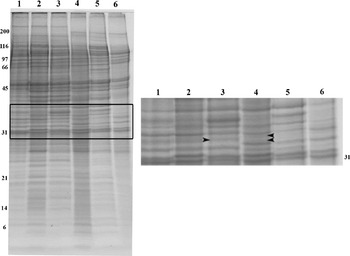
From the 1DE (Fig. 1) it is clear there is a high degree of homogeneity within both assemblages A and B. Highlighted are 3 protein bands (2 for assemblage A and 1 for assemblage B) that were analysed by mass spectrometry. The top band of the assemblage A doublet was identified by mass spectrometry as alpha 2 giardin and the bottom band as a 14-3-3 homologue. For the assemblage B isolates the single band was identified as the 14-3-3 homologue, which has not migrated as far as the assemblage A 14-3-3 band indicating a difference in size. No alpha 2 giardin was present in the assemblage B gels.
1DE of total trophozoite proteins from assemblages B and A. The 3 lanes on the left (Lane 1=BAH 15c1, Lane 2=BAH 12c14, Lane 3=BAH 34c8) are assemblage B isolates and the 3 lanes on the right (Lane 4=BAH 26c11, Lane 5=BAH 2c2, Lane 6=BAH 40c9) are assemblage A. The highlighted region is enlarged to the right. The areas of difference on the gel are indicated with arrow heads.

2DE
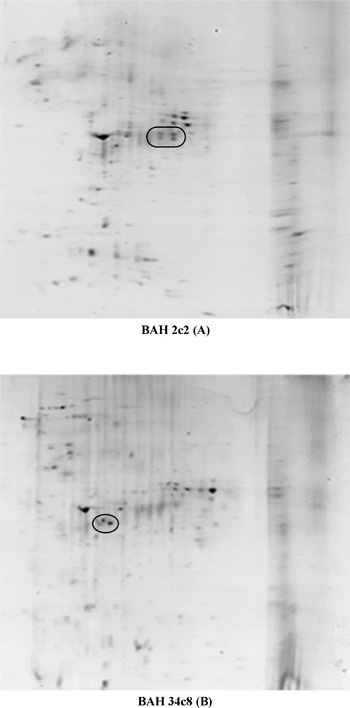
The two dimensional analysis was only performed on representative isolates from assemblage A (BAH 2c2) and B (BAH 34c8) (Fig. 2), due to the intra-assemblage homogeneity seen on 1DE gels. There is a reduction in the overall number of proteins visible from the 1DE. Four assemblage A-specific protein spots were identified within the one region and several assemblage B-specific protein spots were also observed. These 4 protein spots were identified back to the genome as alpha 2 giardin. The 2DE gels shown are representative gels of the isolates tested. There was little variation between replicates: the major differences occurring at the pH extremes, where the resolution was not always adequate to discern discrete spots.
2DE of total trophozoite protein of isolates from assemblages A and B. The circled area on the BAH 2c2 gel shows the 4 spots identified as alpha 2 giardin. No discernible spots are seen at the corresponding region on the BAH 34c8 gel. The circled region on the BAH 34c8 gel shows an unidentifiable assemblage B-specific protein spot.

Protein identification
One protein band from the 1DE (Fig. 1B) and 4 protein spots from the 2DE (Fig. 2B) specific to assemblage A were all identified as the same protein, alpha 2 giardin. Alpha 2 giardin was therefore selected as a potential assemblage A-specific protein for further molecular characterization. The protein spot which is putatively assemblage B-specific gave no significant matches to the G. duodenalis genome sequence available or to any other eukaryotic protein within the NCBI database.
Alpha 2 giardin PCR and sequencing
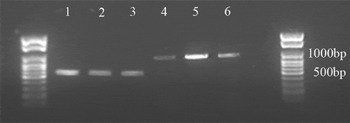
The A2GEX PCR produced amplicons for the assemblage A isolates only (data not shown). The internal Alph2int PCR gave a product of approximately 500 bp for the assemblage A isolates (Fig. 3). The assemblage B isolates gave a product size twice that expected at approximately 1000 bp. The sequencing data of the assemblage A isolates confirmed the amplification of alpha 2 giardin. The assemblage B band was found to be a non-specific amplification of a G. duodenalis gene. No alpha 2 giardin DNA was present in any of the assemblage B samples based on the sequencing results.
PCR of alpha 2 giardin using Alph2int primers. Lane 1 BAH 2c2, Lane 2 BAH 26c11, Lane 3 BAH 40c9, Lane 4 BAH 34c8, Lane 5 BAH 15c1, Lane 6 BAH 12c14. Lanes 1–3 are assemblage A and Lanes 4–6 are assemblage B.

DISCUSSION
This is the first study to perform a comparative protein analysis on genetically characterized isolates of G. duodenalis from different assemblages. Previous studies were conducted prior to the designation of the genetic assemblages thus precluding the possibility of identifying inter-assemblage variation. It is also the first time that a 2DE approach has been used for the comparative analysis of G. duodenalis isolates. We have selected several assemblage-specific protein spots from the gel images; with alpha 2 giardin identified as an assemblage A-specific protein, using mass spectrometry.
There was no variation in protein banding between isolates of the same assemblage for the 1DE analysis. This lack of intra-assemblage variation is interesting due to the amount of heterogeneity seen at the genomic level especially for assemblage B isolates. This result indicates that the variation seen at the genomic level is not having an effect on the molecular mass of the proteins being encoded. However, the differences seen between assemblages are not so surprising. There is a large degree of genetic difference between assemblages A and B. In fact, the level of genetic difference between assemblages A and B is greater than those observed between some species of protozoa (Mayrhofer et al. Reference Mayrhofer, Andrews, Ey and Chilton1995), therefore differences at the protein level were to be expected. Although numerous assemblage-specific proteins were visible in the gels, in this study we have concentrated specifically on the assemblage A-specific protein alpha 2 giardin.
The level of homogeneity within the assemblages and heterogeneity between them also gives some insight into previous studies. With the exception of Capon et al. (Reference Capon, Upcroft, Boreham, Cottis and Bundesen1989), previous studies of protein variation in G. duodenalis using 1DE have not discovered major protein differences (Moore et al. Reference Moore, Sogandares-Bernal, Dennis, Root, Beckwith and Van Voorhis1982; Smith et al. Reference Smith, Gillin, Kaushal and Nash1982; Nash and Keister, Reference Nash and Keister1985; Wenman et al. Reference Wenman, Meuser and Wallis1986). As these studies did not use genetically characterized isolates it is possible they were comparing isolates from the same assemblage, based on the large amount of protein variation we observed between assemblages A and B in the present study. The one human isolate, BAH 12c14, that yielded a unique banding pattern in the study by Capon et al. (Reference Capon, Upcroft, Boreham, Cottis and Bundesen1989) was also used in our study and gave the same banding pattern as all other assemblage B isolates. It is possible that BAH 12c14 was the only assemblage B isolate used by Capon et al. (Reference Capon, Upcroft, Boreham, Cottis and Bundesen1989), explaining why it gave a distinct banding pattern in their study.
This is also the first time that a comparative 2DE approach has been used to examine the proteins produced by the human infective assemblages. Compared to the 1DE, the total number of proteins visible and the molecular weight range of proteins are greatly reduced. This is most likely due to the different protein solubilization methods used in the two techniques. For 2DE, the detergents need to be chosen carefully so as not to interfere with the isoelectric focusing (Gorg et al. Reference Gorg, Obermaier, Boguth, Harder, Scheibe, Wildgruber and Weiss2000). The 2DE gels show many isoelectric point variants of the same proteins, which is not uncommon, and shows the advantage of 2DE in its ability to show post-translational variants of a protein that may be missed in 1DE analysis. Using the two electrophoretic methods in tandem allows a larger number of protein differences to be determined by taking advantage of the global view of 1DE and the fine resolution of 2DE.
Several assemblage B-specific protein bands and spots are visible on the 1DE and 2DE gels; however, these proteins could not be identified. The Mascot algorithm compares the MS output to theoretical results for all proteins within a database, in our case the NCBI eukaryote database. This requires a level of prior knowledge of the organism being tested, most commonly the genome sequence. Currently, the only Giardia sequence available is from the G. duodenalis assemblage A isolate WB. If the assemblage B-specific proteins from the gels are not found in the assemblage A genome then, at the moment, there is nothing they can be compared to in the database. Further sequencing efforts are therefore required before more comparative data can be produced. This would also allow for whole genome comparisons to be performed which may give a better insight to the relatedness of the human infective assemblages than the current methods allow.
The difference in the size of the 14-3-3 homologue proteins is interesting given the importance of this protein. 14-3-3 is a conserved eukaryotic protein with the G. duodenalis assemblage A gene, showing 22–60% homology with other eukaryotic 14-3-3-genes (Lalle et al. Reference Lalle, Salzano, Crescenzi and Pozio2006). It is involved in stimulating protein-protein interactions, controlling protein localization and has a role in the activation/inhibition of enzymes (Siles-Lucas and Gottstein, Reference Siles-Lucas and Gottstein2003). The difference in size may indicate that the assemblages have their own specific protein for controlling cellular mechanisms, be it through protein sequence variation or post-translational modification.
Our results strongly indicate that alpha 2 giardin is an assemblage A-specific protein. The difference at the protein level is clear on both 1DE and 2DE gels; this represents the first protein difference between assemblages A and B. The confirmation of the proteomics results using PCR supports the designation of alpha 2 giardin as an assemblage A-specific protein. Although the A2GEX PCR produced amplicons of the correct size only for assemblage A, there was a large degree of non-specific amplification. As such, we designed a second primer pair, Alph2int, to amplify a region of the gene. This consistently produced amplicons of approximately 500 bp for assemblage A and 1000 bp for assemblage B, which was subsequently identified through sequencing as non-specific amplification.
Alpha 2 giardin, like all alpha giardins, is a Giardia-specific structural protein related to the annexin class of proteins (Morgan and Fernandez, Reference Morgan and Fernandez1995). Annexins are Ca2+-dependent phospholipid-binding proteins. Alpha 2 giardin itself is shown to associate with the plasma membrane and the flagella of the trophozoite (Weiland et al. Reference Weiland, McCarthur, Morrison, Sogin and Svard2005). Alpha 2 giardin is also a target of the host immune response with a study by Palm et al. (Reference Palm, Weiland, Griffiths, Ljungstrom and Svard2003) identifying it as an immuno-dominant protein in Western blot analysis.
Although alpha 2 giardin is localized in the trophozoite its functional significance is not completely understood. Due to the protein's proximity to the plasma membrane it is thought to be involved in anchoring the microtubules of the cytoskeleton to the plasma membrane (Weiland et al. Reference Weiland, McCarthur, Morrison, Sogin and Svard2005). The localization of alpha 2 giardin to the caudal flagella also indicates a possible role in motility (Weiland et al. Reference Weiland, McCarthur, Morrison, Sogin and Svard2005). This information on the localization and potential function of alpha 2 giardin is interesting in light of our results. If alpha 2 giardin has an important role to play in stabilizing the structure of the trophozoite and in motility, why is it assemblage A-specific? We believe there are two possible explanations: firstly, that assemblage B isolates produce their own assemblage-specific alpha giardin-like protein to replace alpha 2 giardin; or secondly, that assemblage B isolates utilize another of the alpha giardins to take the place of alpha 2 giardin.
Although the level of genetic diversity between assemblages A and B is considered to be sufficient to recognize them as different species (Mayrhofer et al. Reference Mayrhofer, Andrews, Ey and Chilton1995) it has not been possible to resolve their taxonomic status because of the lack of phenotypic difference between the assemblages that can be shown to have a genetic basis. The assemblage-specific nature of alpha 2 giardin therefore provides additional evidence for revising the taxonomy of Giardia duodenalis.
We would like to thank the Environmental Biotechnology Co-Operative Research Centre for providing funding for this project as well as Proteomics International for technical support. These analyses were performed in facilities provided by the Lotterywest State Biomedical Facility-Proteomics node, Western Australian Institute for Medical Research, and the WA State Agricultural Biotechnology Centre, Murdoch University.