On 13 December 1875, a twenty-six-year-old Japanese woman named Tashiro Chino, together with her four-year-old daughter, Yasu, filed an application for a passport to the Nagasaki governor. They were travelling to Shanghai, where Chino's husband, Genpei, owned a business, ‘in order to run errands (yōji no tame)’. Tashiro Genpei had opened a branch of his family's pottery shop there in 1868, and soon afterwards began running an inn for Japanese visitors. His inn, Tashiroya, had become one of the hubs of the Japanese community in Shanghai, serving customers ranging from students and priests to high-ranking government officials. The passport application record described Chino as being four feet six inches in height with an ‘average’ nose and pair of eyes and ‘a large mouth, thick lips, a broad face, and light-coloured skin’. Her document was issued by Miyagawa Fusayuki, governor of Nagasaki, on the same day of the application. According to the application record, Chino and Yasu would take the Mitsubishi Mail Steamship Company ship to Shanghai. They were among 133 passport applicants in Nagasaki that year.Footnote 1
Although seldom mentioned in the history of Japan's foreign relations in the late nineteenth century, the Japanese population no longer faced the prohibition on overseas travel when in 1868 the Meiji government emerged. The long-standing restriction on contact with foreigners was first introduced in 1635, when the Tokugawa shogunate banned visits by ships from Christian nations – Spain, Portugal, and England – with a view to forestalling their potentially debilitating religious influence.Footnote 2 The Dutch, the only Europeans allowed to trade with Japan, were placed under quarantine on an artificial island called deshima off the port of Nagasaki. In the same token, the shogunate banned the Japanese from travelling overseas. Leaving the country constituted a major crime for the Japanese subjects, and fortunate castaways who made it home were placed under close surveillance by the authority.Footnote 3 This tight regulation on border-crossing ended officially on 23 May 1866 with the shogunate's announcement to foreign representatives, whose governments had concluded commercial treaties with Japan around the turn of the decade, that its people were now allowed to go abroad for the ‘purpose of learning any science or art or for objects of trade’.Footnote 4
Immediately after this reform, the Japanese began crossing the seas. One of the most popular destinations was Shanghai. Already opened to Western residents under the 1842 treaty of Nanjing and on the rise as a key port for economic and cultural exchange, the city saw the development of one of the earliest Japanese expatriate communities in the modern period.Footnote 5 The range of customers at Tashiroya indicates that by the mid-1870s, the Japanese community in Shanghai was beginning to expand in scale and variety, with priests, students, merchants, traders, labourers, children, prostitutes, and so forth.Footnote 6
How did the border-crossing activities of the Japanese begin after the Tokugawa shogunate lifted the overseas travel ban? How did the shogunate and later the Meiji government cope with this major shift in the movement of its people? Historians have explained that the opening of the border and the following wave of ‘early ryūgakusei contributed to Japan by utilising their cross-cultural experiences and Western knowledge for the promotion of modernisation’.Footnote 7 At the other end of the spectrum, it has been explained that the socially marginalized and economically challenged Japanese fell prey to human trafficking networks, which had spread into Chinese coastal cities and Southeast Asia since the 1870s.Footnote 8 Migration historians have asserted that the Maria Luz incident of July 1872 – in which Chinese coolies on a Peruvian vessel mutinied and arrived in Yokohama – dissuaded the Meiji government from conducting any large-scale migration project.Footnote 9
Current historiography on this question presents three shortcomings. First, there has been a conflation of migration and overseas travel in the historical study of Japanese people who went overseas.Footnote 10 Modern Japanese migration history typically begins with the first government-sponsored migration to Hawaii in 1885 and takes only a cursory look at any preceding episodes.Footnote 11 Detailed historical research of Japanese migrants primarily focuses on the post-1895 period when the Japanese migrants followed the emerging colonial empire in Taiwan, Korea, Southeast Asia, and the South Pacific, or served as its sentinels.Footnote 12 It has been assumed that migration history is the appropriate framework to investigate the subject, at the expense of putting the first two decades of passport travel into a lacuna.
The second limitation is that the existing studies mainly deal with two extremes of the social spectrum of Japanese travellers: elite student travellers on the one hand, and castaways, prostitutes (often referred to as karayuki in Japanese), and trafficked persons on the other. Researchers have discussed the travellers’ view of the outside world or their experiences after a voyage, but not so much on how they travelled. Only a few articles exist on the history of Japanese passports, and there is no full investigation on the details of passport travel in this period.Footnote 13 Thirdly, scholars have never compared the Japanese passport system in the late nineteenth century with the European and American ones. The connection between them, therefore, remains unclear.Footnote 14
By utilizing archival sources in Tokyo, Nagasaki, and elsewhere, this study illustrates how Japan ended the ban on overseas travel and how people began to travel overseas. These materials tell us about the Meiji government's view on its relations with the population and the image it hoped to exhibit to treaty powers by allowing them to go abroad. The result places the cross-border activities of the Japanese in the late nineteenth century in the global network of human movement. It also suggests the importance of local actors in understanding the formulation of Meiji Japan's modernization projects.
I
The idea of controlling people's movement with documents was nothing novel to Japanese rulers. It was indeed one of the fundamental elements that constituted Tokugawa's dominance over the archipelago. In the Tokugawa period, a commoner wishing to travel beyond his or her home domain had to receive a ‘travel certificate’ (ōrai tegata), usually from the dignitaries of the village, whilst the samurai class applied for a ‘gate certificate’ (sekisho tegata) issued by the domain. Having a tegata was absolutely essential for someone to pass checkpoints on the road,Footnote 15 but the function of these documents differed greatly from that of the modern passport. Most tegata did not describe the bearer's identity in any detail. Many sekisho tegata, in particular, omitted even the traveller's name. The primary function of tegata was to demonstrate the authorities’ prior approval of the bearer's travel, but not to verify his or her identity.
The passport system in Japan that was introduced in November 1866 did not stem from these domestic travel documents but instead attempted to replicate the Western system. Immediately after the announcement of the lifting of the overseas travel ban and the introduction of the passport system, the Tokugawa officials explained to the foreign representatives that the passport would be introduced ‘as it appears to be the custom in the western countries when sending their subjects abroad’.Footnote 16 They added that from then on, Japanese travellers without passports ‘should not be treated as our countrymen’.Footnote 17 They then asked French and American diplomats to provide them with samples of their passports.Footnote 18 The resulting format of the Japanese passport included a description of the bearer's physical characteristics such as the shape of eyes, nose, mouth, and so forth – something seen in French and American passports but not in tegata from the Tokugawa period.
The immediate impetus for the introduction of overseas travel was the Shimonoseki War in 1864 and the subsequent negotiations for reparation. In the early 1860s, a few years after the beginning of trade relations with the five treaty powers that had a major impact on its domestic economy, some of Japan's ruling elites were engulfed with anti-foreign sentiments that culminated in exchanges of fire between the Chōshū domain and ships from four Western countries, namely, Britain, the United States, France, and the Netherlands. Chōshū, commanding the strategic sea route at the Shimonoseki Strait, was politically close to the imperial court in Kyoto and followed its order to attack foreign vessels passing by. The four Western powers retaliated, defeated the Chōshū resistance, and imposed an indemnity of three million dollars. The shogunate, although it had not been involved in the combat and was trying its best to stall violence against foreigners, had to assume the responsibility for paying the price on the premise that it represented all of Japan as the sovereign. Over the next several months, the shogunate paid half of the six instalments, but then ran out of cash. By late April 1866, the Western diplomats led by Harry Parkes, British minister to Japan, demanded a series of trade liberalization as quid pro quo for giving up the rest of the indemnity. Among the requested measures was the abrogation of the seclusion policy and the ‘freedom to Japanese to visit foreign countries under a passport system’.Footnote 19 Even though Parkes would have seen this as less important than a general reduction of Japan's import tariff, the shogunate complied. To what extent this could be considered Western imposition is an open question. The fact that the shogunate announced the abolition of the overseas travel ban and the introduction of passports before agreeing to sign the convention suggests that it might have been willing to implement the change. The overseas travel ban was lifted on 23 May 1866, and the shogunate and Parkes signed the tariff convention on 25 June, which applied to other treaty powers through the most-favoured nation treatment.Footnote 20 The convention brought down the tariff for the majority of products exported to Japan to 5 per cent, further advancing the Western merchants’ interests by opening up the Japanese market for their products. Its articles 9 and 10 confirmed that anyone who wanted to engage in foreign trade could go overseas with a passport. It also allowed foreigners to hire Japanese labourers and take them overseas.Footnote 21
It was one of the decisive changes of the bakumatsu era for the negotiators. Tanabe Yasukazu, the shogunate's foreign affairs officer, later recalled that this was what ‘for the first time released the lock of sakoku’.Footnote 22 Parkes wrote to London that articles 9 and 10 of the tariff convention ‘will enable Japan and her people to share freely in the commerce of the world, to the complete abandonment of their old exclusive policy’.Footnote 23
When the two parties signed the convention, Tokugawa's border control policy was on the verge of collapse. At least on two occasions – in Shanghai and in Paris – the shogunate's overseas missions had unexpectedly encountered Japanese students.Footnote 24 Those students had secretly left the country assisted by foreign merchants with whom they established connections through trade activities in Nagasaki. The students in Paris had come from Satsuma. They were in negotiations with a French merchant to set up a trade scheme of their own – in blatant defiance of the shogunate's regulations. Five students from Chōshū had also been attending University College London since 1863.Footnote 25 When the shogunate's mission returned to Edo, the officials called for a change in border control policy. This time, they failed to persuade the highest echelons of the shogunate, but by the mid-1860s, the Tokugawa officials gradually realized that the ban on overseas travel was no longer practicable.Footnote 26 Besides, the shogunate itself had begun sending its officers overseas to Western countries as students, mostly to receive training in navigation or foreign languages.Footnote 27 Officers also visited Shanghai to investigate the possibility of foreign trade.Footnote 28 Overseas travel was already part of its foreign relations.
The hint of the crumbling travel ban brought with it an apparent and formidable challenge to Tokugawa's rule. For decades, there had been rumours of Chinese merchants trading on the coast of Satsuma, ignoring the shogunate's ban and often using the Ryukyu Kingdom as a backdoor.Footnote 29 In the spring of 1865, the shogunate learnt from a Dutch diplomat that Chōshū had dispatched its officers to Shanghai and smuggled back arms and ammunitions to Shimonoseki. This was no trivial matter given that the shogunate was preparing a punitive military action against Chōshū. Investigators sent to Shanghai found out that no less than fifty Chōshū men had imported guns, that several other Japanese had been spotted in Shanghai, and that a foreign merchant had once smuggled rice from Japan to Shanghai by secretly meeting up with Japanese on an island off the coast of Nagasaki. The travel ban now seemed increasingly unenforceable. Tightened surveillance of Japanese ports within the fief of Tokugawa, such as Nagasaki, was not enough to stop the non-Tokugawa domains determined to trade with foreigners on their own.Footnote 30
The shogunate in 1866, therefore, had good reason to introduce the passport system. The 23 May announcement was a belated acknowledgement of what had become an irreversible trend, and an attempt to act as though the shogunate still presided over all foreign affairs. It is also clear that at this point the object of the passport system was to regulate travellers, not migrants. Although the distinction between the two can often be blurred, no evidence points to the possibility that migration, with a view to settlement in a foreign country over an extended period, was on the minds of the Tokugawa authority at this point. This observation implies that only looking at migration cannot be sufficient for understanding the impact of the opening of Japanese borders. It begs the question of what the overall picture of Japanese overseas travel looked like in the 1860s and the 1870s. The next section provides some quantitative evidence.
II
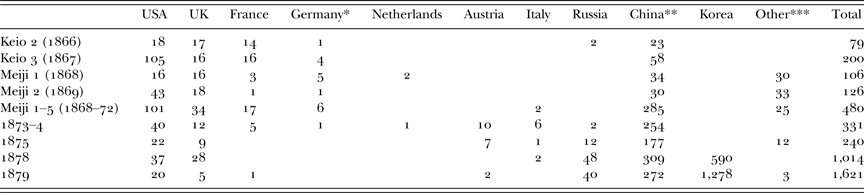
In order to understand fully the scope of overseas travel from one country, one would ideally have a list of who went where, when, for how long, and for what purpose. However, given that the shogunate, and later the Meiji government, exercised only imperfect control over Japanese travellers, many people left the country without passports. Thus, any record from the late nineteenth century is an underestimate of the real scale of cross-border movement. The fact that people often travelled to multiple countries disregarding the destination declared on their passports adds to the complication. Nevertheless, these records of passport applications are still worthwhile for obtaining a rough overview.Footnote 31
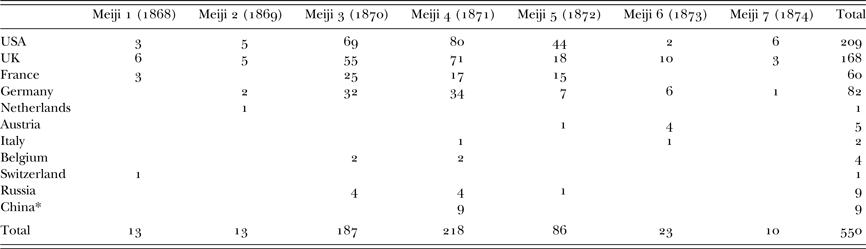
Ishizuki Minoru and Andrew Cobbing both estimated the outward flow of Japanese students to be a few hundred per year at most and showed that the United States and Britain were the most common destinations.Footnote 32 Similarly, but on a larger scale, Tezuka Akira's data lists around 4,200 people who travelled between 1861 and 1912 ‘for the purpose of study or observation’.Footnote 33 It is difficult to reconstruct the breakdown of destinations from his data, but it shows two waves of outgoing travellers in the mid-1870s and the mid-1880s.Footnote 34 Small discrepancies aside, they agree that each year the number of travellers were within the range of a few hundred.
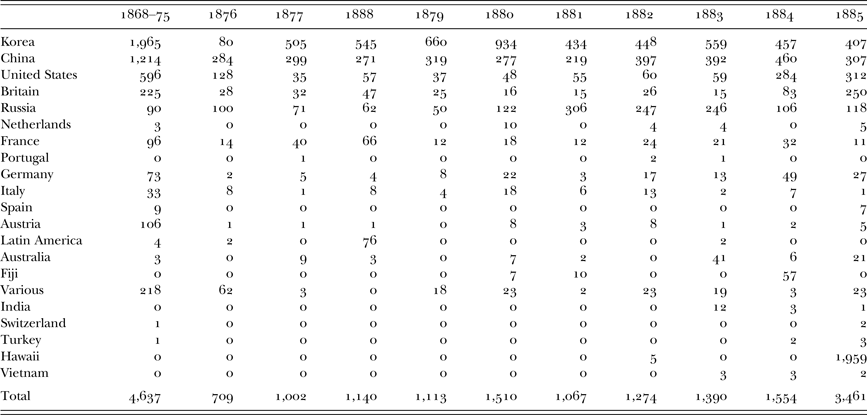
How many non-student travellers went overseas, though? The data in the appendix, put together from official statistics published by the foreign ministry in 1926 and unpublished records of passport applications, gives some guidance. Certainly, this should not be taken to indicate the exact number (or even scale) of overseas travel in these years. Nevertheless, they sufficiently suggest that the statistics on students and officials reveal only a part of the whole story. For the first seven years of Meiji, for instance, the number of travellers to Korea and China dwarfs that to the United States. Also evident is the impact caused by the beginning of emigration to Hawaii, as it almost doubled the total passports given out in 1885.Footnote 35
China and Korea continued to be destinations that were at least as important as the United States and Britain. The data suggests that in 1878 and 1879 China and Korea accounted for the vast majority of all passport applications.Footnote 36 Moreover, the density of traffic between these two countries and Japan would have been higher than what these figures suggest. This is because travellers could entirely bypass the passport application process or make multiple trips with a single document. It was even possible to apply for a passport at an overseas Japanese consulate after leaving the country without a passport, although this practice stopped soon after 1878.Footnote 37
Aside from the total number of travellers, passport records contain information on the background of applicants – their names, addresses, occupation, age, and the declared purpose of travel. It shows, among other things, the centrality of Nagasaki for the Japanese overseas travel in this period. In the first decade after 1868, 1,285 applications were made in Nagasaki, the number roughly three times more than that in Kanagawa (Yokohama).Footnote 38 What is more remarkable is the number of travellers from Tsushima, the island located north of Kyushu, to Korea. In 1878 and 1879, more than half of those who travelled to Korea were residents of this island with a population of around 30,000. It sent at least 650 people to Korea in 1879 – or around 2 per cent of all residents.Footnote 39 For the majority of Japanese travellers in the late 1870s, ‘going overseas’ meant crossing either the Tsushima strait or the East China Sea.
In sum, the information from passport application records points to the existence of a gap between the study of bakumatsu to early Meiji students and migration history. Passport application records provide an avenue with which to approach intra-Asian travellers, who constituted the majority of border-crossers before the mid-1880s. The statistics also attest to the significance of commercial ties that Nagasaki had with Shanghai and Pusan (via Tsushima) before the legalization of Japanese overseas travel. It also suggests that the pattern of movement was heavily influenced by the existence of regular passenger ship services that connected Nagasaki with East Asian ports. It is true that the Meiji government regarded the dispatch of students as an important part of Japan's modernization project. Yet seen as a whole, the students were a minority in the middle of a wave of commercial opportunists heading for East Asia.
III
Faced with the outflow of merchants, labourers, jugglers, and the like, especially to East Asia, the Meiji government responded with caution, paternalism, and a fear of financial drainage. The first incident to illustrate the new government's challenge was what came to be known as the ‘van Reed incident’ or ‘gannenmono (first-year-people) incident’. Eugene van Reed was an American merchant based in Yokohama who worked as the Hawaiian consul. In 1867, he applied for passports to send 300-odd migrants to Hawaii and forty-two to Guam. The migrants to Hawaii were deemed as replacement for Chinese labourers in sugar plantations.Footnote 40 The shogunate authorities granted the passports. The migrants to Guam departed before the takeover of the port by the anti-Tokugawa forces in 1868. The Meiji government was completely unaware of them until 1871, when four of them came back on a British ship that had happened to call at Guam. Having suffered from dismal working conditions, the surviving twenty-eight returned by the beginning of 1872.Footnote 41 As for the emigrants to Hawaii, just before the migrants were shipped to Hawaii the anti-Tokugawa forces took over the office in Kanagawa, which administered Yokohama. Terashima Munenori, the new governor of Kanagawa, and Higashikuze Michitomi, who presided over foreign affairs before the formal establishment of the foreign ministry, refused to grant passports to van Reed's migrants on the ground that Hawaii had not concluded a treaty with Japan.Footnote 42 After a week of negotiations without success, on 17 May 1868, van Reed shipped 148 migrants without passports.Footnote 43 One Hawaiian newspaper praised the arrangement as ‘most opportune in supplying our immediate needs’ and stressed that they were not coolies. The distinction was important because the majority of Western governments had been condemning the inhumane treatment of Chinese coolies shipped across the Pacific since the middle of the century.Footnote 44 Another newspaper observed that the migrants were ‘favourably received by our population, both Hawaiian and foreign’.Footnote 45
The American government, however, saw little difference between Chinese coolies and the arriving Japanese. The US congress had passed the Anti-coolie Act in 1862 and prohibited Americans to engage in the coolie trade ‘in China and elsewhere’. Robert B. van Valkenburgh, American minister to Japan, reckoned that the Act should be applied to the current case, even though he noted that the Japanese government disapproved the shipment of ‘any other than voluntary emigrants’.Footnote 46 The American minister could not intervene, however, because van Reed's ship carried a British flag and he acted as Hawaiian consul general.Footnote 47 Having received van Valkenburgh's report, the US congress expanded the scope of the Anti-coolie Act ‘to include and embrace the inhabitants or subjects of Japan, or of any other oriental country, known as coolies’.Footnote 48 The scepticism against the shipment of Japanese was shared by the American minister resident in Honolulu, Edward McCook, who urged the Hawaiian foreign minister, Stephen Phillips, to ‘discontinue and discourage a traffic so repulsive that it meets with the reprobation of the civilized world’.Footnote 49 Phillips, representing the business interest in the island, disagreed with McCook. He acknowledged that Hawaii had opposed the coolie trade, but the Japanese brought in this time were, to his eyes, ‘not “coolies” in any sense in which that term can be offensively used’.Footnote 50 They were ‘immigrants’ who had arrived of their own will, as far as he was concerned. Unpersuaded, McCook published a notice on 31 August to American citizens and ship-owners in Hawaii, showing them the resolution passed by the Senate on 16 January 1867, which reconfirmed the 1862 Anti-coolie Act.Footnote 51 A local Hawaiian–English bilingual newspaper sided with McCook in opposing the introduction of the Japanese as they believed ‘that fraud was practiced upon both Chinese and Japanese’.Footnote 52
Due to the American opposition, the Meiji government began to fear that the incident, if left unaddressed, might tarnish its reputation. Being known as a coolie-exporting country would jeopardize this new government's effort to stand on par with the treaty powers. In September 1869, it appointed Ueno Kagenori as envoy to Hawaii for the observation of the treatment of the Japanese workers and repatriation of those who wanted to return. Ueno wrote just before his departure that the conditions were ‘close to slave trade’ and it would be ‘a national humiliation vis-à-vis other countries’.Footnote 53 He arrived at Honolulu on 27 December, and arranged the return of forty migrants who wished to go home.Footnote 54 The rest had left for the United States or chose to remain in Hawaii.
After this incident, the Japanese leaders remained deeply apprehensive about the potential damage that the drain of Japanese labour might cause. The lingering impact was observed in an overture to the foreign ministry from F. P. van der Hoeven, the Dutch minister resident in Tokyo. On 4 July 1871, van der Hoeven approached the foreign ministry and asked if the Dutch East Indies could hire Japanese soldiers. He had a high regard for their ability in combat as he had heard stories of Japanese mercenaries hired by the Dutch in Batavia in the early seventeenth century. They were ‘more courageous than our countrymen, so [we] would like to hire [them]’, he told Soejima Taneomi, the foreign minister. According to his plan, the troops would be 500 men at most, engaging in reconnaissance, and the contract would end in six or seven years. ‘It is different from the case of Hawaii’, assured van der Hoeven.Footnote 55
The Dutch representative made at least four face-to-face requests to the Japanese between July 1871 and April 1872. In these talks, Soejima and Terashima Munenori, who had negotiated with van Reed in Yokohama in 1868, refused to oblige on the following grounds. In the first place, Japan's own military force was yet to be fully developed. The legal structure remained in its infancy, and there was no rule on dispatching contracted soldiers overseas. The seventeenth-century precedent took place when the conduct of Japanese soldiers – at least in their view – was not judged under international law. Also problematic for Japan was the existence of the most-favoured nation clause in the treaties that it had concluded with the Western countries. Soejima worried that ‘if we lend your country three hundred men, we will have to accede to offers from other countries that might ask for tens of thousands of men’.Footnote 56 Ultimately, they were afraid that there might soon be a repetition of the van Reed incident. Terashima explained to van der Hoeven:
We will accept [application for passport] if a person himself wants to go, but there have been so many cases of people who had been employed by foreigners, went overseas and got into difficulties. Already last year the government has incurred tremendous amount of expense with regards to those who went to Hawaii Island. We recently began granting [passports] for those going overseas after nominating a guarantor, so that the cost of repatriation will not become the government's loss.Footnote 57
Failing to reach an agreement, van der Hoeven tried to confirm that the Dutch national was still free to take Japanese employees overseas if they willingly signed a contract. Terashima reckoned that the municipal offices (chihōkan) could authorize individual travellers, but was careful to point out that any case of a large group of emigrants should be discussed at the foreign ministry.Footnote 58
The Meiji government's fear of damaging its reputation by becoming a coolie-exporting nation was evident already in the instructions announced on 28 May 1869, which were to be carried by all passport holders. The paternalistic attitude of the government is barely concealed in its language. The passport holders were reminded to observe all treaty obligations; take note of anything potentially useful for the country and report it to the port authority once they returned; interact with and provide support to other Japanese travellers even if they were strangers; to keep calm even if foreigners aggravated them and report to the local authorities – ‘absolutely do not kill or harm them’; store passports in a safe place; never obtain foreign nationality or convert to foreign religions; and, perhaps most tellingly:
Now that you are leaving the homeland and going to a foreign country, each of you must have determination. It goes without saying that you are to behave yourselves, and take the very best care to avoid spoiling the reputation of our country. Also it is absolutely forbidden to get into debt with a foreigner without security; if you run out of money for travel and could not help but to borrow money in a foreign country, you are to do everything you can to pay it back before returning home; make absolutely sure there will be no insincerity. If you dare conduct embezzlement (hikimake) and if that transpires after your return, you and your whole family will be held culpable and be made to pay it back.Footnote 59
The Meiji government therefore understood that the majority of their travellers were not going to be students hailing from privileged backgrounds but commoners who sought economic gains.Footnote 60 Bearing this in mind, the experience of bringing back migrants from Hawaii taught the foreign ministry that it could not send an official mission every time a Japanese emigrant got into trouble and pleaded for help. The foreign ministry therefore began to devise a system in which the ministry would not need to assume any financial liability for future emigrants. Nagasaki prefecture received the ministry's instruction on 18 November 1869 that passport applicants should be questioned about their reason for going overseas, the name of their employer, how they expected to finance their transportation, and how he or she would repay a debt if he or she borrowed money from a foreigner while overseas. Circus performers were also to be asked about their salary and the name of the ship they were travelling on. Moreover, if the applicant was a merchant or an ex-criminal, ‘a note from a guarantor should be submitted…so that if the person gets in debt overseas and cannot repay, people from the [holder's] village or town should be held responsible for paying back’.Footnote 61
In the beginning of the 1870s, the foreign ministry clearly backed down with regard to sending Japanese people overseas. In the summer of 1870, soon after Ueno's return from Hawaii and the first contact from van der Hoeven, the foreign ministry ordered the treaty ports to submit the complete list of outgoing travellers since 1868.Footnote 62 In 1869, the ministry had distributed 300 copies of blank passports, which was more than enough to meet the demand, to each treaty port for the officials to fill them in with applicants’ details and give them out.Footnote 63 Judging from the available records, however, from 1872 to 1875 it never sent more than fifty copies to Nagasaki, where the largest number of applicants turned up.Footnote 64 This sluggish supply of passports caused delays in processing applications. Miyagawa Fusayuki, the governor of Nagasaki who was in charge of issuing passports, often had to nudge Tokyo to send him more blank passports before his stock ran out. Most of Miyagawa's requests were ignored by the foreign ministry. In 1872 and 1875, under pressure from applicants and their foreign employers, he was forced to issue provisional passports that did not have the ministry's seal.Footnote 65
The other reason why there was no large-scale outflow of labourers in the 1870s was that the government sent those trying to start a new life to Hokkaido. The fear of Russia's southward expansion and the necessity of providing a way of living to the population, including the former samurai class, led the Meiji government to initiate a large-scale migration project called tondenhei. Between 1874 and 1882, 2,420 former samurai men and their family members settled in various parts of Hokkaido under the administration of Kaitakushi (Hokkaido Colonization Office).Footnote 66
This is not to suggest that the Meiji government had a good grip on cross-border movements. Many people travelled without proper documents and the government never implemented tight controls on the border, nor was it keen on doing so. Even if the travellers were leaving from a treaty port on a Western steamer, the document check seems to have been very limited.Footnote 67 Moreover, the unclear status of the extent of the Japanese territory led to confusion and the inability of the government to enforce border control. Especially troublesome was the northern edge of the country. Hokkaido and the Kuril Islands, stretching from the east of Hokkaido to the Kamchatka peninsula, attracted visitors due to its abundance of natural resources, most notably fur animals such as sea otters and seals. By the early 1870s, sailors around the North Pacific discovered that the sea otter population in the Kuril Islands had recovered from the decimation that it experienced several decades ago.Footnote 68 Ships flocked to the coast of the Kuril Islands and Etorofu Island, which was the northernmost territory of Japan at the time. The fur-hunting vessels, most of them based in San Francisco, came to Japanese ports first to recruit men. Some of them had the workers apply for passports; others did not bother. The Japanese government vessels were far too limited to monitor such a vast area; even though the Kaitakushi occasionally caught the trespassers and made them pledge they would never return, this was impossible to enforce. It was ‘just like chasing flies over smelly food’, one officer reported from eastern Hokkaido in the early 1880s.Footnote 69
By the end of the 1870s, the foreign ministry felt more comfortable sending people overseas, and to a limited extent began catering to their convenience. In contrast to the Shogunate's announcement in 1866, Japan's first comprehensive law on passports, enacted on 20 February 1878, did not obligate travellers to carry passports. The regulations in this law, Kaigai ryoken kisoku, simply stated that ‘passports are useful when abroad in proving that one is a Japanese citizen, and therefore the foreign ministry issues them’.Footnote 70 The focus of their regulation was on dealing with short-haul travellers, and some measures catered to the needs of travellers rather than regulating their movements. On 6 March, the foreign ministry announced that those going to Korea could apply for a passport in six newly designated cities, all in western Japan and including one in Tsushima, in addition to the ministry and the treaty ports.Footnote 71 Travellers to Korea also benefited from a reduced fee of fifty sen (half yen), compared to two yen for other destinations.Footnote 72 Also in the same month, the ministry introduced for the first time multiple-entry passports for those going to Korea, China, Vladivostok, and Korsakov (on the southern coast of Sakhalin). This was deemed necessary on the ground that these places were ‘close to Japan and there are those who make several round trips every year for either trade or other business, and issuing a passport each time creates complication for them’.Footnote 73
Multi-entry passports were an extension of the measures introduced first for travellers to Shanghai in July 1874, following a suggestion by Miyagawa Fusayuki, the Nagasaki governor, in collaboration with Shinagawa Tadamichi, the Japanese consul at Shanghai. They told the foreign ministry that it was inconvenient for merchants (like the Tashiro family and their employees) shuttling between Shanghai and Nagasaki to apply for passports every time they left Japan and to return the document once they got back. On 17 July 1874, Terashima Munenori, the foreign minister, following Miyagawa's request, agreed to relax the regulations for Shanghai-based merchants who applied for a passport in Nagasaki.Footnote 74 Miyagawa and Shinagawa then advocated for the expansion of the same treatment to merchants based elsewhere such as Yokohama.Footnote 75 By December 1874, Terashima informed the treaty ports other than Nagasaki that those going to any ports in China could make multiple entries with a single passport, provided that their documents were examined every December.Footnote 76 The example points to the importance of officers stationed in the periphery in formulating Japan's border control scheme.
IV
The Meiji government was highly sensitive about how its policy towards outbound travellers may appear in the eyes of Western observers. As noted earlier, the introduction of the passport system was a part of Japan's effort to emulate the customs of the Western world. The restriction on large-scale labour migration aimed to avoid being labelled as a coolie-exporter. It is true that the Japanese authorities succeeded in implementing the measures they wanted. But in reality, European discourse regarding passports in the mid-1860s was quite different from what the Japanese believed it to be. The most striking feature was that Europe was moving towards the abolition of passport requirements at its borders.
Originating in France during the revolution in the 1790s, the modern passport system initially spread over Europe as a means of blocking the escape of the states’ enemies from the country. Half a century later, with the rise of mercantilism and free trade, big businesses based in cities began to view it as an irksome restriction on free economic activities. In central Europe, four states in northern Germany concluded a treaty in 1865 and abolished passports and visa requirements among themselves. Based on this treaty, two years later the North German Federation adopted the passport law that granted freedom of travel within the federation to its nationals and foreigners.Footnote 77 The Prussian king Wilhelm I declared to the parliament that this law aimed at ‘doing away with antiquated restriction upon intercourse’.Footnote 78
Britain had been open to arriving foreigners and had exerted no restriction on them at least since 1850.Footnote 79 Richard Cobden, renowned British politician and campaigner for free trade, asserted in the House of Commons in 1858 that the passport system was ‘totally useless as a security, and therefore ought to be abandoned’.Footnote 80 When France reintroduced the once-abolished passport requirement for British nationals in the spring of 1871, the British public were united in fury. A satirical magazine Punch called for ‘a general strike’ in order to bring down the French policy by withdrawing Britain's business from France. ‘Nobody now, unless on business absolutely necessary, should go to France, as long as the reimposition of the passport plague continues’, it stated.Footnote 81 Thomas Cook, the British pioneer of international tourism and devout believer in free travel, argued that ‘the passport is…regarded by a large class of enlightened and intelligent travellers as utterly incompatible with the freedom of commercial and social intercourse which characterises the present age’.Footnote 82 He called the French policy ‘a great mistake’, ‘semi-barbarism’, and ‘a suicidal policy’ for its commerce.Footnote 83 France succumbed to these voices and scrapped the passport requirements for the British on 11 April 1872.Footnote 84 France also abolished passports on the border with Belgium in the same month.Footnote 85 Lord Granville, British foreign secretary, proclaimed in 1872 that the British law guaranteed all foreigners ‘the unrestricted right of entrance into and residence in this country’.Footnote 86 The undercover students from Satsuma and Chōshū, who smuggled themselves out of Japan with the help of the British merchants in the mid-1860s, would therefore have had no problem on their arrival in Britain. The trend in Europe was clearly towards less restriction at the borders.
Seen in this context, Tokugawa's assumption that the introduction of passports would place its border control system on par with that in the Western world was misplaced. While adopting the French and American format, Japan still catered to its own needs. Is this, then, another story of Japan's superficial mimicry of Western civilization that never altered the fundamental structure of the society? In fact, there is more to the European story of free movement in the Victorian era; and there is more, too, on the Japanese side, than the straightforward transplantation of what the Westerners had been doing.
Even at the height of Victorian ideology of free intercourse among nations, the passport system did not entirely disappear. Despite the fact that more and more governments stopped requiring passports at the borders, people continued to carry them. In Britain, throughout the 1860s, the Foreign Office issued thousands of passports to its nationals primarily because they served as bearers’ proof of citizenship. It was stated in the parliament that ‘Foreign Office Passports are granted only to British-born subjects, or to Ionians, or to such foreigners as have become naturalized.’Footnote 87 Passports were needed because travellers in Europe often encountered arbitrary arrests or detention while travelling through a foreign country.Footnote 88 In order to prove they were exempt from passport requirements, it was necessary to prove their nationality by showing an identification document, which was, for most people, a passport. Travel guides published in Britain in the 1860s and the 1870s thus advised travellers to obtain passports from the Foreign Office ‘as a wise precaution’.Footnote 89
A similar course of discussion can be found in the United States in the 1850s. A legislation in 1856 confirmed that the State Department was the sole authority to issue passports, and the US passport was to be issued only to its citizens. Thus, the US passport in theory began to function as a certificate of citizenship. Confusion lingered on, nonetheless, not least because the criteria of US citizenship and what proof one could employ as evidence remained unclear, especially in the case of free African Americans and US citizens who were long-time residents outside the country.Footnote 90 In the mid-nineteenth century, the passport in the Western world was somewhere between a letter of introduction and certificate of citizenship, moving towards the latter.
In contrast, the passport system in Japan did not help the travellers prove their nationality or citizenship. Practically no foreigner was going to apply for a Japanese passport until Japan acquired Taiwan in 1895, at which point it became an issue whether a colonial subject was entitled to a Japanese passport.Footnote 91 Nor was it necessary for applicants to register with their ‘real’ names. Circus performers and teahouse girls usually had their professional names written on their passports. Between 1868 and 1871, a teahouse girl named Tsukasa – with no family name, indicating that this was not her real name – received passports four times.Footnote 92 Japanese passports did not carry a date of expiration; instead, it stated the length of time the bearer was permitted to stay overseas. The physical description section, adopted from the American passport, did not serve the original purpose of avoiding fraudulent use overseas. This can be seen, for instance, in the fact that in the early 1870s, the applicants known to the foreign ministry, such as diplomats, senior politicians, and military officers, often received a passport describing many of their physical characteristics as ‘average’ (nami). As long as the ministry officials knew the holder of the document, they regarded the physical description as unnecessary. This shows the ministry's view that the foreign authorities were unlikely to pay attention to this section, if at all to the entire document. The category was necessary for the Japanese officials to confirm the return of the traveller at treaty ports. Thus, the Meiji government's act of issuing passport to the Japanese served the state, not the travellers. Whereas the European passport application fee could be understood as a price for receiving due privileges en route, the application fee for a Japanese passport was nothing more than a tax on overseas travellers.
The connection between the Meiji government and its passport travellers presented itself only when the latter crossed the borders of Japan. Once they were abroad, the Meiji government refused to bear any responsibility. Giving out passports did not mean the government would protect them. Nor was it practical to promise such protection, since until the end of the nineteenth century Japan did not possess extraterritoriality. Japanese found culpable for crime while overseas had to face trial by the legal authority of the place concerned, not by the Japanese consul, as was the case for the residents of the treaty powers in China and Japan. In other words, there was no legal use in proving one's nationality as Japanese while he or she was abroad. From a traveller's point of view, a passport was a document that was meaningful only in terms of his or her relations with the Japanese government. It was merely a permission to leave the country for a limited period of time, even though this was only liberally enforced.
Japan's modern passport system thus began to serve the government in regulating the undesired cross-border movement and by doing so unconsciously diverged from one of its original goals of emulating the Western system. The development of the system was sometimes led by port authorities, especially in Nagasaki; yet Nagasaki and Tokyo did not always agree on the treatment of passport applicants. While the latter wished to suppress undesired movements, the implementation of the border control scheme was often perfunctory. In dealing with the passport policy, the foreign ministry in Tokyo was primarily concerned with how it might be perceived by the Western governments. Nagasaki, on the other hand, catered to the needs of local residents – both foreign and Japanese. The result was a confused mixture of paternalistic rhetoric and pragmatic modification of the details of the regulations.
V
The conventional narrative of Japanese travellers focused mainly on students has tended to reiterate the image of nineteenth-century international relations as a dichotomy between the civilized and the rest, in which Japan was depicted as aspiring to join the former. Whilst there is truth in such a view, the investigation of non-student Japanese travellers opens up an avenue for a new interpretation of Japan's place in the nineteenth-century global migration. The Tokugawa shogunate, faced with growing pressure to engage in free trade with the treaty powers as well as the rise of domestic rivals such as Satsuma and Chōshū, ended the travel ban and introduced the passport system. It was hoped, by doing so, that such a change would enable the shogunate to reinvigorate its authority over border control and external sovereignty. The legalization of overseas travel by the Japanese did not come as the first stage of a grand design towards the Western model of modern statehood. Japan copied the format, but the substance and the purpose of the passport policy had more to do with the domestic necessity.
Once the border was opened for the Japanese, the majority of the travellers were merchants and labourers heading to China and Korea, often taking advantage of pre-existing connections between port cities. The route connecting Nagasaki with Shanghai and Pusan turned out to be the busiest route for early Japanese travellers. The trend continued until the introduction of government-sponsored large-scale migrants to Hawaii and the American continent in the mid-1880s.
As far as migrant labourers are concerned, the Meiji government's tactics largely worked. It succeeded in suppressing the movement of manual labourers to foreign soil. There was no second van Reed incident until the first officially sponsored migrants arrived in Hawaii. Many of those who sought new opportunities ended up in Hokkaido. This swaying of surplus labour within the country stemmed from the Meiji government's fear of reputational damage as well as financial drainage that would have resulted from the unrestricted outflow of Japanese manual labourers.
Authorities at the local level, on the other hand, faced a different set of incentives. They were pressured by foreign employers of Japanese labourers to implement liberal reform in the passport system. The Japanese travellers themselves also began to demand more relaxed regulation, including multi-entry passports and lower application fees. The governor of Nagasaki, which turned out to be the most important port for departing Japanese in the early Meiji period, took these demands seriously and negotiated with the foreign ministry in support of liberal reform. When in 1878 the Meiji government announced the Kaigai ryoken kisoku, the assumption was still that it would regulate travellers, not long-term settlers in foreign lands. In other words, the government did not allow for the possibility that a Japanese community was emerging outside the port cities.
The development of the Japanese passport system, therefore, took a life of its own in the first two decades. The purpose of issuing the document differed from the European and American examples that Meiji Japan wanted to copy. The trace of its origins in the Western system did not disappear, but as the European countries increasingly saw passports as an outdated mode of state control on free economic activities, the Japanese system bore less and less resemblance.
Overall, the investigation into the first two decades of the Japanese passport travellers leads to a more complex understanding of modern Japan's opening of borders. One needs to pay more attention to the Eastern impact – the decline of the Chinese coolie trade that led to a demand for alternative sources of labour, and the Meiji government's resulting desire to dissociate its image from that of the Qing government. It also brings to fore the potential usefulness of examining relations between Tokyo and municipal authorities. In the case of the passport system, the role of Nagasaki's governor had a decisive impact in formulating the detail of Japan's modern passport system and thus the precise workings of the ‘opening’ of Japan in the early Meiji period. Such re-examination may also be possible in other aspects of Meiji Japan's modernization. This could lead us to a better understanding of Meiji Japan as a whole, going beyond the government-to-government relations that have dominated the study of Japan's modernization in the late nineteenth century.
Appendix
Student travellers from Japan, 1868–1874

Japanese travellers ‘for study and observation’, 1866–1886

The foreign ministry's statistics on Japanese passports issued by destination, 1868–1885

Primary records of passport applications, 1866–1879