In developed and developing countries, obesity has been increasing in children and adolescents, reflecting the need for early assessment of these groups with regard to cardiovascular risk. In Brazil, the prevalence of excess weight/obesity reaches 40.6% in adults and 16.8% in adolescents, according to data from the Family Budget Survey conducted in the period from 2002 to 2003, which corresponds to 35.5 million overweight adolescents in the country.1
Obesity has been defined as excessive body fat rather than simply excessive body weight.2 Studies have revealed a high prevalence of excessive body fat in eutrophic adolescents, according to body mass index classification – “normal weight obese”.Reference Sampei, Novo, Juliano and Sigulem3, Reference Vieira, Priore and Ribeiro4 In those studies, however, it was not verified whether excessive fat was associated with a higher risk of cardiovascular diseases.
Several anthropometric indices have been used in the prediction of cardiovascular risk in adults. However, owing to the increasing rise of obesity in the last 20 years, researchers have started to evaluate the usefulness of these indicators among the adolescent population as well. Such indicators are classified according to the type of obesity they are used to evaluate. The body mass index reflects total obesity, whereas the skinfolds reflect both total and regional adiposity based on the central and peripheral skinfold ratio;Reference Brambilla, Manzoni and Sironi5 the waist circumference, waist/hip ratio, waist/stature ratio, conicity index, sagittal abdominal diameter, and coronal diameter are indicators of abdominal obesity,Reference Valdez, Seidell, Ahn and Weiss6–Reference Garaulet, Hernandez-Morante, Tebar, Zamora and Canteras8 whereas the circumferences of the hip and thigh reflect the peripheral fat, which is thought to have a protective effect against dyslipidaemia,Reference Caprio, Hyman and McCarthy9 diabetes, and arterial hypertension.Reference Snijder, Zimmet and Visser10
Those measurements have produced better results than the body mass index, which is widely used in the evaluation of the nutritional state of adolescents, probably because fat location plays a more important role than total adiposity in terms of the risk of developing diabetes mellitus type 2 and cardiovascular diseases.Reference Semiz, Ozgoren and Sabir11 However, the most adequate anthropometrical fat location indicator for this specific group has not yet been established.
This study is aimed at evaluating the correlation between body fat location measurements and cardiovascular disease risk factors in adolescents who are eutrophic according to their body mass index but show a high percentage of body fat, compared with either eutrophic adolescents with appropriate body fat or those with excessive weight.
Materials and methods
Rationale
This study is epidemiologic and cross-sectional. The population evaluated comprised 113 female teenagers, who were public school students, in the age group between 14 and 19 years. For the sample selection, all female adolescent students from public schools in Viçosa, Minas Gerais, Brazil, were invited to participate in the study; however, there were inclusion and exclusion criteria. The exclusion criteria included the use of medication that would interfere with the blood pressure, lipid profile, and (or) glucose metabolism, as well as adolescents in the gestational period. Adolescents presenting with illnesses that would interfere with the blood pressure, lipid profile, and (or) glucose metabolism were also excluded.
The adolescents chosen had presented menarche at least 1 year before the study began. The selection of girls who had already presented menarche was based on the knowledge of the relationship between the sexual maturation stage and body composition, and the fact that the presence of menarche characterises the maturation stage that is next to the final stage.
Initially, a screening was performed in the schools of weight and stature measurements to determine body mass index and body composition using bipedal impedance. These measurements were carried out individually, in a room or location set up for this purpose inside the schools. The adolescents who fit the criteria had individual consultations, and body fat evaluation was performed using horizontal bioelectric impedance with a specific protocol to avoid measurement errors.
The adolescents were included after obtaining written consent from their parents or guardians. The study was undertaken after approval from the Ethics on Research with Human Beings Committee of the University Federal of Viçosa (UFV; Viçosa, Minas Gerais, Brazil).
Anthropometry and body composition
Weight and stature were checked according to the recommendations of JelliffeReference Jellife12 and were used to determine body mass index. The cut-off points for body mass index and the anthropometric references used were those recognised by the Centers for Disease Control and Prevention – National Center for Health Statistics,13 according to percentiles for gender and age. Individuals with body mass index values higher than percentile 85 were considered overweight.13
Body composition was estimated using tetrapolar electrical bioimpedance (Biodynamics©, model 310, version 7.1, Seattle, Washington, United States of America). The evaluation was performed between 7:00 and 8:30 am, as the adolescents had been fasting for 12 hours, and the following instructions were observed: maintaining an interval of at least 7 days from the date of the last menstruation to 7 days before the next one; not using diuretics for at least 7 days before the evaluation; not engaging in any physical exercise during the 12 hours before the examination; and urinating at least 30 minutes before the evaluation.Reference Barbosa14
Using body mass index and body composition values, the sample was divided into three groups. Adolescents with body mass index between percentiles 25 and 85 and a total body fat percentage between 20% and 25%;Reference Lohman15 this group was comprised 40 normal or eutrophic individuals defined as having a body mass index within the normal limits – the control group. There were 38 eutrophic adolescents with a high percentage of body fat, with a body mass index between percentiles 25 and 85 and total body fat percentage above 28% – the study group);Reference Lohman15 this group comprised adolescents who were eutrophic, according to body mass index, but had high body fat – “normal weight obese”. The overweight group comprised 35 adolescents with a body mass index above percentile 85 and total body fat percentage above 28% – the control group.Reference Lohman15
Body fat distribution
The abdominal circumference was checked in two places: the lower circumference of the abdomen – waist circumference – and at the umbilical level – umbilical circumference – under the adolescents’ clothes and at the end of a normal exhalation, using a flexible and non-elastic tape measure.Reference Callaway, Chumlea and Bouchard16 The circumference of the hip was checked over the top of light clothes at the highest circumference of the gluteal area.Reference Callaway, Chumlea and Bouchard16 The thigh circumference was measured at 3 centimetres above the patella on the left side of the body for right-handed individuals and on the right side of the body for those who were left-handed.Reference Asayama, Hayashi and Kawada17 The measurements were taken twice and the average of these two measurements was used. The following indices were calculated: waist/hip ratio expressed by the quotient of waist and hip measurements; waist/thigh ratio expressed by the quotient of the umbilical and thigh circumferences; and the waist/stature ratio expressed by the quotient of the waist circumference and stature.
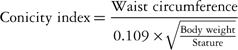
The conicity indexReference Valdez, Seidell, Ahn and Weiss6 was calculated by applying the following formula, which uses the umbilical circumference and stature in metres and weight in kilograms:
The distance between the back and the abdomen, which is called the sagittal abdominal diameter, and the distance between the iliac crests, which is called the coronal diameter, were measured with the adolescents in the supine position, with knees inclined on a flat and firm surface, under their clothes and after a normal exhalation. The medium point was marked using a 50-centimetre metallic pachymeter divided into centimeters and subdivided into millimetres (Cescorf®, Porto Alegre, Rio Grande do Sul, Brazil). The measurements were taken twice and the average of these measurements was used.Reference Garaulet, Hernandez-Morante, Tebar, Zamora and Canteras8
The measurement of skinfolds was taken on the right side of the body, and all measurements were taken by a single evaluator. Each measurement was taken three times non-consecutively, using a Lange Skinfold Caliper (Cambridge, Massachusetts, United States of America). The measurements were obtained using the techniques proposed by Heyward and Stolarczyk,Reference Heyward and Stolarczyk18 with the average of the results obtained being used. Both tricipital and bicipital skinfolds were considered peripheral, whereas the subscapular and suprailiac folds were considered as being central skinfolds. The trunk skinfold and peripheral skinfold ratio was considered an indicator of central fat/peripheral fat.
Cardiovascular risk factors
The participants were advised to fast for 12 hours, and material collection was performed immediately following the anthropometrical evaluation at the clinical analysis laboratory at the Federal University of Viçosa. Following collection, the material was centrifuged for 10 minutes at 3500 rotations per minute in an Excelsa 206 BL centrifuge (Excelsa® II, Model 206 BL, São Paulo, Brazil). The total cholesterol, high-density lipoprotein, and triglycerides were evaluated using the enzymatic method, and automation was provided by Cobas Mira Plus (Roche®, Montclair, New Jersey, United States of America) equipment, whereas the low-density lipoprotein was calculated using the formula proposed by Friedwald.Reference Friedewald, Levy and Fredrickson19 Glycaemia was evaluated using the Glucose-oxidase enzymatic method, and automation was provided by Cobas Mira Plus (Roche®) equipment. Insulin was evaluated using the electrochemiluminescence method with Modular Analytics E170 autoanalyzer using reagents from Roche® (Mannheim, Germany). Insulin resistance was determined using the homeostasis assessment model obtained from the formula – fast insulin, microunits per millilitre × fast glycaemia, millimolar per litre/22.5.20 The leptin dosage was accomplished using the radioimmunoassay method based on the double antibody/Percutaneous Endoscopic Gastrostomy technique with readings taken using a Gama Wizard counter (Perkin Elmer Wizard Gamma Counter Boston, Massachusetts, United States of America). Homocysteine was evaluated using the High Performance Liquid Chromatography method.
Systolic blood pressure and diastolic blood pressure were checked on the upper left limb, using a blood pressure monitor (Omron® Model HEM-741 CINT, Omeron Healthcare Inc., Illinois, United States of America) equipped with automatic inflation, three times at 1-minute intervals, and the average of the last two measurements was used.
Statistical analysis
The distribution of the variables was first verified using the Kolmogorov–Smirnov normality test. The exploratory analysis of the data was undertaken using measurements of the central tendency and dispersion. Tables containing all the variables were then produced. To identify statistical differences between the variables under study among the eutrophic adolescents with high adiposity and the respective controls, the Mann–Whitney test and the Student t-test were used according to the distribution of the variables. In addition, the Pearson or Spearman correlation analysis was performed for the anthropometric variables and the cardiovascular risk factors, according to the normality of the variables. The statistical analysis was performed using Sigma-Statistic 2.0 software. A p-value less than 0.05 was considered statistically significant.
Results
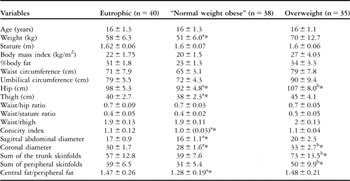
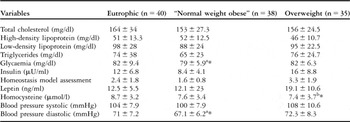
The characteristics of the population being studied are shown in Tables 1 and 2. The averages for age and stature did not differ among the groups, which reflected a degree of homogeneity among them. The weight, body mass index, percent body fat, waist circumference, umbilical circumference, hip, thigh, waist/stature ratio, sagittal abdominal diameter, coronal diameter, sum of the trunk skinfolds, and sum of the peripheral skinfold variables in the eutrophic group were significantly higher than in “normal weight obese” group, but lower in comparison with the overweight group (p < 0.001). Waist/hip ratio and waist/thigh ratio did not differ between the eutrophic and “normal weight obese” groups. Between the eutrophic and overweight groups, no statistically significant differences were observed in the waist/thigh ratio, conicity index, and central fat/peripheral fat.
Means and standard errors of anthropometric characteristics of female adolescent students in public schools of Viçosa, Minas Gerais, Brazil.

Significant (*p < 0.05). The Student's t and Mann–Whitney tests
aDifferences between eutrophic and normal weight obese
bDifferences between eutrophic and overweight
Means and standard errors of parameters related to the cardiovascular risk factors of female adolescent students in public schools of Viçosa, Minas Gerais, Brazil.

Significant (*p < 0.05). The Student's t and Mann–Whitney tests
aDifferences between eutrophic and normal weight obese
bDifferences between eutrophic and overweight
The serum lipid levels were more unfavourable in the eutrophic group compared with the “normal weight obese” group. The eutrophic group showed higher homocysteine values in the adolescents with excessive weight (p < 0.05). In addition, the eutrophic group presented higher values for fast glycaemia, systolic blood pressure, and diastolic blood pressure compared with the “normal weight obese” group, but there were no differences between the eutrophic and overweight groups. Insulin, homeostasis assessment model, and leptin in the eutrophic group were significantly higher than in the “normal weight obese” group but lower than in the overweight group (Table 2).
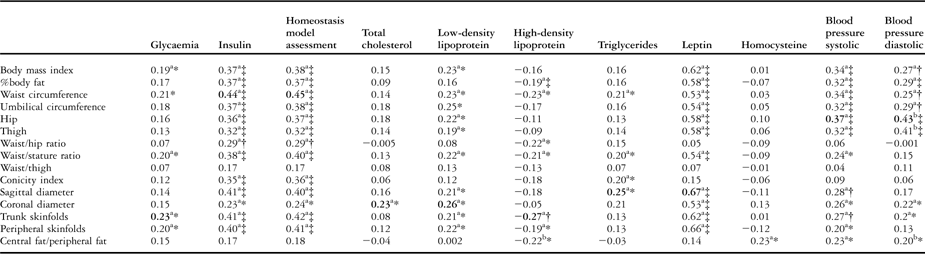
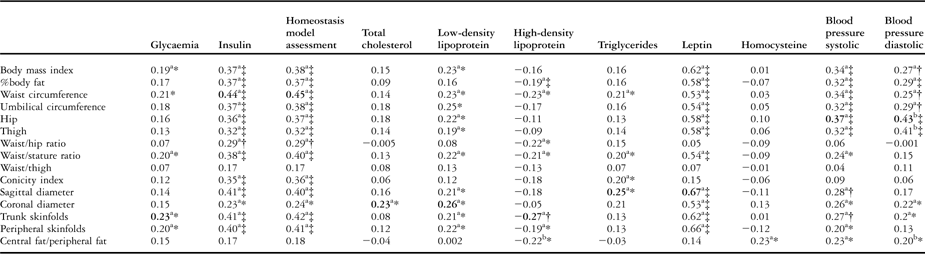
We performed correlation coefficients between the anthropometrical measurements and the biochemical and clinical factors for cardiovascular risk. Among the general population, one can observe that there was a positive correlation between body mass index and hip measurements and glycaemia, insulin, homeostasis assessment model, low-density lipoprotein, leptin, systolic blood pressure, and diastolic blood pressure (Table 3).
Correlation between anthropometric measurements and cardiovascular risk factors in female adolescent students in public schools of Viçosa, Minas Gerais, Brazil.
Significant (*p < 0.05; †p < 0.01; ‡p < 0.001)
aSpearman's correlation test
bPearson's correlation test
There was a positive correlation between percent body fat and insulin, homeostasis assessment model, leptin, systolic blood pressure and diastolic blood pressure, but a negative one with high-density lipoprotein. Waist circumference showed positive association with glycaemia, insulin, homeostasis assessment model, low-density lipoprotein, triglycerides, leptin, systolic blood pressure, and diastolic blood pressure, but a negative one with high-density lipoprotein (Table 3).
Both umbilical circumference and thigh circumference showed a significant correlation with insulin, homeostasis assessment model, low-density lipoprotein, leptin, systolic blood pressure, and diastolic blood pressure. The waist/hip ratio presented a positive correlation with insulin and homeostasis assessment model, but a negative one with high-density lipoprotein. The waist/stature ratio was positively correlated with glycaemia, insulin, homeostasis assessment model, low-density lipoprotein, triglycerides, leptin, and systolic blood pressure (Table 3).
The conicity index presented a correlation with insulin, homeostasis assessment model, and triglycerides. The sagittal abdominal diameter was correlated with insulin, homeostasis assessment model, low-density lipoprotein, triglycerides, leptin, and systolic blood pressure, but showed a negative correlation with high-density lipoprotein. The coronal diameter was correlated with insulin, homeostasis assessment model, total cholesterol, low-density lipoprotein, leptin, systolic blood pressure, and diastolic blood pressure (Table 3).
The central and peripheral skinfolds presented a significant positive correlation with glycaemia, insulin, homeostasis assessment model, low-density lipoprotein, leptin, systolic blood pressure, and diastolic blood pressure, but a negative one with high-density lipoprotein. The central fat/peripheral fat was positively correlated with systolic blood pressure, diastolic blood pressure, and homocysteine, but negatively correlated with high-density lipoprotein. The waist/thigh ratio showed no statistically significant correlation with any risk factor being evaluated (Table 3).
When evaluating for risk factors, the following results were obtained: sum of the trunk skinfolds was the best measurement for predicting glycaemia and high-density lipoprotein; waist circumference for insulin and homeostasis assessment model; coronal diameter for total cholesterol and low-density lipoprotein; sagittal abdominal diameter for triglycerides and leptin; hip measurement for systolic blood pressure and diastolic blood pressure. Among the risk factors being evaluated, leptin followed by insulin and homeostasis assessment model showed the strongest association with the measurements of adiposity and fat distribution among the adolescents (Table 3).
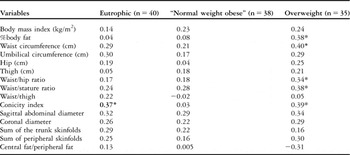
Correlations were noted between the number of cardiovascular disease risk factors among the adolescents and the body fat location measurements (Table 4). The eutrophic group presented a significant correlation with the fat location measured with the conicity index. In the “normal weight obese” group, there was no significant correlation between body mass, total fat or fat location, and the risk measurements being evaluated. The overweight group showed a correlation between the risk factors and percent body fat, waist circumference, waist/hip ratio, waist/stature ratio, and conicity index, with the highest correlation being with waist circumference. When conducting an analysis based on total population, by increasing the number of the samples and the statistical weighting, a significant correlation was verified with all the parameters being evaluated, except for the central fat/peripheral fat ratio. The highest values were found for waist circumference and waist/stature ratio (r = 0.48; data not presented).
Correlation between number of risk factors presented by female adolescents and anthropometric measurements and body composition.

*Significant (p < 0.05). Pearson or Spearman correlation
Discussion
This study showed differences with regard to the anthropometrical measurements, including fat location, among the groups being evaluated. The study group showed higher measurements compared with adolescents with adequate fat, but lower ones in relation to those with excessive weight. This intermediate behaviour also appeared in the biochemical and blood pressure parameters, whereas the eutrophic adolescents with a high fat percentage showed significantly higher values for glycaemia, insulin, homeostasis assessment model, leptin, systolic blood pressure, and diastolic blood pressure in relation to the group with adequate body fat and higher homocysteine than the group with excessive weight. No differences were found in the glycaemia levels or in blood pressure between the group being studied and the one with excessive weight. Fontanive et alReference Fontanive, Costa and Soares21 observed no significant differences in fast glycaemia, triglycerides, total cholesterol, and fractions between the eutrophic adolescents and the ones who were overweight, although this difference has already been reported.Reference Ribeiro, Lamounier, Oliveira, Bensenor and Lotufo22
The data reflect the inability to use only the body mass index when estimating adiposity and the risk to health in young people, as at this age a condition related to body composition has often already appeared. This condition, which has attracted the attention of specialists and is referred to as “normal weight obese”, occurs when individuals with normal body weights in relation to their stature, age, and sex present a high body fat percentage. In a study conducted with 74 women, this condition was shown to be related to glucose intolerance, insulin resistance, and dyslipidaemia.Reference De Lorenzo, Martinoli, Vaia and Di Renzo23 However, information with regard to teenagers is still limited.
Although most correlations between the anthropometrical measurements and the metabolic parameters obtained in this study are not strong, the correlations suggest that the distribution of body fat is relevant in the development of cardiovascular risk factors beginning in adolescence. Of note is the fact that a stronger correlation between the indices and cardiovascular risk factors was observed in the overweight adolescents. Previous studies have showed that the association between central adiposity and risk factors is particularly strong among children and obese teenagers.Reference Brufani, Fintino and Giordani24 Thus, it is possible that some of those associations are influenced by the amount of total body fat; that is, they depend on the presence of a critical amount of fat in order for the relation between central adiposity and risk factors to become apparent.
Of note is the aspect that fat location measurements present differentiated behaviour, namely: glycaemic metabolism and insulin resistance indicators; lipid parameters – coronal diameter for total cholesterol and low-density lipoprotein; waist circumference, waist–hip relationship and sum of the trunk skinfolds for high-density lipoprotein – and blood pressure – hip. This perhaps indicates that they might not be replaceable for one single measurement, and yet may contain complementary information.Reference Yan, Wang and Yao25
In addition, the validity of the indicators that are based on the relation among measurements for predicting cardiovascular risk factors is still under discussion. Studies fail to show that waist/hip ratio reflects intra-abdominal fat when estimated by magnetic resonance imaging,Reference Fox, Peters, Armstrong, Sharpe and Bell26 and that skinfolds and isolated circumferences are better predictors of risk factors than the relation between them among children and adolescents.Reference Sangi, Mueller and Harrist27
When the risk factors were grouped and the correlation between the anthropometrical measurements and the factor numbers was calculated, the highest correlation coefficients were found for waist circumference and waist/stature ratio, when the total population is considered. Waist circumference has been shown to provide a high degree of high sensibility and specificity for the quantification of a high fat percentage in the trunk, while being considered a good predictor of visceral fatty tissue in children and adolescents.Reference Brambilla, Bedogni and Moreno28 Stature affects the measurement of the waist, although the magnitude of this effect has not yet been precisely established. However, the combined use of those measurements could partially correct for such effects. The isolated waist circumference and/or its correction based on stature has been considered useful in identifying both high metabolic and cardiovascular risk in adolescentsReference Maffeis, Banzato and Talamin29 and such methods should be used systematically in clinical practice.Reference Hubert, Guinhouya, Allard and Durocher30, Reference Tybor, Lichtenstein, Dallal, Daniels and Must31
Our data are in accordance with evidence regarding public health statistics, in which increased obesity in youths accelerates the risk of developing type 2 diabetes, as our data take into account the relation found between increased levels of glycaemia and insulin and an increase in excess weight and total and abdominal fat among adolescents.
More than adiposity itself, abdominal fat was related to important cardiovascular risk parameters in female adolescents, whereas waist circumference and waist/stature ratio were the best predictors of risk of disease. In this case, because the measures are simple, innocuous, and low cost, their use associated with body mass index is proposed for clinical practice in order to improve the ability to identify early those individuals with abdominal obesity and high cardiovascular risk.
Acknowledgements
To CAPES for concession of the scholarship to the Post-graduation programme in Science of the Nutrition. To FAPEMIG for the financial support.