1. Introduction
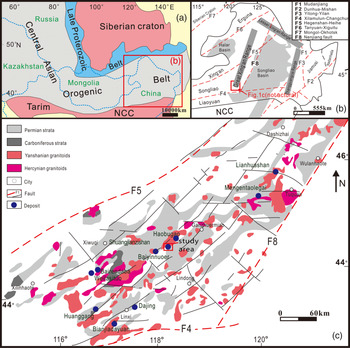
NE China is located in the eastern section of the Central Asian Orogenic Belt (CAOB) (Fig. 1a) and has been jointly influenced by the Palaeo-Asian Ocean, Mongol–Okhotsk Ocean and Palaeo-Pacific tectonic–metallogenic domains (Ouyang et al. Reference Ouyang, Mao, Santosh, Wu, Hou and Wang2014; Zeng et al. Reference Zeng, Qin, Liu, Li, Zhai, Chu and Guo2015; Tang et al. Reference Tang, Xu, Wang, Zhao and Wang2016; Chen et al. Reference Chen, Xia, Ingrin, Deloule and Bi2017; Liu et al. Reference Liu2017). The Palaeo-Asian Ocean was located between the Siberian Craton and the North China Craton (NCC), and the final closure of the Palaeo-Asian Ocean is marked by suturing between the Songliao Block and the Liaoyuan Terrane (Fig. 1b). The closure of the Mongol–Okhotsk Ocean occurred to the NW (current position, F7 in Fig. 1b), and subduction of the Palaeo-Pacific oceanic plate to the east (current position) (Ouyang et al. Reference Ouyang, Mao, Zhou and Su2015). The distribution of granite in the Great Xing’an Range (GXR), an important part of NE China, is mainly controlled by the different tectonic activities that occurred in different periods. The post-orogenic extension during the Triassic Period followed the closure of the Palaeo-Asian Ocean (Liu et al. Reference Liu, Bagas and Wang2016). The northern Mongol–Okhotsk Ocean between the Siberian Craton and NE China closed during Middle–Late Jurassic time (Kravchinsky et al. Reference Kravchinsky, Cogné, Harbert and Kuzmin2002; Cogné et al. Reference Cogné, Kravchinsky, Halim and Hankard2005), and mass subduction of the southeastern Palaeo-Pacific Plate beneath NE China started during the Early Cretaceous Epoch (Zorin, Reference Zorin1999; Wu et al. Reference Wu, Yang, Lo, Wilde, Sun and Jahn2007; Wang et al. Reference Wang, Xu, Lv, Wei, Mei, Fan and Sun2018). Accordingly, it has been reported by previous researchers that the southern GXR is characterized by widespread Jurassic–Cretaceous (Yanshanian) granites and a small amount of Hercynian granitoids (Wu et al. Reference Wu, Jahn, Wilde and Sun2000, Reference Wu, Lin, Wilde, Zhang and Yang2005a; Sui et al. Reference Sui, Ge, Wu, Zhang, Xu and Chang2007; Zhang et al. Reference Zhang, Gao, Ge, Wu, Yang, Wilde and Li2010), bounded by the Hegenshan–Heihe Suture to the north, the Xilamulun–Changchun Suture to the south and the Nenjiang Fault to the east (Fig. 1b, c). These immense volumes of granitic rocks have mostly been considered A-type granites (Li & Yu, Reference Li and Yu1993; Sun et al. Reference Sun, Wu, Li and Lin2000; Jahn et al. Reference Jahn, Wu, Capdeviala, Fourcade, Wang and Zhao2001; Wu et al. Reference Wu, Sun, Li, Jahn and Wilde2002; Zhang et al. Reference Zhang, Parrish, Zhang, Xu, Yuan, Gao and Crowley2007; Yang et al. Reference Yang, Niu, Shan, Sun, Zhang, Li, Jiang and Yu2013). In addition, geochronological and isotopic studies in the southern GXR (Wang et al. Reference Wang, Xu, Lv, Wei, Mei, Fan and Sun2018) have shown that many contemporaneous and A-type granite-related hydrothermal vein-type ore deposits are comparable with those of the adjacent skarn deposits (e.g. the Shuangjianzishan vein-type Ag-Pb-Zn deposit and Haobugao skarn Fe-Zn deposit) and that the magmatism and associated mineralization were coevally generated during the Early Cretaceous Epoch (Zhai et al. Reference Zhai, Liu, Zhang, Yao, Wang and Yang2014; Mei et al. Reference Mei, Lv, Cao, Liu, Zhao, Ai, Tang and Munir2014, Reference Mei, Lv, Liu, Tang, Ai, Wang and Cisse2015; Ruan et al. Reference Ruan, Lv, Yang, Liu, Yu, Wu and Munir2015). The origin of these A-type granites therefore has important geological significance and economic potential because of the close association of A-type granites with skarn and epithermal deposits in the southern GXR (Ouyang et al. Reference Ouyang, Mao and Santosh2013, Reference Ouyang, Mao, Santosh, Wu, Hou and Wang2014; Zhai et al. Reference Zhai, Liu, Zhang, Yao, Wang and Yang2014; Mei et al. Reference Mei, Lv, Liu, Tang, Ai, Wang and Cisse2015; Ruan et al. Reference Ruan, Lv, Yang, Liu, Yu, Wu and Munir2015).
(a) Location of the Central Asian Orogenic Belt (after Liu et al. Reference Liu, Bagas and Wang2016). (b) Tectonic sketch of NE China (after Wu et al. Reference Wu, Sun, Ge, Zhang, Grant, Wilde and Jahn2011). (c) Regional geological map of the southern Great Xing’an Range (GXR) (after Mei et al. Reference Mei, Lv, Cao, Liu, Zhao, Ai, Tang and Munir2014).

The super-large Shuangjianzishan Pb-Zn-Ag deposit, located in southwestern Ganzhuermiao between the Baiyinnuoer and Haobugao deposits (Fig. 1c), is reported to be a typical epithermal vein-type deposit associated with hidden granite porphyry (Wu et al. Reference Wu, Liu, Zeng, Sun and Liu2013; Liu et al. Reference Liu, Bagas and Wang2016; Gu et al. Reference Gu, Chen, Jia and Ju2017). However, whether the Shuangjianzishan granite porphyry is an A-type granite, and the geodynamic setting and genetic mechanism of this granite, remains ambiguous. Two main possible models are at the centre of this controversy: (1) delamination of the lower crust and lithospheric mantle induced by the subduction of the Palaeo-Pacific Plate (Wu et al. Reference Wu, Yang, Wilde and Zhang2005b; Wang et al. Reference Wang, Zhou, Zhang, Ying, Zhang, Wu and Zhu2006a; Zhang et al. Reference Zhang, Ge, Wu, Wilde, Yang and Liu2008; Tian et al. Reference Tian, Ge, Yang, Zhao and Zhang2014; Wang et al. Reference Wang, Pei, Xu, Cao, Wang and Zhang2016b); and (2) post-orogenic lithospheric extension related to the closure of the Mongol–Okhotsk Ocean (Fan et al. Reference Fan, Guo, Wang and Lin2003; Meng, Reference Meng2003; Ying et al. Reference Ying, Zhou, Zhang and Wang2010; Wang et al. Reference Wang, Xu, Lv, Wei, Mei, Fan and Sun2018). We consider that it may be feasible to determine which of the two possible models is more likely by investigating the Shuangjianzishan granite porphyry. In this paper, the formation time, evolution and geodynamic significance of Shuangjianzishan granite porphyry (depth greater than 1000 m) and its high affinity with A-type granite are defined by presenting its zircon U–Pb ages and Sr, Nd, Pb and Hf isotopes and whole-rock geochemical data.
2. Geological setting
NE China consists of the Erguna, Xing’an, Songliao, Jiamusi and Nadanhada massifs (Fig. 1b; Fritzell et al. Reference Fritzell, Bull and Shephard2016; Wang et al. Reference Wang, Chen, Chen, Wolfgang and Muharrem2006b, 2016b). The Erguna Block is of Neoproterozoic age, and Jurassic basalts are widely distributed as dykes (Wu et al. Reference Wu, Sun, Zhao, Li, Zhao, Pang and Li2005c). The oldest basement in the Xing’an Block comprises Palaeozoic amphibolite- to greenschist-facies metamorphic rocks (Miao et al. Reference Miao, Liu, Zhang, Fan, Shi and Xie2007). The underlying basement of the Songliao Basin is composed of Palaeoproterozoic meta-gabbro and meta-granite (Pei et al. Reference Pei, Xu, Yang, Zhao, Liu and Hu2007). The Jiamusi Block contains the Proterozoic Mashan complex and the Early–Late Palaeozoic granitoids (Zhang et al. Reference Zhang, Gao, Ge, Wu, Yang, Wilde and Li2010). The Nadanhada Terrane comprises the Raohe complex (a Late Palaeozoic – Jurassic volcano-sedimentary sequence) and undeformed Mesozoic granitoids (Zhang et al. Reference Zhang, Gao, Ge, Wu, Yang, Wilde and Li2010; Wu et al. Reference Wu, Sun, Ge, Zhang, Grant, Wilde and Jahn2011). All of these massifs were separated by a series of NE-trending faults (Fig. 1b).
As an important component of NE China, the southern Great Xing’an Range is bounded by the Nenjiang, Hegenshan–Heihe and Xilamulun–Changchun sutures (Fig. 1c). The Palaeo-Asian Ocean, Palaeo-Pacific and Mongol–Okhotsk subductions (Kelty et al. Reference Kelty, Yin, Dash, Gehrels and Ribeiro2008; Wang et al. Reference Wang, Xu, Pei, Wang, Li and Cao2015; Tang et al. Reference Tang, Xu, Wang, Zhao and Wang2016; Chen et al. Reference Chen, Xia, Ingrin, Deloule and Bi2017; Liu et al. Reference Liu, Zhang, Wilde, Zhou, Wang, Ge, Wang and Ling2017) have jointly developed a suite of NE-trending and E–W-trending large-scale faults, which strongly controlled the regional stratigraphic sequence, magmatism and polymetallic mineralization in this region (Fig. 1c). A widespread Permian succession of sedimentary and volcanic rocks makes up much of the GXR, and also the significant ore-bearing strata regionally. Intense magmatic activities produced widespread NE-trending granite bodies, mainly the Yanshanian granitoids, in the southern GXR (Fig. 1c). Wu et al. (Reference Wu, Jahn, Wilde, Lo, Yui, Lin, Ge and Sun2003) showed that Mesozoic volcanic rocks and granites in the southern GXR have low initial 87Sr/86Sr ratios (0.7045 ± 0.0015), positive ϵNd(t) values (+1.3 to +2.8) and young Sm–Nd model ages (720–840 Ma). Liu et al. (Reference Liu, Jiang, Leon, Chen, Han and Wan2020) reported that the Wulanba granite in the southern GXR originated from partial melting of juvenile crust derived from the depleted mantle with a minor input of old crust. However, Tang et al. (Reference Tang, Sun and Mao2020) suggested that upper Mesozoic volcanic rocks of the GXR were derived from the partial melting of a mantle wedge that was modified by previously subducted slab-derived fluids, and that the magma was likely introduced with limited crustal contamination. Ouyang et al. (Reference Ouyang, Mao, Zhou and Su2015) identified three magmatic stages of the Mesozoic granitoids that occurred during 255–220 Ma, 184–160 Ma and 155–120 Ma. The intrusive activities peaked during late Mesozoic time (155–120 Ma) and were accompanied by large-scale mineralization. For example, the mineralized Huanggang granite has an age of 135–137 Ma (Mei et al. Reference Mei, Lv, Cao, Liu, Zhao, Ai, Tang and Munir2014; Zhai et al. Reference Zhai, Liu, Zhang, Yao, Wang and Yang2014), the mineralized Baiyinnuoer granite has an age of 135–139 Ma (Jiang et al. Reference Jiang, Nie, Bai, Liu and Liu2011; Shu et al. Reference Shu, Lai, Sun, Wang and Meng2013), the mineralized Haobugao granite has an age of 138–139 Ma (Wang et al. Reference Wang, Xu, Lv, Wei, Mei, Fan and Sun2018) and the mineralized Weilasituo granite has an age of 133–136 Ma (Pan et al. Reference Pan, Guo, Wang, Xue, Hou, Tong and Li2009; Zhai et al. Reference Zhai, Liu, Li, Zhang, Li, Fu, Jiang, Ma and Qi2016). The magmatic and mineralizing activity at Shuangjianzishan has been dated at 133–136 Ma (Zhai et al. Reference Zhai, Anthony, Liu, David, Panagiotis, Stylianos, Li, Li and Sun2020). Several studies of the Shuangjianzishan deposit have addressed the ore deposit geology (Kuang et al. Reference Kuang, Zheng, Lu, Liu, Zhang, Li and Cheng2014), mineralogy (Wu et al. Reference Wu, Liu, Zeng, Liu, Sun, Yin and Yin2014), whole-rock geochemistry (Liu et al. Reference Liu, Bagas and Wang2016; Gu et al. Reference Gu, Chen, Jia and Ju2017), magmatic rock and ore geochronology (Wu et al. Reference Wu, Liu, Zeng, Sun and Liu2013; Liu et al. Reference Liu, Bagas and Wang2016; Ouyang et al. Reference Ouyang, Li and Zhou2016; Wang et al. Reference Wang, Sun, Pei, Liu, Liu and Jiang2016a; Wang et al. Reference Wang, Xu, Lv, Wei, Mei, Fan and Sun2018; Zhang, Reference Zhang2018; Zhai et al. Reference Zhai, Anthony, Liu, David, Panagiotis, Stylianos, Li, Li and Sun2020) and S–Pb isotope geochemistry (Jiang et al. Reference Jiang, Zhu, Huang, Xu and Zhang2017; Wang et al. Reference Wang, Xu, Lv, Wei, Mei, Fan and Sun2018). However, questions related to the petrogenesis and the tectonic setting of the Shuangjianzishan granite porphyry remain unresolved. For example, Liu et al. (Reference Liu, Bagas and Wang2016) suggested that the porphyritic granodiorite is interpreted as being adakitic and related to the subduction of the Palaeo-Pacific oceanic plate, whereas Gu et al. (Reference Gu, Chen, Jia and Ju2017) proposed that granite porphyry formed in a post-orogenic extensional environment related to the upwelling of asthenospheric mantle due to the deep break of the subducting plate of Mongolia–Okhotsk.
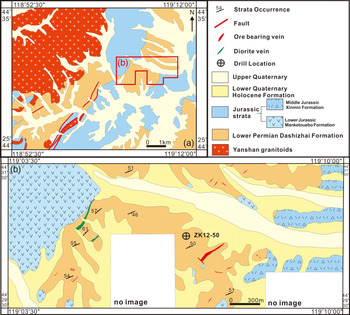
The Shuangjianzishan Pb-Zn-Ag deposit is located in the central part of the Songliao Block (Fig. 1c), which mainly consists of the Upper Jurassic Manketouebo Formation, the Middle Jurassic Xinmin Formation, the Lower Permian Dashizhai Formation and the Quaternary Holocene Formation (Fig. 2b). The Dashizhai Formation comprises tuffaceous and silty slate, and the southeastern Xinmin Formation consists of a suite of volcaniclastic rocks. The northwestern Manketouebo Formation is composed of pyroclastic rocks, felsic lava and andesite. The zircon U–Pb ages of the Manketouebo Formation volcanic rocks are 150–160 Ma (Yang et al. Reference Yang, Gao, Chen, Zhou, Zhang, Jin and Zhang2012). Quaternary sediments, located in the valleys, mainly consist of proluvial and alluvial materials. A large amount of Yanshanian granites are distributed in the northwestern periphery of the mining area (Fig. 2a). An unexposed granite porphyry was discovered by drilling exploration (ZK12-37 in Zhai et al. Reference Zhai, Anthony, Liu, David, Panagiotis, Stylianos, Li, Li and Sun2020; ZK12-50 in Gu et al. Reference Gu, Chen, Jia and Ju2017). Since the discovery of the Shuangjianzishan deposit, several studies on the geochronology have been completed (Table 1). There are three magmatic periods described by the Shuangjianzishan deposit (254–239 Ma, 169–159 Ma and 135–128 Ma) and there is no final consensus on the age of the granite porphyry. For example, Ouyang et al. (Reference Ouyang, Li and Zhou2016) consider that U–Pb zircon ages of the granite porphyry are 159 ± 2 Ma. However, most studies suggested that the age of granite porphyry is c. 130 Ma (Liu et al. Reference Liu, Bagas and Wang2016; Wang et al. Reference Wang, Sun, Pei, Liu, Liu and Jiang2016a; Gu et al. Reference Gu, Chen, Jia and Ju2017; Zhai et al. Reference Zhai, Anthony, Liu, David, Panagiotis, Stylianos, Li, Li and Sun2020).
(a) Geological map of the Shuangjianzishan Pb-Zn-Ag deposit (after Liu et al. Reference Liu, Bagas and Wang2016). (b) Large-scale geological map of the Shuangjianzishan mining area.

Ages of magmatism in Shuangjianzishan deposit, all determined by zircon U–Pb dating

3. Core and sample descriptions
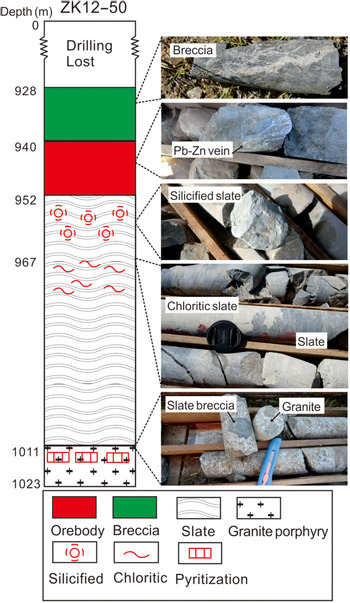
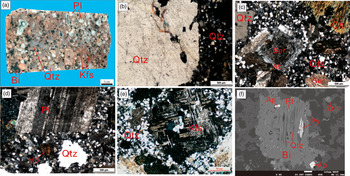
Zhai et al. (Reference Zhai, Anthony, Liu, David, Panagiotis, Stylianos, Li, Li and Sun2020) subdivided the granite porphyry into lower coarse-grained facies and upper fine-grained facies, and Gu et al. (Reference Gu, Chen, Jia and Ju2017) described the mineral composition of the granite hand specimens. According to our observations, the granite porphyry was found in the core of drill hole ZK12-50 from a depth of 1011 m to the bottom at 1023 m, and presents uniform coarse-grained facies without facies change at depth. The granite porphyry is in intrusive contact with the Lower Permian Dashizhai Formation and the contact is an intrusive breccia, with xenoliths of Permian slate within the granite. The main alteration in the granite near the contact zone is pyritization (at 1011 m), and the overlying slates have undergone strong chloritic and silicic alteration (from 967 to 952 m) and contain numerous Pb–Zn veins (Fig. 3). From the granite porphyry to the country rock, the alteration varies from pyritization, chloritic to silicic alteration. Under the influence of the magmatic–hydrothermal activity, abundant breccias cemented by minor quartz-calcite occur in the Permian slate, and the ore bodies are lenticular ore-bearing veinlets (Fig. 3). The number of samples is limited as the core column was badly damaged. Nine rock samples from ZK12-50, collected from 1011–1023 m depths at an interval of about 1 m, were analysed for their zircon U–Pb dates and whole-rock and isotope compositions (Table 2). The granite porphyry is red and has a porphyritic texture (Fig. 4a). The phenocrysts are euhedral plagioclase (15–20 vol%), subhedral K-feldspar (10–15 vol%) and subhedral quartz (20–25 vol%) (Fig. 4b, d, e). The dark minerals observed in hand specimens are mainly flake biotite (> 10 vol%). The matrix (30–35 vol%) consists of quartz, plagioclase and K-feldspar with minor hornblende and accessory minerals (< 2 vol%) including rutile, pyrite, zircon and apatite (Fig. 4f). The plagioclase is partially altered to sericite, and the biotite is partially altered to chlorite (Fig. 4c).
Simplified drill columnar section and photographs of intrusive contact relation.

Sample collection in Shuangjianzishan deposit, all coarse-grained granite

Hand-specimen photograph, photomicrographs and back-scatter electron image for the Shuangjianzishan granite porphyry: (a) porphyritic texture; (b) quartz phenocryst and matrix quartz; (c) sericite and chlorite alteration; (d) plagioplase phenocryst; (e) K-feldspar phenocryst; and (f) biotite and accessory minerals. Pl – plagioclase; Bi – biotite; Qtz – quartz; Kfs – K-feldspar; Ser – sericite; Ab – albite; Chl – chlorite; Hb – hornblende; Ap – apatite; Zrn – zircon; Py – pyrite; Rt – rutile.

4. Analytical methods
4.a. Zircon U–Pb dating
A total of 21 zircon grains in three samples from drill hole ZK12-50 (depth, 1020 m) were separated using conventional heavy liquid and magnetic techniques and mounted in epoxy blocks. These blocks were then polished to obtain an even surface before analysis by laser ablation – inductively coupled plasma – mass spectrometry (LA-ICP-MS). All the zircons were documented via transmitted and reflected light micrographs and cathodoluminescence (CL) images to reveal their internal structures. These procedures were performed at the State Key Laboratory of Geological Processes and Mineral Resources (GPMR), China University of Geosciences (Wuhan). Zircon U-Th-Pb measurements were carried out under a 32-μm diameter laser beam at the GPMR, and a Geo Las 2005 System was used. An Agilent 7700a ICP-MS instrument was employed to acquire ion-signal intensities with a 193-nm Ar-F excimer laser and a homogenizing, imaging optical system (Micro Las, Göttingen, Germany). A detailed description of the instrumentation and analytical accuracy can be found in Liu et al. (Reference Liu, Hu, Gao, Gunther, Xu, Gao and Chen2008, Reference Liu, Gao, Hu, Gao, Zong and Wang2010). Concordia diagrams were generated and weighted mean calculations were performed using Isoplot/Ex_ver3 (Ludwig, Reference Ludwig2003).
4.b. Whole-rock geochemical analyses
Because the rock lithology is relatively uniform without obvious dark enclaves, the sample set is enough when combined with previous studies of the congenetic granites. Three whole-rock samples were crushed and powdered in an agate mill to c. 200 mesh. Major-element analyses were carried out at ALS Chemex (Guangzhou) Co., Ltd. by spectrofluorimetry with relative analytical errors of < 5%. The samples created for trace-element analyses were from the same set as for major-element analysis, and digested by HF+HNO3 in Teflon bombs and analysed with an Agilent 7500a ICP-MS at the GPMR. The detailed sample-digesting procedure for ICP-MS analyses and the analytical precision and accuracy of the trace-element analyses are as described by Liu et al. (Reference Liu, Hu, Gao, Gunther, Xu, Gao and Chen2008).
4.c. Sr-Nd-Pb and Hf isotopic analyses
Three isotope samples were crushed and powdered in an agate mill to c. 200 mesh. Sr and Nd isotopic analyses were carried out via a Micromass Isoprobe multicollector (MC) ICP-MS at the Guangzhou Institute of Geochemistry, Chinese Academy of Sciences (GIGCAS); the analytical procedures regarding the Sr and Nd isotopes are described in detail by Wei et al. (Reference Wei, Liang, Li and Liu2002) and Li et al. (Reference Li, Liu, Sun, Li, Liang and Liu2004). The chemical separation of Sr and Nd was performed via a method similar to the methods described by Li & McCulloch (Reference Li, McCulloch, Flower, Chung, Lo and Lee1998) and Xu et al. (Reference Xu, Castillo, Li, Yu, Zhang and Han2002). Sample powders (50–100 mg) were digested with distilled HF-HNO3 in screw-top PFA beakers at 120°C for 15 days. Sr and rare earth elements (REEs) were then separated using cation columns, followed by the separation of Nd from the REE fraction using di-2-ethylhexyl phosphoric acid (HDEHP) columns. The 87Sr/86Sr value of the NBS987 standard and 143Nd/144Nd value of the JNdi-1 standard were 0.710288 ± 28 (2σ) and 0.512109 ± 12 (2σ), respectively; all the measured 143Nd/144Nd and 87Sr/86Sr values were corrected to 143Nd/144Nd = 0.7219 and 87Sr/86Sr = 0.1194, respectively. Pb isotopic compositions were measured by thermal ionization mass spectrometry (TIMS) using a procedure similar to that described by Xu & Castillo (Reference Xu and Castillo2004). Pb isotopic ratios were corrected for fractionation using replicate analyses of the standard NBS 981. In situ Hf isotopic analyses on the same set of zircons were conducted using a Neptune Plus MC-ICP-MS equipped with a Geolas-2005 193-nm Ar-F excimer laser, also at the GPMR. A laser repetition rate of 10 Hz at 100 mJ was used with a spot size of 44 μm. Details of the analytical technique are described by Hu et al. (Reference Hu, Liu, Gao, Liu, Zhang, Tong, Lin, Zong, Li, Chen, Zhou and Yang2012).
5. Results
5.a. Zircon U–Pb geochronology
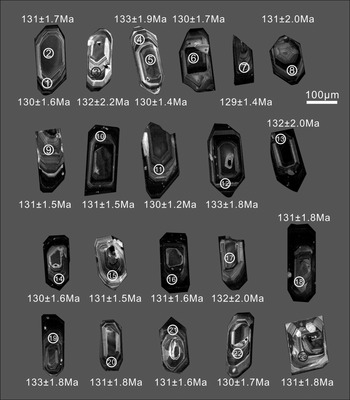
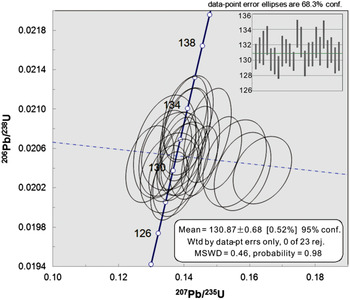
The CL images of selected zircons are shown in Figure 5. The LA-ICP-MS zircon U–Pb analytical data are summarized in Table 3 and illustrated in the concordia diagram (Fig. 6). The zircon grains from the granite are grey, prismatic and euhedral with oscillatory zoning, showing typical magmatic zircons. Most of these grains have high Th/U ratios ranging from 0.34 to 2.10 (Table 4), which supports their magmatic origin (Pupin, Reference Pupin1980; Koschek, Reference Koschek1993). A total of 23 analyses from 21 grains yielded concordant results with a weighted mean 206Pb/238U age of 131 ± 1 Ma (mean square weighted deviation (MSWD) = 0.46, n = 23) (Fig. 6), which is interpreted as the crystallization age of the Shuangjianzishan granite porphyry.
Representative cathodoluminescence (CL) images of zircons from the Shuangjianzishan granite porphyry. Numbers and ages on zircon grains are the analysed spots in Table 3.

LA-ICP-MS zircon U–Pb Shuangjianzishan granite porphyry data

Zircon U–Pb concordia diagrams for the Shuangjianzishan granite porphyry. The concordia age, mean age and mean square weighted deviation (MSWD) are shown in each figure.

Major- (wt%) and trace-element (ppm) contents of the Shuangjianzishan granite porphyry

5.b. Major- and trace-element geochemistry
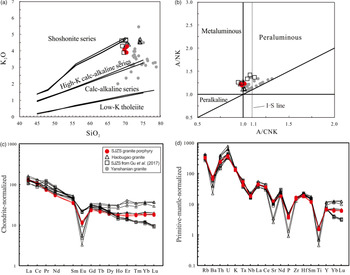
The major- and trace-element abundances of three samples are provided in Table 4. All the samples have relatively high concentrations of SiO2 (69.63–70.32 wt%), Na2O (4.37–4.38 wt%) and K2O (3.92–4.29 wt%), with K2O/Na2O ratios of 0.90–0.98, indicating their high-K calc-alkaline composition (Fig. 7a; Peccerillo & Taylor, Reference Peccerillo and Taylor1976). The granite porphyry is metaluminous and weakly peraluminous with A/CNK (molar ratio of Al2O3/(CaO + Na2O + K2O)) and A/NK ratios ranging over 0.98–1.01 and 1.21–1.24, respectively (Fig. 7b; Maniar & Piccoli, Reference Maniar and Piccoli1989).
(a) SiO2–K2O discriminant plot (after Peccerillo & Taylor, Reference Peccerillo and Taylor1976) for the Shuangjianzishan (SJZS) granite porphyry; (b) A/CNK–A/NK diagram (after Maniar & Piccoli, Reference Maniar and Piccoli1989) for the discriminant of metaluminous, peraluminous and peralkaline rocks; (c) chondrite-normalized REE pattern; and (d) primitive-mantle-normalized trace-element patterns. Primitive mantle and chondrite data are from Sun & McDonough (Reference Sun, McDonough, Saunders and Morry1989). Haobugao data are from Wang et al. (Reference Wang, Xu, Lv, Wei, Mei, Fan and Sun2018), the data represented by the square are from the SJZS granite (Gu et al. Reference Gu, Chen, Jia and Ju2017) and Yanshanian granites data describing the southern GXR are from Mei et al. (Reference Mei, Lv, Cao, Liu, Zhao, Ai, Tang and Munir2014), Ruan et al. (Reference Ruan, Lv, Yang, Liu, Yu, Wu and Munir2015), Wang et al. (Reference Wang, Sun, Pei, Liu, Liu and Jiang2016a) and Liu et al. (Reference Liu, Zhang, Wilde, Zhou, Wang, Ge, Wang and Ling2017).

The granite porphyry exhibits moderate REE contents ranging from 151.61 to 156.41 ppm, is enriched in light REEs (LREEs) and depleted in heavy REE (HREEs), has (La/Yb)N ratios of 3.16–8.93 and has significant negative Eu anomalies (Eu/Eu* = 0.37–0.40) (Table 4). These samples are rich in large-ion lithophile elements (LILE), but depleted in high-field-strength elements (HFSE), displaying strong negative anomalies of Ba, Sr, P and Ti (Fig. 7c, d). These features imply the occurrence of apatite and ilmenite fractional crystallization or the presence of residual apatite and ilmenite minerals in the magma source, and the high Rb concentrations (208–220 ppm) suggest that the Shuangjianzishan granite porphyry may have undergone high crystal fractionation (Fig. 7d).
5.c. Sr-Nd-Pb isotopes
Three samples were analysed for Sr-Nd-Pb isotopic compositions, and the results are presented in Tables 5 and 6. The Shuangjianzishan granite porphyry samples show low (87Sr/86Sr)t values of 0.7055–0.7056 and positive ϵNd(t) values of 0.71–0.88 (Table 5). The two-stage Nd model ages (T DM2) of the Shuangjianzishan granite porphyry are 850–864 Ma. Meanwhile, the Shuangjianzishan granite porphyry samples are characterized by high radiogenic Pb isotope ratios with (206Pb/204Pb)t = 18.12–18.25, (207Pb/204Pb)t = 15.52–15.53 and (208Pb/204Pb)t = 38.00–38.11 (Table 6).
Sr–Nd isotopic compositions of the Shuangjianzishan granite porphyry

*Note: initial Sr and Nd isotopic ratios are calculated based on t = 131 Ma.
Pb isotopic compositions of the Shuangjianzishan granite porphyry

*Note: (206Pb/204Pb)t , (207Pb/204Pb)t and (208Pb/204Pb)t are Pb isotopic ratios at t = 131 Ma for the whole-rock of the Shuangjianzishan granite samples, calculated from the measured whole-rock U, Th and Pb contents and whole-rock Pb isotopic ratios.
5.d. Zircon Hf isotopic composition
The in situ Hf isotopic analysis results of the zircons from the Shuangjianzishan granite porphyry are listed in Table 7. A total of 15 spots of zircon grains obtained from sample ZK12-50 were measured, giving initial 176Hf/177Hf ratios ranging from 0.282833 to 0.282888 with corresponding ϵHf(t) values of 4.9–6.9. The fLu/Hf values range over −0.98 to −0.96, which are much lower than the fLu/Hf values of oceanic crust and continental upper crust (−0.34 and −0.72, respectively) (Amelin et al. Reference Amelin, Lee and Halliday2000). The two-stage model ages (T DM2) vary from 668 to 778 Ma (Table 7).
Zircon Lu–Hf isotopic data of the Shuangjianzishan granite porphyry

*Note: All spots are calculated based on t = 131 Ma for the Shuangjianzishan granite porphyry.
6. Discussion
6.a. Late Jurassic – Early Cretaceous granitic magmatism
The results of the zircon LA-ICP-MS U–Pb dating at Shuangjianzishan yield a diagenetic age of 131 ± 1 Ma for the granite porphyry, consistent with the age of 131–135 Ma presented in previous reports (Table 1). Wu et al. (Reference Wu, Liu, Zeng, Sun and Liu2013) reported a sphalerite Rb–Sr isochron age of 133 ± 4 Ma, and Zhai et al. (Reference Zhai, Anthony, Liu, David, Panagiotis, Stylianos, Li, Li and Sun2020) dated a molybdenite Re–Os age of 134.9 ± 3.4 Ma. The magmatic events that occurred slightly before 130 Ma are therefore coeval with the Pb-Zn-Ag mineralization. In addition, this paper does not contradict the views of Liu et al. (Reference Liu, Bagas and Wang2016), Ouyang et al. (Reference Ouyang, Li and Zhou2016) or Wang et al. (Reference Wang, Sun, Pei, Liu, Liu and Jiang2016a) on the possibility of superimposed mineralization via two periods of mineralization (at c. 165 Ma and c. 130 Ma). However, the major mineralization of the Shuangjianzishan deposit was triggered by the granite porphyry intrusion, which occurred over a short interval during the Early Cretaceous Epoch.
6.b. Petrogenesis and evolution of the Shuangjianzishan granite porphyry
Granitoids have traditionally been classified as I-, S- and A-types based on chemical and mineralogical compositions (Chappell & White Reference Chappell and White1974, Reference Chappell and White1992; Hineab et al. Reference Hineab, Williams, Chappelle and White1978; Whalen et al. Reference Whalen, Currie and Chappell1987). As the emplacement ages of the regional Yanshanian granite and the adjacent Haobugao granite are mainly concentrated within Early Cretaceous time, plotting the chemical composition of these granites is useful for comparison of the Shuangjianzishan granite porphyry with the pervasive Early Cretaceous magmatism. Samples from the Shuangjianzishan granite porphyry are metaluminous to peraluminous (Fig. 7b) and plot within the high-K calc-alkaline series (Fig. 7a), consistent with the adjacent Haobugao granite and most of the Yanshanian granite. Chondrite-normalized REE patterns show that the samples are obviously enriched in LREEs, depleted in HREEs, and have strongly negative Eu anomalies (Fig. 7c). Compared with primitive mantle, the Shuangjianzishan granite porphyry is enriched in Zr, Hf, Rb, Th and U and depleted in Ba, Sr, P and Ti (Fig. 7d), which is similar to typical A-type granite (Li et al. Reference Li, Guo, Li, Li and Zhao2014). S-type granites always contain more Al than that required to form feldspar, and the excess Al is hosted in Al-rich biotite, generally accompanied by more Al-rich minerals such as cordierite or muscovite (Chappell, Reference Chappell1984; Chappell et al. Reference Chappell, Bryant and Wyborn2012). However, the Shuangjianzishan granite porphyry has a low biotite content (Fig. 4f). In addition, the measured A/CNK values are no less than 1.1 (Fig. 7b), indicating that the samples are A-type or I-type granites, not S-type granites (Chappell & White, Reference Chappell and White1992; Chappell, Reference Chappell1999).
A-type granites are widely distributed and closely associated with I-type granites in NE China. Due to the uncertainty and diversity of geological processes and the geochemical behaviour of elements, many researchers (Tian et al. Reference Tian, Ge, Yang, Zhao and Zhang2014) have found that it is difficult to distinguish the A- and I-types in the GXR based on only the discrimination diagrams. In addition, the A-type granites have the same Sr–Nd isotopic characteristics as the I-type granites, indicating that they are derived from the same source (Wu et al. Reference Wu, Sun, Li, Jahn and Wilde2002; Wang et al. Reference Wang, Xu, Lv, Wei, Mei, Fan and Sun2018). A-type granites are usually formed under conditions of high temperature and low pressure (Collins et al. Reference Collins, Beams, White and Chappell1982; Clemens et al. Reference Clemens, Holloway and White1986), and therefore generally contain relatively high-temperature anhydrous minerals, such as pyroxene, fayalite and interstitial biotite (Collins et al. Reference Collins, Beams, White and Chappell1982; Whalen et al. Reference Whalen, Currie and Chappell1987; Eby, Reference Eby1992) and are enriched in HFSEs such as Zr, Nb, Y, REE and Ga. Wu et al. (Reference Wu, Sun, Li, Jahn and Wilde2002) found that A-type granites in NE China usually contain alkali mafic minerals, such as sodic pyroxene, or contain annite and Fe-rich calcic amphibole. From microscopic observation, many biotite and hornblende grains were found in the Shuangjianzishan granite porphyry (Fig. 4a, d). In the diagrams of K2O+Na2O, FeO*/MgO, Nb versus Ga/Al, all the Shuangjianzishan granite porphyry and regional granite samples plot in the A-type field, suggesting that they are A-type granites (Fig. 8a–c). Moreover, in the Nb-Y-Ce diagram (Fig. 8d), all the granite samples plot in the A2 group, suggesting a post-collisional tectonic setting.
Discrimination diagrams of (a) Nb versus 10 000×Ga/Al; (b) Na2O+K2O versus 10 000×Ga/Al; (c) FeO/MgO versus 10 000×Ga/Al; (d) Nb-Y-Ce (after Whalen et al. Reference Whalen, Currie and Chappell1987; Eby, Reference Eby1992). Triangle points are from Wang et al. (Reference Wang, Xu, Lv, Wei, Mei, Fan and Sun2018) and the square from Gu et al. (Reference Gu, Chen, Jia and Ju2017). A1 – anorogenic setting; A2 – post-collisional setting.

As mentioned, the most striking features of the Shuangjianzishan granite porphyry are its low initial 87Sr/86Sr ratios, positive ϵNd(t) values, Nd T DM2 ages (850–864 Ma) and high zircons ϵHf(t) values (Tables 5 and 6), suggesting a high proportion of juvenile material in its petrogenesis. In order to provide a more generalized picture for the southern GXR, we further plotted additional published data describing the adjacent Haobugao deposit granite and regional Mesozoic granites for their Sr-Nd-Hf isotopic compositions. As shown in Figure 9a, all ϵHf(t) spot results from the Shuangjianzishan granite porphyry, consistent with those of Haobugao, deviate from the ancient crustal evolution lines, suggesting that the Shuangjianzishan granite porphyry was derived from the melting of mantle-derived juvenile component. The potential for an enriched mantle source could not be ruled out, as Wang et al. (Reference Wang, Chen, Chen, Wolfgang and Muharrem2006b) proposed that Mesozoic volcanic rocks in the Songliao Basin could be derived from an enriched mantle source. The zircons of the Shuangjianzishan granite porphyry have similar Hf isotopic features as the Phanerozoic igneous rocks in the eastern CAOB (Fig. 9a; Wu & Sun, Reference Wu and Sun1999; Yang et al. Reference Yang, Wu, Shao, Wilde, Xie and Liu2006; Sui et al. Reference Sui, Ge, Wu, Zhang, Xu and Chang2007), distinct from those in the NCC (Fig. 9a; Yang et al. Reference Yang, Wu, Shao, Wilde, Xie and Liu2006). Based on the mixing model proposed by Wu et al. (Reference Wu, Jahn, Wilde and Sun2000, Reference Wu, Sun, Li, Jahn and Wilde2002), it is obvious that most samples from the Shuangjianzishan granite porphyry plot close to the mixing lines of the mantle-derived juvenile components (c. 80%) and the lower crust (c. 20%), similar to those of regional Mesozoic A-type granites (Wu et al. Reference Wu, Jahn, Wilde, Lo, Yui, Lin, Ge and Sun2003); this finding is also supported by the Pb isotopic compositions (Fig. 9c, d). The calculation by no means indicates that the granites were formed by mixing depleted mantle (DM) and lower continental crust (LCC) melts in such proportions. Rather, it suggests that the granitic magmas were produced by melting of a mixed lithology containing lower crustal components intruded or underplated by mantle-derived magma in such a proportion (Wu et al. Reference Wu, Jahn, Wilde, Lo, Yui, Lin, Ge and Sun2003). Furthermore, mafic microgranular enclaves, which are significant evidence of magma mixing (Barbarin, Reference Barbarin2005), have not been observed in this granite porphyry. Typical mineralogical textures representing magma mixing, such as quartz ocelli rimmed by hornblende and/or biotite and acicular apatite (Baxter & Feely, Reference Baxter and Feely2002), have not been found either (Fig. 4a). Accordingly, the small amount of crustal components involved in the magma formation may be due to assimilation occurring in the magma chamber or during magma uprising. Some studies suggested that the generation of such voluminous granites should be related to the melting of heated crust induced from upwelling of the asthenosphere in the late stage of orogenesis or subduction (Wu et al. Reference Wu, Jahn, Wilde and Sun2000). We propose that, following oceanic closure, asthenospheric mantle melting during the Neoproterozoic Era led to mafic underplating in the lower crust, with which it interacted; these were subsequently melted to produce the Shuangjianzishan granite porphyry.
(a) Mantle: plot of ϵHf(t) versus t (Ma) for the zircons from the Shuangjianzishan granite porphyry. CAOB – the Central Asian Orogenic Belt; YFTB – Yanshan Fold and Thrust Belt (Yang et al. Reference Yang, Wu, Shao, Wilde, Xie and Liu2006). (b) Orogene: ϵNd(t) versus (87Sr/86Sr)t isotopic ratio plot showing mixing proportions between two end-members (after Wu et al. Reference Wu, Jahn, Wilde, Lo, Yui, Lin, Ge and Sun2003): (1) depleted mantle or juvenile components (DM – upper mantle peridotite; B – basalt) and (2) crustal components (LCC – lower continental crust; UCC – upper continental crust; both represented by the Mashan gneisses in the Jiamusi Block; Wu et al. Reference Wu, Jahn, Wilde and Sun2000). The grey area represents Mesozoic granites from Wu et al. (Reference Wu, Jahn, Wilde, Lo, Yui, Lin, Ge and Sun2003). (c) Upper crust: 207Pb/204Pb versus 206Pb/204Pb diagram and (d) lower crust: 208Pb/204Pb versus 206Pb/204Pb diagram for distinguishing tectonic setting (after Zartman & Doe, Reference Zartman and Doe1981). Haobugao data Wang et al. (Reference Wang, Xu, Lv, Wei, Mei, Fan and Sun2018).

6.c. Tectonic implications
The peak of the outbreak of volcanic rocks and A-type granites in NE China occurred during the Cretaceous Period, which was also an important period for asthenospheric upwelling, lithospheric thinning and crustal stretching (Wu et al. Reference Wu, Sun, Li, Jahn and Wilde2002), as well as the peak of large-scale magma-thermal events in the Xingmeng Orogenic Belt (Wu et al. Reference Wu, Lin, Wilde, Zhang and Yang2005a; Wang et al. Reference Wang, Zhou, Zhang, Ying, Zhang, Wu and Zhu2006a; Zhang et al. Reference Zhang, Gao, Ge, Wu, Yang, Wilde and Li2010). In the southern GXR, a special geological structure was developed where the Palaeo-Asian and the Palaeo-Pacific tectonic domains overlap. The tectonic setting for the Shuangjianzishan deposit, the Haobugao deposit, and other deposits could be revealed by the presence of A-type granites associated with mineralization, which can form in both post-orogenic and anorogenic settings (Sylvester, Reference Sylvester1989; Bonin, Reference Bonin1990; Eby, Reference Eby1992; Nedelec et al. Reference Nedelec, Stephens and Fallick1995). Eby (Reference Eby1992) sub-divided A-type granites into A1 and A2 groups; the A1 group represents an anorogenic setting and the A2 group represents a variety of tectonic environments. The Shuangjianzishan granite samples, consistent with the Haobugao granite, mainly fall within the A2 group (Figs 8d, 10a, b), suggesting that they formed in a post-orogenic extensional environment.
(a) (Rb/30)-Hf-3Ta discrimination diagram (after Harris et al. Reference Harris, Pearce, Tindle, Coward and Reis1986); (b) Rb versus (Yb+Ta) discrimination diagram (after Pearce, Reference Pearce1996). VAG – volcanic-arc granite; ORG – ocean-ridge granite; WPG – within-plate granite; COLG – collision granite; POG – post-collision granite. Triangle points are from Wang et al. (Reference Wang, Xu, Lv, Wei, Mei, Fan and Sun2018), the square from Gu et al. (Reference Gu, Chen, Jia and Ju2017) and the grey-shaded squares from Mei et al. (Reference Mei, Lv, Cao, Liu, Zhao, Ai, Tang and Munir2014), Ruan et al. (Reference Ruan, Lv, Yang, Liu, Yu, Wu and Munir2015), Wang et al. (Reference Wang, Sun, Pei, Liu, Liu and Jiang2016a) and Liu et al. (Reference Liu, Zhang, Wilde, Zhou, Wang, Ge, Wang and Ling2017).

As mentioned in Section 6.b, the Shuangjianzishan granite porphyry was the result of extensive partial melting of mantle-derived juvenile crust, synchronous with the Early Cretaceous magmatism spanning the entire GXR, which is envisaged to have formed in a lithospheric extensional environment (Li et al. Reference Li, Zhao, Zhou, Vasconcelos, Ma, Deng, Souza, Zhao and Wu2008). In addition, widespread volcanic rocks (137 Ma) exposed around Shuangjianzishan are basically coeval with the Early Cretaceous granite porphyry (Wang et al. Reference Wang, Xu, Lv, Wei, Mei, Fan and Sun2018). It was recognized by previous researchers that the intrusive rocks formed in an extensional environment (Wang et al. Reference Wang, Xu, Lv, Wei, Mei, Fan and Sun2018). Furthermore, the generation of A-type granites requires a high melting temperature (Clemens et al. Reference Clemens, Holloway and White1986), and the upwelling of the asthenosphere could provide the heat necessary to produce a considerable volume of A-type granites in NE China during late Mesozoic time in this extensional setting (Wu et al. Reference Wu, Sun, Li, Jahn and Wilde2002).
To date, two possible models have been proposed for this extensional setting: (1) delamination of the lower crust induced by the subduction of the Palaeo-Pacific Plate (Wu et al. Reference Wu, Yang, Wilde and Zhang2005b; Wang et al. Reference Wang, Zhou, Zhang, Ying, Zhang, Wu and Zhu2006a; Zhang et al. Reference Zhang, Ge, Wu, Wilde, Yang and Liu2008, Reference Zhang, Gao, Ge, Wu, Yang, Wilde and Li2010); and (2) post-orogenic lithospheric extension related to the closure of the Mongol–Okhotsk Ocean (Fan et al. Reference Fan, Guo, Wang and Lin2003; Meng, Reference Meng2003). As previous studies have suggested, the Mongol–Okhotsk Ocean closed during the Middle and Late Jurassic epochs (Zorin, Reference Zorin1999), and the Pacific Plate has expanded considerably since the Late Cretaceous Epoch (Larson et al. Reference Larson, Pitman, Golovchenko, Cande, Dewey, Haxby and La Brecque1985), so the Shuangjianzishan granite porphyry U–Pb age of 131 Ma coincides with post-orogenic extension following the closure of the Mongol–Okhotsk Ocean. Furthermore, Mesozoic volcanic magmatism in the southern GXR shows a NE-trending linear distribution that gradually ages from west to east (125–160 Ma) (Wang et al. Reference Wang, Chen, Chen, Wolfgang and Muharrem2006b), consistent with the Mongol–Okhotsk Ocean closing direction from west to east (Metelkin et al. Reference Metelkin, Vemikovsky and Kazansky2010). Gu et al. (Reference Gu, Chen, Jia and Ju2017) believe the regional tectonic stress in the southern GXR is tensional and that the Mongol–Okhotsk Ocean closing direction favours the reduction in pressure within the plate. However, the subduction of the Palaeo-Pacific Ocean Plate caused large-scale back-arc extension of NE China and is not dominant in this region (Dong et al. Reference Dong, Ge, Yang, Zhao, Wang, Zhang and Su2014; Ma et al. Reference Ma, Cao, Zhou and Zhu2015). Accordingly, it can be conjectured that the Early Cretaceous extensional setting in the southern GXR mainly resulted from the upwelling of asthenospheric mantle in the post-orogenic period of Mongol–Okhotsk Ocean closure.
7. Conclusions
-
1. Zircon LA-ICP-MS U–Pb dating confirms that the Shuangjianzishan granite porphyry in the southern GXR formed during the Early Cretaceous Epoch (131 ± 1 Ma).
-
2. The petrography, geochemistry and isotope compositions indicate that the Shuangjianzishan granite porphyry belongs to metaluminous to peraluminous high-K calc-alkaline A-type granite, and is derived from the partial melting of mantle-derived juvenile component (c. 80%), contaminated by assimilation of a low proportion of the lower crust (c. 20%).
-
3. The Shuangjianzishan granite porphyry was emplaced in a post-orogenic extensional environment related to the asthenosphere upwelling followed the Mongol–Okhotsk Ocean closure.
Acknowledgements
We thank colleagues for their assistance and Tiantong Geological Exploration Co. Ltd., Chifeng, Inner Mongolia, China for support during fieldwork. This research was supported by the Inner Mongolia Autonomous Region Geological Prospecting Fund Management Center (grant no. NMKD2014-23), China Geological Survey (grant no. 121201009000150011) and China Postdoctoral Science Foundation (grant no. 2015M582300). The anonymous reviewers are gratefully acknowledged for their constructive and valuable comments.