INTRODUCTION
In the burgeoning scholarship on religion and American politics, Islam is often relegated to the “other” category of non-Christian religious traditions whose numbers are too small for extensive analysis (Smidt, Kellstedt, and Guth Reference Smidt, Kellstedt, Guth, Smidt, Lyman and Guth2009, 11). This may be linked to a broader knowledge gap regarding Islam within political science (Tepe and Demirkaya Reference Tepe and Demirkaya2011). Studies that do focus extensively on Islam in American politics tend to do so in the context of explaining political participation, religious identity, and voting behavior among American Muslims (Ayers and Hofstetter Reference Ayers and Hofstetter2008; Barreto and Bozonelos Reference Barreto and Bozonelos2009; Contractor Reference Contractor2011; Haddad Reference Haddad2004; Jalalzai Reference Jalalzai2009; Jamal Reference Jamal2005; Khan Reference Khan, Haddad, Smith and Esposito2003). Important work has been done in probing American attitudes toward Islam (Braman and Sinno Reference Braman and Sinno2009; Penning Reference Penning2009; Shortle and Gaddie Reference Shortle and Gaddie2015); however, scant attention has been paid specifically to Islam's representation among policymakers and within the United States (U.S.) Congress. One notable exception is the work of Martin (Reference Martin2009), which examines how legislators represent American Muslim constituencies in their roll-call voting behavior. However, as Shogan (Reference Shogan2001) observes, most research has focused too narrowly on roll-call voting behavior in examining the representation of minority groups, rather than studying how members of Congress discursively represent such groups.
This article addresses this void by exploring patterns in discursive representations of IslamFootnote 1 by U.S. senators across two time periods 10 years apart: the 106th Congress (1999–2000) and the 111th Congress (2009–2010). Many scholars point to the September 11, 2001 attacks as a turning point in tensions between Muslims and non-Muslims in the United States, emphasizing before and after phases (Simmons Reference Simmons2008). Penning (Reference Penning2009, 278) observes that the attacks generated “considerable antipathy and distrust among the American populace toward Islam and its followers.” While some noteworthy changes in discursive representations of Islam among legislators can be identified across the before and after phases examined in this study, similar mechanisms are prominent in both periods. Specifically, securitization of Islam as well as Orientalist tendencies that reify Islam as monolithic, unchanging, different from and inferior to “Western”/Judeo-Christian systems, and something to be “feared and controlled” (Said Reference Said1978; Nimer Reference Nimer, Esposito and Kalin2011) are characteristic of Senate discourse in both the 106th and 111th Congresses. Across both periods there is also evidence for the dichotomization of Islam and Muslims into Moderate/Secular/Good and Radical/Fundamentalist/Bad categories. Finally, the study indicates an enduring role for political ideology in shaping discursive representations of Islam among U.S. senators in both periods.
The article proceeds as follows: First, an overview of securitization is provided, followed by an explication of the study's design and methods. The article then turns to a comparative analysis of senate speeches pertaining to Islam and Muslims during the 106th and the 111th Congresses, beginning with a discussion of the historical context of each period. Findings regarding changes and continuities in overall tone, securitization, and normalization are presented, paying attention to the salient discursive frames that characterized each period. This section also explores the role of political ideology, partisanship, religious affiliation, and other factors influencing Senate rhetoric pertaining to Islam. The concluding section discusses the study's limitations and avenues for future work.
SECURITIZATION
The Copenhagen School in security studies originated with International Relations theorists Barry Buzan and Ole Wæver. Securitization is the most prominent contribution of this school of thought, and one of its core claims is that referent objects are deemed as threats to a society by a “securitization” process that occurs through both language and social relations (Van Rythoven Reference Van Rythoven2015, 2). Speaking from positions of authority, elites convince audiences that a threat is something to be feared using speech acts that “do not simply describe an existing security situation, but bring it into being as a security situation by successfully representing it as such” (Williams Reference Williams2003, 513). Lausten and Wæver (Reference Lausten and Wæver2000, 708) claim that “by saying the words, something is done…It is by labeling something a security issue that it becomes one.” By framing an issue as a national security issue, it is removed from the realm of normal politics and imbued with a sense of urgency and threat. Securitization is thus “not only about the deployment of the rhetorical device of ‘security’ and the location of policy discourse within that framework, but also about the capacity…to [disrupt] the normal rules, practices and politics” regarding an issue (Phillips Reference Phillips2007, 167).
Applied to congressional rhetoric about Islam, the theory suggests that securitizing actors (elites speaking from positions of political authority) have sought to treat Islam in a manner different from the normal rules and practices associated with discourse about religion, such that aspects of Islam are framed as national security issues, while similar aspects of other religions — such as Christianity and Judaism — are not. Because fear is central to the process of threat construction (Van Rythoven Reference Van Rythoven2015, 9), securitization theory suggests aspects of Islam, including its followers, will emerge amidst “recognizable memories, identities, images, metaphors, and other tropes to construct a plausible, yet anxiety inducing, future.” In keeping with the normative goals of the theory, Lausten and Wæver (Reference Lausten and Wæver2000, 733) note that “the aim is desecuritization, which in this case means to let religion be religion.”
DESIGN AND METHOD
While language is central to constructing the identities of Others (Campbell Reference Campbell1998), few studies of religion and politics have utilized discursive methods (Kettell Reference Kettell2009; Patrikios Reference Patrikios2013). Given the Copenhagen School's emphasis on security as a speech act, a discursive approach fits well with securitization theory and the special role it ascribes to the politics of identity (Epstein Reference Epstein2010). Discourse analysis examines “all forms of speech, focusing on the style, content, and functions of texts” by people presumed to be authorized speakers and writers of a hegemonic discourse in society — typically groups of political officials and elites (Milliken Reference Milliken1999, 233; Sjöstedt Reference Sjöstedt2007, 239). Using transcripts of Senate speeches in the Congressional Record, this study analyzes the 234 speechesFootnote 2 pertaining to Islam and Muslims that were delivered by U.S. senators in the 106th and 111th Congresses. THOMAS (www.congress.gov) was used as a search engine to identify speeches in which senators referenced various aspects or symbols pertaining to Islam and Muslims, including: Islam, Muslim, Islamic, Islamist, Allah, Sharia, Muhammad, Mosque, Koran, Caliphate, Sunni, and Shia, as well as variations in the spelling of these terms. In studying these speeches, the objective is to better understand how legislators speak about Islam and determine what patterns are present in constructions of the religion and its followers. In her study of congressional discourse on immigration, Chock (Reference Chock1995, 166) finds that “in selecting certain terms over others, speakers established frameworks of meaning…through which they sought to understand events and to conceive immigration policy.” In addition to exploring how senators establish discursive frameworks of meaning with regard to Islam, this study sheds light on the extent to which aspects of Islam have been securitized and mobilized for political purposes within the U.S. Senate.
While deliberation is central to the democratic process, we know relatively little about variation in congressional floor statements (Kriner and Shen Reference Kriner and Shen2014). This study focuses on Senate speeches for several reasons. In contrast to the House of Representatives, talk time in the Senate is unlimited unless cloture is invoked. Unlike in the House, there is no germaneness rule, which allows for less constrained debate. Utilizing speech data from the Senate facilitates an examination of how representations of Islam emerge within and shape internal deliberations over policymaking. As the smaller and more elite chamber, the Senate provides an important institutional context wherein legislators represent relatively diverse constituencies across their states and are influential in deliberations over executive and judicial nominations as well as foreign affairs. Furthermore, members of the Senate are more nationally recognized as party leaders than members of the House, and partisan dynamics in the Senate are less understood than in the House (McTague and Pearson-Merkowitz Reference McTague and Pearson-Merkowitz2015, 423).
The 1999–2000 and 2009–2010 time periods were selected to compare Senate discourse in the year immediately preceding the September 11th attacks with discourse 10 years later. As Martin (Reference Martin2009) notes, Congresses prior to 2005 likely reflect “unusually high levels of Congressional unity” given their proximity to the immediate aftermath of the September 11th attacks. Martin (Reference Martin2009, 238) chooses to analyze House roll-call behavior during the 109th Congress (2005–2006) with the understanding that this era reflects “more settled attitude[s] toward Muslim-Americans.” By this logic, representations of Islam and Muslims should be even more “settled” in the 111th Congress, enabling us to determine the longer-term impacts of September 11 on constructions of Islam. A discursive structural approach enables us to explore patterns that “stretch over time and space” (Sjöstedt Reference Sjöstedt2007, 236).
By comparing discourse across two periods, this study addresses a common critique of securitization studies utilizing discursive methods — that in their execution they often fail to systematically operationalize and apply their theoretical concepts in empirical settings and in a comparative fashion (Guzzini Reference Guzzini2011; Milliken Reference Milliken1999; Sjöstedt Reference Sjöstedt2007). While post-structuralists typically eschew the use of systematic coding schemes and inter-rater reliability, Sjöstedt (Reference Sjöstedt2007, 235) observes that “methodological structure and transparency does not necessarily mean that the analytical richness of language-based intensive studies is compromised.” In balancing elements of qualitative discourse analysis with quantitative content analysis, this study takes an important step toward bridging two text-focused methods that are rarely combined but have the potential to strengthen conceptual understandings of the role of discourse in constructing power relations (Bennett Reference Bennett2015). Statistical observations facilitate the communication of patterns regarding change and consistency in discursive representations of Islam across time and aid in the investigation of how speakers’ partisan identities or religious affiliations shape these patterns. Qualitative unpacking of these discursive representations simultaneously offers important insights into the meaning speakers attach to relevant symbols and identities, the context for the measurement of these concepts, and the manner in which these symbols and identities are positioned vis-à-vis intergroup power and threat dynamics.
Securitization and Normalization
Both deductive and inductive coding techniques were used. Deductive coding was used regarding the securitization category in the context of theoretical expectations drawn from the Copenhagen School. A speech was coded “securitized” if aspects of Islam and/or Muslims were depicted by the speaker as a potential threat to local, national, or global security. Speeches referencing aspects of the religion or its followers in the context of securitized terms such as war, death, missiles, bomb, nuclear proliferation, militants, ethnic cleansing, attacks, terrorism, murder, kill, genocide, security threats, bloodshed, conflict and similar language were coded as “securitized.” A “securitized-victims” category was developed inductively. A speech was coded as “securitized-victims” if these linguistic elements were present but Muslims were depicted primarily as the victims of such violence rather than its perpetrators. This category enabled an identification of instances in which Muslims were discursively represented in the securitized context of conflict, bombings, and killings — which arguably contributes to the association of Islam as a religion with violence and security threats — but were not depicted as perpetrators of this insecurity in themselves and did not, therefore, meet the theoretical requirements of the category. Speeches coded as “securitized-victims” were treated as distinct representations of Islam and were thus excluded from quantifications of securitization in the analysis.
The “normalized” category was developed inductively as a conceptual counterpart to the “securitized” category in an attempt to theorize the other end of the securitization spectrum, beyond desecuritization. As Gottschalk and Greenberg (Reference Gottschalk, Greenberg, Esposito and Kalin2011, 202) observe in their study of representations of Muslims in political cartoons, such depictions “seldom suggest that Muslims can be ‘normal’ by American standards.” In introducing this coding category, the study hopes to further our understanding of how Islam and Muslims might be discursively constructed as part of ordinary life in America, or as not fundamentally different from or more threatening than other religions like Christianity or Judaism. Speeches depicting Islam as one of many faiths or Muslims as one of many American subgroups deserving consideration or treatment equal to that afforded to other religions or subgroups were coded as “normalized.” Speeches depicting Muslims as one of many religious groups or minorities in American society that are potential victims of discrimination, intolerance, or hate crimes and are therefore deserving of recognition or protection equal to these other subgroups were also coded as “normalized.” Because normalization implies that desecuritization has already occurred, the “normalized” and “securitized” categories were mutually exclusive in the coding scheme. Speeches that did not fulfill either category or were ambiguous regarding these categories were coded as “neither.”
Positive and Negative Tone
Speakers who normalize Islam need not necessarily discuss Islam in a positive light. The purpose of the normalization category is to convey that Islam is being constructed as a religious system that is on par with other religious systems that comprise the global or American religious landscape, as opposed to being constructed as something exceptionally threatening to or incompatible with that landscape. A second coding dimension was used to capture the overall tone of the speeches in which aspects of Islam emerged as “positive,” “negative,” or “ambiguous.” Positive depictions of Islam might construct aspects of the religion or its followers as contributing to world civilization or the fabric of society, possessing admirable virtues or traits, or otherwise warranting trust, praise, respect, friendship, or appreciation. Negative depictions might construct aspects of the religion or its followers as immoral, untrustworthy, irrational, threatening, authoritarian, or otherwise warranting fear, distrust, antipathy, or condemnation. A speech was coded “ambiguous” if aspects of Islam and/or Muslims were depicted in unclear terms regarding tone, or if the speaker depicted aspects of the religion or its followers in both positive and negative terms.Footnote 3
In coding for these categories and exploring other patterns within the speeches, subject positioning was used to examine the positioning of Muslim identities vis-à-vis other identities (Sjöstedt Reference Sjöstedt2007, 240). As Hayes (Reference Hayes2009, 982) notes in his study on the role of identity language in shaping diverging U.S. policy responses to Indian and Iranian nuclear programs, “To securitize successfully, leaders must use the language of security; they must appeal to certain norms and identities in order to communicate the idea of a threat and that the object threatened is valuable.” To contribute to understandings of how political elites discursively construct Muslims as ordinary, valued, or de-essentialized — and thus potentially desecuritized — components of American society, attention was also paid to the use of identity language in normalizing aspects of Islam. The speakers’ stated policy preferences were noted in considering how senators reference aspects of Islam in advocating for certain policy actions or in otherwise mobilizing Islam for political purposes.
Intercoder Reliability
A second coder with a Ph.D. (Doctor of Philosophy) in Political Science analyzed a random sample of 20% of the speeches. An intercoder reliability test for the securitization, normalization, and securitized-victims categories produced a Cohen's Kappa value of 0.874 (agreement was 93.75%), signifying a very high level of intercoder reliability on that dimension. Disagreement here occurred with one speech delivered during the 111th Senate, in which the senator attempted to normalize American Muslims and defend the building of an Islamic Community Center near the World Trade Center in Manhattan (New York City), but ultimately argued for that normalization in the context of preventing future terrorist attacks on the United States. After discussing the speech, consensus was reached that Islam was ultimately securitized by the speaker, though both coders agreed that the overall tone in depicting Muslims was nonetheless “positive” given the extent to which the senator praised the contributions of American Muslims and the Islamic Community Center project. This example underscores the need for the two distinct coding dimensions, as they capture different rhetorical dynamics.
An intercoder reliability test for overall tone in senate speeches pertaining to Islam — positive, negative, or ambiguous — produced a Cohen's Kappa value of 0.794 (agreement was 87.5%), signifying strong intercoder reliability on this dimension. Disagreement occurred only with speeches that one rater coded as “ambiguous” and the other coded as “negative.” Consensus was reached after discussing each case of disagreement, and in most cases the speech was ultimately coded as ambiguous if it did not clearly fit the qualifications of the negative category.
COMPARING THE 106TH AND 111TH SENATES
During the 106th Senate (1999–2000), 86 speeches pertaining to Islam were delivered by 46 senators, including 24 Republicans and 22 Democrats. Discussion of Islam and Muslims in this period was colored by conflict in the Balkans, including a Senate vote in March of 1999 on Senate Concurrent Resolution 21, authorizing the use of military force in Kosovo. Other contextual factors shaping Senate rhetoric about Islam included nuclear proliferation in Southeast Asia, a troubled Israeli-Palestinian peace process, debate over trade relations with China and its repression of religious freedom, concerns about containing Saddam Hussein in Iraq, and growing emphasis on Iran as a possible threat. Prior to the September 11th attacks, securitized phrases like Islamic fundamentalism, Radical Islam, Islamic Radicals, Islamic Extremists, and Islamic Terrorists were already in practice. Most of this rhetoric occurred in the context of discussing Iran or the Palestinians.
This time period also entailed considerations of new hate crimes legislation and a Senate vote on Senate Resolution 133, “A Resolution Supporting Religious Tolerance toward Muslims.” Sponsored by Senator Spencer Abraham (R-MI) and co-sponsored by Senators Russ Feingold (D-WI), Tim Johnson (D-SD), Charles Robb (D-VA), Paul Wellstone (D-MN), Joe Lieberman (D-CT), and Larry Craig (R-ID) in the aftermath of the Oklahoma City bombing and subsequent rush to judgment regarding its perpetrators, the resolution condemned anti-Muslim intolerance, discrimination, and violence. It characterized Islam as a “great Abrahamic faith” and recognized American Muslims as “a vital part of our Nation.” The resolution emphasized that “stereotypes and anti-Muslim rhetoric have also contributed to a backlash against Muslims in some neighborhoods across the United States” (Congressional Record July 1, 1999, S8142–43). The resolution passed unanimously in the Senate in July of 2000, though it died in committee while in the House.
During the 111th Congress (2009–2010), 148 speeches pertaining to Islam were delivered by 48 senators, including 22 Republicans and 25 Democrats.Footnote 4 Because there was much more discussion about aspects of Islam during this period, the contexts varied greatly. Debates regarding the closure of Guantanamo Bay — including a Senate vote in May of 2009 on Amendment 1133, blocking funding for its closure — shaped the discursive environment, as did debates over strategy in Afghanistan, particularly regarding calls for troop escalations and a timetable for the withdrawal of U.S. forces. The nomination of David Hamilton for the Seventh Circuit U.S. Court of Appeals generated discussions of his 2005 ruling as federal district judge that prayers using “Christ” or “Jesus” were sectarian and therefore prohibited in the Indiana House of Representatives, while prayers offered by Muslim imams to Allah were not necessarily sectarian since it is the Arabic word for “God.” Some Republican senators focused on this ruling as indicating favoritism to Islam over Christianity in opposing Hamilton's nomination. The nomination of Elena Kagan for the Supreme Court also generated relevant debate. In opposing her nomination, some Republican senators focused on her approval of the creation of a center for the study of Islamic Law while she was the Dean of Harvard Law School. Rhetoric pertaining to Islam also emerged in the context of proposed legislation on hate crimes, gun violence, and financial reform, and two Democratic senators discussed U.S. relations with Muslims in offering praise for President Obama's June 2009 speech in Cairo, Egypt. There was surprisingly little discussion of the so-called Ground Zero Mosque controversy of 2009 or of the Fort Hood shooting that took place in November of that year, with one senator speaking about each issue.
Changes in Tone, Securitization, and Normalization
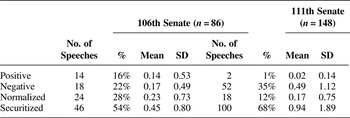
Table 1 summarizes the findings regarding changes in tone, securitization, and normalization across the two time periods of analysis. There is support for the turning point hypothesis regarding September 11 and discursive representations of Islam. While 16% of speeches pertaining to aspects of Islam in the 106th Senate were coded as positive in overall tone, only 1% (two out of 148 speeches) were coded as positive in the 111th Senate. Positive depictions during the 106th Senate emerged most commonly in arguments for the contributions of religion in general to aspects of American life and the importance of religious tolerance and diversity in American society and identity. All but two of the speeches offering positive representations in the 106th Senate also offered normalized depictions of Islam.
Summary of senate speeches

Note: n refers to the number of total speeches pertaining to Islam in each Senate.
While more normalization was evident in the 106th Congress, senators normalizing Islam across both periods typically framed it as one of many American religions (or framed Muslims as one of many American subgroups) that contribute to the strength and vitality of the nation or are deserving of tolerance and protection from discrimination. Such depictions often emerged in advocating for hate crimes legislation domestically or for improving religious freedom internationally, though normalized depictions also emerged in advocating for policy preferences on issues like child labor and financial reform. For example, in advocating for legislation on intercountry adoption, Senator Mary Landrieu (D-LA) quoted Islam's prophet:
You can look all the way back to Muhammad who stated that “the best house is the house in which an orphan receives care.” I hope we can create many such houses with this bill (Congressional Record March 23, 1999, S3134).
There is an assumption of shared values as the senator invokes a prophetic hadith on orphans to mobilize support for her efforts to reform foreign adoptions policy. Rather than activating group boundaries to otherize Islam, an element of its teachings is incorporated into a collective morality that ought to guide legislative decision-making regarding the protection of children.
Identity language is central to securitization theory, and this study suggests constructions of the Self and of the Nation are also crucial to normalization. For example, in condemning comments by Minnesota Governor Jesse Ventura that were critical of organized religion, Senator Chris Dodd (D-CT) cast Islam in positive and normalized terms, stating Ventura's words were “offensive to millions of Americans, be they Christians, Jews, Muslims” and whether they “practice their religion in a church, a synagogue, or a mosque.” In addition to normalizing Muslims as not fundamentally different from American Christians or Jews, the senator mobilized identity language to praise Muslims, mosques, and “organized religion” in general for “contribut[ing] significantly to the strength and well-being of the Nation” (Congressional Record October 5, 1999, S11934). Appeals to identity in normalizing Islam were also apparent in the 111th Senate. In advocating for the Matthew Shepherd Hate Crimes Prevention Act, for instance, Senator Dianne Feinstein (D-CA) linked Muslims with African Americans, Jews, gays, and lesbians in noting that “every person's life is valuable,” emphasizing “the values of tolerance and community that unite us as Americans” (Congressional Record April 28, 2009, S4812).
As summarized in Table 1, across the two periods of analysis negative discursive depictions increased, the frequency of normalization declined, and the proportion of securitized speeches increased. The percentages exclude speeches in which Islam emerged in an arguably securitized framework — in the context of violence, conflict, and a general sense of instability that could potentially threaten U.S. interests — but in which Muslims were depicted primarily as the victims rather than the perpetrators. Speeches in this securitized-victims category were more frequent in the 106th Senate (15%) than in the 111th Senate (3%), as the Balkans conflict in the late 1990s facilitated the construction of Muslims as sympathetic victims among senators who favored U.S. intervention in Kosovo.
Across both periods, Israel-supportive and Iran-threat frames were observable in the emergence of negative and securitized constructions of Islam. Israel-supportive frames, in which the speaker mobilized aspects of Islam in the context of demonstrating support for Israel, were deployed by 26% and 19%, respectively, of the senators who spoke about Islam in the 106th and 111th Senates. Iran-threat frames, in which the speaker mobilized aspects of Islam in underscoring the threat posed by Iran or the need to take action against Iran, were used by 15% and 23%, respectively, of the senators who spoke about Islam in the 106th and 111th Senates. While such frames are undoubtedly influenced by their immediate policy contexts, it is noteworthy that the U.S.-Israel alliance and concerns about containing Iran shaped representations of Islam across both Congresses.
The most pronounced contextual differences in which negative or securitized depictions emerged pertain to the dominance of the ethnic conflict frame in the 1999–2000 period and the dominance of the terrorism-jihad frame in the 2009–2010 period. References to terrorism in speeches pertaining to Islam substantially increased from 15% to 57%. Nearly one-third of speeches in the 111th Senate referenced September 11, and 35% of speeches in this later period specifically referenced al-Qaeda or Osama bin Laden. These changes are in line with the expectation that September 11 represented a critical discursive turning point that has persisted in shaping congressional rhetoric pertaining to Islam.
These discursive turns, and elements of continuity, are observable in the rhetoric of the 16 senators who delivered speeches pertaining to Islam in both Congresses. The senators who offered securitized depictions in the 106th session also did so in the 111th session, albeit with notable shifts in securitizing frames. For example, securitization vis-à-vis enduring ethnic conflict or “Clash of Civilizations” among Senators Gregg (R-NH), McCain (R-AZ), and Roberts (R-KS) shifted, respectively, to securitization vis-à-vis Islamic militants, Islamic Extremism, and Jihad against America. This suggests an enduring securitization within evolving contexts. Only Senator Chuck Schumer (D-NY) offered normalized depictions in both periods, noting “The Koran in Islam treats justice like all the great religions” (Congressional Record June 23, 1999, S7542) and invoking identity language to argue that hate crimes targeting gay, black, Latino, or Muslim individuals undermine “the core values of our Nation” because “in America, you are free to be yourself” (Congressional Record October 22, 2009, S10686).
Interesting parallels appear in the securitizing rhetoric of Senator Jim Inhoffe (R-OK). In criticizing U.S. intervention in Kosovo in the 106th Senate, Inhoffe emphasizes the roles of Albanian Muslims in perpetrating violence against Serb Christians and downplays media coverage of burning mosques as “a propaganda effort,” since during his time in Kosovo he saw that “of some 92 mosques that are there, only one was burning” (Congressional Record May 18, 2000, S4128). In opposing the closure of Guantanamo in the 111th Senate, Inhoffe similarly seeks to discredit notions of Muslim victimhood, arguing the facility meets the “highest international standards” and that millions of dollars are spent on “Korans, prayer rugs, and special meals” (Congressional Record January 30, 2009, S1121). Inhoffe's rhetoric in both periods downplays notions of Muslim suffering that might otherwise impede out-group homogenization and the construction of Muslims as threatening. In justifying the suspension of due process for Guantanamo detainees in a separate speech, Inhoffe securitizes “Chinese Muslims called Uighurs” and states, “the idea that we would have Miranda rights for terrorists, people who have killed Americans, is pretty outrageous” (Congressional Record July 15, 2009, S7538). Consistent with the process whereby securitization enables the disruption of normal politics and imbues issues with an urgency that often has anti-democratic consequences (Lausten and Wæver Reference Lausten and Wæver2000, 708; Phillips Reference Phillips2007, 167), the Uyghur Muslim prisoners are positioned outside the boundaries of the group (and its membership privileges of constitutional protections) as threatening Others — people who have killed Americans.
Securitization, Orientalism, and the Good Muslim-Bad Muslim Dichotomy
While there is some support for the September 11 turning point paradigm, it is important to reiterate the extent to which securitization was already a salient rhetorical practice in the 106th Senate. Over half of the speeches securitized aspects of the religion or its followers as threatening. For example, in a speech supporting the China Nonproliferation Amendment, Senator John Ashcroft (R-MO) linked the threat of Iran to its “Islamic fundamentalist” government. As securitization scholars have noted, the term “fundamentalism” itself serves to securitize religion (Lausten and Wæver Reference Lausten and Wæver2000, 720–721). The senator additionally reinforced the Islamic fundamentalist threat of Iran with references to its weapons of mass destruction, opposition to the United States, destabilization, and sponsorship of terrorism (Congressional Record September 13, 2000, S8453).
Beyond its facilitation of securitization, scholars of religion and politics have problematized the assignment of denominations into “fundamentalist” and “moderate” categories, observing that such an approach “has neither a clear theological rationale nor any historical or organizational foundation,” particularly outside of Protestantism and Catholicism (Smidt, Kellstedt, and Guth Reference Smidt, Kellstedt, Guth, Smidt, Lyman and Guth2009, 11). The use of “fundamentalist” and “moderate” categories in U.S. discourse pertaining to Islam has additionally been criticized as facilitating a dichotomization of “good Muslims” and “bad Muslims” (Maira Reference Maira2009; Mamdani Reference Mamdani2004). As Cole (Reference Cole, Esposito and Kalin2011, 130) notes in his critique of legislators’ use of phrases like Islamic Fascism, placing the word “Islamic” in front of another word “implies it is intrinsic to or characteristic of the Islamic religion or civilization.” These terms have been increasingly scrutinized as contributing to Islamophobia in the aftermath of September 11, but it is worth noting that nine of the 46 senators (19.5%) who spoke about Islam in the 106th Senate used variations of terms like Islamic Fundamentalism, Islamic Terrorism, Islamic Radicals, and Islamic Extremists. This calls into the question the notion that September 11 brought about a shift in representations of Muslims from “seemingly passive objects of American interest” to “an active threat to [American] concerns” (Gottschalk and Greenberg Reference Gottschalk, Greenberg, Esposito and Kalin2011, 202).
Nearly half of all senators (48%) employed these securitizing terms or variations of them in the 111th Senate. The threat of something Islamic that was also radical, extremist, militant, fascist, fundamentalist, or terrorist appeared not only in discussions of Guantanamo and the wars in Afghanistan and Iraq, but also in discussing threats from Iran, Pakistan, Gaza, Yemen, Somalia, and Indonesia. Terminology distinctions were blurry, with senators sometimes alternating between Islamic and Islamist prefixes in describing extremism and terrorism. Facilitated by the emergence of the War on Terror discourse following September 11, these terms also emerged in debates over judicial and executive nominations and in discussions of domestic legislation pertaining to Veterans Health Services. The “War on Terror” was explicitly referenced in some instances, though as scholars of securitization have observed, even when the War on Terror is not explicitly invoked in discourse pertaining to Muslims, “it still lurk[s] as an ambiguous potential connection” (Hansen Reference Hansen2011, 364).
Orientalist depictions of Islam and Muslims were apparent in Senate discourse prior to the September 11th attacks. Contemporary definitional discussions of Islamophobia frequently evoke Edward Said's (Reference Said1978) notion of Orientalism to clarify how the terms relate. Maira (Reference Maira, Esposito and Kalin2011) describes Islamophobia as intertwined with “American Orientalism,” embedding post-September 11 Islamophobia within a broader historical context of U.S.-Middle East political encounters and Orientalist images of Muslims and Arabs. Nimer (Reference Nimer2007) draws on Said's notion of Orientalism to specify that contemporary Islamophobia entails a general and unquestioned acceptance of four characteristics of Islam: First, that Islam is monolithic and unchanging, or incapable of adapting; second, that Islam does not share common values with other major religions; third, that Islam is irrational and inferior to the West; and finally, that Islam is a “violent political ideology” (Nimer Reference Nimer2007, 15–16). Said's (Reference Said1978) thesis also purports that Islam has been constructed as something to be “feared” and “controlled.”
Many of these elements were observable in the 106th Senate. A speech by Senator Judd Gregg (R-NH) arguing against the deployment of U.S. ground forces in Kosovo contains several components that are compatible with the hallmarks of Orientalism:
I think anybody who has done even a cursory study of the Balkans knows that these folks, these cultures, regrettably, have a historic, almost a genetic, attitude which causes constant conflict and which creates tremendous antagonism which leads to violence…Ironically, it goes back, I think, to Kosovo and a battle that was fought, I think, in 1555 or 1585 where Solyman “the Great” fought the Serbs in Kosovo. In fact, just a few years ago, the Serbs dug up their hero of that battle and took his body all around Serbia as an expression of support for that battle and for their hatred of the Moslem empire which had caused that fight to occur. And those hatreds have developed and evolved and have gone forward in every generation, been passed down from generation to generation…We cannot understand it as Americans because we are a melting pot, and we do not have that type of hatred in our Nation…These are proud people, proud people and militaristic people. I know that. I was there for a while. It was a long time ago, but I do not think they have changed. They do not seem to change much (Congressional Record March 19, 1999, S2991).
Here, Muslims are lumped into a broader monolithic Other comprising the Balkans that is essentialized as “proud” and “militaristic.” Violence and conflict are constructed as innate to the region, and Balkans cultures are constructed as static and unchanging. In addition to suggesting that the cultures of the Balkans, including Muslims, have been incapable of adapting since the 16th century battle of Suleiman the Great, the senator contrasts the “genetic” hatreds of those cultures with the “melting pot” of American identity. The statement, “we do not have that type of hatred in our nation” not only implies superiority but exemplifies subject positioning, whereby two identities are juxtaposed by the speaker (i.e., civilized-uncivilized, good-evil). In this case, the “melting pot” tolerance of American identity is juxtaposed with the “genetic hatreds” intolerance of Balkan identity.
Subject positioning vis-à-vis an inferior Muslim polity is also apparent in this excerpt from a speech by Senator John McCain (R-AZ), advocating for U.S. intervention in Fiji:
There is a lot of unrest in Asia today. Indonesia is ridden with ethnic strife, a very important country that is the largest Moslem country in the world and one whose fortunes, economically and ethnically, have declined severely…Let us use the resources at our disposal as a great and moral nation to oust this devil and return Fiji's government to all of its people (Congressional Record July 25, 2000, S7529).
Here, Islam emerges in the context of unrest, ethnic strife, and decline. Echoing Said's characterization of the Orient as lacking agency and the capacity to represent itself, the “largest Moslem country in the world” is constructed as incapable of ousting its own “devil” without U.S. assistance. In arguing for U.S. intervention, Senator McCain positions the United States as morally and materially superior. Such discursive trends are in line with Kundnani's observation of “culturalist” constructions of Islamic extremism among U.S. policymakers, which presume outside intervention is needed to facilitate the emergence of pro-Western democracy since Islamic culture is “inherently antithetical to a modern, secular containment of its aspiration to impose itself on society” (Kundnani Reference Kundnani2014, 55).
Drawing on Orientalist themes, the embedding of Islam in instability, unrest, radicalism, and volatility was prominent in speeches during both time periods, as was the dichotomization of Islam into a moderate (good) component characterized by secularism, democracy, and pro-Western or pro-American orientations, and a more threatening (bad) component characterized by religious fundamentalism, violence, and anti-Americanism. Both trends are observable in Senator Pat Moynihan's (D-NY) 1999 speech arguing for a stronger U.S. alliance with Turkey and its inclusion in a triangular Free Trade Agreement with Israel:
I would begin by noting that Turkey has played a singular role at the crossroads of East and West since 1923, when the legendary Mustafa Kemal “Ataturk” built a Western-oriented, secular state out of the ashes of the collapsed 600-year old Ottoman Empire…it is the only Muslim country with a secular democracy…The EU's equivocation [over Turkey's membership] has bred Turkish disaffection from Europe and plays into the political hands of the Islamists who as recently as 1996 were at the helm of the government. Clearly, the enormous U.S. stake in a secular, Western-oriented Turkey warrants action by the United States…A U.S.-Turkey free trade agreement would help consolidate Turkey's Western orientation and contribute to stability in a highly volatile region of the world (Congressional Record October 18, 1999, S12786–87).
The dynamics of securitization are apparent as the situation “warrants action by the United States.” Consistent with Orientalist frames, Turkey is constructed as a vulnerable Muslim polity in a “highly volatile region,” and Ataturk is praised for fashioning a “Western-oriented” and “secular” state out of a “collapsed” Muslim empire. The elevations of West over East and secular over Islamist are evident, and the juxtaposition of moderate/good versus fundamentalist/bad Islam is reified as Turkey's status as “the only Muslim country with a secular democracy” is contrasted with the threat posed by the “hands of the Islamists.”
Ten years later, similar dynamics are evident in Senator Kit Bond's (R-MO) speech arguing for increased U.S. economic assistance to Indonesia:
[Indonesia] has 90 percent of its population as Muslims. So this is the key to dealing with a Muslim nation…They also face the challenge from radical Islamists who want to establish Sharia law, a government by theocracy rather than by a popularly elected, constitutionally governed government…I believe that it is time for us to realize this is an area where we can make significant progress, if we learn how to work with and provide significant support to a democratically elected head of an Islamic country, who wants to move on the path toward greater economic ties…We have a challenge facing us in Indonesia and others where extremists want to establish shariah law, which has mullahs and ayatollahs who prescribe very harsh penalties for women who step out of place, who appear without total cover in broad daylight, where anybody who commits a violent crime is either thrashed or has a hand cut off or is put to death. This kind of backward approach to maintaining law and order is a threat to the civilized world and progress as we know it (Congressional Record July 10, 2009, S7352–55).
Subject positioning is evident as the senator juxtaposes “backward” mullahs with “the civilized world.” The Orientalist tendency to construct Islam as a monolith is at work in the notion that there is a “key” to “dealing with a Muslim nation.” In addition to emphasizing the challenge of a Muslim country moving toward progress, the speaker conflates the diverse interpretations comprising Islamic law (Shari'a) with specific hudud punishments that oppress women, “thrash” criminals, and “cut off” hands. The threat of Islamic law is arguably magnified by a lack of specificity regarding which “other” countries pose a threat, particularly given the comparatively detailed account of what happens to women and criminals under Islamic law. Once again, the moderate/good Islam that is pro-democracy and presumably secular is contrasted with and constructed as vulnerable to radical Islamists, extremists, mullahs, and ayatollahs.
In these and other speeches examined, good Islam is linked with secular Islam, while too much religion in the context of Islam (fundamentalism, Islamism, theocracy, Shari'a) is securitized. It is important to consider the implications of this dichotomy for practicing Muslims. If only “secular” Muslims do not pose a threat, Muslim identity can never be fully desecuritized. This discursive framework also reifies the depiction of Islam as a block to authentic American citizenship and reinforces the notion that Muslims who actively practice their faith are outsiders in the context of American identity construction and “national sharing” (Shryock Reference Shryock and Ernst2013, 146).
Who Spoke About Islam?
Negative binominal regressions were conducted to explore factors influencing which senators spoke about Islam across both periods, with the number of speeches pertaining to Islam as the dependent variable. A growing literature demonstrates the effect of religious affiliation on aspects of legislative decision-making (Collins et al. Reference Collins, Wink, Guth and Livingston2011; Guth Reference Guth2014; Oldmixon Reference Oldmixon, Smidt, Kellstedt and Guth2009; Yamane and Oldmixon Reference Yamane and Oldmixon2006), and recent work suggests religious identities like “Christian Nationalism” matter in the formation of anti-Muslim prejudice (Shortle and Gaddie Reference Shortle and Gaddie2015). Data on senator religious affiliation for the 106th and 111th Congresses was obtained from an original dataset created by McTague and Pearson-Merkowitz (Reference McTague and Pearson-Merkowitz2013) to explore the impact of religion as a possible factor in shaping who spoke about Islam. To explore whether proportionately larger Muslim constituencies shaped which senators spoke about Islam, data on the percentage of the population in each U.S. state that was estimated to be Muslim for the years 2000 and 2010 was obtained from the Association of Religious Data Archives. Also included in the analysis were variables for party leadership, Senate Foreign Relations Committee membership, partial term in office, political ideology, and partisan identity.
For the 106th Senate, only two variables were significant at the 0.05 level: Senate Foreign Relations Committee membership was positively associated with speaking about Islam while party leadership had a negative association. More patterns emerge in examining the 111th Senate, as Republican partisan identity, conservative political ideology, and Jewish and Catholic religious affiliations were all significant and positively associated with speaking about Islam. The Evangelical religious affiliation and the Muslim constituency variables were not significant in either period.
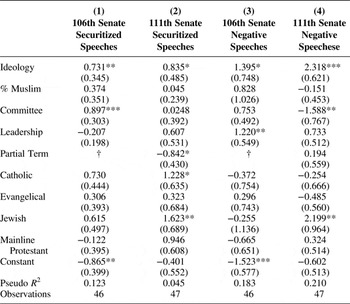
Next, negative binomial regressions were conducted to explore factors influencing which senators securitized and offered negative representations of Islam. Table 2 shows that the Muslim constituency variable is not significant. The findings regarding religious affiliation are mixed. While not significant in the 106th Senate, Catholic and Jewish religious affiliations are significant and positively associated with securitizing and offering negative representations in the 111th Senate. Given the findings of scholars such as Baumgartner, Francia, and Morris (Reference Baumgartner, Francia and Morris2008) that Evangelicals tend to hold more negative views of Islam than other religious groups, it is noteworthy that evangelical religious affiliation is not significant in predicting securitized or negative representations.
Negative binomial regression analysis of senate speeches

Note: The dependent variable is the number of speeches each senator delivered in each Congress. Robust standard errors in parentheses. All significance tests are two-tailed. † omitted due to collinearity
*** p < 0.01, ** p < 0.05, * p < 0.1
The results in Table 2 show that conservative political ideology is significant and positively associated with offering securitized and negative depictions in both periods. When negative binomial regressions were conducted using partisan identity instead of DW Nominate Scores, the models indicated partisan identity was not significant in the 111th Senate, but Republican partisan identity was significant and positively associated with securitization in the 106th Senate. These models also indicated Republican partisan identity was significant and positively associated with offering negative representations across both periods.
Given the small number of normalized and positive speeches, differences in means tests were used to explore factors influencing these speeches. With regard to normalization, only Jewish religious affiliation was statistically significant (p = 0.006, two-tailed test) and only in the 111th Congress. The mean number of normalized speeches for Jewish senators was 1.2, while the mean for all other senators was 0.16. The sample size of normalized speeches is very small, and it is worth reiterating that Jewish senators were also more likely to offer negative depictions in the 111th Congress. On one hand, it is possible that Jewish legislators’ constructions of Islam might be mediated by minority identities that have themselves been otherized in a predominantly Protestant polity (Ulsaner and Lichbach Reference Ulsaner and Lichbach2009). Tolerance and inclusion frames depicting Muslims as one of many faiths deserving protection from discrimination and victimization were prominent in Jewish senators’ speeches across both periods. On the other hand, aspects of Islam also appeared to be mobilized for political purposes by Jewish senators in speaking about Iran, Hamas, the Palestinians, and terrorism.
A partisan divide was evident in that Democrats dominated the normalization and positive representation of Islam across both periods of analysis. In the 106th Senate, the mean number of normalized speeches for Democrats was 0.86 versus 0.21 for Republicans (p = 0.029, two-tailed test). In the 111th Senate, the mean number of normalized speeches was 0.65 for Democrats and 0.05 for Republicans (p = 0.053, two-tailed test). The partisan divide with regard to positive speeches was significant in the 106th Congress, with the mean number of positive speeches being higher for Democratic senators (difference = 0.375, p = 0.093, two-tailed test). In the 111th Congress, Democratic senators delivered both of the two positive speeches.
The finding that politically conservative and Republican senators were more likely to offer negative and securitized representations of Islam is consistent with the findings of large-n surveys that show Republican respondents hold more negative views of Muslims than Democrats, though both groups report overall “cold” feelings toward Muslims (Pew Research Center 2014). Studies of Islamophobia have also pointed to a concentration of anti-Muslim rhetoric and campaigns among political elites, think tanks, media outlets, and grassroots civil society actors that are affiliated with politically conservative groups and the Republican Party (Bail Reference Bail2015; Cole Reference Cole, Esposito and Kalin2011; Nimer Reference Nimer, Esposito and Kalin2011). The anti-Shari'a movement in the United States has been most successful since 2010 in legislating bans that block the use of Islamic law as “foreign” law in politically conservative states like Arizona, Kansas, Louisiana, Oklahoma, South Dakota, Tennessee, and North Carolina (Pew Research Center 2013). A “deep partisan split” was also observed during House Representative Peter King's 2011 congressional hearings on radicalization among American Muslims (Stolberg and Goodstein Reference Stolberg and Goodstein2011). While most studies and surveys focus on the post-September 11 context, this study suggests an ideological and partisan divide in discursive representations of Islam was apparent prior to the September 11th attacks.
CONCLUSION
As congressional discourse shapes public opinion, presidential action, and the policymaking process (Kriner and Shen Reference Kriner and Shen2014; Leep Reference Leep2010), an examination of how Islam and Muslims are constructed within this discourse represents an important endeavor. In addition to contributing to work on securitization, this study furthers our understanding of religion and U.S. politics by exploring discursive representations of Islam in legislative politics. Jamal and Albana (Reference Jamal, Albana, Hammer and Safi2013) observe that the greatest challenges facing the political incorporation of Muslim-Americans stem from a political environment structured by Islamophobia. Discourse by elected officials invoking fear, Orientalist depictions, and problematic dichotomizations regarding Islam contributes to this environment and also sets constraints on the incorporation of Muslim Americans into constructions of American identity. While the analysis of Senate discourse across two time periods shows September 11 did appear to facilitate a higher level of securitization, more negative depictions, and a decrease in normalized constructions of Islam, it is noteworthy that similar patterns emerge across both periods. Orientalist depictions that serve to stereotype and other Muslims are prominent, as are dichotomizations of moderate/secular/good and radical/fundamentalist/bad manifestations of Islam. The Muslim identity can never be fully desecuritized if only “secular” Muslims are constructed as non-threatening in this discursive dichotomy. This trend in Senate discourse arguably hardens the boundaries of American identity vis-à-vis Islam, drawing upon and ultimately reinforcing a broader societal discourse pressuring Muslim-Americans to choose between their American-ness and their Islamic-ness (Simmons Reference Simmons2008, 278).
While this study includes qualitative and quantitative analysis, the small sample size limits generalizability. Further research across additional sessions within both the Senate and the House could provide a fuller picture regarding the construction of Islam in U.S. congressional discourse, as could expanding the scope of analysis to include congressional statements in the media. It would also be fruitful for future studies to explore how Senate rhetoric regarding Islam is related to Senate voting on foreign and domestic policy issues that have implications for Muslims and Muslim-majority states. This analysis suggests there may be an important connection between words and deeds. For example, of the six opponents to Senate Amendment 1133 to H.R. 2346 (2009), which blocked funding for the closure of Guantanamo, all five who spoke about Islam during the 106th or 111th Senates offered normalized depictions of Islam in at least one speech. Insofar as these senators’ “nay” votes may be understood as strong opposition to Guantanamo remaining open, this trend toward normalizing Islam is interesting. Of the eleven opponents to the Iraq War resolution (2002) who spoke about Islam in either the 106th or 111th Senates, eight offered normalized depictions in at least one speech. If one goes further back in time to examine which senators supported SCR 21 (1999) authorizing military operations against Yugoslavia, a relationship with normalization is again apparent; among senators who both voted on this resolution and normalized Islam in at least one speech during the 106th or 111th Senate, all but one voted in favor of the Kosovo intervention. Problems undoubtedly emerge in interpreting such votes as “pro-Muslim” or “anti-Muslim,” particularly as myriad factors are at play in shaping why senators supported or opposed these pieces of legislation. Despite the messiness of such an endeavor, the connection between senators’ discursive representations of Islam and positions on potentially relevant legislation warrants greater scrutiny in future work.