INTRODUCTION
Crustacean decapods, and especially resident species (Heck, Reference Heck1977; Holmquist et al., Reference Holmquist, Powell and Sogard1989; Matheson et al., Reference Matheson, Sogard and Bjorgo1999), play an important role as part of the community structure in seagrass beds of Thallasia testudinum (Banks ex König). They constitute an important food item in the diet of juvenile stages of several coral-reef fishes that visit this marine phanerogam (Heck & Weinstein, Reference Heck and Weinstein1989), as well as for the juvenile stages of the spiny lobster, Panulirus argus White, 1847 (Briones-Fourzán et al., Reference Briones-Fourzán, Castañeda-Fernández de Lara, Lozano-Álvarez and Estrada-Olivo2003). Moreover, majid crabs are common in this particular ecosystem, where high species diversity has been reported (Lemaitre, Reference Lemaitre1981; Carmona-Suárez & Conde, Reference Carmona-Suárez and Conde1996; Marcano & Bolaños, Reference Marcano and Bolaños2001).
Information about several ecological aspects of brachyuran crabs, such as population structure, population dynamics and reproduction, can help to determine recruitment patterns, and the size when males and females attain their functional maturity (Carmona-Suárez, Reference Carmona-Suárez, Bright, Dvorschak and Stachowitsch2002, Reference Carmona-Suárez2007; Baeta et al., Reference Baeta, Cabral, Neto, Marques and Pardal2005; Bas et al., Reference Bas, Luppi and Spivak2005; Litulo, Reference Litulo2005; Teixeira et al., Reference Teixeira, Fransozo, Cobo and Hiyodo2009). Also, reproductive output (expressed in number of eggs/female) and egg size, provide indicators for population dynamics, considering the production of new offsprings per year (Hernández-Reyes et al., Reference Hernández-Reyes, Palazón-Fernández, Bolaños-Curvelo and Hernández2001; Lardies & Castilla, Reference Lardies and Castilla2001; Carmona-Suárez, Reference Carmona-Suárez2003). Moreover, population structure will indicate how stable (or not) the species is in its habitat (Carmona-Suárez, Reference Carmona-Suárez1992; Litulo, Reference Litulo2005; Batista et al., Reference Batista, Leonel and Costa2009).
The tropical decorator crab Microphrys bicornutus (Latreille, 1825) lives in a great diversity of habitats, and is commonly found in coral reefs (Williams, Reference Williams1984), but it is also a frequent inhabitant in Thalassia meadows (Heck, Reference Heck1977; Holmquist et al., Reference Holmquist, Powell and Sogard1989; Carmona-Suárez & Conde, Reference Carmona-Suárez and Conde1996; Carmona-Suárez, Reference Carmona-Suárez2007), as well as in phytals of Halimeda opuntia (Linnaeus) (Batista et al., Reference Batista, Leonel and Costa2009). This decorator crab has also been reported living on Rhizophora mangle (L.) roots (Reyes & Campos, Reference Reyes and Campos1992; López-Greco et al., Reference López-Greco, Hernández, Bolaños, Rodríguez and Hernández2000), inside sponges (Pearse, Reference Pearse1950), and in nests of the fish Malacanthus plumieri (Bloch, 1787) (Gutiérrez-Salcedo et al., Reference Gutiérrez-Salcedo, Aguilar-Pérez, Bermúdez, Campos and Navas-S2007).
Although there is a large body of literature concerning its geographical occurrence (Lemaitre, Reference Lemaitre1981; Williams, Reference Williams1984; Carmona-Suárez & Conde, Reference Carmona-Suárez and Conde1996; Marcano & Bolaños, Reference Marcano and Bolaños2001; Castaño & Campos, Reference Castaño and Campos2003), little has been written about its ecology. Hartnoll (Reference Hartnoll1965) mentions some aspects on relative growth and reproduction, while several authors (López-Greco et al., Reference López-Greco, Hernández, Bolaños, Rodríguez and Hernández2000; Carmona-Suárez, Reference Carmona-Suárez2007; Batista et al., Reference Batista, Leonel and Costa2009) deal with several population characteristics of this decorator crab in different habitats and geographical regions (mangroves and seagrass in Venezuela, and macroalgae in Brazil). Specifically in Buchuaco—Venezuela, Carmona-Suárez (Reference Carmona-Suárez2007) determined that ovigerous females were present throughout the year, excepting during the first months, where the lowest water temperatures were present. Furthermore, this same author states that smallest postpubertal males achieved a body size of 15.16 mm carapace length (CL), whilst postpubertal females attained 8.84 CL. The purpose and importance of this work is to add relevant information and fill some gaps that were not treated in Carmona-Suárez (Reference Carmona-Suárez2007), concerning population dynamics, size distribution, reproductive effort, as well as egg size, of the decorator crab Microphrys bicornutus, that lives in an ecosystem which is localized in an abnormal dry geographical region (Lahey, Reference Lahey, Amiran and Wilson1973), and is frequently exposed to the air, as well as to strong physicochemical variations (Carmona-Suárez, Reference Carmona-Suárez2007).
MATERIALS AND METHODS
The sampling site is located in Buchuaco (11°59′N 69°49′W), on the eastern coast of the Paraguaná Peninsula (State of Falcón, Venezuela). The selected area is formed mainly by a complex of Thalassia testudinum, mixed with algae (Halimeda opuntia L., Caulerpa sertularoides S.G. Gmelin, C. racemosa Forsskal, Penicillus sp. and Padina sp., among others) and coral rubble. The area does not exceed 50 cm in depth at spring tide, and is exposed to the air in several periods of time throughout the year (Carmona-Suárez, Reference Carmona-Suárez2007). For further details on the characterization and physicochemical parameters (salinity, water temperature, dissolved oxygen and seawater level) of the sampling site (see Carmona-Suárez, Reference Carmona-Suárez2007).
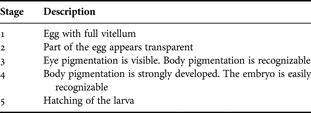
Monthly sampling was carried out manually between June 1988 and December 1990. A 0.25 m2 quadrate was thrown haphazardly twenty-five to thirty times each month, and the interior of the quadrate was searched thoroughly. Due to the extreme shallowness of the area (Carmona-Suárez, Reference Carmona-Suárez2007), material was extracted by hand and examined directly above the surface. Captured animals were counted in the field, measured (CL: carapace length in mm) with a precision Vernier caliper, their sex checked, and the number of ovigerous females determined. Afterwards, they were returned to their environment. Additionally, ovigerous females were collected throughout the sampling years in places distant from the sampling area, in order to estimate reproductive effort, embryonal egg stages and egg size. The eggs of each female were carefully detached from the pleopods and counted manually under a stereo microscope, and the CL of each ovigerous female was measured. Almost all eggs had a spherical form: very few were elliptical and these could be disregarded. The diameter of twenty eggs from each female was measured under a microscope using a graduate reticule. The embryonic stage of the eggs was determined after the classification criteria proposed by Carmona-Suárez (Reference Carmona-Suárez1984), shown in Table 1. Only eggs between stages 1 and 3 were taken into account in order to estimate number of eggs per female.
Classification of embryonal development stages according to the appearance of morphological changes in the embryo.

Permutational analysis of variance (ANOVA) (Anderson, Reference Anderson2005) was used in order to detect differences in body size of males and of females between the sampling years, and differences in egg size between embryonic development stages. Furthermore, linear regression analysis was applied between log-transformed female size and log-transformed number of eggs per female, using standard least squares (Sokal & Rohlf, Reference Sokal and Rohlf1995). For the size distribution of crabs during each year, and between males and females, skewness and kurtosis analyses were conducted (Sokal & Rohlf, Reference Sokal and Rohlf1995). Finally, in order to achieve a better view of the dynamics of the population, crabs were grouped in small (mostly juveniles; 0–7.99 mm CL), medium (8–15.99 mm CL) and large (all adults; larger than 16 mm CL) size-classes.
RESULTS
Size distribution
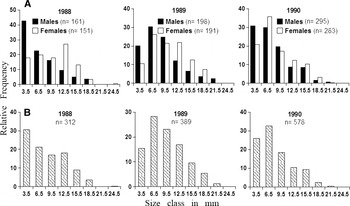
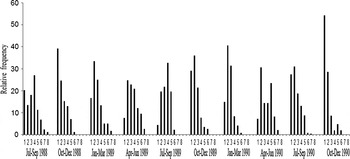
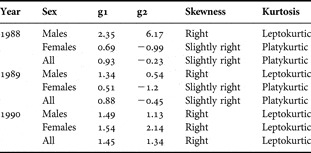
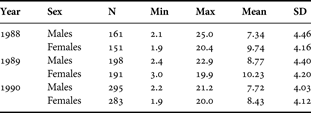
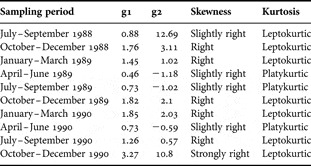
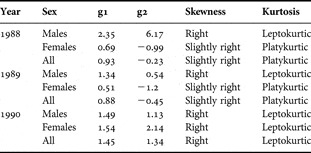
A total of 805 quadrates were examined between July 1988 and December 1990, capturing 1403 crabs. In all the three sampled years, male size distribution always showed a high dominance of very small animals (size-class 3.5 in 1988; size-classes 3.5 to 9.5 in 1989; size-classes 3.5 to 9.5 in 1990) (Figure 1A, B). Males exhibited leptokurtic curves in all the three sampled years; on the other hand, females presented platykurtic curves in 1988 and 1989, but leptokurtic in 1990 (Table 2). Crab size varied significantly between years (ANOVA: df = 2; F = 4.182; P < 0.05). Statistical differences were found in body size, females being larger than males in all the three years (1988: t = 4.91, df = 310, P < 0.05; 1989: t = 3.33, df = 387, P < 0.05; 1990: t = 2.08, df = 576, P < 0.05) (Table 3). Comparing males between years, these were statistically different (ANOVA: df = 2; F = 4.11; P < 0.05), and were significantly smaller in 1988 than in 1990 (t = 2.696; P < 0.05) and significantly larger in 1989 than in 1990 (t = 2.022; P < 0.05). Females also showed significant differences (ANOVA: df = 2; F = 15.687; P < 0.05) being larger in 1988 than in 1990 (t = 4.303; P < 0.05), and in 1989 than in 1990 (t = 5.322; P < 0.05). Moreover, size distribution gathered in 3-month periods showed that the trimester of October–December in all three years was highly skewed to the right with highest frequencies of the small size-classes (Figure 2). The October–December 1990 trimester showed the greatest abundance in the smallest size-classes (3.5 and 6.5 mm). April–June trimesters showed rather a tendency to a flattened (platykurtic) distribution (Table 4), thus there appeared to be a greater abundance of the larger size-classes.
Size distribution of Microphrys bicornutus in Buchuaco—Venezuela between 1988 and 1990: (A) males and females; (B) both sexes.

Relative frequency distribution of size-classes of Microphrys bicornutus (Buchuaco—Venezuela) grouped by trimesters, between 1988 and 1990. Size-classes (carapace length in mm): 1 = 3.5; 2 = 6.5; 3 = 9.5: 4 = 12.5; 5 = 15.5; 6 = 18.5; 7 = 21.5; 8 = 24.5.

Analysis of skewness and kurtosis of annual size-class distribution of Microphrys bicornutus in Buchuaco—Venezuela, between 1988 and 1990.
Descriptive statistics of male and female body sizes (carapace length in mm) sampled during each year (1988 to 1990) in Buchuaco—Venezuela.

N, number; Min, minimum; Max, maximum; SD, standard deviation.
Analysis of skewness and kurtosis of 3-month size-class distribution of Microphrys bicornutus in Buchuaco—Venezuela, between 1988 and 1990.

Population dynamics
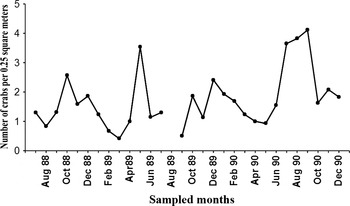
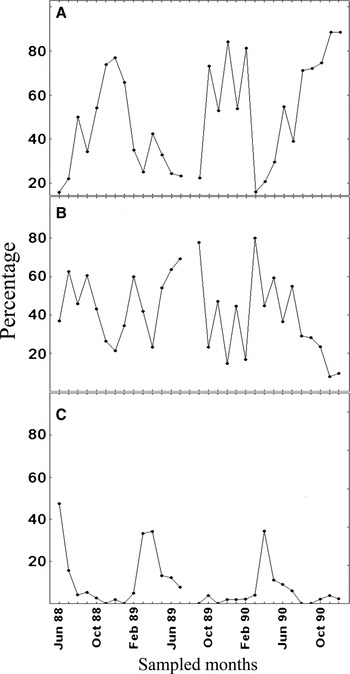
Population abundance fluctuated very strongly during the three years, but no periodicity seemed to be evident. Nevertheless, peaks of abundance appeared in October 1988, May 1989, December 1989 and in July–September 1990 (Figure 3). By separating size of animals in 3 groups (small, medium and large), a periodic fluctuation appeared in the small size-group, observing peaks of relative abundance during the last months of each year, and very low abundance during April of each year (Figure 4A). Medium size showed the most irregular variation during the entire sampling period, but lowest relative abundance was detected in December 1989 and November 1990 (Figure 4B). On the contrary, large crabs did show a strong periodicity throughout all the sampling period. Their highest peaks appeared in June 1988, March–April 1989 and April 1990 (Figure 4C).
Population density variation of Microphrys bicornutus in Buchuaco—Venezuela between 1988 and 1990.

Relative abundance of Microphrys bicornutus in Buchuaco—Venezuela between 1988 and 1990: (A) small crabs (0–7.99 mm carapace length (CL)); (B) medium crabs (8–15.9 mm CL); (C) large crabs (16> mm CL).

Reproductive aspects
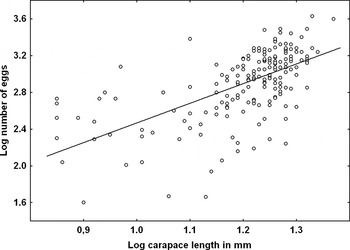
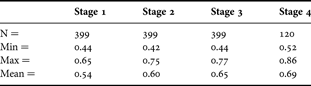
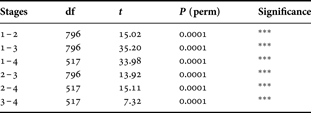
A total of 187 ovigerous females were analysed, ranging in size from 7 to 23.55 mm CL (mean = 16.37± 3.41). Number of eggs per female ranged between 40 and 4305 (mean = 1067.4; standard deviation (SD) = 752.34). Number of eggs was positively correlated with body size of females (log # of eggs = 0.32629 + 2.1390 * log CL; N = 187; r = 0.614; P < 0.05) (Figure 5). Diameter of eggs ranged between 0.42 and 0.86 mm (N = 1317; mean = 0.63; SD = 0.08) (Table 5). Highly significant differences were found between the egg sizes from each of the development stages (permutation ANOVA: df = 3; F = 422.38; P = 0.0001), finding differences between all of the egg stages (Table 6), and showing a gradual egg size increase during embryogenesis.
Log-log linear regression between egg number and carapace length (mm) of ovigerous females in Buchuaco—Venezuela.

Descriptive statistics of egg diameter (in mm) of Microphrys bicornutus in each of the development stages. N, number; Min, minimum; Max, maximum.

Tests among levels of the factor stages, after permutational analysis of variance (perm) of egg size (in mm) in the different development stages in Microphrys bicornutus in Buchuaco—Venezuela.

DISCUSSION
In the present work the size distributions are given for each of the sampling years (see Figure 1), and each showed a distribution strongly skewed to the right. This gives a more detailed insight into how the population behaved, considering the data presented by Carmona-Suárez (Reference Carmona-Suárez1992) where the size distribution was given for the entire sampling period (1988 to 1990). On the other hand, size distribution of M. bicornutus in Isla Margarita (Venezuela) (López-Greco et al., Reference López-Greco, Hernández, Bolaños, Rodríguez and Hernández2000) differed greatly from that found in Buchuaco; during all their sampling year (1988) it resembled almost a normal distribution. As stated in previous works (see Carmona Suárez, 1992, 2007), the shift towards smaller body size in the locality of Buchuaco may have to do with environmental factors that precluded the population to achieve larger body size; one of these is the extreme shallowness of the sampled area (even great extensions of exposure to the air during several periods of each year), which induces low water flow and high water temperatures, among other factors. On the other hand, M. bicornutus specimens from Isla de Margarita were collected on mangrove roots of Rhizophora mangle L. (López-Greco et al., Reference López-Greco, Hernández, Bolaños, Rodríguez and Hernández2000). This island is located in an upwelling system, well known for its high primary productivity (Díaz-Piferrer, Reference Díaz-Piferrer1967). Hence, it can be assumed that size and population distribution of M. bicornutus in Isla Margarita represents a stable and well developed population.
But there could be another explanation for the predominance of smaller crabs: the pressure that predators could have on the population. It has been stated that fish and other crustaceans (Briones-Fourzán et al., Reference Briones-Fourzán, Castañeda-Fernández de Lara, Lozano-Álvarez and Estrada-Olivo2003) feed on small crabs, and Randall (Reference Randall1967) has reported to find M. bicornutus in the stomach contents of the puffer fish Sphaeroides spengleri (Bloch, 1785), a common inhabitant of the Thalassia complex in the sampling area (personal observations). Moreover, it is also feasible that juvenile forms of reef fish that use Thalassia fields as nursery areas (Heck & Weinstein, Reference Heck and Weinstein1989) could also prey on M. bicornutus; these authors determined that decapods were important items in the diet of snappers and scorpaenids in Thalassia seagrass areas that are adjacent to coral reefs, as is the case of the area in Buchuaco. On the other hand, small specimens of M. bicornutus are almost invisible, due to their ability to camouflage or be covered with mud, and can hide between the vegetation and rubble available in the environment. This makes them more difficult to be detected by predators.
Females were statistically larger than males in Buchuaco. On the contrary, López-Greco et al. (Reference López-Greco, Hernández, Bolaños, Rodríguez and Hernández2000) reported that there were no statistical differences in body size between males and females in Isla Margarita. It is well known that male spider crabs achieve sexual (functional) maturity before undergoing the maturity moult (Hartnoll, Reference Hartnoll1965; Carmona-Suárez, Reference Carmona-Suárez2003); this means that males with prepubertal characteristics can have mature gonads and be capable of fertilizing postpubertal females. Therefore, it seems to be that it is not important that M. bicornutus males from Buchuaco achieve large body size, as long as they are capable to reproduce.
The high non-periodic density fluctuations of the whole population during the studied period may be the result of the instability of this, due to the environmental conditions mentioned by Carmona-Suárez (Reference Carmona-Suárez2007) (sea level variations, surface water temperature and dissolved oxygen). Nevertheless, this seems to be restricted to the middle-size crabs, which showed the most irregular relative abundance variation, whereas small-size and large-size crabs exhibited periodic fluctuations. In Buchuaco, peaks of abundace of small animals seem to coincide with peaks of seawater level (data presented in Carmona-Suárez, Reference Carmona-Suárez2007) during the sampling period (November 1988, September 1989 and October 1990). This could be due to the greater water movement, which aids to the dispersion of larvae before settling as megalopae and later development of first juvenile crab stages. Peaks of abundance of larger crabs in Buchuaco also seem to coincide with the lowest seawater levels determined by Carmona-Suárez (Reference Carmona-Suárez2007) (April 1989 and February 1990). No explanation for this has been found. In Joăo Pessoa—Brazil (Batista et al., Reference Batista, Leonel and Costa2009), the number of captured specimens were higher during the rainy season. This cannot be the case in Buchuaco, due to the fact that this locality lies in a geographical area considered as abnormally arid (Lahey, Reference Lahey, Amiran and Wilson1973) and where rain has almost no impact in the marine environment.
The populations of M. bicornutus in Buchuaco (this work) and in Joăo Pessoa—Brazil (Batista et al., Reference Batista, Leonel and Costa2009) share some common features: density variations during two consecutive sampling years in Joăo Pessoa showed no periodicity in all of the 4 sampled localities. Additionally, in this geographical location, smaller immature crabs predominated, most of the sampled crabs ranging between 2.1 and 5 mm CL, with a maximum size of 11 mm. Although crabs in Buchuaco (minimum = 1.86 mm, maximum = 34.40 mm CL; Carmona-Suárez, Reference Carmona-Suárez2007) are also significantly smaller than populations of this species found in other localities in the Caribbean (see Carmona-Suárez, Reference Carmona-Suárez1992), they are much larger than specimens from Joăo Pessoa in Brazil.
In spite of Buchuaco being a harsh environment for the population of Microphrys bicornutus to develop properly (see Carmona-Suárez, Reference Carmona-Suárez1992, Reference Carmona-Suárez2007), egg diameter in this locality is larger than that reported by Hartnoll (Reference Hartnoll1965) for Jamaica, and by López-Greco et al. (Reference López-Greco, Hernández, Bolaños, Rodríguez and Hernández2000) for Isla Margarita—Venezuela for this species. In Buchuaco, the minimum egg diameter is 0.42 mm (stage 1), and the maximum 0.86 mm (stage 4). Hartnoll (Reference Hartnoll1965) reports maximum egg diameter just prior to hatching of 0.55 mm. He also states that eggs are slightly elliptical and they increase a little towards the end of incubation, while most of the examined eggs in Buchuaco were spherical, and the size increase is noticeable. Comparing egg size between Buchuaco (this work) and Isla Margarita—Venezuela (López-Greco et al., Reference López-Greco, Hernández, Bolaños, Rodríguez and Hernández2000), stages 1 and 2 (uneyed eggs: see Table 1) from Buchuaco evidenced larger mean diameters (0.54 to 0.60 mm), than corresponding uneyed eggs from Isla Margarita (López-Greco et al., Reference López-Greco, Hernández, Bolaños, Rodríguez and Hernández2000) (0.44 mm). Furthermore, mean egg diameters in stages 3 and 4 (eyed eggs: see Table 1) were also larger (0.65 to 0.69 mm) than corresponding eyed eggs from Margarita (0.50 mm) (López-Greco et al., Reference López-Greco, Hernández, Bolaños, Rodríguez and Hernández2000). Finally, the low numbers of eggs per brood (mean = 1067.4) found in females captured in Buchuaco do not depart from the observations made in other majid crabs (Hines, Reference Hines1982; Hernández-Reyes, et al., Reference Hernández-Reyes, Palazón-Fernández, Bolaños-Curvelo and Hernández2001; Carmona-Suárez, Reference Carmona-Suárez2003). Nevertheless, larger egg size of M. bicornutus in Buchuaco could be a response of this population to invest more energy in the production of eggs with higher quantities of yolk (thus, larger size), in order to achieve embryos and larvae that can better develop in extreme environmental conditions.
Finally, in spite that the population of M. bicornutus in Buchuaco develops under various inappropriate environmental conditions, it is able to maintain itself, although with certain restrictions, like smaller body size, absence of ovigerous females, during several months in the year, and there is absence of periodical density variation in the medium size individuals. To counteract these inconveniences, reproductive males could be able to mate with larger females, producing eggs that are larger than those described in other geographical regions, hence exhibiting a richer yolk content, and permitting better survival of offsprings.
ACKNOWLEDGEMENTS
I wish to thank Sebastian Trómpiz (UNEFM—Venezuela), whose valuable help in the field and laboratory made it possible to gather all the necessary information for this paper, and to Omégar Céspedes (UNEFM—Venezuela) for occasional help in field assistance. I extend my thanks to Edlin Guerra (Universidad de Oriente—Venezuela) for valuable assistance using PERMANOVA. I also thank the anonymous referees for their valuable observations. All the fieldwork and laboratory analyses were carried out by the author while working as a staff member of the Centro de Investigaciones Marinas (Universidad Francisco de Miranda—Venezuela).