Identifying and defining ancient Maya economic systems is a difficult task and an area of intense debate. Not only are there ongoing disagreements about the various economic paradigms that may be applied to the archaeological record—with formalists applying modern economic theory to all societies, substantivists instead posturing that modern economic theory only applies to contemporary capitalist societies, and Marxists infusing terminology into both of the other camps (Claessen and van de Velde Reference Claessen, van de Velde, Claessen and van de Velde1991; Dalton Reference Dalton, Sabloff and Lamberg-Karlovsky1975:73–75)—but there are also disagreements over the complexity of Maya social and economic systems. For those who view Maya social structure as somewhat similar to “big man” societies in the South Pacific (see, for example, Clark and Blake Reference Clark, Blake, Brumfiel and Fox1994 [for the Preclassic period]; Rathje Reference Rathje, Masson and Freidel2002; Webster Reference Webster, Feinman and Marcus1998 [for the Classic period]), the economy was not very sophisticated, being largely driven by feasting and by the gifting of prestige items. But, for those who argue that the Maya had urban settlements with large population numbers integrated into single societies, a more complex system with multiple forms of economic exchange (McAnany Reference McAnany2010; Scarborough and Valdez Reference Scarborough and Valdez2009) and a market-based economic system is posited (A. Chase Reference Chase1998; A. Chase and D. Chase Reference Chase and Chase2004; Dahlin et al. Reference Dahlin, Jensen, Terry, Wright and Beach2007; Masson and Freidel Reference Masson and Freidel2002). Following Feinman and Garraty (Reference Feinman and Garraty2010:171; see also Smith Reference Smith2004), we see market exchange “as economic transactions where the forces of supply and demand are visible and where prices or exchange equivalencies exist,” noting, as they do, that “market exchange, when present coexists with other modes of transfer and exchange.” Markets are “institutions predicated on the principles of market exchange of alienable commodities” (Garraty Reference Garraty, Garraty and Stark2010:6). Blanton (Reference Blanton, Hirth and Pillsbury2013:23) presciently noted that “a new theoretical synthesis” is needed “to counter not only antimarket thinking but also the limitation inherent in traditional economic theory.” We argue here that the archaeological data from Caracol, Belize, can help to ground such a synthesis in the distant past.
To a large degree, opposition to the existence of markets and a market economy in the ancient Maya area has been predicated on an ideal model of self-sufficiency. Following this model, most families grew their own crops and produced their own basic household items; markets would not have been necessary because residential units were independent and self-sufficient. Under such a model, obsidian (Sidrys Reference Sidrys1976), ground stone (Graham Reference Graham1987), and salt (Andrews Reference Andrews1983; McKillop Reference McKillop2002) were not openly available to Maya populations at large; instead, long-distance exchange for such items formed the power base for the elite (Rathje Reference Rathje1971). It now seems more likely, however, that ancient Maya households and settlements were differentiated, interrelated, and complex. At the same time, general models for the interpretation of ancient economies throughout the Americas have also been called into question (Feinman and Garraty Reference Feinman and Garraty2010; Garraty and Stark Reference Garraty and Stark2010). Among items that deserve review in light of this new work are assertions that pre-Columbian economies were based predominantly on feasting and redistribution. While this may have been possible for small settlements focused on a single elite family, these mechanisms likely were insufficient to support the needs of large and densely settled areas.
While it has sometimes been assumed that centralized elite control of production by attached specialists and elite control of distribution through a redistributive economy and feasting were necessary to support the Maya elite (Hendon Reference Hendon and Bray2003; LeCount Reference LeCount2001; Rice Reference Rice2009), completely centralized economies were relatively rare in the ancient world (Stark and Garraty Reference Stark, Garraty, Garraty and Stark2010:46–47). In the New World, only the Inca maintained a centralized command economy (Stark and Garraty Reference Stark, Garraty, Garraty and Stark2010:46–47; Stanish Reference Stanish, Garraty and Stark2010). Centralized redistribution has archaeologically documented material correlates that include permanent storage facilities for subsistence items (Blanton and Fargher Reference Blanton, Fargher, Garraty and Stark2010) and an uneven on-the-ground distribution of artifacts (Hirth Reference Hirth1998, Reference Hirth, Garraty and Stark2010; Stark and Garraty Reference Stark, Garraty, Garraty and Stark2010:51).
In contrast to redistributed economies, market economies are characterized by a more homogeneous distribution of artifacts, although wealth differences (Smith Reference Smith1987, Reference Smith1999) may play a role and be visible in market exchange distributions (Hirth Reference Hirth, Garraty and Stark2010; Stark and Garraty Reference Stark, Garraty, Garraty and Stark2010:51–52). In particular, market exchange should be evident for items such as domestic pottery that are bulky, heavy, and/or difficult to transport and in need of frequent replacement. While commenting that many households may not have produced their own pottery, Stark and Garraty (Reference Stark, Garraty, Garraty and Stark2010:44) appropriately note that “it is unlikely that ancient states or imperial powers invested in regular household provisioning of quotidian items” (see also West Reference West, Masson and Freidel2002:184–185).
Recent research has suggested that greater complexity and a broader distribution of ancient market exchange systems existed in the past (Feinman and Nicholas Reference Feinman, Nicholas, Garraty and Stark2010; Freidel and Reilly Reference Freidel, Reilly, Staller and Carrasco2010; Hirth and Pillsbury Reference Hirth, Pillsbury, Hirth and Pillsbury2013; Masson and Freidel Reference Masson and Freidel2012, Reference Masson, Freidel, Hirth and Pillsbury2013; Shaw Reference Shaw2012) and that an earlier anthropological emphasis on redistributive economies was seriously overstated (Garraty and Stark Reference Garraty and Stark2010). Both a reevaluation of archaeological evidence and a reconsideration of theoretical models have demonstrated that Polanyi's (see Polyani et al. Reference Polyani, Arensberg and Pearson1957) conceptualization of a market economy was inappropriately narrow and restrictive (Blanton Reference Blanton, Hirth and Pillsbury2013; Feinman and Garraty Reference Feinman and Garraty2010), purposefully emphasizing ideal and “moral” situations that did not exist (Blanton and Fargher Reference Blanton, Fargher, Garraty and Stark2010:207–209). Archaeological work that has taken place within the last quarter century in the Maya area supports these assertions—as does archaeologically collected data from Caracol.
MARKETS AND MARKET ECONOMY AT CARACOL, BELIZE
While physical marketplaces themselves are not universally considered to be essential elements of market economies (Abbott Reference Abbott, Garraty and Stark2010), much archaeological effort in the Maya area has been expended in identifying market locations (Dahlin et al. Reference Dahlin, Jensen, Terry, Wright and Beach2007). Maya markets and market locations undoubtedly served various functions and were presumably the distribution points for a wide variety of material items. Current interpretations of Maya markets are not uniform. One view, based on research at Chunchucmil, a large and dense urban settlement in the northwestern lowlands that was probably incapable of producing its own subsistence needs (Dahlin Reference Dahlin2009; Dahlin et al. Reference Dahlin, Beach, Luzzadder-Beach, Hixson, Hutson, Magnoni, Mansell and Mazeau2005, Reference Dahlin, Jensen, Terry, Wright and Beach2007, Reference Dahlin, Bair, Beach, Moriarty, Terry, Staller and Carrasco2010; Hutson et al. Reference Hutson, Hixson, Magnoni, Mazeau and Dahlin2008), sees Maya markets much like some modern markets that contain a wide variety of food items, including staples. Another view sees Maya markets as the primary venues for administration and the exchange of both food and nonfood items, especially being a venue for exchanging household surplus crafts and for obtaining nonlocal goods (A. Chase Reference Chase1998; A. Chase and D. Chase Reference Chase and Chase2001a, Reference Chase and Chase2004, Reference Chase and Chase2007). Items being exchanged in any market likely varied, depending on local needs. These needs would have also been dependent on risk, such as crop shortages (Freidel and Shaw Reference Freidel, Shaw, McIntosh, Tainter and McIntosh2000).
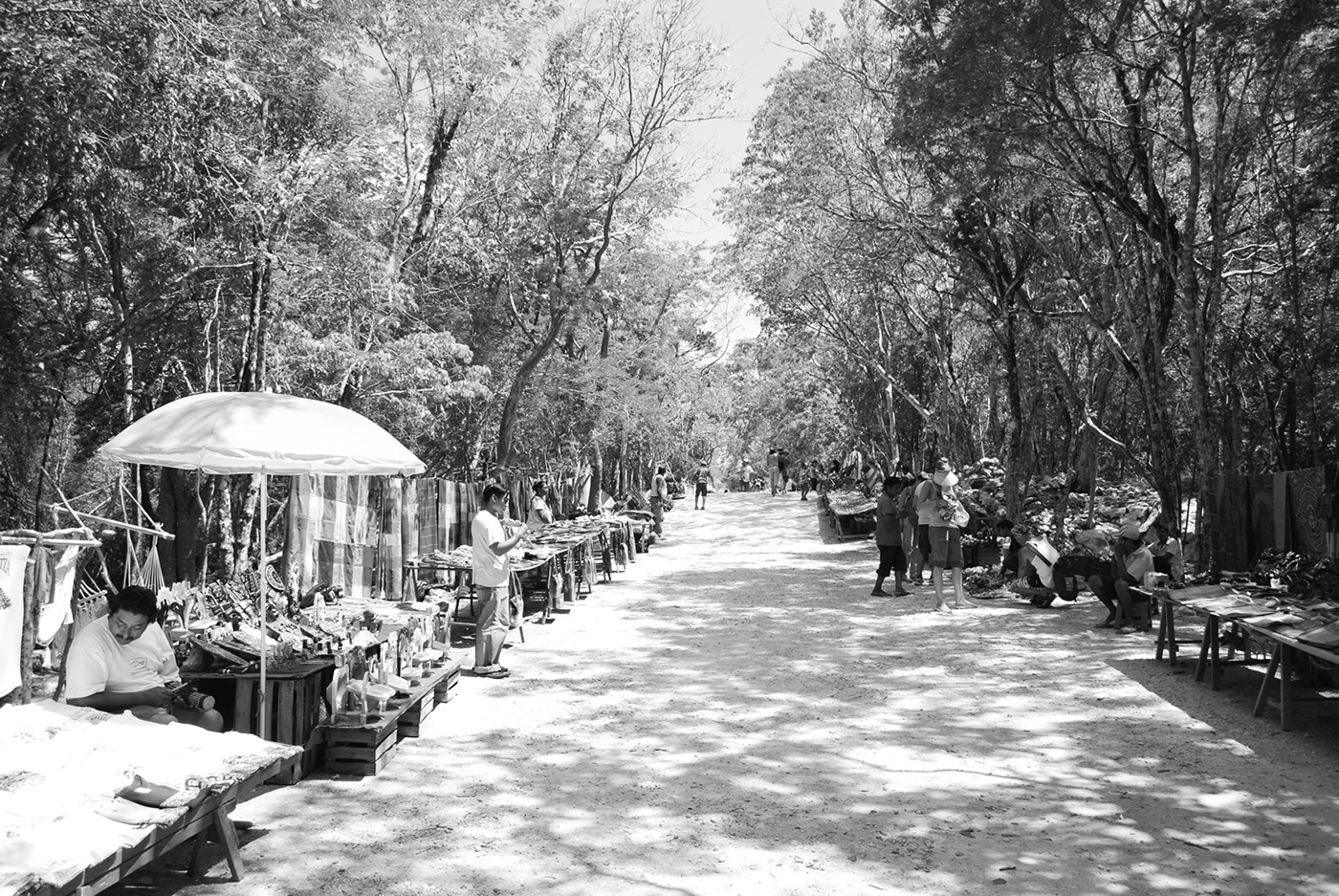
It has been noted elsewhere in Mesoamerica that markets not only provide general populations with wide access to items, but also provide the elite with venues and opportunities for taxation or tribute; markets can also bestow prestige to the elite households who supervise market locations (Hirth Reference Hirth, Garraty and Stark2010:238). The proposed content and function of markets has a bearing on the ability of researchers to securely identify them in the archaeological record. While some markets may have had formally constructed stalls (Carrasco et al. Reference Carrasco Vargas, Vázquez López and Martin2009; Dahlin et al. Reference Dahlin, Jensen, Terry, Wright and Beach2007, Reference Dahlin, Bair, Beach, Moriarty, Terry, Staller and Carrasco2010; Jones Reference Jones1996; May Hau et al. Reference May Hau, Muñoz, González Heredia and Folan1990), many presumably did not—and “periodic” markets would be difficult to identify securely, as they do not require permanent market stalls and such areas are likely to be cleaned in between uses (Hirth Reference Hirth1998:453). One has only to look at the contemporary transitory use of ancient sites like Chichen Itza for tourist transactions to see that even daily use of market space may leave little material evidence (Figure 1). Similarly, even ethnohistorically well-defined markets, such as those at Tenochtitlan, are difficult to identify with certainty in the archaeological record (Masson and Friedel Reference Masson, Freidel, Hirth and Pillsbury2013:209).
Photograph of a modern Maya market at the ancient site of Chichen Itza, Mexico. Each day the vendors assemble their stands along the sides of plazas and causeways, dissembling their displays and removing their wares at day's end. This process likely occurred in conjunction with ancient Maya markets, as well.

As has been noted by others (Garraty Reference Garraty2009; Feinman and Garraty Reference Feinman and Garraty2010:181; Hirth Reference Hirth2009a, Reference Hirth, Hirth and Pillsbury2013), archaeological determination of the existence of a market economy is best made by using multiple lines and scales of evidence. Hirth (Reference Hirth1998:453–454, Reference Hirth2009a:89–90) defined three approaches to identifying ancient Mesoamerican markets: a “configuational approach attempts to identify the location of the marketplace and its associated activities” by analyzing the physical remains of market activities; a “distributional approach seeks to identify market activity from the predicted material outcomes of market exchange and the distribution of products that it creates,” again by analyzing physical remains; and a “contextual approach relies on inferences drawn on indirect data such as the presence of large urban populations and full-time craft specialization believed to require marketplaces to exist.” All three approaches—configurational, distributional, and contextual—can be applied to the site of Caracol. At Caracol, survey and excavation data related to artifact production and distribution, marketplace locations, and road systems used for communication and transportation infrastructure all provide useful evidence in the reconstruction of ancient economy. Using a configurational approach, market locations have been identified through the delineation of archaeological features embedded in the landscape—specifically open plazas associated with range or gallery structures located both in the site epicenter and at causeway termini. These features are found at appropriate marketing distances. Distributional analysis of artifact end-locations indicates a relatively even distribution of products in residential households, which is characteristic of market economies (Hirth Reference Hirth1998; Smith Reference Smith and Smith1976); slight variations in comparable artifact types are also associated with distance from specific markets. A contextual approach focusing on population numbers and evidence for differential household craft production also supports the existence of a market economy.
MARKETS—A CONFIGURATIONAL APPROACH
The city of Caracol covered approximately 177 km2 at its height during the Late Classic period (a.d. 550–900). The entire ancient landscape was modified through construction projects that created monumental architecture, thousands of residential groups, and hundreds of kilometers of agricultural terracing (A. Chase et al. Reference Chase, Chase, Weishampel, Drake, Shrestha, Slatton, Awe and Carter2011). The site is tied together by a radiating causeway system that would have presented a perfect infrastructure for a solar marketing system (A. Chase and D. Chase Reference Chase and Chase1998, Reference Chase and Chase2001a; Smith Reference Smith and Smith1976). As shown below, however, this solar model does not meet Smith's (Reference Smith and Smith1976; see also West Reference West, Masson and Freidel2002:168) strict overview of elite market monopolies.
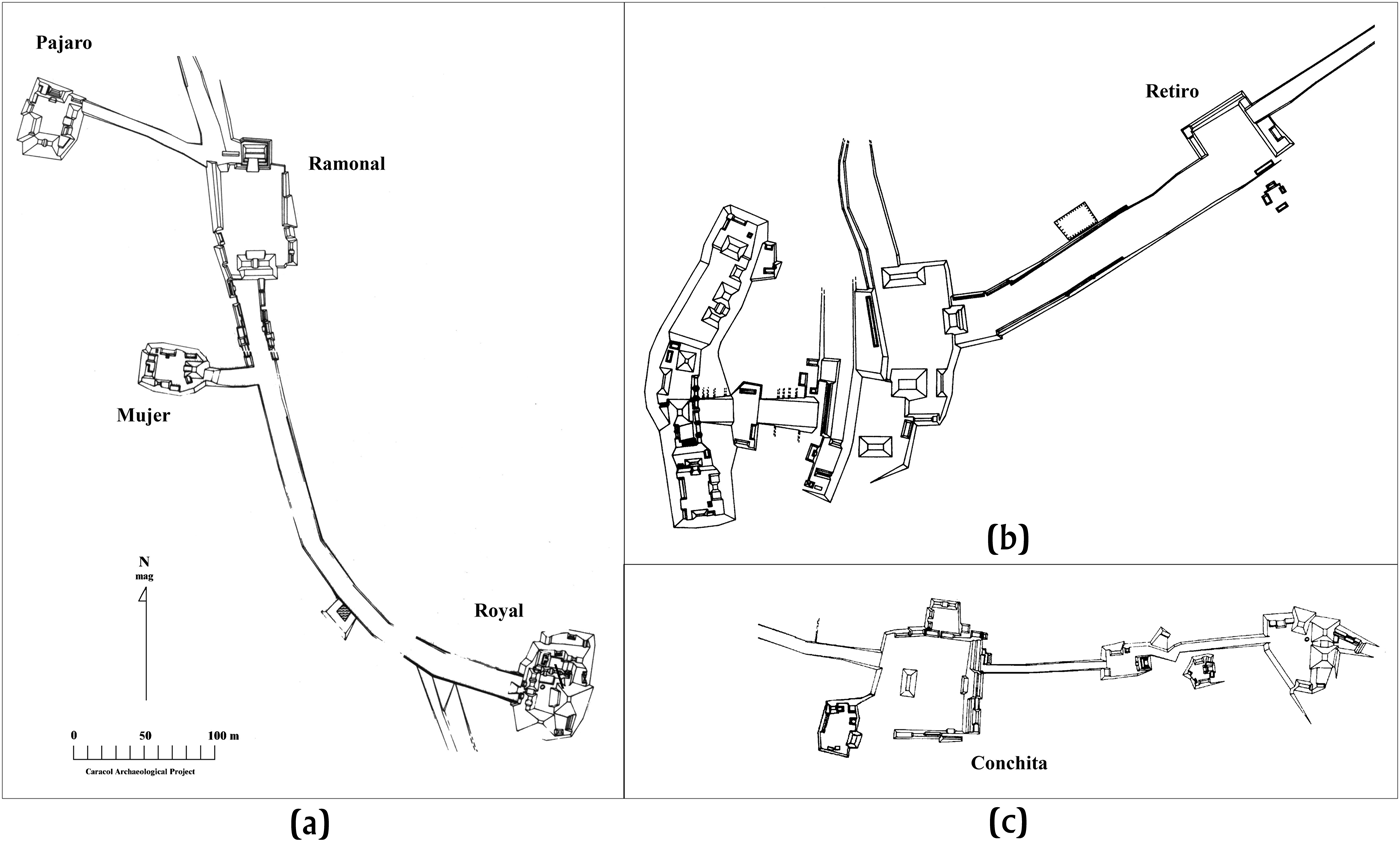
We have previously identified the most likely locations for marketplace distribution at Caracol (A. Chase Reference Chase1998; A. Chase and D. Chase Reference Chase and Chase2001a, Reference Chase and Chase2004). These locales consist of large plazas with range or gallery buildings that are usually adjacent to monumental architecture and that occur at the junctions or termini of the site's road systems (Figure 2). There is, however, variation on how and where plazas were positioned within the landscape. Three free-standing plazas—Conchita, Ramonal, and Puchituk—all located approximately 3–3.5 km from the site epicenter, were embedded in the site settlement at the beginning of the Late Classic period. When preexisting centers were incorporated into the Caracol metropolis, the presumed market plazas were placed either next to extant monumental architecture or new plazas were constructed on the causeways in front of the extant public constructions. For Retiro, the market plaza was set to the northeast of its large buildings, commanding the causeway to the Caracol epicenter and connected by an even wider causeway to the terminus's other plazas. At Ceiba, the market plaza was set adjacent to its largest architectural plaza, effectively bisecting the causeways to the Caracol epicenter to the east and to La Rejolla to the west. The market plaza at Cahal Pichik is to the north of that site's E Group and is integrated with the causeway that runs east to Hatzcap Ceel. At Hatzcap Ceel, the market plaza is immediately north of the Cahal Pichik causeway and west of that terminus's large reservoir. In most cases, low platforms supporting perishable range buildings lined the edges of these proposed market plazas.
Plans of Caracol plazas that are believed to have functioned as markets: (a) Ramonal Plaza; (b) Retiro (market plaza to the east); (c) Conchita Plaza. The locale names are next to the spaces believed to have functioned as markets.
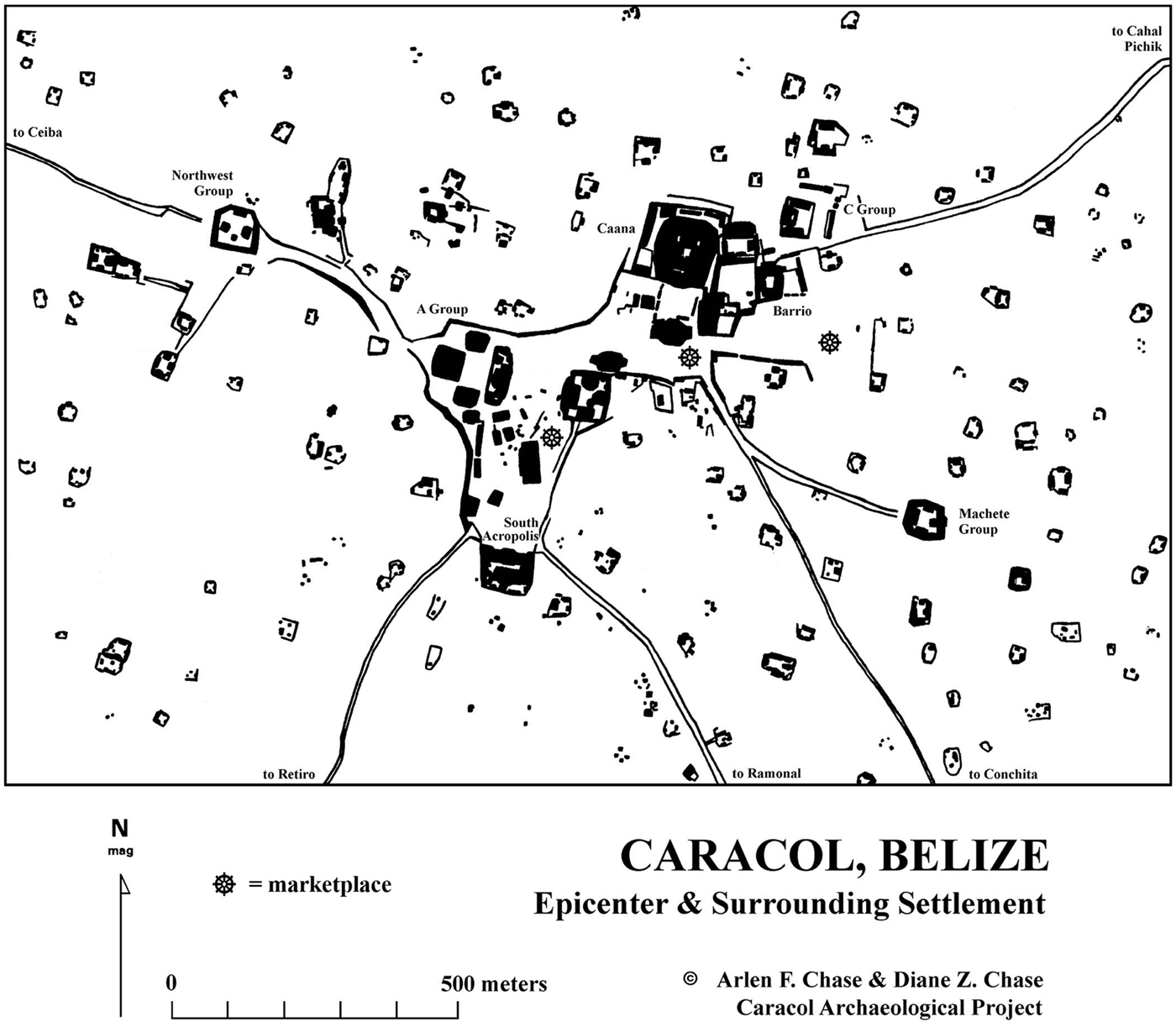
Within the Caracol epicenter itself, three locations have been identified as possible markets (Figure 3). Interestingly, none of them are associated with the gallery or range structures found in the site's termini plazas. The first location is the area south of the Central Acropolis and east of Structure A13, where the current project camp is located. This locality contained multiple low constructions, and camp construction here yielded large numbers of manos and metates. The second area is located north of Reservoir C and east of Barrio, being bounded by the site epicenter's eastern wall. This area was devoid of visible structures, making it not only a suitable ancient market area, but also the location for the modern site visitor center and parking lot. A plaza area bounded by low structures is connected to the northwest corner of this area; it is reminiscent of a similar smaller plaza attached to the Conchita plaza. The third potential epicentral market location is the broad space south of Structure A5 and the articulation point for the Machete-Conchita Causeway with the site epicenter.
Caracol epicenter showing the locations of three potential markets in the site epicenter (labeled with the symbol  ).
There are also smaller structures and platforms that sometimes line the sides of causeways at their juncture with plazas; these features have been interpreted as small market stalls or “shops.” Rows of these stalls are found in four places at Caracol: attached to the Ramonal Plaza on the causeway leading to the elite group known as Royal (Figure 2a); on the northeast side of Cahal Pichik on the causeway to Hatzcap Ceel; along the Machete Causeway where it articulates with the Caracol epicenter; and along the broad causeway between the western Retiro core and its eastern market plaza (Figure 2b).
Two Caracol termini plazas, those at Ramonal and Conchita, were archaeologically tested in 1988 and 1989. A third terminus plaza at Puchituk was archaeologically tested in 1994. The investigations into the plazas and the surrounding structures at these locales revealed a lack of either domestic or ritual remains; the archaeological data further suggested that these plazas and their associated buildings were initially constructed in the early part of the Late Classic period (and were presumably utilized throughout the Late Classic period). The Ramonal and Conchita plazas were tested for chemical signatures by Richard Terry and his students during the 2012 Caracol Archaeological Project field season; the plaza area adjacent to the “stalls” bordering the Machete Causeway where it enters the Caracol epicenter was also chemically tested. Geochemical analyses of soils from the two termini plazas demonstrated that the Conchita Plaza had two spatially distinct parts, a western one where organic remains had been located and an eastern side where other activities took place; the Ramonal Plaza did not evince remnant organic remains in the soils of the plaza, but the stalls south of that plaza may have been associated with perishable food items (A. Chase et al. Reference Chase, Chase, Terry, Horlacher, Chase and King2015; Horlacher and Terry Reference Horlacher and Terry2013).
The causeway termini plazas that presumably functioned as markets at Caracol range in size from 2,800 to 4,620 m2 and, thus, fall within the range of typical market sizes recorded in highland Mexico. In the Mixteca Alta, modern markets measure 2,700 m2 at Ayutla and 3,440 m2 at Nochixtlan (Beals Reference Beals1973:123), and Pluckhahn (Reference Pluckhahn and García2009) identified 37 potential market plazas in the Postclassic landscape. A possible ancient marketplace at El Palmillo, Oaxaca, measures approximately 2,900 m2 (Feinman and Nicholas Reference Feinman, Nicholas, Garraty and Stark2010:95). In the Yucatan, the proposed Early Classic marketplace at Chunchucmil has been estimated at approximately 1,500 m2 (Dahlin et al. Reference Dahlin, Jensen, Terry, Wright and Beach2007:369). Some 15 sites in the Maya lowlands have had marketplaces identified that range in size from 300 to 6,000 m2 (Dahlin et al. Reference Dahlin, Bair, Beach, Moriarty, Terry, Staller and Carrasco2010:198).
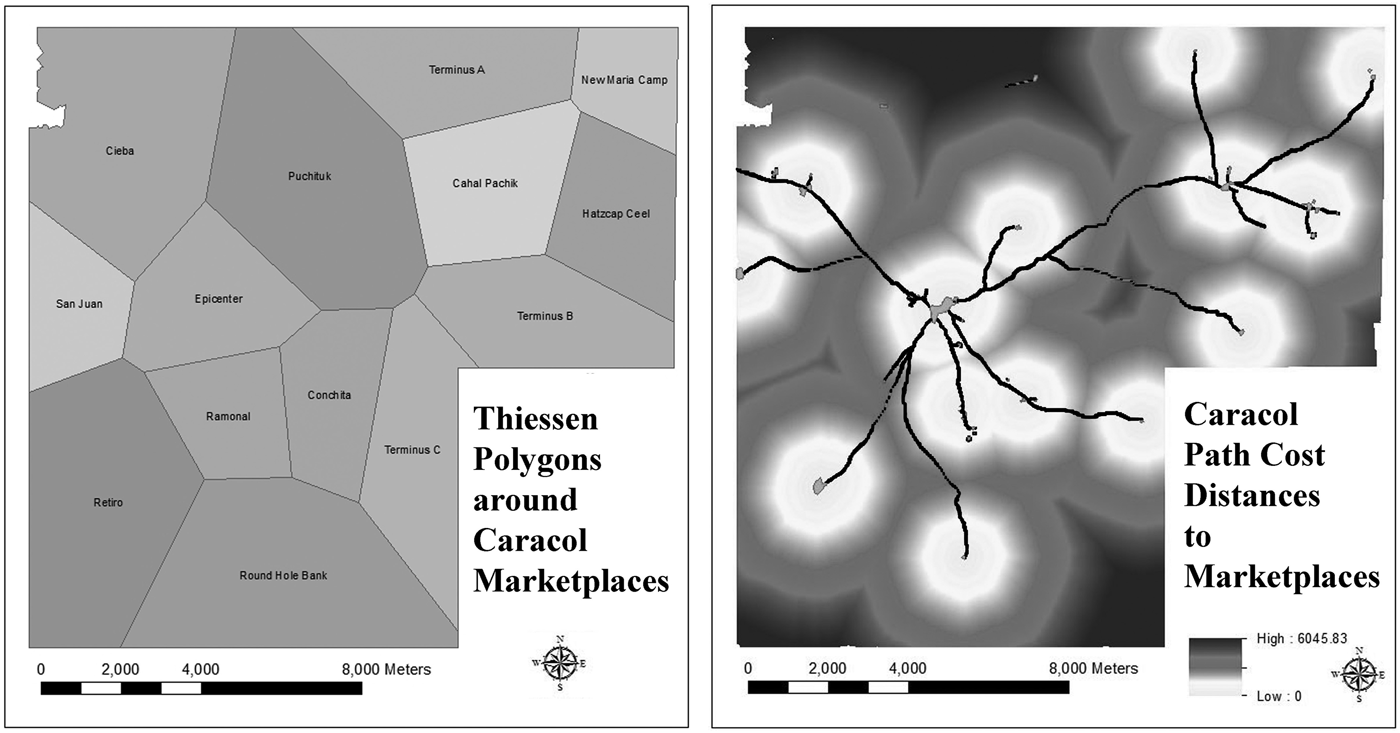
While many Maya researchers have recognized single central marketplaces associated with a given site (see Dahlin et al. Reference Dahlin, Bair, Beach, Moriarty, Terry, Staller and Carrasco2010:220), we suggest that some populous Maya cities had multiple marketplaces. At Caracol, the proposed intrasite market areas ringed the site center and were placed so that no more than 5.3 km existed between these various locations (Figure 4). The shortest distance between these market areas was 1.6 km. This data suggests that each of these markets would have had a service area radius that ranged between 1.6 and 5.3 km. Service areas from regional markets in the Mexican highlands have been suggested as ranging from 4 to 8 km (Blanton Reference Blanton, Berdan, Blanton, Boone, Hodge, Smith and Umberger1996:59) or from 8 to 12 km (Minc Reference Minc2006:99). While the functional service areas at Caracol show closer proximity than exists for other recorded regional markets, this spacing would have been extremely functional. All of the city's inhabitants would have been within an hour's walk to a market.
The site of Caracol showing the known extent of its causeway system and the projected 3 km service areas for each of its markets; these service areas overlap and completely envelop the site's urban core.
Caracol's intrasite markets were convenient for its population and lessened the need for mobility to distant markets. We believe that the markets were periodic and conjoined with other activities, thus serving to reinforce the elite while also provisioning the populace. Based on the proximity and connectivity of elite groups to the causeway terminus with their own sacbes, these large plazas may have originally been controlled by Caracol's leading families. The epicenter's several market areas likely varied in their content and function from those located in the causeway termini plazas. The plethora of manos and metates recovered east of Structure A13 could have been used in the production of food, suggesting that this area may have provided prepared foodstuffs in addition to craft and household items. In contrast to causeway terminus plaza markets, the epicentral market areas are also adjacent to ballcourts and other public access ritual spaces. Thus, only in the epicenter were broader ritual spaces substantially and purposefully conjoined with economic activities, reinforcing centralized elite power. Outlying market locations differed; preexisting centers that had been incorporated into the Caracol metropolis had market spaces adjacent to older ritual plazas; newly constructed markets embedded in the landscape in the early part of the Late Classic period (D. Chase and A. Chase Reference Chase and Chase2004) were separated from ritual plazas (Figure 2b). The physical placement of these Late Classic markets suggests that, except for the Caracol epicenter, economic activity may have taken place in distinct areas; although potentially relatively close to site-wide ritual activity, the separation of the two functions is noticeable—potentially suggesting the increased importance of market activity over time.
MARKETS—A CONTEXTUAL APPROACH
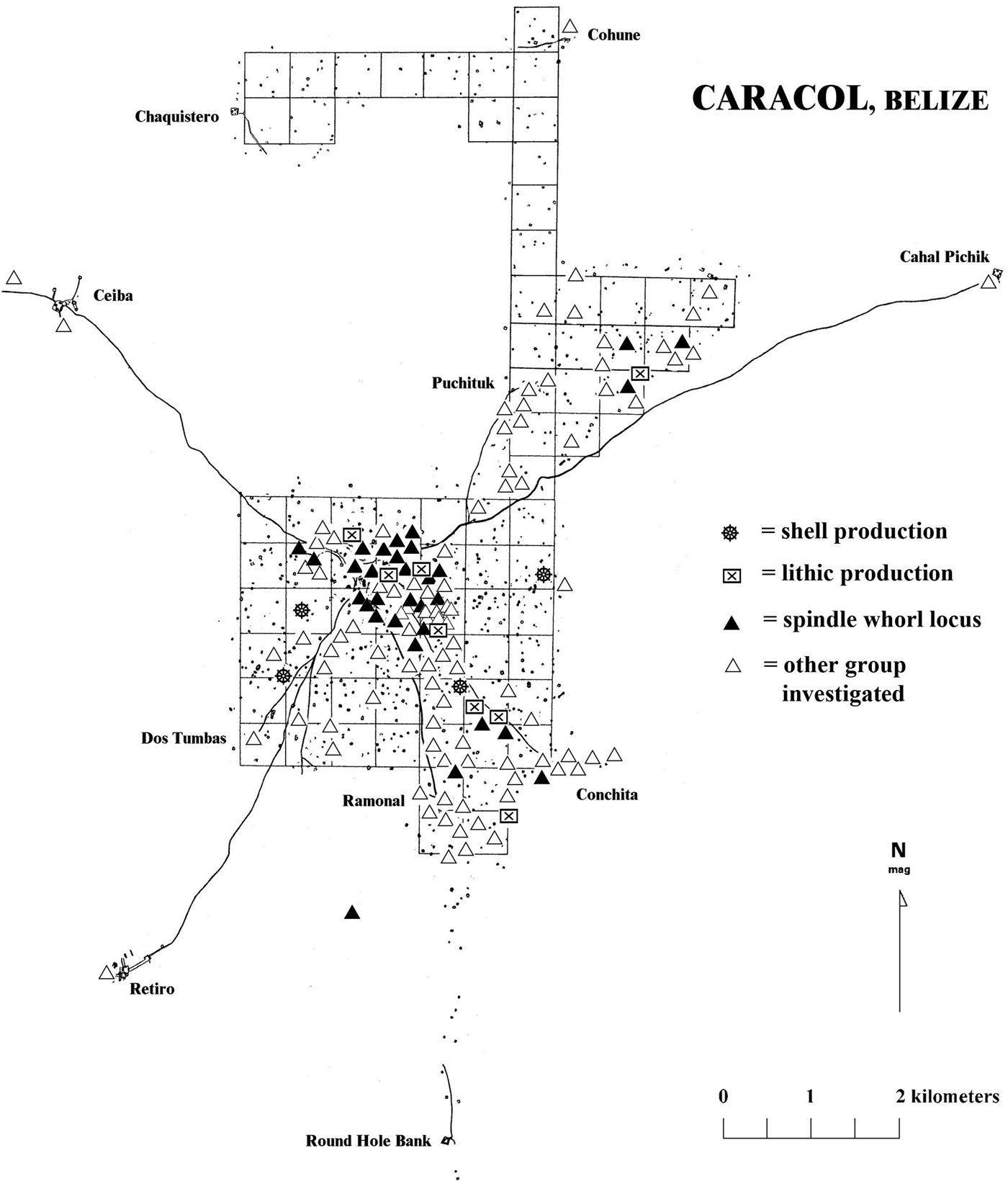
Investigations at Caracol have been undertaken in some 128 residential plazuela groups outside of the epicenter; 118 of these have seen some excavation. These investigations range from cleaning up after looters to single test pits to horizontal clearing and vertical penetration of multiple structures in the same residential group. For the purposes of this paper, discussions are focused on the Late Classic period occupation for which we have the largest archaeological sample; virtually all households were occupied at this time. Households were differentiated with regard to evidence for production (Figure 5) and formed the backbone of the Caracol economy, consistent with other situations in ancient Mesoamerica (see Kowalewski Reference Kowalewski2012).
Plan of Caracol showing distribution of known residential groups associated with the production of shell, lithics, and textile spinning based on artifactual materials.
Caracol's population is conservatively estimated to have been more than 100,000 people at a.d. 650, which translates into a density of approximately 563 people per km2—roughly the population density of contemporary suburban areas like central Florida (D. Chase et al. Reference Chase, Chase, Awe, Walker and Weishampel2011:65–66) and substantially greater than the density of 150 people per km2 projected for Aztec period Morelos where commercial exchange and marketplaces are thought to have been the norm (Smith Reference Smith, Garraty and Stark2010:164). Caracol's population size and density alone provide contextual information in support of the existence of multiple marketplaces at the site, following the tenets of regional analysis (Smith Reference Smith and Smith1976). And differentiated production also provides support for the existence of markets.
While nearly all household excavations yielded chert debitage and broken obsidian blades, the quantity and kinds of lithics present vary among groups. Of 118 groups tested with at least one 1.5- × -1.5 m excavation in a plaza, only three did not yield any obsidian; obsidian was even recovered in three terrace excavations and in one vacant terrain excavation some 7 km distant from the Caracol epicenter. Three operations (two in the epicenter) had a total of 12,455 obsidan artifacts out of the 19,123 pieces of obsidian recovered from the entire site as of 2014. Chert was recovered from every excavated context at Caracol, with at least 80,000 pieces recovered as of 2014. Household chert production is indicated by the large number of groups that contain distinctive lithic waste in the form of broken tools and hundreds of flakes (Pope Reference Pope, Chase and Chase1994); other residential groups contain substantially fewer lithic remains, probably indicative of alternative production foci for items other than chert in these households. In some, but not all cases, the lithic artifacts being produced may be deduced from the remaining production debris. At least eight chert production locales manufactured a surplus of tools beyond those needed for individual household use. In one of these groups, over 8,000 pieces of chert were recovered from a single, shallow test pit. Seven additional surplus chert production areas can be identified because of the sizeable concentrations of lithic debris placed to the rear of a building or redeposited as fill within a building (Martindale Reference Martindale Johnson2008). Moholy-Nagy (Reference Moholy-Nagy1997) has commented on similar redeposition patterns from Tikal. Chert drills are widely distributed at the site and were presumably used in the manufacture of other items created for market exchange; large numbers of chert drills have been recovered from at least three dozen households.
Other households produced different materials. Archaeological preservation of bone at Caracol is problematic, but excavation indicates that bone was worked in five epicentral groups and five nonepicentral groups (Teeter and Chase Reference Teeter and Chase2004:168). In select cases, bone awls and needles provide more specific clues as to tasks that were undertaken (A. Chase et al. Reference Chase, Chase, Zorn and Teeter2008). Three of Caracol's residential groups provide evidence of the extensive working of conch shell, as indicated by hundreds of pieces of shell debris, broken shell artifacts, and slate drills that were used to work the shell (Cobos Reference Cobos, Chase and Chase1994). Another household provided evidence of spondylus shell production. While not associated with evidence for the production of these items, yet another residential group at Caracol provided concentrated amounts of broken and redeposited ceramic incensario pieces—in numbers not seen in any other excavations—suggesting a potential ritual occupation for that group's inhabitants or a role in marketing these items.
Other artifacts indicating differences in household production are spindle whorls (A. Chase et al. Reference Chase, Chase, Zorn and Teeter2008). Some 69 limestone spindle whorls have been found in 26 different, nonepicentral household groups (out of 134 archaeologically investigated), suggesting that minimally one out of every five households spun cloth. Some other kinds of production that surely took place are currently difficult to identify. Objects of wood were also likely produced in many households—and a wide variety of other perishable items must have been manufactured. As in residential groups throughout the site, the inhabitants of Caracol's palaces also engaged in specialized production (A. Chase and D. Chase Reference Chase, Chase, Inomata and Houston2001b). Some textiles were produced in palaces based on spindle whorl distribution, and olive shells and bone items were also worked in at least one of Caracol's palaces.
Evidence does not support the production of artifacts by attached specialists living and/or working in areas adjacent to or conjoined with elite households (see Inomata Reference Inomata2001). We made a concentrated effort to investigate the majority of Caracol's epicentral buildings and residential groups that were in the vicinity of its palaces, looking specifically for attached specialists, but evidence did not support their existence. Instead, it appears that each household produced items beyond what was required for their own consumption. Whether this surplus production took place predominately on a full-time or part-time basis has yet to be determined. Investigations in one part of the site, however, suggest that at least some of Caracol's surplus household production was full-time. Located in a walled area adjacent to the epicenter were individuals who were not situated in an area of farmable land and may have been engaged in specific labor projects in the epicenter; at least some surplus craft production of lithics also occurred in this area. Stable isotope analysis of human bones from this zone shows a diet that was relatively low in maize consumption, consistent with the individuals not having access to farm land. Thus, at least some individuals living within the epicenter likely worked full-time on their trades and did not grow their own food (A. Chase et al. Reference Chase, Chase, White, Ruiz, de León and Martínez2001).
Thus, the recovered archaeological data argue for household—rather than elite-controlled—production at Caracol, in line with economies elsewhere in Mesoamerica (Feinman and Nichols Reference Feinman, Nicholas, Garraty and Stark2010; Kowalewski Reference Kowalewski2012; Masson and Freidel Reference Masson, Freidel, Hirth and Pillsbury2013). No evidence was found that suggests that craft production of certain items, like obsidian, was being practiced in the market plazas, as is argued for Xochicalco (Hirth Reference Hirth2009b:99–100). For Caracol, it appears that most residential households focused on producing surplus craft items for wider exchange and that these items varied from household to household (A. Chase and D. Chase Reference Chase, Chase, Chase and Chase1994). The surplus production of foodstuffs and specialty plants (such as thatch, condiments, and medicinal plants) may have also been a household focus. But, all archaeological indications are that production took place in the household for exchange at the market.
MARKETS—A DISTRIBUTIONAL APPROACH
In contrast to archaeological evidence for differentiated surplus household production, excavations show a far more homogeneous final distribution of most finished artifacts. This distribution in and of itself likely indicates the existence of a market economy (as opposed to centralized redistribution), following Hirth (Reference Hirth1998, Reference Hirth, Garraty and Stark2010). Thus, while much of the exchange taking place in the markets was based in surplus household production, the wide distribution of items like obsidian throughout Caracol's households indicates that at least certain long-distance trade items were available to the populace through market exchange. Household and funerary ceramics, the most frequently replaced—and often among the most difficult artifacts to obtain and transport—are also evenly distributed with nearly all households having access to key types and forms that were traded into the site from outside its boundaries (for example, Belize Red; see A. Chase and D. Chase Reference Chase and Chase2012). Fine-tuned analysis of ceramics suggests, however, slight intra-site variations in available artifact distributions consistent with slight differences in market inventories as will be described below. A similar situation in the availability of ceramics to various households and the projected use of markets for their distribution is noted for Tikal (Culbert Reference Culbert and Sabloff2003:67; Fry Reference Fry and Sabloff2003:159).
Based on the presumed agricultural self-sufficiency of most of Caracol's residential groups due to their proximity to extensive agricultural terracing (Murtha Reference Murtha2009), it is not likely that the terminus markets functioned only in terms of staple subsistence items; rather, specialized goods should have been available in these spaces along with limited or specialized foodstuffs. Bulk subsistence items, however, may have been available for laborers living in proximity to the epicenter who did not grow their own crops (as noted above). Such an interpretation is supported by the presence of food processing implements in epicentral plazas. The epicentral elite also likely did not produce their own food. White and Schwarz (Reference White and Schwartz1989) noted that the ancient Maya diet consisted of approximately 50% maize in the Classic period; at Caracol, the elite had access to more maize in their diet than the rest of the population (A. Chase et al. Reference Chase, Chase, White, Ruiz, de León and Martínez2001), presumably obtaining their maize either from estates located some distance from the epicenter or through a system of tribute or taxation of surplus bulk food items.
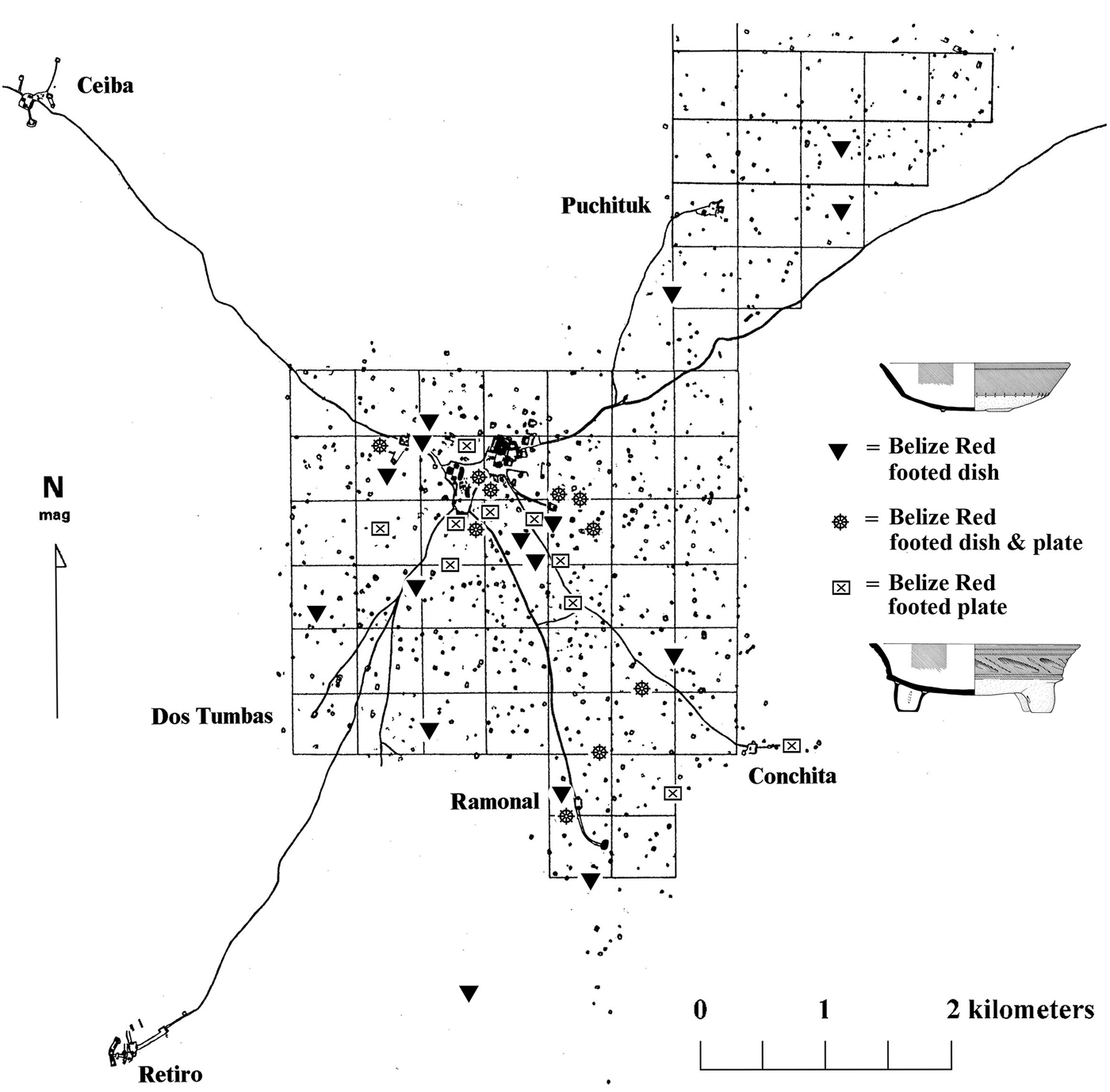
While convenient, well-spaced market locations would be conducive to an even distribution of artifacts, the precise inventory for Caracol's markets surely varied based on distance and market supply. While obsidian and chert are fairly ubiquitous and occur in almost all excavations, ceramic distributions show more variation. Similar ritual vessels, like face caches (D. Chase and A. Chase Reference Chase1998, Reference Chase, Chase, Ruiz, de León and Cuerva2010), are found throughout the site (D. Chase and A. Chase Reference Chase, Chase, Hostettler and Restall2001:44), although with some stylistic variability. Peten-style Late Classic bowls are most common in the western portion of the site, which is closest to their point of origin. A particular kind of brown-slipped nubbin-footed plate is found only in the southeastern part of Caracol, again suggesting a different origin and/or distribution point. Intriguingly, contemporaneous Belize Red forms also vary in their distributions across the site; while sometimes co-occurring, oven-footed plates generally are found in the central and southeastern parts of the site whereas slab-footed dishes are common throughout the site (Figure 6). Similar spatial variation exists in the distribution of decorated cylinders. The fact that polychrome cylinders are widely dispersed among residential groups—and occur in the fill of some of these groups—strongly suggests that they were available in Caracol's markets, rather than resulting solely from “prestige gifting.” Thus, while the general artifactual types are fairly homogeneously distributed, local market differences appear to be reflected in the assemblages of the site's residential groups.
Plan of Caracol showing the distribution of residential groups associated with two classes of contemporary Belize Red plates, possibly illustrating the availability of different ceramic forms at some of the market areas.
MARKETS—MACROECONOMIC SCALE
Although microeconomic scale is useful for identifying artifact distributions associated with markets (Hirth Reference Hirth1998, after Smith Reference Smith and Smith1976), it is also informative to look at the macroeconomic situation for Caracol. Feinman and Garraty (Reference Feinman and Garraty2010:179–180) have noted that the macroeconomic scale “emphasizes the broader, institutional requirements for market development” in that the “the macroeconomic scale of institutions … define the social conditions and ‘rules of the game.’” In a scalar ordering, one moves from household to extra-household organization to institutional constraints to regional scale organization to the external context of commercial interaction. All of these various scales help to frame the existence, development, and articulation of markets and market systems. Thus, it is useful to consider how the economic system of Caracol articulates with a broader regional arena.
Caracol is situated in the western foothills of the Maya Mountains. Its geographical positioning meant that the center could manage the flow of metamorphic and other resources (Graham Reference Graham1987) out of the Maya Mountains into the Peten, thus impacting trade throughout central Belize and the southeast Peten. In fact, the site appears to have been strategically positioned relative to trade corridors connecting the Caribbean Sea on both sides of the Maya Mountains to the Usumacinta River and, indirectly, to the Guatemalan highlands (A. Chase and D. Chase Reference Chase and Chase2012). These southern water and land trade routes (Laporte et al. Reference Laporte, Adanez, Mejía, Laporte, Arroyo and Mejía2008) competed with a more northern, water-based, east-west trade route that was presumably controlled by Tikal (Jones Reference Jones1979).
Archaeological data indicate that Caracol was a major player in long-distance trade early in its history. It was precocious in its use of ritual and in obtaining objects from the Pacific seaboard during the Late Preclassic period (D. Chase and A. Chase Reference Chase, Chase and Houston1998). The site also appears to have had direct connections with central Mexico well before any Teotihuacan individuals become mentioned in later hieroglyphic texts (A. Chase and D. Chase Reference Chase and Chase2011). These long-standing external linkages and implied ties to other parts of Mesoamerica, in combination with successful interpolity warfare at the transition between Early Classic and Late Classic periods (D. Chase and A. Chase Reference Chase, Chase, Brown and Stanton2003), ultimately resulted in a more collaborative social situation at Caracol that was the catalyst for the development of the site's internal markets—in which the bulk of its inhabitants could share in the wealth that was generated by the economic system (A. Chase and D. Chase Reference Chase and Chase2009).
CONCLUSION
In summary, archaeological investigations at Caracol, Belize, provide insight into a once-functioning Maya urban economy, one based on surplus household production of crafts and elite-administered market transactions. These data also showcase the substantial infrastructure—in terms of agricultural terracing, causeways, and marketplaces—that was necessary to fully support and integrate the population within a large Classic period Maya city. The archaeological data suggest that, although the term has fallen from favor, the “penny capitalism” described by Sol Tax (Reference Tax1953) for the Guatemalan highlands, in which various households produced an array of small products for sale or barter within a market system, appears to have firm roots within the Classic period cities of the southern Maya lowlands. As Feinman and Nicholas (Reference Feinman, Nicholas, Garraty and Stark2010) have pointed out for Oaxaca, such commercial household-based activities serviced significant regional market economies—like the one found at Caracol.
What we envision for Caracol is an economic system similar to that projected for Teotihuacan and described for the Aztecs (Feldman Reference Feldman, Lee and Navarrete1978). As at Teotihuacan, the majority of Caracol's inhabitants were either farmers or had family members who were farmers. In contrast to Teotihuacan, however, the Caracol fields were in close proximity to households, facilitating surplus craft production in addition to farming. All or nearly all households participated in craft specialization. Some inhabitants, however, did not produce their own food. These included the elite, who had no fields near their housing and yet had the highest proportion of maize in their diets, and some workers, who lived immediately outside the monumental architecture in the epicenter and who ate maize, but in lower amounts than their neighbors living amid the fields. Thus, at least some surplus food was produced. Given the proximity of most households to agricultural fields, the market likely was not necessary for all household subsistence needs but did provide for items not produced within the unit, such as pottery, heavier ground stone items, foreign goods, and other specialty items. Surplus items produced in Caracol households—shell, cloth, perishable materials, and presumably some food—were also available in these venues.
Although the ancient economic systems of the ancient Maya are difficult to delineate in the archaeological record, researchers have been making significant progress through using multiple lines of evidence. The information that has been gathered relative to these economies indicates that they can no longer be considered as either simple or anomalous. Instead, with continuing progress in the careful collection of detailed landscape and archaeological data, it is now possible to comparatively view ancient Maya economies on the world stage.
RESUMEN
Elaborar modelos sobre los sistemas sociales y económicos de los antiguos mayas del período clásico ha demostrado que es una tarea difícil de realizar debido a varias razones, por ejemplo, el muestreo, la preservación y la interpretación sesgada de los datos. En la medida de que se han realizado más investigaciones arqueológicas, las visiones sobre el período clásico (250–900 d.C.) han llegado a ser progresivamente más complejas. Debido a que ni el arte maya ni los textos jeroglíficos contienen información substancial sobre los sistemas económicos de la antigüedad, algunos arqueólogos han tendido a no destacar el impacto de las antiguas economías en la reconstrucción de la civilización maya del período clásico. Sin embargo, investigaciones arqueológicas en Caracol, Belice, han recobrado evidencia del sistema de caminos, lugares de mercado y áreas de producción que sirvieron como el pilar de la infraestructura económica del sitio. Cuando se combina con la distribución espacial de artefactos, estos datos demuestran la existencia de una economía de mercado con producción de las unidades domésticas y la distribución administrada por la élite del sitio. Los datos arqueológicos de Caracol no solamente demuestran cómo los lugares de mercado formaron parte del paisaje maya sino también cómo se utilizaron para integrar el asentamiento.
ACKNOWLEDGMENTS
Earlier versions of parts of this paper were delivered at the 73rd, 76th, and 77th annual meetings of the Society for American Archaeology: in 2008 in Vancouver, Canada; in 2011 in Sacramento, California; and in 2012 in Memphis, Tennessee. It has been substantially strengthened thanks to the comments of three anonymous reviewers. The paper owes a debt of gratitude to extensive discussions about the archaeological identifications of markets in the Maya area with the late Bruce Dahlin. Lucas Martindale Johnson tabulated the lithic data on chert and obsidian from the Caracol Archaeological Project lot cards and is in the process of analyzing the recovered obsidian. We also thank Rafael Cobos for translating the abstract into Spanish. The Caracol Archaeological Project works in conjunction with the Belize Institute of Archaeology, which provides permitting for investigations. The archaeological research reported on here was funded by the Ahau Foundation; the Alphawood Foundation; the Dart Foundation; the Foundation for the Advancement of Mesoamerican Studies, Inc.; the Geraldine and Emory Ford Foundation; the Government of Belize; the Harry Frank Guggenheim Foundation; the National Aeronautics and Space Agency and the UCF-UF Space Research Initiative (grant NNX08AM11G); the National Science Foundation (grants BNS-8619996, SBR-9311773, and SBR 97-08637); the Stans Foundation; the United States Agency for International Development; the University of Central Florida; and private donations.