The hippocampus is a subcortical structure in the limbic system that has been implicated in memory and learning processes, and in emotionality and emotion regulation through interactions with other brain regions (Cipolotti & Bird, Reference Cipolotti and Bird2006; LaBar & Cabeza, Reference LaBar and Cabeza2006). The hippocampus (specifically, the dentate gyrus) is one of just two brain regions found to show neurogenesis, the generation of new neurons, past the prenatal period into adulthood (Eriksson et al. Reference Eriksson, Perfilieva, Björk-Eriksson, Alborn, Nordborg, Peterson and Gage1998; van Praag et al. Reference van Praag, Schinder, Christie, Toni, Palmer and Gage2002). Insults to the hippocampus have pervasive implications for the brain, and for key cognitive and emotional processes, and impairment in these processes may further exacerbate dysfunction (Abrous et al. Reference Abrous, Koehl and Le Moal2005). A growing number of studies have examined associations between problematic alcohol use and hippocampal volume. A recent meta-analysis of the empirical literature, conducted by our group, indicated that problematic alcohol use shows a significant, moderate association with smaller hippocampal volume (Wilson et al., Reference Wilson, Bair, Thomas and Iacono2017).
The existing literature, synthesized in our meta-analysis, clearly establishes an association between problematic alcohol use and smaller hippocampal volume. However, the vast majority of research has been cross-sectional, and, because the random assignment of humans to alcohol use v. control groups is not possible, the causal nature of this association remains unclear. Hippocampal deviations may reflect an effect of alcohol exposure on the brain, but they may also reflect pre-existing liability toward problematic alcohol use. Suggestive evidence for the former hypothesis comes from experimental animal studies, which demonstrate exposure-related effects on the hippocampus (see Nixon, Reference Nixon2006; Crews & Nixon, Reference Crews and Nixon2009). Animal models of alcoholism indicate that alcohol exposure interrupts neurogenesis – ethanol-exposed animals (rodents, nonhuman primates) show reduced survival of newly formed neurons in the hippocampus (Nixon & Crews, Reference Nixon and Crews2002; He et al. Reference He, Nixon, Shetty and Crews2005; Herrera et al. Reference Herrera, Yagüe, Johnsen-Soriano, Bosch-Morell, Collado-Morente, Muriach, Romero and García-Verdugo2003; Ieraci & Herrera, Reference Ieraci and Herrera2007; Taffe et al. Reference Taffe, Kotzebue, Crean, Crawford, Edwards and Mandyam2010). However, animal studies cannot speak to factors that lead humans to initiate alcohol use in the first place or to develop problematic alcohol use, and cannot rule out the possibility that hippocampal deviations actually confer risk for problematic alcohol use.
Growing evidence from research using causally informative study designs, including longitudinal studies that prospectively assess alcohol use and neural indicators over time, high-risk family studies that compare substance-naïve offspring at high and low familial risk for problematic alcohol use, and co-twin control studies that compare twins who vary in their alcohol use, indicates that at least some of the brain deviations observed among individuals with problematic alcohol use reflect pre-existing liabilities (see Jacobus & Tapert, Reference Jacobus and Tapert2013; Malone et al. Reference Malone, Luciana, Wilson, Sparks, Hunt, Thomas and Iacono2014; Wilson et al. Reference Wilson, Malone, Thomas and Iacono2015a,Reference Wilson, Thomas, Iacono and Wilsonb). However, the few causally informative studies that have considered the hippocampus have yielded inconsistent findings. We are aware of two longitudinal studies that have examined alcohol use and hippocampal volume over time. Cheetham et al. (Reference Cheetham, Allen, Whittle, Simmons, Yücel and Lubman2014) found no significant association between hippocampal volume at age 12 and alcohol-related problems at age 16 in a sample of 98 adolescents; Hanson et al. (Reference Hanson, Medina, Nagel, Spadoni, Gorlick and Tapert2010) likewise found no association between hippocampal volume at age 13 and alcohol and other substance use at age 17 in a sample of 30 adolescents. Of the three high-risk family studies that have examined hippocampal volume among adolescents and young adults at high and low risk for problematic alcohol use, two found no significant differences between offspring with and without a family history of alcohol use disorders (total N = 34 and 30, respectively; Hill et al. Reference Hill, De Bellis, Keshavan, Lowers, Shen, Hall and Pitts2001; Hanson et al. Reference Hanson, Medina, Nagel, Spadoni, Gorlick and Tapert2010), whereas the third did find reduced hippocampal volume (total N = 41; Benegal et al. Reference Benegal, Antony, Venkatasubramanian and Jayakumar2007). Thus, the limited evidence suggests that hippocampal volume reductions are not evident prior to alcohol use, consistent with an exposure-related effect, but sample sizes have been relatively small and perhaps underpowered to detect effects, and additional research is needed to clarify discrepant findings.
We applied the co-twin control study design in a community sample of female twins in early adulthood to examine whether hippocampal deviations reflect pre-existing liability toward problematic alcohol use or instead reflect an alcohol exposure-related effect (see McGue et al. Reference McGue, Osler and Christensen2010). Individuals who develop problematic alcohol use differ from those who do not in many ways. The co-twin control study design accounts for all factors shared by twins that are confounded with alcohol exposure and hippocampal volume, including genetic liability and shared environmental effects, and, thus, provides a more stringent test of potential alcohol exposure effects than is possible with a sample of singletons. Co-twin control analyses decompose an individual twin's level of alcohol exposure into what is shared by twins within a twin pair (primarily reflecting pre-existing liability toward alcohol use) and what differs within a twin pair (level of alcohol use). The first, between-pair component, represents the mean alcohol exposure effect for the twin pair and is fully confounded with all shared factors that predispose toward alcohol use. The second, within-pair component, represents effects of alcohol exposure unconfounded by these shared factors, thus permitting stronger inferences about causal influences of alcohol exposure. Evidence of a significant between-pair effect suggests the association between problematic alcohol use and smaller hippocampal volume reflects pre-existing liability. Evidence of a significant within-pair effect suggests the association reflects an effect of alcohol exposure on the hippocampus. Finally, we examined whether effects hold after accounting for other potentially confounding variables found to be associated with hippocampal volume, including other substance use (Thompson et al. Reference Thompson, Hayashi, Simon, Geaga, Hong, Sui, Lee, Toga, Ling and London2004; Yucel et al. Reference Yucel, Solowij, Respondek, Whittle, Fornito, Pantelis and Lubman2008), externalizing and internalizing psychopathology (Campbell et al. Reference Campbell, Marriott, Nahmias and MacQueen2004; Videbech & Ravnkilde, Reference Videbech and Ravnkilde2004), personality traits (Joffe et al. Reference Joffe, Gatt, Kemp, Grieve, Dobson-Stone, Kuan, Schofield, Gordon and Williams2009), trauma exposure (Kitayama et al. Reference Kitayama, Vaccarino, Kutner, Weiss and Bremner2005; Woon et al. Reference Woon, Sood and Hedges2010), and menstrual phase (Lisofsky et al. Reference Lisofsky, Martensson, Eckert, Lindenberger, Gallinat and Kuhn2015; Protopopescu et al. Reference Protopopescu, Butler, Pan, Root, Altemus, Polanecsky, McEwen, Silbersweig and Stern2008).
Examining these questions in a sample of female twins provides a unique opportunity to explore the association between problematic alcohol use and hippocampal volume in a population understudied in the substance use literature. Although rates of problematic alcohol use and alcohol use disorders have historically been higher among males than among females, this gap has narrowed dramatically in recent years (see Keyes et al. Reference Keyes, Grant and Hasin2008). In addition, there is evidence that long-term negative effects of alcohol on physical and psychiatric health are greater for females than males (see Erol & Karpyak, Reference Erol and Karpyak2015), and several studies suggest that females are more susceptible to neurotoxic effects of alcohol exposure on the brain, indexed by smaller volume of cortical and subcortical structures, including the hippocampus (Agartz et al. Reference Agartz, Momenan, Rawlings, Keric and Hommer1999; Hommer, Reference Hommer2003). Notably, our meta-analysis of associations between problematic alcohol use and hippocampal volume, which included 11 studies in male samples and 4 studies in female samples, found no significant sex effect, but the magnitude of the association between problematic alcohol use and smaller hippocampal volume was larger for females (Wilson et al., Reference Wilson, Bair, Thomas and Iacono2017).
Method
Participants and procedures
Participants were 102 monozygotic (61%) and dyzygotic (39%) female twins drawn from the Minnesota Twin Family Study (MTFS) Enrichment Sample, one of several population-based, longitudinal studies at the Minnesota Center for Twin and Family Research (MCTFR). The Enrichment Sample is an ongoing longitudinal study of reared-together twins and their parents; the study design and sample are described extensively elsewhere (see Keyes et al. Reference Keyes, Malone, Elkins, Legrand, McGue and Iacono2009). Participants in the Enrichment Sample were first assessed at age 11 and were reassessed at ages 14, 17, and 24. The present report focuses primarily on the age-24 assessment (mean = 24.89, s.d. = 0.71, range: 23–26), at which participants completed a comprehensive, multimodal assessment that included interview, questionnaire, laboratory, and neuroimaging components. The subset of twins included in the present report comprised participants who underwent imaging prior to a scanner change; only female twins were assessed on this scanner. Data from 2 participants were subsequently excluded due to significant brain anomalies, yielding a final sample of 100 twins for individual-level analyses and 98 twins (from 49 intact twin pairs) for co-twin control analyses.
Measures
Alcohol use
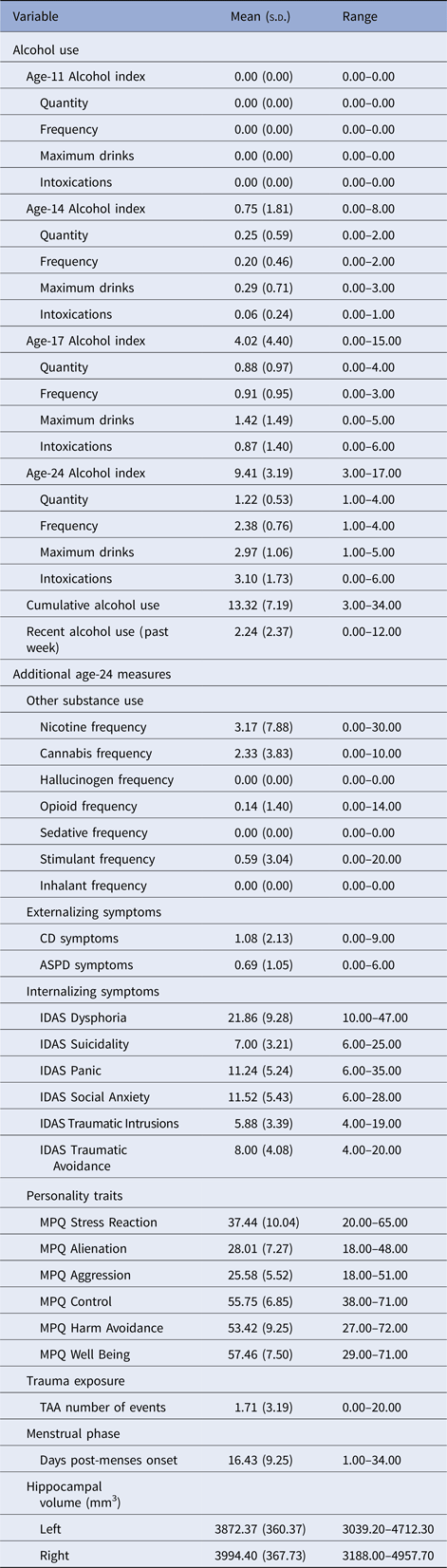
Alcohol use and abuse was assessed at ages 11 and 14 using a Computerized Substance Use (CSU; McGue et al. Reference McGue, Malone, Keyes and Iacono2014) survey and at ages 17 and 24 using a version of the Substance Abuse Module (SAM; Robins et al. Reference Robins, Baber and Cottler1987) of the Composite International Diagnostic Interview (CIDI; Robins et al. Reference Robins, Wing, Wittchen, Helzer, Babor, Burke, Farmer, Jablenski, Pickens, Regier, Sartorius and Towle1988). Both the CSU and our expanded version of the SAM assess Diagnostic and Statistical Manual of Mental Disorders (DSM) diagnostic criteria for alcohol use disorders, as well as drinking frequency, quantity, misuse, and density of alcohol use. We computed alcohol indices at ages 11, 14, 17, and 24 by summing (separately for each time point) responses on four items (frequency of drinking in the preceding 12 months, number of drinks typically consumed per occasion in the preceding 12 months, maximum number of drinks consumed in a single 24-h period since the last assessment 3 to 7 years prior, number of times intoxicated in the lifetime); because responses were skewed and sparse, they were transformed into ordinal measures (five to six categories per item) prior to summing; possible scores on the alcohol index ranged from 0 to a maximum of 23. Comprehensive data on the psychometric properties and validity of the alcohol index are provided in McGue et al. (Reference McGue, Malone, Keyes and Iacono2014); Cronbach's α for the 4-item index ranged from 0.59 to 0.70 across assessments in the present sample. In the present paper, we focus on the alcohol index at age 24 and cumulative alcohol use from ages 11 through 24 (summed across the age-11, 14, 17, and 24 alcohol indices). We also assessed recent alcohol use (maximum number of drinks on one occasion in the preceding week) at age 24 as a potentially confounding variable. Descriptive data for the alcohol indices at each assessment, as well as for cumulative and recent alcohol use, are presented in Table 1. The mean score on the alcohol index at age 24 was 9.41 (s.d. = 3.19, range: 3–17), consistent with drinking 2 to 3 times a month, typically 3 drinks each time, but as many as 12 drinks at once, and having been intoxicated 10 times; 20 (20%) of participants met DSM-IV criteria for an alcohol abuse/dependence diagnosis.
Descriptive statistics for study variables

Notes. CD, conduct disorder; ASPD, antisocial personality disorder; IDAS, Inventory of Depression and Anxiety Symptoms-II; MPQ, Multidimensional Personality Questionnaire; TAA, Trauma Assessment for Adults; Ns range from 76 to 100 across measures and assessments.
Other substance use
Other substance use and abuse was also assessed at ages 11 and 14 using the CSU (McGue et al. Reference McGue, Malone, Keyes and Iacono2014) and at ages 17 and 24 using our version of the SAM (Robins et al. Reference Robins, Baber and Cottler1987) of the CIDI (Robins et al. Reference Robins, Wing, Wittchen, Helzer, Babor, Burke, Farmer, Jablenski, Pickens, Regier, Sartorius and Towle1988), which assesses DSM diagnostic criteria for nicotine, cannabis, hallucinogen, opioid, sedative, stimulant, and inhalant use disorders, as well as frequency of substance use in the preceding 12 months. In the present paper, we focus on age-24 substance use frequency. Descriptive data for age-24 substance use frequencies are presented in Table 1. Because no hallucinogen, sedative, or inhalant use in the preceding 12 months was reported in this sample, we did not consider these variables further.
Externalizing psychopathology
Symptoms of DSM-IV conduct disorder (CD) were assessed at ages 11, 14, and 17 using the Diagnostic Interview of Children and Adolescents – Revised (DICA-R; Reich & Welner, Reference Reich and Welner1988), updated for DSM-IV; the DICA-R was administered to both twin participants and their mothers, and a best-estimate procedure was used to assign symptoms if endorsed by either. CD symptoms were summed across assessments, yielding a childhood (through age 17) CD symptom count. Symptoms of DSM-IV antisocial personality disorder (ASPD) were assessed at age 24 using a semi-structured interview comparable to the Structured Clinical Interview for DSM-III-R Axis II Disorders (SCID-II; Spitzer et al. Reference Spitzer, Williams, Gibbon and First1987), updated for DSM-IV, yielding an adult (age 15 through age 24) ASPD symptom count. Interrater reliability of psychiatric diagnoses, assessed on a randomly selected subsample of 600 MTFS participants, was good (all κs ⩾ 0.71). Descriptive data for CD and ASPD symptoms are presented in Table 1.
Internalizing psychopathology
Depressive and anxiety symptoms were assessed at age 24 using a modified version of the Inventory of Depression and Anxiety Symptoms-II (IDAS-II; Watson et al. Reference Watson, O'Hara, Naragon-Gainey, Koffel, Chmielewski, Kotov, Stasik and Ruggero2012). Our version of the IDAS-II is a 38-item (1 = not at all, 5 = extremely) self-report questionnaire that yields scores on Dysphoria, Suicidality, Panic, Social Anxiety, Posttraumatic Stress Disorder (PTSD) Intrusions, and PTSD Avoidance subscales; participants were asked to focus on a 2-week period since the last assessment (7 years prior) when they had felt the most stressed. Cronbach's α for the 4- to 10-item subscales ranged from 0.86 to 0.91 in the present sample. Descriptive data for the IDAS-II subscales are presented in Table 1.
Personality traits
Normal-range personality traits were assessed at age 24 using a brief version of the Multidimensional Personality Questionnaire (MPQ; Patrick et al. Reference Patrick, Curtin and Tellegen2002; Tellegen & Waller, Reference Tellegen, Waller, Boyle, Matthews and Saklofske2008). The brief MPQ is a 133-item (1 = definitely true, 4 = definitely false) self-report questionnaire that yields scores on Stress Reactivity, Alienation, Aggression, Control, Harm Avoidance, and Well Being. Cronbach's α for the 18-item subscales ranged from 0.83 to 0.92 in the present sample. Descriptive data for the MPQ subscales are presented in Table 1.
Trauma exposure
Exposure to potentially traumatic events was assessed at age 24 using an interviewer-administered version of the Trauma Assessment for Adults (TAA: Resnick et al. Reference Resnick, Best, Kilpatrick, Freedy and Falsetti1993). The TAA assesses lifetime exposure to stressful or disturbing events (e.g. military combat experience, serious accidents, natural disasters, serious injury/illness). We computed a trauma exposure index by summing the number of exposures across events. Descriptive data for the TAA trauma exposure are presented in Table 1.
Menstrual phase
Menstrual phase was assessed using the self-reported date of onset of the most recent menstrual cycle. Menstrual phase was operationalized as the number of days post-menses onset at the time of the MRI scan. Descriptive data for the menstrual phase are presented in Table 1.
Neuroimaging
Image acquisition
Imaging data were collected on a Siemens 3T Tim Trio scanner (Siemens Medical Systems, Erlangen, Germany) using a 32-channel array head coil at the University of Minnesota's Center for Magnetic Resonance Research. Three-dimensional T1-weighted anatomical images were acquired in the sagittal plane using a magnetization prepared rapid gradient echo (MP-RAGE) sequence (TR = 2530 ms, TE = 3.65 ms, flip angle = 7°, matrix size = 256 × 256, FOV = 256 mm, GRAPPA = 2, 240 coronal slices with 1-mm isotropic voxels, single shot, interleaved acquisition).
Image processing
All images were normalized and manually reviewed for artifact prior to subsequent processing. Imaging data were processed using the standard FreeSurfer pipeline (version 5.3.0; http://surfer.nmr.mhg.harvard.edu) (Fischl et al. Reference Fischl, Salat, Busa, Albert, Dieterich, Haselgrove, van der Kouwe, Killiany, Kennedy, Klaveness, Montillo, Makris, Rosen and Dale2002, Reference Fischl, van der Kouwe, Destrieux, Halgren, Segonne, Salat, Busa, Seidman, Goldstein, Kennedy, Caviness, Makris, Rosen and Dale2004) and were manually reviewed for accuracy. Volumetric data were obtained for the left and right hippocampus, as well as an estimate of total brain volume (‘BrainSegVolNotVent,’ the sum of the volume of all brain structures, including cerebellum), used as a covariate in analyses.
Statistical analyses
Preliminary analyses
We examined zero-order correlations between the age-24 alcohol index and left and right hippocampal volume, as well as cumulative and recent alcohol use, other substance use, externalizing and internalizing psychopathology, personality traits, trauma exposure, and menstrual phase.
Individual-level analyses
We conducted linear mixed models to examine associations between problematic alcohol use, including proximal (age 24) and cumulative (age 11 to age 24) alcohol use, and left and right hippocampal volume. Individual-level linear mixed models were conducted in R version 3.3.1 using lmer from the lme4 package (Bates et al. Reference Bates, Maechler, Bolker, Walker, Christensen, Singmann, Dai, Eigen and Pcpp2015) with denominator degrees of freedom adjusted using the Kenward-Roger approximation from the lmerTest package (Kuznetsoca et al. Reference Kuznetsoca, Brockhoff and Christensen2014). Random intercepts were included at the twin pair level to account for within-twin pair correlations (resemblance between twins in a twin pair). All models included participant age, zygosity, and total brain volume as covariates.
Co-twin control analyses
Co-twin control analyses decompose each individual twin's alcohol exposure into between-pair and within-pair effects (see Begg & Parides, Reference Begg and Parides2003; McGue et al. Reference McGue, Malone, Keyes and Iacono2014). The between-pair effect is represented by the twin pair's mean on the alcohol variable and the within-pair effect is represented by the difference between the twin pair's mean and an individual twin's score. Ignoring covariates and the constant (intercept), the model can be written as  $\hat Y_{ij} = b_B\bar X_{.j} + b_W(X_{ij} - \bar X_{.j})$, where
 $\hat Y_{ij}$ is the expected volume of the hippocampus for a given individual twin i in twin pair j,
 $\bar X_{.j}$ represents the mean alcohol score for twin pair j, and X ij represents the alcohol score for twin i in twin pair j. This equation can be re-expressed using simple algebra as
 $\hat Y_{ij} = b_{B^*}X_{.j} + b_W\bar X_{ij} $, with the between-pair effect now represented by b B* to distinguish it from b B in the original equation. Doing so yields the identical estimate of the within-pair, or exposure effect, while providing a more appropriate estimate of the between-pair effect (McGue et al. Reference McGue, Malone, Keyes and Iacono2014; also compositional effect, Bryk & Raudenbush, Reference Bryk and Raudenbush1992). The between-pair effect in this parameterization largely captures genetic and shared environmental propensity toward alcohol use among reared-together twins, independent of individual twins’ level of alcohol use, and a significant between-pair effect suggests that hippocampal deviations are consistent with a pre-existing liability toward problematic alcohol use. The within-pair effect in either parameterization reflects the effects of alcohol exposure unconfounded by shared genetic and environmental risk, and is consistent with an exposure-related effect of alcohol on the hippocampus. Co-twin control analyses were also conducted using lmer from the lmer4 package in R, specifying random intercepts at the twin pair level.
Follow-up analyses
We included potentially confounding variables (recent alcohol use, other substance use, externalizing and internalizing psychopathology, personality traits, trauma exposure, menstrual cycle) in individual-level and co-twin control models to examine whether associations between problematic alcohol use and smaller hippocampal volume held. We also examined main and interaction effects of zygosity, and conducted co-twin control analyses separately among MZ (n = 62) and DZ (n = 38) twins. Evidence of significant within-pair effects only for DZ twins suggests that an association between problematic alcohol use and hippocampal volume is entirely due to confounding effects of familial influences; evidence of significant within-pair effects for MZ twins but larger within-pair effects for DZ than MZ twins suggests the association is partially due to confounding familial influences but is still consistent with a partial causal effect; and evidence of comparable and significant within-pair effects for both MZ and DZ twins is consistent with an entirely causal effect (see McGue et al. Reference McGue, Osler and Christensen2010).
Results
Preliminary analyses
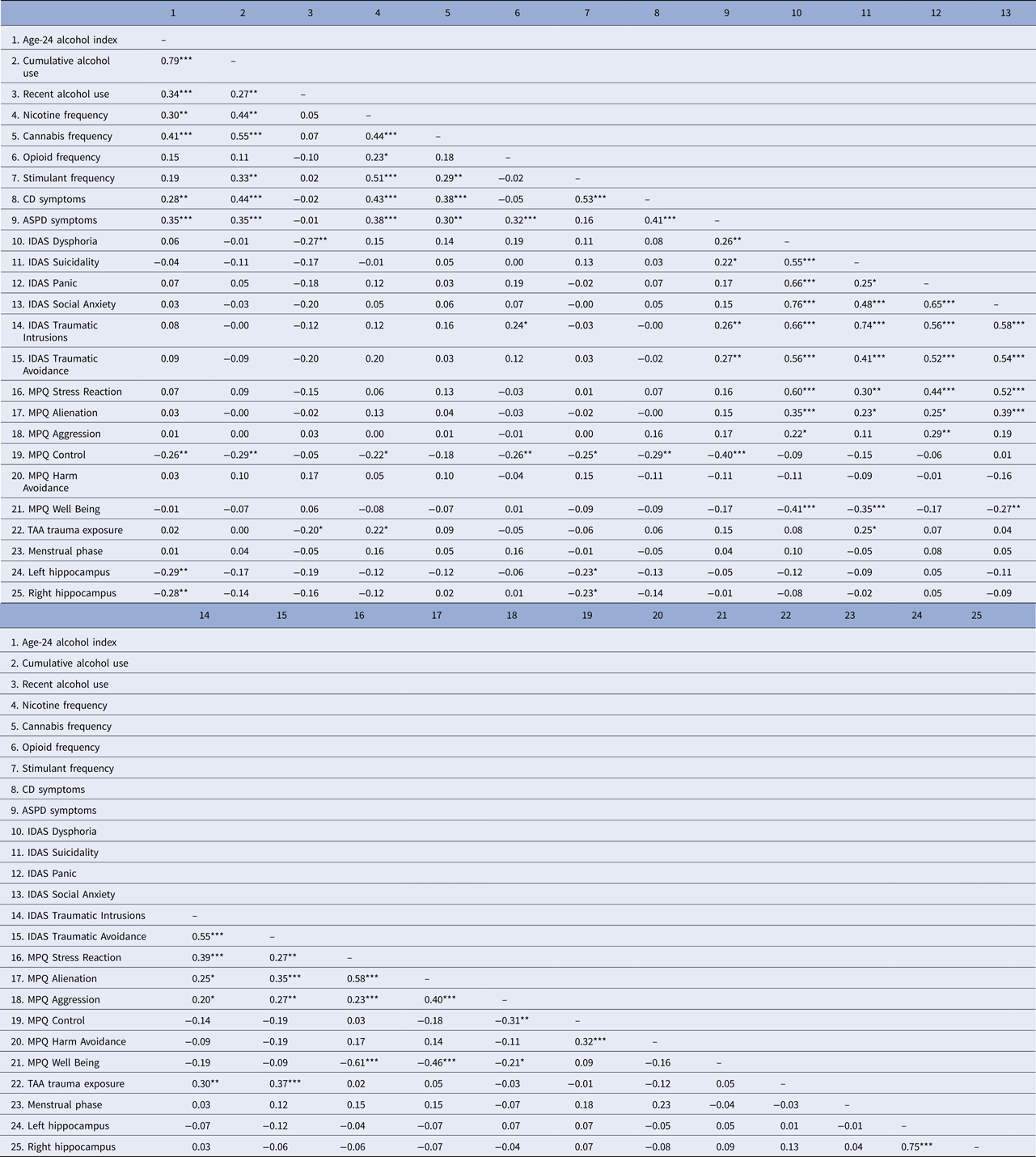
Zero-order correlations are presented in Table 2. As expected, age-24 alcohol use was generally significantly associated with cumulative and recent alcohol use, other substance use, externalizing psychopathology, and lower control; associations with internalizing psychopathology, personality traits, trauma exposure, and menstrual phase were generally modest and nonsignificant.
Zero-order correlations between study variables

CD, conduct disorder; ASPD, antisocial personality disorder; IDAS, Inventory of Depression and Anxiety Symptoms-II; MPQ, Multidimensional Personality Questionnaire; TAA, Trauma Assessment for Adults; Ns range from 87 to 100 across measures and assessments. * p < 0.050. ** p < 0.010. *** p < .001.
Individual-level associations between problematic alcohol use and hippocampal volume
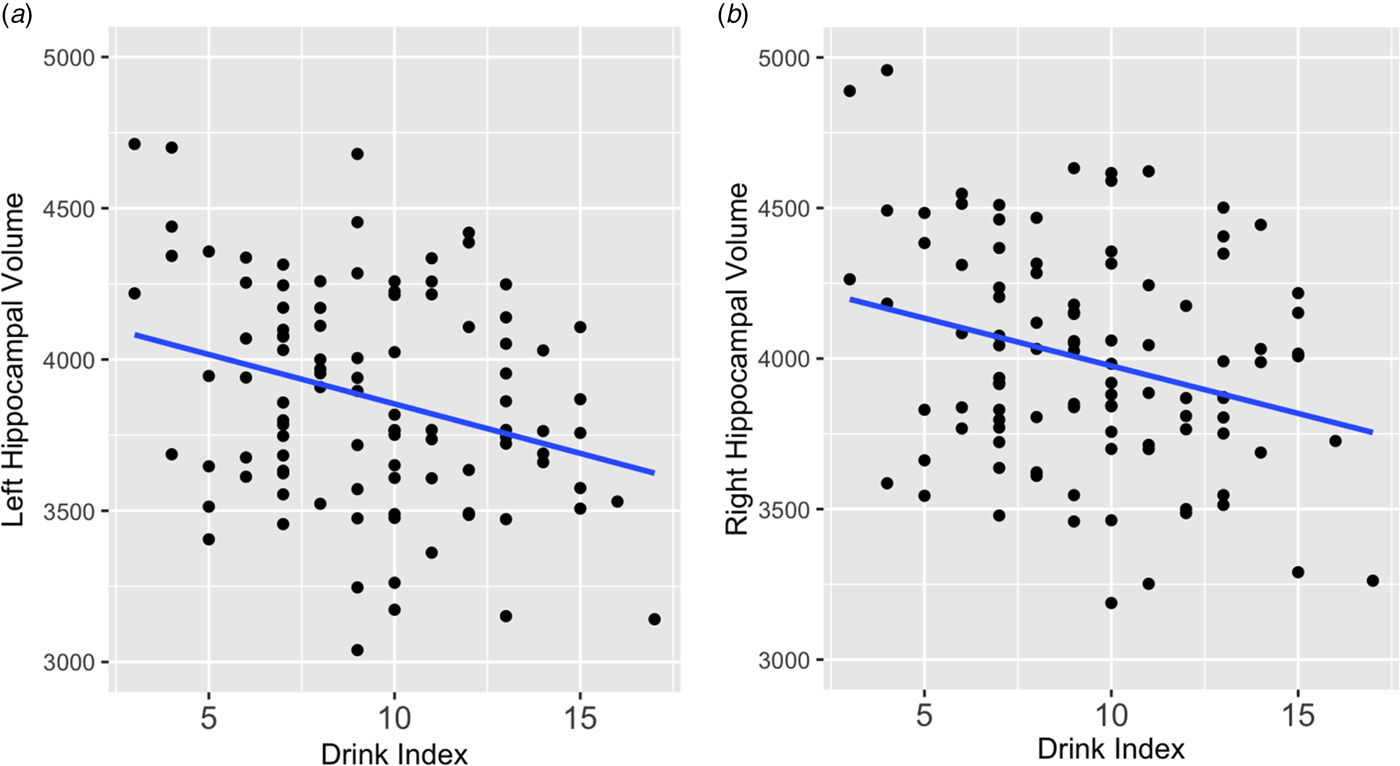
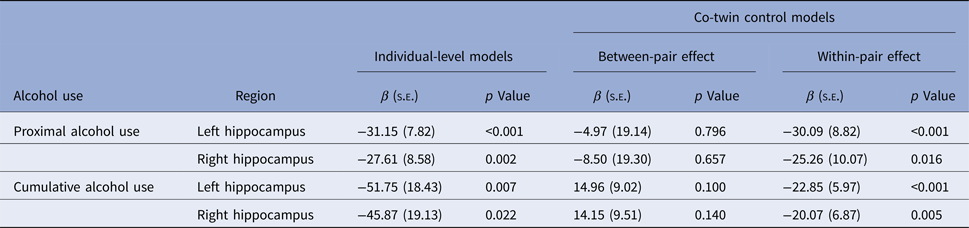
Individual-level analyses examined associations between problematic alcohol use and left and right hippocampal volume among the full sample of twins and are comparable to analyses conducted in a sample of singletons. Results of these individual-level analyses indicated that proximal (age 24) alcohol use was significantly and negatively associated with the left and right hippocampal volume, meaning that greater alcohol use was associated with the smaller hippocampal volume (see Table 3 and Fig. 1). Cumulative alcohol use was also significantly and negatively associated with the left and right hippocampal volume (Table 3).
Individual-level associations between problematic alcohol use at age 24 and left (a) and right (b) hippocampal volume (N = 100).

Individual-level and co-twin control analyses of problematic alcohol use and hippocampal volume

Notes. Results of individual-level linear mixed models and co-twin control analyses. Individual-level analyses examined associations between proximal (age-24 alcohol index) and cumulative (age 11 to age 24) alcohol use and hippocampal volume; models included random intercepts at the twin-pair level to account for within-pair correlations. Individual-level analyses were followed up using co-twin control analyses that decomposed effects into between-pair (pre-existing, shared familial liability) and within-pair (alcohol exposure) effects. All models included participant age, zygosity, and total brain volume as covariates. N = 100 twins in individual-level models, n = 98 twins (from 49 intact twin pairs) in co-twin control models.
Co-twin control analyses: pre-existing liability v. alcohol exposure-related effect
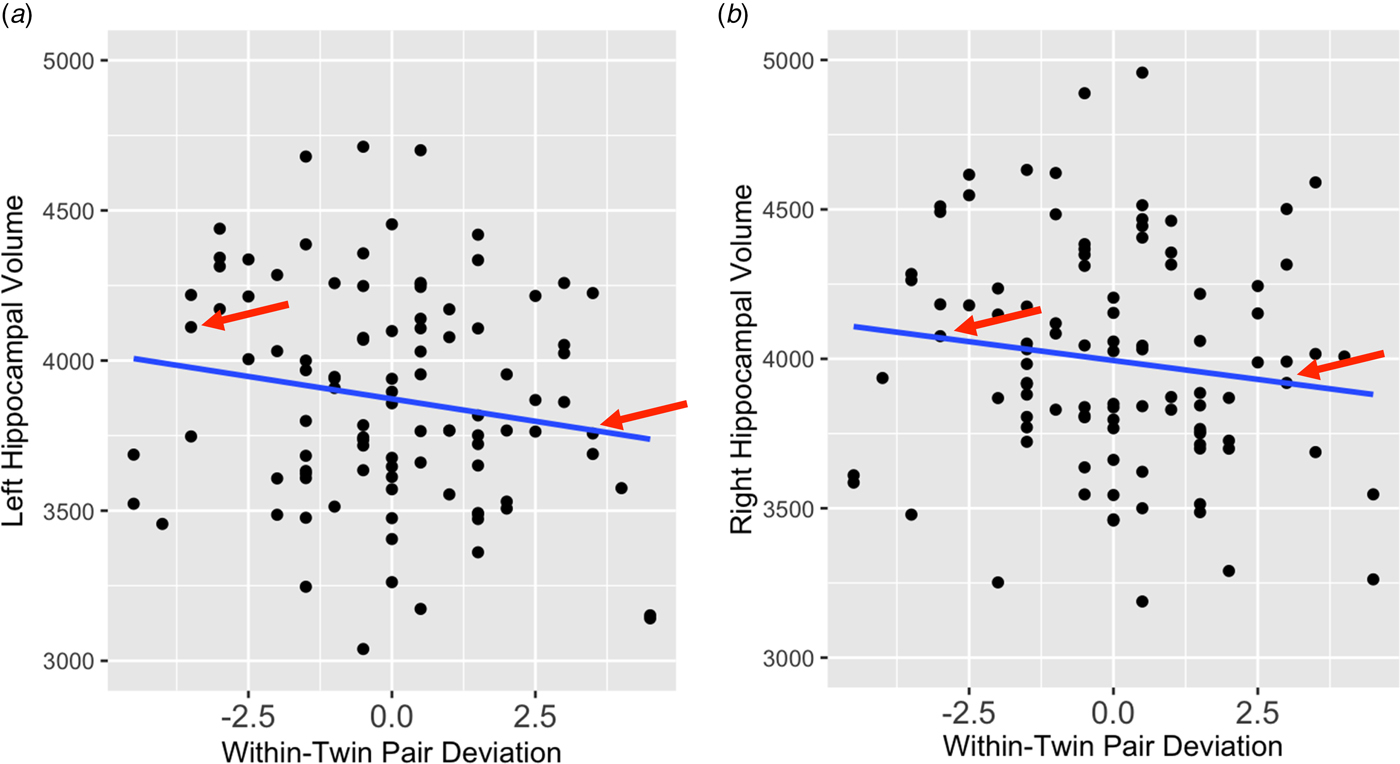
Effects for individual-level analyses are fully confounded with any genetic and shared environmental liability toward problematic alcohol use. Thus, we conducted follow-up co-twin control analyses to differentiate pre-existing liability from alcohol exposure-related effects. Results of co-twin control analyses indicated that within-pair effects were significant for proximal (age 24) alcohol use for left and right hippocampal volume, meaning that the twin who used more alcohol had smaller hippocampal volume relative to her lesser-drinking co-twin, even accounting for shared genetic and environmental liability toward problematic alcohol use (see Table 3 and Fig. 2). In contrast, between-pair effects were nonsignificant, indicating that pre-existing, shared familial factors were not significantly associated with hippocampal volume. Results for cumulative alcohol use followed the same pattern, with significant within-pair effects for left and right hippocampal volume, and nonsignificant between-pair effects (see Table 3). Taken together, results of the co-twin control analyses are consistent with an exposure-related effect of alcohol on the hippocampus.
Co-twin differences in problematic alcohol use at age 24 and left (a) and right (b) hippocampal volume (N = 98). Arrows indicate exemplar twin pairs in which co-twins show differences in their level of drinking; the greater alcohol using twin (on the right in each panel) has smaller left and right hippocampal volume relative to the lesser alcohol using twin (on the left in each panel), after accounting for their shared genetic and environmental liability toward problematic alcohol use.

Follow-up analyses
Potentially confounding variables
Co-twin control analyses cannot control for factors that are not shared by twins that are confounded with problematic alcohol use and hippocampal volume. We examined whether the association between problematic alcohol use (age-24 alcohol index, cumulative alcohol use) and smaller hippocampal volume held after including several such potentially confounding variables – recent alcohol use, other substance use, externalizing and internalizing psychopathology, personality traits, trauma exposure, menstrual phase – in individual-level and co-twin control models. Results of these analyses indicated that individual-level associations between proximal (age 24) alcohol use and smaller hippocampal volume and the within-pair effects in co-twin control models remained significant (all ps < 0.050), even after accounting for effects of potentially confounding variables. However, the individual-level association between cumulative alcohol use and smaller hippocampal volume, and the within-pair effect, was no longer significant when nicotine use was included in these models (p = 0.148, p = 0.105, respectively), suggesting that effects of cumulative alcohol use are less robust to co-occurring nicotine use than the more proximal effects of alcohol use (see online Supplementary Table S1).
Zygosity
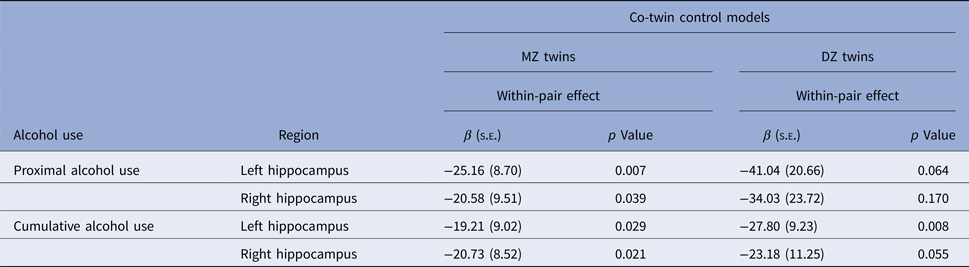
There were no significant main or interaction effects of zygosity in individual-level or co-twin control models for proximal or cumulative alcohol use (all ps > 0.212), indicating that associations between problematic alcohol use and hippocampal volume did not differ among MZ v. DZ twins. However, coefficients for the within-pair effects for proximal and cumulative alcohol use for DZ twins were larger in magnitude than for MZ twins, suggesting some confounding effects of familial influences; nonetheless, that all within-pair effects were significant for MZ twins is consistent with at least partial causal effects of problematic alcohol use on hippocampal volume (see Table 4).
Within-pair effects from co-twin control analyses of problematic alcohol use and hippocampal volume for MZ and DZ twins

Notes. Within-pair (alcohol exposure) effects from co-twin control analyses conducted separately among MZ twin pairs and DZ twin pairs for proximal (age-24 alcohol index) and cumulative (age 11 to age 24) alcohol use and hippocampal volume. All models included participant age and total brain volume as covariates. n = 62 twins (from 31 intact twin pairs) in MZ co-twin control models, n = 38 twins (from 19 intact twin pairs) in DZ co-twin control models.
Discussion
It is undisputed that problematic alcohol use is associated with deviations in the physiology of the brain, including its structure and functioning, and in the learning, memory, and emotional impairments observed among individuals evidencing problematic alcohol use (see White et al. Reference White, Matthews and Best2000; Oscar-Berman & Marinković, Reference Oscar-Berman and Marinković2007). However, the nature of this association remains to be fully explicated. Current models of alcohol addiction draw largely from the experimental animal literature and from human studies of adults with heavy, chronic alcohol use. These models explicitly or implicitly consider the brain deviations observed in long-term alcoholics to reflect neurotoxic effects of alcohol on the brain – pre-existing characteristics, including brain deviations, that may lead to problematic alcohol use are rarely included in these models, and alcohol exposure is implicitly considered to be random. A growing number of studies has examined whether brain deviations associated with alcohol addiction are evident prior to its onset. Evidence from longitudinal and high-risk family studies indicate that many of the brain deviations associated with problematic alcohol use considered to reflect a neurotoxic effect on the brain are actually evident prior to initiation of alcohol use and instead reflect pre-existing liability toward problematic alcohol use (see Jacobus & Tapert, Reference Jacobus and Tapert2013; Malone et al. Reference Malone, Luciana, Wilson, Sparks, Hunt, Thomas and Iacono2014; Wilson et al. Reference Wilson, Malone, Thomas and Iacono2015a, Reference Wilson, Thomas, Iacono and Wilsonb).
In the present study, we followed up a recent meta-analysis by our group (Wilson et al., Reference Wilson, Bair, Thomas and Iacono2017) that indicated that problematic alcohol use is moderately and significantly associated with the smaller hippocampal volume. We used a causally informative study design, the co-twin control study design, that allowed us to differentiate pre-existing liability for problematic alcohol use from effects of alcohol exposure on the hippocampus in a sample of female twins. Results of our co-twin control analysis suggest the association between problematic alcohol use and smaller hippocampal volume reflects an alcohol exposure-related effect – greater-alcohol using twins had smaller hippocampal volumes relative to lesser-alcohol using co-twins, after accounting for genetic and shared environmental propensity toward problematic alcohol use. Results held after accounting for other potentially confounding variables found to be associated with hippocampal volume, including other substance use, externalizing and internalizing psychopathology, personality traits, trauma exposure, and menstrual phase, speaking to the robustness of the potentially causal influence of alcohol exposure on hippocampal volume. Although larger exposure-related effects among DZ than MZ twins suggests at least partial confounding of familial influences, the significant effects among MZ twins are consistent with at least a partial causal effect of problematic alcohol use on hippocampal volume.
Evidence that alcohol exposure is associated with smaller hippocampal volume in humans is consistent with results of experimental animal studies, which show exposure-related effects on the hippocampus, including interrupted neurogenesis (see Nixon & Crews, Reference Nixon and Crews2002; Herrera et al. Reference Herrera, Yagüe, Johnsen-Soriano, Bosch-Morell, Collado-Morente, Muriach, Romero and García-Verdugo2003; He et al. Reference He, Nixon, Shetty and Crews2005; Ieraci & Herrera, Reference Ieraci and Herrera2007; Taffe et al. Reference Taffe, Kotzebue, Crean, Crawford, Edwards and Mandyam2010)Footnote †Footnote 1. Moreover, both animal (Nixon & Crews, Reference Nixon and Crews2002) and human studies (Bartels et al. Reference Bartels, Kunert, Stawicki, Kröner-Herwig, Ehrenreich and Krampe2007) indicate substantial neuronal recovery, increased hippocampal volume, and improved neuropsychological functioning with long-term alcohol abstinence. The present study adds to cross-sectional and correlational studies conducted among humans by using a powerful ‘natural experiment,’ the co-twin control study design. By demonstrating that greater alcohol exposure is associated with smaller hippocampal volume after accounting for genetic and shared environmental factors that confer liability toward problematic alcohol use, as well as several other potentially confounding variables, the present results provide greater confidence in a true alcohol exposure-related effect on the hippocampus.
Our examination of problematic substance use and hippocampal volume in a female sample is a considerable strength as females have been historically understudied in the substance use literature – we are aware of only 4 studies that have examined problematic alcohol use and hippocampal volume in female samples, compared to 11 studies in male samples (see Wilson et al., Reference Wilson, Bair, Thomas and Iacono2017). This is an important disparity given increasing rates of problematic alcohol use and alcohol use disorders among females (Keyes et al. Reference Keyes, Grant and Hasin2008), as well as evidence that the female brain may be more susceptible to the harmful effects of alcohol (Erol & Karpyak, Reference Erol and Karpyak2015). However, although the results of the present study indicate effects of alcohol exposure on hippocampal volume in females, future research in larger samples of both males and females are needed to determine whether this is a sex-specific effect (see, e.g. Harper et al. Reference Harper, Malone and Iaconoin press) or whether results for males are consistent with an exposure-related effect of alcohol on hippocampal volume.
Other important limitations must also be noted. Primary among these is that, although the co-twin control study design offers greater causal inference than the typical cross-sectional study design by accounting for all measured and unmeasured confounding genetic and environmental influences shared by twins within a twin pair, this study design nonetheless cannot speak to what leads one co-twin to drink more than the other in the first place. Factors not shared by twins, such as the co-occurring use of other substances or stressful life events, may be confounded with problematic alcohol use and hippocampal volume. The present results indicate that the association between problematic alcohol use and smaller hippocampal volume reflects an alcohol exposure-related effect, but this does not necessarily reflect a neurotoxic effect of alcohol. It may be that greater alcohol use has direct neurotoxic effects on the hippocampus, but it may also be that greater alcohol use indirectly affects the hippocampus by increasing exposure to other factors, such as other substance use, head trauma due to accidents, and/or acute or chronic stress, each of which have been found to be associated with reduced hippocampal volume in humans (e.g. McEwen, Reference McEwen2007; Tate & Bigler, Reference Tate and Bigler2000; Filbey et al. Reference Filbey, McQueeny, Kadamangudi, Bice and Ketcherside2015). We attempted to account statistically for such potentially confounding influences by considering recent alcohol use, other substance use, externalizing and internalizing psychopathology, personality traits, trauma exposure, and menstrual phase; effects for problematic alcohol use and smaller hippocampal volume remained significant (with the one exception of nicotine use for cumulative alcohol use). Future research with larger samples is needed to replicate the present findings and to explore in greater detail the potential implications of other substance use and other potential confounds that may account for deviations in hippocampal volume within a twin pair. Finally, the alcohol use index (comprising quantity, frequency, density, and intoxication) that we used as a measure of problematic alcohol use, including proximal (age 24) and cumulative (age 11 to age 24) alcohol use, has demonstrated reliability and validity in this sample and others (Harper et al. Reference Harper, Malone and Iaconoin press; Malone et al. Reference Malone, Luciana, Wilson, Sparks, Hunt, Thomas and Iacono2014; McGue et al. Reference McGue, Malone, Keyes and Iacono2014; Irons et al. Reference Irons, Iacono and McGue2015; Wilson et al. Reference Wilson, Malone, Thomas and Iacono2015), but other aspects of alcohol use may also be relevant, such as binge drinking or hangover symptoms; evidence from animal studies that chronic intermittent alcohol exposure (an analogue to human binge drinking) leads to reduced hippocampal neurogenesis (Nixon & Crews, Reference Nixon and Crews2002), speaks to the importance of considering such factors in future research. Our examination of proximal and cumulative alcohol exposure indicated both had potentially causal influences on hippocampal volume. Evidence from animal and human studies of substantial neuronal recovery, increased hippocampal volume, and improved neuropsychological functioning with long-term alcohol abstinence (Bartels et al. Reference Bartels, Kunert, Stawicki, Kröner-Herwig, Ehrenreich and Krampe2007; Cardenas et al. Reference Cardenas, Studholme, Gazdzinski, Durazzo and Meyerhoff2007; Gazdzinski et al. Reference Gazdzinski, Durazzo, Yeh, Hardin, Banys and Meyerhoff2008) will inform future research examining nuanced effects of the timing of alcohol exposure on the hippocampus.
In conclusion, the present study, which capitalized upon differences in levels of drinking within twin pairs, indicates that the association between problematic alcohol use and smaller hippocampal volume in females reflects an alcohol exposure-related effect. Differentiating pre-existing brain deviations that confer risk for problematic alcohol use from those that reflect effects of alcohol on the brain will inform etiological models of addiction and further prevention and intervention efforts.
Supplementary material
The supplementary material for this article can be found at https://doi.org/10.1017/S0033291717003166
Acknowledgements
This research was supported by resources from the University of Minnesota's Center for Magnetic Resonance Research (P41-RR008079, P41-EB015894, P30-NS076408), and the Minnesota Supercomputing Institute.
Research reported in this article was supported by the National Institute on Drug Abuse of the National Institutes of Health under Award Numbers K01DA037280 (S. W.) and R01DA036216 (W. G. I.). The content is solely the responsibility of the authors and does not necessarily represent the official views of the National Institutes of Health.
Declaration of interest
None.
Ethical standards
The authors assert that all procedures contributing to this work comply with the ethical standards of the relevant national and institutional committees on human experimentation and with the Helsinki Declaration of 1975, as revised in 2008.