Implications
Certain saturated fatty acids (SFA) are thought to increase the risk of cardiovascular disease (CVD). Milk and dairy products are a major source of SFA in the human diet in Europe, and therefore research has been directed towards developing sustainable strategies to decrease milk fat SFA content. This study examined the effect of inclusion level and rapeseed type on milk fatty acid (FA) composition and dairy cow performance. The results showed that replacing calcium salts of palm oil distillate with rapeseed supplements altered milk FA composition without adverse effects on milk production. Inclusion of milled rapeseeds in the diet of lactating cows could be used as part of an overall strategy for decreasing SFA in the human diet with potential to lower CVD risk.
Introduction
Clinical and biomedical studies have shown that cardiovascular disease (CVD) risk factors can be improved by the isoenergetic replacement of saturated fatty acids (SFA) with cis-monounsaturated fatty acids (MUFA) in the human diet (Kris-Etherton et al., Reference Kris-Etherton, Pearson, Wan, Hargrove, Moriarty and Fishell1999; Mensink et al., Reference Mensink, Zock, Kester and Katan2003). Milk and dairy products are the major source of SFA in the European diet (Hulshof et al., Reference Hulshof, van Erp-Baart, Anttolainen, Becker, Church, Couet, Hermann-Kunz, Kesteloot, Leth, Martins, Moreiras, Moschandreas, Pizzoferrato, Rimestad, Thorgeirsdottir, van Amelsvoort, Aro, Kafatos, Lanzmann-Petithory and van Poppel1999; Henderson et al., Reference Henderson, Gregory, Irving and Swan2003). Rather than simply advocating population-wide decreases in milk and dairy product consumption, altering the FA composition of ruminant milk offers the opportunity to lower SFA intake while maintaining the contribution of these foods to high-quality protein, bioactive lipid, mineral and vitamin supply in the human diet (Shingfield et al., Reference Shingfield, Chilliard, Toivonen, Kairenius and Givens2008).
Numerous studies have shown the potential of oilseed and plant oil supplements in the diet to alter bovine milk FA composition (Glasser et al., Reference Glasser, Ferlay and Chilliard2008; Shingfield et al., Reference Shingfield, Chilliard, Toivonen, Kairenius and Givens2008). A recent review reported an average decrease in total SFA concentration in milk fat of almost 10 g/100 g FAs when cows consume just over 500 g rapeseed oil/day (average response from a number of studies; Glasser et al., Reference Glasser, Ferlay and Chilliard2008). Larger decreases in SFA of almost 20 g/100 g of total FAs have been reported in milk from cows fed diets supplemented with 4.1 kg/day of crushed rapeseeds supplying 1.97 kg of rapeseed oil, but the changes in milk fat composition were accompanied by substantial reductions in nutrient intake and milk yield relative to the control diet (Givens et al., Reference Givens, Allison and Blake2003). Feeding high levels of supplemental fat to dairy cows can adversely affect rumen function and lower milk production (Palmquist, Reference Palmquist1994; Lock and Shingfield, Reference Lock and Shingfield2004). Givens et al. (Reference Givens, Kliem, Humphries, Shingfield and Morgan2009) concluded that rapeseed milled with wheat, which offers a practical solution for processing oilseeds on-farm with the added benefit of minimising oil losses during milling, represented the most ideal compromise for lowering milk fat SFA content and increasing cis-MUFA concentrations without affecting animal performance and minimising associated increases in milk fat trans FAs.
Including rapeseed-based supplements in the diet of lactating cows also increases milk trans FA concentrations (Loor et al., Reference Loor, Herbein and Jenkins2002; Rego et al., Reference Rego, Alves, Antunes, Rosa, Alfaia, Prates, Cabrita, Fonseca and Bessa2009). Although some evidence suggests that trans FAs from ruminant-derived products may not exert as negative an effect on CVD risk as those from industrial sources (Jakobsen et al., Reference Jakobsen, Bysted, Andersen, Heitmann, Hartkopp, Leth, Overvad and Dyerberg2006; Willett and Mozaffarian, Reference Willett and Mozaffarian2008), other evidence is inconsistent (Shingfield et al., Reference Shingfield, Chilliard, Toivonen, Kairenius and Givens2008; Brouwer et al., Reference Brouwer, Wanders and Katan2010). Several varieties of rapeseed containing higher proportions of oleic acid and lower amounts of polyunsaturated fatty acids (PUFA) have been bred and commercialised primarily for use as industrial frying oils (Schierholt et al., Reference Schierholt, Becker and Ecke2000 and Reference Schierholt, Rücker and Becker2001). High oleic acid rapeseed variants offer the potential to lower milk SFA content, enhance cis-9 18:1 concentrations and minimise increases in trans FAs compared with conventional rapeseeds. The apparent biohydrogenation of cis-9 18:1 in the rumen is not as high as that of 18:2n-6 and 18:3n-3 (Shingfield et al., Reference Shingfield, Bernard, Leroux and Chilliard2010) with the implication that high oleic acid variants would result in a greater proportion of dietary unsaturated FAs escaping the rumen compared with conventional rapeseeds. Furthermore, studies in grazing cows have shown that increases in milk trans FA concentrations due to plant oils are directly related to the ratio of PUFA : cis-9 18:1 in lipid supplements (Rego et al., Reference Rego, Alves, Antunes, Rosa, Alfaia, Prates, Cabrita, Fonseca and Bessa2009), with the implication that oilseeds rich in cis-9 18:1 rather than PUFA would minimise the appearance of ruminal biohydrogenation intermediates in milk fat triacylglycerides.
Previous studies have examined the effects of high oleic acid rapeseed oil on milk fat composition (Jenkins, Reference Jenkins1998; Loor et al., Reference Loor, Herbein and Jenkins2002), but direct comparisons with conventional sources of rapeseed oil have not been reported. In addition, relatively few studies (Collomb et al., Reference Collomb, Sollberger, Bütikofer, Sieber, Stoll and Schaeren2004; Givens et al., Reference Givens, Kliem, Humphries, Shingfield and Morgan2009; Rego et al., Reference Rego, Alves, Antunes, Rosa, Alfaia, Prates, Cabrita, Fonseca and Bessa2009) have examined the effect of dietary rapeseed inclusion on milk FA composition in sufficient detail to allow definitive conclusions on the impact of the distribution of trans FA isomers to be drawn. In this experiment, nutrient intake, milk production and milk FA composition responses to replacing calcium salts of palm oil distillate (CPO) with incremental amounts of milled conventional or high oleic acid rapeseeds were evaluated in high-yielding lactating cows fed maize silage-based diets.
Material and methods
Experimental design, animals and management
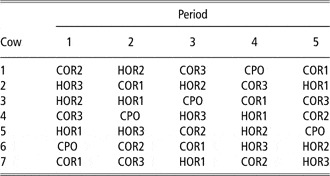
A total of seven multiparous Holstein–Friesian cows of (mean ± s.e.) live weight 633 ± 18.3 kg, parity 5.6 ± 0.53, 79 ± 7.9 days in lactation and producing 44.7 ± 1.39 kg milk/day were used. Animals were randomly allocated to one of seven treatments in an incomplete 7 × 7 Latin square design with five 28-day experimental periods (Table 1). Cows were housed in individual tie stalls equipped with a rubber mattress and bedded with wood shavings. Clean water and trace mineralised blocks (Rockies (red), Tithebarn Ltd, Cheshire, UK) were available ad libitum. Cows were milked in situ at 0400 and 1600 h.
Allocation of experimental treatments according to an incomplete 7 × 7 Latin square design

COR1, COR2 and COR3 = conventional oleic acid rapeseed at three inclusion levels; HOR1, HOR2 and HOR3 = high oleic acid rapeseed at three inclusion levels; CPO = calcium salts of palm oil distillate-based diet.
Experimental diets
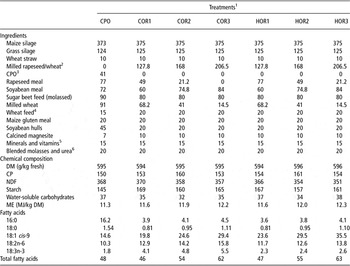
Diets were offered as total mixed rations (TMR; forage : concentrate ratio, 50 : 50 on a dry matter (DM) basis with the forage component consisting of maize silage and grass silage, 750 and 250 g/kg of forage DM, respectively). Treatments consisted of a control diet containing 41 g/kg DM of CPO (Megalac®, Volac International Ltd, Royston, UK) or the same basal diet with CPO replaced by 35, 46 or 57 g/kg DM of lipid derived from two different rapeseed varieties milled with wheat. Wheat was used as a binding agent to facilitate the milling of rapeseeds and also prevent oil losses following the rupturing of the seed coat. The milled rapeseed blend was prepared by processing the whole seeds with wheat grain (50 : 50, fresh weight basis) in a machine, which uses a combination of hammer (12 mm) and roller mills (processor model AFM 998Q; Buschhoft, GmbH & Co, Ahlen, Germany). Rapeseed treatments were comprised of a mixture of conventional varieties (Mozart and Astrid; COR) or a high oleic acid rapeseed (Nexera 160; Dow AgroSciences LLC, Hitchin, UK) variant. Diets were formulated to be isoenergetic and isonitrogenous (Thomas, Reference Thomas2004) and supply 750, 1000 or 1250 g rapeseed oil/day assuming a predicted mean DM intake of 22 kg/day. Ingredients and chemical composition of the experimental diets are shown in Table 2. Cows were offered diets as equal meals at 0830 and 1600 h. Feed refusals were removed and weighed before the morning milking.
Ingredients and chemical composition of experimental diets (g/kg DM or as stated)

DM = dry matter; CPO = calcium salts of palm oil distillate; COR1, COR2 and COR3 = conventional oleic acid rapeseed; HOR1, HOR2 and HOR3 = high oleic acid rapeseed; ME = metabolisable energy.
11, 2 and 3, rapeseed inclusion levels of 73, 96 and 118 g/kg DM, respectively.
2Added as a single mixture.
3Megalac® (Volac International Ltd, Royston, UK) declared composition (g/kg DM) as containing oil (840), calcium (90) and ME 33.25 MJ/kg DM.
4Wheat feed (GP Feeds Ltd, Cheshire, UK) declared composition (g/kg DM) as containing CP (175), NDF (400), starch and sugars (340) and ME 11.5 MJ/kg DM.
5Proprietary mineral and vitamin supplement (Rockies (Red), Tithebarn Ltd, Cheshire, UK) declared composition as containing 380 g/kg sodium and (mg/kg) magnesium (5000), iron (1500), cobalt (50), copper (300), iodine (150), manganese (200), zinc (300) and selenium (10).
6Regumaize 44 (SvG Intermol Ltd, Bootle, Merseyside, UK) declared composition (g/kg DM) as containing CP (440), water-soluble carbohydrates (550), ME 11.8 MJ/kg DM.
Experimental measurements, sample collection and chemical analysis
Individual animal dietary intake was recorded daily. Samples of fresh TMR, subsamples of individual dietary components and refused feeds were collected daily during each sampling week, and pooled to provide weekly composite samples. Composite feed samples were stored at −18°C until analysed for chemical composition. Oven-dried (60°C), milled (1 mm screen) samples of forages, concentrates, conventional and high oleic acid rapeseed/wheat mixes were submitted for neutral detergent fibre, organic matter, crude protein (CP), water-soluble carbohydrates, ether extract, starch, metabolisable energy and FA determinations according to procedures described elsewhere by Kliem et al. (Reference Kliem, Morgan, Humphries, Shingfield and Givens2008).
Milk yields were recorded twice daily for individual animals during the last 7 days of each experimental period. Samples of milk preserved with potassium dichromate (1 mg/ml; Lactabs, Thomson and Capper, Runcorn, UK) were collected during this period and submitted for fat, CP and lactose determinations based on infrared spectroscopy (Foss Electric Ltd, York, UK). Additional samples of unpreserved milk were collected during the last 24 h of each experimental period, stored at −20°C until composited according to milk yield and submitted for FA analysis.
Lipid in 1 ml milk and appropriate sample weight of forage, concentrate and lipid supplements was extracted and transesterified to fatty acid methyl esters (FAME) according to standard methods (Kliem et al., Reference Kliem, Morgan, Humphries, Shingfield and Givens2008). The distribution of conjugated linoleic acid (CLA) isomers in milk FAME was determined by HPLC using four silver impregnated silica columns (ChromSpher 5 Lipids, 250 × 4.6 mm; 5 μm particle size, Varian Ltd, Oxford, UK) coupled in series using 0.1% (v/v) of acetonitrile in heptane as the mobile phase (Shingfield et al., Reference Shingfield, Ahvenjärvi, Toivonen, Ärölä, Nurmela, Huhtanen and Griinari2003). Isomers were identified using an authentic CLA methyl ester standard (O-5632, Sigma-Aldrich, YA-Kemia Limited, Helsinki, Finland) and chemically synthesised trans-9, cis-11 CLA (Shingfield et al., Reference Shingfield, Reynolds, Lupoli, Yurawecz, Delmonte, Griinari, Grandison and Beever2005). Identification was verified using cis-9, trans-11 CLA as a landmark isomer.
Milk FA composition was expressed as a weight percentage of total FAs using response factors derived from the analysis of a butter oil reference standard (CRM 164; Community Bureau of Reference, Brussels, Belgium). Concentrations of specific conjugated isomers in milk fat were calculated based on proportionate peak area responses determined by HPLC and the sum of trans-7, cis-9 CLA, trans-8, cis-10 CLA and cis-9, trans-11 CLA weight percentage determined as a single peak by gas chromatography.
Statistical analysis
Intake, milk production and milk FA composition data were analysed using a general linear model with effects for cow, period and treatment (Statistical Analysis Systems software package version 8.2, SAS Institute, Cary, NC, USA). Treatment carry-over effects were also included in the statistical model but were removed when declared non significant (P < 0.10). Preplanned contrasts included (i) CPO v. COR1, (ii) CPO v. HOR1, (iii) linear component of the response to incremental amounts of milled conventional rapeseeds in the diet, (iv) linear component of the response to incremental amounts of milled high oleic acid rapeseeds in the diet and (v) comparison of mean responses to milled conventional and high oleic acid rapeseeds in the diet. Single degree of freedom contrasts were also included in the statistical model to test for the significance of non-linear (quadratic) components of the response to incremental amounts of both types of milled rapeseed supplements in the diet. Least square means are reported and treatment effects were considered significant at P < 0.05.
Results
Analysis of the milled rapeseed/wheat supplements confirmed the higher cis-9 18:1 content of HOR compared with COR (68 and 57 g/100 g FAs, respectively). Lipid derived from the COR supplement compared with the HOR supplement contained 16:0 (5 v. 4 g/100 g FAs), 18:0 (2 v. 2 g/100 g FAs), 18:2n-6 (20 v. 16 g/100 g FAs) and 18:3n-3 (8 v. 2 g/100 g FAs). The higher enrichment of cis-9 18:1 in HOR was therefore associated with a lower sum of 18:2n-6 and 18:3n-3 relative to COR (18 v. 29 g/100 g FAs). The total FA content of the COR and HOR supplements were 230 and 236 g/kg DM, respectively.
By design, all seven experimental diets were of similar chemical composition. However, total dietary FA content was increased with incremental inclusion of milled rapeseeds (Table 1). The predominant FA in the CPO diet was 16:0 contributing to more than one-third of total FAs, whereas cis-9 18:1 was the major dietary FA for all other treatments. For each inclusion level, the amount of cis-9 18:1 in the diet was approximately 5 g/kg DM higher on the HOR than COR treatments. Increasing inclusion level of rapeseed also increased dietary 18:2n-6 and 18:3n-3 content, but the total amount of PUFA at each level of inclusion was consistently higher for COR than HOR treatments.
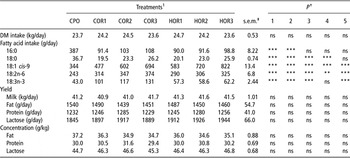
There was no effect (P > 0.05) of replacing CPO with milled rapeseeds on DM intake, milk yield, milk constituent content or output (Table 3). FA intake varied in direct relation to milled rapeseed inclusion, with both varieties resulting in lower (P < 0.001) intake of 16:0 and 18:0 and higher (P < 0.001) intake of cis-9 18:1, 18:2n-6 and 18:3n-3 than the CPO diet. Intake of cis-9 18:1, 18:2n-6 and 18:3n-3 increased linearly (P < 0.001) with incremental milled rapeseed inclusion. Consumption of cis-9 18:1 was on average 117 g/day higher (P < 0.001) for cows fed HOR than COR treatments, whereas ingestion of PUFA was higher (P < 0.001) by cows fed the COR than HOR diets.
Effect of replacing CPO with incremental amounts of milled conventional or high oleic acid rapeseeds on DM and fatty acid intake, milk yield and composition

CPO = calcium salts of palm oil distillate-based diet; COR1, COR2 and COR3 = conventional oleic acid rapeseed at three inclusion levels; HOR1, HOR2 and HOR3 = high oleic acid rapeseed at three inclusion levels; DM = dry matter.
†Refers to the significance of five preplanned comparisons; 1 – CPO diet compared with 73 g/kg of milled COR; 2 – CPO diet compared with 73 g/kg of milled HORs; 3 – linear component of the response to incremental amounts of milled CORs in the diet; 4 – linear component of the response to incremental amounts of milled HORs in the diet; 5 – comparison of mean responses to milled COR and HOR in the diet. *, ** and ***P < 0.05, P < 0.01 and P < 0.001, respectively.
‡s.e.m. for n = 35 measurements, 13 error d.f.
11, 2 and 3, refers to rapeseed inclusion levels of 73, 96 and 118 g/kg DM, respectively.
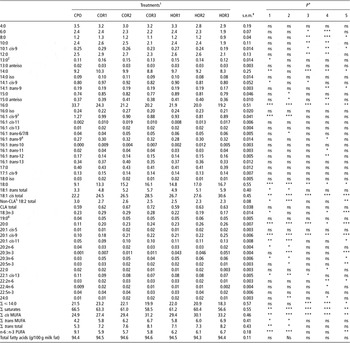
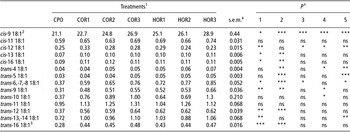
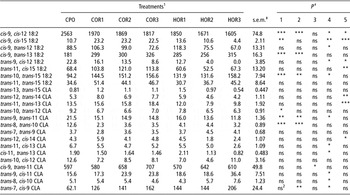
Replacing CPO with both rapeseed supplements altered milk FA composition changes that were characterised as a decrease (P < 0.01) in total SFA, mainly due to lowered (P < 0.001) 16:0 concentrations, and an increase (P < 0.05) in total cis- and trans-16:1, total 18:1 and total trans FA content (Table 4). Furthermore, supplements of milled rapeseeds also resulted in a decrease (P < 0.001) in cis-9 16:1, 18:2n-6, trans-8, cis-10 CLA and trans-9, trans-11 CLA and an increase (P < 0.01) in 18:0, 20:0, cis-9 and -11 20:1 (Table 4), cis (Δ9, 13 and 16) and trans (Δ6 to Δ9, 12 and 16) 18:1 (Table 5), cis-9, trans-13 18:2 and trans-10, trans-15 18:2 (Table 6). Relative to the CPO treatment, the COR1 treatment resulted in specific changes in 13:0, 14:0, 18:3n-3, cis-12 18:1, trans-13, -14 18:1, cis-9, cis-15 18:2 and trans-10, cis-12 CLA concentrations, whereas the HOR1 diet increased (P < 0.01) milk trans-4 and trans-5 18:1 content compared with CPO (Table 5).
Effect of replacing CPO with incremental amounts of milled conventional or high oleic acid rapeseeds on milk fatty acid composition (g/100 g fatty acids)

CPO = calcium salts of palm oil distillate-based diet, COR1, COR2 and COR3 = conventional oleic acid rapeseed at three inclusion levels, HOR1, HOR2 and HOR3 = high oleic acid rapeseed at three inclusion levels; CLA = conjugated linoleic acid; MUFA = monounsaturated fatty acids; PUFA = polyunsaturated fatty acids; DM = dry matter.
†Refers to the significance of five comparisons; 1 – CPO diet v. COR diet level 1; 2 – CPO v. HOR diet level 1; 3 – linear response to COR inclusion level; 4 – linear response to HOR inclusion level; 5 – average of COR diet responses v. average of HOR responses. *, ** and ***P < 0.05, P < 0.01 and P < 0.001, respectively.
‡s.e.m. for n = 35 measurements, 13 error d.f.
11, 2 and 3, refers to rapeseed inclusion levels of 73, 96 and 118 g/kg DM, respectively.
2Co-elutes with cis-9 12:1 as a minor isomer.
3Co-elutes with 17:0 anteiso.
4Co-elutes with 17:0 iso.
5All 18:2 isomers excluding CLA.
6Co-elutes with cis-15 18:1.
Effect of replacing CPO with incremental amounts of milled conventional or high oleic acid rapeseeds on milk 18:1 isomer composition (g/100 g fatty acids)

CPO = calcium salts of palm oil distillate-based diet, COR1, COR2 and COR3 = conventional oleic acid rapeseed at three inclusion levels, HOR1, HOR2 and HOR3 = high oleic acid rapeseed at three inclusion levels; DM = dry matter.
†Refers to the significance of five comparisons; 1 – CPO diet v. COR diet level 1; 2 – CPO diet v. HOR diet level 1; 3 – linear response to COR inclusion level; 4 – linear response to HOR inclusion level; 5 – average of COR diet responses v. average of HOR responses. *, ** and ***P < 0.05, P < 0.01 and P < 0.001, respectively.
‡s.e.m. for n = 35 measurements, 13 error d.f.
11, 2 and 3, refers to rapeseed inclusion levels of 73, 96 and 118 g/kg DM, respectively.
2Co-elutes with cis-10 18:1 as a minor isomer.
3Co-elutes with cis-14 18:1.
Effect of replacing CPO with incremental amounts of milled conventional or high oleic acid rapeseeds on milk 18:2 isomer composition (mg/100 g fatty acids)

CPO = calcium salts of palm oil distillate; COR1, COR2 and COR3 = conventional oleic acid rapeseed at three inclusion levels; HOR1, HOR2 and HOR 3 = high oleic acid rapeseed at three inclusion levels; DM = dry matter.
†Refers to the significance of five comparisons; 1 – CPO diet v. COR diet level 1; 2 – CPO diet v. HOR diet level 1; 3 – linear response to COR inclusion level; 4 – linear response to HOR inclusion level; 5 – average of COR diet responses v. average of HOR responses. *, ** and *** P < 0.05, P < 0.01 and P < 0.001, respectively.
‡s.e.m. for n = 35 measurements, 13 error d.f.
11, 2 and 3, refers to rapeseed inclusion levels of 73, 96 and 118 g/kg DM, respectively.
2P = 0.05.
Incremental inclusion of milled rapeseeds in the diet resulted in linear (P < 0.05) decreases in total short- and medium-chain SFA with between 4 and 14 carbon atoms, 16:0 and total SFA and elicited linear (P < 0.05) increases in 18:0, cis-9 18:1 and total cis- MUFA concentrations. The decrease in milk fat 8:0 and trans-9 14:1 content was also non-linear (P < 0.05). Linear responses (P < 0.05) to incremental amounts of milled HOR were also observed for milk fat trans-16:1 (Table 4), trans-4, -9 and -10 18:1 (Table 5), 18:2n-6, cis-9, cis-15 18:2 and trans-9, cis-12 18:2 (Table 6), several isomers of CLA (Table 6) and 18:3n-3 (Table 4) concentrations.
The type of rapeseed in the diet also influenced milk FA composition. Milk from cows fed milled CORs contained higher (P < 0.05) 14:0, 16:0, 18:3n-3, ⩽C14 FAs, total SFA (Table 4), cis-12 18:1 (Table 5) and specific 18:2 isomers including 18:2n-6 and cis-9, cis-15 18:2 (Table 6) compared with milled HORs. In contrast, HOR treatments resulted in higher (P < 0.05) mean milk fat 18:0, 20:0, cis-20:1, cis-9 18:1, trans-4 18:1, trans-5 18:1 and trans-6-8 18:1 contents than the COR treatments. Increases in the 18:3n-3 content of milk from cows fed the COR diet resulted in a lower (P < 0.05) n-6 : n-3 ratio than the control and HOR treatments supplying the same amount of rapeseed oil.
Discussion
This experiment examined the effects of replacing CPO with incremental amounts of two varieties of milled rapeseeds on milk production and milk FA composition in high-yielding dairy cows fed a maize silage-based diet. Supplements of milled high oleic acid rapeseed and wheat contained lower concentrations of cis-9 18:1 relative to milled conventional rapeseed and wheat than anticipated. Previous studies have examined the effects of a rapeseed oil, which contained 77 g cis-9 18:1/100 g FAs in lactating cows (Jenkins, Reference Jenkins1998; Loor et al. Reference Loor, Herbein and Jenkins2002), whereas the cis-9 18:1 content of oil from high oleic acid mutants can vary from 70% to 81% total FAs (Schierholt et al., Reference Schierholt, Becker and Ecke2000). No measurements of the lipid composition of whole rapeseeds were made in this study, but the oil of the ‘Nexera’ high oleic acid rapeseed variety typically contains 73 g cis-9 18:1 and 17 g of PUFA/100 g total FAs (Dow AgroSciences LLC).
Including both types of rapeseed in the diet even at the highest inclusion level supplying in excess of 1100 g oil/day had no significant effect on DM intake, milk yield or milk constituent composition compared with the CPO diet, with the exception of a marginal decrease in milk fat concentrations. Previous studies have shown that supplementing the diet with supplements providing 1000 g rapeseed oil/day have no significant impact on DM intake and milk yield of cows when compared with a control diet, (Chelikani et al., Reference Chelikani, Bell and Kennelly2004; Givens et al., Reference Givens, Kliem, Humphries, Shingfield and Morgan2009), but may, depending on the composition of the basal diet, lower milk fat synthesis (Chelikani et al., Reference Chelikani, Bell and Kennelly2004). However, supplementing the diet with 1214 g/day of rapeseed oil in the form of whole cracked rapeseeds was shown to decrease DM intake, milk yield and fat yield in mid-lactation cows (Givens et al., Reference Givens, Allison and Blake2003). It is generally accepted that high levels of plant oils or oilseeds in the diet induce adverse effects on rumen function and cow performance (Palmquist, Reference Palmquist1994; Lock and Shingfield, Reference Lock and Shingfield2004). Results from this study as well as earlier studies highlight that a form of lipid in the diet is an important determinant of the potential effects on intake and milk production. Ground rapeseeds have been shown to reduce fat corrected milk yield, milk fat and protein content in the absence of changes in DM intake (Chichlowski et al., Reference Chichlowski, Schroeder, Park, Keller and Schimek2005). However, supplements of milled rapeseeds and wheat were reported to stimulate higher DM intake compared with the same amount of lipid in the diet as rapeseed oil (Givens et al., Reference Givens, Kliem, Humphries, Shingfield and Morgan2009). Overall, available data suggest that inclusion of milled rapeseeds in the diet minimises potential negative effects of rapeseed oil on rumen function and animal performance.
Replacing CPO with both rapeseed varieties resulted in a decrease in milk fat 16:0 and total SFA content. This is partially due to the presence of a palm oil-based rumen-protected lipid supplement in the CPO ration that was used to ensure that treatments were isoenergetic. However, earlier studies have shown that compared with a diet control containing no additional lipid, rapeseed oil lowers milk fat 16:0 and total SFA concentrations (Collomb et al., Reference Collomb, Sollberger, Bütikofer, Sieber, Stoll and Schaeren2004; Ryhänen et al., Reference Ryhänen, Tallavaara, Griinari, Jaakkola, Mantere-Alhonen and Shingfield2005; Rego et al., Reference Rego, Alves, Antunes, Rosa, Alfaia, Prates, Cabrita, Fonseca and Bessa2009), indicating that irrespective of the composition of the basal diet, rapeseed-based lipid supplements can be expected to decrease milk SFA content. Rapeseed oil in the diet leads to an increase in long-chain unsaturated FAs available for absorption in the small intestine of lactating cows (Loor et al., Reference Loor, Herbein and Jenkins2002) leading to an inhibition of FA synthesis de novo in the mammary gland (Chilliard et al., Reference Chilliard, Ferlay, Mansbridge and Doreau2000). In this study, rapeseed inclusion did not appear to affect other short- and medium-chain SFA concentrations, although the COR1 treatment increased milk fat 14:0 content compared with the CPO diet.
Incremental inclusion of rapeseeds in the diet resulted in a linear decrease in milk SFA concentrations, 16:0 in particular, with no evidence that the changes in milk FA composition reached a plateau under the specified conditions of this experiment. Furthermore, marginal decreases in milk SFA content were greater for the HOR compared with the COR rapeseed with HOR treatments resulting in lower milk fat concentrations of SFA synthesised de novo and higher 18:0 concentrations. It is probable that the differences in the extent of changes in milk SFA due to rapeseed variety is at least in part due to a concentration effect, as HOR treatments induced a higher enrichment of cis-9 18:1. It is also possible that the larger decreases in milk SFA concentration following HOR rapeseed supplementation reflects direct competition between cis-9 18:1 and newly synthesised SFA for esterification with glycerol at the sn-2 and sn-3 during mammary triacylglycerol synthesis (Hansen and Knudsen, Reference Hansen and Knudsen1987).
Despite diets containing rapeseeds resulting in a lower 18:0 intake than the CPO diet, both COR and HOR treatments enhanced milk fat 18:0 concentration. This can be explained by rapeseed diets resulting in a higher 18-carbon unsaturated FA intake than the CPO diet, which, following complete hydrogenation in the rumen (Harfoot and Hazlewood, Reference Harfoot and Hazlewood1997) increases the availability of 18:0 for absorption in the bovine small intestine. Post-ruminal flow of 18:0 has been found to be approximately 11 times greater than intake (on a g/day basis) in lactating cows fed diets containing rapeseed oil (Loor et al., Reference Loor, Herbein and Jenkins2002). An increase in milk 18:0 concentrations is a typical response to dietary rapeseed supplements (Givens and Shingfield, Reference Givens and Shingfield2006; Glasser et al., Reference Glasser, Ferlay and Chilliard2008).
Replacing CPO with rapeseed enhanced cis-MUFA in milk fat. The second most abundant cis-MUFA, cis-9 16:1, had a lower concentration in milk fat from cows consuming rapeseed diets when compared with the CPO diet, which is in agreement with earlier studies examining the effect of rapeseed in the diet in lactating cows (DePeters et al., Reference DePeters, German, Taylor, Essex and Perez-Monti2001; Collomb et al., Reference Collomb, Sollberger, Bütikofer, Sieber, Stoll and Schaeren2004). A lower concentration of cis-9 16:1 can be attributed to decreased supply of 16:0 available for conversion to cis-9 16:1 via the action of Δ9-desaturase in the mammary gland. Use of 13C-labelled FA substrates indicate that around 50% cis-9 16:1 secreted in milk is synthesised endogenously via the action of Δ9-desaturase on 16:0 (Mosley and McGuire, Reference Mosley and McGuire2007).
Enhanced cis-MUFA concentration in milk fat from all of the rapeseed diets was primarily due to increases in cis-9 18:1 concentration. This can be explained by an increased intake of cis-9 18:1, and also due to increased mammary availability of 18:0, which is desaturated at the mammary gland level. Around 50% of 18:0 taken up by the mammary gland is desaturated (Enjalbert et al., Reference Enjalbert, Nicot, Bayourthe and Moncoulon1998), and all studies examining responses to supplemental rapeseeds or rapeseed oil in the diet report an increase in milk cis-9 18:1 concentration (Givens and Shingfield, Reference Givens and Shingfield2006; Glasser et al., Reference Glasser, Ferlay and Chilliard2008). Increases in milk fat cis-9 18:1 concentrations to both rapeseeds were linear across the range of supplements fed in this experiment, indicating the potential to further enhance milk cis-9 18:1 content. Rapeseed inclusion also increased the concentration of several other cis-18:1 (Δ13 and 16) isomers. It is probable that these FAs originate from the rumen as a result of incomplete biohydrogenation of 18:3n-3 contained in rapeseeds (Jouany et al., Reference Jouany, Lassalas, Doreau and Glasser2007).
Addition of both rapeseed types to the diet resulted in numerical increases in milk trans-16:1 and trans-18:1 content compared with the CPO diet. All rapeseed diets resulted in significant increases in cis-9 18:1, 18:2n-6 and 18:3n-3 intake when compared with the CPO diet, but there was no significant increase in milk fat trans-11 18:1 concentration, the major trans FA in milk fat that is a common intermediate formed during the penultimate step of PUFA biohydrogenation in the rumen (Harfoot and Hazlewood, Reference Harfoot and Hazlewood1997; Shingfield et al., Reference Shingfield, Bernard, Leroux and Chilliard2010). A lack of change in milk fat trans-11 18:1 content has been reported in cows fed milled rapeseeds even when a similar amount of lipid in the form of rapeseed oil enhanced the concentration of this biohydrogenation intermediate in milk (Givens et al., Reference Givens, Kliem, Humphries, Shingfield and Morgan2009). Previous studies have also reported that ground rapeseeds have no effect (Collomb et al., Reference Collomb, Sollberger, Bütikofer, Sieber, Stoll and Schaeren2004) or result in marginal increases in milk fat trans-11 18:1 concentrations (Chichlowski et al., Reference Chichlowski, Schroeder, Park, Keller and Schimek2005).
In spite of cows consuming more PUFA on the COR than HOR treatments, there was no significant difference between rapeseed types with respect to trans-MUFA or total trans FAs in milk indicating that biohydrogenation of cis-9 18:1 as well as 18:2n-6 and 18:3n-3 in the rumen results in the formation and accumulation of substantial amounts of trans FAs that are incorporated into milk fat. Total trans-MUFA secretion in milk was more closely associated with cis-9 18:1 intake (R 2 = 0.785; y = 0.05x + 45.83) than with PUFA intake (R 2 = 0.528; y = 0.09x + 40.60). In vitro studies have shown that cis-9 18:1 is converted to a range of trans 18:1 isomers during incubation with rumen-derived microorganisms (Mosley et al., Reference Mosley, Powell, Riley and Jenkins2002; McKain et al., Reference McKain, Shingfield and Wallace2010). In particular, around 70% to 100% of trans-7, trans-9, trans-10 and trans-12 18:1 were thought to originate from the isomerisation of cis-9 18:1 (Mosley et al., Reference Mosley, Powell, Riley and Jenkins2002). Furthermore, trans-9 18:1 can be further isomerised during incubations with mixed rumen bacteria to yield a range of positional trans 18:1 isomers (Proell et al., Reference Proell, Mosley, Powell and Jenkins2002). Supplying higher amounts of cis-9 18:1 in the diet in the form of the HOR supplement in this study resulted in a higher enrichment of trans-4, trans-5 and trans-6-8 18:1 in milk fat, and a numerical but non-significant (P = 0.09) enrichment of milk trans-9 18:1 content compared with the COR diet. Earlier studies also reported a significant increase in milk trans-6-8, trans-9 18:1, trans-12, trans-13-14 and trans-16 18:1 in cows fed when rapeseed supplements were fed compared with a control diet (Collomb et al., Reference Collomb, Sollberger, Bütikofer, Sieber, Stoll and Schaeren2004; Givens et al., Reference Givens, Kliem, Humphries, Shingfield and Morgan2009).
Trans-7, cis-9 CLA is the second most abundant CLA isomer in bovine milk fat on most diets (Shingfield et al., Reference Shingfield, Chilliard, Toivonen, Kairenius and Givens2008), that is synthesised exclusively via the action of Δ9 desaturase on trans-7 18:1 in ruminant tissues (Corl et al., Reference Corl, Baumgard, Griinari, Delmonte, Morehouse, Yurawecz and Bauman2002; Piperova et al., Reference Piperova, Sampugna, Teter, Kalscheur, Yurawecz, Ku, Morehouse and Erdman2002). Enhanced concentrations of this isomer in milk fat following replacement of CPO with milled rapeseeds can be attributed to an increased availability of trans-7 18:1 at the mammary gland, following the formation of this intermediate during biohydrogenation of cis-9 18:1 in the rumen (Mosley et al., Reference Mosley, Powell, Riley and Jenkins2002). Consistent with products formed during incubations of cis-9 18:1 with mixed rumen bacteria (Mosley et al., Reference Mosley, Powell, Riley and Jenkins2002), HOR enhanced milk fat trans-6-8 18:1 content and resulted in numerically higher concentrations of trans-7, cis-9 CLA compared with COR treatments.
Milk fat cis-9, trans-13 18:2 content was substantially enhanced when rapeseed lipids replaced CPO in the diet. This FA is at least partially synthesised endogenously in the mammary gland via the action of Δ9-desaturase on trans-13 18:1 formed in the rumen (Shingfield et al., Reference Shingfield, Chilliard, Toivonen, Kairenius and Givens2008). Both trans-13 18:1 and cis-9, trans-13 18:2 tend to increase following the feeding of 18:2n-6 or 18:3n-3 – rich plant oils (Collomb et al., Reference Collomb, Sollberger, Bütikofer, Sieber, Stoll and Schaeren2004; Shingfield et al., Reference Shingfield, Chilliard, Toivonen, Kairenius and Givens2008). Including rapeseed lipids at the expense of CPO resulted in reduced concentrations of trans-8, trans-10 CLA and trans-9, trans-11 CLA in milk. Incubations of 18:2n-6 with mixed rumen microbes (Jouany et al., Reference Jouany, Lassalas, Doreau and Glasser2007), measurements of FA flows at the omasum (Shingfield et al., Reference Shingfield, Chilliard, Toivonen, Kairenius and Givens2008) and milk FA composition in cows fed plant oils (Shingfield et al., Reference Shingfield, Chilliard, Toivonen, Kairenius and Givens2008; Rego et al., Reference Rego, Alves, Antunes, Rosa, Alfaia, Prates, Cabrita, Fonseca and Bessa2009) indicate that trans-8, trans-10 CLA and trans-9, trans-11 CLA accumulate in the rumen in direct relation to 18:2n-6 intake. The results of this study for milk fat CLA isomer concentrations appear to be consistent with the higher 18:2n-6 intake of cows fed diets containing milled rapeseeds than CPO.
In conclusion, replacing CPO with milled rapeseeds at inclusion levels up to 1150 g oil/day decreased milk fat SFA, enhanced milk cis-MUFA and increased trans FA concentrations without inducing adverse effects on DM intake and milk production. Use of a HOR variety induced larger decreases in milk fat SFA, increased (P < 0.001) the ratio of trans-MUFA : trans-PUFA and altered the relative abundance of specific trans FA isomers compared with isoenergetic amounts of CORs.
Acknowledgements
This research was supported by LIPGENE, an EU Sixth Framework Programme Integrated Project (2004 to 2009) (http://www.ucd.ie/lipgene/). The authors would like to thank Dow AgroSciences LLC (Hitchin, UK) for donating the HOR. The authors gratefully acknowledge and appreciate the assistance of Eleanor Allan and the late Colin Grayer for statistical support and staff at the Centre for Dairy Research for care of the experimental animals.